

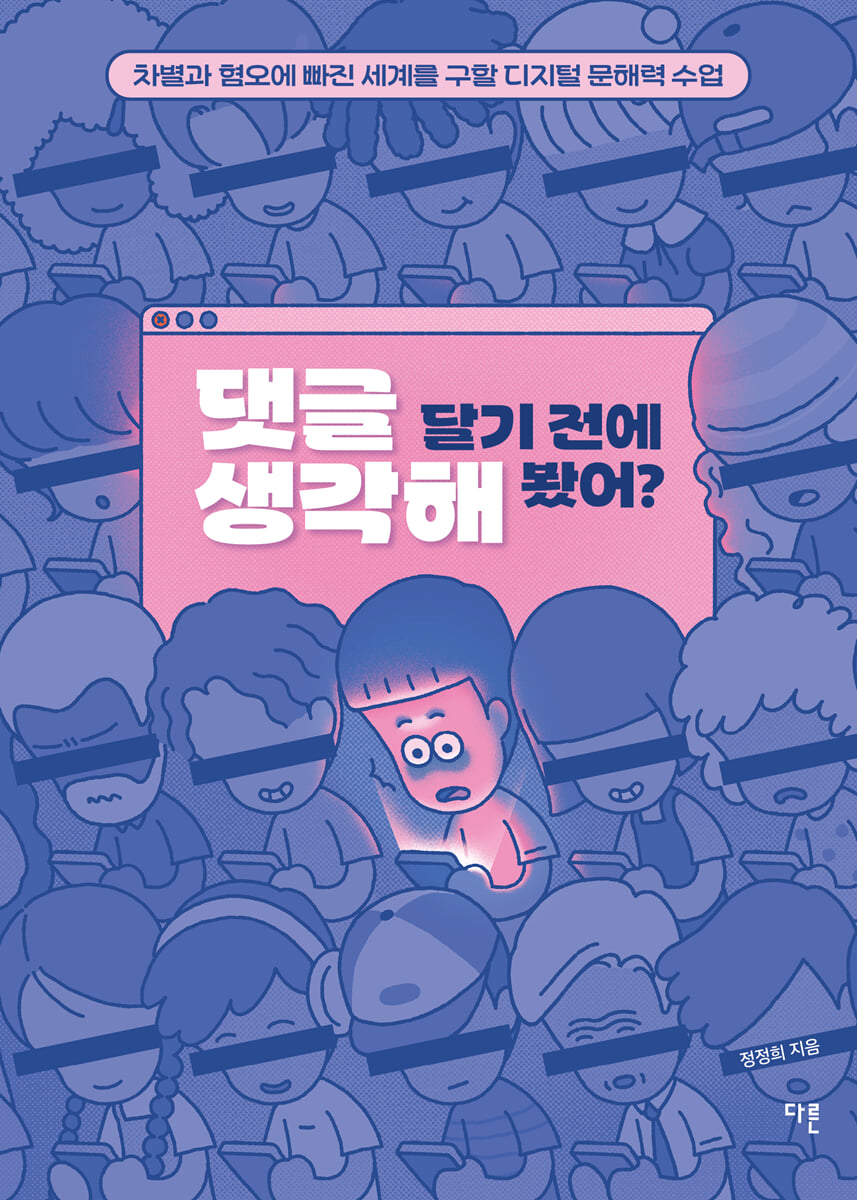
Did you think before commenting?
 |
Description
Book Introduction
Internet comment sections stained with discrimination and hate,
The right language promise to start again there
Awakening with 'Language Sensitivity' and Correcting with 'Human Rights Awareness'
It is a world where discrimination and hatred run rampant, with labels like ‘Tttak’, ‘Imgeo’, and ‘Heukhyung’.
In spaces like the Internet where anonymity is guaranteed, these words are used even more indiscriminately in the name of freedom of expression.
What about the youth who encounter the world through YouTube, social media, and online communities? They often use hateful expressions without even knowing what they mean or why they're wrong, and sometimes they even spit out dangerous words like a knife in their mouth just for fun.
There is a growing call for digital literacy education for young people, for whom most language activities take place online, outside of school.
This book uses the internet, a space familiar to young people, to confront discrimination and hatred that exist throughout society.
Each chapter delves deeply into the language life of today's youth, covering nine topics: disability, race, gender, appearance, generation, class and academic background, foreign languages, new words, and profanity.
The introduction, which vividly captures the everyday language of teenagers in the form of internet posts and comments, allows us to critically reflect on and discover problems in expressions that we have previously overlooked.
Discussion topics, such as human rights and diversity, are highlighted in bold throughout the text, and alternatives to incorrect words are listed at the end of each chapter to help young people find balance in their thinking.
The right language promise to start again there
Awakening with 'Language Sensitivity' and Correcting with 'Human Rights Awareness'
It is a world where discrimination and hatred run rampant, with labels like ‘Tttak’, ‘Imgeo’, and ‘Heukhyung’.
In spaces like the Internet where anonymity is guaranteed, these words are used even more indiscriminately in the name of freedom of expression.
What about the youth who encounter the world through YouTube, social media, and online communities? They often use hateful expressions without even knowing what they mean or why they're wrong, and sometimes they even spit out dangerous words like a knife in their mouth just for fun.
There is a growing call for digital literacy education for young people, for whom most language activities take place online, outside of school.
This book uses the internet, a space familiar to young people, to confront discrimination and hatred that exist throughout society.
Each chapter delves deeply into the language life of today's youth, covering nine topics: disability, race, gender, appearance, generation, class and academic background, foreign languages, new words, and profanity.
The introduction, which vividly captures the everyday language of teenagers in the form of internet posts and comments, allows us to critically reflect on and discover problems in expressions that we have previously overlooked.
Discussion topics, such as human rights and diversity, are highlighted in bold throughout the text, and alternatives to incorrect words are listed at the end of each chapter to help young people find balance in their thinking.
- You can preview some of the book's contents.
Preview
index
Entering
1.
It's not wrong, it's other people
[Round 1] You can't make a decision, so you have decision paralysis?
Now it's like this #disability
[Round 2] Isn't being black a compliment to a black person?
Now it's like this #race
[Round 3] A woman's enemy is another woman?
Now it's like this #gender
2.
There is no hope in a society that divides people.
[Round 4] Ham Choi-geuk, you said that to make me laugh?
Now it's like this #appearance
[Round 5] Children are Jammin, and old people are Tttak?
Now it's like this #generation
[Round 6] If you live in a rental apartment, you are considered a tenant?
Now it's like this #class and academic background
3.
Because it starts with knowing and using it properly
[Round 7] Do you think English looks more sophisticated than Korean?
Now it's like this #foreign language
[Round 8] Whether it's a dog or a dot, you just need to understand it, right?
Now it's like this #new word
[Round 9] Are you saying that you curse because you are close to each other?
Now it's like this #vulgar
References
1.
It's not wrong, it's other people
[Round 1] You can't make a decision, so you have decision paralysis?
Now it's like this #disability
[Round 2] Isn't being black a compliment to a black person?
Now it's like this #race
[Round 3] A woman's enemy is another woman?
Now it's like this #gender
2.
There is no hope in a society that divides people.
[Round 4] Ham Choi-geuk, you said that to make me laugh?
Now it's like this #appearance
[Round 5] Children are Jammin, and old people are Tttak?
Now it's like this #generation
[Round 6] If you live in a rental apartment, you are considered a tenant?
Now it's like this #class and academic background
3.
Because it starts with knowing and using it properly
[Round 7] Do you think English looks more sophisticated than Korean?
Now it's like this #foreign language
[Round 8] Whether it's a dog or a dot, you just need to understand it, right?
Now it's like this #new word
[Round 9] Are you saying that you curse because you are close to each other?
Now it's like this #vulgar
References
Detailed image

Into the book
This kind of thinking is also reflected in the words we speak in our daily lives.
When you have trouble making decisions, it's often called 'decision paralysis'.
It is a derogatory expression of the hesitation of people with disabilities from the perspective that they are lacking beings.
Differences must be understood and respected for what they are.
Ranking people up as better than others just because they are different is discrimination.
--- p.27 From “[Round 1] You can’t make a decision, so you have decision paralysis?”
It's also problematic that the term 'black' is used only to refer to the physical superiority or hip-hop talent of black people.
There is a hidden double standard of discrimination against black people, thinking that they are stupid but strong, and that they only know how to play popular music, not classical music.
You might argue that you absolutely did not mean it that way, or that you praised it because you like pop music more than classical music.
Of course, it's not always a bad thing to have the intention of praising someone.
But if it makes the person hearing it feel bad, then it's not a compliment.
--- p.40 From “[Round 2] Isn’t being black a compliment to a black person?”
The problem isn't appearance, but rather the way we talk about appearance that imprisons our consciousness.
A friend who has been teased as a 'pig' since childhood will always be concerned about his body.
A girl who is called 'ㄱㄹㄹ' might laugh it off right away, but every time she looks in the mirror, that word comes to mind.
Someone may have said it just for fun, but the person who heard it gets caught in the frame of that statement.
The same goes for 'Hamchoeok (How many hamburgers can you eat at most)'.
--- p.81-82 From “[Round 4] Ham Choi-gyeok, you said that to make people laugh?”
At some point, the culture of obsessing over youth and rejecting aging became the belief of modern society.
Look at the number of people getting plastic surgery in their 30s to maintain a youthful appearance, and the products labeled 'anti-aging' are selling like hotcakes.
Naturally, aging is considered ugly and a disease, and is therefore an object of disgust.
The word 'anti-aging' itself means preventing aging.
This statement only makes sense if we assume that aging itself is negative.
--- p.95-96 From “[Round 5] Children are Jammin, and old people are Tttak?”
Meritocracy is an attitude that evaluates people solely based on their abilities.
But if we blindly believe in this ability-ism, discrimination becomes natural.
When you look down on and ridicule someone who is in a worse situation than you, you don't feel guilty because you think it's just a difference in ability.
Because this mindset is ingrained in their minds, they feel justified in belittling students attending local campuses.
That's how the term 'Jijapdae (a miscellaneous university located in a local area)' was created.
--- p.117 From “[Round 6] If I live in a rental apartment, am I renting?”
Some people say that sometimes swearing out loud, even to yourself, can help with mental health.
In fact, when we swear, our brain secretes dopamine, which makes us feel good, along with cortisol.
However, if you swear repeatedly, the effect of this dopamine decreases, and our brain tries to increase the amount of dopamine secreted through increasingly stronger swearing.
That's how our brain becomes addicted to swearing.
So, I'm telling you not to swear, even if it's just to yourself.
When you have trouble making decisions, it's often called 'decision paralysis'.
It is a derogatory expression of the hesitation of people with disabilities from the perspective that they are lacking beings.
Differences must be understood and respected for what they are.
Ranking people up as better than others just because they are different is discrimination.
--- p.27 From “[Round 1] You can’t make a decision, so you have decision paralysis?”
It's also problematic that the term 'black' is used only to refer to the physical superiority or hip-hop talent of black people.
There is a hidden double standard of discrimination against black people, thinking that they are stupid but strong, and that they only know how to play popular music, not classical music.
You might argue that you absolutely did not mean it that way, or that you praised it because you like pop music more than classical music.
Of course, it's not always a bad thing to have the intention of praising someone.
But if it makes the person hearing it feel bad, then it's not a compliment.
--- p.40 From “[Round 2] Isn’t being black a compliment to a black person?”
The problem isn't appearance, but rather the way we talk about appearance that imprisons our consciousness.
A friend who has been teased as a 'pig' since childhood will always be concerned about his body.
A girl who is called 'ㄱㄹㄹ' might laugh it off right away, but every time she looks in the mirror, that word comes to mind.
Someone may have said it just for fun, but the person who heard it gets caught in the frame of that statement.
The same goes for 'Hamchoeok (How many hamburgers can you eat at most)'.
--- p.81-82 From “[Round 4] Ham Choi-gyeok, you said that to make people laugh?”
At some point, the culture of obsessing over youth and rejecting aging became the belief of modern society.
Look at the number of people getting plastic surgery in their 30s to maintain a youthful appearance, and the products labeled 'anti-aging' are selling like hotcakes.
Naturally, aging is considered ugly and a disease, and is therefore an object of disgust.
The word 'anti-aging' itself means preventing aging.
This statement only makes sense if we assume that aging itself is negative.
--- p.95-96 From “[Round 5] Children are Jammin, and old people are Tttak?”
Meritocracy is an attitude that evaluates people solely based on their abilities.
But if we blindly believe in this ability-ism, discrimination becomes natural.
When you look down on and ridicule someone who is in a worse situation than you, you don't feel guilty because you think it's just a difference in ability.
Because this mindset is ingrained in their minds, they feel justified in belittling students attending local campuses.
That's how the term 'Jijapdae (a miscellaneous university located in a local area)' was created.
--- p.117 From “[Round 6] If I live in a rental apartment, am I renting?”
Some people say that sometimes swearing out loud, even to yourself, can help with mental health.
In fact, when we swear, our brain secretes dopamine, which makes us feel good, along with cortisol.
However, if you swear repeatedly, the effect of this dopamine decreases, and our brain tries to increase the amount of dopamine secreted through increasingly stronger swearing.
That's how our brain becomes addicted to swearing.
So, I'm telling you not to swear, even if it's just to yourself.
--- p.179 From “[Round 9] You say we curse because we’re close?”
Publisher's Review
“You’re saying that the words I said carelessly today were discrimination?”
The value and weight of words reflected in everyday life
A Guide to Smart Language Use for Digital Citizens
The root of all hatred is stereotypes.
'Decision paralysis' instills in us the stereotype that people with disabilities are deficient, and '?-rin-i' instills in us the stereotype that children are immature.
What about the derogatory terms "tttak" and "yeongeumchung" used to describe the elderly? The recent emergence of "no senior zones," which bar seniors from entering, following the "no kids zone," clearly demonstrates how negative stereotypes stemming from such terms can ultimately lead to discrimination and hatred.
Would it be okay if I didn't know my words were hate speech? Just because I didn't intend to hurt someone doesn't mean their pain will go away.
So it's important to know what that means and what impact it will have on the world.
In today's information-rich digital age, literacy requires more than just spelling; it also requires understanding the meaning of words in context.
This is why this book goes beyond simply listening to what is heard and seeing what is seen, and meticulously explains what the problem is and why it can be changed from the perspective of young people.
It is time to re-establish our standards of thinking in line with the times and to weed out incorrect words.
The starting point of that change is the youth, the protagonists of the future.
This book will help young people rethink the value and weight of their own words and serve as a guide for respecting and living together with the socially disadvantaged.
The value and weight of words reflected in everyday life
A Guide to Smart Language Use for Digital Citizens
The root of all hatred is stereotypes.
'Decision paralysis' instills in us the stereotype that people with disabilities are deficient, and '?-rin-i' instills in us the stereotype that children are immature.
What about the derogatory terms "tttak" and "yeongeumchung" used to describe the elderly? The recent emergence of "no senior zones," which bar seniors from entering, following the "no kids zone," clearly demonstrates how negative stereotypes stemming from such terms can ultimately lead to discrimination and hatred.
Would it be okay if I didn't know my words were hate speech? Just because I didn't intend to hurt someone doesn't mean their pain will go away.
So it's important to know what that means and what impact it will have on the world.
In today's information-rich digital age, literacy requires more than just spelling; it also requires understanding the meaning of words in context.
This is why this book goes beyond simply listening to what is heard and seeing what is seen, and meticulously explains what the problem is and why it can be changed from the perspective of young people.
It is time to re-establish our standards of thinking in line with the times and to weed out incorrect words.
The starting point of that change is the youth, the protagonists of the future.
This book will help young people rethink the value and weight of their own words and serve as a guide for respecting and living together with the socially disadvantaged.
GOODS SPECIFICS
- Date of issue: June 17, 2024
- Page count, weight, size: 188 pages | 316g | 150*210*12mm
- ISBN13: 9791156336204
- ISBN10: 1156336201
You may also like
카테고리
korean


korean

![GQ KOREA Mark (Monthly): December [2025]](http://librairie.coreenne.fr/cdn/shop/files/8ef265dbbfbf186523ed75ba7319009d.jpg?v=1765340328&width=3840)


