

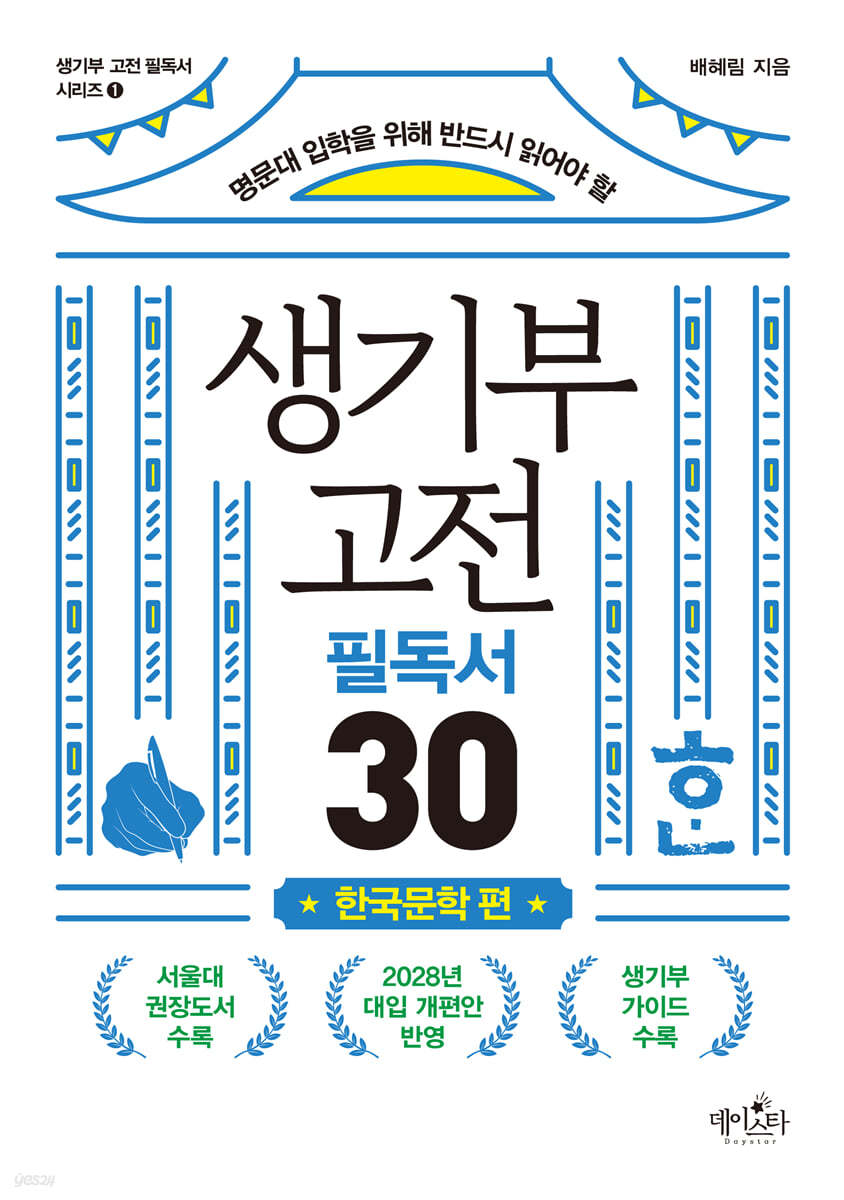
30 Must-Read Classics of Korean Literature
 |
Description
Book Introduction
A collection of 30 must-read classic Korean literature books for all Korean youth. In line with the drastically changed 2028 college entrance reform plan, not only the special features of the life science department but also in-depth reading activities A 10-Minute Daily Classic Reading Plan to Develop the Integrated Thinking Skills and Insights Desired by Top-Ranking Universities The flow of education and college entrance examination systems has been changing rapidly recently. This also means that the type of talent our society and universities desire is changing. Universities, especially top-tier universities, now want well-rounded, integrated talent who can communicate and collaborate effectively within a community, not just cognitively. How can we cultivate these capabilities? In a rapidly changing world, the fastest way to discover unchanging values, find fundamental questions and answers to solve problems, and cultivate the ability to gain insight into objects and phenomena is through reading, and especially through reading the classics. The 『30 Essential Readings for the Living Classics』 series was designed to help students develop integrated and holistic capabilities through reading a variety of classics. Six current teachers who share the importance of classics have carefully selected 180 representative classic works from various fields, including Korean literature, foreign literature, economics, science, history, and philosophy. This book focuses on recommended or required readings from leading domestic universities, and contains representative works that students must review. In particular, it reflects the changes in the educational field, where the importance of detailed academic abilities and special skills in school records is increasing ahead of the implementation of the 2022 revised curriculum and 2028 college entrance reform plan. The first book in this series, 『30 Must-Read Classics by Saenggibu, Korean Literature Edition』, introduces 30 books of Korean literature that students must read. These are not only useful works in themselves, but also works that have special value in the history of our literature, works by important authors, and collections of works that are valuable as a genre. The author, who is a current teacher, personally read and carefully selected them. To help students understand the work as three-dimensionally as possible, we have added detailed commentary on the work to help them prepare for their internal exams. We have also put in a lot of effort to ensure that it goes beyond a simple reading activity and is connected to academics by providing in-depth exploration and a guide to using the life skills book to enhance students' academic abilities. In particular, it presents research topics and directions to be explored in connection with classics for each subject, and introduces specific examples and methods to reflect each work in connection with the subject details of the school life record, making it the best way to prepare for the comprehensive student evaluation in connection with reading. |
- You can preview some of the book's contents.
Preview
index
Series Preface
Field Introduction
▶ First book - "The Square/Nine Clouds" by Choi In-hun
▶ Second Book - "The Little Ball Shot by a Dwarf," by Jo Se-hee
▶ Third book - "Yeolha Diary", Park Ji-won
▶ Fourth Book - Sky, Wind, Stars, and Poetry, Yun Dong-ju
▶ Fifth Book - Your Silence, Han Yong-un
▶ Sixth Book - Jeong Ji-yong's Complete Works, Jeong Ji-yong
▶ Seventh Book - "Poor Love Song," by Shin Kyeong-rim
▶ Eighth Book - Complete Works of Yuksa Lee, Yuksa Lee
▶ Ninth Book - "The Shell, Go Away" by Shin Dong-yup
▶ Tenth Book - "Heartlessness" by Lee Gwang-su
▶ Eleventh Book - "Three Generations" by Yeom Sang-seop
▶ Book 12 - "A Scenery of the Riverside" by Park Tae-won
▶ Book 13 - "Peaceful World" by Chae Man-sik
▶ Fourteenth Book - "The Descendants of Cain," by Hwang Sun-won
▶ Fifteenth Book - "Snow" by Lee Cheong-jun
▶ Sixteenth Book - "This is what Hwang Man-geun said," by Seong Seok-je
▶ Seventeenth Book - "Rainy Season" by Yun Heung-gil
▶ Eighteenth Book - "People of Wonmi-dong," Yang Gui-ja
▶ Nineteenth Book - "Gwanchon Essays," by Lee Mun-gu
▶ Book 20 - The Old Man Who Carved Bats, by Yoon Oh-young
▶ Book 21 - "Fate" by Picheon Deuk
▶ Book 22 - "Anthology of Modern Korean Plays," by Woojin Kim et al.
▶ Twenty-third book - Lee Geun-sam's Complete Works, Lee Geun-sam
▶ Book 24 - "Human Problems," by Kang Kyung-ae
▶ Book 25 - "Siyonghyangakbo," translated by Kim Myeong-jun
▶ Book 26 - "The Tale of Hojil Yangban and Heo Saeng" by Park Ji-won
▶ Book 27 - "Geumo Myth," by Kim Si-seup
▶ Book 28 - "Our Old Sijo We Must Know," by Hwang Jin-i et al.
▶ Book 29 - The Tale of Chunhyang, author unknown
▶ Book 30 - "Land," by Park Kyung-ni
Field Introduction
▶ First book - "The Square/Nine Clouds" by Choi In-hun
▶ Second Book - "The Little Ball Shot by a Dwarf," by Jo Se-hee
▶ Third book - "Yeolha Diary", Park Ji-won
▶ Fourth Book - Sky, Wind, Stars, and Poetry, Yun Dong-ju
▶ Fifth Book - Your Silence, Han Yong-un
▶ Sixth Book - Jeong Ji-yong's Complete Works, Jeong Ji-yong
▶ Seventh Book - "Poor Love Song," by Shin Kyeong-rim
▶ Eighth Book - Complete Works of Yuksa Lee, Yuksa Lee
▶ Ninth Book - "The Shell, Go Away" by Shin Dong-yup
▶ Tenth Book - "Heartlessness" by Lee Gwang-su
▶ Eleventh Book - "Three Generations" by Yeom Sang-seop
▶ Book 12 - "A Scenery of the Riverside" by Park Tae-won
▶ Book 13 - "Peaceful World" by Chae Man-sik
▶ Fourteenth Book - "The Descendants of Cain," by Hwang Sun-won
▶ Fifteenth Book - "Snow" by Lee Cheong-jun
▶ Sixteenth Book - "This is what Hwang Man-geun said," by Seong Seok-je
▶ Seventeenth Book - "Rainy Season" by Yun Heung-gil
▶ Eighteenth Book - "People of Wonmi-dong," Yang Gui-ja
▶ Nineteenth Book - "Gwanchon Essays," by Lee Mun-gu
▶ Book 20 - The Old Man Who Carved Bats, by Yoon Oh-young
▶ Book 21 - "Fate" by Picheon Deuk
▶ Book 22 - "Anthology of Modern Korean Plays," by Woojin Kim et al.
▶ Twenty-third book - Lee Geun-sam's Complete Works, Lee Geun-sam
▶ Book 24 - "Human Problems," by Kang Kyung-ae
▶ Book 25 - "Siyonghyangakbo," translated by Kim Myeong-jun
▶ Book 26 - "The Tale of Hojil Yangban and Heo Saeng" by Park Ji-won
▶ Book 27 - "Geumo Myth," by Kim Si-seup
▶ Book 28 - "Our Old Sijo We Must Know," by Hwang Jin-i et al.
▶ Book 29 - The Tale of Chunhyang, author unknown
▶ Book 30 - "Land," by Park Kyung-ni
Detailed image
.jpg)
Into the book
What is needed to cultivate the talent modern society demands? Surprisingly, a return to the past is called for.
It's about finding what doesn't change in a changing world.
It's reading the classics.
Classics transcend time and space and contain universal values of human culture.
It is like a treasure trove containing the essence of humanity.
Reading and exploring the classics goes beyond simply acquiring knowledge; it's a process of discovering the culture, ideas, and values of the era, as well as the fundamental questions and answers that humanity faces.
--- p.6 From the "Series Preface"
A time to establish my own values through the process of looking at and solving universal problems that many people have been concerned about throughout their lives.
These are things you can experience naturally when reading classics.
This is a great way to develop creativity and critical thinking skills.
Reading classics can also broaden your understanding of various emotions and situations.
This is an opportunity to gain a deeper understanding of yourself and others.
Reading classics is not simply reading a book, it is reading life and exploring the meaning of life.
--- p.7 From the "Series Preface"
A high school student's record book is like a student's business card.
The school life record book is a complete record of how you prepare for your future career.
As a current teacher, I feel the importance of school records.
Whether your career path is clear or unclear, the safest and most comfortable way to approach it is through reading.
Especially if it's quality reading.
As a way to create your own portfolio, I recommend drawing a roadmap for your school life record through classic reading.
--- p.8 From the "Series Preface"
Before ideology, humans need both a personal space and a public square where they can interact with others.
No institution can be transcendent, beyond human existence.
This is exactly what the author wants to say through “The Square.”
Ideology should be helpful to human life.
Ideology should not dictate human life.
As you read this book, I hope you'll ponder the relationship between human life and ideology, and furthermore, reflect on what ideologies can be helpful to human life.
--- p.21 From “The Square, a Dream of the Nine”
The Japanese colonial period was a humiliating historical period, and during that time, there were countless independence activists who stood at the forefront, raised their voices, and made sacrifices.
Yun Dong-ju was ashamed and distressed at not being able to speak out confidently in such an era.
And he expressed those feelings through poetry.
It is a repeated act of constantly reminding oneself of one's own shame and suffering.
Showing shame is revealing weakness, but Yun Dong-ju speaks frankly about this.
Through this, we do not remain silent, but painfully reflect on and repent of our heartbreaking history.
This ultimately makes you think about what is right and what is wrong.
--- p.51 From “Sky, Wind, Stars, and Poetry”
The reason why “Poor Love Song” is still meaningful to read today is not only because our society is still gloomy.
Because his work makes us think about how we should live and with what kind of heart we should live in this reality.
Through this book, I encourage you to think about what kind of zeitgeist is needed in the "present" era in which we live.
Moving forward, I hope we can seriously consider the direction our society should take and what we can do to create a better future for all of us.
--- p.80 From "Poor Love Song"
"Three Generations" is a representative work of modern Korean literature that examines how various types of people lived during the Japanese colonial period and how the contradictions of the social structure and generational change at the time can be understood in the course of changes in modern Korean history.
Through this book, I hope you will examine the differences in thinking and values between three generations, including me, my parents, and my grandparents, and reflect on why these differences arise over time and how to overcome the problems that arise from these differences.
It's about finding what doesn't change in a changing world.
It's reading the classics.
Classics transcend time and space and contain universal values of human culture.
It is like a treasure trove containing the essence of humanity.
Reading and exploring the classics goes beyond simply acquiring knowledge; it's a process of discovering the culture, ideas, and values of the era, as well as the fundamental questions and answers that humanity faces.
--- p.6 From the "Series Preface"
A time to establish my own values through the process of looking at and solving universal problems that many people have been concerned about throughout their lives.
These are things you can experience naturally when reading classics.
This is a great way to develop creativity and critical thinking skills.
Reading classics can also broaden your understanding of various emotions and situations.
This is an opportunity to gain a deeper understanding of yourself and others.
Reading classics is not simply reading a book, it is reading life and exploring the meaning of life.
--- p.7 From the "Series Preface"
A high school student's record book is like a student's business card.
The school life record book is a complete record of how you prepare for your future career.
As a current teacher, I feel the importance of school records.
Whether your career path is clear or unclear, the safest and most comfortable way to approach it is through reading.
Especially if it's quality reading.
As a way to create your own portfolio, I recommend drawing a roadmap for your school life record through classic reading.
--- p.8 From the "Series Preface"
Before ideology, humans need both a personal space and a public square where they can interact with others.
No institution can be transcendent, beyond human existence.
This is exactly what the author wants to say through “The Square.”
Ideology should be helpful to human life.
Ideology should not dictate human life.
As you read this book, I hope you'll ponder the relationship between human life and ideology, and furthermore, reflect on what ideologies can be helpful to human life.
--- p.21 From “The Square, a Dream of the Nine”
The Japanese colonial period was a humiliating historical period, and during that time, there were countless independence activists who stood at the forefront, raised their voices, and made sacrifices.
Yun Dong-ju was ashamed and distressed at not being able to speak out confidently in such an era.
And he expressed those feelings through poetry.
It is a repeated act of constantly reminding oneself of one's own shame and suffering.
Showing shame is revealing weakness, but Yun Dong-ju speaks frankly about this.
Through this, we do not remain silent, but painfully reflect on and repent of our heartbreaking history.
This ultimately makes you think about what is right and what is wrong.
--- p.51 From “Sky, Wind, Stars, and Poetry”
The reason why “Poor Love Song” is still meaningful to read today is not only because our society is still gloomy.
Because his work makes us think about how we should live and with what kind of heart we should live in this reality.
Through this book, I encourage you to think about what kind of zeitgeist is needed in the "present" era in which we live.
Moving forward, I hope we can seriously consider the direction our society should take and what we can do to create a better future for all of us.
--- p.80 From "Poor Love Song"
"Three Generations" is a representative work of modern Korean literature that examines how various types of people lived during the Japanese colonial period and how the contradictions of the social structure and generational change at the time can be understood in the course of changes in modern Korean history.
Through this book, I hope you will examine the differences in thinking and values between three generations, including me, my parents, and my grandparents, and reflect on why these differences arise over time and how to overcome the problems that arise from these differences.
--- p.120 From “Three Generations”
Publisher's Review
The secret to developing skills that remain constant despite the changing college entrance exam system: reading the classics.
The first book in the "30 Must-Read Classics for the Life Sciences" series, selected by current teachers.
《30 Must-Read Classics of Korean Literature》
The current educational and college entrance examination systems are undergoing significant changes, including the implementation of the high school credit system, integration of liberal arts and sciences, and expansion of the comprehensive student admissions system.
This also means that it has become very important for students to explore their own career paths, choose their subjects, and create their own portfolios when preparing for college entrance exams.
Top universities, in particular, want creative and comprehensive thinkers who can create and demonstrate new value.
Not just cognitive abilities.
We seek talented individuals who are well-developed, including the ability to actively communicate and cooperate within the community.
How can we cultivate these capabilities? In a rapidly changing world, the fastest way to discover unchanging values, find fundamental questions and answers to solve problems, and cultivate the ability to gain insight into objects and phenomena is through reading, and especially through reading the classics.
The "30 Essential Readings for the Living Classics" series was designed to help students develop integrated and holistic capabilities through reading a variety of classics.
This series introduces 180 representative classic works carefully selected by six current teachers who share the importance of classics in various fields, including Korean literature, foreign literature, economics, science, history, and philosophy.
These are representative works that students must review, focusing on recommended and required readings presented by leading domestic universities.
A guide to in-depth study of classic must-reads and the use of the life cycle.
From preparing for school exams to career guidance and tax specials, all in one book!
Above all, this series summarizes the core content of classic must-reads, lowering the psychological hurdles for students to read the classics and allowing them to comfortably accept them.
With detailed explanations, you can prepare for your internal exams, and we have put a lot of effort into ensuring that it goes beyond simple reading and is connected to academics by providing a guide to in-depth exploration activities.
In particular, as the importance of detailed academic abilities and special skills in school records is increasing due to the 2022 revised curriculum and the 2028 college entrance reform plan, we wanted to specifically show the direction of connection with the life history report.
It presents research topics and directions to be explored in connection with classics for each subject, and also introduces specific examples and methods that can be reflected in connection with the specific subjects in the school life record after reading the classics.
This book will help students create their own portfolios by reading classics from various fields and drawing up a roadmap for their school records.
Above all, I hope that it will help you learn the joy of reading and the value of life, and serve as a guide in making choices on your journey toward college entrance.
Carefully selected by a current Korean language teacher
30 Must-Read Classic Korean Literature Books for Korean Youth
《30 Must-Read Classics by Saenggibu, Korean Literature Edition》 is the first book in the series, and contains 30 representative works of Korean literature, focusing on domestic literary works that frequently appear in school grades and the college entrance exam.
The author said, “It is not only about the usefulness of the works themselves, but also about works that have special value in the history of Korean literature, collections of works that have value in their respective fields, and works by important authors in the history of Korean literature.
“I personally read and selected the classic works that I thought students should know,” he said.
Literary works come to life only when read three-dimensionally.
The author guides students to read the work in the most three-dimensional way possible by reflecting as much of the essential content as possible in each work, and in particular, at the end of the work introduction, he included examples of using the life book, which contains subjects that can be connected to the work and career activities linked to related departments, to serve as a guide for students who are at a loss as to which post-reading activities to do in which subjects.
Through this book, students will be able to develop diverse literary skills and learn the joy of reading and the value of life.
The first book in the "30 Must-Read Classics for the Life Sciences" series, selected by current teachers.
《30 Must-Read Classics of Korean Literature》
The current educational and college entrance examination systems are undergoing significant changes, including the implementation of the high school credit system, integration of liberal arts and sciences, and expansion of the comprehensive student admissions system.
This also means that it has become very important for students to explore their own career paths, choose their subjects, and create their own portfolios when preparing for college entrance exams.
Top universities, in particular, want creative and comprehensive thinkers who can create and demonstrate new value.
Not just cognitive abilities.
We seek talented individuals who are well-developed, including the ability to actively communicate and cooperate within the community.
How can we cultivate these capabilities? In a rapidly changing world, the fastest way to discover unchanging values, find fundamental questions and answers to solve problems, and cultivate the ability to gain insight into objects and phenomena is through reading, and especially through reading the classics.
The "30 Essential Readings for the Living Classics" series was designed to help students develop integrated and holistic capabilities through reading a variety of classics.
This series introduces 180 representative classic works carefully selected by six current teachers who share the importance of classics in various fields, including Korean literature, foreign literature, economics, science, history, and philosophy.
These are representative works that students must review, focusing on recommended and required readings presented by leading domestic universities.
A guide to in-depth study of classic must-reads and the use of the life cycle.
From preparing for school exams to career guidance and tax specials, all in one book!
Above all, this series summarizes the core content of classic must-reads, lowering the psychological hurdles for students to read the classics and allowing them to comfortably accept them.
With detailed explanations, you can prepare for your internal exams, and we have put a lot of effort into ensuring that it goes beyond simple reading and is connected to academics by providing a guide to in-depth exploration activities.
In particular, as the importance of detailed academic abilities and special skills in school records is increasing due to the 2022 revised curriculum and the 2028 college entrance reform plan, we wanted to specifically show the direction of connection with the life history report.
It presents research topics and directions to be explored in connection with classics for each subject, and also introduces specific examples and methods that can be reflected in connection with the specific subjects in the school life record after reading the classics.
This book will help students create their own portfolios by reading classics from various fields and drawing up a roadmap for their school records.
Above all, I hope that it will help you learn the joy of reading and the value of life, and serve as a guide in making choices on your journey toward college entrance.
Carefully selected by a current Korean language teacher
30 Must-Read Classic Korean Literature Books for Korean Youth
《30 Must-Read Classics by Saenggibu, Korean Literature Edition》 is the first book in the series, and contains 30 representative works of Korean literature, focusing on domestic literary works that frequently appear in school grades and the college entrance exam.
The author said, “It is not only about the usefulness of the works themselves, but also about works that have special value in the history of Korean literature, collections of works that have value in their respective fields, and works by important authors in the history of Korean literature.
“I personally read and selected the classic works that I thought students should know,” he said.
Literary works come to life only when read three-dimensionally.
The author guides students to read the work in the most three-dimensional way possible by reflecting as much of the essential content as possible in each work, and in particular, at the end of the work introduction, he included examples of using the life book, which contains subjects that can be connected to the work and career activities linked to related departments, to serve as a guide for students who are at a loss as to which post-reading activities to do in which subjects.
Through this book, students will be able to develop diverse literary skills and learn the joy of reading and the value of life.
GOODS SPECIFICS
- Date of issue: May 30, 2024
- Page count, weight, size: 316 pages | 440g | 148*210*20mm
- ISBN13: 9791168271937
- ISBN10: 1168271932
You may also like
카테고리
korean


korean

![GQ KOREA Mark (Monthly): December [2025]](http://librairie.coreenne.fr/cdn/shop/files/8ef265dbbfbf186523ed75ba7319009d.jpg?v=1765340328&width=3840)


