

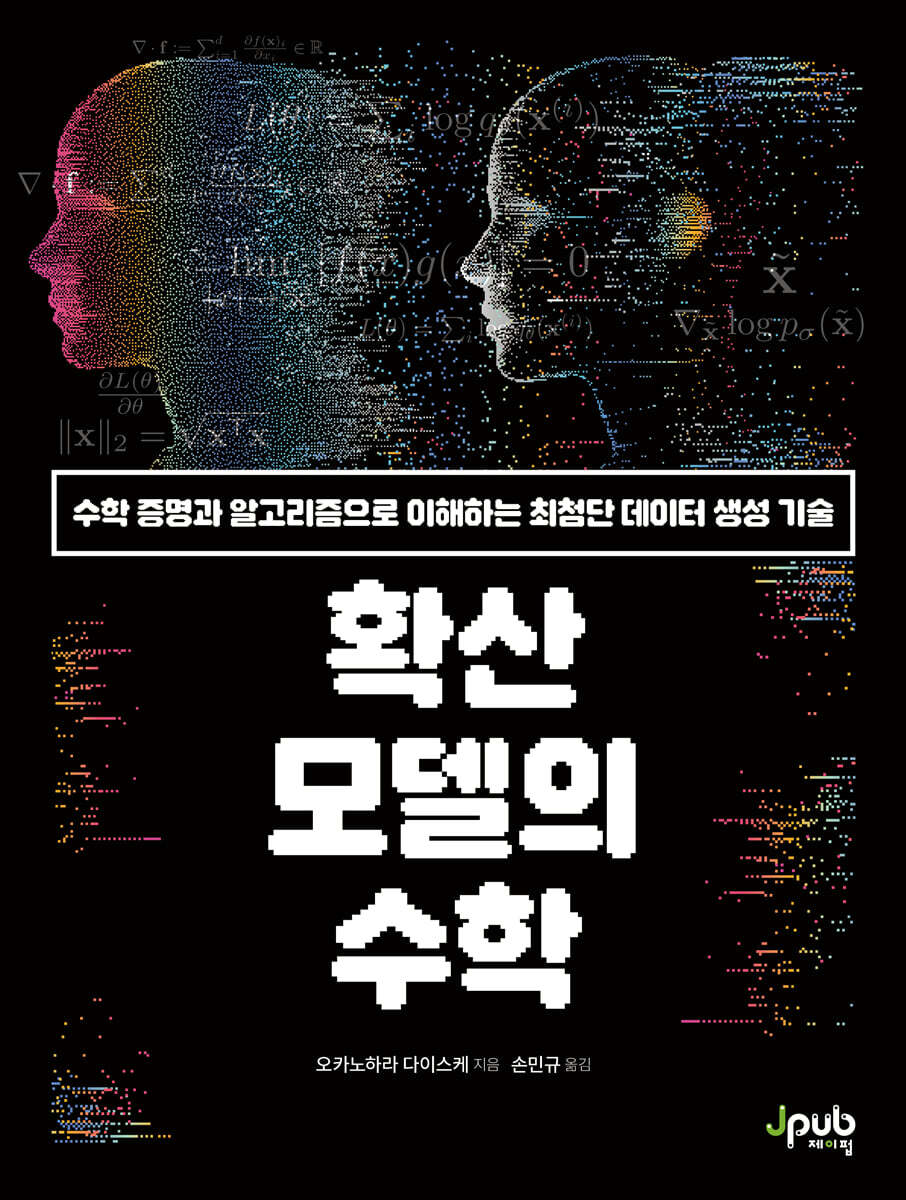
Mathematics of the diffusion model
 |
Description
Book Introduction
Mathematical principles of diffusion model technology for generating images/videos/voices/texts
The diffusion model is attracting attention as a generative model that creates high-quality data based on technologies such as DALL-E2, Midjourney, and Stable Diffusion that generate images corresponding to text.
This book explains in great detail the basic concepts of the diffusion model, its development process, and application examples.
By examining the principles of the diffusion model mathematically, we can better understand the theory and draw out the high potential of the diffusion model.
The diffusion model is attracting attention as a generative model that creates high-quality data based on technologies such as DALL-E2, Midjourney, and Stable Diffusion that generate images corresponding to text.
This book explains in great detail the basic concepts of the diffusion model, its development process, and application examples.
By examining the principles of the diffusion model mathematically, we can better understand the theory and draw out the high potential of the diffusion model.
- You can preview some of the book's contents.
Preview
index
Translator's Preface viii
Recommendation ix
Preface xi
List of symbols xv
CHAPTER 1 Generative Model 1
1.1 What is a generative model? 1
1.2 Energy-based model and distribution function 4
1.3 Learning Method 6
1.4 The Difficulty of Generating Multimodal Data in High Dimensions 13
1.5 Score: Slope 14 for log-likelihood input
__1.5.1 Langevin Monte Carlo Method 16
__1.5.2 Score Matching 18
__1.5.3 Implicit Score Matching 19
__1.5.4 Proof that implicit score matching can estimate scores 22
__1.5.5 Denoising Score Matching 26
__1.5.6 Proof that denoising score matching can estimate scores 30
__1.5.7 Proof when noise follows a normal distribution 32
__1.5.8 Summary of Score Matching Methods 37
Summary 37
CHAPTER 2 Diffusion Models 39
2.1 Score-based models and denoising diffusion probability models 39
2.2 Score-based model 40
__2.2.1 Problems with the Langevin Monte Carlo Method Using Estimated Scores 40
__2.2.2 Score-based models combine scores from multiple post-perturbation distributions 42
2.3 Denoising Diffusion Probability Model 46
__2.3.1 Latent variable model consisting of diffusion and reverse diffusion processes 46
__2.3.2 DDPM Learning 51
__2.3.3 56 with denoising score matching in DDPM
__2.3.4 Data Generation Using DDPM 61
2.4 Unified structure using signal-to-noise ratio of SBM and DDPM 62
__2.4.1 Relationship between SBM and DDPM 62
__2.4.2 Continuous Time Model 70
__2.4.3 The same solution can be obtained regardless of the noise schedule 71
__2.4.4 Learnable Noise Schedule 72
Summary 73
CHAPTER 3 Continuous Time Diffusion Models 75
3.1 Stochastic Differential Equations 76
3.2 SDE Representation of SBM and DDPM 77
3.3 De-diffusion process of SDE expression 80
3.4 Learning the SDE Representation Diffusion Model 81
3.5 SDE Expression Diffusion Model Sampling 83
3.6 Probability Flow ODE 84
__3.6.1 Proof that the marginal likelihoods of the probability flow ODE and SDE are identical 86
__3.6.2 Likelihood Calculation for Probabilistic Flow ODEs 88
__3.6.3 Probability Flow in Signal and Noise ODE 88
3.7 Characteristics of the Diffusion Model 89
__3.7.1 Relationship with Existing Latent Variable Models 90
__3.7.2 The diffusion model is stable in learning 91
__3.7.3 Decomposing complex generation problems into simpler sub-generation problems 92
__3.7.4 Various conditions can be combined 93
__3.7.5 The symmetry of creation can be introduced naturally 94
__3.7.6 When extracting samples, the number of steps is large, so the generation speed is slow 95
__3.7.7 Unresolved issue of how to generalize to the diffusion model 95
Summary 96
CHAPTER 4 EVOLUTION OF THE DIFFUSION MODEL 97
4.1 Score 97 in conditional generation
4.2 Classifier Guidance 98
4.3 Guidance 99 without using a classifier
4.4 Subspace Diffusion Model 102
__4.4.1 Learning the Subspace Diffusion Model 104
__4.4.2 Sampling of Subspace Diffusion Models 106
4.5 Diffusion Model Considering Symmetry 107
__4.5.1 Geometry and Symmetry 107
__4.5.2 Rotational arrangement of compounds 110
Summary 117
CHAPTER 5 APPLICATIONS 119
5.1 Image Generation, Super-Resolution, Complementation, and Image Transformation 120
5.2 Creating Videos and Panoramas 121
5.3 Semantic Extraction and Transformation 122
5.4 Voice Synthesis and Emphasis 123
5.5 Formation and Rotation of Compounds 124
5.6 Improving Robustness to Adversarial Perturbations 125
5.7 Data Compression 126
Summary 127
APPENDIX A Appendix 129
A.1 Posterior probability distribution when the prior distribution is normal and the likelihood is linearly normal 129
A.2 ELBO 130
A.3 Deriving a Probabilistic Flow ODE Using Signal and Noise 131
A.4 Conditional Generation Problem 135
A.5 Denoising Implicit Diffusion Model 137
A.6 Proof of the Stochastic Differential Equation for the Inverse Diffusion Process 141
A.7 Diffusion Model with Non-Gaussian Noise 146
A.8 Analog Bits: Discrete Variable Diffusion Model 147
Reference 149
Search 154
Recommendation ix
Preface xi
List of symbols xv
CHAPTER 1 Generative Model 1
1.1 What is a generative model? 1
1.2 Energy-based model and distribution function 4
1.3 Learning Method 6
1.4 The Difficulty of Generating Multimodal Data in High Dimensions 13
1.5 Score: Slope 14 for log-likelihood input
__1.5.1 Langevin Monte Carlo Method 16
__1.5.2 Score Matching 18
__1.5.3 Implicit Score Matching 19
__1.5.4 Proof that implicit score matching can estimate scores 22
__1.5.5 Denoising Score Matching 26
__1.5.6 Proof that denoising score matching can estimate scores 30
__1.5.7 Proof when noise follows a normal distribution 32
__1.5.8 Summary of Score Matching Methods 37
Summary 37
CHAPTER 2 Diffusion Models 39
2.1 Score-based models and denoising diffusion probability models 39
2.2 Score-based model 40
__2.2.1 Problems with the Langevin Monte Carlo Method Using Estimated Scores 40
__2.2.2 Score-based models combine scores from multiple post-perturbation distributions 42
2.3 Denoising Diffusion Probability Model 46
__2.3.1 Latent variable model consisting of diffusion and reverse diffusion processes 46
__2.3.2 DDPM Learning 51
__2.3.3 56 with denoising score matching in DDPM
__2.3.4 Data Generation Using DDPM 61
2.4 Unified structure using signal-to-noise ratio of SBM and DDPM 62
__2.4.1 Relationship between SBM and DDPM 62
__2.4.2 Continuous Time Model 70
__2.4.3 The same solution can be obtained regardless of the noise schedule 71
__2.4.4 Learnable Noise Schedule 72
Summary 73
CHAPTER 3 Continuous Time Diffusion Models 75
3.1 Stochastic Differential Equations 76
3.2 SDE Representation of SBM and DDPM 77
3.3 De-diffusion process of SDE expression 80
3.4 Learning the SDE Representation Diffusion Model 81
3.5 SDE Expression Diffusion Model Sampling 83
3.6 Probability Flow ODE 84
__3.6.1 Proof that the marginal likelihoods of the probability flow ODE and SDE are identical 86
__3.6.2 Likelihood Calculation for Probabilistic Flow ODEs 88
__3.6.3 Probability Flow in Signal and Noise ODE 88
3.7 Characteristics of the Diffusion Model 89
__3.7.1 Relationship with Existing Latent Variable Models 90
__3.7.2 The diffusion model is stable in learning 91
__3.7.3 Decomposing complex generation problems into simpler sub-generation problems 92
__3.7.4 Various conditions can be combined 93
__3.7.5 The symmetry of creation can be introduced naturally 94
__3.7.6 When extracting samples, the number of steps is large, so the generation speed is slow 95
__3.7.7 Unresolved issue of how to generalize to the diffusion model 95
Summary 96
CHAPTER 4 EVOLUTION OF THE DIFFUSION MODEL 97
4.1 Score 97 in conditional generation
4.2 Classifier Guidance 98
4.3 Guidance 99 without using a classifier
4.4 Subspace Diffusion Model 102
__4.4.1 Learning the Subspace Diffusion Model 104
__4.4.2 Sampling of Subspace Diffusion Models 106
4.5 Diffusion Model Considering Symmetry 107
__4.5.1 Geometry and Symmetry 107
__4.5.2 Rotational arrangement of compounds 110
Summary 117
CHAPTER 5 APPLICATIONS 119
5.1 Image Generation, Super-Resolution, Complementation, and Image Transformation 120
5.2 Creating Videos and Panoramas 121
5.3 Semantic Extraction and Transformation 122
5.4 Voice Synthesis and Emphasis 123
5.5 Formation and Rotation of Compounds 124
5.6 Improving Robustness to Adversarial Perturbations 125
5.7 Data Compression 126
Summary 127
APPENDIX A Appendix 129
A.1 Posterior probability distribution when the prior distribution is normal and the likelihood is linearly normal 129
A.2 ELBO 130
A.3 Deriving a Probabilistic Flow ODE Using Signal and Noise 131
A.4 Conditional Generation Problem 135
A.5 Denoising Implicit Diffusion Model 137
A.6 Proof of the Stochastic Differential Equation for the Inverse Diffusion Process 141
A.7 Diffusion Model with Non-Gaussian Noise 146
A.8 Analog Bits: Discrete Variable Diffusion Model 147
Reference 149
Search 154
Detailed image

Into the book
A generative model is a model that generates data in the target domain.
And some generative models can also evaluate the likelihood p(x) of given data x.
Understanding how data is generated is one effective way to understand it, and being able to generate data freely can be beneficial to many applications.
So, a lot of research has been done on generative models for a long time.
--- p.1
The first is the score-based model (SBM).
As we saw in Chapter 1, we can obtain samples from the target probability distribution using the Langevin Monte Carlo method, which uses scores estimated by denoising score matching.
However, in practice, there are problems with score estimation, sampling takes a very long time, and sampling does not work well in high-dimensional multimodal distributions.
To address this issue, we examine learning scores from distributions perturbed by noise of different sizes and generating data using the Langevin Monte Carlo method.
--- p.39
Probabilistic flow ODEs can be viewed as a special form of neural ODEs, which are generative models using ODEs.
Neural ODE models the change in each time step using a neural network by changing the data extracted from the prior distribution using differential equations.
The probability flow ODE defines this change amount based on the previous equation (3.6).
--- p.85
Guidance that does not use a classifier can solve the classifier guidance problem.
There is no need to train the classifier separately from the unconditional scores at various noise levels, and in general training, the conditions can be dropped out with a certain probability.
So, learning can be greatly simplified.
Additionally, by sharing the learning of conditional and unconditional scores, we can significantly improve the generation quality by reducing the possibility of discovering relationships between y and x that are actually unrelated.
--- p.101
Video generation, which was the most difficult task to learn, is also being implemented using a diffusion model.
Video generation can be viewed as the problem of generating an image for each frame.
Video generation deals with a very high-dimensional data generation problem, so it was difficult to even overfit the training data.
Video generation using a diffusion model is a method of generating some frames and using them as conditions.
And some generative models can also evaluate the likelihood p(x) of given data x.
Understanding how data is generated is one effective way to understand it, and being able to generate data freely can be beneficial to many applications.
So, a lot of research has been done on generative models for a long time.
--- p.1
The first is the score-based model (SBM).
As we saw in Chapter 1, we can obtain samples from the target probability distribution using the Langevin Monte Carlo method, which uses scores estimated by denoising score matching.
However, in practice, there are problems with score estimation, sampling takes a very long time, and sampling does not work well in high-dimensional multimodal distributions.
To address this issue, we examine learning scores from distributions perturbed by noise of different sizes and generating data using the Langevin Monte Carlo method.
--- p.39
Probabilistic flow ODEs can be viewed as a special form of neural ODEs, which are generative models using ODEs.
Neural ODE models the change in each time step using a neural network by changing the data extracted from the prior distribution using differential equations.
The probability flow ODE defines this change amount based on the previous equation (3.6).
--- p.85
Guidance that does not use a classifier can solve the classifier guidance problem.
There is no need to train the classifier separately from the unconditional scores at various noise levels, and in general training, the conditions can be dropped out with a certain probability.
So, learning can be greatly simplified.
Additionally, by sharing the learning of conditional and unconditional scores, we can significantly improve the generation quality by reducing the possibility of discovering relationships between y and x that are actually unrelated.
--- p.101
Video generation, which was the most difficult task to learn, is also being implemented using a diffusion model.
Video generation can be viewed as the problem of generating an image for each frame.
Video generation deals with a very high-dimensional data generation problem, so it was difficult to even overfit the training data.
Video generation using a diffusion model is a method of generating some frames and using them as conditions.
--- p.121
Publisher's Review
Understanding Diffusion Models with Formulas and Figures
We've all witnessed the impact of advances in AI that generate images from text, such as DALL-E2, Midjourney, and Stable Diffusion.
The basis of these technologies is the diffusion model.
Understanding the proliferation models that generate high-quality data is essential to understanding today's generative AI, but relevant literature is scarce.
This book explains in detail the basic concepts of the diffusion model, its development process, and application cases.
To help you understand the formula more intuitively, we provide several figures and graphs, and by comparing learning stability, likelihood estimation, and conditional generation with existing generative models, you can clearly understand the diffusion model.
What makes this book even more special is that it was written by Daisuke Okanohara, Chief Research Officer of Preferred Networks, Japan's leading AI company.
Daisuke Okanohara, a veteran author who is praised for “providing a rich context surrounding technology,” won the 32nd Okawa Publishing Award for this book.
If you want to properly understand the diffusion model at the heart of artificial intelligence today, this book will serve as a guide.
Key Contents
● Overview and basic concepts of the generative model
● Understanding diffusion models using SNR and score-based models
● Features of continuous-time diffusion models and diffusion models
● Development of diffusion models such as classifier guidance, subspace, and symmetry
● Application examples of diffusion models such as video, voice synthesis, and compounds
We've all witnessed the impact of advances in AI that generate images from text, such as DALL-E2, Midjourney, and Stable Diffusion.
The basis of these technologies is the diffusion model.
Understanding the proliferation models that generate high-quality data is essential to understanding today's generative AI, but relevant literature is scarce.
This book explains in detail the basic concepts of the diffusion model, its development process, and application cases.
To help you understand the formula more intuitively, we provide several figures and graphs, and by comparing learning stability, likelihood estimation, and conditional generation with existing generative models, you can clearly understand the diffusion model.
What makes this book even more special is that it was written by Daisuke Okanohara, Chief Research Officer of Preferred Networks, Japan's leading AI company.
Daisuke Okanohara, a veteran author who is praised for “providing a rich context surrounding technology,” won the 32nd Okawa Publishing Award for this book.
If you want to properly understand the diffusion model at the heart of artificial intelligence today, this book will serve as a guide.
Key Contents
● Overview and basic concepts of the generative model
● Understanding diffusion models using SNR and score-based models
● Features of continuous-time diffusion models and diffusion models
● Development of diffusion models such as classifier guidance, subspace, and symmetry
● Application examples of diffusion models such as video, voice synthesis, and compounds
GOODS SPECIFICS
- Date of issue: July 5, 2024
- Pages, weight, size: 172 pages | 360g | 170*225*11mm
- ISBN13: 9791193926444
You may also like
카테고리
korean


korean

![GQ KOREA Mark (Monthly): December [2025]](http://librairie.coreenne.fr/cdn/shop/files/8ef265dbbfbf186523ed75ba7319009d.jpg?v=1765340328&width=3840)


