

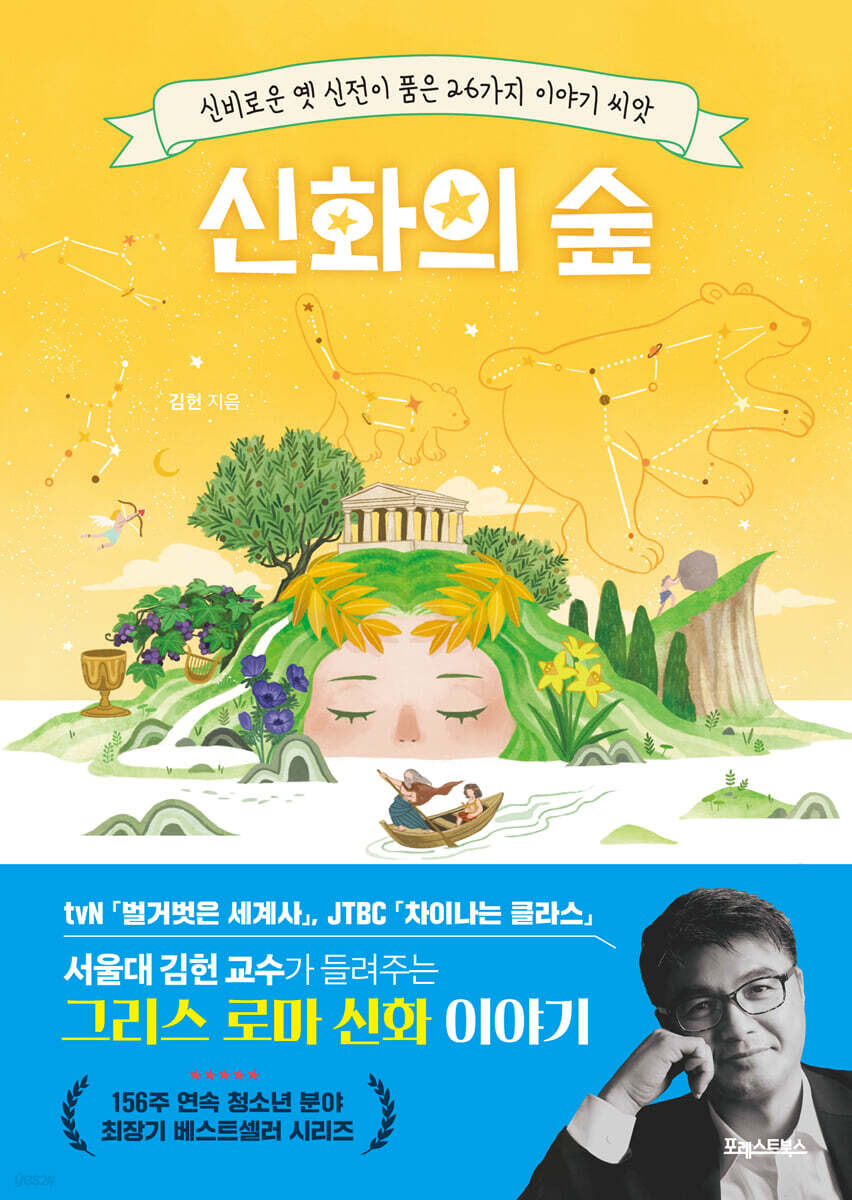
Forest of Myths
 |
Description
Book Introduction
- A word from MD
-
Stories of Myths, Gods, and HumansGreek and Roman mythology told by Seoul National University Professor Kim Heon, who led the Western classical craze.
From Narcissus to Theseus, 26 mystical stories are included in 『The Forest of Myths』.
Following the bestsellers 『The Forest of Philosophy』 and 『The Forest of Classics』, let's enter the world of myths that have survived through history.
May 28, 2024. Youth PD Lee Jae-eun
The world's oldest and most entertaining classic,
The world of Greco-Roman mythology that has survived through history
tvN [Naked World History] JTBC [China Class] Professor Kim Heon's new book!
The third book in the "Forest of Philosophy" and "Forest of Classics" series, which has long been a bestseller in the youth book market and has pleasantly shattered the conventional wisdom that philosophy and classics are difficult and dull, has been published and is a hot topic.
This book, which deals with Greco-Roman mythology, quickly became a hit on Mom Cafe even before it was published.
Professor Kim Heon of Seoul National University, a classicist who led the Western classics craze by explaining the stories and value of Greek and Roman mythology in a fun and easy-to-understand way for everyone through various broadcast media and lectures, including JTBC's [Naked World History] and tvN's [China Class], revealed that he wrote this book with special affection.
He also found strength and answers to move forward by reading the epics of ancient Greece when life was truly difficult and hard.
That is why the author recommends that growing youth chew on myths and digest them well.
There is not a single useless part in the stories of Greco-Roman mythology.
In particular, this book has compiled stories from the original myths that can pique children's interest and expand their thinking and concentration skills, such as the tragedy of Narcissus, which shows the dangers of excessive self-love (narcissism), the arrogance of Arachne, who lost everything despite her outstanding talent, and the courage of Theseus, who chose endless challenges and finally stood tall as a hero.
“I wish my child would read books.” This is probably the wish of every parent.
But what's really important is that the child reads books 'by himself' and 'for fun'.
Only then can you truly internalize the knowledge and enlightenment in the book.
If you've been concerned about your child's picky reading habits, now is the time to delve into the forest of myths, which not only offers interesting storytelling but also offers a clear understanding of the theme.
By the time you close the last page, you'll find your child confidently saying, "This book is really fun!" or "I shouldn't be like Narcissus, always saving myself!"
The world of Greco-Roman mythology that has survived through history
tvN [Naked World History] JTBC [China Class] Professor Kim Heon's new book!
The third book in the "Forest of Philosophy" and "Forest of Classics" series, which has long been a bestseller in the youth book market and has pleasantly shattered the conventional wisdom that philosophy and classics are difficult and dull, has been published and is a hot topic.
This book, which deals with Greco-Roman mythology, quickly became a hit on Mom Cafe even before it was published.
Professor Kim Heon of Seoul National University, a classicist who led the Western classics craze by explaining the stories and value of Greek and Roman mythology in a fun and easy-to-understand way for everyone through various broadcast media and lectures, including JTBC's [Naked World History] and tvN's [China Class], revealed that he wrote this book with special affection.
He also found strength and answers to move forward by reading the epics of ancient Greece when life was truly difficult and hard.
That is why the author recommends that growing youth chew on myths and digest them well.
There is not a single useless part in the stories of Greco-Roman mythology.
In particular, this book has compiled stories from the original myths that can pique children's interest and expand their thinking and concentration skills, such as the tragedy of Narcissus, which shows the dangers of excessive self-love (narcissism), the arrogance of Arachne, who lost everything despite her outstanding talent, and the courage of Theseus, who chose endless challenges and finally stood tall as a hero.
“I wish my child would read books.” This is probably the wish of every parent.
But what's really important is that the child reads books 'by himself' and 'for fun'.
Only then can you truly internalize the knowledge and enlightenment in the book.
If you've been concerned about your child's picky reading habits, now is the time to delve into the forest of myths, which not only offers interesting storytelling but also offers a clear understanding of the theme.
By the time you close the last page, you'll find your child confidently saying, "This book is really fun!" or "I shouldn't be like Narcissus, always saving myself!"
- You can preview some of the book's contents.
Preview
index
Preface: Myths, Gods, and Human Stories
The First Forest: A Mysterious and Beautiful Mythical Love Story
Echo, the fairy who left behind an echo
Narcissus, the hunter who became a daffodil
The Tale of a Fairy Entangled in a Laurel Tree
Arethusa, the nymph who became a spring
Hades kidnapped Persephone
Orpheus descends to the underworld
The love and separation of Eros and Psyche
Psyche's Adventures in Winning Love
The power of love and soul that overcomes death
The Unfulfilled Love of Pyramus and Thisbe
Learn more_ Logos of numerous brands and Greek and Roman mythology
The Second Forest: A Curse and Calamity of a God Filled with Terrible Wrath
Callisto and Arcas become constellations in the sky.
Actaeon, cursed by the goddess and turned into a deer
Punishment of becoming a rock that sheds tears forever
The misfortunes that befell Broteas and Pelops, the brothers
Arachne becomes a spider weaving cloth forever
The harsh price of betraying Apollo
What Erythithon, cursed with hunger, ended up eating
The touch of Midas that turns everything to gold
Medusa's curse: turning anyone who meets her eyes to stone
Pygmalion, who turned a statue into a human being
Learn more_ The origin of the names of the twelve months of the year
The Third Forest: The Brave Ones Who Forge Their Own New Paths
The Adventures of Perseus on Pegasus
The Endless Challenges of the Female Hunter Atalanta
Aiakos, the king of the ant people
The unbreakable spirit of the resurrected Pelops
Theseus's Decision to Embrace the Wider World
Theseus challenges, challenges, and challenges again
Learn more_ The story of the constellations that decorate the night sky
The First Forest: A Mysterious and Beautiful Mythical Love Story
Echo, the fairy who left behind an echo
Narcissus, the hunter who became a daffodil
The Tale of a Fairy Entangled in a Laurel Tree
Arethusa, the nymph who became a spring
Hades kidnapped Persephone
Orpheus descends to the underworld
The love and separation of Eros and Psyche
Psyche's Adventures in Winning Love
The power of love and soul that overcomes death
The Unfulfilled Love of Pyramus and Thisbe
Learn more_ Logos of numerous brands and Greek and Roman mythology
The Second Forest: A Curse and Calamity of a God Filled with Terrible Wrath
Callisto and Arcas become constellations in the sky.
Actaeon, cursed by the goddess and turned into a deer
Punishment of becoming a rock that sheds tears forever
The misfortunes that befell Broteas and Pelops, the brothers
Arachne becomes a spider weaving cloth forever
The harsh price of betraying Apollo
What Erythithon, cursed with hunger, ended up eating
The touch of Midas that turns everything to gold
Medusa's curse: turning anyone who meets her eyes to stone
Pygmalion, who turned a statue into a human being
Learn more_ The origin of the names of the twelve months of the year
The Third Forest: The Brave Ones Who Forge Their Own New Paths
The Adventures of Perseus on Pegasus
The Endless Challenges of the Female Hunter Atalanta
Aiakos, the king of the ant people
The unbreakable spirit of the resurrected Pelops
Theseus's Decision to Embrace the Wider World
Theseus challenges, challenges, and challenges again
Learn more_ The story of the constellations that decorate the night sky
Detailed image

Into the book
Narcissus wanted to greet him and shake his hand.
Just as Echo imitated Narcissus's voice, Narcissus in the spring made the same movements as Narcissus outside the spring.
The two reached out to each other equally.
The moment my hand touched the spring water, it rippled and the man in the water became distorted.
It was the same even when I tried to kiss her.
Even though they longed for each other, their meeting could never happen.
Finally, Narcissus realized everything.
“The man who made love bloom in my heart is me.
"It is my image reflected in the water! It is I who ignited the flame of love in my heart. I have ignited it, and I will be consumed by it!"
--- p.30
Many people complain that the gods in Greco-Roman mythology are so mean.
This is because we believe that God is not only omnipotent and omniscient, but also morally perfect and must uphold justice and goodness.
In fact, when I see corruption rampant in the world and evil people living well, I think, 'There is no God in this world.
We often complain, 'If there is a God, how could this happen?'
So, perhaps the Greeks and Romans imagined the gods, like Zeus and Hera in this story, to be not so different from us humans? They believed that the gods were not ethically perfect beings who embodied goodness and justice, but rather acted as they pleased, driven by their own desires and passions, and thus the world we inhabit was absurd and unreasonable.
Perhaps it is because a flawed god like Zeus or Hera seems more suitable to explain the world we live in than a good and perfect god.
--- pp.132-133
As we read the story, we must reflect not only on the actions of the human Arachne, who was disrespectful to the gods, but also on the actions of the gods themselves.
Arachne was wrong, but isn't Athena's actions, such as tearing Arachne's cloth to shreds and beating her in a fit of rage, also condemnable? Had she calmly admitted defeat, praised Arachne's skill, and encouraged her to cultivate humility, Arachne would have gained profound insight and revered the goddess, and the onlookers would have all paid her respectful tribute.
But Athena was unable to suppress her anger and missed the opportunity to show off her elegant character.
The lesson from this myth is very clear.
If you have the skills of Arachne, it would be good to also try to acquire the virtue of humility that she lacked.
If you possess the power and authority of the goddess Athena, you should also strive to possess the qualities of tolerance, consideration, and the fairness to admit defeat.
--- pp.172-173
“My brother, you are the son of Poseidon, yet you dishonor the name of Poseidon.
If you had used your strength to do good deeds to help the weak, you too would have been a hero.
Today, I will show you that no matter how harsh and evil the world may be, those with good hearts will ultimately triumph, that heroes are stronger than villains.
“I will return to you all the pain you have caused to those who have suffered!”
Theseus raised his bronze club high and struck it hard at Procrustes.
And he left the inn and walked briskly towards Athens.
The challenges and adventures he embarked on with fear made him grow into a very strong hero.
If he had not challenged himself, he might have lived a weak life like a 'mama's boy' in the Troezen Palace, in his mother's arms.
If you were to go it alone, you'd probably remain an incompetent person, unable to do anything properly. However, only those who overcome their fears and take on challenges with courage can succeed. Even if you don't succeed in everything and experience failure at times, you'll grow by the amount you challenge yourself. Through that growth, you'll ultimately get closer to success.
Just as Echo imitated Narcissus's voice, Narcissus in the spring made the same movements as Narcissus outside the spring.
The two reached out to each other equally.
The moment my hand touched the spring water, it rippled and the man in the water became distorted.
It was the same even when I tried to kiss her.
Even though they longed for each other, their meeting could never happen.
Finally, Narcissus realized everything.
“The man who made love bloom in my heart is me.
"It is my image reflected in the water! It is I who ignited the flame of love in my heart. I have ignited it, and I will be consumed by it!"
--- p.30
Many people complain that the gods in Greco-Roman mythology are so mean.
This is because we believe that God is not only omnipotent and omniscient, but also morally perfect and must uphold justice and goodness.
In fact, when I see corruption rampant in the world and evil people living well, I think, 'There is no God in this world.
We often complain, 'If there is a God, how could this happen?'
So, perhaps the Greeks and Romans imagined the gods, like Zeus and Hera in this story, to be not so different from us humans? They believed that the gods were not ethically perfect beings who embodied goodness and justice, but rather acted as they pleased, driven by their own desires and passions, and thus the world we inhabit was absurd and unreasonable.
Perhaps it is because a flawed god like Zeus or Hera seems more suitable to explain the world we live in than a good and perfect god.
--- pp.132-133
As we read the story, we must reflect not only on the actions of the human Arachne, who was disrespectful to the gods, but also on the actions of the gods themselves.
Arachne was wrong, but isn't Athena's actions, such as tearing Arachne's cloth to shreds and beating her in a fit of rage, also condemnable? Had she calmly admitted defeat, praised Arachne's skill, and encouraged her to cultivate humility, Arachne would have gained profound insight and revered the goddess, and the onlookers would have all paid her respectful tribute.
But Athena was unable to suppress her anger and missed the opportunity to show off her elegant character.
The lesson from this myth is very clear.
If you have the skills of Arachne, it would be good to also try to acquire the virtue of humility that she lacked.
If you possess the power and authority of the goddess Athena, you should also strive to possess the qualities of tolerance, consideration, and the fairness to admit defeat.
--- pp.172-173
“My brother, you are the son of Poseidon, yet you dishonor the name of Poseidon.
If you had used your strength to do good deeds to help the weak, you too would have been a hero.
Today, I will show you that no matter how harsh and evil the world may be, those with good hearts will ultimately triumph, that heroes are stronger than villains.
“I will return to you all the pain you have caused to those who have suffered!”
Theseus raised his bronze club high and struck it hard at Procrustes.
And he left the inn and walked briskly towards Athens.
The challenges and adventures he embarked on with fear made him grow into a very strong hero.
If he had not challenged himself, he might have lived a weak life like a 'mama's boy' in the Troezen Palace, in his mother's arms.
If you were to go it alone, you'd probably remain an incompetent person, unable to do anything properly. However, only those who overcome their fears and take on challenges with courage can succeed. Even if you don't succeed in everything and experience failure at times, you'll grow by the amount you challenge yourself. Through that growth, you'll ultimately get closer to success.
--- pp.311-312
Publisher's Review
"Seoul National University's most popular mythology course, now in one book."
26 stories showcasing the essence of Greco-Roman mythology, compiled by Professor Kim Heon.
Professor Kim Heon, author of "The Forest of Myth," gave a humanities lecture that was so well-received that it was selected as a popular lecture at Seoul National University, and even sparked a craze for reading Western classics, creating a surprising spectacle.
This is because it not only provides enlightenment and resonance, but also has an engaging development and vivid storytelling.
In this book, too, spoken language was used instead of stiff written language to vividly portray the subtle emotions and exciting conversations between the characters in mythology, including gods, fairies, and humans.
"How could a cute little nymph like Echo help Zeus? Who is Zeus? He's the world's biggest womanizer.
Such Zeus often appeared in the forest and fell in love with the nymphs of the forest or spring.
Zeus's wife, Hera, who sensed the situation, rushed to raid the scene of Zeus's infidelity, growling.
“Just then, Echo appeared.” (From the text)
As you follow the story with such interest, you will meet Theseus in danger, become impatient as you watch the nymph Daphne running away from the sun god Apollo, and sigh at Cassandra, who no one believes her words.
At the same time, you will naturally realize that although this is a story that has been passed down for thousands of years, the emotions and nature of the characters, including love, jealousy, and despair, are not much different from those of today.
"The power of classics to cultivate the ability to question, a skill most needed in this day and age."
To raise children who know how to ask good questions
There is a saying that goes, "You can ask as many questions as you know" and "The level of questions you ask is a reflection of your ability."
This happened when US President Obama visited Korea in the past. He told reporters from all over the world that since Korea was the host country of the event, he would give Korean reporters a special 'opportunity to ask questions.'
But not a single Korean reporter asked a question.
Why couldn't they ask questions freely?
This episode has been talked about time and time again, and some have pointed out that the domestic education system, which does not prioritize discussion or questioning, is problematic.
But now is the era of 'AI'.
This began to properly emphasize the importance of human questioning ability.
AI, such as ChatGPT and Midjourney, can provide desired answers and creative results based on the questioner's commands, i.e., the question being asked.
That's why AI experts point to 'questioning' as a common quality that humans will need in the future.
So, what should we do to develop the ability to ask questions?
The most certain answer is 'reading', and among them, mythology and philosophy are already proven classics.
This is where the utility of books and classics lies.
Classics are stories that have survived for thousands of years, and because they feature a variety of characters and episodes, they naturally help readers develop literacy and reasoning skills. They also help readers empathize with characters, uncover hidden intentions, and develop critical thinking skills based on the thought process of "what would I do?"
Now, let's have your child listen to the 26 stories from the ancient temple through this book.
Surely, it won't be long before you witness the amazing transformation of your child, who will add sparkling thoughts to the wisdom passed down from ages ago and express them in his own words quite beautifully.
26 stories showcasing the essence of Greco-Roman mythology, compiled by Professor Kim Heon.
Professor Kim Heon, author of "The Forest of Myth," gave a humanities lecture that was so well-received that it was selected as a popular lecture at Seoul National University, and even sparked a craze for reading Western classics, creating a surprising spectacle.
This is because it not only provides enlightenment and resonance, but also has an engaging development and vivid storytelling.
In this book, too, spoken language was used instead of stiff written language to vividly portray the subtle emotions and exciting conversations between the characters in mythology, including gods, fairies, and humans.
"How could a cute little nymph like Echo help Zeus? Who is Zeus? He's the world's biggest womanizer.
Such Zeus often appeared in the forest and fell in love with the nymphs of the forest or spring.
Zeus's wife, Hera, who sensed the situation, rushed to raid the scene of Zeus's infidelity, growling.
“Just then, Echo appeared.” (From the text)
As you follow the story with such interest, you will meet Theseus in danger, become impatient as you watch the nymph Daphne running away from the sun god Apollo, and sigh at Cassandra, who no one believes her words.
At the same time, you will naturally realize that although this is a story that has been passed down for thousands of years, the emotions and nature of the characters, including love, jealousy, and despair, are not much different from those of today.
"The power of classics to cultivate the ability to question, a skill most needed in this day and age."
To raise children who know how to ask good questions
There is a saying that goes, "You can ask as many questions as you know" and "The level of questions you ask is a reflection of your ability."
This happened when US President Obama visited Korea in the past. He told reporters from all over the world that since Korea was the host country of the event, he would give Korean reporters a special 'opportunity to ask questions.'
But not a single Korean reporter asked a question.
Why couldn't they ask questions freely?
This episode has been talked about time and time again, and some have pointed out that the domestic education system, which does not prioritize discussion or questioning, is problematic.
But now is the era of 'AI'.
This began to properly emphasize the importance of human questioning ability.
AI, such as ChatGPT and Midjourney, can provide desired answers and creative results based on the questioner's commands, i.e., the question being asked.
That's why AI experts point to 'questioning' as a common quality that humans will need in the future.
So, what should we do to develop the ability to ask questions?
The most certain answer is 'reading', and among them, mythology and philosophy are already proven classics.
This is where the utility of books and classics lies.
Classics are stories that have survived for thousands of years, and because they feature a variety of characters and episodes, they naturally help readers develop literacy and reasoning skills. They also help readers empathize with characters, uncover hidden intentions, and develop critical thinking skills based on the thought process of "what would I do?"
Now, let's have your child listen to the 26 stories from the ancient temple through this book.
Surely, it won't be long before you witness the amazing transformation of your child, who will add sparkling thoughts to the wisdom passed down from ages ago and express them in his own words quite beautifully.
GOODS SPECIFICS
- Date of issue: May 20, 2024
- Page count, weight, size: 328 pages | 548g | 152*214*20mm
- ISBN13: 9791193506448
- ISBN10: 1193506441
You may also like
카테고리
korean


korean

![GQ KOREA Mark (Monthly): December [2025]](http://librairie.coreenne.fr/cdn/shop/files/8ef265dbbfbf186523ed75ba7319009d.jpg?v=1765340328&width=3840)


