

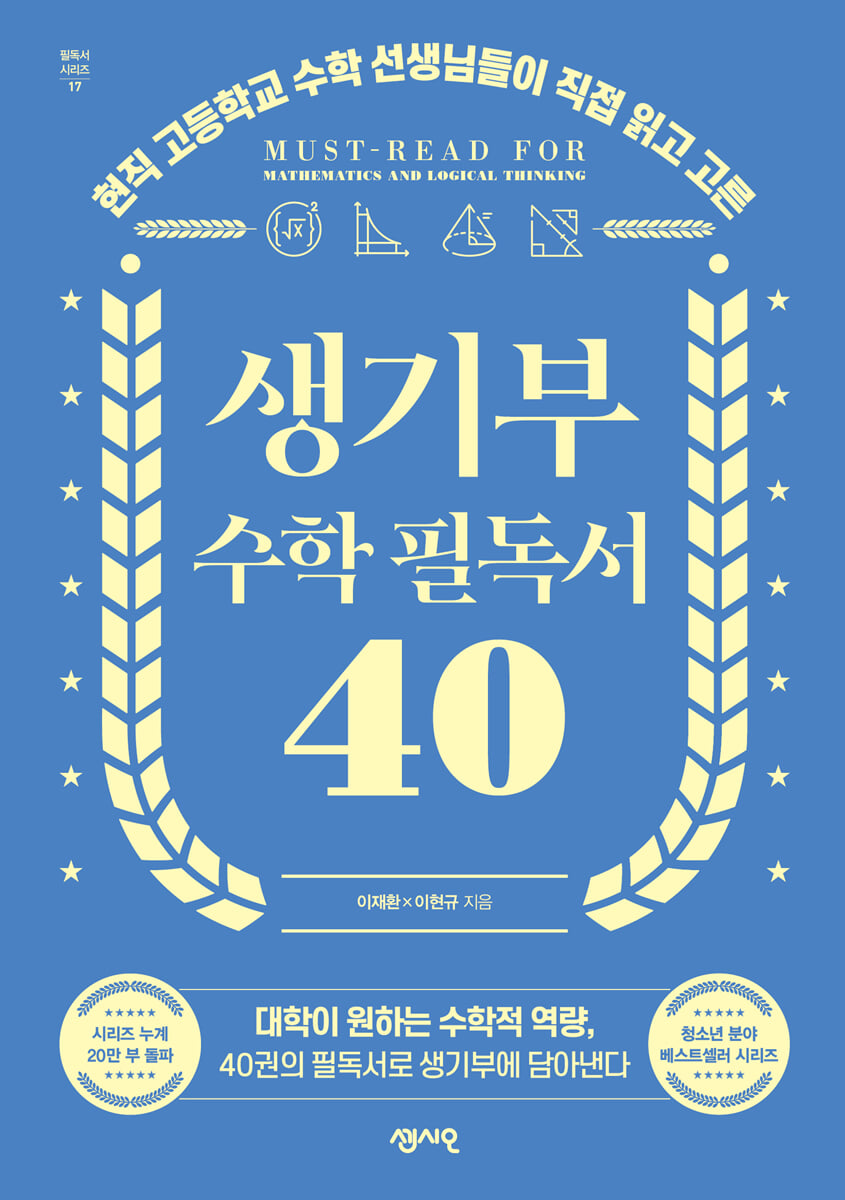
40 Must-Read Math Books for the Life Sciences Department
 |
Description
Book Introduction
Mathematics has become a key skill for the talents that universities want.
How can I capture it in my life?
With the new college entrance exam system and the high school credit system that will be fully implemented starting in 2025, 'special abilities and special skills' have emerged as the core of the comprehensive student record selection process.
Among them, the book 『40 Must-Read Books for Mathematics in the Secondary School』 was published, which introduces a method to perfectly fill the three special subjects of mathematics in the Secondary School through 'reading'.
The authors of this book, who have been teaching high school for 14 and 18 years, respectively, wrote the book based on their concerns about how to creatively promote activities related to the life sciences in mathematics, which is relatively inactive compared to other subjects.
Mathematics is a great subject for all students to demonstrate their academic abilities, regardless of their career aspirations.
However, most students are unable to find appropriate topics because they believe they should only explore topics directly related to their career path.
As a result, the mathematical inquiry process is omitted and only the result that 'mathematics was used in this part' is mentioned and passed over.
This book utilizes 40 mathematics-related books to offer students greater freedom in mathematical inquiry activities by introducing a rich array of methods, including the calculation and proof of formulas, the incorporation of humanistic approaches, storytelling, and experimental methods utilizing mathematical software and various media.
We have selected must-read math books in various convergence fields, including books covering math concepts and famous math topics found in textbooks, math used in statistics in the big data era, physics and math in the space engineering era, biology and math in the bio-revolution era, computer programming or coding and various logic mechanisms and math, cryptography and math used in cryptocurrencies, NFTs, and e-commerce, and game theory and math.
The most notable feature of this book is that it suggests over 120 specific and in-depth follow-up activities that can be incorporated into the life skills training program.
We provide detailed guidance on various activities that can be organically linked to each section of the student life section, from writing research reports, which are the immediate task at hand, to more advanced experiments and research activities, and even autonomous activities, career activities, and club activities.
At the end of each section, we have included examples of ‘life-saving books that you can read’ to increase usability.
Through this book, students will be able to break the mold of 'mathematical activities are simply calculations of numbers and formulas' and engage in more diverse and active activities.
Currently, research on big data, artificial intelligence (AI), deep learning, fintech, e-commerce, user interface (UI), and optimization algorithms, led by IT companies such as Apple, Amazon, Nvidia, and Tesla, is based on "mathematical thinking."
Reflecting this trend, questions requiring mathematical thinking are increasingly appearing in college entrance exams and interviews, even in humanities, social sciences, and Korean language subjects.
Therefore, required reading for math is not just for science majors.
Through this book, students will be able to concretely incorporate the process of independently expanding their mathematical knowledge and developing their mathematical and logical capabilities into their life history, bringing them one step closer to their goal of successful college entrance.
How can I capture it in my life?
With the new college entrance exam system and the high school credit system that will be fully implemented starting in 2025, 'special abilities and special skills' have emerged as the core of the comprehensive student record selection process.
Among them, the book 『40 Must-Read Books for Mathematics in the Secondary School』 was published, which introduces a method to perfectly fill the three special subjects of mathematics in the Secondary School through 'reading'.
The authors of this book, who have been teaching high school for 14 and 18 years, respectively, wrote the book based on their concerns about how to creatively promote activities related to the life sciences in mathematics, which is relatively inactive compared to other subjects.
Mathematics is a great subject for all students to demonstrate their academic abilities, regardless of their career aspirations.
However, most students are unable to find appropriate topics because they believe they should only explore topics directly related to their career path.
As a result, the mathematical inquiry process is omitted and only the result that 'mathematics was used in this part' is mentioned and passed over.
This book utilizes 40 mathematics-related books to offer students greater freedom in mathematical inquiry activities by introducing a rich array of methods, including the calculation and proof of formulas, the incorporation of humanistic approaches, storytelling, and experimental methods utilizing mathematical software and various media.
We have selected must-read math books in various convergence fields, including books covering math concepts and famous math topics found in textbooks, math used in statistics in the big data era, physics and math in the space engineering era, biology and math in the bio-revolution era, computer programming or coding and various logic mechanisms and math, cryptography and math used in cryptocurrencies, NFTs, and e-commerce, and game theory and math.
The most notable feature of this book is that it suggests over 120 specific and in-depth follow-up activities that can be incorporated into the life skills training program.
We provide detailed guidance on various activities that can be organically linked to each section of the student life section, from writing research reports, which are the immediate task at hand, to more advanced experiments and research activities, and even autonomous activities, career activities, and club activities.
At the end of each section, we have included examples of ‘life-saving books that you can read’ to increase usability.
Through this book, students will be able to break the mold of 'mathematical activities are simply calculations of numbers and formulas' and engage in more diverse and active activities.
Currently, research on big data, artificial intelligence (AI), deep learning, fintech, e-commerce, user interface (UI), and optimization algorithms, led by IT companies such as Apple, Amazon, Nvidia, and Tesla, is based on "mathematical thinking."
Reflecting this trend, questions requiring mathematical thinking are increasingly appearing in college entrance exams and interviews, even in humanities, social sciences, and Korean language subjects.
Therefore, required reading for math is not just for science majors.
Through this book, students will be able to concretely incorporate the process of independently expanding their mathematical knowledge and developing their mathematical and logical capabilities into their life history, bringing them one step closer to their goal of successful college entrance.
- You can preview some of the book's contents.
Preview
index
Opening 1 _ The most effective way to create an attractive and lively life is by far 'reading'.
Opening Remarks 2 - Why We Published '40 Essential Readings for Mathematics Students'
PART 1.
Let's differentiate our own vitality by using reading!
Why Students Ahead of College Entrance Exams Focus on Their Student Life
How do we create a smart, life-changing program that demonstrates our capabilities?
The High School Credit System Response Act, which will be fully implemented starting in 2025.
Obsession with career paths and rushed reading is a no-no.
Just reading "40 Essential Readings for Math Students" will change your results.
PART 2.
Life Sciences Mathematics Essential Reading ① Mathematics Concepts
Mathematical thinking builds a brain brimming with analytical, logical, and creative skills.
BOOK 1. 《Wise Mathematical Thinking》Operative Math Learning Using Engineering Tools
BOOK 2. "Mathematics Through the Eyes 1": The world of mathematics understood at a glance through pictures.
BOOK 3. The Beauty of Formulas: How did mathematical formulas become the stepping stones that guided civilization?
BOOK 4. "Mathematics is Experimentation": The best textbook for use in conjunction with club activities.
BOOK 5. "The Bold Math Book" Stimulates logical sensibility through stories and illustrations.
BOOK 6. 《The Stranger Math Book》Different Perspectives on Differentiation and Integration
BOOK 7. "Mathematics That Make You Like Math": Math stories told with a cheerful wit.
BOOK 8. "Beautiful Stories of High School Mathematics": A Treasure Map to Finding Concise Proofs and Amazing Formulas
BOOK 9. 《Encyclopedia of Mathematics》Basic liberal arts mathematics applicable to exams, real life, and common sense
★A Case Study of Life Skills through Reading: "Mathematics is an Experiment"
PART 3.
Life Sciences Mathematics Essential Reading ② History of Mathematics
Explore the great mathematical journey that advanced humanity.
BOOK 10. "Mathematics Through the Calendar": A glance at the birth and development of core mathematical concepts.
BOOK 11. "The Great Questions that Gave Birth to Mathematics" Twenty Big Questions that Run Through the Colorful History of Mathematics
BOOK 12. 《Millennium Problems in Mathematics 7》 Seven Mathematical Problems with a $1 Million Bounty
BOOK 13. The Number E, Euler's Beloved Number: The Story of the Great Number E, Developed by Napier and Euler
BOOK 14. Fermat's Last Theorem: The One Theorem That Captivated Mathematicians Worldwide for 350 Years
★A Case Study on Reading to Boost Your Life: "Euler's Beloved Number e"
PART 4.
Life Sciences Math Must-Reads ③ Math and Real Life
An exciting time to reinterpret everything in everyday life mathematically.
BOOK 15. How Mathematics Created Civilization: A historical textbook on the power of mathematics to create great civilizations.
BOOK 16. "Mathematics in Real Life": Exploring various mathematical topics found in everyday life.
BOOK 17. 《Chatter of Everything》Advanced Mathematics Lectures by Ten Leading Mathematics Authorities in Korea
BOOK 18. A Day Through Calculus: The Wonderful World of Calculus: Finding the Optimal Way in Everyday Life
BOOK 19. "Again, the Moment We Need Math": A Liberal Arts Mathematics Seminar with an Oxford Mathematics Professor
BOOK 20. "The Usefulness of Mathematics": Why Mathematics is More Needed in the Age of AI
★A Case Study of Life-Growing Through Reading: "How Mathematics Created Civilization"
PART 5.
Life Sciences Mathematics Essential Reading ④ Mathematics and Convergence
We're on a quest to discover new territories for mathematics in the era of the Fourth Industrial Revolution!
BOOK 21. "Statistics, Grasping Big Data": A Knowledge Concert of Convergence and Integration Through Statistics
BOOK 22. "Big Data and Statistics": A practical guide to applying probability and statistics to big data analysis.
BOOK 23. All the Formulas of the World: A Useful Dictionary of Mysterious Mathematics and Science
BOOK 24. "Calculus Made Easy: Mastering Calculus and Physics": Connecting Calculus and Physics, Let's Tackle Both Subjects Simultaneously
BOOK 25. The Mathematics of Life: The Convergence of Mathematics and Biology at the Cutting Edge of Academic Research
BOOK 26. The Power of Mathematics to Conquer a Complex World: Gaining Life Wisdom through Computational Mathematical Thinking
BOOK 27. 《Basic Analysis for Programmers》Functions and calculus used from the basics of programming to applications
BOOK 28. "Programmers, Think Mathematical": The Mathematical Thinking Skills Essential for Skilled Programmers
BOOK 29. "My First AI Math": A Practical Math Story That Develops AI Literacy
BOOK 30. "Deep Learning Mathematics for Beginners": Understanding Deep Learning Mathematics with Pictures and Confirming with Excel
BOOK 31. "Mathematical Optimization: A Guide to Optimization Solutions, Algorithms, and the Trends in Problem Solving"
BOOK 32. "If Life Had Answers Like Math": Mathematical Modeling to Understand and Solve Social Phenomena
BOOK 33. 《Seeing Mathematics in Korean History》The allure of mathematics for liberal arts students, and the liberal arts for science students.
BOOK 34. The Mathematician Who Went to the Art Museum: Amazing Mathematical Tricks Hidden in Beautiful Paintings
BOOK 35. 《Understanding Cryptography through Mathematics》Everything about cryptography, from Caesar to digital encryption.
BOOK 36. The 1/n Trap: The World of Game Theory: Reading Your Opponent and Making Strategic Choices
★A Case Study of Life Savings Through Reading: "Statistics, Grasping Big Data"
PART 6.
Life Science Math Must-Reads ⑤ The Interest of Math
A math book that makes math more accessible and fun.
BOOK 37. The Math Store That Sees the Future: The World's Most Fun Math Store Selling Ideas
BOOK 38. "Mathematics Unlocks All the World's Secrets": KAIST's "Future Math Class"
BOOK 39. "Healing with Mathematics": A Message of Healing Through Mathematics
BOOK 40. "Fun Math Puzzles for Gifted Students": Stimulating interest and expanding mathematical thinking skills through puzzle play.
★A Case Study of Reading to Boost Your Life: "The Math Store with a Vision for the Future"
Appendix 1.
Math-related sites recommended by math teachers
Appendix 2.
High School Credit System Regional Joint Curriculum and High School-University Linkage Program
Opening Remarks 2 - Why We Published '40 Essential Readings for Mathematics Students'
PART 1.
Let's differentiate our own vitality by using reading!
Why Students Ahead of College Entrance Exams Focus on Their Student Life
How do we create a smart, life-changing program that demonstrates our capabilities?
The High School Credit System Response Act, which will be fully implemented starting in 2025.
Obsession with career paths and rushed reading is a no-no.
Just reading "40 Essential Readings for Math Students" will change your results.
PART 2.
Life Sciences Mathematics Essential Reading ① Mathematics Concepts
Mathematical thinking builds a brain brimming with analytical, logical, and creative skills.
BOOK 1. 《Wise Mathematical Thinking》Operative Math Learning Using Engineering Tools
BOOK 2. "Mathematics Through the Eyes 1": The world of mathematics understood at a glance through pictures.
BOOK 3. The Beauty of Formulas: How did mathematical formulas become the stepping stones that guided civilization?
BOOK 4. "Mathematics is Experimentation": The best textbook for use in conjunction with club activities.
BOOK 5. "The Bold Math Book" Stimulates logical sensibility through stories and illustrations.
BOOK 6. 《The Stranger Math Book》Different Perspectives on Differentiation and Integration
BOOK 7. "Mathematics That Make You Like Math": Math stories told with a cheerful wit.
BOOK 8. "Beautiful Stories of High School Mathematics": A Treasure Map to Finding Concise Proofs and Amazing Formulas
BOOK 9. 《Encyclopedia of Mathematics》Basic liberal arts mathematics applicable to exams, real life, and common sense
★A Case Study of Life Skills through Reading: "Mathematics is an Experiment"
PART 3.
Life Sciences Mathematics Essential Reading ② History of Mathematics
Explore the great mathematical journey that advanced humanity.
BOOK 10. "Mathematics Through the Calendar": A glance at the birth and development of core mathematical concepts.
BOOK 11. "The Great Questions that Gave Birth to Mathematics" Twenty Big Questions that Run Through the Colorful History of Mathematics
BOOK 12. 《Millennium Problems in Mathematics 7》 Seven Mathematical Problems with a $1 Million Bounty
BOOK 13. The Number E, Euler's Beloved Number: The Story of the Great Number E, Developed by Napier and Euler
BOOK 14. Fermat's Last Theorem: The One Theorem That Captivated Mathematicians Worldwide for 350 Years
★A Case Study on Reading to Boost Your Life: "Euler's Beloved Number e"
PART 4.
Life Sciences Math Must-Reads ③ Math and Real Life
An exciting time to reinterpret everything in everyday life mathematically.
BOOK 15. How Mathematics Created Civilization: A historical textbook on the power of mathematics to create great civilizations.
BOOK 16. "Mathematics in Real Life": Exploring various mathematical topics found in everyday life.
BOOK 17. 《Chatter of Everything》Advanced Mathematics Lectures by Ten Leading Mathematics Authorities in Korea
BOOK 18. A Day Through Calculus: The Wonderful World of Calculus: Finding the Optimal Way in Everyday Life
BOOK 19. "Again, the Moment We Need Math": A Liberal Arts Mathematics Seminar with an Oxford Mathematics Professor
BOOK 20. "The Usefulness of Mathematics": Why Mathematics is More Needed in the Age of AI
★A Case Study of Life-Growing Through Reading: "How Mathematics Created Civilization"
PART 5.
Life Sciences Mathematics Essential Reading ④ Mathematics and Convergence
We're on a quest to discover new territories for mathematics in the era of the Fourth Industrial Revolution!
BOOK 21. "Statistics, Grasping Big Data": A Knowledge Concert of Convergence and Integration Through Statistics
BOOK 22. "Big Data and Statistics": A practical guide to applying probability and statistics to big data analysis.
BOOK 23. All the Formulas of the World: A Useful Dictionary of Mysterious Mathematics and Science
BOOK 24. "Calculus Made Easy: Mastering Calculus and Physics": Connecting Calculus and Physics, Let's Tackle Both Subjects Simultaneously
BOOK 25. The Mathematics of Life: The Convergence of Mathematics and Biology at the Cutting Edge of Academic Research
BOOK 26. The Power of Mathematics to Conquer a Complex World: Gaining Life Wisdom through Computational Mathematical Thinking
BOOK 27. 《Basic Analysis for Programmers》Functions and calculus used from the basics of programming to applications
BOOK 28. "Programmers, Think Mathematical": The Mathematical Thinking Skills Essential for Skilled Programmers
BOOK 29. "My First AI Math": A Practical Math Story That Develops AI Literacy
BOOK 30. "Deep Learning Mathematics for Beginners": Understanding Deep Learning Mathematics with Pictures and Confirming with Excel
BOOK 31. "Mathematical Optimization: A Guide to Optimization Solutions, Algorithms, and the Trends in Problem Solving"
BOOK 32. "If Life Had Answers Like Math": Mathematical Modeling to Understand and Solve Social Phenomena
BOOK 33. 《Seeing Mathematics in Korean History》The allure of mathematics for liberal arts students, and the liberal arts for science students.
BOOK 34. The Mathematician Who Went to the Art Museum: Amazing Mathematical Tricks Hidden in Beautiful Paintings
BOOK 35. 《Understanding Cryptography through Mathematics》Everything about cryptography, from Caesar to digital encryption.
BOOK 36. The 1/n Trap: The World of Game Theory: Reading Your Opponent and Making Strategic Choices
★A Case Study of Life Savings Through Reading: "Statistics, Grasping Big Data"
PART 6.
Life Science Math Must-Reads ⑤ The Interest of Math
A math book that makes math more accessible and fun.
BOOK 37. The Math Store That Sees the Future: The World's Most Fun Math Store Selling Ideas
BOOK 38. "Mathematics Unlocks All the World's Secrets": KAIST's "Future Math Class"
BOOK 39. "Healing with Mathematics": A Message of Healing Through Mathematics
BOOK 40. "Fun Math Puzzles for Gifted Students": Stimulating interest and expanding mathematical thinking skills through puzzle play.
★A Case Study of Reading to Boost Your Life: "The Math Store with a Vision for the Future"
Appendix 1.
Math-related sites recommended by math teachers
Appendix 2.
High School Credit System Regional Joint Curriculum and High School-University Linkage Program
Detailed image

Into the book
First, understand and acquire the mathematical knowledge and skills richly contained in the book itself.
Then, you can develop your problem-solving skills by assuming a specific problem situation and analyzing it logically based on the mathematical facts you have already acquired.
By utilizing the books on the convergence topics presented in Part 5, you can connect various pieces of knowledge, enabling integration with other subjects and practical application in real life.
By understanding the content of books expressed in text and pictures, collecting or exploring interesting parts, and presenting them on a topic, you can develop your reasoning and communication skills. In the process, you can develop a self-directed learning attitude and practical skills by collecting, organizing, and analyzing various materials and information.
Reading math books is a great way to accumulate and demonstrate the core competencies required in math classes.
--- p.34
The book fascinatingly explores the backstories of several mathematicians who, at times, faced frustration, despair, and hardship, and how, despite this, their efforts finally paid off.
This cannot help but be a powerful motivator for students who are tired and struggling during the entrance exam process.
If there is a story about a mathematician that moved you or made you empathize with the book, please write it in various ways.
It might be possible to melt it.
--- p.57
BOOK 5 "The Bold Math Book"
Above all, what cannot be overlooked is the fact that just as we can develop a humanistic sensibility through art, we can also develop a logical sensibility through mathematics.
The ability to infer new facts from given facts, to find connections between various concepts, and to penetrate the core of a problem and identify the conditions necessary to solve it are the virtues we truly seek to learn through mathematics.
--- pp.69-70
Exploring Airplane Seating Algorithms | Curriculum Links: Computer Science Linked Exploration
-You may have experienced waiting in a long line to board an airplane and waiting for the people ahead of you to put their luggage in the overhead bin and take their seats.
Would boarding times be shortened if boarding order were adjusted based on seat group? Let's study the following three airplane seating algorithms to maximize boarding times.
We also explore new algorithms of our own.
1.
Rear seating: Boarding from the rear group to the front group.
2.
Random seating: A method of boarding passengers randomly and without conditions.
3.
Stephan seating: Starting from the innermost back seat, with one seat left, and gradually moving outward.
--- p.72
BOOK 11: The Great Questions That Gave Birth to Mathematics
Mathematics may seem to progress very slowly, but it is steadily moving forward through rigorous proofs and generalizations.
Therefore, once a mathematical theory is born, it is not lost, but remains forever as a source for more comprehensive generalizations.
The source of this vitality of mathematics lies in ‘great questions.’
Through the process of solving twenty questions, the book provides a glimpse into how mathematics has developed in the past, where it is now, and where it will head in the future.
--- p.120
Follow-up cultural activities, such as math plays and math novels | Related Unit: Geometry (Spatial Figures)
-Read the geometric fantasy book "Flatland," a must-read for Harvard and Yale universities recommended in the book, and have fun understanding geometry by imagining the lives of residents living in a two-dimensional world.
We can continue with various follow-up activities, such as writing a play script or a short story, to see if we too are trapped in a three-dimensional life and what it would be like to view our lives from a four-dimensional perspective.
--- p.122
BOOK 16: Mathematics in Real Life
This book is also helpful for performance assessments that examine real-life applications of mathematics.
If you force yourself to research topics related to your career path, you may end up dealing with topics that are too difficult to understand and go beyond advanced mathematics. As a result, you will often see reports that only introduce mathematics without explaining its essence.
Even if it is not related to your career path, it is advisable to choose a topic that delves deeply into the essence of mathematics.
--- p.159
Exploring the Topic of Finding the Best Seats at the Movie Theater | Related Units: Mathematics (Sets and Propositions), Calculus (Differential Calculus)
- Problems such as finding the best location for viewing the statue of Admiral Yi Sun-sin in Gwanghwamun, finding the best seats in a movie theater, and finding the latitude at which Saturn's rings are most widely visible are all similar to the Regiomontanus maximum angle problem.
It was included in the 2010 Seoul National University special admission interview math problem, and the question presented three solution methods (using the extreme value of differentiation, the arithmetic-geometric mean of the denominator, and using the central angle).
Let's solve this completely and move on to the problem of finding the optimal shooting position that produces the maximum shooting angle in soccer.
--- p.159
BOOK 3 6 The 1/n Trap
A variety of interesting incidents and real-life examples are presented throughout the book.
It's full of exciting topics, including auctions, the prisoner's dilemma, the volunteer's dilemma, the blackmailer's paradox, and pirate games.
I especially recommend this course to students aspiring to major in economics or psychology, as it will help them understand the wider range of factors that should be considered in decision-making.
In real games, mathematical solutions alone often don't work.
Mathematical solutions can easily overlook important emotions like jealousy, humiliation, pride, and moral indignation, and the variables they generate.
Before making any decision, as I mentioned earlier, I need to consider what would happen if everyone thought like me, and conversely, what would happen if everyone didn't think like me.
-- p.278
Exploring Real-World Cases Similar to Game Theory | Curriculum Links: Exploring the Connections Between Mathematics and Politics
-The 2002 Moscow theater hostage crisis by Chechen terrorists and the Iran nuclear development sanctions talks are various examples of the 'blackmailer's paradox (a game where two people split $100, but if no agreement is reached, no one gets the money).
We explore how historical events such as the 1964 Catherine Genovese case and the 1962 Cuban Missile Crisis are similar to game theory and what strategies are advantageous in such cases.
Then, you can develop your problem-solving skills by assuming a specific problem situation and analyzing it logically based on the mathematical facts you have already acquired.
By utilizing the books on the convergence topics presented in Part 5, you can connect various pieces of knowledge, enabling integration with other subjects and practical application in real life.
By understanding the content of books expressed in text and pictures, collecting or exploring interesting parts, and presenting them on a topic, you can develop your reasoning and communication skills. In the process, you can develop a self-directed learning attitude and practical skills by collecting, organizing, and analyzing various materials and information.
Reading math books is a great way to accumulate and demonstrate the core competencies required in math classes.
--- p.34
The book fascinatingly explores the backstories of several mathematicians who, at times, faced frustration, despair, and hardship, and how, despite this, their efforts finally paid off.
This cannot help but be a powerful motivator for students who are tired and struggling during the entrance exam process.
If there is a story about a mathematician that moved you or made you empathize with the book, please write it in various ways.
It might be possible to melt it.
--- p.57
BOOK 5 "The Bold Math Book"
Above all, what cannot be overlooked is the fact that just as we can develop a humanistic sensibility through art, we can also develop a logical sensibility through mathematics.
The ability to infer new facts from given facts, to find connections between various concepts, and to penetrate the core of a problem and identify the conditions necessary to solve it are the virtues we truly seek to learn through mathematics.
--- pp.69-70
Exploring Airplane Seating Algorithms | Curriculum Links: Computer Science Linked Exploration
-You may have experienced waiting in a long line to board an airplane and waiting for the people ahead of you to put their luggage in the overhead bin and take their seats.
Would boarding times be shortened if boarding order were adjusted based on seat group? Let's study the following three airplane seating algorithms to maximize boarding times.
We also explore new algorithms of our own.
1.
Rear seating: Boarding from the rear group to the front group.
2.
Random seating: A method of boarding passengers randomly and without conditions.
3.
Stephan seating: Starting from the innermost back seat, with one seat left, and gradually moving outward.
--- p.72
BOOK 11: The Great Questions That Gave Birth to Mathematics
Mathematics may seem to progress very slowly, but it is steadily moving forward through rigorous proofs and generalizations.
Therefore, once a mathematical theory is born, it is not lost, but remains forever as a source for more comprehensive generalizations.
The source of this vitality of mathematics lies in ‘great questions.’
Through the process of solving twenty questions, the book provides a glimpse into how mathematics has developed in the past, where it is now, and where it will head in the future.
--- p.120
Follow-up cultural activities, such as math plays and math novels | Related Unit: Geometry (Spatial Figures)
-Read the geometric fantasy book "Flatland," a must-read for Harvard and Yale universities recommended in the book, and have fun understanding geometry by imagining the lives of residents living in a two-dimensional world.
We can continue with various follow-up activities, such as writing a play script or a short story, to see if we too are trapped in a three-dimensional life and what it would be like to view our lives from a four-dimensional perspective.
--- p.122
BOOK 16: Mathematics in Real Life
This book is also helpful for performance assessments that examine real-life applications of mathematics.
If you force yourself to research topics related to your career path, you may end up dealing with topics that are too difficult to understand and go beyond advanced mathematics. As a result, you will often see reports that only introduce mathematics without explaining its essence.
Even if it is not related to your career path, it is advisable to choose a topic that delves deeply into the essence of mathematics.
--- p.159
Exploring the Topic of Finding the Best Seats at the Movie Theater | Related Units: Mathematics (Sets and Propositions), Calculus (Differential Calculus)
- Problems such as finding the best location for viewing the statue of Admiral Yi Sun-sin in Gwanghwamun, finding the best seats in a movie theater, and finding the latitude at which Saturn's rings are most widely visible are all similar to the Regiomontanus maximum angle problem.
It was included in the 2010 Seoul National University special admission interview math problem, and the question presented three solution methods (using the extreme value of differentiation, the arithmetic-geometric mean of the denominator, and using the central angle).
Let's solve this completely and move on to the problem of finding the optimal shooting position that produces the maximum shooting angle in soccer.
--- p.159
BOOK 3 6 The 1/n Trap
A variety of interesting incidents and real-life examples are presented throughout the book.
It's full of exciting topics, including auctions, the prisoner's dilemma, the volunteer's dilemma, the blackmailer's paradox, and pirate games.
I especially recommend this course to students aspiring to major in economics or psychology, as it will help them understand the wider range of factors that should be considered in decision-making.
In real games, mathematical solutions alone often don't work.
Mathematical solutions can easily overlook important emotions like jealousy, humiliation, pride, and moral indignation, and the variables they generate.
Before making any decision, as I mentioned earlier, I need to consider what would happen if everyone thought like me, and conversely, what would happen if everyone didn't think like me.
-- p.278
Exploring Real-World Cases Similar to Game Theory | Curriculum Links: Exploring the Connections Between Mathematics and Politics
-The 2002 Moscow theater hostage crisis by Chechen terrorists and the Iran nuclear development sanctions talks are various examples of the 'blackmailer's paradox (a game where two people split $100, but if no agreement is reached, no one gets the money).
We explore how historical events such as the 1964 Catherine Genovese case and the 1962 Cuban Missile Crisis are similar to game theory and what strategies are advantageous in such cases.
--- p.281
Publisher's Review
40 must-read books for math majors, all in one volume.
What's the most important thing to prepare for in the life history section, especially the core section, the tax assessment section? The tax assessment section, recorded by the subject teacher, captures the student's academic achievement level, the effort they demonstrated during class, and their growth process.
There is nothing more useful than 'reading' to naturally demonstrate this process of growth and development.
If you can follow up a book with meaningful follow-up activities related to it, it's the perfect scenario for creating attractive tax benefits.
For example, if you're exploring a specific topic, you can create an engaging resume that showcases your abilities by showing what books sparked your interest or curiosity, what efforts you made to learn more about the subject, and even how the book influenced you.
《40 Must-Read Books for Mathematics in the Life Sciences Department》 is a book written by current high school math teachers to guide 40 must-read books and related post-reading activities to enrich and create more creative activities related to the life sciences department, which is relatively less active compared to other subjects.
Based on the experiences of the teachers who are the authors, who have read and used the books with their students, we have selected only books that are suitable for current high school students in terms of difficulty and structure, and above all, that can lead to various follow-up activities and explorations.
The books, carefully selected by the authors, are organized by topic, including the concepts of mathematics (9 volumes), the history of mathematics (5 volumes), mathematics and real life (6 volumes), and the interest of mathematics (4 volumes), as well as the field of mathematics and convergence studies (16 volumes), thereby significantly strengthening the scope and covering a wide spectrum of modern mathematics.
By utilizing these 40 required readings, we propose that students be able to engage in mathematical inquiry activities with greater freedom, by introducing a rich array of methods, including humanistic approaches, storytelling, and experimental methods utilizing mathematical software and various media, in addition to inquiry activities that involve calculating and proving formulas.
We have selected must-read math books in various convergence fields, including books covering math concepts and famous math topics found in textbooks, math used in statistics in the big data era, physics and math in the space engineering era, biology and math in the bio-revolution era, computer programming or coding and various logic mechanisms and math, cryptography and math used in cryptocurrencies, NFTs, and e-commerce, and game theory and math.
“Among the subjects of life management, math is the most difficult!”
A book that is like a savior that solves the worries of parents and students.
As with science subjects, math subjects, which are full of formulas and theorems, are particularly difficult to manage in terms of student life.
There are several reasons why.
First, when reading and exploring authoritative books in the field of mathematics, the content often goes beyond the high school curriculum level.
So it is difficult for students to understand on their own.
Second, if you focus too much on career paths (computer engineering, pharmacy, statistics, etc.), you may end up with mathematical explorations that seem very artificial and awkward to those involved in admissions.
Follow-up activities that are far removed from the curriculum and students' abilities are more likely to be counterproductive than helpful for college entrance.
Third, it is easy to become obsessed with the idea that mathematical activities must involve calculations or proofs.
So it's easy to get caught up in activities that are stiff and uninteresting.
Fourth, we don't really know how mathematics is actually used in our jobs or real-life situations today.
It is difficult to plan realistic career-related follow-up activities because we do not know how and to what extent mathematics is used in biology, physics, statistics, computer engineering, and even business administration.
So, although there is a lot of advice on managing your math skills on the Internet and elsewhere, most of it ends up being just general.
This book, “40 Must-Read Books for Mathematics in Life Science,” is for parents and students who are feeling thirsty like this.
The most notable feature of this book is that it suggests over 120 specific and in-depth follow-up activities that can be incorporated into the life skills training program.
We provide detailed guidance on various activities that can be organically linked to each section of the student life section, from writing research reports, which are the immediate task at hand, to more advanced experiments and research activities, and even autonomous activities, career activities, and club activities.
At the end of each section, we provide a practical example of how to incorporate various research activities into your special education.
Through this book, students who struggle with math will be able to read essential reading that will develop their logical, analytical, and mathematical thinking skills, and will be able to try a variety of post-reading activities.
In addition, you will be able to break the mold of 'math activities are just calculations of numbers and formulas' and complete your own differentiated life story through more diverse and active activities.
Demonstrates mathematical ability and logical thinking
Fusion reading creates a unique vitality!
Nowadays, there is a growing trend of questions requiring mathematical thinking being asked in humanities, social sciences, and Korean language subjects during college entrance exams and interviews.
Why, among the various basic academic disciplines, do universities today prioritize the mathematical proficiency of prospective students? Behind this, there are corporations that dominate the world today.
A whopping nine out of the top ten companies in the S&P 500 by market capitalization (Apple, Amazon, Nvidia, Tesla, etc.) are IT companies, and they conduct research based on mathematical thinking in areas such as big data, artificial intelligence (AI), deep learning, fintech, e-commerce, user interface (UI), and optimization algorithms.
Universities, which aim to produce the talented individuals society demands, also have no choice but to select students in line with this changing ideal of talent.
Therefore, the talent that companies and universities seek—integrated talent who can coolly analyze reality, derive optimal solutions, and solve problems efficiently and systematically—is based on "mathematical thinking."
This is why the importance of ‘mathematics’ in college entrance exams is increasing.
Through "40 Essential Readings for Mathematics in the Life Sciences Department," students can enrich their life sciences with the mathematical skills required for all departments and majors.
Through this book, students can develop their mathematical knowledge and develop their mathematical and logical skills through self-directed learning, and will be able to move one step closer to their goal of successful college entrance.
What's the most important thing to prepare for in the life history section, especially the core section, the tax assessment section? The tax assessment section, recorded by the subject teacher, captures the student's academic achievement level, the effort they demonstrated during class, and their growth process.
There is nothing more useful than 'reading' to naturally demonstrate this process of growth and development.
If you can follow up a book with meaningful follow-up activities related to it, it's the perfect scenario for creating attractive tax benefits.
For example, if you're exploring a specific topic, you can create an engaging resume that showcases your abilities by showing what books sparked your interest or curiosity, what efforts you made to learn more about the subject, and even how the book influenced you.
《40 Must-Read Books for Mathematics in the Life Sciences Department》 is a book written by current high school math teachers to guide 40 must-read books and related post-reading activities to enrich and create more creative activities related to the life sciences department, which is relatively less active compared to other subjects.
Based on the experiences of the teachers who are the authors, who have read and used the books with their students, we have selected only books that are suitable for current high school students in terms of difficulty and structure, and above all, that can lead to various follow-up activities and explorations.
The books, carefully selected by the authors, are organized by topic, including the concepts of mathematics (9 volumes), the history of mathematics (5 volumes), mathematics and real life (6 volumes), and the interest of mathematics (4 volumes), as well as the field of mathematics and convergence studies (16 volumes), thereby significantly strengthening the scope and covering a wide spectrum of modern mathematics.
By utilizing these 40 required readings, we propose that students be able to engage in mathematical inquiry activities with greater freedom, by introducing a rich array of methods, including humanistic approaches, storytelling, and experimental methods utilizing mathematical software and various media, in addition to inquiry activities that involve calculating and proving formulas.
We have selected must-read math books in various convergence fields, including books covering math concepts and famous math topics found in textbooks, math used in statistics in the big data era, physics and math in the space engineering era, biology and math in the bio-revolution era, computer programming or coding and various logic mechanisms and math, cryptography and math used in cryptocurrencies, NFTs, and e-commerce, and game theory and math.
“Among the subjects of life management, math is the most difficult!”
A book that is like a savior that solves the worries of parents and students.
As with science subjects, math subjects, which are full of formulas and theorems, are particularly difficult to manage in terms of student life.
There are several reasons why.
First, when reading and exploring authoritative books in the field of mathematics, the content often goes beyond the high school curriculum level.
So it is difficult for students to understand on their own.
Second, if you focus too much on career paths (computer engineering, pharmacy, statistics, etc.), you may end up with mathematical explorations that seem very artificial and awkward to those involved in admissions.
Follow-up activities that are far removed from the curriculum and students' abilities are more likely to be counterproductive than helpful for college entrance.
Third, it is easy to become obsessed with the idea that mathematical activities must involve calculations or proofs.
So it's easy to get caught up in activities that are stiff and uninteresting.
Fourth, we don't really know how mathematics is actually used in our jobs or real-life situations today.
It is difficult to plan realistic career-related follow-up activities because we do not know how and to what extent mathematics is used in biology, physics, statistics, computer engineering, and even business administration.
So, although there is a lot of advice on managing your math skills on the Internet and elsewhere, most of it ends up being just general.
This book, “40 Must-Read Books for Mathematics in Life Science,” is for parents and students who are feeling thirsty like this.
The most notable feature of this book is that it suggests over 120 specific and in-depth follow-up activities that can be incorporated into the life skills training program.
We provide detailed guidance on various activities that can be organically linked to each section of the student life section, from writing research reports, which are the immediate task at hand, to more advanced experiments and research activities, and even autonomous activities, career activities, and club activities.
At the end of each section, we provide a practical example of how to incorporate various research activities into your special education.
Through this book, students who struggle with math will be able to read essential reading that will develop their logical, analytical, and mathematical thinking skills, and will be able to try a variety of post-reading activities.
In addition, you will be able to break the mold of 'math activities are just calculations of numbers and formulas' and complete your own differentiated life story through more diverse and active activities.
Demonstrates mathematical ability and logical thinking
Fusion reading creates a unique vitality!
Nowadays, there is a growing trend of questions requiring mathematical thinking being asked in humanities, social sciences, and Korean language subjects during college entrance exams and interviews.
Why, among the various basic academic disciplines, do universities today prioritize the mathematical proficiency of prospective students? Behind this, there are corporations that dominate the world today.
A whopping nine out of the top ten companies in the S&P 500 by market capitalization (Apple, Amazon, Nvidia, Tesla, etc.) are IT companies, and they conduct research based on mathematical thinking in areas such as big data, artificial intelligence (AI), deep learning, fintech, e-commerce, user interface (UI), and optimization algorithms.
Universities, which aim to produce the talented individuals society demands, also have no choice but to select students in line with this changing ideal of talent.
Therefore, the talent that companies and universities seek—integrated talent who can coolly analyze reality, derive optimal solutions, and solve problems efficiently and systematically—is based on "mathematical thinking."
This is why the importance of ‘mathematics’ in college entrance exams is increasing.
Through "40 Essential Readings for Mathematics in the Life Sciences Department," students can enrich their life sciences with the mathematical skills required for all departments and majors.
Through this book, students can develop their mathematical knowledge and develop their mathematical and logical skills through self-directed learning, and will be able to move one step closer to their goal of successful college entrance.
GOODS SPECIFICS
- Date of issue: April 26, 2024
- Page count, weight, size: 336 pages | 418g | 140*200*20mm
- ISBN13: 9791166571480
- ISBN10: 1166571483
You may also like
카테고리
korean


korean

![GQ KOREA Mark (Monthly): December [2025]](http://librairie.coreenne.fr/cdn/shop/files/8ef265dbbfbf186523ed75ba7319009d.jpg?v=1765340328&width=3840)


