

Outsider Life Lessons from a Weed Scientist
 |
Description
Book Introduction
A botanist's declaration of support for all outsiders in the world!
In the 2019-21 Japanese national and private junior high school entrance exams
The most cited book in exam questions
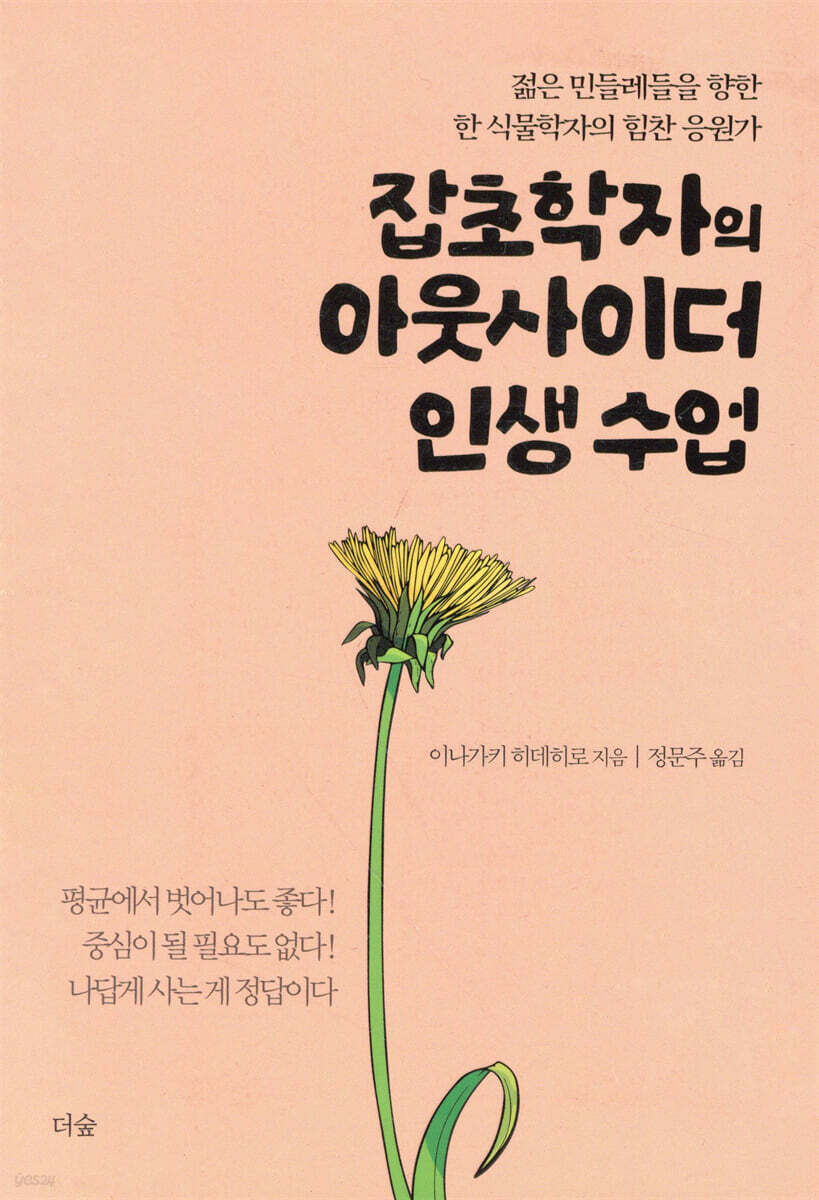
"The Outsider's Life Lessons from a Weed Scientist" is a heartwarming science essay that teaches us the importance of being ourselves through various stories about the secrets of life's individuality and the evolution of living organisms.
The author, a botanist, became interested in individuality after visiting a middle school.
The school was a place where children who could not go to school for various reasons gathered.
At first, he thought it was a group of students who were struggling with schoolwork or had trouble communicating with their peers.
However, while teaching, I realized that the children there were more capable of deep thinking than anyone else, had flexible thinking, and were curious and positive in their communication with the teacher.
This book was written based on this experience.
The author explores human nature by examining what individuality is and the role individuality and diversity have played in the evolution of living things through nine keywords.
And it makes us think again about what it means to live as an outsider who has not lost his individuality in a society that forces us to be an 'average creature'.
In the 2019-21 Japanese national and private junior high school entrance exams
The most cited book in exam questions
"The Outsider's Life Lessons from a Weed Scientist" is a heartwarming science essay that teaches us the importance of being ourselves through various stories about the secrets of life's individuality and the evolution of living organisms.
The author, a botanist, became interested in individuality after visiting a middle school.
The school was a place where children who could not go to school for various reasons gathered.
At first, he thought it was a group of students who were struggling with schoolwork or had trouble communicating with their peers.
However, while teaching, I realized that the children there were more capable of deep thinking than anyone else, had flexible thinking, and were curious and positive in their communication with the teacher.
This book was written based on this experience.
The author explores human nature by examining what individuality is and the role individuality and diversity have played in the evolution of living things through nine keywords.
And it makes us think again about what it means to live as an outsider who has not lost his individuality in a society that forces us to be an 'average creature'.
- You can preview some of the book's contents.
Preview
index
preface
1st Period: What is Individuality?
Is it hard to grow weeds? │ Are late-growing sprouts valuable? │ The natural world is rich in individuality. │ The reason why dandelion flowers have no individuality in their colors. │ Individuality is a survival strategy that arises out of ‘necessity.’ │ The tragedy of potatoes. │ The world without individuality. │ The coexistence of individuality and sociality. │ The reason why no two faces are the same in a world populated by billions of people. │ The number of individualities is infinite. │ The role of 98% of DNA. │ Even identical twins have different personalities the moment they are born.
What is 2nd period normal?
Humans hate 'much'│The limitations of the human brain│How humans understand 'much'│The standard by which humans understand the world│The value lost in a homogenized world│The 'average' is an idea created by humans for comparison│The heterogeneity of the natural world│The illusion called 'ordinary'│Outsiders create evolution│The meaning lies in being different│What can be measured and what cannot be measured
What is the distinction between the 3rd period and the 4th period?
There is no distinction in nature.│Where does the boundary between a mountain begin and end?│Is there no boundary between dolphins and whales?│The boundary between humans and monkeys.│Can living things be classified? No?│A dandelion, a butterfly, and me.│Our brains strive for comparison.│On distinction and discrimination.│How many colors are there in a rainbow?│Flowers are more beautiful when they are colorful.
4th Period: What is Diversity?
Genetic Diversity and Species Diversity│Why Flowers Bloom in Different Colors│Only One or Number One│Only Number One Survives?│Only One Survives│Every Creature Has Its Own Domain Where It Can Be Number One│The Concept of Niche│Earthworms? Puppies? Water Striders, Their Own Niches│Everyone Has Their Own Spot to Shine│Why Niches Provide Hints
What does 5th period '~answer' mean?
How to become number one│Create and set your own field│There are things you are good at, but… …│Let’s compete with ‘being ~’│No one knows the elephant│Me as seen by friends, me as seen by parents│You can find your own identity when you let go of ‘being ~’│A weed that is not caught up in the rules made by humans
What does it mean to win the 6th period?
"Each of us is a flower of great virtue." │ Humans love to judge victory and defeat. │ Competition isn't everything. │ Losing is okay. │ Even if you're clumsy, give it a try. │ Humans, the pinnacle of evolution, were the losers of losers. │ Even the way we lose has evolved. │ "Me," a miracle created by the pyramid of chance.
7th Period What Does It Mean to Be Strong?
Weakness is Strong│Are Weeds Weak?│Why Weeds Don't Grow in the Forest│What It Means to Be Strong│The Strong Don't Always Win│Why Homo Sapiens Survived and Neanderthals Extinct
8th Period What is precious?
Even if the weed is stepped on… │On the true spirit of weeds│Two ways to measure growth│Different choices for weeds in fierce competition│A weed that combines hardness and softness│Being stepped on is not painful for plantains│The growth that truly matters
9th Period What Does It Mean to Live?
Which is more evolved, trees or grass? │Plants evolve to have shorter life spans │To live forever 189 │There is no life that does not want to live │Let's look up at the sky.
There are no weeds that bow their heads.
Conclusion
1st Period: What is Individuality?
Is it hard to grow weeds? │ Are late-growing sprouts valuable? │ The natural world is rich in individuality. │ The reason why dandelion flowers have no individuality in their colors. │ Individuality is a survival strategy that arises out of ‘necessity.’ │ The tragedy of potatoes. │ The world without individuality. │ The coexistence of individuality and sociality. │ The reason why no two faces are the same in a world populated by billions of people. │ The number of individualities is infinite. │ The role of 98% of DNA. │ Even identical twins have different personalities the moment they are born.
What is 2nd period normal?
Humans hate 'much'│The limitations of the human brain│How humans understand 'much'│The standard by which humans understand the world│The value lost in a homogenized world│The 'average' is an idea created by humans for comparison│The heterogeneity of the natural world│The illusion called 'ordinary'│Outsiders create evolution│The meaning lies in being different│What can be measured and what cannot be measured
What is the distinction between the 3rd period and the 4th period?
There is no distinction in nature.│Where does the boundary between a mountain begin and end?│Is there no boundary between dolphins and whales?│The boundary between humans and monkeys.│Can living things be classified? No?│A dandelion, a butterfly, and me.│Our brains strive for comparison.│On distinction and discrimination.│How many colors are there in a rainbow?│Flowers are more beautiful when they are colorful.
4th Period: What is Diversity?
Genetic Diversity and Species Diversity│Why Flowers Bloom in Different Colors│Only One or Number One│Only Number One Survives?│Only One Survives│Every Creature Has Its Own Domain Where It Can Be Number One│The Concept of Niche│Earthworms? Puppies? Water Striders, Their Own Niches│Everyone Has Their Own Spot to Shine│Why Niches Provide Hints
What does 5th period '~answer' mean?
How to become number one│Create and set your own field│There are things you are good at, but… …│Let’s compete with ‘being ~’│No one knows the elephant│Me as seen by friends, me as seen by parents│You can find your own identity when you let go of ‘being ~’│A weed that is not caught up in the rules made by humans
What does it mean to win the 6th period?
"Each of us is a flower of great virtue." │ Humans love to judge victory and defeat. │ Competition isn't everything. │ Losing is okay. │ Even if you're clumsy, give it a try. │ Humans, the pinnacle of evolution, were the losers of losers. │ Even the way we lose has evolved. │ "Me," a miracle created by the pyramid of chance.
7th Period What Does It Mean to Be Strong?
Weakness is Strong│Are Weeds Weak?│Why Weeds Don't Grow in the Forest│What It Means to Be Strong│The Strong Don't Always Win│Why Homo Sapiens Survived and Neanderthals Extinct
8th Period What is precious?
Even if the weed is stepped on… │On the true spirit of weeds│Two ways to measure growth│Different choices for weeds in fierce competition│A weed that combines hardness and softness│Being stepped on is not painful for plantains│The growth that truly matters
9th Period What Does It Mean to Live?
Which is more evolved, trees or grass? │Plants evolve to have shorter life spans │To live forever 189 │There is no life that does not want to live │Let's look up at the sky.
There are no weeds that bow their heads.
Conclusion
Detailed image

Into the book
Under certain conditions, what appears to be an outsider to the human eye can exhibit extraordinary abilities.
Long ago, when nature faced a major environmental change it had never experienced before, the creatures that adapted to that environment were outsiders who showed a different appearance from the average.
And before long, the entity that was once called an outsider became the standard, and within the group created by the outsider, those who were once treated as outsiders adapted to the new environment.
In the process, an entity completely different from the average of the past era took hold.
This is how the evolution of living things took place.
Unfortunately, we cannot observe the process of evolution because it takes place over a long period of time.
--- From "Outsiders Create Evolution"
People of old wondered why the vegetables and crops they watered and grew with great care withered in the summer drought, while the weeds, which no one watered, remained green.
Crops that grow with water and weeds that no one waters have completely different ways of spreading their roots.
When times are tough, when we have to endure, weeds silently spread their roots.
Weeds do not easily wither and die because their roots exert their strength when drought comes.
--- From "What Really Matters: Growth"
Humans have difficulty comparing and understanding different numbers in their true state.
A group of living creatures with individual characteristics have their own unique and non-uniform appearances, and in that state, it is difficult for humans to understand them.
So, the average is what humans created to easily compare and understand groups.
--- From "'Average' is an idea created by humans for comparison"
If yellow flowers are best for most dandelions, it would be nice if all the other flowers in the world were yellow, but that's not the case.
Dandelions have their own optimal colors for dandelions, and violets have their own optimal colors for violets.
So why do so many different flowers bloom in nature in the first place? While a variety of flowers might be beautiful, it's also complex and cumbersome. So why shouldn't just one type bloom? Why do so many different types of life exist in nature in the first place?
--- From "Why Flowers Bloom in Variety"
It is quite difficult to change all living creatures, who value different things and want to exist in their own way, into the same form.
However, after much effort, humans have developed the technology to 'change living things into the same shape'.
It must have been very difficult.
However, in the process of striving for uniformity, it seems that we have lost the original value that each of us possessed.
--- From "Lost Values in a Uniform World"
The kiwi, which lives in New Zealand, is a flightless bird.
It may sound strange that birds can't fly, but it's actually widely believed that kiwi ancestors were able to fly.
But as time passed, individuals that could not fly were born.
Although they were birds, they were truly outsiders because they could not fly, but in New Zealand, there were no predators that could attack kiwis, so they had no reason to fly away.
Birds that dislike flying would have less opportunity to fly and therefore expend less energy.
They would have been able to survive by eating less food and lay more eggs with the energy they saved.
People today speculate that outsiders who hated flying may have produced many flightless offspring, thus evolving into flightless birds.
--- From "Outsiders Create Evolution"
Young people, you have to fight to find the only one area where you can become number one.
And it's okay to lose.
If you keep challenging yourself, you will come across many places where you cannot win.
You may experience countless defeats along the way.
But finding a position where you can't be number one ultimately leads to finding a position where you can be number one.
It's about finding the only one's realm where you can become number one.
In school, we learn many subjects.
There will be subjects you are good at and subjects you are bad at.
Even within a subject you are good at, there may be sections you are bad at, and even within a subject you are bad at, there may be sections you are good at, not sections you are bad at in general.
One of the reasons we learn all kinds of things in school is so we can try them countless times.
--- From "It's Okay to Lose"
Living things 'live in the present'.
And that's the continuation. There is no living thing that says, 'I don't know why I live' or 'I don't know what I should live for.'
Also, there is no living thing that says, ‘I’m tired of living’ or ‘I want to die.’
To live life to the fullest, cherishing the time given to us, and then to pass the baton of life on to the next generation before dying.
That is what it means for a living thing to 'live'.
That's all there is to it.
All living things live like that.
Living is simple.
You might be thinking, "Is that all there is to life?"
You may think, 'As you live, aren't there more joyful and fun things, aren't there more meaning to life?'
If that happens, it would be a very happy thing.
If you find that kind of meaning in life, even if it's small, that's a very great thing.
--- "Let's look up at the sky.
From "There is no weed that bows its head"
Long ago, when nature faced a major environmental change it had never experienced before, the creatures that adapted to that environment were outsiders who showed a different appearance from the average.
And before long, the entity that was once called an outsider became the standard, and within the group created by the outsider, those who were once treated as outsiders adapted to the new environment.
In the process, an entity completely different from the average of the past era took hold.
This is how the evolution of living things took place.
Unfortunately, we cannot observe the process of evolution because it takes place over a long period of time.
--- From "Outsiders Create Evolution"
People of old wondered why the vegetables and crops they watered and grew with great care withered in the summer drought, while the weeds, which no one watered, remained green.
Crops that grow with water and weeds that no one waters have completely different ways of spreading their roots.
When times are tough, when we have to endure, weeds silently spread their roots.
Weeds do not easily wither and die because their roots exert their strength when drought comes.
--- From "What Really Matters: Growth"
Humans have difficulty comparing and understanding different numbers in their true state.
A group of living creatures with individual characteristics have their own unique and non-uniform appearances, and in that state, it is difficult for humans to understand them.
So, the average is what humans created to easily compare and understand groups.
--- From "'Average' is an idea created by humans for comparison"
If yellow flowers are best for most dandelions, it would be nice if all the other flowers in the world were yellow, but that's not the case.
Dandelions have their own optimal colors for dandelions, and violets have their own optimal colors for violets.
So why do so many different flowers bloom in nature in the first place? While a variety of flowers might be beautiful, it's also complex and cumbersome. So why shouldn't just one type bloom? Why do so many different types of life exist in nature in the first place?
--- From "Why Flowers Bloom in Variety"
It is quite difficult to change all living creatures, who value different things and want to exist in their own way, into the same form.
However, after much effort, humans have developed the technology to 'change living things into the same shape'.
It must have been very difficult.
However, in the process of striving for uniformity, it seems that we have lost the original value that each of us possessed.
--- From "Lost Values in a Uniform World"
The kiwi, which lives in New Zealand, is a flightless bird.
It may sound strange that birds can't fly, but it's actually widely believed that kiwi ancestors were able to fly.
But as time passed, individuals that could not fly were born.
Although they were birds, they were truly outsiders because they could not fly, but in New Zealand, there were no predators that could attack kiwis, so they had no reason to fly away.
Birds that dislike flying would have less opportunity to fly and therefore expend less energy.
They would have been able to survive by eating less food and lay more eggs with the energy they saved.
People today speculate that outsiders who hated flying may have produced many flightless offspring, thus evolving into flightless birds.
--- From "Outsiders Create Evolution"
Young people, you have to fight to find the only one area where you can become number one.
And it's okay to lose.
If you keep challenging yourself, you will come across many places where you cannot win.
You may experience countless defeats along the way.
But finding a position where you can't be number one ultimately leads to finding a position where you can be number one.
It's about finding the only one's realm where you can become number one.
In school, we learn many subjects.
There will be subjects you are good at and subjects you are bad at.
Even within a subject you are good at, there may be sections you are bad at, and even within a subject you are bad at, there may be sections you are good at, not sections you are bad at in general.
One of the reasons we learn all kinds of things in school is so we can try them countless times.
--- From "It's Okay to Lose"
Living things 'live in the present'.
And that's the continuation. There is no living thing that says, 'I don't know why I live' or 'I don't know what I should live for.'
Also, there is no living thing that says, ‘I’m tired of living’ or ‘I want to die.’
To live life to the fullest, cherishing the time given to us, and then to pass the baton of life on to the next generation before dying.
That is what it means for a living thing to 'live'.
That's all there is to it.
All living things live like that.
Living is simple.
You might be thinking, "Is that all there is to life?"
You may think, 'As you live, aren't there more joyful and fun things, aren't there more meaning to life?'
If that happens, it would be a very happy thing.
If you find that kind of meaning in life, even if it's small, that's a very great thing.
--- "Let's look up at the sky.
From "There is no weed that bows its head"
--- "Let's look up at the sky.
From "There is no weed that bows its head"
From "There is no weed that bows its head"
Publisher's Review
“Even if fate doesn’t go the way I want, I want to live diligently without giving up until the end.”
“I read it because it was a book for my child’s homework.
“I couldn’t stop crying while reading.”
“It was a warning to human society from the perspective of natural society.”
“This book is for children, of course, but also for adults who know frustration.”
"A book for those who struggle with differences and the things they want to do."
“I highly recommend this to young people and anyone who is feeling tired right now.”
This is the praise that readers poured out for "The Weed Scientist's Outsider Life Lessons."
This book was the most cited question paper in the 2021 Japanese national and private junior high school entrance exams, and the author, Hidehiro Inagaki, was ranked among the authors whose questions appeared most frequently in the Japanese junior high school entrance exam Japanese language for three consecutive years from 2019 to 2021.
He is also a representative Japanese botanist who is loved by many readers in Korea.
"The Outsider's Life Lessons from a Weed Scientist" is a heartwarming science essay that teaches us the importance of being ourselves through various stories about the secrets of life's individuality and the evolution of living organisms.
The author, a botanist, became interested in individuality after visiting a middle school.
The school was a place where children who could not go to school for various reasons gathered.
At first, he thought it was a group of students who were struggling with schoolwork or had trouble communicating with their peers.
However, while teaching, I realized that the children there were more capable of deep thinking than anyone else, had flexible thinking, and were curious and positive in their communication with the teacher.
This book was written based on this experience.
The author explores human nature by examining what individuality is and the role individuality and diversity have played in the evolution of living things through nine keywords.
And it makes us think again about what it means to live as an outsider who has not lost his individuality in a society that forces us to be an 'average creature'.
It has always been the outsiders who have brought about new evolution!
A heartwarming science book that teaches the value of individuality and diversity.
The author presents nine keywords: usually, distinction, diversity, '~respond', winning, being strong, precious, and living.
In "What is Individuality in the First Period", the book defines individuality, which can be said to be the most important concept.
They say that individuality is a survival strategy and weapon that we have because we ‘need it.’
In other words, the reason why our personality or characteristics have individuality is because that individuality is necessary for humans, and no living thing, including humans, has an unnecessary individuality.
In "What is Average in Period 2", we talk about the "average," a standard created by humans to understand the world.
The human brain tries to understand this complex and diverse world by numerically quantifying and ranking things by creating and comparing averages to understand 'muchness'.
But in nature, there is no such thing as an average or normal.
There is only 'diversity', which means that there are many different things.
In "What does '~answer' mean in the 5th period", many people, especially young people, face the problem of 'I'm not good at anything and I don't know what I like.'
It presents a solution to the practical problem of 'How can I find a niche where I can become number one?'
In biology, a niche is a place where you can become number one.
By looking into the life of a weed that is not bound by human-made rules, it makes us think about what kind of clothes called '~daum' are that make us lose our own identity, and how to find our own niche.
In "8th Period: What is Important", we talk about the attitude of not losing what is important even if you are stepped on and stepped on again.
A trampled weed does not rise again.
Trampled weeds don't grow back.
Rather than expending energy on the act of getting back up again and again after being stepped on, it only carries out its important mission of blooming and leaving seeds by growing sideways, shortening its stem, or extending its roots underground.
A compelling and engaging explanation through the ecology of plants suggests wise solutions to our attitudes toward life, the problems we face, and various concerns.
Moreover, the author's perspective, which views all beings in the world as meaningful and precious, will provide warm comfort to those who are frustrated and struggling with the reality before their eyes.
It's okay to deviate from the average! You don't have to be the center!
Living my own way is the right answer.
In the preface, the author states that this book is written for young readers.
His writings contain many messages that sometimes make us nod our heads and sometimes make us look back.
The story of the earthworm with no hands or feet brings a sense of solemnity.
At first glance, earthworms seem like very simple creatures.
However, it is believed that the ancestors of earthworms were initially creatures with a head and foot-like organs for movement.
In order to survive as the number one living underground, eating dirt, earthworms have abandoned their feet.
The two experiments, known as the "Gauze Experiments," make us think about wise choices for survival and coexistence.
In the first experiment, paramecium worms and baby paramecium worms were raised in the same tank, and in the subsequent experiment, the same experiment was conducted with paramecium worms and green paramecium worms.
As a result, in the first experiment, only the baby paramecium survived, and in the second experiment, all of them coexisted in the same tank without disappearing.
In the first experiment, the habitat was not divided, but in the second experiment, which was successful, the habitat was divided, and each took the number one spot.
In nature, all living things share the same habitat, each claiming the number one spot.
Therefore, all living things in nature are number one.
The author states that there are at least 1.75 million number ones, as there are 1.75 million known species of living things in the natural world.
After all, there are many ways to become number one.
“I read it because it was a book for my child’s homework.
“I couldn’t stop crying while reading.”
“It was a warning to human society from the perspective of natural society.”
“This book is for children, of course, but also for adults who know frustration.”
"A book for those who struggle with differences and the things they want to do."
“I highly recommend this to young people and anyone who is feeling tired right now.”
This is the praise that readers poured out for "The Weed Scientist's Outsider Life Lessons."
This book was the most cited question paper in the 2021 Japanese national and private junior high school entrance exams, and the author, Hidehiro Inagaki, was ranked among the authors whose questions appeared most frequently in the Japanese junior high school entrance exam Japanese language for three consecutive years from 2019 to 2021.
He is also a representative Japanese botanist who is loved by many readers in Korea.
"The Outsider's Life Lessons from a Weed Scientist" is a heartwarming science essay that teaches us the importance of being ourselves through various stories about the secrets of life's individuality and the evolution of living organisms.
The author, a botanist, became interested in individuality after visiting a middle school.
The school was a place where children who could not go to school for various reasons gathered.
At first, he thought it was a group of students who were struggling with schoolwork or had trouble communicating with their peers.
However, while teaching, I realized that the children there were more capable of deep thinking than anyone else, had flexible thinking, and were curious and positive in their communication with the teacher.
This book was written based on this experience.
The author explores human nature by examining what individuality is and the role individuality and diversity have played in the evolution of living things through nine keywords.
And it makes us think again about what it means to live as an outsider who has not lost his individuality in a society that forces us to be an 'average creature'.
It has always been the outsiders who have brought about new evolution!
A heartwarming science book that teaches the value of individuality and diversity.
The author presents nine keywords: usually, distinction, diversity, '~respond', winning, being strong, precious, and living.
In "What is Individuality in the First Period", the book defines individuality, which can be said to be the most important concept.
They say that individuality is a survival strategy and weapon that we have because we ‘need it.’
In other words, the reason why our personality or characteristics have individuality is because that individuality is necessary for humans, and no living thing, including humans, has an unnecessary individuality.
In "What is Average in Period 2", we talk about the "average," a standard created by humans to understand the world.
The human brain tries to understand this complex and diverse world by numerically quantifying and ranking things by creating and comparing averages to understand 'muchness'.
But in nature, there is no such thing as an average or normal.
There is only 'diversity', which means that there are many different things.
In "What does '~answer' mean in the 5th period", many people, especially young people, face the problem of 'I'm not good at anything and I don't know what I like.'
It presents a solution to the practical problem of 'How can I find a niche where I can become number one?'
In biology, a niche is a place where you can become number one.
By looking into the life of a weed that is not bound by human-made rules, it makes us think about what kind of clothes called '~daum' are that make us lose our own identity, and how to find our own niche.
In "8th Period: What is Important", we talk about the attitude of not losing what is important even if you are stepped on and stepped on again.
A trampled weed does not rise again.
Trampled weeds don't grow back.
Rather than expending energy on the act of getting back up again and again after being stepped on, it only carries out its important mission of blooming and leaving seeds by growing sideways, shortening its stem, or extending its roots underground.
A compelling and engaging explanation through the ecology of plants suggests wise solutions to our attitudes toward life, the problems we face, and various concerns.
Moreover, the author's perspective, which views all beings in the world as meaningful and precious, will provide warm comfort to those who are frustrated and struggling with the reality before their eyes.
It's okay to deviate from the average! You don't have to be the center!
Living my own way is the right answer.
In the preface, the author states that this book is written for young readers.
His writings contain many messages that sometimes make us nod our heads and sometimes make us look back.
The story of the earthworm with no hands or feet brings a sense of solemnity.
At first glance, earthworms seem like very simple creatures.
However, it is believed that the ancestors of earthworms were initially creatures with a head and foot-like organs for movement.
In order to survive as the number one living underground, eating dirt, earthworms have abandoned their feet.
The two experiments, known as the "Gauze Experiments," make us think about wise choices for survival and coexistence.
In the first experiment, paramecium worms and baby paramecium worms were raised in the same tank, and in the subsequent experiment, the same experiment was conducted with paramecium worms and green paramecium worms.
As a result, in the first experiment, only the baby paramecium survived, and in the second experiment, all of them coexisted in the same tank without disappearing.
In the first experiment, the habitat was not divided, but in the second experiment, which was successful, the habitat was divided, and each took the number one spot.
In nature, all living things share the same habitat, each claiming the number one spot.
Therefore, all living things in nature are number one.
The author states that there are at least 1.75 million number ones, as there are 1.75 million known species of living things in the natural world.
After all, there are many ways to become number one.
GOODS SPECIFICS
- Date of issue: May 3, 2024
- Page count, weight, size: 200 pages | 288g | 130*190*17mm
- ISBN13: 9791192444925
- ISBN10: 1192444922
You may also like
카테고리
korean


korean

![GQ KOREA Mark (Monthly): December [2025]](http://librairie.coreenne.fr/cdn/shop/files/8ef265dbbfbf186523ed75ba7319009d.jpg?v=1765340328&width=3840)


