

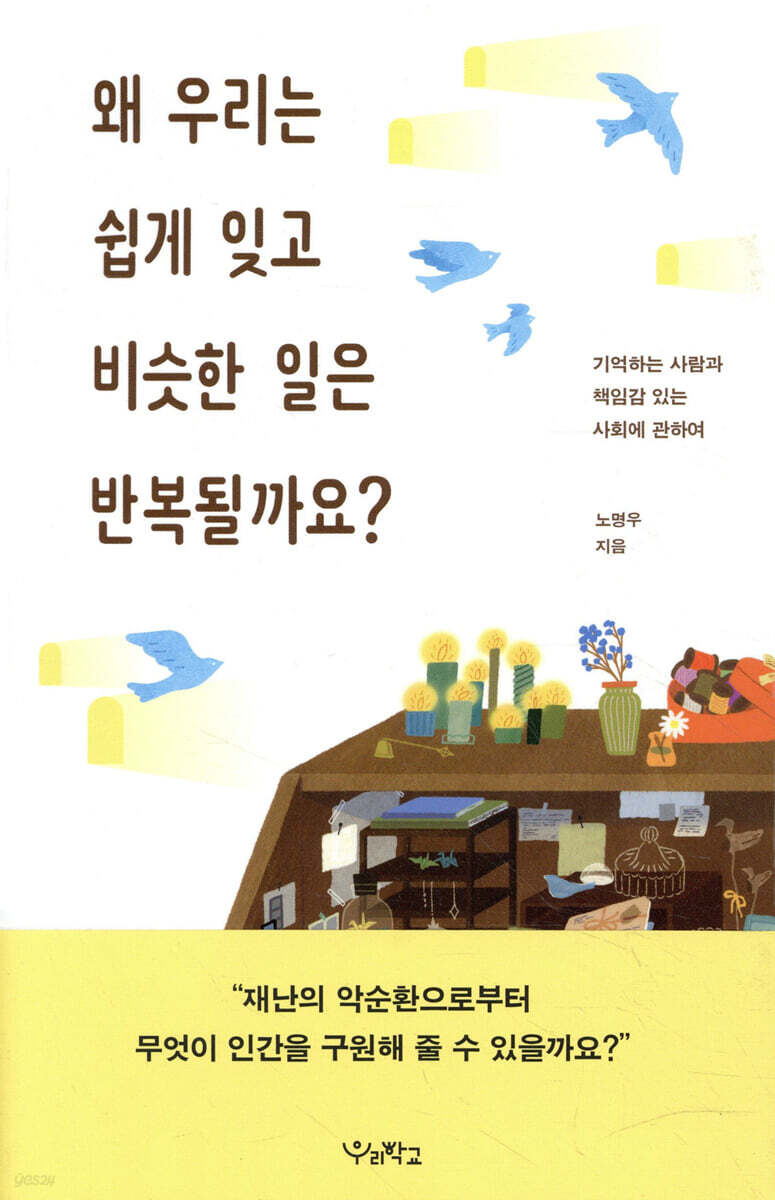
Why do we forget so easily and similar things happen again?
 |
Description
Book Introduction
In an era of everyday disaster, we question the well-being of our society.
An innocent, heartbreaking, and timeless story to tell to future generations
On disasters and social memory in our world
In an age of everyday disaster, a book has been published that deeply and willingly explores the meaning of "social memory" for a safe life and world.
This book asks again about the 'well-being' of our society, with the heart of tying yellow ribbons to the countless people who were here but never returned, the innocent names taken away by disaster.
How far removed are we from the state violence, genocide, industrial accidents, natural disasters, and the complex human-caused consequences that have plagued us since the 20th century? We have the right, and should, to remain distant from the countless disasters that have shocked us and been called "catastrophes."
But our real world is not safe at all, and where we ignore disasters, an even more disastrous 'repetition of disasters' takes place.
Sociologist Noh Myung-woo, who has published works such as 『Sociology of Worldly Affairs』 and 『Theater of Life』, has excellently drawn out the universal context of the world we live in from the most ordinary and concrete lives. He faces this disaster with a desperate attitude, dedicating time and heart to stopping this evil and endless disaster.
Throughout the book, he closely examines dozens of social disasters that have occurred in our society and around the world from a sociological perspective, patiently interpreting the structure of disasters that stands out in each stage: 'provisional - precursor - occurrence of the event.'
It also clearly shows how the post-disaster mechanism of 'the struggle between memory and counterattack' is dragging this world into darkness.
This book is like walking through a long tunnel with a candle, stopping at every place where the darkness deepens and quietly illuminating the surroundings until the world we have turned away from reveals itself.
The power of objective reasoning that never loses its warmth embraces even the questions we can't bring ourselves to ask, such as, "They might be sad, but aren't we actually a little tired?" and "Aren't similar things just going to happen again and again?"
This book is about the previous generation promising to walk together toward the suffering of others through solidarity of memory, and the next generation, the future generation, facing the moment when the 'why?' of that day becomes their own 'why?'
An innocent, heartbreaking, and timeless story to tell to future generations
On disasters and social memory in our world
In an age of everyday disaster, a book has been published that deeply and willingly explores the meaning of "social memory" for a safe life and world.
This book asks again about the 'well-being' of our society, with the heart of tying yellow ribbons to the countless people who were here but never returned, the innocent names taken away by disaster.
How far removed are we from the state violence, genocide, industrial accidents, natural disasters, and the complex human-caused consequences that have plagued us since the 20th century? We have the right, and should, to remain distant from the countless disasters that have shocked us and been called "catastrophes."
But our real world is not safe at all, and where we ignore disasters, an even more disastrous 'repetition of disasters' takes place.
Sociologist Noh Myung-woo, who has published works such as 『Sociology of Worldly Affairs』 and 『Theater of Life』, has excellently drawn out the universal context of the world we live in from the most ordinary and concrete lives. He faces this disaster with a desperate attitude, dedicating time and heart to stopping this evil and endless disaster.
Throughout the book, he closely examines dozens of social disasters that have occurred in our society and around the world from a sociological perspective, patiently interpreting the structure of disasters that stands out in each stage: 'provisional - precursor - occurrence of the event.'
It also clearly shows how the post-disaster mechanism of 'the struggle between memory and counterattack' is dragging this world into darkness.
This book is like walking through a long tunnel with a candle, stopping at every place where the darkness deepens and quietly illuminating the surroundings until the world we have turned away from reveals itself.
The power of objective reasoning that never loses its warmth embraces even the questions we can't bring ourselves to ask, such as, "They might be sad, but aren't we actually a little tired?" and "Aren't similar things just going to happen again and again?"
This book is about the previous generation promising to walk together toward the suffering of others through solidarity of memory, and the next generation, the future generation, facing the moment when the 'why?' of that day becomes their own 'why?'
- You can preview some of the book's contents.
Preview
index
1.
There's a seventeen-year-old from 2014 who didn't return on Friday.
2.
There are also disasters that are not marked on the calendar.
3.
Looking at disasters through the eyes of victims
4.
Where will we go after the disaster, at the crossroads of counterattack and remembrance?
5.
Memory is a promise we all take responsibility for.
6.
We are all involved in disaster
7.
A song to sing together so that you don't walk alone
There's a seventeen-year-old from 2014 who didn't return on Friday.
2.
There are also disasters that are not marked on the calendar.
3.
Looking at disasters through the eyes of victims
4.
Where will we go after the disaster, at the crossroads of counterattack and remembrance?
5.
Memory is a promise we all take responsibility for.
6.
We are all involved in disaster
7.
A song to sing together so that you don't walk alone
Into the book
Disasters are different.
Disasters leave scars that cannot be forgotten, no matter how hard you try.
Even if you thought you had forgotten, whenever you hear the word "school trip," Koreans after April 16, 2014, think of the Sewol Ferry Disaster.
I still repeat the same grumble I had in April of that year, when I saw the world's common sense melt away along with the Sewol Ferry disaster: "Is this a country?"
Eliot's poem "The Waste Land," which we used to say without meaning, "April is the cruelest month," is a line that we cannot easily utter after the Sewol ferry disaster because our hearts are heavy.
--- From "Chapter 1 - After the Disaster, We Can't Go Back to How It Was Before"
Some disasters sometimes seem to be caused by human violence and cruelty, while others are caused by human ignorance and negligence.
Some disasters are caused by natural disasters beyond human control, while others seem like completely unpredictable accidents.
But all disasters have something in common.
The fact that the victim became a victim even though he did nothing wrong.
--- From "Chapter 2 - To stop recurring disasters, we must examine the mechanisms of disasters"
Walter Benjamin, a German philosopher and literary critic who was one of the victims of the Nazis, once said that human history is not a history of progress added to progress, but a history of catastrophe added to tragedy.
The 'angel of history' imagined by Benjamin looks down with astonishment not at the splendid achievements of technological civilization, but at the endless parade of disasters.
--- From "Chapter 3 - What does our world look like as seen from the perspective of the 'Angel of History'"
If we think only of that moment of catastrophe that rises above the water, the disaster seems like a tragedy that happens in a split second.
Considering that it took only 20 seconds for the Sampoong Department Store to completely collapse, it's not unreasonable to think so.
However, if you look deep into the sea, you will see a huge, continuous landform that was not visible before, even though it is a small island that is rising above the water.
That's why we miss so much when we interpret disasters by only looking at the context of their occurrence.
Some disasters are not the result of a temporary or precursory phase lasting a few months or even a few years, but rather of a very long temporary or precursory phase lasting decades or even centuries.
--- From "Chapter 3 - Inequality Turns Natural Disasters into Disasters"
There are those who hope that after the media spotlight has passed, public attention on the disaster will once again subside.
If they are the clear perpetrators of a disaster or a group that should be held responsible for it, but their social influence is strong, they do their best to keep the disaster site unknown to the outside world, as their position would be at risk if the tragedy were to become known to the outside world and provoke public outrage.
So that the moment of oblivion comes quickly.
--- From Chapter 4 - Why do we easily forget and repeat similar things?
The punishment of the court should be neither more nor less than the gravity of the crime they committed.
But as we have seen, disaster is a catastrophe created by injustice in a social context that cannot be judged in court.
Injustice that brings disaster cannot be judged in court.
As long as injustice is not judged, disasters are bound to repeat themselves.
--- From "Chapter 5 - Crime and Punishment and Punishment and Crime: Social Mnemonics Go Beyond the Scope of Criminal Punishment"
The Three Mile Island accident, coupled with the realization that there is no single truth about nuclear power that all experts agree on, that expert committees like the NRC cannot be trusted unconditionally, and that many risks are sealed by expert groups, sparked an anti-nuclear movement in the United States.
The fact that a group of experts monopolize information that could potentially make everyone a victim of disaster, and then hide that information to suit their needs, confirms the absence of public interest.
The Three Mile Island incident revealed to the world that the absence of publicness is a social vulnerability that turns accidents into disasters, just as much as inequality.
--- From “Chapter 6 - Nuclear power generation started with the power of science to reduce dependence on fossil fuels”
Is criminal punishment the only means of restoring disaster victims to their original state? While crime and punishment are matters of law, they are the domain of the courts. Crime and punishment is a framework for society to hold perpetrators and the social structures that created them accountable after a disaster.
Crime only addresses the immediate state of a disaster, but sin is a word that expresses a wrongdoing that is fundamentally investigated and discovered by going back to the temporary state of a disaster, using the power of deep memory as a driving force.
Even if the punishment is over, the responsibility for the crime does not disappear.
Disasters leave scars that cannot be forgotten, no matter how hard you try.
Even if you thought you had forgotten, whenever you hear the word "school trip," Koreans after April 16, 2014, think of the Sewol Ferry Disaster.
I still repeat the same grumble I had in April of that year, when I saw the world's common sense melt away along with the Sewol Ferry disaster: "Is this a country?"
Eliot's poem "The Waste Land," which we used to say without meaning, "April is the cruelest month," is a line that we cannot easily utter after the Sewol ferry disaster because our hearts are heavy.
--- From "Chapter 1 - After the Disaster, We Can't Go Back to How It Was Before"
Some disasters sometimes seem to be caused by human violence and cruelty, while others are caused by human ignorance and negligence.
Some disasters are caused by natural disasters beyond human control, while others seem like completely unpredictable accidents.
But all disasters have something in common.
The fact that the victim became a victim even though he did nothing wrong.
--- From "Chapter 2 - To stop recurring disasters, we must examine the mechanisms of disasters"
Walter Benjamin, a German philosopher and literary critic who was one of the victims of the Nazis, once said that human history is not a history of progress added to progress, but a history of catastrophe added to tragedy.
The 'angel of history' imagined by Benjamin looks down with astonishment not at the splendid achievements of technological civilization, but at the endless parade of disasters.
--- From "Chapter 3 - What does our world look like as seen from the perspective of the 'Angel of History'"
If we think only of that moment of catastrophe that rises above the water, the disaster seems like a tragedy that happens in a split second.
Considering that it took only 20 seconds for the Sampoong Department Store to completely collapse, it's not unreasonable to think so.
However, if you look deep into the sea, you will see a huge, continuous landform that was not visible before, even though it is a small island that is rising above the water.
That's why we miss so much when we interpret disasters by only looking at the context of their occurrence.
Some disasters are not the result of a temporary or precursory phase lasting a few months or even a few years, but rather of a very long temporary or precursory phase lasting decades or even centuries.
--- From "Chapter 3 - Inequality Turns Natural Disasters into Disasters"
There are those who hope that after the media spotlight has passed, public attention on the disaster will once again subside.
If they are the clear perpetrators of a disaster or a group that should be held responsible for it, but their social influence is strong, they do their best to keep the disaster site unknown to the outside world, as their position would be at risk if the tragedy were to become known to the outside world and provoke public outrage.
So that the moment of oblivion comes quickly.
--- From Chapter 4 - Why do we easily forget and repeat similar things?
The punishment of the court should be neither more nor less than the gravity of the crime they committed.
But as we have seen, disaster is a catastrophe created by injustice in a social context that cannot be judged in court.
Injustice that brings disaster cannot be judged in court.
As long as injustice is not judged, disasters are bound to repeat themselves.
--- From "Chapter 5 - Crime and Punishment and Punishment and Crime: Social Mnemonics Go Beyond the Scope of Criminal Punishment"
The Three Mile Island accident, coupled with the realization that there is no single truth about nuclear power that all experts agree on, that expert committees like the NRC cannot be trusted unconditionally, and that many risks are sealed by expert groups, sparked an anti-nuclear movement in the United States.
The fact that a group of experts monopolize information that could potentially make everyone a victim of disaster, and then hide that information to suit their needs, confirms the absence of public interest.
The Three Mile Island incident revealed to the world that the absence of publicness is a social vulnerability that turns accidents into disasters, just as much as inequality.
--- From “Chapter 6 - Nuclear power generation started with the power of science to reduce dependence on fossil fuels”
Is criminal punishment the only means of restoring disaster victims to their original state? While crime and punishment are matters of law, they are the domain of the courts. Crime and punishment is a framework for society to hold perpetrators and the social structures that created them accountable after a disaster.
Crime only addresses the immediate state of a disaster, but sin is a word that expresses a wrongdoing that is fundamentally investigated and discovered by going back to the temporary state of a disaster, using the power of deep memory as a driving force.
Even if the punishment is over, the responsibility for the crime does not disappear.
--- From "Chapter 7 - Ultimate forgiveness is only possible if there is a sincere request from society"
Publisher's Review
Disaster and Memory from a Sociological Perspective
Countless people who were here but never returned
With the heart of tying a yellow ribbon in front of the names taken away by the disaster
When we witness a disaster, we are immediately forced to ask ourselves questions that must be answered first.
“Why did the disaster occur?”, “Why did a similar disaster occur again?” are painful and easy to forget questions.
This book is the answer to that question.
Many disasters that have had a great impact on our world and are called 'catastrophes' are incidents in which 'a large number of people died at the same time on a single day or during a specific period of time.'
In the face of this disaster, which is so terrible in its very nature, we turn our heads in fear and dread.
However, in places that have been ignored, the pain and damage left by the disaster, as well as the causes of the disaster and the structure that causes the disaster to repeat itself, still remain.
In particular, the disasters that have occurred from the 20th century to the present, such as state violence, genocide, industrial accidents, natural disasters, and complex man-made disasters, sound like a distant story to contemporary teenagers.
Because it is far from today's teenage years, both temporally and spatially.
We have the right to be far from disaster.
A safe life, a healthy daily life, a trouble-free life… … .
But no one can confidently say that our world is safe.
Because we have witnessed time and again how our trust has been betrayed in the most inappropriate way when it should have been done.
How far have we truly come since the last disaster? Has it truly come?
In 『Why Do We Forget So Easily and Repeat Similar Things?』 (hereafter referred to as 『Why Do We』), the disasters that have occurred in our society are divided into provisional, premonitory, and outbreak phases, and we discuss what we could have done and what we must do in each phase.
The sociologist's perspective does not remain limited to Korea, but examines disasters around the world to reveal the structure and mechanisms of disasters.
It clearly shows a world that was similarly unethical, inhumane, irrational and unequal.
This allows us to reflect on what we were able to do in each disaster and explore what we need to do going forward.
The author maintains a calm tone and objective perspective throughout, a process that brings to mind someone walking through a long tunnel holding a candle.
A faithful and steadfast night watchman who stops wherever darkness deepens and quietly illuminates the surroundings until its source is revealed.
In the face of repeated disasters, for today's teenagers and a society whose memory is fading, isn't the story we can offer something beyond comforting: a sense of responsibility? Sociologist Noh Myung-woo, who studies alongside citizens, takes the time and heart to uncover the disasters he has uncovered with a poignant attitude.
Innocent, heartbreaking, and enduring stories from past centuries to the present encourage us to be more open to our neighbors, more attentive to the lives of our fellow citizens, and more attentive to the suffering of those we barely know.
From unexpected pandemics, unimaginable wars, ongoing conflicts, the deepening climate crisis, and similarly recurring major disasters, we convey our long-standing well-being to everyone in our society, including teenagers who live with the feeling that a series of disasters is part of their daily lives.
“Not forgetting”
Without turning away from the suffering of others
Reclaiming social responsibility through solidarity of memory
The purpose of expelling 'certain people*' is to protect our homeland, for the future.
They will never give up their inflammatory thoughts if they live anywhere.
So we need to reduce their number as much as possible.
Only orphans who do not remember the torture their parents suffered should be accepted and protected.
Send the other orphans with the deportation procession.
_Paulo Cossi, translated by Lee Hyeon-gyeong, 『Mez Yegern』, Mimesis, 2011, p. 95.
*Refers to Armenians living in Turkey in 1915.
The person who wrote this letter, which asked to accept only orphans who do not remember, was Mehmet Talat Pasha, the de facto leader of the Ottoman Empire who carried out the massacre at the time.
10.29 5.18 4.3 1995 2014 2016 2018 1914~1918 1939~1945 1915~1916 1937 1978 1975~1979 1989 1994 1995.7.… …
Itaewon, Gwangju, Jeju, Sampoong Department Store, Sewol Ferry, Guui Station, Taean Thermal Power Plant.
World War I, World War II, Mez Jägern, Nanking, Love Canal, Cambodia, Hillsborough, Rwanda, Bosnia… …
We think of a certain day just by looking at a date, a year, or a noun, and we pause for a moment to catch our breath.
Because I feel like I can't breathe.
I feel suffocated in front of the huge memory.
State violence, genocide, industrial accidents, complex human disasters… … It would be no exaggeration to say that our history since the 20th century has been a history of disasters and human disasters, wars and conflicts, incidents and accidents.
The endless series of disasters left scars that, in many cases, have not yet healed.
It is painful to recall the disaster.
When I think about it, the death is so strange, so unnatural that it feels unreal that a person could die like that.
We almost forget about all this death in our daily lives.
But when the season approaches spring, when I see the yellow carpet in the children's play area, when the video on the subway screen shows what to do in case of a fire, when someone's anniversary comes around, it suddenly comes to mind.
All that death.
The order to protect only children who “do not remember the suffering their parents endured” reveals that what perpetrators fear is precisely memory.
In particular, the memory of future generations is what all perpetrators who seek to maintain the world without repentance fear most.
It is the only way to block the perpetrator's scheme to bury the truth beneath the layers of time that pile up and to let the evidence flow over the indifferent flow of time.
Those who remember the horrors that have befallen our world instill a tinge of fear in their hearts, lest the perpetrators who seek to conceal the truth and maintain the world without repentance run rampant.
When our memories are what bring the truth to mind, the memories of the next generation are more powerful than any other memories.
Just as when Elie Wiesel, the boy who was taken to Auschwitz at the age of fifteen, lost his parents and three sisters, and survived alone, began to speak out, the world heard the memories of the Holocaust anew.
Before some names,
On days when I couldn't say "hello,"
We make our promise today
What stories can our society tell on the 10th anniversary of the Sewol Ferry Disaster? Ten years on, I wonder what kind of stories we've become as citizens who can hear them.
And talking about '10 years ago' with teenagers, that is, teenagers whose age was not that far from their birth, talking about '10 years ago', talking about '100 years ago'.
Chew on its meaning.
How can we say that the world existed ten years ago, and that the world existed a hundred years ago, and that the world was so miserable?
"Why Us" is a book about similar disasters that occurred in different countries, such as the Itaewon disaster, the Hillsborough disaster in the UK, the humidifier disinfectant disaster, the Love Canal disaster in the US, the collapse of the Sampoong Department Store, and the collapse of Rana Plaza in Bangladesh.
State violence, including the genocide in Armenia, Nanjing, across Europe, Cambodia, Rwanda, and Bosnia, the Jeju April 3 Incident and the military massacre during the May 18 Gwangju Democratization Movement, and the No Gun Ri massacre.
Hurricane Katrina, a natural disaster, and the Guui Station screen door disaster, an industrial disaster, made us think about the inequality of disasters.
It explores the causes of catastrophic disasters that have occurred in our world, including the Sewol ferry disasters that occurred in the Changgyeongho, Namyeongho, and Seohae Ferry, and the structure that leads to such disasters being repeated.
The book analyzes disasters that occur on various foundations, such as the process that begins with hostile remarks toward a group and progresses to mass murder, deregulation and social indifference, irresponsibility, inadequate disaster response and rescue, and the unequal social conditions of individual victims. It also makes clear that in the face of similarly recurring disasters, our 'memory' provides a starting point for solutions.
The power to resist the silent counterattack of time and the perpetrators that drag us into oblivion lies only in 'memory'.
Only those who remember can keep other humans from disappearing.
Memory is how we protect each other and how we move toward a safer world.
Knowing the darkness of our world, and remembering that it is still there.
When you walk through a storm (When you walk alone in a storm)
Hold your head up high
And don't be afraid of the dark
At the end of a storm
There's a golden sky (with golden clouds)
And the sweet silver song of a lark
Walk on through the wind
Walk on through the rain
Though your dreams be tossed and blown
Walk on, walk on
With hope in your heart
And you'll never walk alone
You'll never walk alone
_Hammerstein Oscar Ⅱ, 〈You'll never walk alone〉, 1945.
So that it doesn't disappear, so that it doesn't become blurred.
Until the truth is fully revealed and our grief is alleviated, until innocent souls can depart in peace.
It offers a promise of remembrance to stories that are so ancient and sometimes so close that they seem even more distant.
Countless people who were here but never returned
With the heart of tying a yellow ribbon in front of the names taken away by the disaster
When we witness a disaster, we are immediately forced to ask ourselves questions that must be answered first.
“Why did the disaster occur?”, “Why did a similar disaster occur again?” are painful and easy to forget questions.
This book is the answer to that question.
Many disasters that have had a great impact on our world and are called 'catastrophes' are incidents in which 'a large number of people died at the same time on a single day or during a specific period of time.'
In the face of this disaster, which is so terrible in its very nature, we turn our heads in fear and dread.
However, in places that have been ignored, the pain and damage left by the disaster, as well as the causes of the disaster and the structure that causes the disaster to repeat itself, still remain.
In particular, the disasters that have occurred from the 20th century to the present, such as state violence, genocide, industrial accidents, natural disasters, and complex man-made disasters, sound like a distant story to contemporary teenagers.
Because it is far from today's teenage years, both temporally and spatially.
We have the right to be far from disaster.
A safe life, a healthy daily life, a trouble-free life… … .
But no one can confidently say that our world is safe.
Because we have witnessed time and again how our trust has been betrayed in the most inappropriate way when it should have been done.
How far have we truly come since the last disaster? Has it truly come?
In 『Why Do We Forget So Easily and Repeat Similar Things?』 (hereafter referred to as 『Why Do We』), the disasters that have occurred in our society are divided into provisional, premonitory, and outbreak phases, and we discuss what we could have done and what we must do in each phase.
The sociologist's perspective does not remain limited to Korea, but examines disasters around the world to reveal the structure and mechanisms of disasters.
It clearly shows a world that was similarly unethical, inhumane, irrational and unequal.
This allows us to reflect on what we were able to do in each disaster and explore what we need to do going forward.
The author maintains a calm tone and objective perspective throughout, a process that brings to mind someone walking through a long tunnel holding a candle.
A faithful and steadfast night watchman who stops wherever darkness deepens and quietly illuminates the surroundings until its source is revealed.
In the face of repeated disasters, for today's teenagers and a society whose memory is fading, isn't the story we can offer something beyond comforting: a sense of responsibility? Sociologist Noh Myung-woo, who studies alongside citizens, takes the time and heart to uncover the disasters he has uncovered with a poignant attitude.
Innocent, heartbreaking, and enduring stories from past centuries to the present encourage us to be more open to our neighbors, more attentive to the lives of our fellow citizens, and more attentive to the suffering of those we barely know.
From unexpected pandemics, unimaginable wars, ongoing conflicts, the deepening climate crisis, and similarly recurring major disasters, we convey our long-standing well-being to everyone in our society, including teenagers who live with the feeling that a series of disasters is part of their daily lives.
“Not forgetting”
Without turning away from the suffering of others
Reclaiming social responsibility through solidarity of memory
The purpose of expelling 'certain people*' is to protect our homeland, for the future.
They will never give up their inflammatory thoughts if they live anywhere.
So we need to reduce their number as much as possible.
Only orphans who do not remember the torture their parents suffered should be accepted and protected.
Send the other orphans with the deportation procession.
_Paulo Cossi, translated by Lee Hyeon-gyeong, 『Mez Yegern』, Mimesis, 2011, p. 95.
*Refers to Armenians living in Turkey in 1915.
The person who wrote this letter, which asked to accept only orphans who do not remember, was Mehmet Talat Pasha, the de facto leader of the Ottoman Empire who carried out the massacre at the time.
10.29 5.18 4.3 1995 2014 2016 2018 1914~1918 1939~1945 1915~1916 1937 1978 1975~1979 1989 1994 1995.7.… …
Itaewon, Gwangju, Jeju, Sampoong Department Store, Sewol Ferry, Guui Station, Taean Thermal Power Plant.
World War I, World War II, Mez Jägern, Nanking, Love Canal, Cambodia, Hillsborough, Rwanda, Bosnia… …
We think of a certain day just by looking at a date, a year, or a noun, and we pause for a moment to catch our breath.
Because I feel like I can't breathe.
I feel suffocated in front of the huge memory.
State violence, genocide, industrial accidents, complex human disasters… … It would be no exaggeration to say that our history since the 20th century has been a history of disasters and human disasters, wars and conflicts, incidents and accidents.
The endless series of disasters left scars that, in many cases, have not yet healed.
It is painful to recall the disaster.
When I think about it, the death is so strange, so unnatural that it feels unreal that a person could die like that.
We almost forget about all this death in our daily lives.
But when the season approaches spring, when I see the yellow carpet in the children's play area, when the video on the subway screen shows what to do in case of a fire, when someone's anniversary comes around, it suddenly comes to mind.
All that death.
The order to protect only children who “do not remember the suffering their parents endured” reveals that what perpetrators fear is precisely memory.
In particular, the memory of future generations is what all perpetrators who seek to maintain the world without repentance fear most.
It is the only way to block the perpetrator's scheme to bury the truth beneath the layers of time that pile up and to let the evidence flow over the indifferent flow of time.
Those who remember the horrors that have befallen our world instill a tinge of fear in their hearts, lest the perpetrators who seek to conceal the truth and maintain the world without repentance run rampant.
When our memories are what bring the truth to mind, the memories of the next generation are more powerful than any other memories.
Just as when Elie Wiesel, the boy who was taken to Auschwitz at the age of fifteen, lost his parents and three sisters, and survived alone, began to speak out, the world heard the memories of the Holocaust anew.
Before some names,
On days when I couldn't say "hello,"
We make our promise today
What stories can our society tell on the 10th anniversary of the Sewol Ferry Disaster? Ten years on, I wonder what kind of stories we've become as citizens who can hear them.
And talking about '10 years ago' with teenagers, that is, teenagers whose age was not that far from their birth, talking about '10 years ago', talking about '100 years ago'.
Chew on its meaning.
How can we say that the world existed ten years ago, and that the world existed a hundred years ago, and that the world was so miserable?
"Why Us" is a book about similar disasters that occurred in different countries, such as the Itaewon disaster, the Hillsborough disaster in the UK, the humidifier disinfectant disaster, the Love Canal disaster in the US, the collapse of the Sampoong Department Store, and the collapse of Rana Plaza in Bangladesh.
State violence, including the genocide in Armenia, Nanjing, across Europe, Cambodia, Rwanda, and Bosnia, the Jeju April 3 Incident and the military massacre during the May 18 Gwangju Democratization Movement, and the No Gun Ri massacre.
Hurricane Katrina, a natural disaster, and the Guui Station screen door disaster, an industrial disaster, made us think about the inequality of disasters.
It explores the causes of catastrophic disasters that have occurred in our world, including the Sewol ferry disasters that occurred in the Changgyeongho, Namyeongho, and Seohae Ferry, and the structure that leads to such disasters being repeated.
The book analyzes disasters that occur on various foundations, such as the process that begins with hostile remarks toward a group and progresses to mass murder, deregulation and social indifference, irresponsibility, inadequate disaster response and rescue, and the unequal social conditions of individual victims. It also makes clear that in the face of similarly recurring disasters, our 'memory' provides a starting point for solutions.
The power to resist the silent counterattack of time and the perpetrators that drag us into oblivion lies only in 'memory'.
Only those who remember can keep other humans from disappearing.
Memory is how we protect each other and how we move toward a safer world.
Knowing the darkness of our world, and remembering that it is still there.
When you walk through a storm (When you walk alone in a storm)
Hold your head up high
And don't be afraid of the dark
At the end of a storm
There's a golden sky (with golden clouds)
And the sweet silver song of a lark
Walk on through the wind
Walk on through the rain
Though your dreams be tossed and blown
Walk on, walk on
With hope in your heart
And you'll never walk alone
You'll never walk alone
_Hammerstein Oscar Ⅱ, 〈You'll never walk alone〉, 1945.
So that it doesn't disappear, so that it doesn't become blurred.
Until the truth is fully revealed and our grief is alleviated, until innocent souls can depart in peace.
It offers a promise of remembrance to stories that are so ancient and sometimes so close that they seem even more distant.
Editor's Note
The reason I, a third-year middle school student in the spring of 2014, was able to safely get through that season was simply because I happened to be absent from a certain place.
On the same day, the following year, we drew all the curtains to darken the classroom and watched a memorial video for people who had clearly been there until the spring of last year.
That day was the birthday of a child in my class, and the child cried, asking what was this on his birthday.
I thought.
'Yeah, what is all this?' I wanted to cry from the moment the video started.
No tears came out.
I thought there was no good reason to cry.
I shouldn't cry.
I couldn't save anyone, I'm sorry.
I'm not going to be saved, I'm angry.
I stared at those two sentences.
When I was a sophomore in high school, I went on a school trip to Jeju Island.
I went by plane.
But for some reason, I don't remember ever getting on a plane.
It was only after seeing the photos my friend showed me later that I realized that I had taken a plane there and that it had rained on the way back, so I had to wear a raincoat.
Before I saw the photo, I remembered that I had gone on a boat.
Some memories are not mine.
But it forms a part of me.
Sometimes I feel like humans have come too far, and even more sometimes I feel like it's a wonder we're even alive.
Life expectancy has increased dramatically, but what does that really mean? Surviving from birth to adulthood was a miracle a thousand years ago, a hundred years ago, a decade ago, and still is today.
I don't believe in miracles.
I believe in myself and in people like me.
Our memories.
It is said that the human ability to think of the past, present, and future separately emerged as the neocortex developed.
Then I believe in the neocortex.
When it is said that what is not my memory makes me, examining the memories of disasters from the past century to the present is like bringing another person into my life.
I hope I can live long enough to be satisfied and have some good memories with them.
Because disasters are repeated through indifference and forgetfulness.
May our memories protect us enough.
Editor's Note
The reason I, a third-year middle school student in the spring of 2014, was able to safely get through that season was simply because I happened to be absent from a certain place.
On the same day, the following year, we drew all the curtains to darken the classroom and watched a memorial video for people who had clearly been there until the spring of last year.
That day was the birthday of a child in my class, and the child cried, asking what was this on his birthday.
I thought.
'Yeah, what is all this?' I wanted to cry from the moment the video started.
No tears came out.
I thought there was no good reason to cry.
I shouldn't cry.
I couldn't save anyone, I'm sorry.
I'm not going to be saved, I'm angry.
I stared at those two sentences.
When I was a sophomore in high school, I went on a school trip to Jeju Island.
I went by plane.
But for some reason, I don't remember ever getting on a plane.
It was only after seeing the photos my friend showed me later that I realized that I had taken a plane there and that it had rained on the way back, so I had to wear a raincoat.
Before I saw the photo, I remembered that I had gone on a boat.
Some memories are not mine.
But it forms a part of me.
Sometimes I feel like humans have come too far, and even more sometimes I feel like it's a wonder we're even alive.
Life expectancy has increased dramatically, but what does that really mean? Surviving from birth to adulthood was a miracle a thousand years ago, a hundred years ago, a decade ago, and still is today.
I don't believe in miracles.
I believe in myself and in people like me.
Our memories.
It is said that the human ability to think of the past, present, and future separately emerged as the neocortex developed.
Then I believe in the neocortex.
When it is said that what is not my memory makes me, examining the memories of disasters from the past century to the present is like bringing another person into my life.
I hope I can live long enough to be satisfied and have some good memories with them.
Because disasters are repeated through indifference and forgetfulness.
May our memories protect us enough.
The reason I, a third-year middle school student in the spring of 2014, was able to safely get through that season was simply because I happened to be absent from a certain place.
On the same day, the following year, we drew all the curtains to darken the classroom and watched a memorial video for people who had clearly been there until the spring of last year.
That day was the birthday of a child in my class, and the child cried, asking what was this on his birthday.
I thought.
'Yeah, what is all this?' I wanted to cry from the moment the video started.
No tears came out.
I thought there was no good reason to cry.
I shouldn't cry.
I couldn't save anyone, I'm sorry.
I'm not going to be saved, I'm angry.
I stared at those two sentences.
When I was a sophomore in high school, I went on a school trip to Jeju Island.
I went by plane.
But for some reason, I don't remember ever getting on a plane.
It was only after seeing the photos my friend showed me later that I realized that I had taken a plane there and that it had rained on the way back, so I had to wear a raincoat.
Before I saw the photo, I remembered that I had gone on a boat.
Some memories are not mine.
But it forms a part of me.
Sometimes I feel like humans have come too far, and even more sometimes I feel like it's a wonder we're even alive.
Life expectancy has increased dramatically, but what does that really mean? Surviving from birth to adulthood was a miracle a thousand years ago, a hundred years ago, a decade ago, and still is today.
I don't believe in miracles.
I believe in myself and in people like me.
Our memories.
It is said that the human ability to think of the past, present, and future separately emerged as the neocortex developed.
Then I believe in the neocortex.
When it is said that what is not my memory makes me, examining the memories of disasters from the past century to the present is like bringing another person into my life.
I hope I can live long enough to be satisfied and have some good memories with them.
Because disasters are repeated through indifference and forgetfulness.
May our memories protect us enough.
Editor's Note
The reason I, a third-year middle school student in the spring of 2014, was able to safely get through that season was simply because I happened to be absent from a certain place.
On the same day, the following year, we drew all the curtains to darken the classroom and watched a memorial video for people who had clearly been there until the spring of last year.
That day was the birthday of a child in my class, and the child cried, asking what was this on his birthday.
I thought.
'Yeah, what is all this?' I wanted to cry from the moment the video started.
No tears came out.
I thought there was no good reason to cry.
I shouldn't cry.
I couldn't save anyone, I'm sorry.
I'm not going to be saved, I'm angry.
I stared at those two sentences.
When I was a sophomore in high school, I went on a school trip to Jeju Island.
I went by plane.
But for some reason, I don't remember ever getting on a plane.
It was only after seeing the photos my friend showed me later that I realized that I had taken a plane there and that it had rained on the way back, so I had to wear a raincoat.
Before I saw the photo, I remembered that I had gone on a boat.
Some memories are not mine.
But it forms a part of me.
Sometimes I feel like humans have come too far, and even more sometimes I feel like it's a wonder we're even alive.
Life expectancy has increased dramatically, but what does that really mean? Surviving from birth to adulthood was a miracle a thousand years ago, a hundred years ago, a decade ago, and still is today.
I don't believe in miracles.
I believe in myself and in people like me.
Our memories.
It is said that the human ability to think of the past, present, and future separately emerged as the neocortex developed.
Then I believe in the neocortex.
When it is said that what is not my memory makes me, examining the memories of disasters from the past century to the present is like bringing another person into my life.
I hope I can live long enough to be satisfied and have some good memories with them.
Because disasters are repeated through indifference and forgetfulness.
May our memories protect us enough.
GOODS SPECIFICS
- Date of issue: April 16, 2024
- Page count, weight, size: 220 pages | 346g | 135*210*20mm
- ISBN13: 9791167552419
- ISBN10: 1167552415
You may also like
카테고리
korean


korean

![GQ KOREA Mark (Monthly): December [2025]](http://librairie.coreenne.fr/cdn/shop/files/8ef265dbbfbf186523ed75ba7319009d.jpg?v=1765340328&width=3840)


