

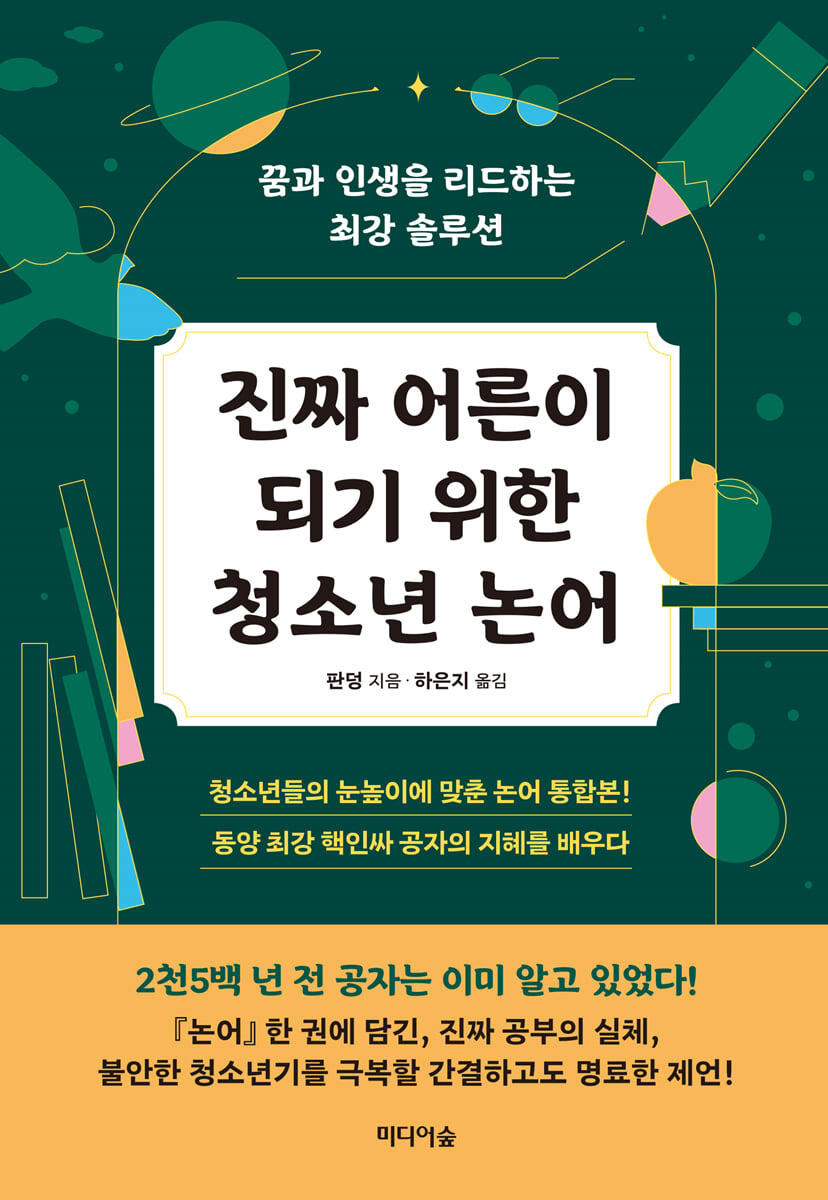
The Analects of Confucius for Youth to Become a True Adult
 |
Description
Book Introduction
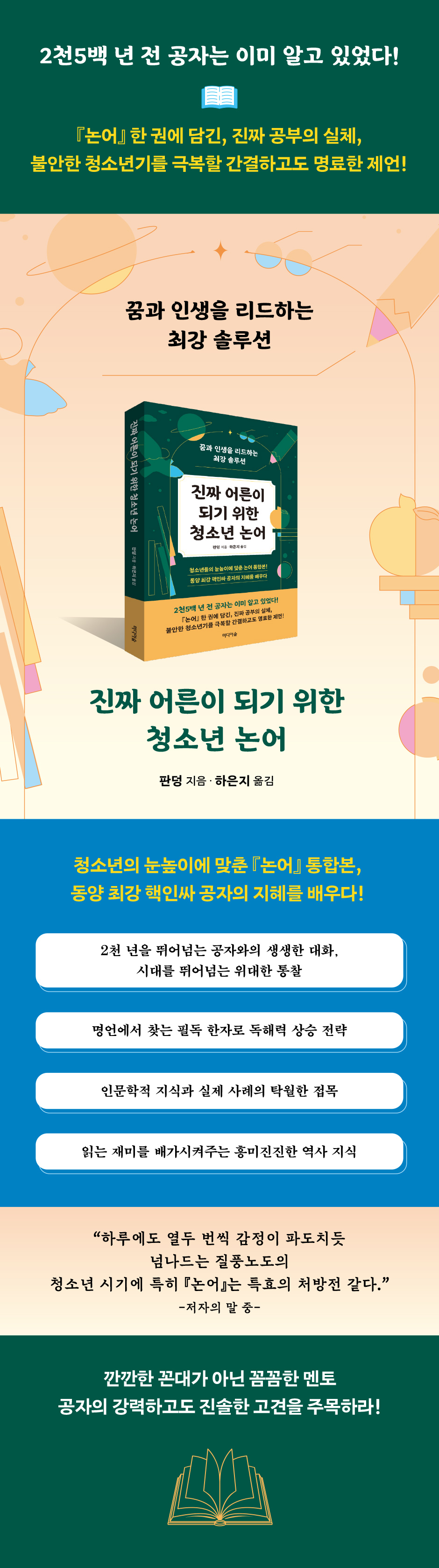
Confucius already knew this 2,500 years ago! The most powerful solution to lead learning The true essence of study contained in one volume of the Analects of Confucius Simple and clear advice to help you overcome your anxious teenage years! The Analects of Confucius means ‘edited words.’ As the title suggests, the Analects is a book that compiles and records the conversations, attitudes, and approaches to life of Confucius and his disciples. But why should we, living in the 21st century, pay attention to these conversations from 2,500 years ago? To answer this question, bestselling author Pan Deng has crafted a compelling account of Confucius's life and wisdom, tailored to the perspectives of young people. Although the Analects were written 2,500 years ago, they still provide many lessons for our lives today. Many of the principles and truths in the Analects have been verified by modern scientific theories. In particular, the Analects reveal profound and serious reflections on ‘learning.’ Confucius's attitude of always pondering something, reflecting on the day, and learning for a better tomorrow is a serious attitude toward life that modern people must learn today. This is not limited to simply studying life. This attitude also applies to teenagers who must devote themselves to studying every day. ‘Studying’ is not simply and superficially solving and understanding reference books or workbooks. ‘Studying’ must be truly connected to our lives. A study that can be applied to real life is a 'living' study. Therefore, the core content of 『The Analects for Youth to Become a True Adult』 is ‘learning.’ But learning here is not simply learning by reading and reciting books. The Analects cover everything from studying and relationships with friends to personality and daily life. This embodies the truth that Confucius emphasized: 'one principle sees through everything', that is, seeing through everything with one principle. The Analects help us gain insight into daily life through friendships, into people's personalities through daily life, and into life through individual character and personality. During their turbulent teenage years, they serve as a compass that tells them what kind of person they are, what other people think and live, and how the world works. It suggests the path to living a happy life by finding meaning and living by what standards in life. It will also provide answers to various worries that arise during the shaky and anxious period of adolescence, provide comfort in their suffering, and lead them on the peaceful path to becoming a 'true adult.' |
- You can preview some of the book's contents.
Preview
index
Prologue _ Confucius's nagging can be repeated infinitely.
Chapter 1: Can you enjoy studying when you're bored?
ㆍ The first words of Confucius, a lifelong mentor, "Isn't it joyful to be filled with learning?"
ㆍ Pride and arrogance that destroys humanity
Learning is open to anyone, anywhere, comfortably.
ㆍ Small paths will come together to form a path that will shake the world.
ㆍTen thousand hours of hard work surpasses genius.
Chapter 2: Raise the Quality of Study
ㆍ The reason why the chick's struggle to break out of the egg is great
Anyone can become a teacher if they hone what they have learned.
ㆍUntil you surpass the wisdom of a thousand years and acquire the knowledge of ten thousand years
ㆍ A level of 'enjoyment' that no one can surpass
Chapter 3: A Study Method Just for 'Me'
ㆍ The habit of making useless knowledge useful
Only after thinking about it two or three times can you ask a real question.
ㆍ Add thought to learning and knowledge to blossom your thoughts.
ㆍ Finding a balance between knowing and doing
ㆍ How to escape from burnout and slump
Chapter 4: Towards the Top Tier of Studying: 'Rock Jija'
ㆍ A hero does not abuse his power.
ㆍ Challenge the theories of Einstein and Newton.
If one person can do it, anyone can do it.
ㆍ The ultimate learning master, a rocker who knows how to have fun
Who am I? Where am I? Let's dive into the realm of immersion.
ㆍ Two things to achieve your goals: 'beginner's mind' and 'consistent'
Chapter 5: What on earth should I study?
ㆍ How to solve worries about ignorance
ㆍ What on earth should I study?
Discover your inner talents through endless questions.
ㆍ Go beyond the subtle difference between 99 and 100 degrees
ㆍ 4 Steps to Study to Reach the Top of Your Dreams
ㆍ Go forward silently, but with more constructive thinking.
Chapter 6: What does it mean to be good at studying?
ㆍ A person who puts studying on the back burner and only worries
Don't hide behind the curtain of rationalization that says, "They are geniuses."
ㆍ Six disadvantages that arise when you neglect learning
Anyone can become a teacher, no matter what they learn.
ㆍ Small mutterings like a comfortable friend, the language of poetry
ㆍ Rather, the effect of a good shock, antifragility
Chapter 1: Can you enjoy studying when you're bored?
ㆍ The first words of Confucius, a lifelong mentor, "Isn't it joyful to be filled with learning?"
ㆍ Pride and arrogance that destroys humanity
Learning is open to anyone, anywhere, comfortably.
ㆍ Small paths will come together to form a path that will shake the world.
ㆍTen thousand hours of hard work surpasses genius.
Chapter 2: Raise the Quality of Study
ㆍ The reason why the chick's struggle to break out of the egg is great
Anyone can become a teacher if they hone what they have learned.
ㆍUntil you surpass the wisdom of a thousand years and acquire the knowledge of ten thousand years
ㆍ A level of 'enjoyment' that no one can surpass
Chapter 3: A Study Method Just for 'Me'
ㆍ The habit of making useless knowledge useful
Only after thinking about it two or three times can you ask a real question.
ㆍ Add thought to learning and knowledge to blossom your thoughts.
ㆍ Finding a balance between knowing and doing
ㆍ How to escape from burnout and slump
Chapter 4: Towards the Top Tier of Studying: 'Rock Jija'
ㆍ A hero does not abuse his power.
ㆍ Challenge the theories of Einstein and Newton.
If one person can do it, anyone can do it.
ㆍ The ultimate learning master, a rocker who knows how to have fun
Who am I? Where am I? Let's dive into the realm of immersion.
ㆍ Two things to achieve your goals: 'beginner's mind' and 'consistent'
Chapter 5: What on earth should I study?
ㆍ How to solve worries about ignorance
ㆍ What on earth should I study?
Discover your inner talents through endless questions.
ㆍ Go beyond the subtle difference between 99 and 100 degrees
ㆍ 4 Steps to Study to Reach the Top of Your Dreams
ㆍ Go forward silently, but with more constructive thinking.
Chapter 6: What does it mean to be good at studying?
ㆍ A person who puts studying on the back burner and only worries
Don't hide behind the curtain of rationalization that says, "They are geniuses."
ㆍ Six disadvantages that arise when you neglect learning
Anyone can become a teacher, no matter what they learn.
ㆍ Small mutterings like a comfortable friend, the language of poetry
ㆍ Rather, the effect of a good shock, antifragility
Detailed image
Into the book
People learn throughout their lives.
Graduating from college doesn't mean your learning is over.
The most important thing at the starting point of lifelong learning is your mindset toward learning.
Even when running a 100m race, when we stand at the starting line, we calm our pounding hearts and calm our minds.
The same goes for studying.
You need to decide what kind of attitude and mindset you should have.
--- From the text
The joy and pleasure in the 'non-returning pleasure' that Confucius thought of is 'a heart that arises spontaneously'.
No matter how difficult or challenging a task may be, there is joy and happiness hidden within it.
If you approach things with a "heart of enjoyment," difficult studies, burdensome collaborations, and the sadness of not being recognized will all melt away like snow and be easily resolved.
--- From the text
Some people say that we have to experience things to learn about many things in life, such as how to get along with friends, how to communicate well with teachers or parents, and how to handle class duties well.
If you don't experience it yourself, you'll say that what you read in a book is just a piece of paper.
But actually, if you open the book, you can see that that is not the case.
Many people will regret it, thinking, "Wow, this was in the book? I wish I had read it sooner..."
This is why I stimulate 'intellectual deficiency'.
--- From the text
Confucius's words, "If only I could realize the truth, I would be willing to give up my body," are similar to Einstein's life.
Einstein devoted his later years to studying the formulas of the universe.
He is a person who actually lived the life of Confucius's words, 'If you awaken to the Way in the morning and die in the evening, you will be happy.'
--- From the text
In an age when people loved to worship great and outstanding people as gods, Confucius often heard people say this.
When you think of Mozart, many people probably have similar thoughts.
When talking about his piano skills, most people ask, “How can we compare him to him?
He was a genius.
“I’ve been writing songs since I was five years old,” he would say.
If you say that Beethoven was a great musician, someone will surely answer like this.
“He was a genius.
“It’s different from us.”
--- From the text
When studying, we need help from teachers, but we must also learn 'Geoilbansam' on our own.
How can I do this? When the teacher tells me something, I try to think of another piece of knowledge related to it.
As you organize your notes of wrong answers, think carefully about why you got that question wrong and avoid making the same mistake the next time you encounter the same type of question.
As you expand your chain of thought and develop your ability to reason, induce, and organize, your learning efficiency will naturally increase.
--- From the text
Confucius tells us not to think too hard about being a teacher.
If you can do 'ongoijishin', you can teach someone even if you don't have a teaching license.
After school, go home and tell your parents about what you learned that day.
If you can express that content accurately and in an understandable way, then you have already completely mastered that knowledge.
Another good idea is to form a group with your classmates and study together regularly.
--- From the text
There is a term in psychology called 'delayed gratification'.
One of the areas of self-control refers to the ability to voluntarily suppress and control immediate pleasure, reward, or desires in order to achieve greater results, while enduring the resulting frustration.
There are also research results that show that the stronger this ability is in a person, the more likely he or she is to achieve great things.
--- From the text
Some people write down passages that impressed them while reading a book in a separate notebook, while others like to underline them with colorful pens.
However, there are many people who do not remember the content of the sentence they wrote with a pen.
You're just pretending to be enthusiastic on the outside.
Why can't I remember? Because I don't think.
--- From the text
Many of the problems we face today are essentially no different from those faced by Confucius two thousand years ago.
Think about it.
Even among Confucius's disciples at the time, there must have been those who did not understand his teachings, considered them too difficult, considered them useless knowledge, or complained that they could never follow them.
There may even have been people who raised objections without even learning.
Every time that happened, Confucius said to them,
He advised me to 'think a lot and learn a lot.'
Graduating from college doesn't mean your learning is over.
The most important thing at the starting point of lifelong learning is your mindset toward learning.
Even when running a 100m race, when we stand at the starting line, we calm our pounding hearts and calm our minds.
The same goes for studying.
You need to decide what kind of attitude and mindset you should have.
--- From the text
The joy and pleasure in the 'non-returning pleasure' that Confucius thought of is 'a heart that arises spontaneously'.
No matter how difficult or challenging a task may be, there is joy and happiness hidden within it.
If you approach things with a "heart of enjoyment," difficult studies, burdensome collaborations, and the sadness of not being recognized will all melt away like snow and be easily resolved.
--- From the text
Some people say that we have to experience things to learn about many things in life, such as how to get along with friends, how to communicate well with teachers or parents, and how to handle class duties well.
If you don't experience it yourself, you'll say that what you read in a book is just a piece of paper.
But actually, if you open the book, you can see that that is not the case.
Many people will regret it, thinking, "Wow, this was in the book? I wish I had read it sooner..."
This is why I stimulate 'intellectual deficiency'.
--- From the text
Confucius's words, "If only I could realize the truth, I would be willing to give up my body," are similar to Einstein's life.
Einstein devoted his later years to studying the formulas of the universe.
He is a person who actually lived the life of Confucius's words, 'If you awaken to the Way in the morning and die in the evening, you will be happy.'
--- From the text
In an age when people loved to worship great and outstanding people as gods, Confucius often heard people say this.
When you think of Mozart, many people probably have similar thoughts.
When talking about his piano skills, most people ask, “How can we compare him to him?
He was a genius.
“I’ve been writing songs since I was five years old,” he would say.
If you say that Beethoven was a great musician, someone will surely answer like this.
“He was a genius.
“It’s different from us.”
--- From the text
When studying, we need help from teachers, but we must also learn 'Geoilbansam' on our own.
How can I do this? When the teacher tells me something, I try to think of another piece of knowledge related to it.
As you organize your notes of wrong answers, think carefully about why you got that question wrong and avoid making the same mistake the next time you encounter the same type of question.
As you expand your chain of thought and develop your ability to reason, induce, and organize, your learning efficiency will naturally increase.
--- From the text
Confucius tells us not to think too hard about being a teacher.
If you can do 'ongoijishin', you can teach someone even if you don't have a teaching license.
After school, go home and tell your parents about what you learned that day.
If you can express that content accurately and in an understandable way, then you have already completely mastered that knowledge.
Another good idea is to form a group with your classmates and study together regularly.
--- From the text
There is a term in psychology called 'delayed gratification'.
One of the areas of self-control refers to the ability to voluntarily suppress and control immediate pleasure, reward, or desires in order to achieve greater results, while enduring the resulting frustration.
There are also research results that show that the stronger this ability is in a person, the more likely he or she is to achieve great things.
--- From the text
Some people write down passages that impressed them while reading a book in a separate notebook, while others like to underline them with colorful pens.
However, there are many people who do not remember the content of the sentence they wrote with a pen.
You're just pretending to be enthusiastic on the outside.
Why can't I remember? Because I don't think.
--- From the text
Many of the problems we face today are essentially no different from those faced by Confucius two thousand years ago.
Think about it.
Even among Confucius's disciples at the time, there must have been those who did not understand his teachings, considered them too difficult, considered them useless knowledge, or complained that they could never follow them.
There may even have been people who raised objections without even learning.
Every time that happened, Confucius said to them,
He advised me to 'think a lot and learn a lot.'
--- From the text
Publisher's Review
Confucius was never a 'old fart'
In the Analects, it is not about the nagging of adults,
Contains 'Master's Advice'
The way modern people study the Analects is simple.
I read a few different interpretations on the internet and it seemed like a public
We delude ourselves into thinking that we fully understand the other person's thoughts.
However, the author emphasizes that such an approach is tantamount to missing the precious essence of the Analects.
Although the Analects were written 2,500 years ago, they are still full of content that provides deep insight into our lives.
Scientific research is also continuously producing results that prove that Confucius's teachings are correct.
Therefore, the author says that in order to properly understand the Analects, we must not simply leave them as Confucius's famous sayings, but apply them to our lives, our daily lives, and our studies.
This is because learning knowledge that can be applied to real life is what makes it a truly 'living' discipline.
The era we live in now is one in which changes occur every day, and the pace of scientific civilization development is dazzling.
The advancement of information and communication technology, known as the Fourth Industrial Revolution, is bringing about enormous changes not only in the relationships between people and each other, and between people and the world, but also in the relationships between people and technology.
We may have to coexist with robots that are smarter than humans, robots that have perception and emotions.
Where can we learn the wisdom to prepare for and navigate these chaotic changes?
Confucius also lived during the Spring and Autumn Period and the Warring States Period, a period when the world changed rapidly, as if heaven and earth were being created.
He endured the turbulent times with his disciples and developed wisdom about life.
The book that contains this wisdom is the Analects of Confucius.
Living in an era of endless competition not so different from today, Confucius's concerns are no different from those faced by today's youth.
This book weaves together the wisdom of Confucius, focusing on the biggest concerns of young people, such as academics, relationships with friends, and an uncertain future.
If there's one thing our youth must learn today, it's the enlightenment from the Analects that can be applied directly to life in the Internet age.
This book covers only the topics that interest young people the most.
It can be broadly divided into four parts: study, friendships, personality, and daily life.
The author of this book has tried to think together with young people about the most pressing issues they are currently struggling with, and suggests a path forward.
However, let us not think that Confucius's words are the interference of an old man.
His language is imbued with a timeless wisdom that I never heard from my parents or teachers.
If you know the difference between 'nagging' and 'advice', his words will never sound like nagging.
Now, if you want to remember the wise man's advice as a guide for life, open the book right now.
In the Analects, it is not about the nagging of adults,
Contains 'Master's Advice'
The way modern people study the Analects is simple.
I read a few different interpretations on the internet and it seemed like a public
We delude ourselves into thinking that we fully understand the other person's thoughts.
However, the author emphasizes that such an approach is tantamount to missing the precious essence of the Analects.
Although the Analects were written 2,500 years ago, they are still full of content that provides deep insight into our lives.
Scientific research is also continuously producing results that prove that Confucius's teachings are correct.
Therefore, the author says that in order to properly understand the Analects, we must not simply leave them as Confucius's famous sayings, but apply them to our lives, our daily lives, and our studies.
This is because learning knowledge that can be applied to real life is what makes it a truly 'living' discipline.
The era we live in now is one in which changes occur every day, and the pace of scientific civilization development is dazzling.
The advancement of information and communication technology, known as the Fourth Industrial Revolution, is bringing about enormous changes not only in the relationships between people and each other, and between people and the world, but also in the relationships between people and technology.
We may have to coexist with robots that are smarter than humans, robots that have perception and emotions.
Where can we learn the wisdom to prepare for and navigate these chaotic changes?
Confucius also lived during the Spring and Autumn Period and the Warring States Period, a period when the world changed rapidly, as if heaven and earth were being created.
He endured the turbulent times with his disciples and developed wisdom about life.
The book that contains this wisdom is the Analects of Confucius.
Living in an era of endless competition not so different from today, Confucius's concerns are no different from those faced by today's youth.
This book weaves together the wisdom of Confucius, focusing on the biggest concerns of young people, such as academics, relationships with friends, and an uncertain future.
If there's one thing our youth must learn today, it's the enlightenment from the Analects that can be applied directly to life in the Internet age.
This book covers only the topics that interest young people the most.
It can be broadly divided into four parts: study, friendships, personality, and daily life.
The author of this book has tried to think together with young people about the most pressing issues they are currently struggling with, and suggests a path forward.
However, let us not think that Confucius's words are the interference of an old man.
His language is imbued with a timeless wisdom that I never heard from my parents or teachers.
If you know the difference between 'nagging' and 'advice', his words will never sound like nagging.
Now, if you want to remember the wise man's advice as a guide for life, open the book right now.
GOODS SPECIFICS
- Date of issue: April 20, 2024
- Page count, weight, size: 256 pages | 428g | 148*215*14mm
- ISBN13: 9791158742188
- ISBN10: 1158742185
You may also like
카테고리
korean


korean

![GQ KOREA Mark (Monthly): December [2025]](http://librairie.coreenne.fr/cdn/shop/files/8ef265dbbfbf186523ed75ba7319009d.jpg?v=1765340328&width=3840)


