

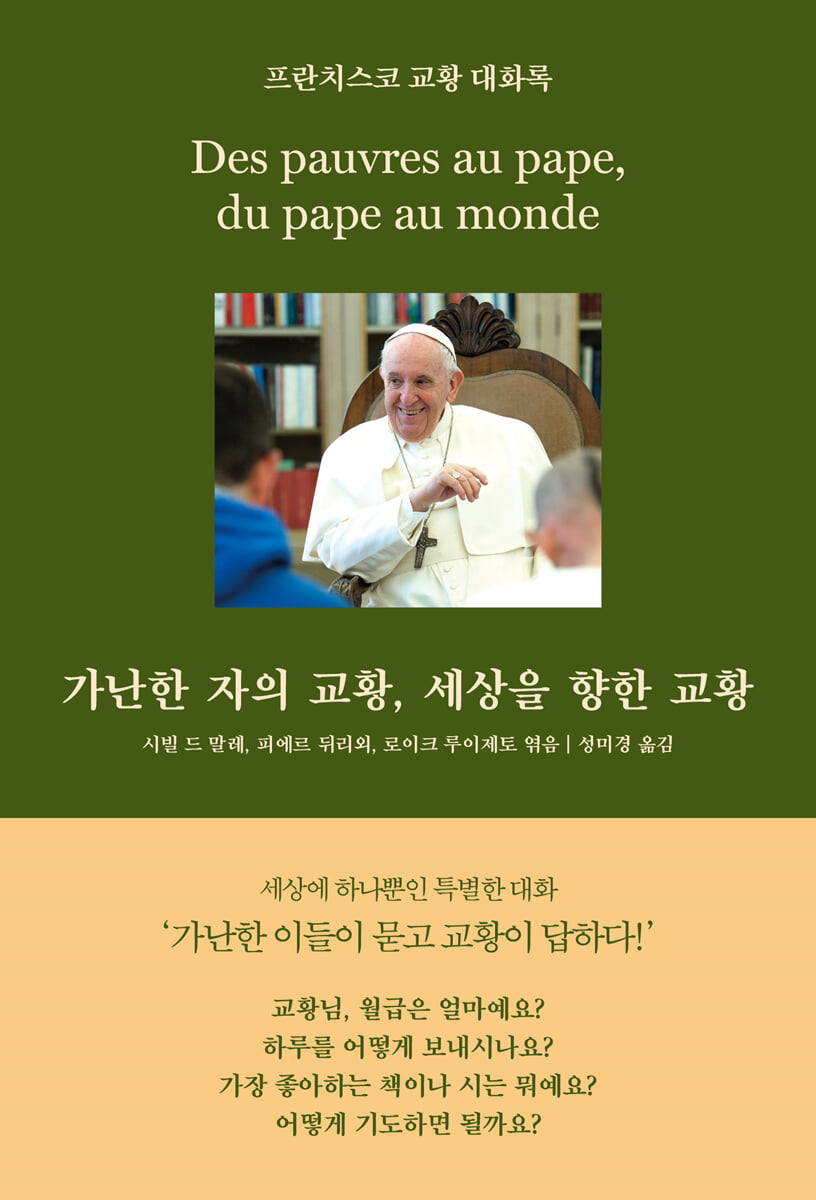
The Pope of the Poor, the Pope of the World
 |
Description
Book Introduction
“Your Holiness, how much is your salary?”
“How do you spend your day?”
“What is your favorite book or poem?”
“How should I pray?”
“How should we fight poverty?”
A special dialogue, one of a kind in the world
The poor ask, Pope Francis answers!
This book is a candid and inspiring collection of Pope Francis's conversations with the poor around the world.
You can encounter Pope Francis's honest answers to a wide range of questions, including personal questions that no one has dared to ask before, such as the Pope's salary, love, family, interests, worries, health, stress relief methods, and hopes, as well as questions about injustice, war, evil, despair, poverty and discrimination, race, minorities, and religious issues.
- You can preview some of the book's contents.
Preview
index
▶ Prologue: The Poor Ask, the Pope Answers
Chapter 1: “The Pope is an Ordinary Man”
▶ Chapter 2: “Don’t Forget the Poor”
▶ Chapter 3: “The Wealth Is Not Theirs”
▶ Chapter 4: Injustice Shouting to the Heavens
▶ Chapter 5: “Hope is a Gift”
▶ Chapter 6: Those Who Sow the Seeds of Peace
▶ Chapter 7: “No one is born by chance.”
▶ Epilogue: Leave the Door Open
Chapter 1: “The Pope is an Ordinary Man”
▶ Chapter 2: “Don’t Forget the Poor”
▶ Chapter 3: “The Wealth Is Not Theirs”
▶ Chapter 4: Injustice Shouting to the Heavens
▶ Chapter 5: “Hope is a Gift”
▶ Chapter 6: Those Who Sow the Seeds of Peace
▶ Chapter 7: “No one is born by chance.”
▶ Epilogue: Leave the Door Open
Publisher's Review
Pope Francis's Candid and Inspiring Dialogue
A book that captures the honest conversations between Pope Francis and the world's poor.
You can encounter Pope Francis's honest answers to a wide range of questions, including personal questions that no one has dared to ask before, such as the Pope's salary, love, family, interests, worries, health, stress relief methods, and hopes, as well as questions about injustice, war, evil, despair, poverty and discrimination, race, minorities, and religious issues.
Everything you ever wanted to know about Pope Francis: salary, daily life, worries, and even stress relief.
The questions, which came from all over the world, including Brazil, France, Iran, the Philippines, Argentina, Lebanon, India, Spain, Poland, and Belgium, were borderless and diverse.
The Pope answers sincerely, sometimes humorously.
"What's the first thing you do when you wake up in the morning?" "When I open my eyes, I'm a complete zombie for the first 30 minutes! Then I pray." (omitted)
- “What is the Pope’s weakness?”- “He gets angry easily.
What should I say, I guess you have no patience? (omitted)
- “To whom does the Pope go to confession?” - “To Father Manuel, a Franciscan priest.”
- “How do you fight pride?”- “I practice self-control, abstinence, prayer, and a little bit of introspection.
“Sometimes you need to consult with others and seek advice, otherwise you might jump to conclusions.”
Besides, “Where does the Vatican’s money go?” “There are countries where parish priests are paid like other professions.
What do you think about this?” “Why doesn’t the church stand on the side of the weak anymore, as Jesus wanted?” Questions about religion and clergy, such as “How can we accept people who are different from each other and have different beliefs, religions, and backgrounds?” “Some societies reject homosexuals based on the Bible.
Sensitive questions about race, faith, and respect for humanity also appear, such as, “How does the Pope receive them?”
You can also find curious questions and answers that even the general public would be curious about, such as how he usually relieves stress, who his life mentor is, who his favorite saint is, and what his hopes are as the Pope.
The Pope's Encounter with the Homeless, the Poor, and the Beggars: From the Book's Publication
This book contains conversations that seem unlikely to ever happen.
This is because it vividly depicts the conversations between Pope Francis and the poor who have lived difficult lives, experienced countless pains and humiliations, and had no say or voice.
This special meeting was organized at the suggestion of the Lazar Association, which runs a 'communal living facility for the homeless and young workers'.
The appointment to meet the Pope in Rome to mark the 10th anniversary of the association's founding appeared to be canceled due to the spread of the coronavirus.
But the Pope kept his promise, and association officials proposed that the Pope meet directly with the world's poor, and this unprecedented meeting took place.
Originally, close to 200 people were scheduled to meet the Pope in person, but due to the COVID-19 pandemic, only a small number met him in person, while some participated via video conference. In addition, thousands of questions were compiled and selected from organizations around the world for a Q&A session.
Throughout this meeting, the Pope was honest, sincere, and truthful, and at times even answered directly.
The book was published after the Pope agreed to transfer the copyright to charities that helped on five continents around the world.
“It makes me happy to see people living simply and transparently!”
“In a world filled with inequality, arrogance, and tyranny, we must fight marginalization and discrimination.”
From the moment of his election, Pope Francis declared himself to be a “poor church for the poor” and was the first pope in history to choose the name Francis, after Saint Francis of Assisi.
Since his days as a cardinal, he has lived in a small apartment rather than an official residence and has not even had a chauffeur. Even after becoming the Pope, he continues to live a simple and humble life, even driving a compact car.
Additionally, he became a topic of conversation for taking care of the disabled, the poor, and the marginalized wherever he visited.
Regardless of religion, many people respect the Pope and pay attention to his voice.
In this book, we can also vividly experience Pope Francis's usual beliefs and thoughts.
As a religious person and as a human being, his anguish, thoughts, and voices are conveyed, including his pity for those suffering from poverty, his stance on other religions, his state of mind when his faith is shaken, and his stance on world conflicts.
Pope Francis, who went beyond words and thoughts and invited the poor directly to meet with them on equal footing and engage in open dialogue.
And in that conversation, the Pope's living voice was salvaged, and every word contained traces of deep reflection and agony.
Through this book, readers will be able to fully understand what kind of person Pope Francis truly is.
I recommend this book to anyone who loves Pope Francis and wants to know more about him.
You can encounter the world he dreams of, his hopes as a religious person, and even the various aspects of Francis as a human being.
· How do you spend your day? (Kelly Carolini from Brazil)
Well, first of all, I should say that not a single day has been 'normal'.
There are always surprising things that happen.
But this is how things usually go.
I wake up, pray, and do other things, and at 9:30 in the morning, I leave the house of Saint Martha.
We begin the audience by going to the Apostolic Palace in the Vatican, where the office is located.
I'll come back at 1pm, have lunch, and rest for a bit.
In the afternoon, I usually sign documents, hold audiences again, and say a little prayer.
(omitted)
· What is your favorite moment? When you feel the most joyful? When you relax, or when you live passionately? (Serge from France)
It's a moment when I listen to music that not only softens me, but also soothes my anger and calms my mind.
More precisely, when listening to Wagner's music.
· What do you do when you're unsure? (Ian from the Philippines)
When that moment comes, I'm tempted to get away quickly.
I, too, sometimes find myself in a state of uncertainty and want to escape from that state.
Then I pause for a moment.
If that doesn't work, at least try to stop.
If you try to get out, it won't work.
So I'm trying to take my time in a stopped state.
Think about the situation, ask people for advice, and pray.
Let time pass by like that for a few days.
If you read a document today, you can look at it again later.
Slowly, like a hen brooding her eggs.
The hen rolls the eggs up and down every day to ensure good hatching.
If you are unsure about a decision, you should first look into it from both sides.
· You are the head of the church.
I think it will be difficult to get rid of pride.
(Loik)
The Pope is a poor man… … .
The Pope is an ordinary person with problems like everyone else.
So I put down my mitre and say, “Lord, I am just an ordinary person before you.”
Then, put on the episcopal hat again and say what you need to say.
· Why did you choose the name Francis? (Petersson Felix, Brazil)
I was elected Pope on the evening of March 13, 2013.
Until noon that day, I had no idea that I would become the Pope.
But during lunchtime, many surprising things happened, and I got the feeling that the cardinals were going to elect me as the Pope.
In the first round of voting, votes came out in favor of me, and in subsequent rounds, my support increased.
Gradually, the election became certain, and eventually the majority chose me.
I didn't know anything.
(Omitted) At that time, I was very calm and prayed to God for light while turning the rosary.
The moment I was elected, Cardinal Hummes, a Brazilian Franciscan who was standing next to me, hugged me and said, “Don’t forget the poor.”
When I heard that, I kept repeating to myself, 'Poor people, poor people... '
At that time, the name of Saint Francis of Assisi came to mind.
· How should we combat poverty? How should we, living in a consumer society, overcome poverty? (Alain, France)
There is no universally valid answer to this question.
In an unfair society, poverty is not just a personal problem.
We need to change our social model to prevent poverty from persisting.
When poverty occurs, we must confront it personally.
We have to confront it in a very innovative way.
And we must contribute to helping those in poverty, eliminating social injustice, and combating the corruption that comes with wealth.
We must fight against shamelessness and indifference.
To help people living on the margins of society, we need systems and the will to do so, like you.
A book that captures the honest conversations between Pope Francis and the world's poor.
You can encounter Pope Francis's honest answers to a wide range of questions, including personal questions that no one has dared to ask before, such as the Pope's salary, love, family, interests, worries, health, stress relief methods, and hopes, as well as questions about injustice, war, evil, despair, poverty and discrimination, race, minorities, and religious issues.
Everything you ever wanted to know about Pope Francis: salary, daily life, worries, and even stress relief.
The questions, which came from all over the world, including Brazil, France, Iran, the Philippines, Argentina, Lebanon, India, Spain, Poland, and Belgium, were borderless and diverse.
The Pope answers sincerely, sometimes humorously.
"What's the first thing you do when you wake up in the morning?" "When I open my eyes, I'm a complete zombie for the first 30 minutes! Then I pray." (omitted)
- “What is the Pope’s weakness?”- “He gets angry easily.
What should I say, I guess you have no patience? (omitted)
- “To whom does the Pope go to confession?” - “To Father Manuel, a Franciscan priest.”
- “How do you fight pride?”- “I practice self-control, abstinence, prayer, and a little bit of introspection.
“Sometimes you need to consult with others and seek advice, otherwise you might jump to conclusions.”
Besides, “Where does the Vatican’s money go?” “There are countries where parish priests are paid like other professions.
What do you think about this?” “Why doesn’t the church stand on the side of the weak anymore, as Jesus wanted?” Questions about religion and clergy, such as “How can we accept people who are different from each other and have different beliefs, religions, and backgrounds?” “Some societies reject homosexuals based on the Bible.
Sensitive questions about race, faith, and respect for humanity also appear, such as, “How does the Pope receive them?”
You can also find curious questions and answers that even the general public would be curious about, such as how he usually relieves stress, who his life mentor is, who his favorite saint is, and what his hopes are as the Pope.
The Pope's Encounter with the Homeless, the Poor, and the Beggars: From the Book's Publication
This book contains conversations that seem unlikely to ever happen.
This is because it vividly depicts the conversations between Pope Francis and the poor who have lived difficult lives, experienced countless pains and humiliations, and had no say or voice.
This special meeting was organized at the suggestion of the Lazar Association, which runs a 'communal living facility for the homeless and young workers'.
The appointment to meet the Pope in Rome to mark the 10th anniversary of the association's founding appeared to be canceled due to the spread of the coronavirus.
But the Pope kept his promise, and association officials proposed that the Pope meet directly with the world's poor, and this unprecedented meeting took place.
Originally, close to 200 people were scheduled to meet the Pope in person, but due to the COVID-19 pandemic, only a small number met him in person, while some participated via video conference. In addition, thousands of questions were compiled and selected from organizations around the world for a Q&A session.
Throughout this meeting, the Pope was honest, sincere, and truthful, and at times even answered directly.
The book was published after the Pope agreed to transfer the copyright to charities that helped on five continents around the world.
“It makes me happy to see people living simply and transparently!”
“In a world filled with inequality, arrogance, and tyranny, we must fight marginalization and discrimination.”
From the moment of his election, Pope Francis declared himself to be a “poor church for the poor” and was the first pope in history to choose the name Francis, after Saint Francis of Assisi.
Since his days as a cardinal, he has lived in a small apartment rather than an official residence and has not even had a chauffeur. Even after becoming the Pope, he continues to live a simple and humble life, even driving a compact car.
Additionally, he became a topic of conversation for taking care of the disabled, the poor, and the marginalized wherever he visited.
Regardless of religion, many people respect the Pope and pay attention to his voice.
In this book, we can also vividly experience Pope Francis's usual beliefs and thoughts.
As a religious person and as a human being, his anguish, thoughts, and voices are conveyed, including his pity for those suffering from poverty, his stance on other religions, his state of mind when his faith is shaken, and his stance on world conflicts.
Pope Francis, who went beyond words and thoughts and invited the poor directly to meet with them on equal footing and engage in open dialogue.
And in that conversation, the Pope's living voice was salvaged, and every word contained traces of deep reflection and agony.
Through this book, readers will be able to fully understand what kind of person Pope Francis truly is.
I recommend this book to anyone who loves Pope Francis and wants to know more about him.
You can encounter the world he dreams of, his hopes as a religious person, and even the various aspects of Francis as a human being.
· How do you spend your day? (Kelly Carolini from Brazil)
Well, first of all, I should say that not a single day has been 'normal'.
There are always surprising things that happen.
But this is how things usually go.
I wake up, pray, and do other things, and at 9:30 in the morning, I leave the house of Saint Martha.
We begin the audience by going to the Apostolic Palace in the Vatican, where the office is located.
I'll come back at 1pm, have lunch, and rest for a bit.
In the afternoon, I usually sign documents, hold audiences again, and say a little prayer.
(omitted)
· What is your favorite moment? When you feel the most joyful? When you relax, or when you live passionately? (Serge from France)
It's a moment when I listen to music that not only softens me, but also soothes my anger and calms my mind.
More precisely, when listening to Wagner's music.
· What do you do when you're unsure? (Ian from the Philippines)
When that moment comes, I'm tempted to get away quickly.
I, too, sometimes find myself in a state of uncertainty and want to escape from that state.
Then I pause for a moment.
If that doesn't work, at least try to stop.
If you try to get out, it won't work.
So I'm trying to take my time in a stopped state.
Think about the situation, ask people for advice, and pray.
Let time pass by like that for a few days.
If you read a document today, you can look at it again later.
Slowly, like a hen brooding her eggs.
The hen rolls the eggs up and down every day to ensure good hatching.
If you are unsure about a decision, you should first look into it from both sides.
· You are the head of the church.
I think it will be difficult to get rid of pride.
(Loik)
The Pope is a poor man… … .
The Pope is an ordinary person with problems like everyone else.
So I put down my mitre and say, “Lord, I am just an ordinary person before you.”
Then, put on the episcopal hat again and say what you need to say.
· Why did you choose the name Francis? (Petersson Felix, Brazil)
I was elected Pope on the evening of March 13, 2013.
Until noon that day, I had no idea that I would become the Pope.
But during lunchtime, many surprising things happened, and I got the feeling that the cardinals were going to elect me as the Pope.
In the first round of voting, votes came out in favor of me, and in subsequent rounds, my support increased.
Gradually, the election became certain, and eventually the majority chose me.
I didn't know anything.
(Omitted) At that time, I was very calm and prayed to God for light while turning the rosary.
The moment I was elected, Cardinal Hummes, a Brazilian Franciscan who was standing next to me, hugged me and said, “Don’t forget the poor.”
When I heard that, I kept repeating to myself, 'Poor people, poor people... '
At that time, the name of Saint Francis of Assisi came to mind.
· How should we combat poverty? How should we, living in a consumer society, overcome poverty? (Alain, France)
There is no universally valid answer to this question.
In an unfair society, poverty is not just a personal problem.
We need to change our social model to prevent poverty from persisting.
When poverty occurs, we must confront it personally.
We have to confront it in a very innovative way.
And we must contribute to helping those in poverty, eliminating social injustice, and combating the corruption that comes with wealth.
We must fight against shamelessness and indifference.
To help people living on the margins of society, we need systems and the will to do so, like you.
GOODS SPECIFICS
- Date of issue: April 6, 2023
- Page count, weight, size: 168 pages | 240g | 128*188*15mm
- ISBN13: 9791186757918
- ISBN10: 1186757914
You may also like
카테고리
korean


korean

![GQ KOREA Mark (Monthly): December [2025]](http://librairie.coreenne.fr/cdn/shop/files/8ef265dbbfbf186523ed75ba7319009d.jpg?v=1765340328&width=3840)


