

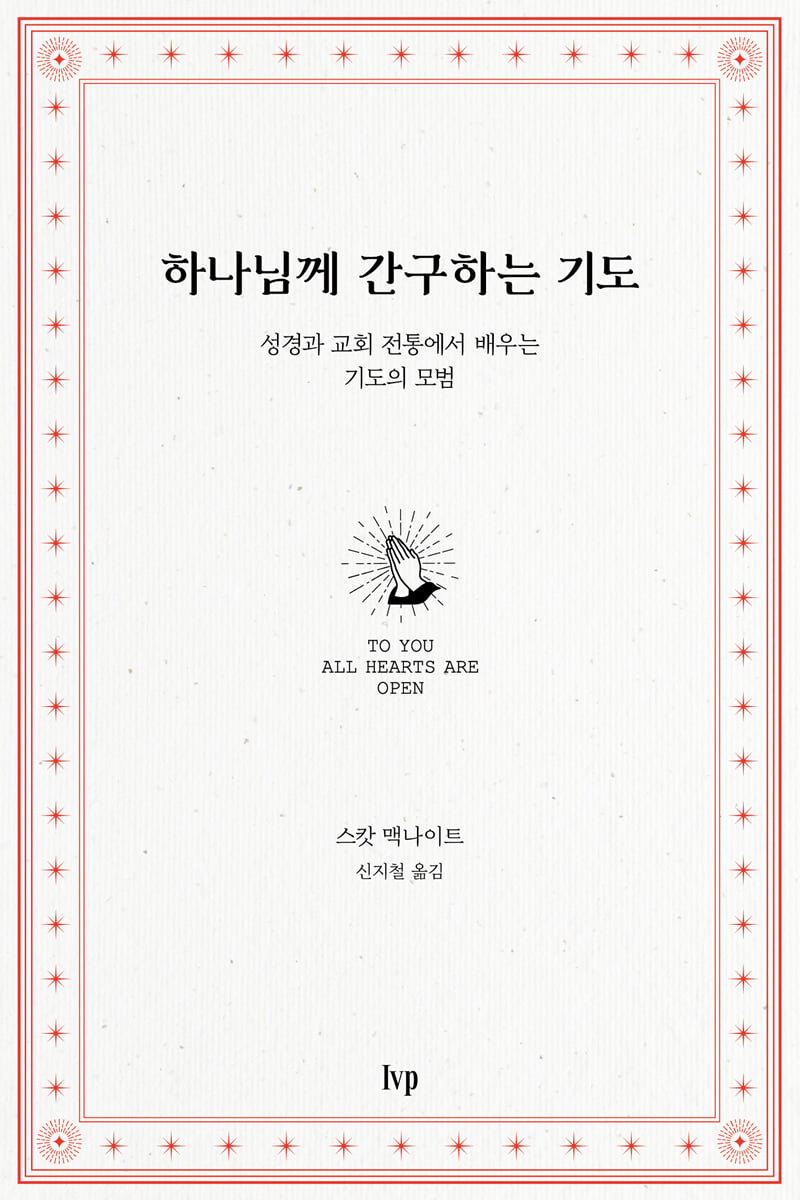
Prayer to God
 |
Description
Book Introduction
The greatest privilege we experience as children of God! An invitation to prayer.
“Our longing for the feast of the Kingdom of God soars!” Recommended by Father Joo Nak-hyun!
“How should I pray to God?”
Rediscovering prayer, a practice inherited from the wisdom of the Bible and the tradition of the church.
Scott McKnight, a prominent biblical scholar, examines the prayers that God's people have offered to Him for thousands of years from the perspective of petition.
We reaffirm the value and significance of proper prayer of petition not only through examples presented in the Bible but also through examples of the prayer that have been practiced by many Christians across denominations and sects for centuries.
It teaches us in detail how to address the object of our prayers, how to address God, and how to convey our wishes to God.
For those who want to draw near to God but don't know how to pray, Scott McKnight opens the door to a conversation that leads to an intimate relationship with God.
“Our longing for the feast of the Kingdom of God soars!” Recommended by Father Joo Nak-hyun!
“How should I pray to God?”
Rediscovering prayer, a practice inherited from the wisdom of the Bible and the tradition of the church.
Scott McKnight, a prominent biblical scholar, examines the prayers that God's people have offered to Him for thousands of years from the perspective of petition.
We reaffirm the value and significance of proper prayer of petition not only through examples presented in the Bible but also through examples of the prayer that have been practiced by many Christians across denominations and sects for centuries.
It teaches us in detail how to address the object of our prayers, how to address God, and how to convey our wishes to God.
For those who want to draw near to God but don't know how to pray, Scott McKnight opens the door to a conversation that leads to an intimate relationship with God.
- You can preview some of the book's contents.
Preview
index
Part 1: Rediscovering Biblical Models of Prayer
Chapter 1 From the Patriarchs to David and Solomon
Chapter 2 From Jesus to the Early Church
Part 2 Remembering the Church's Model of Prayer
Chapter 3: What is the main prayer?
Chapter 4: Elements of the Prayer
Reinvigorating the Church's Model of Prayer
Chapter 5: Maintaining the Right Posture
Chapter 6: Praying to God
Chapter 7: Remembering God
Chapter 8: Waiting on God
Chapter 9: Talking to God
Chapter 10: Approaching God through Christ in the Holy Spirit
11.
Practice: Summary
Getting the Best Out of Your Air Conditioner
Reviews
main
Chapter 1 From the Patriarchs to David and Solomon
Chapter 2 From Jesus to the Early Church
Part 2 Remembering the Church's Model of Prayer
Chapter 3: What is the main prayer?
Chapter 4: Elements of the Prayer
Reinvigorating the Church's Model of Prayer
Chapter 5: Maintaining the Right Posture
Chapter 6: Praying to God
Chapter 7: Remembering God
Chapter 8: Waiting on God
Chapter 9: Talking to God
Chapter 10: Approaching God through Christ in the Holy Spirit
11.
Practice: Summary
Getting the Best Out of Your Air Conditioner
Reviews
main
Into the book
I learned to pray not only from the pastor of our church and my father, but also by listening to and imitating the prayers of other believers.
So I learned to pray very easily in the English used in the King James Version.
So, to me, the expression “Thou art” is just as natural as “You are.”
My father, who recently passed away at the age of ninety, prayed in English as written in the King James Version until he left this world.
And I can still hear my father praying.
He still prays this way today.
Because that's exactly how my father taught me to pray.
---From the "Introduction"
We have distinguished four elements in the types of petitionary prayer, but we have not explained them all.
The four elements are:
A person praying calls out to God, speaks to God, thinks of God, makes a request to God, and then expects God to fulfill it.
We will soon see that there were some changes to these four elements in the New Testament era.
But that change changed everything.
Before turning our attention to Jesus and the apostles, we need to consider that this type was common in the prayers of the Jews who lived roughly at the same time as Jesus and the apostles.
---From Chapter 2, From Jesus to the Early Church
The prayers in this psalm are not prayers that are “prayed once and then finished.”
Because it was written down, it became the prayer of the Israelites and the prayer of Jesus and the apostles.
That is why the Psalms are often called Jesus' prayer book.
Additionally, the New Testament authors refer to or allude to the Psalms more than a hundred times.
No Old Testament book is quoted more often in the New Testament than the Psalms.
And the Psalms were used as a prayer book for the church.
I have heard countless times throughout my life that it is beneficial to have the habit of reading one Psalm each day and then praying it as if it were your own prayer.
---From "Chapter 3: What is the main prayer?"
Strengthen me today with the power of God.
Reassure me with God's truth.
Let us be silent in the beauty of God.
Let us raise our voices in God's justice.
Uphold me with God's faithfulness.
Move me with God's zeal.
Let us fear God and realize the truth.
Give me abundant life through the breath of God.
---From "Chapter 5: Taking the Right Posture"
Anglicans join others in offering the prayer.
However, there is one point of emphasis in this Anglican approach that needs to be mentioned.
It is often expressed in the Latin phrase “lex orandi, lex credendi,” which roughly translates as “the rule of prayer is the rule of faith.”
It may be a bit of an awkward expression, but we learn theology through prayer, and our prayers express our theology.
Our worship is our theology, and our theology is our worship.
Evagrius of Pontus, a famous Eastern Orthodox monk, put this point more eloquently than anyone else:
“If you are a theologian, you will pray correctly.
“If you pray correctly, you are a correct theologian.”
---From "Chapter 7 Remembering God"
We believe in God, “the Creator of heaven and earth,” and we confess our faith in Him in the Creed.
But we are constantly under attack by the idolatries of our time: money, pleasure, power, fame, glory, and possessions.
We are tempted to seek satisfaction in loving something other than our relationship with God.
So when we pray using the term 'God', we need to constantly remind ourselves who is the true God and who is not.
---From Chapter 9, Talking to God
But reflection is necessary to connect our prayers with the truth about God.
When we appeal to God based on our reflections about who He is and what He does, we are thinking theologically.
Solomon did it in his prayers, David and the Old Testament prophets did it, and Jesus taught it in the Lord's Prayer.
Paul also went through a similar process of reflection in the prayer he wrote at the beginning of his letters.
“Father God, you are full of grace.
Therefore, “Have mercy on us.” Saying this to God is not an attempt to manipulate Him.
This is not a one-sided, “Give me what I want!” argument, but a claim rooted in our deepest theology.
It is difficult to say that a prayer that asks God to be consistent with His being as God is manipulation.
In effect, this plea is an assertion of God's Godhood in His being.
So I learned to pray very easily in the English used in the King James Version.
So, to me, the expression “Thou art” is just as natural as “You are.”
My father, who recently passed away at the age of ninety, prayed in English as written in the King James Version until he left this world.
And I can still hear my father praying.
He still prays this way today.
Because that's exactly how my father taught me to pray.
---From the "Introduction"
We have distinguished four elements in the types of petitionary prayer, but we have not explained them all.
The four elements are:
A person praying calls out to God, speaks to God, thinks of God, makes a request to God, and then expects God to fulfill it.
We will soon see that there were some changes to these four elements in the New Testament era.
But that change changed everything.
Before turning our attention to Jesus and the apostles, we need to consider that this type was common in the prayers of the Jews who lived roughly at the same time as Jesus and the apostles.
---From Chapter 2, From Jesus to the Early Church
The prayers in this psalm are not prayers that are “prayed once and then finished.”
Because it was written down, it became the prayer of the Israelites and the prayer of Jesus and the apostles.
That is why the Psalms are often called Jesus' prayer book.
Additionally, the New Testament authors refer to or allude to the Psalms more than a hundred times.
No Old Testament book is quoted more often in the New Testament than the Psalms.
And the Psalms were used as a prayer book for the church.
I have heard countless times throughout my life that it is beneficial to have the habit of reading one Psalm each day and then praying it as if it were your own prayer.
---From "Chapter 3: What is the main prayer?"
Strengthen me today with the power of God.
Reassure me with God's truth.
Let us be silent in the beauty of God.
Let us raise our voices in God's justice.
Uphold me with God's faithfulness.
Move me with God's zeal.
Let us fear God and realize the truth.
Give me abundant life through the breath of God.
---From "Chapter 5: Taking the Right Posture"
Anglicans join others in offering the prayer.
However, there is one point of emphasis in this Anglican approach that needs to be mentioned.
It is often expressed in the Latin phrase “lex orandi, lex credendi,” which roughly translates as “the rule of prayer is the rule of faith.”
It may be a bit of an awkward expression, but we learn theology through prayer, and our prayers express our theology.
Our worship is our theology, and our theology is our worship.
Evagrius of Pontus, a famous Eastern Orthodox monk, put this point more eloquently than anyone else:
“If you are a theologian, you will pray correctly.
“If you pray correctly, you are a correct theologian.”
---From "Chapter 7 Remembering God"
We believe in God, “the Creator of heaven and earth,” and we confess our faith in Him in the Creed.
But we are constantly under attack by the idolatries of our time: money, pleasure, power, fame, glory, and possessions.
We are tempted to seek satisfaction in loving something other than our relationship with God.
So when we pray using the term 'God', we need to constantly remind ourselves who is the true God and who is not.
---From Chapter 9, Talking to God
But reflection is necessary to connect our prayers with the truth about God.
When we appeal to God based on our reflections about who He is and what He does, we are thinking theologically.
Solomon did it in his prayers, David and the Old Testament prophets did it, and Jesus taught it in the Lord's Prayer.
Paul also went through a similar process of reflection in the prayer he wrote at the beginning of his letters.
“Father God, you are full of grace.
Therefore, “Have mercy on us.” Saying this to God is not an attempt to manipulate Him.
This is not a one-sided, “Give me what I want!” argument, but a claim rooted in our deepest theology.
It is difficult to say that a prayer that asks God to be consistent with His being as God is manipulation.
In effect, this plea is an assertion of God's Godhood in His being.
---From "Chapter 11: Practice: Summary"
Publisher's Review
A special teaching on prayer deeply rooted in the great traditions of the Church and in Scripture.
Christians communicate with God through prayer.
The Bible is full of examples of people who communicated with God through prayer and asked for his favor.
From Abraham's servant Eliezer, Jacob, David, Solomon, and even Jesus, the Son of God, prayed to the Father for His will.
And Jesus also taught his disciples how to pray.
The Church has practiced communal prayer to God for centuries, following the Bible and the teachings of Jesus.
Scott McKnight, a theologian renowned for his wise approach to questions of faith and practice, notes that the prayer of petition, the greatest privilege we experience as children of God, has developed throughout the history of the church as a unique form called the "Prayer."
He points out that during the Reformation, all elements of Roman Catholicism that appeared unbiblical were removed through the so-called "stripping of the altar," but the original prayer was not only maintained in the Reformed faith, but also further developed beyond denominations and sects.
An invitation to the most traditional and newest prayers
Although we have heard a lot about the importance of prayer, many Christians feel frustrated because they do not know how to convey their desires to God and do not know whether their prayers are being answered.
Scott McKnight says that the reason our prayers are not answered is not only because we don't ask, but also because we don't know how to ask.
He analyzes the most important elements and characteristics of the prayer of petition, which has developed over many years as a unique form of prayer of petition in the church community.
It presents a standard way to address God, the object of prayer, how to recall Him, how to convey our desires to Him, and what is the source that enables us to boldly pursue those desires.
And he introduces many of his fellow Christians who still follow and practice that great tradition from the Bible and the history of the Church, as well as several beautiful prayers he wrote himself.
He invites readers into the world of prayer, which maintains the consistent form that the Church has long pursued, yet can be applied infinitely to the circumstances of communities and individuals.
Wise and kind suggestions to enrich the Christian's public and personal prayers.
In a religious climate that emphasizes individual spirituality, the religious life of modern Christians has become increasingly individualized, and even prayer life is considered a strictly personal domain.
Christians who are critical of excessive formality and solemnity argue that spontaneous and personal prayer is far more authentic and intimate.
To them, the common prayer shared by the community in a structured and refined language may feel unfamiliar.
But McKnight immediately refutes their claims with hundreds of beautiful prayers found in the Bible itself.
The prayers in the Bible became the prayers of the Israelites, Jesus, and the apostles, and Jesus quoted the Psalms as if they were his own prayer book.
McKnight argues that prayer, which addresses God in refined and dignified form and language, has the power to shape our spirituality.
This book, which suggests training in learning to pray through prayer, will breathe new life and enthusiasm for prayer into our faith life, which has become stagnant and fruitless.
Main Readers
· Ordinary Christians interested in prayer
· Readers who practice public prayer in church gatherings, small groups, etc.
· Readers who want to know the form and method of prayer
· Pastors who want to restore the community's prayers during public worship services.
Christians communicate with God through prayer.
The Bible is full of examples of people who communicated with God through prayer and asked for his favor.
From Abraham's servant Eliezer, Jacob, David, Solomon, and even Jesus, the Son of God, prayed to the Father for His will.
And Jesus also taught his disciples how to pray.
The Church has practiced communal prayer to God for centuries, following the Bible and the teachings of Jesus.
Scott McKnight, a theologian renowned for his wise approach to questions of faith and practice, notes that the prayer of petition, the greatest privilege we experience as children of God, has developed throughout the history of the church as a unique form called the "Prayer."
He points out that during the Reformation, all elements of Roman Catholicism that appeared unbiblical were removed through the so-called "stripping of the altar," but the original prayer was not only maintained in the Reformed faith, but also further developed beyond denominations and sects.
An invitation to the most traditional and newest prayers
Although we have heard a lot about the importance of prayer, many Christians feel frustrated because they do not know how to convey their desires to God and do not know whether their prayers are being answered.
Scott McKnight says that the reason our prayers are not answered is not only because we don't ask, but also because we don't know how to ask.
He analyzes the most important elements and characteristics of the prayer of petition, which has developed over many years as a unique form of prayer of petition in the church community.
It presents a standard way to address God, the object of prayer, how to recall Him, how to convey our desires to Him, and what is the source that enables us to boldly pursue those desires.
And he introduces many of his fellow Christians who still follow and practice that great tradition from the Bible and the history of the Church, as well as several beautiful prayers he wrote himself.
He invites readers into the world of prayer, which maintains the consistent form that the Church has long pursued, yet can be applied infinitely to the circumstances of communities and individuals.
Wise and kind suggestions to enrich the Christian's public and personal prayers.
In a religious climate that emphasizes individual spirituality, the religious life of modern Christians has become increasingly individualized, and even prayer life is considered a strictly personal domain.
Christians who are critical of excessive formality and solemnity argue that spontaneous and personal prayer is far more authentic and intimate.
To them, the common prayer shared by the community in a structured and refined language may feel unfamiliar.
But McKnight immediately refutes their claims with hundreds of beautiful prayers found in the Bible itself.
The prayers in the Bible became the prayers of the Israelites, Jesus, and the apostles, and Jesus quoted the Psalms as if they were his own prayer book.
McKnight argues that prayer, which addresses God in refined and dignified form and language, has the power to shape our spirituality.
This book, which suggests training in learning to pray through prayer, will breathe new life and enthusiasm for prayer into our faith life, which has become stagnant and fruitless.
Main Readers
· Ordinary Christians interested in prayer
· Readers who practice public prayer in church gatherings, small groups, etc.
· Readers who want to know the form and method of prayer
· Pastors who want to restore the community's prayers during public worship services.
GOODS SPECIFICS
- Date of issue: February 28, 2023
- Page count, weight, size: 232 pages | 312g | 140*210*20mm
- ISBN13: 9788932819907
- ISBN10: 8932819904
You may also like
카테고리
korean


korean

![GQ KOREA Mark (Monthly): December [2025]](http://librairie.coreenne.fr/cdn/shop/files/8ef265dbbfbf186523ed75ba7319009d.jpg?v=1765340328&width=3840)


