

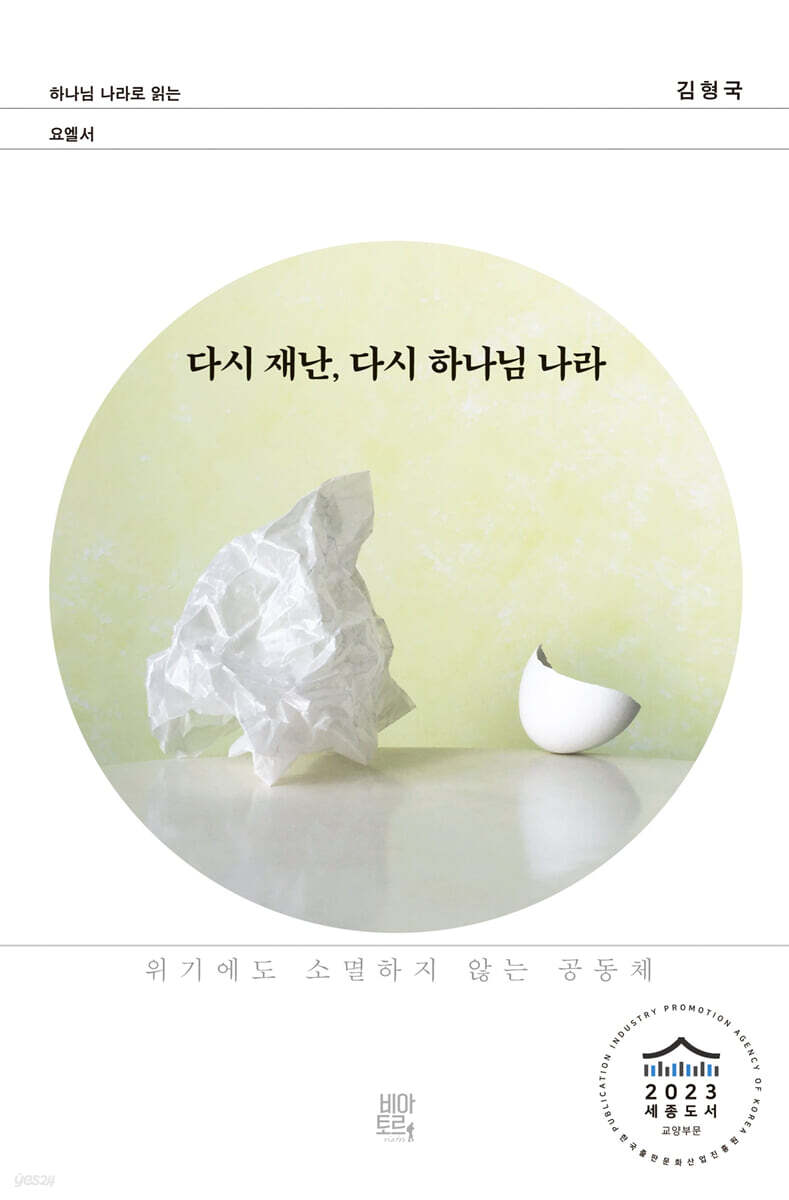
Another disaster, another kingdom of God
 |
Description
Book Introduction
People who remain resolute even when disaster strikes!
A community that doesn't disappear even in times of crisis!
Finding the truth in the Old Testament Book of Joel
Disasters are not a new problem today.
It has continued throughout history and will not disappear in the future.
right.
Although COVID-19 is slowly approaching endemicity, there is no end to the news that puts us in trouble.
From social disasters that everyone experiences to personal accidents and illnesses, it is a homework that everyone faces that is not easily solved.
Who can be free from it?
The same was true of Israel in the Old Testament.
They too are shaken to the core of their basic industries, and the very existence of the country is at risk.
Their questions are directed to the God they believe in and follow.
Why? Why? Why? But God's explanation, delivered through Joel's voice, shocked them.
That explanation is still valid for the Korean church today.
Disasters come back in different forms, but the mistakes humans make and the traps they often fall into remain the same.
The voice of God vividly recorded in the Book of Joel makes us look back now.
Are we discovering God in disaster? Are we missing something important in the impending danger?
But I still think that everything will be okay once this disaster passes.
But Pastor Kim Hyung-guk says disaster will come again.
He emphasizes that although COVID-19 will recede and life will return to normal, disaster will strike again.
However, there is no need to be afraid or discouraged, and we are told to pay attention to the people of the Kingdom of God who have bravely overcome any crisis that has come their way.
Because through them we can discover the path God has prepared.
Only then, no matter how great the trials, we will open our eyes to God's plan contained within them, and no matter how many disasters come, we will be safe, belonging to the kingdom of God.
『Disaster Again, God's Kingdom Again』 is the second book in the 'Reading the Bible through the Kingdom of God' series, following 『God's Kingdom in the City』.
Going forward, we will continue to present the Bible in a sermon format, but unlike existing Bible commentaries, we will continue to interpret the Bible with the key word, “Expanding the Kingdom of God through the church community.”
A community that doesn't disappear even in times of crisis!
Finding the truth in the Old Testament Book of Joel
Disasters are not a new problem today.
It has continued throughout history and will not disappear in the future.
right.
Although COVID-19 is slowly approaching endemicity, there is no end to the news that puts us in trouble.
From social disasters that everyone experiences to personal accidents and illnesses, it is a homework that everyone faces that is not easily solved.
Who can be free from it?
The same was true of Israel in the Old Testament.
They too are shaken to the core of their basic industries, and the very existence of the country is at risk.
Their questions are directed to the God they believe in and follow.
Why? Why? Why? But God's explanation, delivered through Joel's voice, shocked them.
That explanation is still valid for the Korean church today.
Disasters come back in different forms, but the mistakes humans make and the traps they often fall into remain the same.
The voice of God vividly recorded in the Book of Joel makes us look back now.
Are we discovering God in disaster? Are we missing something important in the impending danger?
But I still think that everything will be okay once this disaster passes.
But Pastor Kim Hyung-guk says disaster will come again.
He emphasizes that although COVID-19 will recede and life will return to normal, disaster will strike again.
However, there is no need to be afraid or discouraged, and we are told to pay attention to the people of the Kingdom of God who have bravely overcome any crisis that has come their way.
Because through them we can discover the path God has prepared.
Only then, no matter how great the trials, we will open our eyes to God's plan contained within them, and no matter how many disasters come, we will be safe, belonging to the kingdom of God.
『Disaster Again, God's Kingdom Again』 is the second book in the 'Reading the Bible through the Kingdom of God' series, following 『God's Kingdom in the City』.
Going forward, we will continue to present the Bible in a sermon format, but unlike existing Bible commentaries, we will continue to interpret the Bible with the key word, “Expanding the Kingdom of God through the church community.”
- You can preview some of the book's contents.
Preview
index
Prologue When the world falls apart
1.
The Power of Interpreting Disaster 1:1-20
What is a disaster?
Why do disasters strike?
How to respond to disaster
2.
The Last Days 2:1-17
“The Day of the Lord”
The only way to avoid that day
They failed, then we
3.
God's Desire and Grace 2:18-32
An old wish, is it over like this?
A Plan Revived by Grace
4.
Judgment Hour 3:1-16
The final disaster, judgment
The Day of Judgment that no one can escape
The attitude of a person who welcomes the judgment
5.
Power Through Disaster 3:16-21
Recovery finally arrives
But not now
Through the disaster to the end
Epilogue “Ah, I guess we avoided total destruction!”
supplement
Bible.
Joel KHKV (Revised Standard Version of the Holy Bible)
celebration.
A song of hope for the kingdom of God
contemplation.
Five Encounters: Reading Together and Sharing Our Lives
record.
COVID-19 and the Korean Church
1.
The Power of Interpreting Disaster 1:1-20
What is a disaster?
Why do disasters strike?
How to respond to disaster
2.
The Last Days 2:1-17
“The Day of the Lord”
The only way to avoid that day
They failed, then we
3.
God's Desire and Grace 2:18-32
An old wish, is it over like this?
A Plan Revived by Grace
4.
Judgment Hour 3:1-16
The final disaster, judgment
The Day of Judgment that no one can escape
The attitude of a person who welcomes the judgment
5.
Power Through Disaster 3:16-21
Recovery finally arrives
But not now
Through the disaster to the end
Epilogue “Ah, I guess we avoided total destruction!”
supplement
Bible.
Joel KHKV (Revised Standard Version of the Holy Bible)
celebration.
A song of hope for the kingdom of God
contemplation.
Five Encounters: Reading Together and Sharing Our Lives
record.
COVID-19 and the Korean Church
Into the book
Not knowing what's happening, not wanting to know, and even if we do know, not facing it, thinking that someone else will solve the problem and that as long as we're safe and secure, we're fine—this is an attitude that humanity has been repeating for a long time.
This is clearly evident in the 21st century film "Don't Look Up" and in the Book of Joel, written over 2,500 years ago.
--- p.64
Israel expected that when the Day of the Lord came, God would judge the surrounding nations that had been harassing Israel.
And yet, that God wages war against Israel! Yet, the shocking theme of the Minor Prophets, including Joel, is that the target of judgment is not just the nations surrounding Israel, but Israel itself.
--- p.74
We think that God is obligated to forgive us when we repent, so we sin again and enjoy the 'grace of forgiveness' again.… All this cheap forgiveness comes from the loss of the fear of God.
This is the result of forgetting that God has the sovereignty to forgive, and of depersonalizing God as if forgiveness could be received mechanically and automatically.
In doing so, our faith also becomes impersonal.
--- p.88
I don't know how many people have a wrong image of God.
I see him as someone who harasses people, makes things difficult for them, demands difficult things from them, and causes them inconvenience and unhappiness.
They even mistake me for someone who forces a boring life on them.
no.
God wants to give us the best.
If we search the Gospel of John for the things God wants to give us, they come out endlessly… He wants to give us all of these things.
This is God's true heart.
But God has not only a plan in mind, but also a specific plan.
--- p.115
When we think of prophets or seers, we often think of fortune tellers and shamans who can tell us the future, but the prophets of the Old Testament are different.
They are the ones who explain what is happening now, predict what will happen in the future, and propose concrete solutions.
It is God's plan for us all to become such people.
--- p.131
Past experiences, past studies, past training, past ministry, all were precious then.
Because I relied on the Lord at that time.
But our faith is not about remembering and boasting about past experiences, but about how we live our lives today.
What matters is right now, today.
It was fine then, but what about today? If it doesn't work today, it's because I'm no longer calling on the Lord.
The essence of the Christian faith is to call on His name today and tomorrow, until the very moment of my death, even as I cross the line of death.
--- p.144
When injustice and evil run rampant, we think that God has already left and is no longer present.
We assume that God punishes injustice and evil the moment he sees it.
But if God judges immediately, none of us will survive.
God has delayed judgment and “did not avenge their blood,” but on the day of final judgment and restoration, He says, “Now I will avenge them.”
--- p.228
One of the reasons why the Korean church is vulnerable to crisis can be found in its low sense of community.
Korean churches are organized and institutionalized, and are strong in Sunday worship and various activities.
But when disaster strikes, faith becomes weaker than in other countries.
The reason is that I have been living a difficult life and practicing my faith alone, and when disaster struck on top of that, I reached my limit of being able to endure it alone.
Korean Christians are living their faith 'alone' without a clear sense of community as the new Israel.
This is clearly evident in the 21st century film "Don't Look Up" and in the Book of Joel, written over 2,500 years ago.
--- p.64
Israel expected that when the Day of the Lord came, God would judge the surrounding nations that had been harassing Israel.
And yet, that God wages war against Israel! Yet, the shocking theme of the Minor Prophets, including Joel, is that the target of judgment is not just the nations surrounding Israel, but Israel itself.
--- p.74
We think that God is obligated to forgive us when we repent, so we sin again and enjoy the 'grace of forgiveness' again.… All this cheap forgiveness comes from the loss of the fear of God.
This is the result of forgetting that God has the sovereignty to forgive, and of depersonalizing God as if forgiveness could be received mechanically and automatically.
In doing so, our faith also becomes impersonal.
--- p.88
I don't know how many people have a wrong image of God.
I see him as someone who harasses people, makes things difficult for them, demands difficult things from them, and causes them inconvenience and unhappiness.
They even mistake me for someone who forces a boring life on them.
no.
God wants to give us the best.
If we search the Gospel of John for the things God wants to give us, they come out endlessly… He wants to give us all of these things.
This is God's true heart.
But God has not only a plan in mind, but also a specific plan.
--- p.115
When we think of prophets or seers, we often think of fortune tellers and shamans who can tell us the future, but the prophets of the Old Testament are different.
They are the ones who explain what is happening now, predict what will happen in the future, and propose concrete solutions.
It is God's plan for us all to become such people.
--- p.131
Past experiences, past studies, past training, past ministry, all were precious then.
Because I relied on the Lord at that time.
But our faith is not about remembering and boasting about past experiences, but about how we live our lives today.
What matters is right now, today.
It was fine then, but what about today? If it doesn't work today, it's because I'm no longer calling on the Lord.
The essence of the Christian faith is to call on His name today and tomorrow, until the very moment of my death, even as I cross the line of death.
--- p.144
When injustice and evil run rampant, we think that God has already left and is no longer present.
We assume that God punishes injustice and evil the moment he sees it.
But if God judges immediately, none of us will survive.
God has delayed judgment and “did not avenge their blood,” but on the day of final judgment and restoration, He says, “Now I will avenge them.”
--- p.228
One of the reasons why the Korean church is vulnerable to crisis can be found in its low sense of community.
Korean churches are organized and institutionalized, and are strong in Sunday worship and various activities.
But when disaster strikes, faith becomes weaker than in other countries.
The reason is that I have been living a difficult life and practicing my faith alone, and when disaster struck on top of that, I reached my limit of being able to endure it alone.
Korean Christians are living their faith 'alone' without a clear sense of community as the new Israel.
--- p.238
Publisher's Review
As a prophet who discerns the times,
As a community that takes refuge in God and waits for the last day
"Disaster Again, God's Kingdom Again" came out at a time when the COVID-19 pandemic was subsiding, but it still talks about disaster.
There is an atmosphere of wanting to forget everything and start anew, but this statement makes it meaningless.
'Another disaster in the midst of all this!' As the author says, disasters are sure to strike again, and news of disasters continues to come from all over the world, from earthquakes to wars.
In the meantime, small hopes are emerging, but the prospect of the world getting better is far from certain.
This 'prophecy' that disasters do not easily recede is not that difficult.
The truly difficult prophecy is to reveal the reason.
Here, a concept different from the prophecy we commonly think of appears.
Prophecy is not just about telling the future, but it is about 'explaining' what is happening now and, based on that, clearly 'foretelling' what is to come.
The author says that the Old Testament prophet Joel did this, and emphasizes that such prophets are still needed today.
To the familiar proposition, “All believers are priests,” we add, “All believers are prophets.”
The author then diagnoses that the reason the Korean church today is reeling from disaster is because there is no prophet like Joel.
“The reason why the Korean church today is likely to repeat the failure of Israel is because the people who played the role of prophets and their prophetic sermons have almost disappeared.… It is difficult to find a prophet like Joel who unpacks and conveys God’s heart and will revealed through disasters without adding or subtracting anything.” (pp. 91-92) In other words, this is because many churches did not face the reason for the disasters and instead let the message of God contained within them slip away.
So, what would happen if, as the author suggests, every believer became a prophet? The ultimate destination, surprisingly, would be "community."
If the church community were overflowing with voices "explaining" and "foretelling," it would likely become noisier. However, the result is a tightly connected community of believers, the kingdom of God.
Perhaps this is an inevitable result.
This is because prophets prophesy not based on their own feelings or opinions, but on the big picture of God's work and the Holy Spirit.
“When the Holy Spirit descends and prophesies, Koreans, who have been greatly influenced by shamanism, tend to think that they have become divine beings or that something supernatural and mysterious is happening.
However, the prophecies, dreams, and visions that appear in the Bible have to do with God Himself and His work.
“It means that those who have received the Holy Spirit gain the knowledge of God, and through that precious knowledge, they have the ability to discern worldly affairs, human affairs, and even the times” (pp. 129-130). The author reveals that “it is God’s plan for all believers to become such people” (p. 131).
At this point, it becomes clear why the author is so fixated on disaster.
Only those who discern the times through disaster can take refuge in God, their fortress and refuge, and only by gathering together in this way can they help and protect one another until the last day.
But many churches did not read the signs from heaven in the disaster and therefore did not flee to God.
To such people, the author challenges them through Paul, “If God did not spare the original branches that were disloyal, do you think he will spare the grafted branches?” (p. 81).
It takes a lot of courage to deliver such a heavy message in an already disastrous situation.
So the author confesses, “I was discouraged, wondering if anyone would listen… I guess that’s how the prophet Joel felt” (p. 258).
But soon, “There is no room for despair in you.
You stand before the words of God, “Live the life that has been entrusted to you” (page 126).
I hope that this attitude, which was transmitted from the prophet Joel to the author, will spread more widely through this book.
Christians are not exempt from disaster.
But the reason we can maintain a calm attitude is not because the pain is light, but because we 'know' the end.
Because there are people who are with you.
As the author wrote, I sincerely hope that the Korean church will face its true face through this disaster and take refuge in God.
I hope that the Kingdom of God will be revealed here and now.
As a community that takes refuge in God and waits for the last day
"Disaster Again, God's Kingdom Again" came out at a time when the COVID-19 pandemic was subsiding, but it still talks about disaster.
There is an atmosphere of wanting to forget everything and start anew, but this statement makes it meaningless.
'Another disaster in the midst of all this!' As the author says, disasters are sure to strike again, and news of disasters continues to come from all over the world, from earthquakes to wars.
In the meantime, small hopes are emerging, but the prospect of the world getting better is far from certain.
This 'prophecy' that disasters do not easily recede is not that difficult.
The truly difficult prophecy is to reveal the reason.
Here, a concept different from the prophecy we commonly think of appears.
Prophecy is not just about telling the future, but it is about 'explaining' what is happening now and, based on that, clearly 'foretelling' what is to come.
The author says that the Old Testament prophet Joel did this, and emphasizes that such prophets are still needed today.
To the familiar proposition, “All believers are priests,” we add, “All believers are prophets.”
The author then diagnoses that the reason the Korean church today is reeling from disaster is because there is no prophet like Joel.
“The reason why the Korean church today is likely to repeat the failure of Israel is because the people who played the role of prophets and their prophetic sermons have almost disappeared.… It is difficult to find a prophet like Joel who unpacks and conveys God’s heart and will revealed through disasters without adding or subtracting anything.” (pp. 91-92) In other words, this is because many churches did not face the reason for the disasters and instead let the message of God contained within them slip away.
So, what would happen if, as the author suggests, every believer became a prophet? The ultimate destination, surprisingly, would be "community."
If the church community were overflowing with voices "explaining" and "foretelling," it would likely become noisier. However, the result is a tightly connected community of believers, the kingdom of God.
Perhaps this is an inevitable result.
This is because prophets prophesy not based on their own feelings or opinions, but on the big picture of God's work and the Holy Spirit.
“When the Holy Spirit descends and prophesies, Koreans, who have been greatly influenced by shamanism, tend to think that they have become divine beings or that something supernatural and mysterious is happening.
However, the prophecies, dreams, and visions that appear in the Bible have to do with God Himself and His work.
“It means that those who have received the Holy Spirit gain the knowledge of God, and through that precious knowledge, they have the ability to discern worldly affairs, human affairs, and even the times” (pp. 129-130). The author reveals that “it is God’s plan for all believers to become such people” (p. 131).
At this point, it becomes clear why the author is so fixated on disaster.
Only those who discern the times through disaster can take refuge in God, their fortress and refuge, and only by gathering together in this way can they help and protect one another until the last day.
But many churches did not read the signs from heaven in the disaster and therefore did not flee to God.
To such people, the author challenges them through Paul, “If God did not spare the original branches that were disloyal, do you think he will spare the grafted branches?” (p. 81).
It takes a lot of courage to deliver such a heavy message in an already disastrous situation.
So the author confesses, “I was discouraged, wondering if anyone would listen… I guess that’s how the prophet Joel felt” (p. 258).
But soon, “There is no room for despair in you.
You stand before the words of God, “Live the life that has been entrusted to you” (page 126).
I hope that this attitude, which was transmitted from the prophet Joel to the author, will spread more widely through this book.
Christians are not exempt from disaster.
But the reason we can maintain a calm attitude is not because the pain is light, but because we 'know' the end.
Because there are people who are with you.
As the author wrote, I sincerely hope that the Korean church will face its true face through this disaster and take refuge in God.
I hope that the Kingdom of God will be revealed here and now.
GOODS SPECIFICS
- Date of issue: February 21, 2023
- Page count, weight, size: 316 pages | 426g | 140*210*19mm
- ISBN13: 9791191851687
- ISBN10: 1191851680
You may also like
카테고리
korean


korean

![GQ KOREA Mark (Monthly): December [2025]](http://librairie.coreenne.fr/cdn/shop/files/8ef265dbbfbf186523ed75ba7319009d.jpg?v=1765340328&width=3840)


