

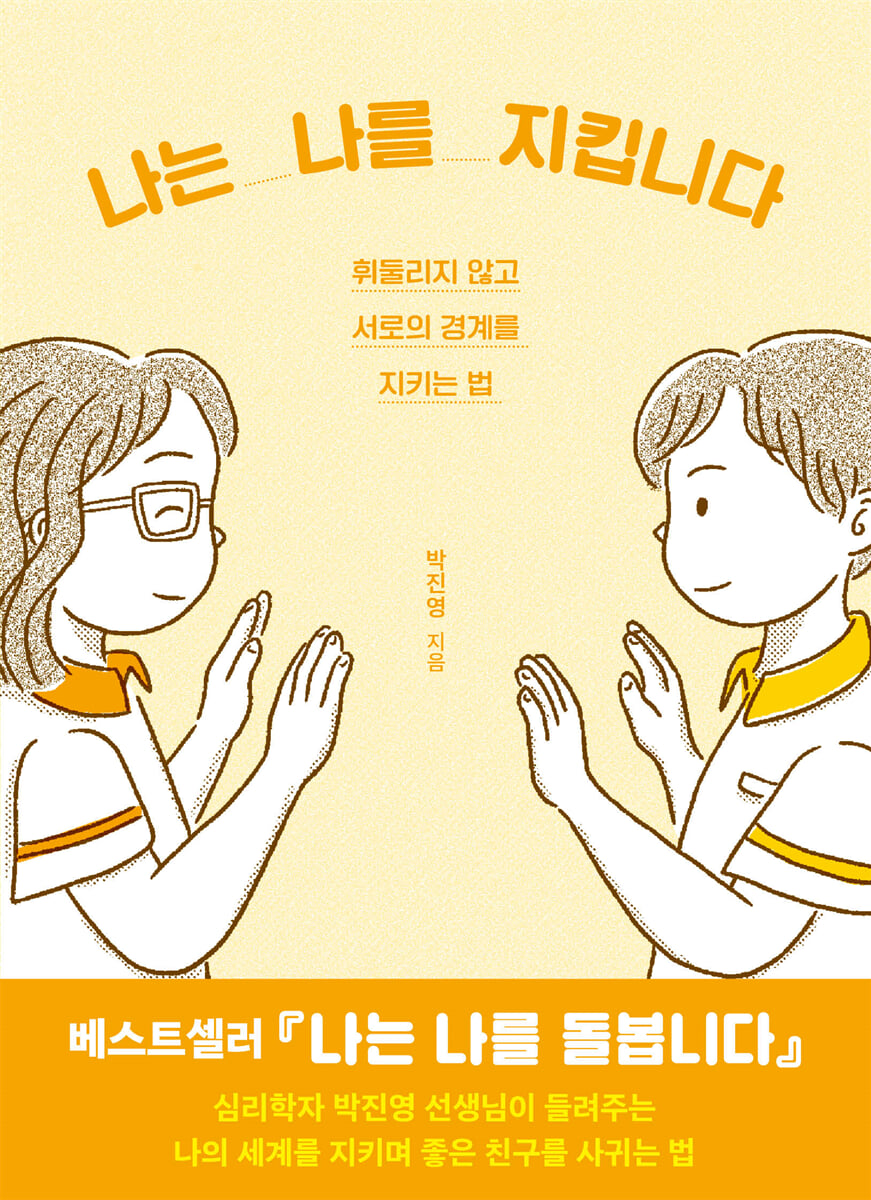
I protect myself
 |
Description
Book Introduction
“There are some relationships where you have to say no.”
Bestselling author of "I Take Care of Myself"
Psychologist Park Jin-young shares his lessons on respecting boundaries and protecting each other.
“Why do I keep getting swayed by others?”, “Can I refuse relationships that cross the line?”, “How can I protect myself from bad relationships?” As teenagers go through a period of growth and begin to experience dense human relationships with others, “I Protect Myself” is a book that informs teenagers that all relationships have a healthy distance and that they can live side by side, affectionately, and happily when they respect each other’s boundaries.
Psychologist Jinyoung Park, author of the best-selling book "I Take Care of Myself," which became a hot topic for suggesting "self-compassion" exercises for teenagers, suggests "setting boundaries" and "care for relationships" in this book to protect my world and become a good friend.
Among the various human relationships formed during adolescence, it is difficult to pinpoint exactly which ones, but there are bound to be some that feel uncomfortable.
There are friends who violate my autonomy even when choosing convenience store snacks, and there are also friends who force me to engage in unwanted physical contact, making me feel guilty.
Perhaps it is not as easy as it sounds for teenagers to firmly say “No” in an embarrassing situation they are experiencing for the first time in their lives.
While the author empathizes with the difficulty and discomfort of rejection, he conveys the message that we should first think about what we want from this relationship.
Only after exploring myself first can I understand the boundaries the other person desires, and further, reflect on whether I have ever violated their boundaries.
"I Protect Myself" not only provides concrete ways to explore your own boundaries and check your respect for others' boundaries, but also how to recognize what you want and make your voice heard.
Through this, we help young readers to protect their own world without being swayed by others, understand and respect the boundaries between themselves and others, and become valuable friends.
Bestselling author of "I Take Care of Myself"
Psychologist Park Jin-young shares his lessons on respecting boundaries and protecting each other.
“Why do I keep getting swayed by others?”, “Can I refuse relationships that cross the line?”, “How can I protect myself from bad relationships?” As teenagers go through a period of growth and begin to experience dense human relationships with others, “I Protect Myself” is a book that informs teenagers that all relationships have a healthy distance and that they can live side by side, affectionately, and happily when they respect each other’s boundaries.
Psychologist Jinyoung Park, author of the best-selling book "I Take Care of Myself," which became a hot topic for suggesting "self-compassion" exercises for teenagers, suggests "setting boundaries" and "care for relationships" in this book to protect my world and become a good friend.
Among the various human relationships formed during adolescence, it is difficult to pinpoint exactly which ones, but there are bound to be some that feel uncomfortable.
There are friends who violate my autonomy even when choosing convenience store snacks, and there are also friends who force me to engage in unwanted physical contact, making me feel guilty.
Perhaps it is not as easy as it sounds for teenagers to firmly say “No” in an embarrassing situation they are experiencing for the first time in their lives.
While the author empathizes with the difficulty and discomfort of rejection, he conveys the message that we should first think about what we want from this relationship.
Only after exploring myself first can I understand the boundaries the other person desires, and further, reflect on whether I have ever violated their boundaries.
"I Protect Myself" not only provides concrete ways to explore your own boundaries and check your respect for others' boundaries, but also how to recognize what you want and make your voice heard.
Through this, we help young readers to protect their own world without being swayed by others, understand and respect the boundaries between themselves and others, and become valuable friends.
- You can preview some of the book's contents.
Preview
index
Intro: Do you need to draw a line between your heart and your relationships?
Part 1: Cultivating Relationships That Respect Each Other's Boundaries
Part 2: Rejecting Harmful Relationships
Part 3: Why am I swayed by others?
Part 4: Can we really become friends?
Part 5: How to Be a Good Friend and Protect Yourself
Going Out: I Declare a Careful Relationship That Protects Me
Part 1: Cultivating Relationships That Respect Each Other's Boundaries
Part 2: Rejecting Harmful Relationships
Part 3: Why am I swayed by others?
Part 4: Can we really become friends?
Part 5: How to Be a Good Friend and Protect Yourself
Going Out: I Declare a Careful Relationship That Protects Me
Detailed image

Into the book
It's natural for social animals to be overly concerned with what other people think, to be overly concerned with what others think, and to be very curious about what other people think.
To build a good relationship, you need to know what you want, but you also need to know what the other person wants.
If you don't care at all about what other people think or how they feel about society, you might not notice that your friend is feeling down and might even annoy them by playing a boring prank on them.
--- p.14
Interestingly, when we talk about pain in relationships, we use the expression “I was hurt,” which applies to both the body and the mind.
Although wounds on the body are visible, and wounds on the mind are invisible, many cultures use the word "wound" to describe psychological distress.
The expression "hurt" appears more often when talking about distress arising from interpersonal relationships, rather than simply from anxious or stressful situations.
--- p.21
The key is not to dismiss "difference" as "mistake" by criticizing others for being so sensitive about the boundaries they each set.
If there's someone who keeps making me question whether I'm weird or not because of the lines I've drawn, that person might not respect me.
--- p.37
Violence in an intimate relationship may seem like an impossible thing to happen, but unfortunately, violence also occurs between lovers and family members.
As the saying goes, “I had no choice(?) because I loved him,” love and violence may seem like they don’t go together at first glance, but there are many cases where the two are naturally connected.
But remember, violence and love can never go together.
--- p.60
When you encounter a bullying situation, it's best to convey the message that such behavior is unacceptable by saying things like, "That's not right," "That's crossing the line," or "That's not funny at all," even if you're just passing by. If you find it difficult to express yourself, it's best to report the situation to someone in charge, such as a teacher or guidance counselor, who can mediate the situation.
--- p.67
At first glance, it may seem impossible for the invisible mind of another to become one with our own, but that is not the case.
Even though we can't know everything about another person's heart, it is possible to expand our inner intersections by sharing diverse experiences.
--- p.121
While it's important to recognize that trying to do well for everyone is an unrealistic goal and set realistic goals, it's also helpful to revise your standards for what constitutes "good."
Often, a strong bond in which you know everything about that person is considered the standard for a good relationship.
But as we've seen, the characteristics of relationships that truly contribute to quality of life vary from person to person.
Some people feel they need a certain amount of distance and their own space, even in relationships that seem supposed to be very intimate, and when they feel that these boundaries are violated, their happiness and relationship satisfaction decline.
To build a good relationship, you need to know what you want, but you also need to know what the other person wants.
If you don't care at all about what other people think or how they feel about society, you might not notice that your friend is feeling down and might even annoy them by playing a boring prank on them.
--- p.14
Interestingly, when we talk about pain in relationships, we use the expression “I was hurt,” which applies to both the body and the mind.
Although wounds on the body are visible, and wounds on the mind are invisible, many cultures use the word "wound" to describe psychological distress.
The expression "hurt" appears more often when talking about distress arising from interpersonal relationships, rather than simply from anxious or stressful situations.
--- p.21
The key is not to dismiss "difference" as "mistake" by criticizing others for being so sensitive about the boundaries they each set.
If there's someone who keeps making me question whether I'm weird or not because of the lines I've drawn, that person might not respect me.
--- p.37
Violence in an intimate relationship may seem like an impossible thing to happen, but unfortunately, violence also occurs between lovers and family members.
As the saying goes, “I had no choice(?) because I loved him,” love and violence may seem like they don’t go together at first glance, but there are many cases where the two are naturally connected.
But remember, violence and love can never go together.
--- p.60
When you encounter a bullying situation, it's best to convey the message that such behavior is unacceptable by saying things like, "That's not right," "That's crossing the line," or "That's not funny at all," even if you're just passing by. If you find it difficult to express yourself, it's best to report the situation to someone in charge, such as a teacher or guidance counselor, who can mediate the situation.
--- p.67
At first glance, it may seem impossible for the invisible mind of another to become one with our own, but that is not the case.
Even though we can't know everything about another person's heart, it is possible to expand our inner intersections by sharing diverse experiences.
--- p.121
While it's important to recognize that trying to do well for everyone is an unrealistic goal and set realistic goals, it's also helpful to revise your standards for what constitutes "good."
Often, a strong bond in which you know everything about that person is considered the standard for a good relationship.
But as we've seen, the characteristics of relationships that truly contribute to quality of life vary from person to person.
Some people feel they need a certain amount of distance and their own space, even in relationships that seem supposed to be very intimate, and when they feel that these boundaries are violated, their happiness and relationship satisfaction decline.
--- p.172
Publisher's Review
“There are some relationships where you have to say no.”
How to keep each other's boundaries without being swayed
How close does "intimacy" really mean? We often use terms like "family-like" or "tight" to describe the degree of intimacy or the narrowing of distance between people in interpersonal relationships.
However, according to several recent psychological studies, all relationships between people have boundaries, and the more people respect and maintain each other's boundaries, the higher the level of relationship satisfaction and the longer the relationship lasts.
For example, we often see each other linking arms as if it were natural since we are friends.
But what if one partner feels awkward and somewhat uncomfortable with physical contact, like linking arms? Even if it's uncomfortable, that partner might find it difficult to say "no" to their friend, so they might tolerate it.
However, if this uncomfortable situation repeats itself, it can cause discomfort or resentment to build up in your friend, and eventually, it can ruin your relationship with troubles such as misunderstandings or arguments.
The fact is that what is an expression of 'friendliness' to some may be 'uncomfortable' to others.
According to David Frost, a psychologist at Columbia University in the United States, each person actually desires different levels of intimacy in a relationship, and whether each person's boundaries are respected and maintained has a significant impact on their happiness.
The research team surveyed about 1,700 couples and found that people were less happy when they didn't feel as intimate as they wanted.
What's interesting is that even if they were lovers, if they felt that their partner was 'too' close to them than they wanted, they felt negative emotions such as depression and frustration.
During adolescence, when children are more interested in relationships with peers and dating boyfriends and girlfriends, they need to be wise and considerate in observing each other's boundaries.
This is because it allows us to maintain a valuable relationship with each other while not invading the boundaries of our friends, and protecting our world and boundaries without being swayed by others.
Author of the bestselling youth book, "I Take Care of Myself"
Psychologist Jinyoung Park tells us
A Declaration of "Respect for Boundaries" and "Caring for Relationships" for Youth
Jinyoung Park, who studies social psychology at Duke University in the United States, suggested 'self-compassion' practice for teenagers through his best-selling book 'I Take Care of Myself'.
Although our society has been obsessed with raising self-esteem, the advice to raise self-esteem can be toxic for teenagers who have difficulty in self-affirmation due to the extremely high internal and social standards, and the emphasis is on self-compassion and being generous to oneself.
In this book, “I Protect Myself,” the focus shifts from self-directedness to relationships, focusing on “respect for boundaries” and “care for relationships.”
Even in the friendships or romantic relationships we form during our teenage years, there are bound to be relationships that feel uncomfortable for some reason, relationships that infringe on our autonomy, even when it comes to choosing a menu at a convenience store, and relationships that force us to engage in unwanted physical contact, making us feel guilty instead.
The author says that what we must not forget in various relationships is the attitude of thinking about what we want from the relationship first, focusing on ourselves.
It's a message to explore yourself first and then reflect on what the other person wants and whether you've ever violated their boundaries.
The author cautions that forcing a "sticky" relationship on someone who wants to keep a reasonable distance is a violation of the other person's boundaries.
Conversely, my doctor advises me to examine whether I am forcing myself to tolerate people who keep approaching me without paying attention.
Because maintaining a happy relationship for both of you is possible when we observe, respect, and care for each other's boundaries.
“Can we be good friends?”
Drawing a line to protect myself
Respecting each other's boundaries
Through “I Protect Myself,” the author tells young people that they can protect themselves and build valuable relationships.
Perhaps, he advises, we need to 'draw lines' to protect ourselves, in addition to drawing lines to stop rude opponents.
Because I need to protect myself first and understand what I want before I can understand and respect the boundaries of others.
“Sometimes I feel like there’s not much I can do to make good friends, but that’s not true.
You will meet more and more different people in the future, and while there will be some who don't fit in well with you, there will certainly be many who do.
“You can look forward to it.”
- Writer Jinyoung Park (psychologist)
The author also offers a new perspective on the feelings of alienation, resentment, and loneliness we feel in relationships.
Although these negative emotions may seem unnecessary at first glance, it is explained that these very emotions are what lead us to strive to connect with others and increase intimacy in our relationships.
Just as we feel thirsty because our bodies lack water, if we need water but don't feel thirsty and don't drink it, our lives could be at risk.
Likewise, when we become isolated or neglect social interactions with others, feelings of loneliness and alienation within us signal us to pay more attention to forming good relationships.
In "I Protect Myself," the author presented various situations that young readers might encounter in their daily lives and discussed ways to respond to them.
The book contains various situations that teenagers may encounter for the first time, such as a friend who tells them their personal stories or secrets even though they are not close to them, a situation where they witness violence, big or small, in the classroom, and a lover who makes them feel guilty by saying things like, “You should allow this much in a relationship,” and demands physical contact that they do not want.
And in these situations, it contains specific methods to protect myself from being swayed by others, to recognize what I want, and to make my voice heard.
Each chapter ends with a "Try It" section, which includes a checklist to help young readers explore their own boundaries and check their respect for the boundaries of others.
How to keep each other's boundaries without being swayed
How close does "intimacy" really mean? We often use terms like "family-like" or "tight" to describe the degree of intimacy or the narrowing of distance between people in interpersonal relationships.
However, according to several recent psychological studies, all relationships between people have boundaries, and the more people respect and maintain each other's boundaries, the higher the level of relationship satisfaction and the longer the relationship lasts.
For example, we often see each other linking arms as if it were natural since we are friends.
But what if one partner feels awkward and somewhat uncomfortable with physical contact, like linking arms? Even if it's uncomfortable, that partner might find it difficult to say "no" to their friend, so they might tolerate it.
However, if this uncomfortable situation repeats itself, it can cause discomfort or resentment to build up in your friend, and eventually, it can ruin your relationship with troubles such as misunderstandings or arguments.
The fact is that what is an expression of 'friendliness' to some may be 'uncomfortable' to others.
According to David Frost, a psychologist at Columbia University in the United States, each person actually desires different levels of intimacy in a relationship, and whether each person's boundaries are respected and maintained has a significant impact on their happiness.
The research team surveyed about 1,700 couples and found that people were less happy when they didn't feel as intimate as they wanted.
What's interesting is that even if they were lovers, if they felt that their partner was 'too' close to them than they wanted, they felt negative emotions such as depression and frustration.
During adolescence, when children are more interested in relationships with peers and dating boyfriends and girlfriends, they need to be wise and considerate in observing each other's boundaries.
This is because it allows us to maintain a valuable relationship with each other while not invading the boundaries of our friends, and protecting our world and boundaries without being swayed by others.
Author of the bestselling youth book, "I Take Care of Myself"
Psychologist Jinyoung Park tells us
A Declaration of "Respect for Boundaries" and "Caring for Relationships" for Youth
Jinyoung Park, who studies social psychology at Duke University in the United States, suggested 'self-compassion' practice for teenagers through his best-selling book 'I Take Care of Myself'.
Although our society has been obsessed with raising self-esteem, the advice to raise self-esteem can be toxic for teenagers who have difficulty in self-affirmation due to the extremely high internal and social standards, and the emphasis is on self-compassion and being generous to oneself.
In this book, “I Protect Myself,” the focus shifts from self-directedness to relationships, focusing on “respect for boundaries” and “care for relationships.”
Even in the friendships or romantic relationships we form during our teenage years, there are bound to be relationships that feel uncomfortable for some reason, relationships that infringe on our autonomy, even when it comes to choosing a menu at a convenience store, and relationships that force us to engage in unwanted physical contact, making us feel guilty instead.
The author says that what we must not forget in various relationships is the attitude of thinking about what we want from the relationship first, focusing on ourselves.
It's a message to explore yourself first and then reflect on what the other person wants and whether you've ever violated their boundaries.
The author cautions that forcing a "sticky" relationship on someone who wants to keep a reasonable distance is a violation of the other person's boundaries.
Conversely, my doctor advises me to examine whether I am forcing myself to tolerate people who keep approaching me without paying attention.
Because maintaining a happy relationship for both of you is possible when we observe, respect, and care for each other's boundaries.
“Can we be good friends?”
Drawing a line to protect myself
Respecting each other's boundaries
Through “I Protect Myself,” the author tells young people that they can protect themselves and build valuable relationships.
Perhaps, he advises, we need to 'draw lines' to protect ourselves, in addition to drawing lines to stop rude opponents.
Because I need to protect myself first and understand what I want before I can understand and respect the boundaries of others.
“Sometimes I feel like there’s not much I can do to make good friends, but that’s not true.
You will meet more and more different people in the future, and while there will be some who don't fit in well with you, there will certainly be many who do.
“You can look forward to it.”
- Writer Jinyoung Park (psychologist)
The author also offers a new perspective on the feelings of alienation, resentment, and loneliness we feel in relationships.
Although these negative emotions may seem unnecessary at first glance, it is explained that these very emotions are what lead us to strive to connect with others and increase intimacy in our relationships.
Just as we feel thirsty because our bodies lack water, if we need water but don't feel thirsty and don't drink it, our lives could be at risk.
Likewise, when we become isolated or neglect social interactions with others, feelings of loneliness and alienation within us signal us to pay more attention to forming good relationships.
In "I Protect Myself," the author presented various situations that young readers might encounter in their daily lives and discussed ways to respond to them.
The book contains various situations that teenagers may encounter for the first time, such as a friend who tells them their personal stories or secrets even though they are not close to them, a situation where they witness violence, big or small, in the classroom, and a lover who makes them feel guilty by saying things like, “You should allow this much in a relationship,” and demands physical contact that they do not want.
And in these situations, it contains specific methods to protect myself from being swayed by others, to recognize what I want, and to make my voice heard.
Each chapter ends with a "Try It" section, which includes a checklist to help young readers explore their own boundaries and check their respect for the boundaries of others.
GOODS SPECIFICS
- Date of issue: February 29, 2024
- Page count, weight, size: 180 pages | 258g | 138*190*11mm
- ISBN13: 9791167552549
You may also like
카테고리
korean


korean

![GQ KOREA Mark (Monthly): December [2025]](http://librairie.coreenne.fr/cdn/shop/files/8ef265dbbfbf186523ed75ba7319009d.jpg?v=1765340328&width=3840)


