

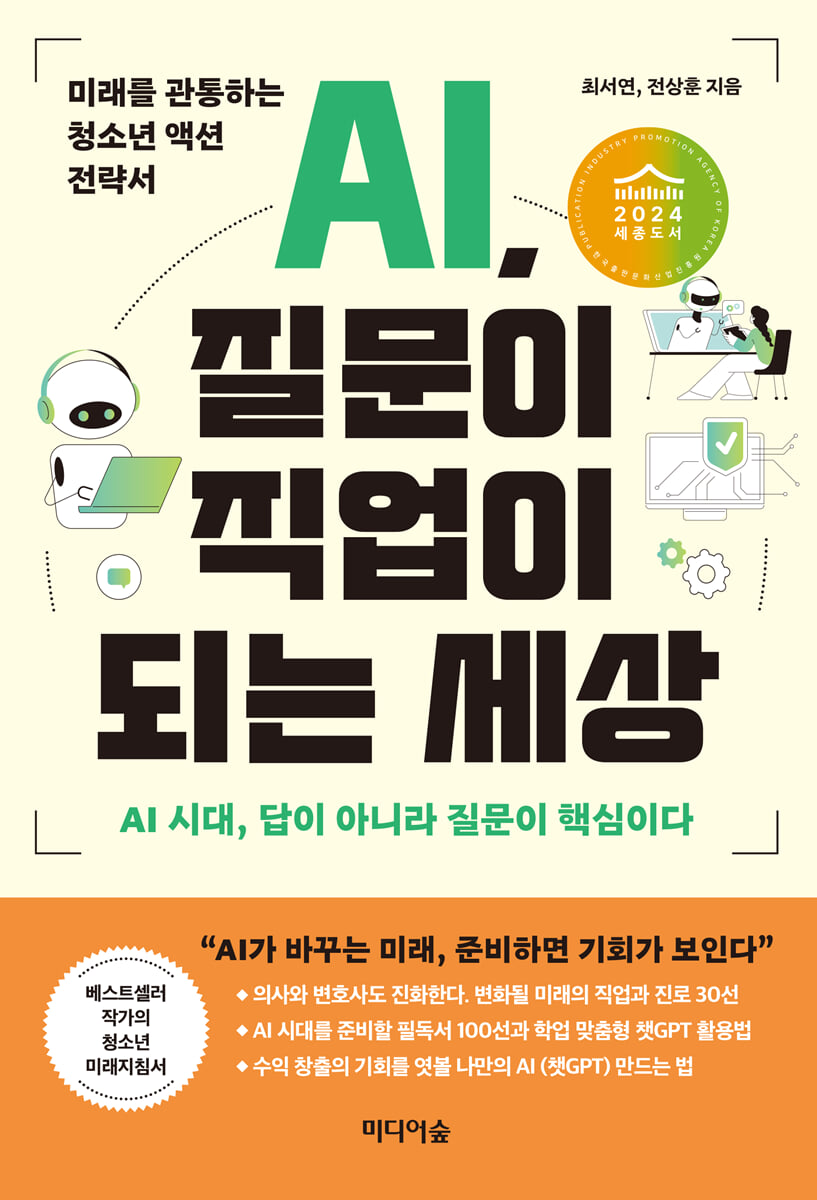
AI: A World Where Questions Become Your Job
 |
Description
Book Introduction
"The golden time to prepare for a future transformed by AI is running out." Even teenagers need to understand how AI will change the world. What should young people who will live in the AGI era prepare for and how? The authors of this book, Dr. Seo-yeon Choi and Dr. Sang-hoon Jeon, are practical future strategy experts who have been advocating for nearly a decade that we must prepare for the imminent era of artificial intelligence. They emphasize that even teenagers need to understand the world that artificial intelligence will change. I have given numerous lectures on artificial intelligence and future strategies, including ChatGPT, at educational offices, schools, government offices, and companies. In particular, his previously published book, "Chat GPT: A World Where Questions Become Money," received rave reviews from numerous readers and became a bestseller. His lectures also garnered great responses from people in their teens to their seventies. In particular, they wrote this book after experiencing the need for practical survival strategies and coping strategies that young people, who will have to live in the uncertain era of artificial intelligence, can face with confidence rather than fear while giving lectures. From ChatGPT, which has now become a part of our daily lives, to AGI (Artificial General Intelligence), which will soon surpass human intelligence, it explains the beginnings and history of artificial intelligence and presents a blueprint for the future. The study and career paths that will need to be redefined due to artificial intelligence are explained in an easy-to-understand way using real-life examples. Stories from theory and experience allow young people to see inside themselves. In addition, the book is filled with valuable information that young people cannot miss, such as an introduction to occupations that will change due to AI, how to use Chat GPT tailored to their studies, how to create your own Chat GPT, and 100 must-read books to prepare for the era of artificial intelligence. More importantly, it provides insights into what specific abilities, unlike in the past, humans need to cultivate to remain competitive and increase their value in a future society driven by artificial intelligence. After reading this book, you will gain the confidence that you can become a human being who can thrive even more successfully despite the onslaught of artificial intelligence, which will not only affect simple laborers but also professionals and artists. |
- You can preview some of the book's contents.
Preview
index
Prologue - The future never waits for us.
Part 1.
The AI world ahead
Chapter 1: The Future Generative AI Will Bring
.
Artificial Intelligence Takes a Leap Forward with Deep Learning
.
The Birth of AI That Sees, Hears, and Speaks
. AGI, surpassing humans
Chapter 2: Life in the Future - How AI is Changing Our Daily Lives
.
ChatGPT Embedded into Everyday Life
.
What Happens When AI and Self-Driving Cars Meet
.
Spatial computing that breaks down spatial boundaries
.
Artificial intelligence is a double-edged sword
Chapter 3: Jobs of the Future - Will My Job Be Safe?
.
3.41 million jobs will be lost
.
Professionals and artists are both at risk
.
The changes that will sweep through future jobs in 2030
.
What should we prepare for in the era of the gig economy?
. New jobs created in the AI era
.
5 Strategies for the Tech Freelance Era
.
Experience doesn't just mean trying.
Chapter 4: Future Education - Focusing on 'Questions' Rather Than Answers
.
Great Questions That Changed Human History
.
Wake up from your sleep
.
Why humanities?
Chapter 5: The Society of the Future - Is the Real Fake or the Fake Real?
.
Did President Zelensky really surrender?
.
Critical thinking is the future competitive edge.
.
Humanoid robots that are difficult to distinguish from humans
Part 2.
Become a valuable super individual
Chapter 1: Capabilities Required in the AI Era
Don't compete with AI, collaborate with it.
. 7 Essential Skills for the AI Era
.
The most human ability is the key
.
Problems that AI cannot solve yet
Chapter 2: Create Valuable Knowledge
.
Theory without experience is useless.
Practical knowledge becomes more important in the AI era.
.
Give meaning to knowledge
.
My own insight is my weapon.
Chapter 3: Big Picture Creativity Training: Becoming a Question Genius
.
People who don't ask questions
.
A Question That Keeps on Going: Big Picture Creativity Training
.
The answer lies with artificial intelligence
Chapter 4: Fusion of Fragmented Information
.
Why You Should Still Learn English
.
Fusion of fragmented information
.
7 Steps to Using the Scamper Technique
Part 3.
Become a potential hunter
Chapter 1: I Find My Potential
.
From apples to sommeliers
.
Smart Career Exploration - Leverage AI
.
1% ability is not 0%
Chapter 2: Stimulate My Curiosity
.
The End of Average
.
Being a model student in Korea
.
How to find what I like
Chapter 3: The Magic of Abundance through Lack
.
If you water the plant too much, it will die.
.
The magic of self-control that moves you forward
.
Ubermensch and Overman: The Superhuman Who Creates Value
Chapter 4: Change the way you do things
.
Studying how to change the final destination of a special express train
.
Why learning is fun
. Key to growing into an AI expert
.
AI in schools starting in 2025
.
Ride the wave of change
.
Break free from your comfort zone and embrace unfamiliar challenges.
Part 4.
Increase human value
Chapter 1: The Human Ability to Not Be Defeated by AI
.
Three days is four days?
. AI says, 'Father, go into the bag.'
.
A man can be destroyed but not defeated.
.
A special element that only humans can do
Chapter 2: The Power of Thought That Creates a Special Me
.
Contemplation is the process of finding the specialness within myself.
.
Reading is an artistic act that stimulates the inner self.
.
The 4-Step Reading-Thinking-Action Linking Strategy
Chapter 3: The Power of Debate to Develop Critical Thinking
.
Argument with airline staff
.
Critical thinking changes history
.
The secret to being a good debater
Chapter 4: The Power of Rest: Finding Irregular Patterns
.
I need my own siesta
.
Rest is also a strategy
.
Dreams move
.
Dream Action Plan Step 3
supplement
1.
ChatGPT question method
2.
Precautions when using ChatGPT
3.
How to Use ChatGPT Tailored for Academic Purposes
4.
Other useful types of generative AI to know about
5.
How to create your own profitable chat GPT and register it in the GPT Store.
6. 30 Job Changes (Evolution) in the AI Era
7. 100 Must-Read Books for the AI Era (100 Books to Improve Literacy)
Epilogue - The future always exceeds expectations.
Part 1.
The AI world ahead
Chapter 1: The Future Generative AI Will Bring
.
Artificial Intelligence Takes a Leap Forward with Deep Learning
.
The Birth of AI That Sees, Hears, and Speaks
. AGI, surpassing humans
Chapter 2: Life in the Future - How AI is Changing Our Daily Lives
.
ChatGPT Embedded into Everyday Life
.
What Happens When AI and Self-Driving Cars Meet
.
Spatial computing that breaks down spatial boundaries
.
Artificial intelligence is a double-edged sword
Chapter 3: Jobs of the Future - Will My Job Be Safe?
.
3.41 million jobs will be lost
.
Professionals and artists are both at risk
.
The changes that will sweep through future jobs in 2030
.
What should we prepare for in the era of the gig economy?
. New jobs created in the AI era
.
5 Strategies for the Tech Freelance Era
.
Experience doesn't just mean trying.
Chapter 4: Future Education - Focusing on 'Questions' Rather Than Answers
.
Great Questions That Changed Human History
.
Wake up from your sleep
.
Why humanities?
Chapter 5: The Society of the Future - Is the Real Fake or the Fake Real?
.
Did President Zelensky really surrender?
.
Critical thinking is the future competitive edge.
.
Humanoid robots that are difficult to distinguish from humans
Part 2.
Become a valuable super individual
Chapter 1: Capabilities Required in the AI Era
Don't compete with AI, collaborate with it.
. 7 Essential Skills for the AI Era
.
The most human ability is the key
.
Problems that AI cannot solve yet
Chapter 2: Create Valuable Knowledge
.
Theory without experience is useless.
Practical knowledge becomes more important in the AI era.
.
Give meaning to knowledge
.
My own insight is my weapon.
Chapter 3: Big Picture Creativity Training: Becoming a Question Genius
.
People who don't ask questions
.
A Question That Keeps on Going: Big Picture Creativity Training
.
The answer lies with artificial intelligence
Chapter 4: Fusion of Fragmented Information
.
Why You Should Still Learn English
.
Fusion of fragmented information
.
7 Steps to Using the Scamper Technique
Part 3.
Become a potential hunter
Chapter 1: I Find My Potential
.
From apples to sommeliers
.
Smart Career Exploration - Leverage AI
.
1% ability is not 0%
Chapter 2: Stimulate My Curiosity
.
The End of Average
.
Being a model student in Korea
.
How to find what I like
Chapter 3: The Magic of Abundance through Lack
.
If you water the plant too much, it will die.
.
The magic of self-control that moves you forward
.
Ubermensch and Overman: The Superhuman Who Creates Value
Chapter 4: Change the way you do things
.
Studying how to change the final destination of a special express train
.
Why learning is fun
. Key to growing into an AI expert
.
AI in schools starting in 2025
.
Ride the wave of change
.
Break free from your comfort zone and embrace unfamiliar challenges.
Part 4.
Increase human value
Chapter 1: The Human Ability to Not Be Defeated by AI
.
Three days is four days?
. AI says, 'Father, go into the bag.'
.
A man can be destroyed but not defeated.
.
A special element that only humans can do
Chapter 2: The Power of Thought That Creates a Special Me
.
Contemplation is the process of finding the specialness within myself.
.
Reading is an artistic act that stimulates the inner self.
.
The 4-Step Reading-Thinking-Action Linking Strategy
Chapter 3: The Power of Debate to Develop Critical Thinking
.
Argument with airline staff
.
Critical thinking changes history
.
The secret to being a good debater
Chapter 4: The Power of Rest: Finding Irregular Patterns
.
I need my own siesta
.
Rest is also a strategy
.
Dreams move
.
Dream Action Plan Step 3
supplement
1.
ChatGPT question method
2.
Precautions when using ChatGPT
3.
How to Use ChatGPT Tailored for Academic Purposes
4.
Other useful types of generative AI to know about
5.
How to create your own profitable chat GPT and register it in the GPT Store.
6. 30 Job Changes (Evolution) in the AI Era
7. 100 Must-Read Books for the AI Era (100 Books to Improve Literacy)
Epilogue - The future always exceeds expectations.
Detailed image
Into the book
- The pace of AI development may seem threatening.
However, it is preferable to view it as progress that naturally permeates our daily lives.
Artificial intelligence has long since left the realm of experts.
It is already affecting many aspects of our daily lives.
The question, “What can AI do?” is rapidly being redefined to encompass all human capabilities, signaling an era in which the lines between human and machine capabilities are blurring.
Now is the time to ask:
“When is a human being most human?”, “What can only humans do?”
- Questions are essential in generative AI such as ChatGPT.
ChatGPT's answers vary completely depending on the prompt.
Because we don't know what answers ChatGPT will come up with, it's important to be precise with the questions that lead to the answers.
A high level of critical thinking is required because if an unsatisfactory answer is given, you must continue to derive an answer.
If you want to get novel ideas, your questions have to be novel.
- The number of N-jobbers, such as freeters or tech freelancers (independent experts based on technology), who effectively utilize generative AI such as ChatGPT to connect their talents and hobbies to economic activities, will increase further.
As remote work and digital platforms become more prevalent, new skills and capabilities will be required.
Therefore, we must take these changes into account and focus on developing the skills and competencies needed for the future job market.
- The future of education in the age of artificial intelligence must focus on learning how to ask questions as much as finding answers.
Even if you feel like you already know enough, don't just move on. Ask yourself why it's like that, where it can be applied, whether there are other ways, and whether there were any errors in the times.
Inquiry-based learning encourages deeper exploration of knowledge and fosters creative and self-directed learning skills.
- We need to change our habits of finding the right answer.
The habit of finding the right answer as if solving a test paper is unnecessary in a world where there are no right answers.
There are no right or wrong questions.
So no one can judge right or wrong.
Questions are like snowmen; the more you ask them, the bigger they become, no matter which way they roll.
By breaking the established answers, established directions, and established rules, you can feel the freedom of questioning.
Let's take our first step as 'questioners' rather than hunters seeking answers in a world full of questions.
- For raw knowledge to become valuable knowledge, what is in your head must come out.
Knowledge cannot be acquired simply by storing it in the head, that is, in the brain.
Only when you encounter a problem and use critical thinking to find a solution, when you combine knowledge and experience to come up with creative ideas, or when you find a new solution with deep patience and thought and then put it into action can you truly say that you have "knowledge."
The problem-solving skills and insights gained through mistakes and failures are the best value-added process.
- Being proficient in English allows individuals to participate effectively in a variety of international situations, including collaboration and research, as well as extensive data collection and access to information.
English is a gateway to accessing IT technology.
AI tools are primarily developed and optimized for English.
Mastering English opens up opportunities to more effectively utilize cutting-edge technologies and tools. English in the AI era isn't just for communication.
This means maximizing the potential of technological advancements, engaging in global discourse, and enhancing personal and professional development in an increasingly interconnected world. In the age of AI, English is essential for survival.
- Nvidia Chairman Jensen Huang said, “It’s not AI that threatens your job, it’s the people who use AI.”
Aristotle claimed, “Curiosity is what makes humans human,” and Einstein said, “I am not a genius.
“I’m just curious,” he said.
In particular, Greg Orme, a lecturer at London Business School, said that human curiosity is the only superpower that can beat machines.
- Dreams move.
Dreams and goals are not something that can be achieved by setting a destination and ending there.
As information and experience increase, things change and become slightly different.
In the long run, it would be a good idea to first make a plan for what kind of person you want to be and what kind of life you want to live.
And it's also a good idea to open up various paths to unfold it and set a middle ground.
As you steadily walk along this path, you will realize how precious the existence of today and the value of time are.
However, it is preferable to view it as progress that naturally permeates our daily lives.
Artificial intelligence has long since left the realm of experts.
It is already affecting many aspects of our daily lives.
The question, “What can AI do?” is rapidly being redefined to encompass all human capabilities, signaling an era in which the lines between human and machine capabilities are blurring.
Now is the time to ask:
“When is a human being most human?”, “What can only humans do?”
- Questions are essential in generative AI such as ChatGPT.
ChatGPT's answers vary completely depending on the prompt.
Because we don't know what answers ChatGPT will come up with, it's important to be precise with the questions that lead to the answers.
A high level of critical thinking is required because if an unsatisfactory answer is given, you must continue to derive an answer.
If you want to get novel ideas, your questions have to be novel.
- The number of N-jobbers, such as freeters or tech freelancers (independent experts based on technology), who effectively utilize generative AI such as ChatGPT to connect their talents and hobbies to economic activities, will increase further.
As remote work and digital platforms become more prevalent, new skills and capabilities will be required.
Therefore, we must take these changes into account and focus on developing the skills and competencies needed for the future job market.
- The future of education in the age of artificial intelligence must focus on learning how to ask questions as much as finding answers.
Even if you feel like you already know enough, don't just move on. Ask yourself why it's like that, where it can be applied, whether there are other ways, and whether there were any errors in the times.
Inquiry-based learning encourages deeper exploration of knowledge and fosters creative and self-directed learning skills.
- We need to change our habits of finding the right answer.
The habit of finding the right answer as if solving a test paper is unnecessary in a world where there are no right answers.
There are no right or wrong questions.
So no one can judge right or wrong.
Questions are like snowmen; the more you ask them, the bigger they become, no matter which way they roll.
By breaking the established answers, established directions, and established rules, you can feel the freedom of questioning.
Let's take our first step as 'questioners' rather than hunters seeking answers in a world full of questions.
- For raw knowledge to become valuable knowledge, what is in your head must come out.
Knowledge cannot be acquired simply by storing it in the head, that is, in the brain.
Only when you encounter a problem and use critical thinking to find a solution, when you combine knowledge and experience to come up with creative ideas, or when you find a new solution with deep patience and thought and then put it into action can you truly say that you have "knowledge."
The problem-solving skills and insights gained through mistakes and failures are the best value-added process.
- Being proficient in English allows individuals to participate effectively in a variety of international situations, including collaboration and research, as well as extensive data collection and access to information.
English is a gateway to accessing IT technology.
AI tools are primarily developed and optimized for English.
Mastering English opens up opportunities to more effectively utilize cutting-edge technologies and tools. English in the AI era isn't just for communication.
This means maximizing the potential of technological advancements, engaging in global discourse, and enhancing personal and professional development in an increasingly interconnected world. In the age of AI, English is essential for survival.
- Nvidia Chairman Jensen Huang said, “It’s not AI that threatens your job, it’s the people who use AI.”
Aristotle claimed, “Curiosity is what makes humans human,” and Einstein said, “I am not a genius.
“I’m just curious,” he said.
In particular, Greg Orme, a lecturer at London Business School, said that human curiosity is the only superpower that can beat machines.
- Dreams move.
Dreams and goals are not something that can be achieved by setting a destination and ending there.
As information and experience increase, things change and become slightly different.
In the long run, it would be a good idea to first make a plan for what kind of person you want to be and what kind of life you want to live.
And it's also a good idea to open up various paths to unfold it and set a middle ground.
As you steadily walk along this path, you will realize how precious the existence of today and the value of time are.
--- From the text
Publisher's Review
“300 million jobs will disappear!”
-Goldman Sachs report
What are you preparing for the era of generative AI?
How to Become an Irreplaceable Talent for Youth
The Bank of Korea predicted that 3.41 million jobs in our society will disappear due to artificial intelligence in 2023.
IBM, a global IT giant, has announced that it will no longer hire people for jobs that could be replaced by artificial intelligence. This could lead to the loss of as many as 7,800 jobs within IBM alone.
Goldman Sachs predicted that generative AI like ChatGPT could threaten 300 million jobs in the US and EU alone.
Many experts predict that white-collar workers in professional occupations are actually more at risk.
On the other hand, even if artificial intelligence technology develops further in the future, there are still things that are evaluated as something that only humans can do.
In these types of jobs, artificial intelligence could help humans maximize work efficiency.
The World Economic Forum also released a report stating that artificial intelligence technology innovation will create 69 million new jobs over the next five years.
Artificial intelligence has already penetrated our daily lives and is changing the way we live.
In this era of great change, where things change so rapidly, today's ways quickly become the ways of the past.
Therefore, it is by no means easy to devise a new survival strategy in this chaos.
The authors, Korea's leading practical future strategists, clearly present a direction for coping with an uncertain future and practical survival strategies for young people living in the AI heyday.
“3.41 million jobs, including high-income professionals, are likely to be replaced by artificial intelligence.”
Bank of Korea 2023 Report, "AI and Labor Market Changes"
“Generative AI will threaten 300 million jobs in the US and EU alone.”
- Goldman Sachs March 2023 Investment Report
“In the future, we will not hire people for jobs that can be replaced by artificial intelligence.
“We plan to entrust 7,800 in-house jobs to AI in the future.”
-Arvind Krishna, IBM Chairman
“Over the five years from 2023 to 2027, 69 million jobs will be created and 83 million jobs will disappear.”
- World Economic Forum 2023 Report, "The Future of Jobs"
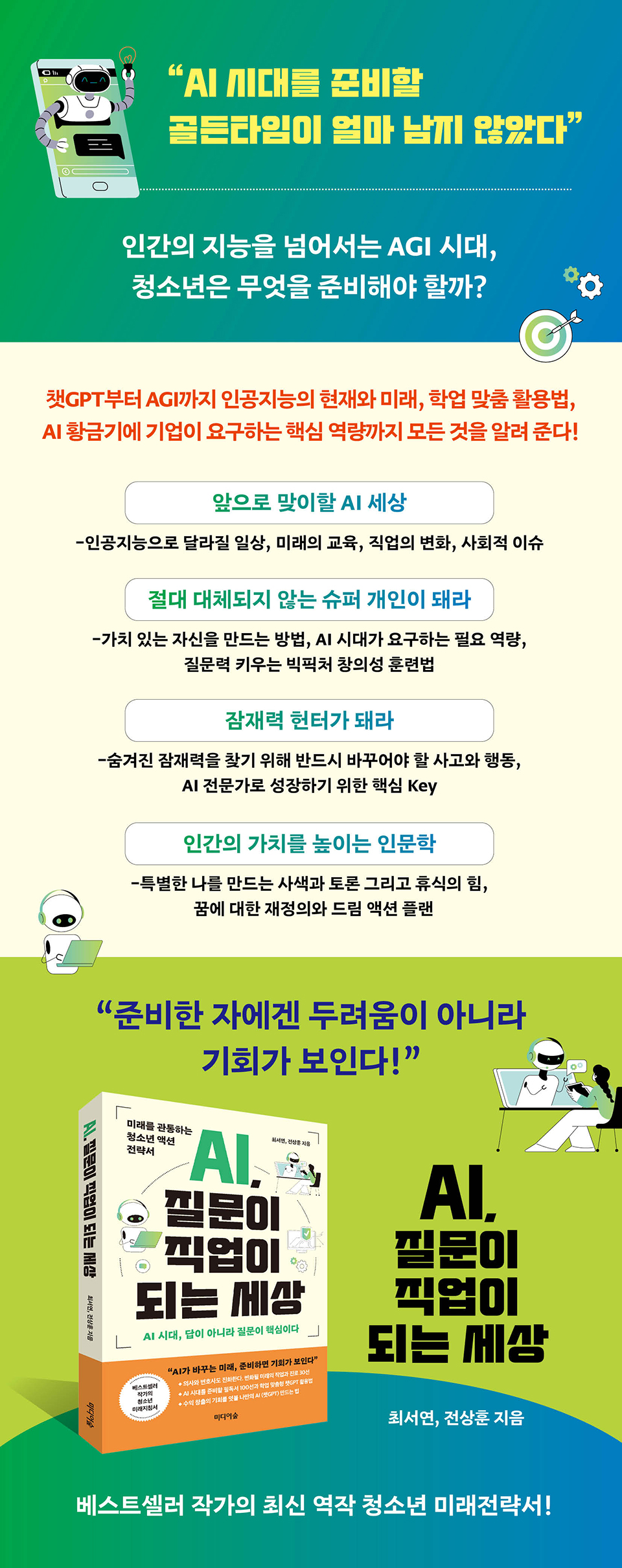
From ChatGPT to AGI, AI is transforming education, jobs, and society.
The golden age of AI: Everything you need to know about the core competencies young people need to develop!
Part 1 describes the future of education, changes in jobs, social issues, and changes in daily life, while depicting the world that will be ushered in by artificial intelligence such as ChatGPT.
Part 2 will cover how to create a valuable self, future capabilities required in the AI era, valuable knowledge, and the secret to asking penetrating questions: Big Picture Creativity Training.
Part 3 discusses changes in thinking and behavior to discover one's hidden potential, covering the dos and don'ts of preparing to adapt to the future AI society, and guides readers through various examples of future survival strategies in the era of generative AI.
The final Part 4 explores the importance of rest, redefining dreams, and provides practical, actionable reflection notebook samples.
It deals with how to develop literacy skills that humans can demonstrate when they are at their most human.
In addition, the appendix introduces how to use ChatGPT, a customized academic tool, questioning methods and precautions, 100 books to improve literacy in the AI era, and 30 occupations that will change in the AI era.
The authors urge young people living in today's era to understand the trends of the times, anticipate potential developments, and be bold in changing.
This book will help young people seeking their dreams and purpose in life not only survive the AI era but also become leaders who will lead change at the forefront.
-Goldman Sachs report
What are you preparing for the era of generative AI?
How to Become an Irreplaceable Talent for Youth
The Bank of Korea predicted that 3.41 million jobs in our society will disappear due to artificial intelligence in 2023.
IBM, a global IT giant, has announced that it will no longer hire people for jobs that could be replaced by artificial intelligence. This could lead to the loss of as many as 7,800 jobs within IBM alone.
Goldman Sachs predicted that generative AI like ChatGPT could threaten 300 million jobs in the US and EU alone.
Many experts predict that white-collar workers in professional occupations are actually more at risk.
On the other hand, even if artificial intelligence technology develops further in the future, there are still things that are evaluated as something that only humans can do.
In these types of jobs, artificial intelligence could help humans maximize work efficiency.
The World Economic Forum also released a report stating that artificial intelligence technology innovation will create 69 million new jobs over the next five years.
Artificial intelligence has already penetrated our daily lives and is changing the way we live.
In this era of great change, where things change so rapidly, today's ways quickly become the ways of the past.
Therefore, it is by no means easy to devise a new survival strategy in this chaos.
The authors, Korea's leading practical future strategists, clearly present a direction for coping with an uncertain future and practical survival strategies for young people living in the AI heyday.
“3.41 million jobs, including high-income professionals, are likely to be replaced by artificial intelligence.”
Bank of Korea 2023 Report, "AI and Labor Market Changes"
“Generative AI will threaten 300 million jobs in the US and EU alone.”
- Goldman Sachs March 2023 Investment Report
“In the future, we will not hire people for jobs that can be replaced by artificial intelligence.
“We plan to entrust 7,800 in-house jobs to AI in the future.”
-Arvind Krishna, IBM Chairman
“Over the five years from 2023 to 2027, 69 million jobs will be created and 83 million jobs will disappear.”
- World Economic Forum 2023 Report, "The Future of Jobs"
From ChatGPT to AGI, AI is transforming education, jobs, and society.
The golden age of AI: Everything you need to know about the core competencies young people need to develop!
Part 1 describes the future of education, changes in jobs, social issues, and changes in daily life, while depicting the world that will be ushered in by artificial intelligence such as ChatGPT.
Part 2 will cover how to create a valuable self, future capabilities required in the AI era, valuable knowledge, and the secret to asking penetrating questions: Big Picture Creativity Training.
Part 3 discusses changes in thinking and behavior to discover one's hidden potential, covering the dos and don'ts of preparing to adapt to the future AI society, and guides readers through various examples of future survival strategies in the era of generative AI.
The final Part 4 explores the importance of rest, redefining dreams, and provides practical, actionable reflection notebook samples.
It deals with how to develop literacy skills that humans can demonstrate when they are at their most human.
In addition, the appendix introduces how to use ChatGPT, a customized academic tool, questioning methods and precautions, 100 books to improve literacy in the AI era, and 30 occupations that will change in the AI era.
The authors urge young people living in today's era to understand the trends of the times, anticipate potential developments, and be bold in changing.
This book will help young people seeking their dreams and purpose in life not only survive the AI era but also become leaders who will lead change at the forefront.
GOODS SPECIFICS
- Date of issue: March 10, 2024
- Page count, weight, size: 272 pages | 496g | 153*225*16mm
- ISBN13: 9791158742157
- ISBN10: 1158742150
You may also like
카테고리
korean


korean

![GQ KOREA Mark (Monthly): December [2025]](http://librairie.coreenne.fr/cdn/shop/files/8ef265dbbfbf186523ed75ba7319009d.jpg?v=1765340328&width=3840)


