

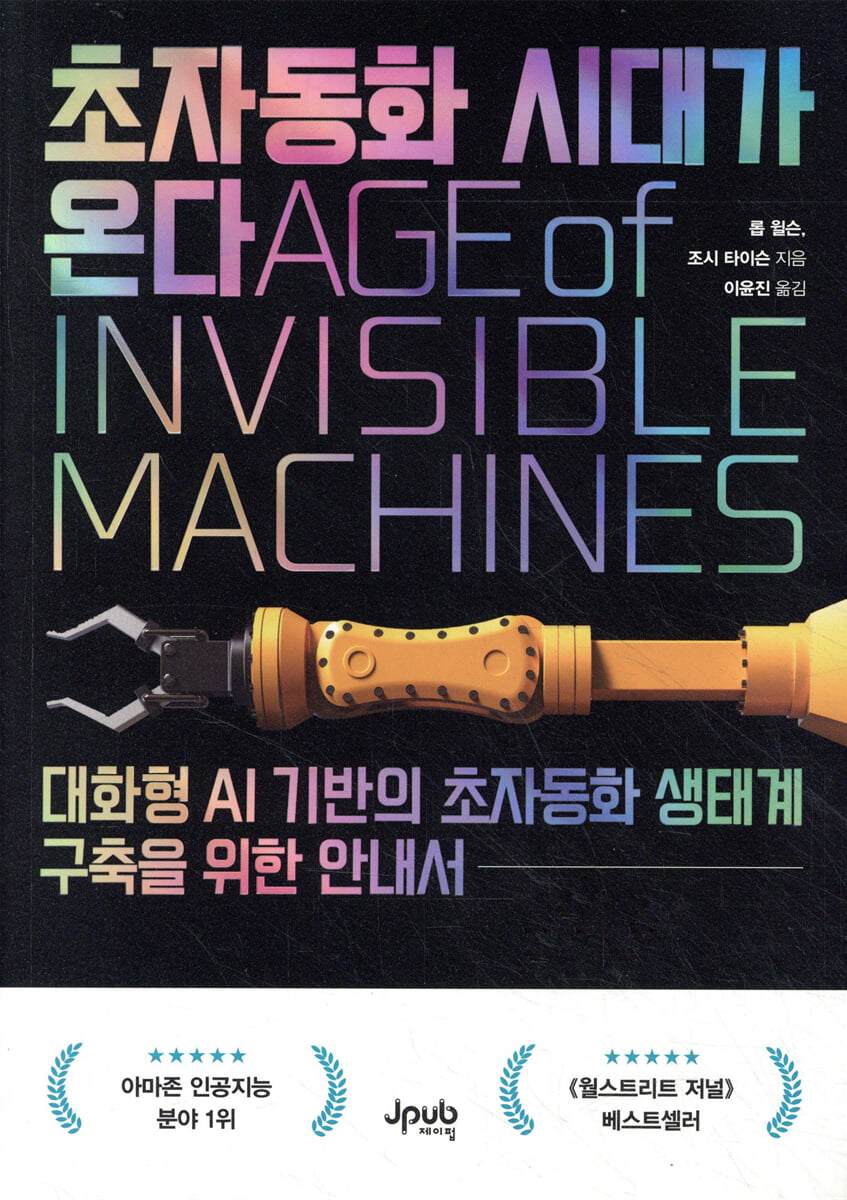
The era of hyperautomation is coming
 |
Description
Book Introduction
The Future of Every Business Is Changing with Conversational AI
As customer and employee interactions shift to digital in the wake of the pandemic, interest in hyperautomation has grown.
Noting that conversational AI is necessary to achieve and sustain hyperautomation, the authors explore the broad implications of conversational AI for businesses and humanity as a whole.
Drawing on over 20 years of insights from conversational AI, we'll show you how to leverage conversational user interfaces, composable architecture, and no-code creation to create a strategic environment where everyone can use technology effectively.
You'll also learn strategies for building a hyper-automation ecosystem that any business can implement immediately.
As customer and employee interactions shift to digital in the wake of the pandemic, interest in hyperautomation has grown.
Noting that conversational AI is necessary to achieve and sustain hyperautomation, the authors explore the broad implications of conversational AI for businesses and humanity as a whole.
Drawing on over 20 years of insights from conversational AI, we'll show you how to leverage conversational user interfaces, composable architecture, and no-code creation to create a strategic environment where everyone can use technology effectively.
You'll also learn strategies for building a hyper-automation ecosystem that any business can implement immediately.
- You can preview some of the book's contents.
Preview
index
Recommendation (Korean version) 10
Letter of Recommendation (Original) 14
About the Author and Translator 16
Starting with 18
Acknowledgements 22
About this book 24
PART 1: Imagining an Ecosystem of Intelligent Digital Workers 30
CHAPTER 1_ Hyperautomation has already begun 34
Hyperautomation minus the hype 39
Hyperautomation Brings Hyperinnovation 46
__Key Points 47
CHAPTER 2_ What is Conversational AI? 48
__51 Misconceptions About Conversational AI
__Key Points 59
CHAPTER 3_ Competition in the Age of Hyperautomation 60
__What successful hyperautomation looks like 62
Hyperautomation to Maintain Competitiveness 65
__Key Points 68
CHAPTER 4_ Ethics of Empirical AI 69
__How should we talk about AI? 78
__Key Points 79
CHAPTER 5_ How Hyperautomation Will Change the World 81
__Superautomatic 83 wielding a powerful axe
Where there's hyperautomation, there's hyperinnovation. 84
__This time it's the real Internet of Things 110
__Key Points 113
CHAPTER 6_ A Personal Journey 114
__Key Content 118
PART 2: Planning an Ecosystem for Intelligent Digital Workers 120
CHAPTER 7_ Understanding Terminology 125
__Key Content 133
CHAPTER 8_ Dreams and Reality 134
__Operating without a design strategy 136
__Key Content 139
CHAPTER 9_ Explaining Ecosystem Evolution 140
__Evolutionary Stage 142 of Intelligent Digital Workers
__Spending Quality Time with an Intelligent Digital Walker 143
__Case changes according to evolutionary stage 145
__Key Points 149
CHAPTER 10_ Team and Co-creation Mindset 150
__Team Introduction 153
__A Day in the Life of a Strategic Liaison 159
__Teams Should Practice 'Design Thinking' 163
__Key Content 166
CHAPTER 11_ Preparing Tools and Architecture 167
__Core Microservices 174
__Open systems are needed to orchestrate hyperautomation 178
__The key to feasibility is speed 187
__Key Points 199
CHAPTER 12_ Researching Suppliers 200
__Supplier Validity Test 201
__Don't overlook the user experience 206
__Key Content 209
CHAPTER 13_ Explaining the Strategy to Others 210
__Four Ways to Make Your Argument Stronger 213
__Persuasion Process 217
__Key Content 221
PART 3: Building an Ecosystem of Intelligent Digital Workers 222
CHAPTER 14_ Hyperautomation Process 225
Markov Chain 231
__Journey Map Creation 233
__Key Points 243
CHAPTER 15_ Design Strategies for Hyperautomation 244
Design for Human-Controlled Outcomes 247
Pattern Sequencing for a Successful Ecosystem 249
__Key Sequence Patterns for Conversational AI 252
__Pattern Utilization 265
__Key Content 265
CHAPTER 16_ Production Design for Hyperautomation 267
__It all depends on analysis and reporting 270
__Efforts toward Adaptive Design 273
__Best Practices for Analysis and Reporting 276
__Key Content 278
CHAPTER 17_ Best Practices for Interactive Design 279
__Two Important Ideas 300
__Production Design Checklist 303
PART 4 CONCLUSION 316
CHAPTER 18_ Where Should We Go? 318
References and Sites 327
Search 332
Letter of Recommendation (Original) 14
About the Author and Translator 16
Starting with 18
Acknowledgements 22
About this book 24
PART 1: Imagining an Ecosystem of Intelligent Digital Workers 30
CHAPTER 1_ Hyperautomation has already begun 34
Hyperautomation minus the hype 39
Hyperautomation Brings Hyperinnovation 46
__Key Points 47
CHAPTER 2_ What is Conversational AI? 48
__51 Misconceptions About Conversational AI
__Key Points 59
CHAPTER 3_ Competition in the Age of Hyperautomation 60
__What successful hyperautomation looks like 62
Hyperautomation to Maintain Competitiveness 65
__Key Points 68
CHAPTER 4_ Ethics of Empirical AI 69
__How should we talk about AI? 78
__Key Points 79
CHAPTER 5_ How Hyperautomation Will Change the World 81
__Superautomatic 83 wielding a powerful axe
Where there's hyperautomation, there's hyperinnovation. 84
__This time it's the real Internet of Things 110
__Key Points 113
CHAPTER 6_ A Personal Journey 114
__Key Content 118
PART 2: Planning an Ecosystem for Intelligent Digital Workers 120
CHAPTER 7_ Understanding Terminology 125
__Key Content 133
CHAPTER 8_ Dreams and Reality 134
__Operating without a design strategy 136
__Key Content 139
CHAPTER 9_ Explaining Ecosystem Evolution 140
__Evolutionary Stage 142 of Intelligent Digital Workers
__Spending Quality Time with an Intelligent Digital Walker 143
__Case changes according to evolutionary stage 145
__Key Points 149
CHAPTER 10_ Team and Co-creation Mindset 150
__Team Introduction 153
__A Day in the Life of a Strategic Liaison 159
__Teams Should Practice 'Design Thinking' 163
__Key Content 166
CHAPTER 11_ Preparing Tools and Architecture 167
__Core Microservices 174
__Open systems are needed to orchestrate hyperautomation 178
__The key to feasibility is speed 187
__Key Points 199
CHAPTER 12_ Researching Suppliers 200
__Supplier Validity Test 201
__Don't overlook the user experience 206
__Key Content 209
CHAPTER 13_ Explaining the Strategy to Others 210
__Four Ways to Make Your Argument Stronger 213
__Persuasion Process 217
__Key Content 221
PART 3: Building an Ecosystem of Intelligent Digital Workers 222
CHAPTER 14_ Hyperautomation Process 225
Markov Chain 231
__Journey Map Creation 233
__Key Points 243
CHAPTER 15_ Design Strategies for Hyperautomation 244
Design for Human-Controlled Outcomes 247
Pattern Sequencing for a Successful Ecosystem 249
__Key Sequence Patterns for Conversational AI 252
__Pattern Utilization 265
__Key Content 265
CHAPTER 16_ Production Design for Hyperautomation 267
__It all depends on analysis and reporting 270
__Efforts toward Adaptive Design 273
__Best Practices for Analysis and Reporting 276
__Key Content 278
CHAPTER 17_ Best Practices for Interactive Design 279
__Two Important Ideas 300
__Production Design Checklist 303
PART 4 CONCLUSION 316
CHAPTER 18_ Where Should We Go? 318
References and Sites 327
Search 332
Detailed image

Into the book
The technologies surrounding conversational AI are moving toward a convergence that will fundamentally change the relationship between people and machines.
The way customers and employees experience businesses is already being reshaped by the hallmarks of convergence, and massive amounts of data are being leveraged to disrupt entire industries.
This isn't much of an exaggeration, considering the subpar chatbot experience that permeates much of the current automation landscape around the world.
--- p.35
Indeed, successfully implementing conversational AI requires an open ecosystem built for hyperautomation.
High-level automation and continuous evolution become the norm through shared information libraries and code-free development tools in the ecosystem.
It is possible to build an ecosystem using technologies that are part of the existing ecosystem, but even then, it requires significant evolution.
Hyperautomation transforms the ecosystem from a scalable, application-based system with disparate graphical user interfaces to a technology- and feature-based system with a unified, conversational interface that connects everything.
To achieve hyperautomation, you need a platform that provides both freedom and flexibility.
(...) The significance of proper conversational AI is that it is not a simple technology, but rather part of a business strategy to build an ecosystem that automates tasks and processes in a way that surpasses human capabilities through the sequential application of various technologies.
Conversational AI isn't magic, but a combination of mathematics and logic that, when properly tuned, can eliminate all communication barriers between people and machines.
--- p.50
As hyperautomation tools and strategies are leveraged by large and small organizations, and even individuals, business and technology will swirl together, creating a fertile and dynamic new environment.
From a design perspective, experiences created through hyperautomation must have a clear goal of improving what only humans can do.
The core of what is being said is that the experience created through hyperautomation is a better-than-human experience (BtHX).
--- p.85
Let's assume that several machines are already running in your organization.
The system is likely not operating within a single ecosystem, but rather is the result of randomly executing chatbots.
These are typically multiple point-solution chatbots built using different architectures, rather than being part of an overall strategy.
The solution chatbot may have originated from an exploratory project.
It could be a chatbot that comes with an existing platform like ServiceNow or Salesforce, or someone might have decided to build a Q&A chatbot using a poorly designed FAQ collection tool.
--- p.136
Automation at scale can be achieved with microservices.
By breaking down skills into component services, and then breaking those down into component levels, you get a flexible and infinitely customizable set of microservices.
In an intelligent ecosystem, microservices can be pulled from anywhere in a shared library, modified, sequenced, and deployed, creating new automations and new microservices that can be continuously repeated, resequenced, and redeployed.
/ In terms of defining the form of the ecosystem, microservices are mapped to flows.
A sequential flow of microservices constitutes the services and skills that IDW leverages.
--- p.174
Conversational AI allows users to compare their experience using a solution to the experience they have when talking to another human being, rather than to their experience using other similar technologies.
The designer's job is not to mimic human interaction, but to design for a realm that goes far beyond human interaction.
The real value comes from sequencing technologies to design experiences that improve current workflows.
This is different from what many experience designers aim for.
In the realm of graphical user interfaces, designs that reduce friction and are unobtrusive are preferred.
While conversational design aims to do this, the overarching goal is to create experiences that contribute to a much larger web of environments and experiences.
The way customers and employees experience businesses is already being reshaped by the hallmarks of convergence, and massive amounts of data are being leveraged to disrupt entire industries.
This isn't much of an exaggeration, considering the subpar chatbot experience that permeates much of the current automation landscape around the world.
--- p.35
Indeed, successfully implementing conversational AI requires an open ecosystem built for hyperautomation.
High-level automation and continuous evolution become the norm through shared information libraries and code-free development tools in the ecosystem.
It is possible to build an ecosystem using technologies that are part of the existing ecosystem, but even then, it requires significant evolution.
Hyperautomation transforms the ecosystem from a scalable, application-based system with disparate graphical user interfaces to a technology- and feature-based system with a unified, conversational interface that connects everything.
To achieve hyperautomation, you need a platform that provides both freedom and flexibility.
(...) The significance of proper conversational AI is that it is not a simple technology, but rather part of a business strategy to build an ecosystem that automates tasks and processes in a way that surpasses human capabilities through the sequential application of various technologies.
Conversational AI isn't magic, but a combination of mathematics and logic that, when properly tuned, can eliminate all communication barriers between people and machines.
--- p.50
As hyperautomation tools and strategies are leveraged by large and small organizations, and even individuals, business and technology will swirl together, creating a fertile and dynamic new environment.
From a design perspective, experiences created through hyperautomation must have a clear goal of improving what only humans can do.
The core of what is being said is that the experience created through hyperautomation is a better-than-human experience (BtHX).
--- p.85
Let's assume that several machines are already running in your organization.
The system is likely not operating within a single ecosystem, but rather is the result of randomly executing chatbots.
These are typically multiple point-solution chatbots built using different architectures, rather than being part of an overall strategy.
The solution chatbot may have originated from an exploratory project.
It could be a chatbot that comes with an existing platform like ServiceNow or Salesforce, or someone might have decided to build a Q&A chatbot using a poorly designed FAQ collection tool.
--- p.136
Automation at scale can be achieved with microservices.
By breaking down skills into component services, and then breaking those down into component levels, you get a flexible and infinitely customizable set of microservices.
In an intelligent ecosystem, microservices can be pulled from anywhere in a shared library, modified, sequenced, and deployed, creating new automations and new microservices that can be continuously repeated, resequenced, and redeployed.
/ In terms of defining the form of the ecosystem, microservices are mapped to flows.
A sequential flow of microservices constitutes the services and skills that IDW leverages.
--- p.174
Conversational AI allows users to compare their experience using a solution to the experience they have when talking to another human being, rather than to their experience using other similar technologies.
The designer's job is not to mimic human interaction, but to design for a realm that goes far beyond human interaction.
The real value comes from sequencing technologies to design experiences that improve current workflows.
This is different from what many experience designers aim for.
In the realm of graphical user interfaces, designs that reduce friction and are unobtrusive are preferred.
While conversational design aims to do this, the overarching goal is to create experiences that contribute to a much larger web of environments and experiences.
--- p.246-247
Publisher's Review
Beyond Automation, Towards Hyper-Automation
Hyperautomation is not a choice, it's a survival requirement.
The pandemic has rapidly transformed not only businesses but also our daily lives into digital systems.
As large-scale language models have evolved, generative AI such as ChatGPT and Copilot have emerged, ushering in a new era.
Gartner, which has taken note of these rapid changes, defined "hyperautomation" as "automating more and more processes with minimal human intervention using artificial intelligence and machine learning," and selected it as one of the top 10 strategic technology trends.
The world is moving beyond automation to hyperautomation, and hyperautomation is no longer an option but a requirement for survival.
Anyone can implement a variety of innovative technologies without writing code, and achieve better automation than humans at all levels of society through conversational interfaces that require no training.
No need to navigate between applications or stop everything to find the correct password.
You can ask invisible machines for help through your phone, a nearby smart speaker, or a voice-enabled device.
In this paper, the authors provide insights gained over 20 years in the field of conversational AI, capturing its potential.
First, let's look at the concepts of hyperautomation and conversational AI and why they should be adopted.
Next, we explore the appropriate tools and architecture for building an intelligent digital ecosystem, as well as the role of organizations in determining the success of hyperautomation.
Here are a number of examples of successful hyper-automation adoption, including Ant Group, which has grown to the point where it is quickly catching up with global financial group JP Morgan Chase in terms of corporate value by successfully implementing conversational AI and machine learning, and Lemonade, an insurance company that provides Maya, a conversational AI that answers all questions 24 hours a day, 365 days a year.
Finally, we explain the components of an ecosystem for hyperautomating business processes, workflows, tasks, and communications, and the strategies for developing a hyperautomation ecosystem, divided into conversational design and production design.
By the time you finish this book, you'll know how to leverage this powerful technology and how it can empower your organization to become increasingly autonomous.
Hyperautomation is not a choice, it's a survival requirement.
The pandemic has rapidly transformed not only businesses but also our daily lives into digital systems.
As large-scale language models have evolved, generative AI such as ChatGPT and Copilot have emerged, ushering in a new era.
Gartner, which has taken note of these rapid changes, defined "hyperautomation" as "automating more and more processes with minimal human intervention using artificial intelligence and machine learning," and selected it as one of the top 10 strategic technology trends.
The world is moving beyond automation to hyperautomation, and hyperautomation is no longer an option but a requirement for survival.
Anyone can implement a variety of innovative technologies without writing code, and achieve better automation than humans at all levels of society through conversational interfaces that require no training.
No need to navigate between applications or stop everything to find the correct password.
You can ask invisible machines for help through your phone, a nearby smart speaker, or a voice-enabled device.
In this paper, the authors provide insights gained over 20 years in the field of conversational AI, capturing its potential.
First, let's look at the concepts of hyperautomation and conversational AI and why they should be adopted.
Next, we explore the appropriate tools and architecture for building an intelligent digital ecosystem, as well as the role of organizations in determining the success of hyperautomation.
Here are a number of examples of successful hyper-automation adoption, including Ant Group, which has grown to the point where it is quickly catching up with global financial group JP Morgan Chase in terms of corporate value by successfully implementing conversational AI and machine learning, and Lemonade, an insurance company that provides Maya, a conversational AI that answers all questions 24 hours a day, 365 days a year.
Finally, we explain the components of an ecosystem for hyperautomating business processes, workflows, tasks, and communications, and the strategies for developing a hyperautomation ecosystem, divided into conversational design and production design.
By the time you finish this book, you'll know how to leverage this powerful technology and how it can empower your organization to become increasingly autonomous.
GOODS SPECIFICS
- Date of issue: April 4, 2024
- Page count, weight, size: 336 pages | 468g | 152*215*16mm
- ISBN13: 9791192987910
You may also like
카테고리
korean


korean

![GQ KOREA Mark (Monthly): December [2025]](http://librairie.coreenne.fr/cdn/shop/files/8ef265dbbfbf186523ed75ba7319009d.jpg?v=1765340328&width=3840)


