

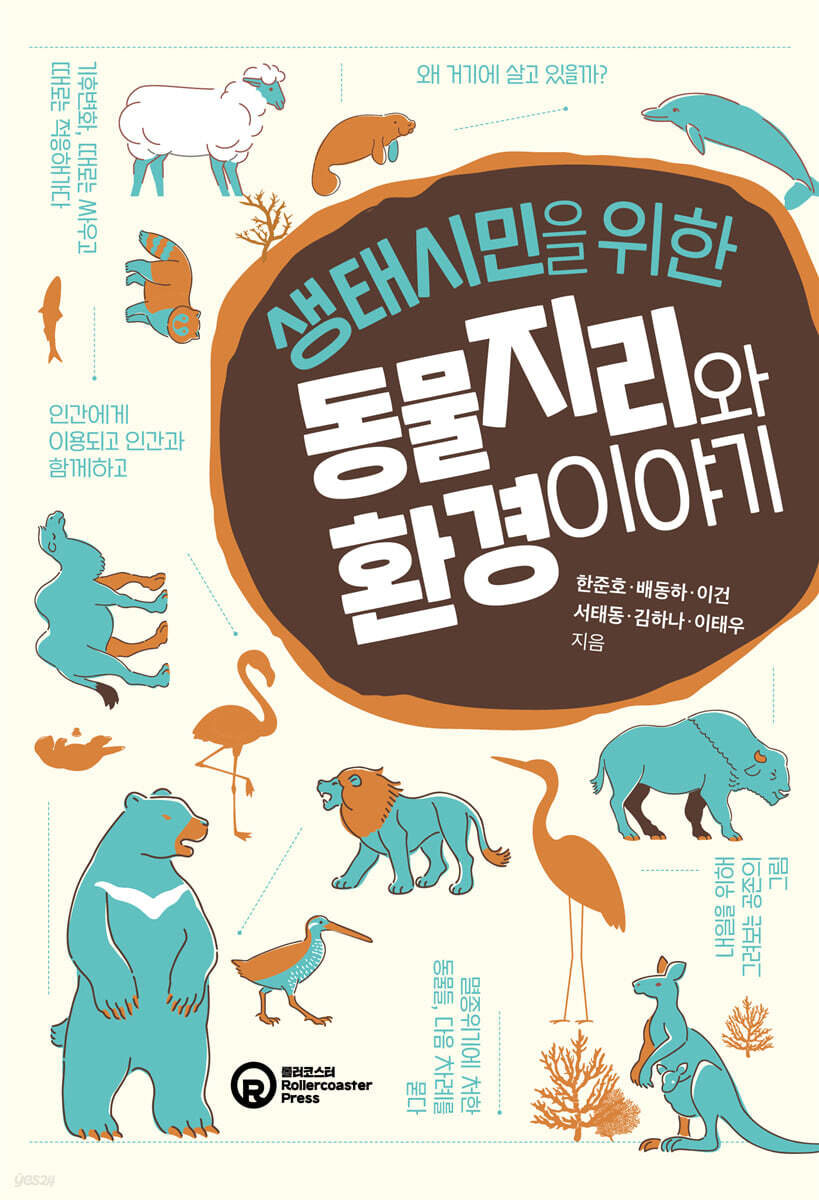
Animal geography and environmental stories for ecological citizens
 |
Description
Book Introduction
A Sustainable Geography Textbook for Eco-Citizens in the Anthropocene Era
Finding the right relationship between humans and animals and envisioning tomorrow's Earth environment.
This book was published in 2022 by teachers from the group 'Choi Ji-seon' (a group of geography teachers who do their best), who wrote 'Geography Stories of Non-existent Countries for Global Citizens', which became a steady seller in youth education books, and was published two years later. It deals with the topics of animals and the environment, which have recently become the subject of global interest.
How did animals, another species that coexist with humans on Earth, arrive at their current state? And how are they coping with an era of daily change driven by climate change? Six geography teachers, each actively involved in the field, selected 18 animals worthy of attention in the age of climate change. They examined their history, ecology, and current state through a geographical lens, exploring ways to protect the environment and coexist with humans within the ecosystem.
Finding the right relationship between humans and animals and envisioning tomorrow's Earth environment.
This book was published in 2022 by teachers from the group 'Choi Ji-seon' (a group of geography teachers who do their best), who wrote 'Geography Stories of Non-existent Countries for Global Citizens', which became a steady seller in youth education books, and was published two years later. It deals with the topics of animals and the environment, which have recently become the subject of global interest.
How did animals, another species that coexist with humans on Earth, arrive at their current state? And how are they coping with an era of daily change driven by climate change? Six geography teachers, each actively involved in the field, selected 18 animals worthy of attention in the age of climate change. They examined their history, ecology, and current state through a geographical lens, exploring ways to protect the environment and coexist with humans within the ecosystem.
- You can preview some of the book's contents.
Preview
index
Entering
[1] Why do you live there?
1 Honghak hates electric cars Honghak
The mountain range that sent whales into the river! The Amazon River Dolphin
3. Kangaroo Jumps: Is It a Good Meat to Eat?
[2] Climate change: Sometimes fighting, sometimes adapting
4 The white bear is actually the polar bear, the king of survival in the Arctic.
5 Don't come to our warm city anymore, White Heron
6. Herring, a fish that makes people laugh and cry due to climate change
7. The European bison emerged as a threat to climate change and became a force to combat it.
[3] Used by humans and together with humans
8. Through the coniferous forest to the sea in search of 'soft gold'
9 Animals, Are They Suitable for Coexistence? Sheep
10 Differences in Beliefs About Meat and Pork
11. Cows live on the 'roof of the world'? Yaks
[4] Endangered Animals Ask Who Will Be Next
12 Will I ever see you in the sea again? Coral
13 Which sea should I go to find the Little Mermaid?
14 The bird that crosses the world's largest hourglass, the Bar-tailed Godwit
[5] A picture of coexistence drawn for tomorrow
15 I want to be together again on the Korean Peninsula. Asiatic black bear
16 Man-made king, but it's dangerous outside the grasslands! Lion
17. The mischievous raccoon that adapted to climate change and took over the city.
Camels have traveled across 18 continents and continents.
References
annotation
Search
[1] Why do you live there?
1 Honghak hates electric cars Honghak
The mountain range that sent whales into the river! The Amazon River Dolphin
3. Kangaroo Jumps: Is It a Good Meat to Eat?
[2] Climate change: Sometimes fighting, sometimes adapting
4 The white bear is actually the polar bear, the king of survival in the Arctic.
5 Don't come to our warm city anymore, White Heron
6. Herring, a fish that makes people laugh and cry due to climate change
7. The European bison emerged as a threat to climate change and became a force to combat it.
[3] Used by humans and together with humans
8. Through the coniferous forest to the sea in search of 'soft gold'
9 Animals, Are They Suitable for Coexistence? Sheep
10 Differences in Beliefs About Meat and Pork
11. Cows live on the 'roof of the world'? Yaks
[4] Endangered Animals Ask Who Will Be Next
12 Will I ever see you in the sea again? Coral
13 Which sea should I go to find the Little Mermaid?
14 The bird that crosses the world's largest hourglass, the Bar-tailed Godwit
[5] A picture of coexistence drawn for tomorrow
15 I want to be together again on the Korean Peninsula. Asiatic black bear
16 Man-made king, but it's dangerous outside the grasslands! Lion
17. The mischievous raccoon that adapted to climate change and took over the city.
Camels have traveled across 18 continents and continents.
References
annotation
Search
Detailed image

Into the book
The Amazon river dolphin has developed a long-standing relationship with the indigenous people who have lived in the Amazon.
When heavy rains flood indigenous villages, Amazon river dolphins swim close to their homes.
Its cute appearance and tendency to follow people without being wary of them may have made it close to the natives.
The Amazonian indigenous people have many legends, especially those related to the Amazon river dolphin.
One of the most popular tales is about an Amazon river dolphin that transforms into a human and steals the souls of the natives or takes them to the enchanting underwater city of Encanchi.
--- From "The Mountain Range That Sent Whales to the River! _ Amazon River Dolphins"
In recent years, interest in the environment and ethics has been increasing.
The meat-eating culture that has existed since the beginning of human history poses a moral dilemma.
The dilemma of modern people wanting to eat meat while reducing their environmental burden has reached Australia, where a limited compromise seems to have been found in the form of kangaroo diets.
But in Australia, home to the world's largest commercial slaughter of terrestrial wildlife, views of kangaroos are multifaceted and conflicting.
--- From "The jumping kangaroo, is it a good meat to eat? _ Kangaroo"
Sea otters, once endangered due to excessive human greed, have been targeted for restoration after it became known that they have a significant impact on the ecosystem, and their population is gradually recovering.
Species that play a key role in maintaining the balance of the ecosystem, such as sea otters, are called 'keystone species.'
--- From "Through the coniferous forest to the sea in search of soft gold _ Sea Otter"
In Australia, the proportion of farms adopting painkillers and anesthetics for mulesing has increased significantly to over 86% (as of 2020) in line with the need to improve animal welfare, and various alternatives, such as using liquid nitrogen to cool the skin around the sheep's rump to reduce wrinkles, are steadily being introduced.
Which is more violent: infesting your body with maggots, cutting off the skin around your anus, or creating a species that cannot survive without you?
--- From "Are Animals Suitable for Coexistence? _ Sheep"
This culture is also related to India's climate.
India, which is part of monsoon Asia, is affected by the hot and humid climate caused by the hot and humid summer monsoon, and rice farming is actively carried out in river basins.
Because agriculture has developed and we can produce a wide variety of foods, with just a little effort, it is possible to survive on a vegetarian diet.
--- From "A Cow Lives on the Roof of the World? _ Yak"
When the Bar-tailed Godwit flies to New Zealand, it crosses the Pacific Ocean in one go, but there is one stop along the way to the Arctic coast.
This is the tidal flat on the west coast of our country.
They rest to replenish their energy before breeding in the Arctic coastal tundra.
If food is not readily available upon arrival in the Arctic coastal tundra, or if nesting and mate preparation are delayed longer than expected, it is necessary to replenish food at the staging area.
--- From "The bird that crosses the world's largest hourglass - the black-tailed godwit"
Umbrella species are species at the top of the ecosystem food chain.
Protecting relatively large, wide-ranging animals indirectly protects many other organisms that make up the ecosystem across a wide range of habitats.
It's like opening an umbrella and being able to shelter from the rain together under it.
The Asiatic black bear was selected as an animal that could have a positive and massive ripple effect on the entire Korean Peninsula ecosystem.
When heavy rains flood indigenous villages, Amazon river dolphins swim close to their homes.
Its cute appearance and tendency to follow people without being wary of them may have made it close to the natives.
The Amazonian indigenous people have many legends, especially those related to the Amazon river dolphin.
One of the most popular tales is about an Amazon river dolphin that transforms into a human and steals the souls of the natives or takes them to the enchanting underwater city of Encanchi.
--- From "The Mountain Range That Sent Whales to the River! _ Amazon River Dolphins"
In recent years, interest in the environment and ethics has been increasing.
The meat-eating culture that has existed since the beginning of human history poses a moral dilemma.
The dilemma of modern people wanting to eat meat while reducing their environmental burden has reached Australia, where a limited compromise seems to have been found in the form of kangaroo diets.
But in Australia, home to the world's largest commercial slaughter of terrestrial wildlife, views of kangaroos are multifaceted and conflicting.
--- From "The jumping kangaroo, is it a good meat to eat? _ Kangaroo"
Sea otters, once endangered due to excessive human greed, have been targeted for restoration after it became known that they have a significant impact on the ecosystem, and their population is gradually recovering.
Species that play a key role in maintaining the balance of the ecosystem, such as sea otters, are called 'keystone species.'
--- From "Through the coniferous forest to the sea in search of soft gold _ Sea Otter"
In Australia, the proportion of farms adopting painkillers and anesthetics for mulesing has increased significantly to over 86% (as of 2020) in line with the need to improve animal welfare, and various alternatives, such as using liquid nitrogen to cool the skin around the sheep's rump to reduce wrinkles, are steadily being introduced.
Which is more violent: infesting your body with maggots, cutting off the skin around your anus, or creating a species that cannot survive without you?
--- From "Are Animals Suitable for Coexistence? _ Sheep"
This culture is also related to India's climate.
India, which is part of monsoon Asia, is affected by the hot and humid climate caused by the hot and humid summer monsoon, and rice farming is actively carried out in river basins.
Because agriculture has developed and we can produce a wide variety of foods, with just a little effort, it is possible to survive on a vegetarian diet.
--- From "A Cow Lives on the Roof of the World? _ Yak"
When the Bar-tailed Godwit flies to New Zealand, it crosses the Pacific Ocean in one go, but there is one stop along the way to the Arctic coast.
This is the tidal flat on the west coast of our country.
They rest to replenish their energy before breeding in the Arctic coastal tundra.
If food is not readily available upon arrival in the Arctic coastal tundra, or if nesting and mate preparation are delayed longer than expected, it is necessary to replenish food at the staging area.
--- From "The bird that crosses the world's largest hourglass - the black-tailed godwit"
Umbrella species are species at the top of the ecosystem food chain.
Protecting relatively large, wide-ranging animals indirectly protects many other organisms that make up the ecosystem across a wide range of habitats.
It's like opening an umbrella and being able to shelter from the rain together under it.
The Asiatic black bear was selected as an animal that could have a positive and massive ripple effect on the entire Korean Peninsula ecosystem.
--- From "I want to be together again on the Korean Peninsula _ Asiatic Black Bear"
Publisher's Review
For ecological citizens living in the Anthropocene
The Anthropocene, a new geological epoch that follows the current Holocene, was first proposed by Dutch atmospheric chemist Paul Crutzen. It is a term that focuses on the massive impact that humans have had on the Earth's geology and ecosystem.
Global warming, loss of biodiversity, ocean pollution, waste problems, and deforestation, which are considered characteristics of the Anthropocene, are evidence of the enormous impact that humans have had on the planet on an unprecedented scale.
As consensus grows that the Earth is being destroyed by human activity, the term "Anthropocene" has become a globally accepted term, and scientists plan to officially declare the current era the "Anthropocene" at the International Congress of Geosciences to be held in Busan in 2024.
The very emergence of the new word 'Anthropocene' signifies that humanity has recognized that its activities could lead to a catastrophic future.
Humanity is attempting to create a sustainable Earth through various activities such as creating electric vehicles, separating waste, designating and managing endangered species, and launching the re100 campaign.
The fact that Korean students study about ecological citizenship at school can also be considered one of these activities.
This change in perception is also bringing about changes in our perspectives on and relationships with animals, and that is the starting point of this book.
Now, we have moved beyond the unilateral use of animals solely for the benefit of humans, and are now viewing animals as entities that coexist with us on Earth and protect the ecosystem.
Animals as the protagonists of geography!
We live in close interaction with animals.
In the nearest places, you can see companion animals living together, and you can easily see animals living together in ecosystems in the mountains and fields.
There are countless things, including the food we eat and the clothes we wear, that could not exist without animals.
In some areas, animals were used to transport people and goods, and in others, for farming.
Recently, interest in these animals has grown to the point where social discussions are taking place around topics such as fur, meat consumption, animal rights, and climate change.
All of these interactions between humans and animals and the processes by which they have adapted to the changing Earth are related to geography, and show that animals are a very important subject in discussing geography. However, animals have been only a supporting entity in geography classes in schools.
This book explains that animals are the main actors in creating the ecological environment, and actively introduces animals that are suffering from climate changes caused by human destruction of the environment, as well as animals that have been exploited and sacrificed by humans.
And it shows that if animals cannot survive, humans cannot survive either.
Through 18 different species of animals, ranging from those commonly seen around us to those living in environments completely different from ours, it points out the selfishness and errors of humanity and envisions a future where humans and animals coexist and create the Earth's ecosystem together.
Where animals cannot survive, humans cannot survive either.
The authors select 18 species of animals that can help us explore the ecological environment and sustainable Earth that animals and humans have created so far, and introduce them in five chapters.
In the first chapter, we explore the factors that influenced the appearance and habits of animals that pique human curiosity, such as flamingos, kangaroos, and Amazon river dolphins, as well as the regional characteristics.
Next, we introduce the history of polar bears, European bison, and other animals struggling to adapt to climate change caused by humans, and emphasize the severity of climate change that is pushing them into a survival crisis.
Chapters on sea otters, yaks, and sheep show the suffering animals have suffered and are currently experiencing due to the indiscriminate use of animals by humans that disrupts the balance of the ecosystem, and also discuss animal welfare and animal rights, which are currently being discussed in society.
The fourth chapter presents a warning to humanity from endangered corals and sea cows, as well as the severity of the environmental conditions that have driven them to a point of survival crisis.
Lastly, we will share the latest news on the Asiatic black bear restoration project in our country and the raccoon's expansion into urban areas, and also raise current concerns about the coexistence of humans and animals.
A geography textbook for young people that is both informative and interesting.
《Animal Geography and Environmental Stories for Ecological Citizens》 stands out for its easy-to-understand writing style and friendly explanations, befitting a youth education book.
However, just because the explanation is easy, we do not just skim over the basics.
It contains important examples and insights that will lead to a holistic explanation and a change in perspective that will make us realize that this is a global problem.
It uses everyday materials to easily explain important concepts, and it also freely moves across space and time to fully demonstrate the strengths and charms of geography.
It also actively showcases important concepts and unfamiliar cultures, such as umbrella species, keystone species, kangaroos, mulesing, and trophy hunting.
170 images, including photographs, drawings, maps, and diagrams, that aid in understanding the content help readers, from teenagers to adults, to easily access the book. Interesting content that can be easily accessed through media or daily life, such as the Little Mermaid from movies and legends, Coca-Cola commercials, Dua Lipa's music video, the animation "Bonobono," and the documentary "The Omnivore's Dilemma," are also used appropriately to attract readers' attention.
After reading this book, you will see the pets you have at home, the farm animals you meet at barns or ranches, the exhibit animals you see at zoos or aquariums, and the wild animals you encounter while walking around your neighborhood in a different light.
The Anthropocene, a new geological epoch that follows the current Holocene, was first proposed by Dutch atmospheric chemist Paul Crutzen. It is a term that focuses on the massive impact that humans have had on the Earth's geology and ecosystem.
Global warming, loss of biodiversity, ocean pollution, waste problems, and deforestation, which are considered characteristics of the Anthropocene, are evidence of the enormous impact that humans have had on the planet on an unprecedented scale.
As consensus grows that the Earth is being destroyed by human activity, the term "Anthropocene" has become a globally accepted term, and scientists plan to officially declare the current era the "Anthropocene" at the International Congress of Geosciences to be held in Busan in 2024.
The very emergence of the new word 'Anthropocene' signifies that humanity has recognized that its activities could lead to a catastrophic future.
Humanity is attempting to create a sustainable Earth through various activities such as creating electric vehicles, separating waste, designating and managing endangered species, and launching the re100 campaign.
The fact that Korean students study about ecological citizenship at school can also be considered one of these activities.
This change in perception is also bringing about changes in our perspectives on and relationships with animals, and that is the starting point of this book.
Now, we have moved beyond the unilateral use of animals solely for the benefit of humans, and are now viewing animals as entities that coexist with us on Earth and protect the ecosystem.
Animals as the protagonists of geography!
We live in close interaction with animals.
In the nearest places, you can see companion animals living together, and you can easily see animals living together in ecosystems in the mountains and fields.
There are countless things, including the food we eat and the clothes we wear, that could not exist without animals.
In some areas, animals were used to transport people and goods, and in others, for farming.
Recently, interest in these animals has grown to the point where social discussions are taking place around topics such as fur, meat consumption, animal rights, and climate change.
All of these interactions between humans and animals and the processes by which they have adapted to the changing Earth are related to geography, and show that animals are a very important subject in discussing geography. However, animals have been only a supporting entity in geography classes in schools.
This book explains that animals are the main actors in creating the ecological environment, and actively introduces animals that are suffering from climate changes caused by human destruction of the environment, as well as animals that have been exploited and sacrificed by humans.
And it shows that if animals cannot survive, humans cannot survive either.
Through 18 different species of animals, ranging from those commonly seen around us to those living in environments completely different from ours, it points out the selfishness and errors of humanity and envisions a future where humans and animals coexist and create the Earth's ecosystem together.
Where animals cannot survive, humans cannot survive either.
The authors select 18 species of animals that can help us explore the ecological environment and sustainable Earth that animals and humans have created so far, and introduce them in five chapters.
In the first chapter, we explore the factors that influenced the appearance and habits of animals that pique human curiosity, such as flamingos, kangaroos, and Amazon river dolphins, as well as the regional characteristics.
Next, we introduce the history of polar bears, European bison, and other animals struggling to adapt to climate change caused by humans, and emphasize the severity of climate change that is pushing them into a survival crisis.
Chapters on sea otters, yaks, and sheep show the suffering animals have suffered and are currently experiencing due to the indiscriminate use of animals by humans that disrupts the balance of the ecosystem, and also discuss animal welfare and animal rights, which are currently being discussed in society.
The fourth chapter presents a warning to humanity from endangered corals and sea cows, as well as the severity of the environmental conditions that have driven them to a point of survival crisis.
Lastly, we will share the latest news on the Asiatic black bear restoration project in our country and the raccoon's expansion into urban areas, and also raise current concerns about the coexistence of humans and animals.
A geography textbook for young people that is both informative and interesting.
《Animal Geography and Environmental Stories for Ecological Citizens》 stands out for its easy-to-understand writing style and friendly explanations, befitting a youth education book.
However, just because the explanation is easy, we do not just skim over the basics.
It contains important examples and insights that will lead to a holistic explanation and a change in perspective that will make us realize that this is a global problem.
It uses everyday materials to easily explain important concepts, and it also freely moves across space and time to fully demonstrate the strengths and charms of geography.
It also actively showcases important concepts and unfamiliar cultures, such as umbrella species, keystone species, kangaroos, mulesing, and trophy hunting.
170 images, including photographs, drawings, maps, and diagrams, that aid in understanding the content help readers, from teenagers to adults, to easily access the book. Interesting content that can be easily accessed through media or daily life, such as the Little Mermaid from movies and legends, Coca-Cola commercials, Dua Lipa's music video, the animation "Bonobono," and the documentary "The Omnivore's Dilemma," are also used appropriately to attract readers' attention.
After reading this book, you will see the pets you have at home, the farm animals you meet at barns or ranches, the exhibit animals you see at zoos or aquariums, and the wild animals you encounter while walking around your neighborhood in a different light.
GOODS SPECIFICS
- Date of issue: February 5, 2024
- Page count, weight, size: 348 pages | 490g | 140*205*21mm
- ISBN13: 9791191311396
You may also like
카테고리
korean


korean

![GQ KOREA Mark (Monthly): December [2025]](http://librairie.coreenne.fr/cdn/shop/files/8ef265dbbfbf186523ed75ba7319009d.jpg?v=1765340328&width=3840)


