

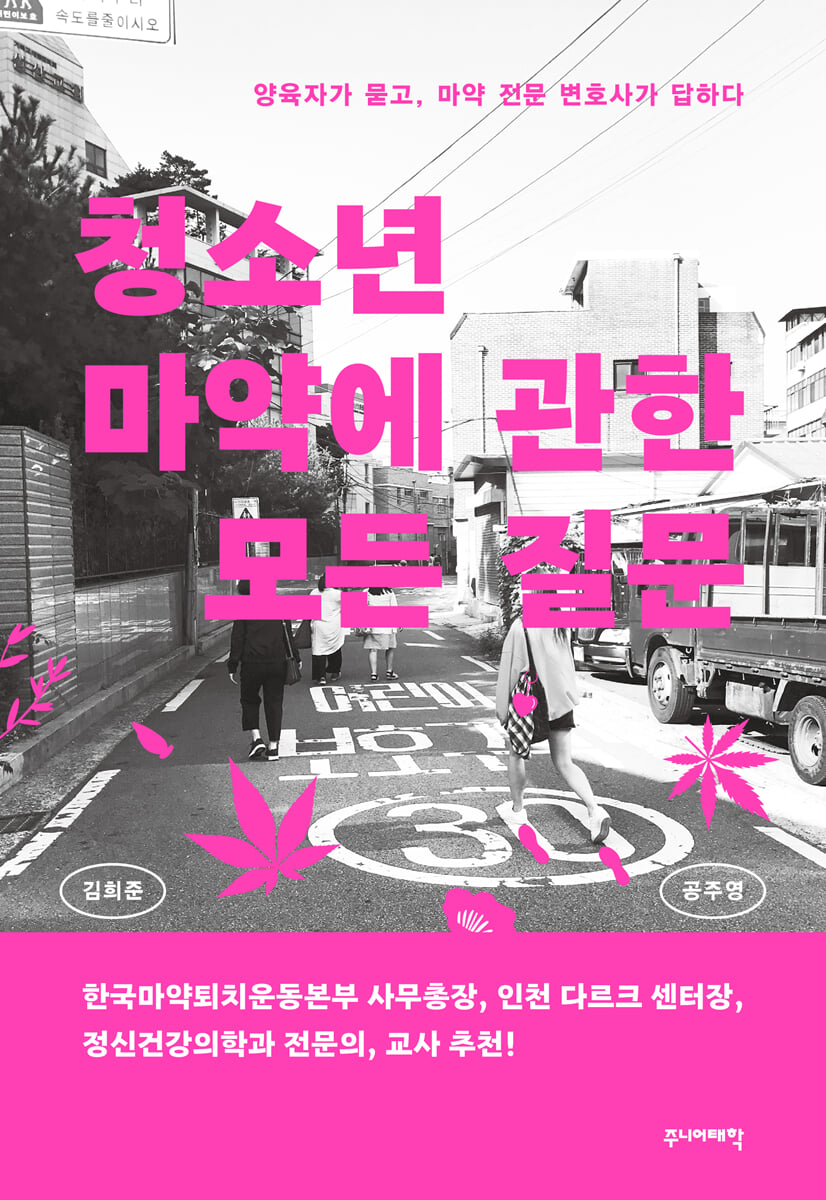
All your questions about youth drugs
 |
Description
Book Introduction
“Where do kids get drugs and become addicted?”
It's time to stop being complacent and take practical preventative measures!
The first book to highlight youth drug problems!
Parents Ask, Drug Attorneys Answer
"All Questions About Youth Drugs" is the first book in Korea to shed light on youth drug issues, and is written in a question-and-answer format between a parent of a teenage child and a drug lawyer.
The author, attorney Kim Hee-jun, worked in the violent crimes division for over 20 years.
He is a former prosecutor who is considered one of the best when it comes to drug issues.
He has spearheaded many drug cases, including the Jo Bong-haeng case, which is well known through the Netflix drama [Suriname], as well as cases in the Chinese underworld, entertainment industry, and white-collar industries.
It is widely known that he was the first to detect a new drug, GHB, and even gave it the name 'water mulberry'.
Propofol was also investigated for the first time in Korea and listed as a narcotic drug along with GHB, providing grounds for punishment.
Attorney Kim Hee-jun met many drug offenders while investigating drug cases, and met most of them again.
It has been repeatedly confirmed that once you start using drugs, it is difficult to quit.
The most common regret I heard from Jaebeom was, “If only someone had told me how dangerous drugs were, I wouldn’t have tried them.”
For some things, the best prevention is to never have a 'first', and that's the case with drugs.
Just a few years ago, drug addicts were mostly in their 40s, but now they are getting younger, in their 20s and even teenagers.
Preventive education is more important than ever.
This is why Attorney Kim wrote this book.
It's time to stop being complacent and take practical preventative measures!
The first book to highlight youth drug problems!
Parents Ask, Drug Attorneys Answer
"All Questions About Youth Drugs" is the first book in Korea to shed light on youth drug issues, and is written in a question-and-answer format between a parent of a teenage child and a drug lawyer.
The author, attorney Kim Hee-jun, worked in the violent crimes division for over 20 years.
He is a former prosecutor who is considered one of the best when it comes to drug issues.
He has spearheaded many drug cases, including the Jo Bong-haeng case, which is well known through the Netflix drama [Suriname], as well as cases in the Chinese underworld, entertainment industry, and white-collar industries.
It is widely known that he was the first to detect a new drug, GHB, and even gave it the name 'water mulberry'.
Propofol was also investigated for the first time in Korea and listed as a narcotic drug along with GHB, providing grounds for punishment.
Attorney Kim Hee-jun met many drug offenders while investigating drug cases, and met most of them again.
It has been repeatedly confirmed that once you start using drugs, it is difficult to quit.
The most common regret I heard from Jaebeom was, “If only someone had told me how dangerous drugs were, I wouldn’t have tried them.”
For some things, the best prevention is to never have a 'first', and that's the case with drugs.
Just a few years ago, drug addicts were mostly in their 40s, but now they are getting younger, in their 20s and even teenagers.
Preventive education is more important than ever.
This is why Attorney Kim wrote this book.
- You can preview some of the book's contents.
Preview
index
Chapter 1.
Drugs and narcotics
1.
First, what are drugs, and what is addiction?
2.
I heard that even 'study aid drugs' can be addictive. Is that true?
3.
They say drug addiction is a brain disease. What effect does it have on the brain?
4.
What are drugs?
5.
What is the difference between drugs and narcotics?
6.
What are psychotropic drugs?
7.
What is cannabis?
8.
Once you become addicted to drugs, it's almost impossible to quit. Why is that?
9.
What are the symptoms of addiction?
10.
They say teenagers get addicted more easily than adults. Why is that?
11.
What kind of drugs are mainly imported into our country?
12.
Will I be punished for possessing drugs or taking them once or twice?
13.
Are juveniles punished equally when they commit drug crimes?
*Read more - Youth-focused organizations you can turn to when you have concerns / How was the new drug "Mulbong" discovered? / Drug testing Q&A
Chapter 2.
Youth and Drugs
14.
What drugs do teenagers in our country mostly get addicted to?
15.
What are the main reasons why you use drugs?
16.
Why is a malfunction in the reward circuit more fatal for adolescents?
17.
How do teenagers usually get introduced to drugs?
18.
Where do you usually get your drugs?
19.
What can we do in our daily lives to prevent drug addiction?
20.
Is it really necessary to provide separate preventive education?
21.
What kind of training do you provide specifically?
22.
What is the government doing to prevent youth drug use?
23.
How do other countries provide preventive education?
*Read more - The History of Drugs in Korea / Interview with a School Nurse
Chapter 3.
pills
24 What should I do if I have ever used drugs?
25 Where can I get help if I think my child is addicted to drugs?
26 How should I respond when a friend offers me drugs?
27 Are adolescent addicts more difficult to treat than adults?
28 Where can I get treatment?
29.
When is it best to start treatment?
30.
What should I do if I am hesitant to seek treatment for fear that the fact of treatment will become known?
31.
Will my treatment records remain even after I become an adult?
32.
How can I prevent a relapse?
*Read more - How is drug addiction treated? / Is drug addiction a personal responsibility?
Drugs and narcotics
1.
First, what are drugs, and what is addiction?
2.
I heard that even 'study aid drugs' can be addictive. Is that true?
3.
They say drug addiction is a brain disease. What effect does it have on the brain?
4.
What are drugs?
5.
What is the difference between drugs and narcotics?
6.
What are psychotropic drugs?
7.
What is cannabis?
8.
Once you become addicted to drugs, it's almost impossible to quit. Why is that?
9.
What are the symptoms of addiction?
10.
They say teenagers get addicted more easily than adults. Why is that?
11.
What kind of drugs are mainly imported into our country?
12.
Will I be punished for possessing drugs or taking them once or twice?
13.
Are juveniles punished equally when they commit drug crimes?
*Read more - Youth-focused organizations you can turn to when you have concerns / How was the new drug "Mulbong" discovered? / Drug testing Q&A
Chapter 2.
Youth and Drugs
14.
What drugs do teenagers in our country mostly get addicted to?
15.
What are the main reasons why you use drugs?
16.
Why is a malfunction in the reward circuit more fatal for adolescents?
17.
How do teenagers usually get introduced to drugs?
18.
Where do you usually get your drugs?
19.
What can we do in our daily lives to prevent drug addiction?
20.
Is it really necessary to provide separate preventive education?
21.
What kind of training do you provide specifically?
22.
What is the government doing to prevent youth drug use?
23.
How do other countries provide preventive education?
*Read more - The History of Drugs in Korea / Interview with a School Nurse
Chapter 3.
pills
24 What should I do if I have ever used drugs?
25 Where can I get help if I think my child is addicted to drugs?
26 How should I respond when a friend offers me drugs?
27 Are adolescent addicts more difficult to treat than adults?
28 Where can I get treatment?
29.
When is it best to start treatment?
30.
What should I do if I am hesitant to seek treatment for fear that the fact of treatment will become known?
31.
Will my treatment records remain even after I become an adult?
32.
How can I prevent a relapse?
*Read more - How is drug addiction treated? / Is drug addiction a personal responsibility?
Detailed image

Into the book
People believe that ADHD medication will improve their attention and concentration, so they believe that this medication will help them study better, make them smarter, and improve their grades.
But what happens if a normal child takes these brain-altering medications? Symptoms like headaches and anxiety can occur, and in severe cases, hallucinations, delusions, and even suicide attempts can occur.
--- p.26
Online drug advertising is illegal.
Medicines cannot be sold online.
In particular, psychotropic drugs such as methylphenidate are illegal not only to advertise or sell, but also to purchase without a doctor's prescription.
--- p.28
A representative diet drug with strong addictive properties is phentermine.
Because the shape of the product resembles a butterfly, it is also called ‘butterfly medicine.’
Phentermine suppresses appetite by increasing the activity of neurotransmitters in the brain that make you feel less hungry or more full.
Because phentermine is highly addictive, it should only be taken for short periods of time, no longer than four weeks, and should not be taken with other appetite suppressants.
--- p.30
In English, drugs are expressed in two ways: narcotic and drug.
Narcotic comes from the Greek word narkotikos, meaning 'numb', and refers to a drug that has a sleeping and pain-relieving effect when taken in small doses, but is dangerous and habit-forming when taken in large doses.
--- p.43
Even if it is clearly a drug, if it is not registered as a narcotic under the law, it is difficult to legally regulate it under the principle of legality. Therefore, we must continuously strive to detect new drugs, and when detected, we must not miss the task of registering them under the law.
--- p.51
It is often said that narcotics, marijuana, and psychotropic drugs are all called drugs, but this is not an accurate term.
All three are collectively called 'narcotics'.
Drugs are a type of narcotic.
--- p.52
It's easy to think that the reason people can't quit drugs is because they're trying to increase their pleasure, but it's more accurate to say that it's because of the pain that accompanies withdrawal symptoms.
To escape that pain, they resort to drugs again.
So, it may be a big mistake to think that people use drugs for the feeling of happiness and thrill.
It is only for a very brief moment that a drug addict says he “floated up into the sky and glimpsed heaven.”
Because you will soon fall into hellish pain.
--- p.64
One of the side effects of methamphetamine is called 'meth mouth', which is a symptom that causes tooth decay.
When you use drugs, you become less able to pay attention to oral hygiene, such as brushing your teeth, and your salivary glands dry out, making you more prone to tooth decay.
If you become addicted, you will also grind your teeth severely.
It becomes an environment where it is difficult for natural teeth and gums to remain healthy.
'Meth bug' is a side effect that causes excessive scratching, which feels like bugs are crawling on the skin.
It leaves a bad scar.
--- p.66~67
When you use drugs, dopamine is secreted in excess, causing the system to malfunction.
What if the TV volume is too loud? Turn it down.
The brain also reduces the amount of dopamine it secretes when too much is produced.
Then, the small pleasures you used to feel in your daily life disappear, and you start using more drugs to get back the pleasure you felt when you first started using the drug.
If this happens repeatedly, the system will eventually break down.
--- p.69
During adolescence, the brain is still developing and is very flexible.
Therefore, they are more sensitive to external stimuli such as stress or drugs and are more susceptible to negative influences.
This is the background to why the brain of adolescents is more prone to addiction than the brain of adults.
Moreover, if you become addicted, problems with the development of the prefrontal cortex occur, and the symptoms become more severe.
--- p.71
That investigation prompted me to propose a legal amendment to list propofol as a narcotic, and it was registered as such in 2011.
Currently, propofol is classified as a psychotropic drug among narcotics.
Our country became the first country in the world to list propofol as a narcotic drug.
Currently, those who administer propofol for purposes other than medical purposes are also punished.
--- p.80~81
Recently, a consumer drug diagnostic kit has been released that can detect the presence of GHB in beverages or alcohol.
You can check by rubbing the drink on the sticker or dipping the test paper in the drink.
Preparing and checking these kits in advance can also be a way to prevent drug damage.
--- p.86
The fact that most drug offenders are in their 20s is evidence that many people have been exposed to drugs since their teens.
Among the teenage drug offenders recently caught are not only aspiring celebrities or children of the wealthy, but also many ordinary students.
As such, the problem of teenage drug use is very serious.
--- p.91
In the past, typical drug dealers, so-called 'pongjaengi', would meet face to face and make direct transactions.
Nowadays, with the development of the internet and social media, non-face-to-face transactions can be made through Telegram or the dark web.
This kind of environment is perfect for teenagers.
Investigative agencies, including the police and prosecutors, are working tirelessly to block cyber drug supply routes, but they are facing difficulties because most criminal servers are located overseas and drug offenders often engage in hit-and-run tactics, like guerrilla warfare.
--- p.96
The Narcotics Control Act provides for different statutory penalties depending on the type of drug and the type of crime.
In other words, the severity of the statutory sentence varies depending on whether the narcotic is a narcotic, a psychotropic drug, or marijuana, and whether the type of crime is simple administration, trafficking, provision, smuggling, or manufacturing.
Generally, the statutory penalties become heavier in the order of administration, possession, provision, sale, smuggling, and manufacturing.
--- p.99
Thailand has legalized the use of cannabis for medical and recreational purposes since June 2022.
But this doesn't mean that marijuana isn't dangerous or addictive.
Countries that have legalized marijuana have done so because the number of users has reached a point where the country cannot control it.
--- p.100
Hair grows on average about 1 centimeter per month.
The timing of administration is roughly estimated by how far the drug ingredient is detected from the hair root.
To accurately estimate the timing of medication, it is usually cut into 1 centimeter pieces, which is one month, and examined.
To perform this segmentation test, more than 300 hairs are required.
--- p.110
Even if you have bleached, dyed, or shaved your hair, there is no way to avoid testing if you have taken drugs.
If hair cannot be collected, the drug can also be found in fingernails, toenails, saliva, sweat, and dead skin cells.
Acts that cleverly try to avoid prosecution are considered destruction of evidence, which makes the crime worse and makes the offender appear to be unreflective, and therefore are punished more severely than those that confess and reflect.
--- p.113
The problem of fentanyl is particularly serious in the United States.
There is even a saying that you should not pick up folded bills that have fallen on the street.
Because there might be fentanyl powder in that bill.
This is because there have been many cases where people have died after the fentanyl powder was blown into the wind and entered the respiratory tract of the person who picked it up the moment the bill was opened.
There was even an incident where a police officer who was cracking down on a fentanyl offender collapsed after inhaling fentanyl powder that had been blown away during the crackdown.
Because of these risks, fentanyl is primarily used in microgram-dosed patches rather than in injection or powder form.
--- p.118
The actual location of 'Zombie Street' is Kensington, Philadelphia, Pennsylvania, USA.
I often show this street when warning people about the dangers of drugs, and everyone is shocked by the strange sight.
This street was called 'Zombie Street' because the drug addicts looked like zombies often seen in horror movies.
--- p.120
The 1970s were the golden age of marijuana.
It spread when US troops stationed in Korea came into contact with domestic marijuana.
During this period, a new drug was also being produced on a large scale domestically: methamphetamine, or heroin (philopon).
At that time, drugs were one of the important export items.
Hiropon was sold mainly in Japan.
--- p.124~125
Illegal drug dealers use youth as tools to obtain fentanyl.
They transport teenagers who pretend to be sick in vans and drive them to hospitals across the country where they can easily prescribe fentanyl.
They prescribe fentanyl to teenagers for fake pain, then buy the fentanyl from various pharmacies and distribute it for dozens of times the price.
They lure teenagers by offering them fentanyl or pocket money.
--- p.127
Drugs are usually delivered to buyers using the 'throw method'.
The throwing method is a method where drugs are hidden in a specific location that is difficult to find, such as a fire hydrant, gas meter, or air conditioner outdoor unit in a residential area, and when the buyer deposits the money, the buyer is given the coordinates of the location and told to go find it.
Suppliers and buyers never meet in person, and there are no records of communication such as phone calls or emails.
Drug trafficking is becoming increasingly sophisticated with the development of internet technology and the emergence of virtual currencies.
--- p.143
This means that the era in which drugs were secretly traded only in places like entertainment establishments through gangsters, as seen in dramas and movies, is no longer here.
If you're thinking, "How could teenagers get drugs and become addicted?", then you should be the one educating yourself about drugs.
--- p.152
Stimulant drugs such as cocaine, amphetamines, methamphetamine, and ecstasy cause increased activity and restless behavior.
I can't even sleep for a few nights.
Parents may also view this as a mental health issue.
So, if your child goes to the hospital and receives treatment without telling you that he or she is taking drugs, he or she may be misdiagnosed with bipolar disorder.
--- p.158
Currently, our country provides 10 hours of 'drug abuse prevention education' in schools every year.
At this time, we also provide drug prevention education.
But this is not enough.
While rehabilitation treatment is important, effective preventive education that blocks access to drugs is even more important, so it is essential to implement effective preventive education in schools.
--- p.163
The problem is out-of-school youth.
Children in school receive brief preventive education, but youth outside of school do not even have that opportunity.
The country will have to come up with countermeasures.
--- p.164
Parents might worry about giving their young children too much information about drugs, but teenagers are far more internet-savvy than adults.
Because young people have a faster ability to search and absorb information than adults, it is much safer to provide accurate information and knowledge through proper preventative education before they are exposed to misinformation.
--- p.166
I read an article that said there was a code of journalistic ethics for reporting on suicide.
I hope that those who report and produce drug-related news and content will give more thought to the harmful effects they can have on young people.
--- p.172
In our country, according to the Narcotics Control Act, not only taking drugs but also simply possessing them is punishable by imprisonment.
Even if you complain that it is your first offense and you only committed it once, you may be sentenced to a higher sentence than expected depending on the type of crime.
--- p.185
Another place to go is the Drug Addiction Rehabilitation Center, or DARC.
Dark is a private facility that helps drug addicts rehabilitate, and it is modeled after the Japanese Dark in the form of a group home.
Here, addicts live together 24 hours a day, helping each other rehabilitate.
--- p.189
There is no set treatment time for drug addiction, but as with all illnesses, it is best to begin treatment as soon as possible.
The more severe the addiction, the more difficult it becomes to treat it.
Once you start treatment, rather than being anxious about getting rid of the addiction all at once, you need to have the mindset to manage it continuously, like a chronic disease such as high blood pressure or diabetes.
--- p.204
In the early stages of drug addiction, many people try to treat themselves at home, but this is often unsuccessful.
It is recommended to receive systematic treatment with the help of a specialist doctor.
If the cause of addiction is psychological, then that part should be treated as well.
--- p.205
Many addicts believe that treatment is over once detoxification is complete.
They rationalize that they are not addicts and that they had no choice but to use drugs at the time for various reasons.
Many people stop taking the medication, but it doesn't take long before they fall back into the habit of taking the medication again.
Therefore, drug addiction treatment should be done step by step with a long-term perspective.
--- p.209
Mitchell Netburn, president of Samaritan Daytop Village, who visited Korea in July 2023 to discuss the opening of a drug addiction rehabilitation center in the Chungcheong region, said that drug addiction should be viewed as a “health” issue.
Comparing rehabilitation to cancer treatment, he emphasized, “Just as a person can relapse at any time 10 or 20 years after completing cancer treatment, we should not label someone who has completed a drug rehabilitation program a failure or a bad person if they try drugs again.”
But what happens if a normal child takes these brain-altering medications? Symptoms like headaches and anxiety can occur, and in severe cases, hallucinations, delusions, and even suicide attempts can occur.
--- p.26
Online drug advertising is illegal.
Medicines cannot be sold online.
In particular, psychotropic drugs such as methylphenidate are illegal not only to advertise or sell, but also to purchase without a doctor's prescription.
--- p.28
A representative diet drug with strong addictive properties is phentermine.
Because the shape of the product resembles a butterfly, it is also called ‘butterfly medicine.’
Phentermine suppresses appetite by increasing the activity of neurotransmitters in the brain that make you feel less hungry or more full.
Because phentermine is highly addictive, it should only be taken for short periods of time, no longer than four weeks, and should not be taken with other appetite suppressants.
--- p.30
In English, drugs are expressed in two ways: narcotic and drug.
Narcotic comes from the Greek word narkotikos, meaning 'numb', and refers to a drug that has a sleeping and pain-relieving effect when taken in small doses, but is dangerous and habit-forming when taken in large doses.
--- p.43
Even if it is clearly a drug, if it is not registered as a narcotic under the law, it is difficult to legally regulate it under the principle of legality. Therefore, we must continuously strive to detect new drugs, and when detected, we must not miss the task of registering them under the law.
--- p.51
It is often said that narcotics, marijuana, and psychotropic drugs are all called drugs, but this is not an accurate term.
All three are collectively called 'narcotics'.
Drugs are a type of narcotic.
--- p.52
It's easy to think that the reason people can't quit drugs is because they're trying to increase their pleasure, but it's more accurate to say that it's because of the pain that accompanies withdrawal symptoms.
To escape that pain, they resort to drugs again.
So, it may be a big mistake to think that people use drugs for the feeling of happiness and thrill.
It is only for a very brief moment that a drug addict says he “floated up into the sky and glimpsed heaven.”
Because you will soon fall into hellish pain.
--- p.64
One of the side effects of methamphetamine is called 'meth mouth', which is a symptom that causes tooth decay.
When you use drugs, you become less able to pay attention to oral hygiene, such as brushing your teeth, and your salivary glands dry out, making you more prone to tooth decay.
If you become addicted, you will also grind your teeth severely.
It becomes an environment where it is difficult for natural teeth and gums to remain healthy.
'Meth bug' is a side effect that causes excessive scratching, which feels like bugs are crawling on the skin.
It leaves a bad scar.
--- p.66~67
When you use drugs, dopamine is secreted in excess, causing the system to malfunction.
What if the TV volume is too loud? Turn it down.
The brain also reduces the amount of dopamine it secretes when too much is produced.
Then, the small pleasures you used to feel in your daily life disappear, and you start using more drugs to get back the pleasure you felt when you first started using the drug.
If this happens repeatedly, the system will eventually break down.
--- p.69
During adolescence, the brain is still developing and is very flexible.
Therefore, they are more sensitive to external stimuli such as stress or drugs and are more susceptible to negative influences.
This is the background to why the brain of adolescents is more prone to addiction than the brain of adults.
Moreover, if you become addicted, problems with the development of the prefrontal cortex occur, and the symptoms become more severe.
--- p.71
That investigation prompted me to propose a legal amendment to list propofol as a narcotic, and it was registered as such in 2011.
Currently, propofol is classified as a psychotropic drug among narcotics.
Our country became the first country in the world to list propofol as a narcotic drug.
Currently, those who administer propofol for purposes other than medical purposes are also punished.
--- p.80~81
Recently, a consumer drug diagnostic kit has been released that can detect the presence of GHB in beverages or alcohol.
You can check by rubbing the drink on the sticker or dipping the test paper in the drink.
Preparing and checking these kits in advance can also be a way to prevent drug damage.
--- p.86
The fact that most drug offenders are in their 20s is evidence that many people have been exposed to drugs since their teens.
Among the teenage drug offenders recently caught are not only aspiring celebrities or children of the wealthy, but also many ordinary students.
As such, the problem of teenage drug use is very serious.
--- p.91
In the past, typical drug dealers, so-called 'pongjaengi', would meet face to face and make direct transactions.
Nowadays, with the development of the internet and social media, non-face-to-face transactions can be made through Telegram or the dark web.
This kind of environment is perfect for teenagers.
Investigative agencies, including the police and prosecutors, are working tirelessly to block cyber drug supply routes, but they are facing difficulties because most criminal servers are located overseas and drug offenders often engage in hit-and-run tactics, like guerrilla warfare.
--- p.96
The Narcotics Control Act provides for different statutory penalties depending on the type of drug and the type of crime.
In other words, the severity of the statutory sentence varies depending on whether the narcotic is a narcotic, a psychotropic drug, or marijuana, and whether the type of crime is simple administration, trafficking, provision, smuggling, or manufacturing.
Generally, the statutory penalties become heavier in the order of administration, possession, provision, sale, smuggling, and manufacturing.
--- p.99
Thailand has legalized the use of cannabis for medical and recreational purposes since June 2022.
But this doesn't mean that marijuana isn't dangerous or addictive.
Countries that have legalized marijuana have done so because the number of users has reached a point where the country cannot control it.
--- p.100
Hair grows on average about 1 centimeter per month.
The timing of administration is roughly estimated by how far the drug ingredient is detected from the hair root.
To accurately estimate the timing of medication, it is usually cut into 1 centimeter pieces, which is one month, and examined.
To perform this segmentation test, more than 300 hairs are required.
--- p.110
Even if you have bleached, dyed, or shaved your hair, there is no way to avoid testing if you have taken drugs.
If hair cannot be collected, the drug can also be found in fingernails, toenails, saliva, sweat, and dead skin cells.
Acts that cleverly try to avoid prosecution are considered destruction of evidence, which makes the crime worse and makes the offender appear to be unreflective, and therefore are punished more severely than those that confess and reflect.
--- p.113
The problem of fentanyl is particularly serious in the United States.
There is even a saying that you should not pick up folded bills that have fallen on the street.
Because there might be fentanyl powder in that bill.
This is because there have been many cases where people have died after the fentanyl powder was blown into the wind and entered the respiratory tract of the person who picked it up the moment the bill was opened.
There was even an incident where a police officer who was cracking down on a fentanyl offender collapsed after inhaling fentanyl powder that had been blown away during the crackdown.
Because of these risks, fentanyl is primarily used in microgram-dosed patches rather than in injection or powder form.
--- p.118
The actual location of 'Zombie Street' is Kensington, Philadelphia, Pennsylvania, USA.
I often show this street when warning people about the dangers of drugs, and everyone is shocked by the strange sight.
This street was called 'Zombie Street' because the drug addicts looked like zombies often seen in horror movies.
--- p.120
The 1970s were the golden age of marijuana.
It spread when US troops stationed in Korea came into contact with domestic marijuana.
During this period, a new drug was also being produced on a large scale domestically: methamphetamine, or heroin (philopon).
At that time, drugs were one of the important export items.
Hiropon was sold mainly in Japan.
--- p.124~125
Illegal drug dealers use youth as tools to obtain fentanyl.
They transport teenagers who pretend to be sick in vans and drive them to hospitals across the country where they can easily prescribe fentanyl.
They prescribe fentanyl to teenagers for fake pain, then buy the fentanyl from various pharmacies and distribute it for dozens of times the price.
They lure teenagers by offering them fentanyl or pocket money.
--- p.127
Drugs are usually delivered to buyers using the 'throw method'.
The throwing method is a method where drugs are hidden in a specific location that is difficult to find, such as a fire hydrant, gas meter, or air conditioner outdoor unit in a residential area, and when the buyer deposits the money, the buyer is given the coordinates of the location and told to go find it.
Suppliers and buyers never meet in person, and there are no records of communication such as phone calls or emails.
Drug trafficking is becoming increasingly sophisticated with the development of internet technology and the emergence of virtual currencies.
--- p.143
This means that the era in which drugs were secretly traded only in places like entertainment establishments through gangsters, as seen in dramas and movies, is no longer here.
If you're thinking, "How could teenagers get drugs and become addicted?", then you should be the one educating yourself about drugs.
--- p.152
Stimulant drugs such as cocaine, amphetamines, methamphetamine, and ecstasy cause increased activity and restless behavior.
I can't even sleep for a few nights.
Parents may also view this as a mental health issue.
So, if your child goes to the hospital and receives treatment without telling you that he or she is taking drugs, he or she may be misdiagnosed with bipolar disorder.
--- p.158
Currently, our country provides 10 hours of 'drug abuse prevention education' in schools every year.
At this time, we also provide drug prevention education.
But this is not enough.
While rehabilitation treatment is important, effective preventive education that blocks access to drugs is even more important, so it is essential to implement effective preventive education in schools.
--- p.163
The problem is out-of-school youth.
Children in school receive brief preventive education, but youth outside of school do not even have that opportunity.
The country will have to come up with countermeasures.
--- p.164
Parents might worry about giving their young children too much information about drugs, but teenagers are far more internet-savvy than adults.
Because young people have a faster ability to search and absorb information than adults, it is much safer to provide accurate information and knowledge through proper preventative education before they are exposed to misinformation.
--- p.166
I read an article that said there was a code of journalistic ethics for reporting on suicide.
I hope that those who report and produce drug-related news and content will give more thought to the harmful effects they can have on young people.
--- p.172
In our country, according to the Narcotics Control Act, not only taking drugs but also simply possessing them is punishable by imprisonment.
Even if you complain that it is your first offense and you only committed it once, you may be sentenced to a higher sentence than expected depending on the type of crime.
--- p.185
Another place to go is the Drug Addiction Rehabilitation Center, or DARC.
Dark is a private facility that helps drug addicts rehabilitate, and it is modeled after the Japanese Dark in the form of a group home.
Here, addicts live together 24 hours a day, helping each other rehabilitate.
--- p.189
There is no set treatment time for drug addiction, but as with all illnesses, it is best to begin treatment as soon as possible.
The more severe the addiction, the more difficult it becomes to treat it.
Once you start treatment, rather than being anxious about getting rid of the addiction all at once, you need to have the mindset to manage it continuously, like a chronic disease such as high blood pressure or diabetes.
--- p.204
In the early stages of drug addiction, many people try to treat themselves at home, but this is often unsuccessful.
It is recommended to receive systematic treatment with the help of a specialist doctor.
If the cause of addiction is psychological, then that part should be treated as well.
--- p.205
Many addicts believe that treatment is over once detoxification is complete.
They rationalize that they are not addicts and that they had no choice but to use drugs at the time for various reasons.
Many people stop taking the medication, but it doesn't take long before they fall back into the habit of taking the medication again.
Therefore, drug addiction treatment should be done step by step with a long-term perspective.
--- p.209
Mitchell Netburn, president of Samaritan Daytop Village, who visited Korea in July 2023 to discuss the opening of a drug addiction rehabilitation center in the Chungcheong region, said that drug addiction should be viewed as a “health” issue.
Comparing rehabilitation to cancer treatment, he emphasized, “Just as a person can relapse at any time 10 or 20 years after completing cancer treatment, we should not label someone who has completed a drug rehabilitation program a failure or a bad person if they try drugs again.”
--- p.218
Publisher's Review
The first book to address youth drug problems
The youth drug problem is serious.
Beyond drug use, there are also news reports of teenagers joining or running drug organizations.
We can no longer ignore reality while chanting the mantra of a 'drug-free country.'
Parents of teenagers ask,
A lawyer with a drug test background answers.
Author Gong Ju-young, who worked on the book as a foster parent, is very interested in environmental and ecological issues and has published several books on this topic.
I started studying drugs as a result of writing, and the more I read about drugs, including documentaries, the more my concerns deepened.
I finally realized that drugs had spread so close to my daily life, and I even felt a sense of fear that something really big might happen.
I was wondering what other parents would think, so I brought up the topic of drugs at a meeting with friends who have teenage children.
I'm surprised again that most people don't even know about basic drug abuse, like fentanyl or diet pills.
Maybe this is what the current generation looks like.
We can no longer ignore the fact that the number of teenage drug addicts is rapidly increasing while we are complacently turning a blind eye to the issue, thinking, “Where can kids get drugs and become addicted?”
Author Gong Ju-young has carefully selected questions that will help her understand youth and solve youth drug problems while talking with her teenage children about drugs.
Additionally, the book included interviews with high school health teachers to show how drug prevention education is actually implemented in schools and to explore ways to make education more practical.
Besides formal education
Let's start with practical drug prevention education!
This book is written in a question-and-answer format, making it easy for parents, teachers, and youth to read.
If you read about things you've always been curious about, you'll be able to resolve them more quickly.
Although it is in a question-and-answer format, the book systematically questions the definition of drugs step by step.
It provides detailed information on everything from the concept of narcotics to the process of addiction and treatment, such as what narcotics are, what ingredients they contain that lead to addiction, what happens in the brain and what symptoms appear when you are addicted, why addiction is a brain disease, how it can be treated, and where to get treatment in Korea. It also provides clear and easy information on legal punishment, such as how narcotics are distributed and what punishment you receive if you become a narcotics offender.
They also emphasize that drug addiction is more than just an individual problem, and they call for the government to actively intervene to provide prevention, treatment, and rehabilitation measures.
The most urgent task is to transform the current formal drug abuse prevention education into an effective one.
This includes out-of-school youth as well.
The youth drug problem is serious.
Beyond drug use, there are also news reports of teenagers joining or running drug organizations.
We can no longer ignore reality while chanting the mantra of a 'drug-free country.'
Parents of teenagers ask,
A lawyer with a drug test background answers.
Author Gong Ju-young, who worked on the book as a foster parent, is very interested in environmental and ecological issues and has published several books on this topic.
I started studying drugs as a result of writing, and the more I read about drugs, including documentaries, the more my concerns deepened.
I finally realized that drugs had spread so close to my daily life, and I even felt a sense of fear that something really big might happen.
I was wondering what other parents would think, so I brought up the topic of drugs at a meeting with friends who have teenage children.
I'm surprised again that most people don't even know about basic drug abuse, like fentanyl or diet pills.
Maybe this is what the current generation looks like.
We can no longer ignore the fact that the number of teenage drug addicts is rapidly increasing while we are complacently turning a blind eye to the issue, thinking, “Where can kids get drugs and become addicted?”
Author Gong Ju-young has carefully selected questions that will help her understand youth and solve youth drug problems while talking with her teenage children about drugs.
Additionally, the book included interviews with high school health teachers to show how drug prevention education is actually implemented in schools and to explore ways to make education more practical.
Besides formal education
Let's start with practical drug prevention education!
This book is written in a question-and-answer format, making it easy for parents, teachers, and youth to read.
If you read about things you've always been curious about, you'll be able to resolve them more quickly.
Although it is in a question-and-answer format, the book systematically questions the definition of drugs step by step.
It provides detailed information on everything from the concept of narcotics to the process of addiction and treatment, such as what narcotics are, what ingredients they contain that lead to addiction, what happens in the brain and what symptoms appear when you are addicted, why addiction is a brain disease, how it can be treated, and where to get treatment in Korea. It also provides clear and easy information on legal punishment, such as how narcotics are distributed and what punishment you receive if you become a narcotics offender.
They also emphasize that drug addiction is more than just an individual problem, and they call for the government to actively intervene to provide prevention, treatment, and rehabilitation measures.
The most urgent task is to transform the current formal drug abuse prevention education into an effective one.
This includes out-of-school youth as well.
GOODS SPECIFICS
- Date of issue: January 30, 2024
- Page count, weight, size: 224 pages | 398g | 148*215*14mm
- ISBN13: 9791168102415
- ISBN10: 1168102413
You may also like
카테고리
korean


korean

![GQ KOREA Mark (Monthly): December [2025]](http://librairie.coreenne.fr/cdn/shop/files/8ef265dbbfbf186523ed75ba7319009d.jpg?v=1765340328&width=3840)


