

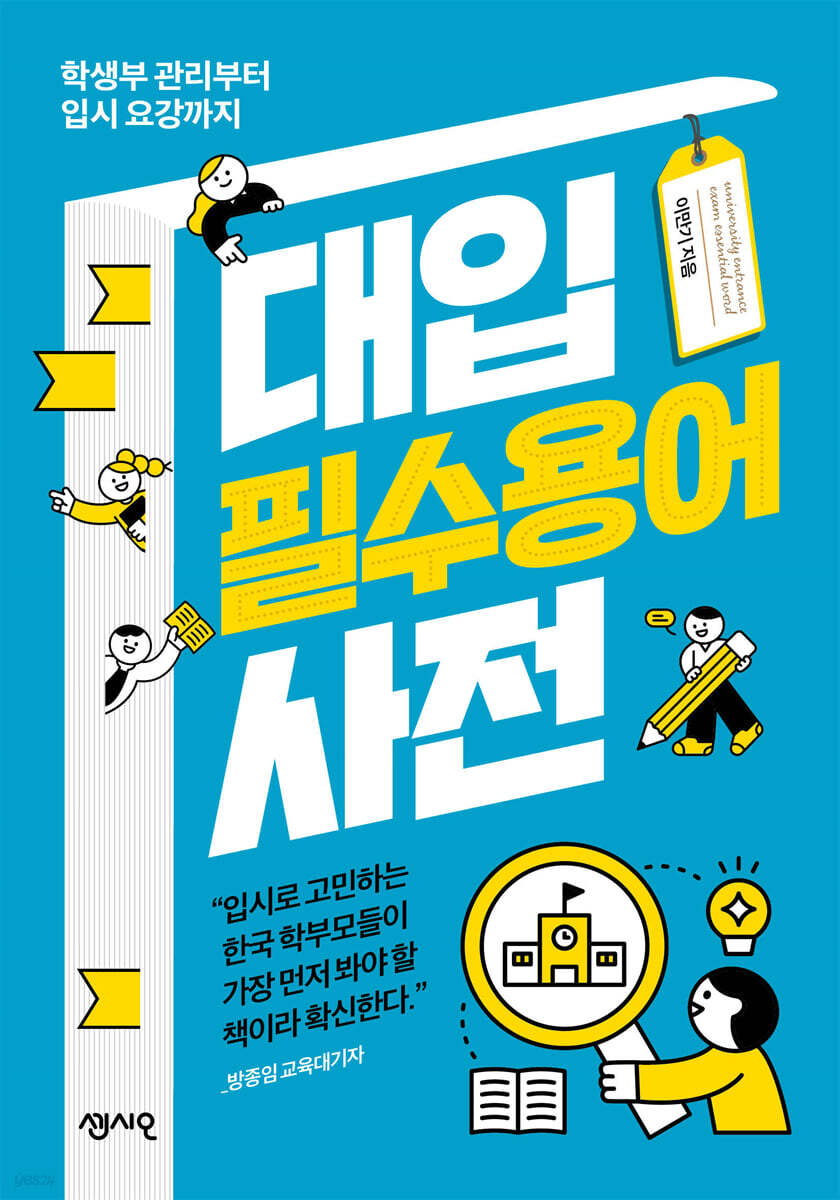
Dictionary of essential college admission terms
 |
Description
Book Introduction
Providing insight into the overall college entrance exam system in Korea
Korea's first 'College Entrance Exam Glossary'
“I am confident that this is the first and most essential book that Korean parents concerned about college entrance exams should read.”
Highly recommended by Bang Jong-im!
According to the '2028 College Entrance Examination Reform Plan,' Korea's college entrance examination system is expected to undergo another major change.
Parents and students are becoming anxious about the college entrance exam system that changes frequently.
Even if you want to study in detail about how things will change and what you need to prepare for, you are often blocked by complicated and unfamiliar college entrance terminology.
In order to properly understand the college entrance exam information pouring in from various media and press and to respond quickly to government measures, one must have a basic vocabulary related to college entrance exams and improve college entrance exam literacy by firmly organizing essential college entrance exam terms in one's head.
For this purpose, Director Lee Man-ki, a veteran college entrance exam expert representing Korea, has stepped forward.
The author published Korea's first "Dictionary of Essential College Entrance Terms," which organizes over 500 essential college entrance terms into an easily understandable language.
The author, who is currently the director of the Yuwei Educational Evaluation Research Institute, was the original Ilta instructor at EBS and is still busy providing explanations and advice on college entrance and college entrance exam trends by appearing on major media outlets such as KBS, MBC, SBS, and YTN.
Director Lee Man-ki's "Dictionary of Essential College Entrance Terms" is not just a simple dictionary of terms.
This book contains Q&A sessions with students and parents through thousands of on-site and online information sessions and college counseling sessions the author has conducted over the past 40 years. It also includes the know-how that helped his two daughters get into prestigious universities.
This book aims to provide readers with insight into the entire college entrance exam process, starting with each of the approximately 500 terms. Furthermore, it aims to provide consulting services to prospective students based on the author's long-standing experience as an admissions expert in the Korean college entrance exam system.
Nowadays, studying hard and putting in a lot of effort will never yield effective results.
For example, even for regular admission, understanding and analysis of the CSAT scores are absolutely necessary.
Because each university applies the conversion score in a different way and the reflection ratio for each section of the CSAT is also different, even if the total CSAT score is the same, the universities and departments that are advantageous or disadvantageous to each student are different.
Therefore, if you do not know the exact terms and concepts such as 'bonus points', 'conversion scores' by university, 'CSAT reflection areas', and the details that apply to each test taker, you are bound to suffer a loss.
Each student who encounters this book will have different tendencies, career paths, goals, and grades.
Each reader will gain insight into the entire college entrance exam process through this book, and will also benefit from personalized consulting from the author, Korea's leading college entrance exam expert.
Korea's first 'College Entrance Exam Glossary'
“I am confident that this is the first and most essential book that Korean parents concerned about college entrance exams should read.”
Highly recommended by Bang Jong-im!
According to the '2028 College Entrance Examination Reform Plan,' Korea's college entrance examination system is expected to undergo another major change.
Parents and students are becoming anxious about the college entrance exam system that changes frequently.
Even if you want to study in detail about how things will change and what you need to prepare for, you are often blocked by complicated and unfamiliar college entrance terminology.
In order to properly understand the college entrance exam information pouring in from various media and press and to respond quickly to government measures, one must have a basic vocabulary related to college entrance exams and improve college entrance exam literacy by firmly organizing essential college entrance exam terms in one's head.
For this purpose, Director Lee Man-ki, a veteran college entrance exam expert representing Korea, has stepped forward.
The author published Korea's first "Dictionary of Essential College Entrance Terms," which organizes over 500 essential college entrance terms into an easily understandable language.
The author, who is currently the director of the Yuwei Educational Evaluation Research Institute, was the original Ilta instructor at EBS and is still busy providing explanations and advice on college entrance and college entrance exam trends by appearing on major media outlets such as KBS, MBC, SBS, and YTN.
Director Lee Man-ki's "Dictionary of Essential College Entrance Terms" is not just a simple dictionary of terms.
This book contains Q&A sessions with students and parents through thousands of on-site and online information sessions and college counseling sessions the author has conducted over the past 40 years. It also includes the know-how that helped his two daughters get into prestigious universities.
This book aims to provide readers with insight into the entire college entrance exam process, starting with each of the approximately 500 terms. Furthermore, it aims to provide consulting services to prospective students based on the author's long-standing experience as an admissions expert in the Korean college entrance exam system.
Nowadays, studying hard and putting in a lot of effort will never yield effective results.
For example, even for regular admission, understanding and analysis of the CSAT scores are absolutely necessary.
Because each university applies the conversion score in a different way and the reflection ratio for each section of the CSAT is also different, even if the total CSAT score is the same, the universities and departments that are advantageous or disadvantageous to each student are different.
Therefore, if you do not know the exact terms and concepts such as 'bonus points', 'conversion scores' by university, 'CSAT reflection areas', and the details that apply to each test taker, you are bound to suffer a loss.
Each student who encounters this book will have different tendencies, career paths, goals, and grades.
Each reader will gain insight into the entire college entrance exam process through this book, and will also benefit from personalized consulting from the author, Korea's leading college entrance exam expert.
- You can preview some of the book's contents.
Preview
index
Opening remarks_ Trying to explain something again
Introduction_ Successful college entrance begins with entrance exam literacy.
(go)
Bonus points
weight
Grading
Godbango
Individual detailed abilities and special skills
Black test
vacancy
Department of Contract Studies
High School Education Contribution University Support Project
High School-University Linkage Program
High school type
High school credit system
Legal provisions for high school types
Even-moment rotation type
High-Growth Analyzer
Fixed split score
Joint Curriculum
Fair College Scholastic Ability Test
Common application submission
Detailed abilities and special skills by subject
Subject-by-subject hierarchy
Process-centered evaluation
Gwangtal
Curriculum/Extracurricular
Academic performance indicators
Curriculum
Completion of teaching certificate
Teacher Aptitude and Personality Assessment
Cross-support
Oral interview test
National Education Commission
Contribution admission system
equal opportunity selection
Director Lee Man-ki's Niche Consulting
· Can bonus points be overcome?
· Why humanities students should also pay attention to math weighting
· There is a trick to scoring.
· Which high school would be better to go to?
· How should I prepare for the high school credit system?
· How to prepare for the written exam (1) Korean
· How to prepare for the written exam (2) Mathematics
· To create a deep specialization
· How to prepare for the written exam (3) English
· How to prepare for the written exam (4) Social Studies
· Subjects and extracurricular activities evaluated by admissions officers
· How to prepare for the written exam (5) Science
· Things to keep in mind when cross-supporting
· Prepare for the oral exam like this
(*omitted*)
(he)
School life record entry guidelines
School Principal Recommendation Process (Principal Recommendation Process)
school violence
School district
School year
Reflection ratio by grade
Bachelor's structure
Student Affairs
Alternative form for those who do not have a student record
Student record actual reflection ratio
Student Academic Performance Evaluation
Student-centered admissions
Comprehensive student admissions process
Student Design Major
School fighter
Academic evaluation
Academic evaluation score items
Korea Institute for Curriculum and Evaluation (KICE)
Korean Council for University Education (KCUE)
Going to an American university with the Korean CSAT
Announcement of successful candidates
Pass diagnosis (pass prediction)
Overseas high school admission process
Core (recommended) subjects
Behavioral characteristics and overall opinion
dummy applicant
Conversion score
Proof of activity
Huli
Director Lee Man-ki's Niche Consulting
· The impact of school violence on college admissions
· Are you considering de-escalation?
Seoul National University's Q&A on the 2024 Comprehensive Student Admissions Process
· College admission for out-of-school youth
· Points to note in the student extracurricular activities selection process
· If you have been consistently preparing for extracurricular activities, you can apply for the comprehensive student admissions process!
· The Use and Meaning of the March Academic Evaluation
· The college entrance exam is 10 days away!
· Changed Seoul National University CSAT score calculation method
· From overseas high school to domestic university
· Recommended subjects, must I complete them?
· The importance of conversion scores
Introduction_ Successful college entrance begins with entrance exam literacy.
(go)
Bonus points
weight
Grading
Godbango
Individual detailed abilities and special skills
Black test
vacancy
Department of Contract Studies
High School Education Contribution University Support Project
High School-University Linkage Program
High school type
High school credit system
Legal provisions for high school types
Even-moment rotation type
High-Growth Analyzer
Fixed split score
Joint Curriculum
Fair College Scholastic Ability Test
Common application submission
Detailed abilities and special skills by subject
Subject-by-subject hierarchy
Process-centered evaluation
Gwangtal
Curriculum/Extracurricular
Academic performance indicators
Curriculum
Completion of teaching certificate
Teacher Aptitude and Personality Assessment
Cross-support
Oral interview test
National Education Commission
Contribution admission system
equal opportunity selection
Director Lee Man-ki's Niche Consulting
· Can bonus points be overcome?
· Why humanities students should also pay attention to math weighting
· There is a trick to scoring.
· Which high school would be better to go to?
· How should I prepare for the high school credit system?
· How to prepare for the written exam (1) Korean
· How to prepare for the written exam (2) Mathematics
· To create a deep specialization
· How to prepare for the written exam (3) English
· How to prepare for the written exam (4) Social Studies
· Subjects and extracurricular activities evaluated by admissions officers
· How to prepare for the written exam (5) Science
· Things to keep in mind when cross-supporting
· Prepare for the oral exam like this
(*omitted*)
(he)
School life record entry guidelines
School Principal Recommendation Process (Principal Recommendation Process)
school violence
School district
School year
Reflection ratio by grade
Bachelor's structure
Student Affairs
Alternative form for those who do not have a student record
Student record actual reflection ratio
Student Academic Performance Evaluation
Student-centered admissions
Comprehensive student admissions process
Student Design Major
School fighter
Academic evaluation
Academic evaluation score items
Korea Institute for Curriculum and Evaluation (KICE)
Korean Council for University Education (KCUE)
Going to an American university with the Korean CSAT
Announcement of successful candidates
Pass diagnosis (pass prediction)
Overseas high school admission process
Core (recommended) subjects
Behavioral characteristics and overall opinion
dummy applicant
Conversion score
Proof of activity
Huli
Director Lee Man-ki's Niche Consulting
· The impact of school violence on college admissions
· Are you considering de-escalation?
Seoul National University's Q&A on the 2024 Comprehensive Student Admissions Process
· College admission for out-of-school youth
· Points to note in the student extracurricular activities selection process
· If you have been consistently preparing for extracurricular activities, you can apply for the comprehensive student admissions process!
· The Use and Meaning of the March Academic Evaluation
· The college entrance exam is 10 days away!
· Changed Seoul National University CSAT score calculation method
· From overseas high school to domestic university
· Recommended subjects, must I complete them?
· The importance of conversion scores
Detailed image

Publisher's Review
To succeed in college entrance exams, first develop your 'college entrance exam literacy'.
"The First Book Korean Parents Worried About College Entrance Exams Should Read" _Education Reporter, Bang Jong-im
"A book that could almost be called a 'textbook for college entrance exams'" - Nam Yoon-gon, Director of Megastudy's College Entrance Strategy Research Institute
A book that addresses the fundamentals of college entrance exams. _Lee Young-deok, Director of Daesung Academic Development Research Institute
Including Bang Jong-im, a reporter for education, Megastudy, Jinhaksa, Daeseong Academy, and Jongro Academy, etc.
A book unanimously recommended by the country's top entrance exam institutions!
The 2028 college entrance exam, which will be taken by students who will be entering their first year of high school in 2025, is expected to undergo another major change.
The elective subject system in the college entrance exam will be abolished, the high school grade evaluation will be changed from the existing 9-grade system to a 5-grade relative evaluation system, and the high school credit system will be fully implemented.
Many parents and students are curious and anxious about the ever-changing college entrance exam system.
You might feel anxious that you might miss something or suffer a loss because you didn't make the right choice.
Even if you diligently attend the entrance information session, the explanations are not easy to understand.
The biggest reason is that the basic terms and concepts have not been established in my head.
When attending informational sessions or online lectures about college entrance, complex concepts like curriculum, standard scores, elective subjects, small-scale subjects, and evaluation methods appear one after another, and terms like linked perception, mock evaluation, ranking grades, achievement, and achievement-level distribution ratios are rampant, making them difficult to grasp even after hearing them.
Without a foundation in basic vocabulary related to college entrance exams, it is impossible to establish and expand insight into the rapidly changing college entrance exam system.
Just as children learning to read need a Korean dictionary, this is precisely why a 'college entrance terminology dictionary' is necessary to navigate the college entrance exam field.
To properly understand the college entrance exam information pouring in from various media and press and to respond quickly to government measures, you must firmly organize essential college entrance exam terminology in your head to improve your college entrance exam literacy.
For this purpose, Director Lee Man-ki, a veteran college entrance exam expert representing Korea, has stepped forward.
The author, currently the director of the Yuwei Educational Evaluation Institute, has been a leading college entrance exam expert in Korea for nearly 40 years, working across both public and private education. He was the original Ilta instructor on EBS and continues to appear in various media outlets, offering explanations and advice on college entrance exam and CSAT trends. He has now published "Dictionary of Essential College Entrance Terms," serving as a guide for students and parents navigating the fierce college entrance exam battle.
40 years of college entrance exam know-how compiled into a single book.
Although this book borrows the form of a dictionary, it is not a simple glossary.
As we explain each term, we provide practical admissions tips related to it.
Another goal of this book is to provide consulting services to prospective students based on the author's long-standing experience as an admissions expert in the Korean college entrance exam field.
For example, in the case of the heading 'frequency distribution', this book explains the meaning and use of the frequency distribution table, and at the same time shows through real-life examples how to interpret and apply the frequency distribution, which is the most important factor in the CSAT score report.
It points out the various entrance exam elements that are intertwined like a net in a single word and suggests what attitude and strategy test takers should adopt in each situation.
The goal of this book is to provide readers with insight into the entire college entrance exam process, starting from a single term, and to convey the author's expertise gained from conducting thousands of college entrance information sessions and consultations over 40 years.
The author says that he tried to make it so that readers can experience the same effect as attending an admissions information session and answering questions on site while reading this book.
We deliver detailed niche consulting through the pages so that each reader, with their own unique personality, career path, goals, and grades, feels as if it were their own story or their child's story.
In college entrance exams, accurate interpretation and application are more important than perseverance.
Nowadays, studying hard and putting in a lot of effort will never yield effective results.
We need to diagnose the wise direction in which each test taker can maximize the achievements they have made in their respective positions.
For example, in the case of regular admission, each university applies the conversion score in a different way and the reflection ratio for each section of the CSAT is also different, so even if the total CSAT score is the same, the universities and departments that are advantageous or disadvantageous to each student are different.
Therefore, if you do not know the exact terms and concepts such as ‘bonus points,’ ‘conversion scores’ by university, and ‘areas reflected in the CSAT,’ you are bound to suffer a loss.
This book will be a useful tool for countless students struggling in the college entrance exam arena today, helping them find the wisest shortcut and establish the right milestones within the "triangle of suffering" of the CSAT, school grades, and university entrance exams.
"The First Book Korean Parents Worried About College Entrance Exams Should Read" _Education Reporter, Bang Jong-im
"A book that could almost be called a 'textbook for college entrance exams'" - Nam Yoon-gon, Director of Megastudy's College Entrance Strategy Research Institute
A book that addresses the fundamentals of college entrance exams. _Lee Young-deok, Director of Daesung Academic Development Research Institute
Including Bang Jong-im, a reporter for education, Megastudy, Jinhaksa, Daeseong Academy, and Jongro Academy, etc.
A book unanimously recommended by the country's top entrance exam institutions!
The 2028 college entrance exam, which will be taken by students who will be entering their first year of high school in 2025, is expected to undergo another major change.
The elective subject system in the college entrance exam will be abolished, the high school grade evaluation will be changed from the existing 9-grade system to a 5-grade relative evaluation system, and the high school credit system will be fully implemented.
Many parents and students are curious and anxious about the ever-changing college entrance exam system.
You might feel anxious that you might miss something or suffer a loss because you didn't make the right choice.
Even if you diligently attend the entrance information session, the explanations are not easy to understand.
The biggest reason is that the basic terms and concepts have not been established in my head.
When attending informational sessions or online lectures about college entrance, complex concepts like curriculum, standard scores, elective subjects, small-scale subjects, and evaluation methods appear one after another, and terms like linked perception, mock evaluation, ranking grades, achievement, and achievement-level distribution ratios are rampant, making them difficult to grasp even after hearing them.
Without a foundation in basic vocabulary related to college entrance exams, it is impossible to establish and expand insight into the rapidly changing college entrance exam system.
Just as children learning to read need a Korean dictionary, this is precisely why a 'college entrance terminology dictionary' is necessary to navigate the college entrance exam field.
To properly understand the college entrance exam information pouring in from various media and press and to respond quickly to government measures, you must firmly organize essential college entrance exam terminology in your head to improve your college entrance exam literacy.
For this purpose, Director Lee Man-ki, a veteran college entrance exam expert representing Korea, has stepped forward.
The author, currently the director of the Yuwei Educational Evaluation Institute, has been a leading college entrance exam expert in Korea for nearly 40 years, working across both public and private education. He was the original Ilta instructor on EBS and continues to appear in various media outlets, offering explanations and advice on college entrance exam and CSAT trends. He has now published "Dictionary of Essential College Entrance Terms," serving as a guide for students and parents navigating the fierce college entrance exam battle.
40 years of college entrance exam know-how compiled into a single book.
Although this book borrows the form of a dictionary, it is not a simple glossary.
As we explain each term, we provide practical admissions tips related to it.
Another goal of this book is to provide consulting services to prospective students based on the author's long-standing experience as an admissions expert in the Korean college entrance exam field.
For example, in the case of the heading 'frequency distribution', this book explains the meaning and use of the frequency distribution table, and at the same time shows through real-life examples how to interpret and apply the frequency distribution, which is the most important factor in the CSAT score report.
It points out the various entrance exam elements that are intertwined like a net in a single word and suggests what attitude and strategy test takers should adopt in each situation.
The goal of this book is to provide readers with insight into the entire college entrance exam process, starting from a single term, and to convey the author's expertise gained from conducting thousands of college entrance information sessions and consultations over 40 years.
The author says that he tried to make it so that readers can experience the same effect as attending an admissions information session and answering questions on site while reading this book.
We deliver detailed niche consulting through the pages so that each reader, with their own unique personality, career path, goals, and grades, feels as if it were their own story or their child's story.
In college entrance exams, accurate interpretation and application are more important than perseverance.
Nowadays, studying hard and putting in a lot of effort will never yield effective results.
We need to diagnose the wise direction in which each test taker can maximize the achievements they have made in their respective positions.
For example, in the case of regular admission, each university applies the conversion score in a different way and the reflection ratio for each section of the CSAT is also different, so even if the total CSAT score is the same, the universities and departments that are advantageous or disadvantageous to each student are different.
Therefore, if you do not know the exact terms and concepts such as ‘bonus points,’ ‘conversion scores’ by university, and ‘areas reflected in the CSAT,’ you are bound to suffer a loss.
This book will be a useful tool for countless students struggling in the college entrance exam arena today, helping them find the wisest shortcut and establish the right milestones within the "triangle of suffering" of the CSAT, school grades, and university entrance exams.
GOODS SPECIFICS
- Date of issue: January 2, 2024
- Page count, weight, size: 408 pages | 572g | 140*200*24mm
- ISBN13: 9791166571350
You may also like
카테고리
korean


korean

![GQ KOREA Mark (Monthly): December [2025]](http://librairie.coreenne.fr/cdn/shop/files/8ef265dbbfbf186523ed75ba7319009d.jpg?v=1765340328&width=3840)


