

I want to break up with you, but I've never met you before
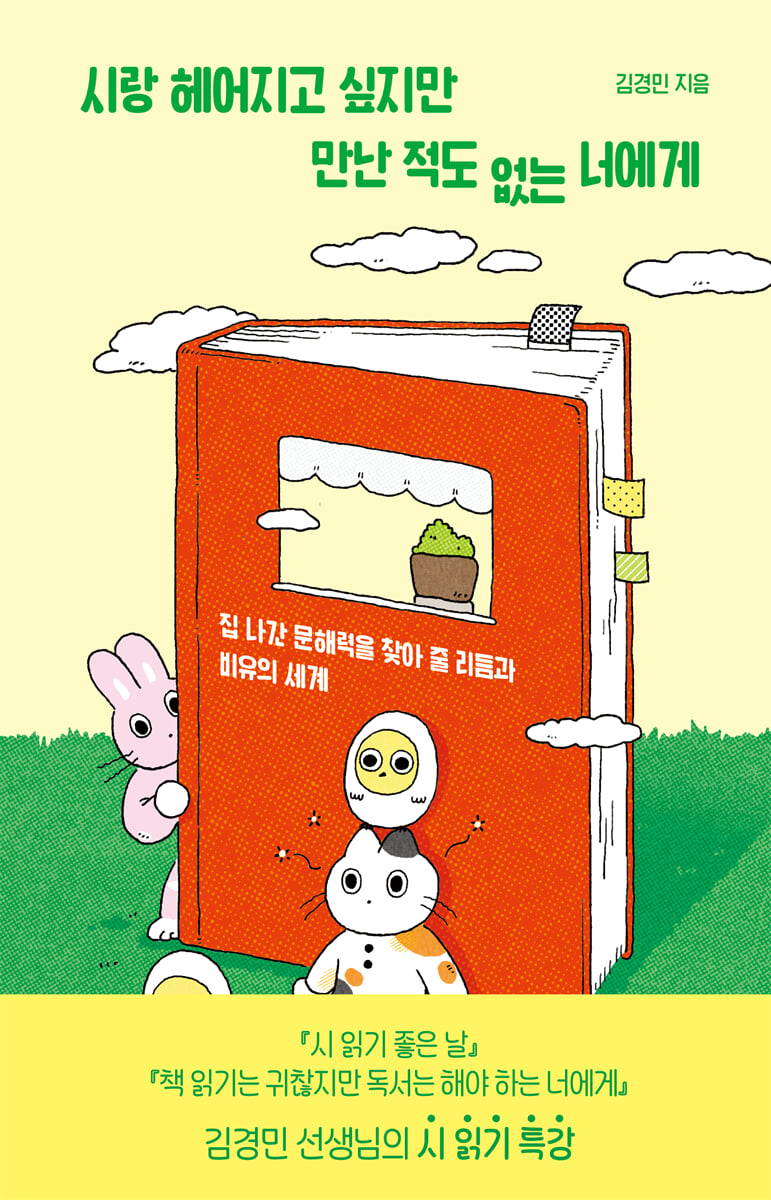 |
Description
Book Introduction
“Before we call the name of the poem
Poetry was merely a fingerprint of the realm of language…
A poetry reading class for teenagers who are quickly turning away from poetry due to the prejudice that it is difficult and boring.
Yun Dong-ju wrote.
“It is a shame that poetry is written so easily” (Poetry Written Easily).
So, if a poem is written easily, shouldn't it be easy to read? But what happens when you read a poem? First of all, I don't understand what you're saying.
It's difficult because I don't know what you mean.
A poem that is not difficult is almost a unicorn.
Because it's difficult, it's not fun, and because it's not fun, you stay away from it, and because you stay away from poetry, you don't know even more what poetry is saying.
This is the true feeling of a teenager when he encounters poetry.
"What is poetry? Or rather, why does poetry speak this way?" This book begins with this very question.
Why does poetry not simply say "I love you" directly, but instead makes it difficult to understand? In Chapter 1, we explored several reasons why poetry can be difficult, beyond the fact that it expresses itself in a way that differs from how we speak in everyday life.
Chapter 2 discusses the reasons why we learn poetry and why we must learn it.
It's easy to wonder what use a poetic imagination is if you're not going to be a poet, but this book beautifully demonstrates that the answer is no.
In the last three chapters, I introduce methods to make reading poetry easier and more enjoyable without giving up on it.
In fact, it is perhaps natural that poetry feels difficult.
It is often thought that reading poetry only requires sensitivity, but understanding poetry requires active reasoning and interpretation.
In this very context, poetry is a genre that demands a higher level of literacy than any other text.
With an increasing diversity of contemporary poetry appearing in textbooks, and the traditional, rote memorization-based study methods making it difficult to fully grasp a poem, if the mere sight of poetry brings an inexplicable thrill, you absolutely must pick up this book! It will instantly restore the joy and pleasure of reading poetry.
Poetry was merely a fingerprint of the realm of language…
A poetry reading class for teenagers who are quickly turning away from poetry due to the prejudice that it is difficult and boring.
Yun Dong-ju wrote.
“It is a shame that poetry is written so easily” (Poetry Written Easily).
So, if a poem is written easily, shouldn't it be easy to read? But what happens when you read a poem? First of all, I don't understand what you're saying.
It's difficult because I don't know what you mean.
A poem that is not difficult is almost a unicorn.
Because it's difficult, it's not fun, and because it's not fun, you stay away from it, and because you stay away from poetry, you don't know even more what poetry is saying.
This is the true feeling of a teenager when he encounters poetry.
"What is poetry? Or rather, why does poetry speak this way?" This book begins with this very question.
Why does poetry not simply say "I love you" directly, but instead makes it difficult to understand? In Chapter 1, we explored several reasons why poetry can be difficult, beyond the fact that it expresses itself in a way that differs from how we speak in everyday life.
Chapter 2 discusses the reasons why we learn poetry and why we must learn it.
It's easy to wonder what use a poetic imagination is if you're not going to be a poet, but this book beautifully demonstrates that the answer is no.
In the last three chapters, I introduce methods to make reading poetry easier and more enjoyable without giving up on it.
In fact, it is perhaps natural that poetry feels difficult.
It is often thought that reading poetry only requires sensitivity, but understanding poetry requires active reasoning and interpretation.
In this very context, poetry is a genre that demands a higher level of literacy than any other text.
With an increasing diversity of contemporary poetry appearing in textbooks, and the traditional, rote memorization-based study methods making it difficult to fully grasp a poem, if the mere sight of poetry brings an inexplicable thrill, you absolutely must pick up this book! It will instantly restore the joy and pleasure of reading poetry.
- You can preview some of the book's contents.
Preview
index
Introduction
Chapter 1: Poetry, Why Is It So Difficult?
I don't empathize: When your emotions don't match
Difficult to understand: When background knowledge is needed
Unfamiliar: When you break out of stereotypes
It's different from everyday language: when using implicit language
Chapter 2: Difficult Poetry: Why Learn It?
To understand the complex mind
To share the pain of the times and the community
To develop poetic imagination
For sophisticated language use
Chapter 3: How to Read Poetry Well
Title: What the Poetry Means
Topic: Poetry is not an essay
Tension: A Device Created by Language
Speaker: It could be a confession, it could be fiction.
Rhythm: Poetry was originally a song
Language: Is poetry abstract or concrete?
Metaphor: Why We Don't Call Love Love
Truth: What's Beyond the Facts
Going out words
Poems included in the book
Chapter 1: Poetry, Why Is It So Difficult?
I don't empathize: When your emotions don't match
Difficult to understand: When background knowledge is needed
Unfamiliar: When you break out of stereotypes
It's different from everyday language: when using implicit language
Chapter 2: Difficult Poetry: Why Learn It?
To understand the complex mind
To share the pain of the times and the community
To develop poetic imagination
For sophisticated language use
Chapter 3: How to Read Poetry Well
Title: What the Poetry Means
Topic: Poetry is not an essay
Tension: A Device Created by Language
Speaker: It could be a confession, it could be fiction.
Rhythm: Poetry was originally a song
Language: Is poetry abstract or concrete?
Metaphor: Why We Don't Call Love Love
Truth: What's Beyond the Facts
Going out words
Poems included in the book
Detailed image

Into the book
It may sound a little grandiose, but good poetry reveals the truth of life, the truth of the world.
This is why poetry, which seems neither interesting nor practical at all, has survived to this day and is read by many people.
That's why we still read, write, and learn poetry.
If poetry feels too distant and difficult, it may be because you have never properly encountered poetry.
--- p.6
Metaphorically speaking, the language we use in our daily lives is like a pair of shoes that have already become worn and tattered.
Poetry wants to strip the dirt off these shoes and make them shiny and glossy.
Just as we casually wear shoes with worn-out soles and toes, everyday language is so overused that it doesn't create much tension.
The literary genre that wants to make this kind of language sticky is poetry.
--- p.49
Of course, literature uses imagination as an important fuel, but imagination cannot be unrelated to reality.
Imagination is the power to dream of a world that should exist, not a world that already exists, and to dream of a reality that should exist, not a reality that already exists.
--- p.64~65
Unlike prose, which is made up of lines, poetry is made up of lines and stanzas.
The lines and stanzas are not mere decorations, but forms given by the poet with a clear intention.
Just as prose conveys its message in paragraphs, poetry expresses itself through the division of lines and stanzas.
So to speak, lines and syllables are both joints of breath and joints of meaning.
This is why poetry, which seems neither interesting nor practical at all, has survived to this day and is read by many people.
That's why we still read, write, and learn poetry.
If poetry feels too distant and difficult, it may be because you have never properly encountered poetry.
--- p.6
Metaphorically speaking, the language we use in our daily lives is like a pair of shoes that have already become worn and tattered.
Poetry wants to strip the dirt off these shoes and make them shiny and glossy.
Just as we casually wear shoes with worn-out soles and toes, everyday language is so overused that it doesn't create much tension.
The literary genre that wants to make this kind of language sticky is poetry.
--- p.49
Of course, literature uses imagination as an important fuel, but imagination cannot be unrelated to reality.
Imagination is the power to dream of a world that should exist, not a world that already exists, and to dream of a reality that should exist, not a reality that already exists.
--- p.64~65
Unlike prose, which is made up of lines, poetry is made up of lines and stanzas.
The lines and stanzas are not mere decorations, but forms given by the poet with a clear intention.
Just as prose conveys its message in paragraphs, poetry expresses itself through the division of lines and stanzas.
So to speak, lines and syllables are both joints of breath and joints of meaning.
--- p.135
Publisher's Review
“Sorry, Siya.
“Let’s break up.”
“…But, who are you?”
Ah, why do I want to break up already when we’ve never even met?
Open the Korean language textbook.
There are novels, essays, and of course, poetry.
The poem is clearly distinct and has a distinct line, whether viewed from the side, behind, or five hundred paces away.
What day is it today?
My Korean teacher shouldn't call my number.
If you're lucky, it's a reading, if you're unlucky, it's twenty questions.
(So, what does this poem mean? What is the theme of this poem? Etc.) Poetry is supposed to be beautiful, but my score on the test when I encountered poetry was not beautiful at all.
You, wandering through the labyrinth without answers called 'poetry',
You, who gets motion sickness just by looking at the text that has been edited,
You, who are suffering because poetry is difficult,
A book just for you
"What on earth is poetry? Or rather, why does poetry speak in this way? Why can't we just say "I love you" when we're talking about love? Instead, we use other words and expressions?" This book begins with these very questions.
This is a question that the author, a former Korean language teacher and writer who has written books filled with his love for poetry and books, had while reading and studying poetry, and also a question that he received from his students while teaching poetry.
In Chapter 1, we explored this question and addressed some of the reasons why poetry can feel difficult.
Chapter 2 discusses the reasons why we learn poetry and why we must learn it.
It's easy to wonder what use a poetic imagination is if you're not going to be a poet, but this book beautifully demonstrates that the answer is no.
In the last three chapters, I introduce methods to make reading poetry easier and more enjoyable without giving up on it.
In fact, it is perhaps natural that poetry feels difficult.
Because poetry uses language differently than we do in everyday life (we don't say love is love), takes the obvious as unacceptable or the unexpected as unacceptable (in poetry, ice can be a symbol of love, or sadness can be an expression of love), and makes the reader stop and reflect.
It is often thought that reading poetry requires only sensitivity, but understanding poetry requires active reasoning and interpretation skills.
In this very context, poetry is a genre that demands a higher level of literacy than any other text.
Find your literacy after leaving home
Special lecture on reading poetry from ancient to modern times
This book contains a total of 55 poems, ranging from old poems frequently included in textbooks, such as “A Distant Future” by poet Kim So-wol, “Ogamdo Poetry No. 3” by poet Yi Sang, and “Glass Window 1” by poet Jeong Ji-yong, to modern poems that are difficult to find in textbooks.
There are no novels, no essays, only poetry that is unmistakable whether you look at it from the front, the back, or from five hundred paces away. Perhaps that is why you may feel an inexplicable thrill as soon as you open this book, but the very fact that you feel that thrill is proof that this book is necessary.
With an increasing variety of contemporary poetry appearing in textbooks, and the traditional, rote memorization-based study methods making it difficult to fully grasp the text, this book will teach you how to read poetry, and more importantly, the joy and pleasure of reading poetry.
A prescription for 'poetry disgust' (not being disgusted with poetry, but a symptom of disliking poetry) by Kim Kyung-min, who wrote essays on poetry and reading, such as 'A Good Day to Read Poetry,' 'All the Things I Love Make Me Cry,' and 'Reading Books in My Youth,' and wrote 'To You Who Are Tired of Reading, but Must Read,' which is a record of reading 24 books with his high school son (who was a middle school student at the time), sharing his thoughts, and discussing them.
“Let’s break up.”
“…But, who are you?”
Ah, why do I want to break up already when we’ve never even met?
Open the Korean language textbook.
There are novels, essays, and of course, poetry.
The poem is clearly distinct and has a distinct line, whether viewed from the side, behind, or five hundred paces away.
What day is it today?
My Korean teacher shouldn't call my number.
If you're lucky, it's a reading, if you're unlucky, it's twenty questions.
(So, what does this poem mean? What is the theme of this poem? Etc.) Poetry is supposed to be beautiful, but my score on the test when I encountered poetry was not beautiful at all.
You, wandering through the labyrinth without answers called 'poetry',
You, who gets motion sickness just by looking at the text that has been edited,
You, who are suffering because poetry is difficult,
A book just for you
"What on earth is poetry? Or rather, why does poetry speak in this way? Why can't we just say "I love you" when we're talking about love? Instead, we use other words and expressions?" This book begins with these very questions.
This is a question that the author, a former Korean language teacher and writer who has written books filled with his love for poetry and books, had while reading and studying poetry, and also a question that he received from his students while teaching poetry.
In Chapter 1, we explored this question and addressed some of the reasons why poetry can feel difficult.
Chapter 2 discusses the reasons why we learn poetry and why we must learn it.
It's easy to wonder what use a poetic imagination is if you're not going to be a poet, but this book beautifully demonstrates that the answer is no.
In the last three chapters, I introduce methods to make reading poetry easier and more enjoyable without giving up on it.
In fact, it is perhaps natural that poetry feels difficult.
Because poetry uses language differently than we do in everyday life (we don't say love is love), takes the obvious as unacceptable or the unexpected as unacceptable (in poetry, ice can be a symbol of love, or sadness can be an expression of love), and makes the reader stop and reflect.
It is often thought that reading poetry requires only sensitivity, but understanding poetry requires active reasoning and interpretation skills.
In this very context, poetry is a genre that demands a higher level of literacy than any other text.
Find your literacy after leaving home
Special lecture on reading poetry from ancient to modern times
This book contains a total of 55 poems, ranging from old poems frequently included in textbooks, such as “A Distant Future” by poet Kim So-wol, “Ogamdo Poetry No. 3” by poet Yi Sang, and “Glass Window 1” by poet Jeong Ji-yong, to modern poems that are difficult to find in textbooks.
There are no novels, no essays, only poetry that is unmistakable whether you look at it from the front, the back, or from five hundred paces away. Perhaps that is why you may feel an inexplicable thrill as soon as you open this book, but the very fact that you feel that thrill is proof that this book is necessary.
With an increasing variety of contemporary poetry appearing in textbooks, and the traditional, rote memorization-based study methods making it difficult to fully grasp the text, this book will teach you how to read poetry, and more importantly, the joy and pleasure of reading poetry.
A prescription for 'poetry disgust' (not being disgusted with poetry, but a symptom of disliking poetry) by Kim Kyung-min, who wrote essays on poetry and reading, such as 'A Good Day to Read Poetry,' 'All the Things I Love Make Me Cry,' and 'Reading Books in My Youth,' and wrote 'To You Who Are Tired of Reading, but Must Read,' which is a record of reading 24 books with his high school son (who was a middle school student at the time), sharing his thoughts, and discussing them.
GOODS SPECIFICS
- Publication date: December 29, 2023
- Page count, weight, size: 172 pages | 266g | 135*210*12mm
- ISBN13: 9791167552464
You may also like
카테고리
korean


korean

![GQ KOREA Mark (Monthly): December [2025]](http://librairie.coreenne.fr/cdn/shop/files/8ef265dbbfbf186523ed75ba7319009d.jpg?v=1765340328&width=3840)


