

Inside Machine Learning Interview
 |
Description
Book Introduction
From the basics of ML interviews to practical approaches for real-world applications.
To confidently answer any ML interview question, you need to clearly define the entire ML workflow and related core concepts.
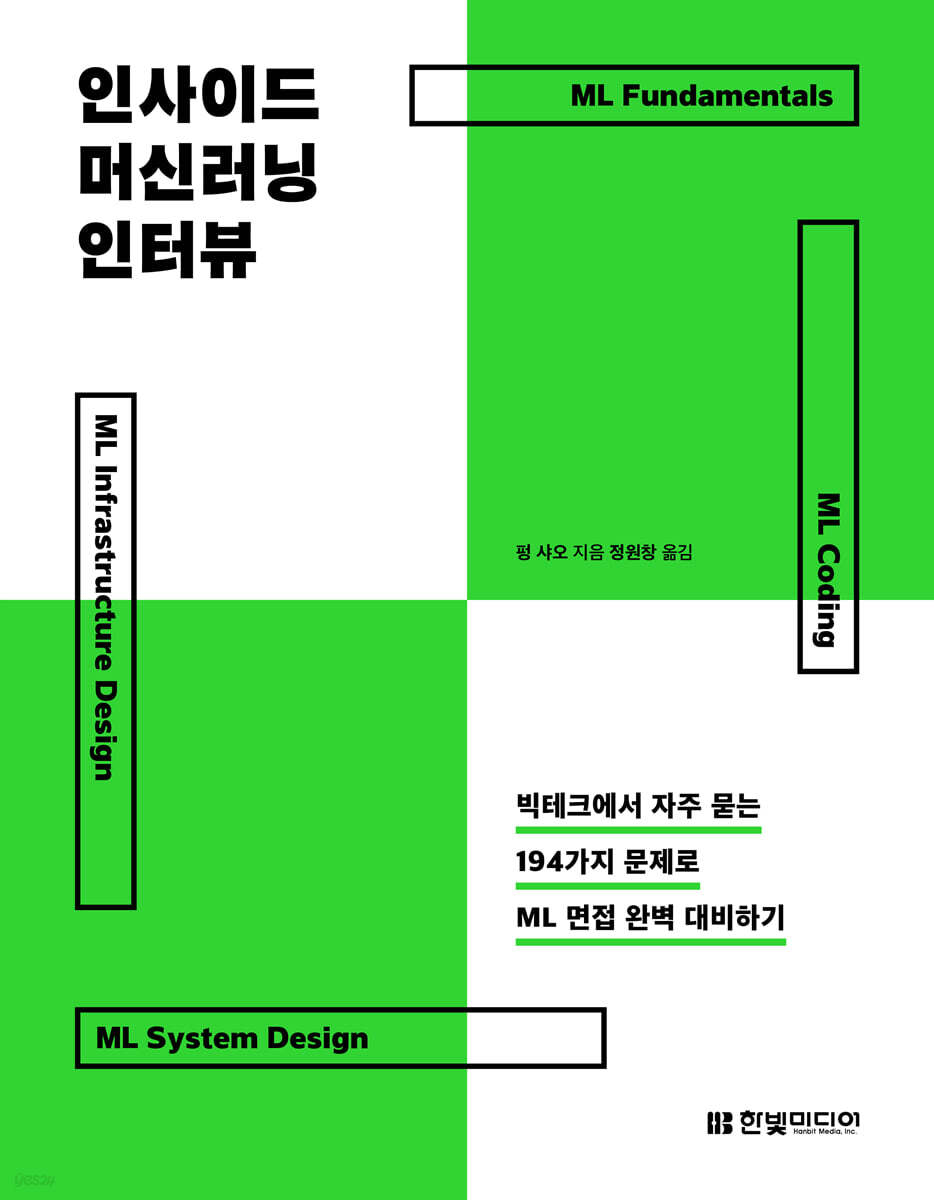
This book covers everything from ML fundamentals and coding interviews to system and infrastructure design interviews, step by step, examining the problems and solution strategies that applicants must prepare for.
Drawing on his experience interviewing nearly a thousand candidates at Amazon, Twitter, and AI startups, the author uncovers 194 frequently asked questions in big tech ML interviews and offers tips for formulating the best answers.
Let's use the book's keyword-focused, clear answers and interview tips to reinforce your strengths and thoroughly address your weaknesses, leading to a successful interview.
To confidently answer any ML interview question, you need to clearly define the entire ML workflow and related core concepts.
This book covers everything from ML fundamentals and coding interviews to system and infrastructure design interviews, step by step, examining the problems and solution strategies that applicants must prepare for.
Drawing on his experience interviewing nearly a thousand candidates at Amazon, Twitter, and AI startups, the author uncovers 194 frequently asked questions in big tech ML interviews and offers tips for formulating the best answers.
Let's use the book's keyword-focused, clear answers and interview tips to reinforce your strengths and thoroughly address your weaknesses, leading to a successful interview.
- You can preview some of the book's contents.
Preview
index
Chapter 1: Preparing for an ML Interview
Technical phone screen
ML Basics Knowledge Interview
ML coding interview
ML System Design Interview
Other interviews
Essential Elements of a Good Answer
Chapter 2: ML Basics
Q2.1 Dataset Collection Step
Q2.2 Problems with data collection
Q2.3 Considerations when Collecting Data
Q2.4 Handling Label Imbalance
Q2.5 Handling missing labels
Q2.6 Input Feature Type
Q2.7 Feature Selection and Importance
Q2.8 Feature Selection Method
Q2.9 Missing feature values
Q2.10 Modeling Algorithm
Q2.11 How Logistic Regression Works
Q2.12 Logistic Regression Loss Function
Q2.13 Gradient Descent Optimization
Q2.14 Hyperparameter Tuning
Q2.15 Handling model overfitting
Q2.16 Normalization Techniques
Q2.17 Linear Regression and Logistic Regression
Q2.18 Neural network activation function
Q2.19 Decision Trees, Random Forests, and Gradient Boosting Decision Trees
Q2.20 Boosting and Bagging
Q2.21 Unsupervised Learning Techniques
Q2.22 How k-means works
Q2.23 Semi-supervised learning techniques
Q2.24 Loss Function Types
Q2.25 Convexity of loss function
Q2.26 Classification Model Evaluation Indicators
Q2.27 Regression Model Evaluation Indicators
Q2.28 Model Optimization
Q2.29 Model Performance Improvement
Chapter 3 ML Coding
Q3.1 k-means
Q3.2 k-nearest neighbors
Q3.3 Decision Tree
Q3.4 Linear Regression
Q3.5 Evaluation Criteria
Q3.6 Reservoir Sampling
Q3.7 Probability Problem
Q3.8 Hash Table and Distributed Programming Problems
Q3.9 Graph Problem
Q3.10 String Problem
Q3.11 Array Problem
Chapter 4: ML System Design 1 - Recommender Systems
Q4.1 System Purpose
Q4.2 System Indicators
Q4.3 Recommended Content Types
Q4.4 Recommended Content Mix
Q4.5 System operating parameters
Q4.6 System Components
Q4.7 Cold start problem
Q4.8 Dataset Type
Q4.9 Dataset Collection Techniques
Q4.10 Dataset Bias
Q4.11 Mitigating Serving Bias
Q4.12 Mitigating position bias
Q4.13 Source of recommended candidates
Q4.14 Recommendation Candidate Generation Step
Q4.15 Recommendation Candidate Generation Algorithm
Q4.16 Embedding Technology
Q4.17 Candidate Scoring for Large-Scale Recommender Systems
Q4.18 New Content Indexing
Q4.19 Merging and organizing recommended candidates
Q4.20 Pre-ranking model training
Q4.21 Pre-ranking model evaluation indicators
Q4.22 Pre-ranking model algorithm
Q4.23 Pre-ranking model optimization
Q4.24 Key Features of the Ranking Model
Q4.25 Text or ID-based features
Q4.26 Count-based features
Q4.27 Training a Heavy Ranking Model
Q4.28 Heavy Ranking Model Algorithm
Q4.29 Ranking Model Architecture
Q4.30 Ranking Model Predicted Value Correction
Q4.31 Ranking Model Evaluation Indicators
Q4.32 Multi-task model and individual model
Q4.33 Model Serving System
Q4.34 Caching
Q4.35 Model Update
Q4.36 Online Experiment
Q4.37 Model Load
Q4.38 Model Experiment Considerations
Q4.39 Offline Evaluation Index
Q4.40 Online performance degradation
Chapter 5 ML System Design 2 - Applications
Q5.1 Document Parsing
Q5.2 Sentiment Analysis
Q5.3 Topic Modeling Techniques
Q5.4 Document Summary
Q5.5 Natural Language Understanding
Q5.6 Supervised Learning Labels
Q5.7 Unsupervised Learning Features
Q5.8 Discriminative Problem Features
Q5.9 Generative Model Features
Q5.10 Building an Information Extraction Model
Q5.11 Information Extraction Evaluation Index
Q5.12 Building a Classification Model
Q5.13 Building a Regression Model
Q5.14 Topic Assignment
Q5.15 Topic Modeling Evaluation Indicators
Q5.16 Building a Document Clustering Model
Q5.17 Clustering Evaluation Indicators
Q5.18 Building a Text Generation Model
Q5.19 Text Generation Evaluation Index
Q5.20 Modeling Workflow
Q5.21 Offline Forecast
Chapter 6: ML Infrastructure Design
Q6.1 Accelerate model development
Q6.2 Accelerate Model Learning
Q6.3 Model Training Distribution
Q6.4 Model Training Pipeline Evaluation
Q6.5 Distributed Learning Error
Q6.6 Model Update
Q6.7 Model Optimization
Q6.8 Serving System Components
Q6.9 Problems during serving
Q6.10 Feature Sign Language Improvement
Q6.11 Latency Improvement
Q6.12 Handling Multiple Requests
Q6.13 Model update during serving
Q6.14 Model Deployment and Rollback
Q6.15 Server Monitoring
Q6.16 Performance degradation during serving
Chapter 7: Advanced ML Problems
Q7.1 Delayed Label
Q7.2 Learning without labels
Q7.3 Pricing Model
Appendix A Generative Models: From Noisy Channel Models to LLM
A.1 Machine Translation (MT)
A.2 Automatic Speech Recognition (ASR)
A.3 Convergence to transformers
A.4 Fine-tuning for real-world challenges
References
Search
Technical phone screen
ML Basics Knowledge Interview
ML coding interview
ML System Design Interview
Other interviews
Essential Elements of a Good Answer
Chapter 2: ML Basics
Q2.1 Dataset Collection Step
Q2.2 Problems with data collection
Q2.3 Considerations when Collecting Data
Q2.4 Handling Label Imbalance
Q2.5 Handling missing labels
Q2.6 Input Feature Type
Q2.7 Feature Selection and Importance
Q2.8 Feature Selection Method
Q2.9 Missing feature values
Q2.10 Modeling Algorithm
Q2.11 How Logistic Regression Works
Q2.12 Logistic Regression Loss Function
Q2.13 Gradient Descent Optimization
Q2.14 Hyperparameter Tuning
Q2.15 Handling model overfitting
Q2.16 Normalization Techniques
Q2.17 Linear Regression and Logistic Regression
Q2.18 Neural network activation function
Q2.19 Decision Trees, Random Forests, and Gradient Boosting Decision Trees
Q2.20 Boosting and Bagging
Q2.21 Unsupervised Learning Techniques
Q2.22 How k-means works
Q2.23 Semi-supervised learning techniques
Q2.24 Loss Function Types
Q2.25 Convexity of loss function
Q2.26 Classification Model Evaluation Indicators
Q2.27 Regression Model Evaluation Indicators
Q2.28 Model Optimization
Q2.29 Model Performance Improvement
Chapter 3 ML Coding
Q3.1 k-means
Q3.2 k-nearest neighbors
Q3.3 Decision Tree
Q3.4 Linear Regression
Q3.5 Evaluation Criteria
Q3.6 Reservoir Sampling
Q3.7 Probability Problem
Q3.8 Hash Table and Distributed Programming Problems
Q3.9 Graph Problem
Q3.10 String Problem
Q3.11 Array Problem
Chapter 4: ML System Design 1 - Recommender Systems
Q4.1 System Purpose
Q4.2 System Indicators
Q4.3 Recommended Content Types
Q4.4 Recommended Content Mix
Q4.5 System operating parameters
Q4.6 System Components
Q4.7 Cold start problem
Q4.8 Dataset Type
Q4.9 Dataset Collection Techniques
Q4.10 Dataset Bias
Q4.11 Mitigating Serving Bias
Q4.12 Mitigating position bias
Q4.13 Source of recommended candidates
Q4.14 Recommendation Candidate Generation Step
Q4.15 Recommendation Candidate Generation Algorithm
Q4.16 Embedding Technology
Q4.17 Candidate Scoring for Large-Scale Recommender Systems
Q4.18 New Content Indexing
Q4.19 Merging and organizing recommended candidates
Q4.20 Pre-ranking model training
Q4.21 Pre-ranking model evaluation indicators
Q4.22 Pre-ranking model algorithm
Q4.23 Pre-ranking model optimization
Q4.24 Key Features of the Ranking Model
Q4.25 Text or ID-based features
Q4.26 Count-based features
Q4.27 Training a Heavy Ranking Model
Q4.28 Heavy Ranking Model Algorithm
Q4.29 Ranking Model Architecture
Q4.30 Ranking Model Predicted Value Correction
Q4.31 Ranking Model Evaluation Indicators
Q4.32 Multi-task model and individual model
Q4.33 Model Serving System
Q4.34 Caching
Q4.35 Model Update
Q4.36 Online Experiment
Q4.37 Model Load
Q4.38 Model Experiment Considerations
Q4.39 Offline Evaluation Index
Q4.40 Online performance degradation
Chapter 5 ML System Design 2 - Applications
Q5.1 Document Parsing
Q5.2 Sentiment Analysis
Q5.3 Topic Modeling Techniques
Q5.4 Document Summary
Q5.5 Natural Language Understanding
Q5.6 Supervised Learning Labels
Q5.7 Unsupervised Learning Features
Q5.8 Discriminative Problem Features
Q5.9 Generative Model Features
Q5.10 Building an Information Extraction Model
Q5.11 Information Extraction Evaluation Index
Q5.12 Building a Classification Model
Q5.13 Building a Regression Model
Q5.14 Topic Assignment
Q5.15 Topic Modeling Evaluation Indicators
Q5.16 Building a Document Clustering Model
Q5.17 Clustering Evaluation Indicators
Q5.18 Building a Text Generation Model
Q5.19 Text Generation Evaluation Index
Q5.20 Modeling Workflow
Q5.21 Offline Forecast
Chapter 6: ML Infrastructure Design
Q6.1 Accelerate model development
Q6.2 Accelerate Model Learning
Q6.3 Model Training Distribution
Q6.4 Model Training Pipeline Evaluation
Q6.5 Distributed Learning Error
Q6.6 Model Update
Q6.7 Model Optimization
Q6.8 Serving System Components
Q6.9 Problems during serving
Q6.10 Feature Sign Language Improvement
Q6.11 Latency Improvement
Q6.12 Handling Multiple Requests
Q6.13 Model update during serving
Q6.14 Model Deployment and Rollback
Q6.15 Server Monitoring
Q6.16 Performance degradation during serving
Chapter 7: Advanced ML Problems
Q7.1 Delayed Label
Q7.2 Learning without labels
Q7.3 Pricing Model
Appendix A Generative Models: From Noisy Channel Models to LLM
A.1 Machine Translation (MT)
A.2 Automatic Speech Recognition (ASR)
A.3 Convergence to transformers
A.4 Fine-tuning for real-world challenges
References
Search
Detailed image

Publisher's Review
A veteran interviewer with experience at Amazon, Twitter, and AI startups.
Tips for a Successful ML Interview from an ML Engineer
Applicants facing ML interviews may have many concerns, such as what skills to develop, what topics to focus on, and what to consider when answering questions.
This book provides a comprehensive overview of the skills needed for employment in the ML field, along with robust, practical problem-solving strategies, appendices, and reference materials reflecting the latest technologies.
First, essential practical workflow knowledge required for employment in the ML field.
Contains 194 frequently asked questions from ML interviews at big tech companies, including FAANG.
It consists of concise questions and clear, keyword-based answers, making it useful for organizing content before the interview.
To aid understanding, we have added extensive footnotes to difficult concepts or ambiguous expressions.
Second, step-by-step instructions for preparing for basic to advanced problems.
It consists of five interview sessions (ML Basics - ML Coding - ML System Design - ML Infrastructure Design - Advanced ML Problems), making it easy to find content based on the position you are applying for, difficulty level, and needs.
Third, a strategy to construct a powerful answer centered on core keywords.
We'll introduce answer-structuring strategies for scoring well in ML interviews, including extracting key keywords from the question, comparing different approaches, and discussing pros, cons, and tradeoffs.
Fourth, a practical problem-solving approach based on real-world scenarios.
Covering practical concepts and scenarios across the ML lifecycle, it helps both job seekers preparing for interviews and experienced practitioners solidify their fundamentals.
Readers who need this book
- Job seekers hoping to pursue a career in ML
- Practitioners who want to increase their competitiveness in the ML field
Tips for a Successful ML Interview from an ML Engineer
Applicants facing ML interviews may have many concerns, such as what skills to develop, what topics to focus on, and what to consider when answering questions.
This book provides a comprehensive overview of the skills needed for employment in the ML field, along with robust, practical problem-solving strategies, appendices, and reference materials reflecting the latest technologies.
First, essential practical workflow knowledge required for employment in the ML field.
Contains 194 frequently asked questions from ML interviews at big tech companies, including FAANG.
It consists of concise questions and clear, keyword-based answers, making it useful for organizing content before the interview.
To aid understanding, we have added extensive footnotes to difficult concepts or ambiguous expressions.
Second, step-by-step instructions for preparing for basic to advanced problems.
It consists of five interview sessions (ML Basics - ML Coding - ML System Design - ML Infrastructure Design - Advanced ML Problems), making it easy to find content based on the position you are applying for, difficulty level, and needs.
Third, a strategy to construct a powerful answer centered on core keywords.
We'll introduce answer-structuring strategies for scoring well in ML interviews, including extracting key keywords from the question, comparing different approaches, and discussing pros, cons, and tradeoffs.
Fourth, a practical problem-solving approach based on real-world scenarios.
Covering practical concepts and scenarios across the ML lifecycle, it helps both job seekers preparing for interviews and experienced practitioners solidify their fundamentals.
Readers who need this book
- Job seekers hoping to pursue a career in ML
- Practitioners who want to increase their competitiveness in the ML field
GOODS SPECIFICS
- Date of issue: March 15, 2024
- Page count, weight, size: 332 pages | 776g | 183*235*19mm
- ISBN13: 9791169212120
- ISBN10: 1169212123
You may also like
카테고리
korean


korean

![GQ KOREA Mark (Monthly): December [2025]](http://librairie.coreenne.fr/cdn/shop/files/8ef265dbbfbf186523ed75ba7319009d.jpg?v=1765340328&width=3840)


