

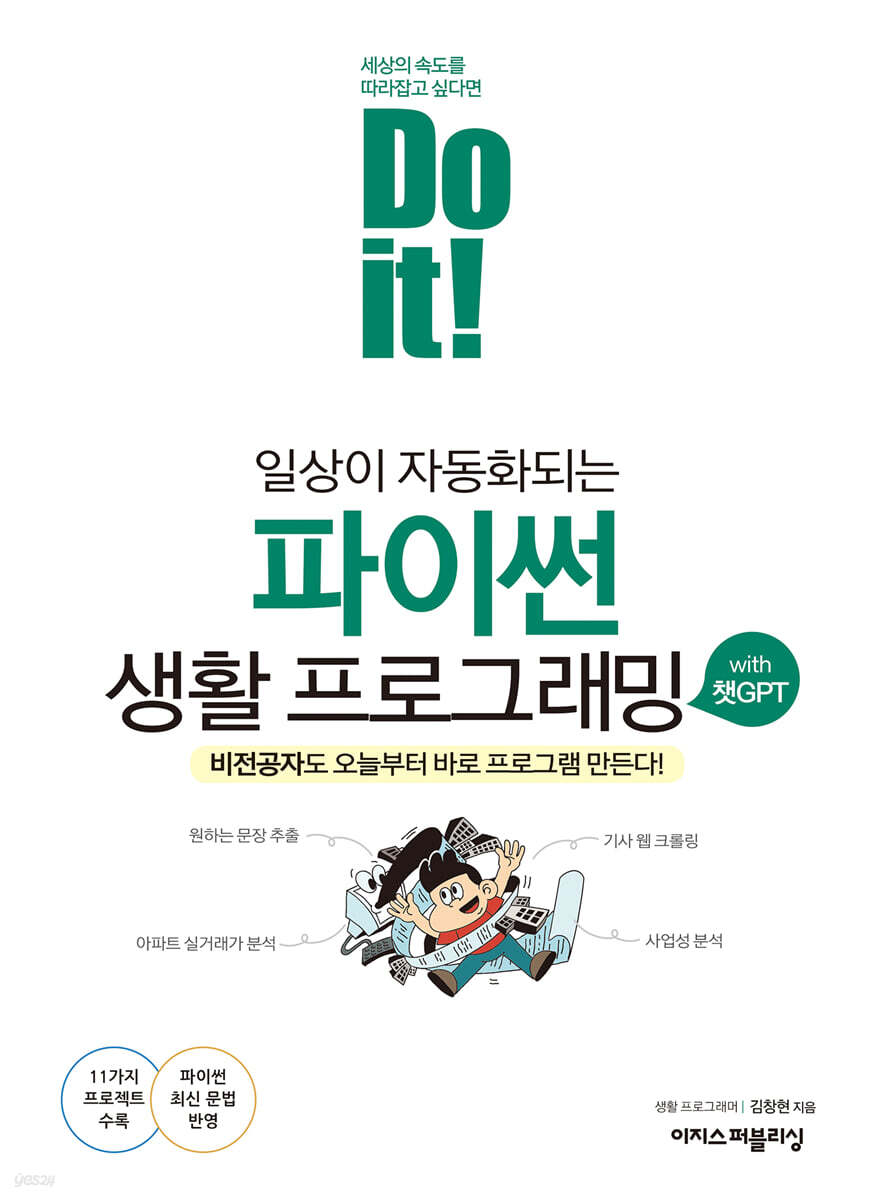
Do it! Python Life Programming with ChatGPT to Automate Your Daily Life
 |
Description
Book Introduction
Even non-majors can start creating programs today!
Let Python handle the tedious and repetitive tasks! "Do it! Python Life Programming," which has guided over ten thousand readers into life programming, is back with even more power, incorporating the latest Python syntax and ChatGPT usage! With ChatGPT firmly established in our daily lives, coding has never been more important or easier to learn. The author of this book, Dr. Chang-Hyeon Kim, is a liberal arts student at heart, having studied geography. However, after encountering Python, he has become a life programmer who solves problems by creating the things he needs for his daily life and work. Although coding is said to be a trend, I wrote this book to be a friendly guide for those of you who are still unfamiliar with it. Let's get started with life programming by following a life-related program that I created because I really needed it! In this book, you will create a total of 11 programs, from the easiest calculator to extracting lines from the American drama "Friends," analyzing real estate transaction statistics, and crawling portal site articles. These programs can be followed by anyone who is new to Python syntax, and can be helpful for learning by using ChatGPT for coding and debugging. There is a saying that if you give a man a fish, you feed him for a day, but if you teach him how to catch a fish, you feed him for a lifetime. As you follow the programs introduced in this book, you will naturally want to create your own useful programs for your daily life, and you will be able to do so. By the end of this book, Python will be a powerful tool for your work, employment, and graduation! |
- You can preview some of the book's contents.
Preview
index
In publishing a revised edition
Chapter 1: Preparing for Python Programming
_01-1 Why did a geography doctor fall in love with Python?
__Why I fell in love with Python
__The deeper you know Python, the more profound it becomes.
__Overcome the error and complete the program.
_01-2 Preparing the Python Development Environment
[Do it! Practice] Installing Python
[Do it! Practice] Setting System Variables Directly
[Do it! Practice] Using the IDLE Environment
Using the f string
01-3 Preparing the Interpreter and Editor
Understanding the Difference Between an Interpreter and an Editor
When to Use IDLE
[Do it! Practice] Installing Notepad++
[Do it! Practice] Creating a Python Program in Notepad++
[Do it! Practice] Running a Program Directly in Notepad++
[Do it! Practice] Coding Python with Visual Studio Code
[Do it! Practice] Coding Python with Colab
Reflection problem
Chapter 2: Creating a Program with Basic Grammar
02-1 Using Python as a Calculator
Learn basic operators
[Do it! Practice] Finding the Average Age
02-2 Print the 19-stage multiplication table
Directly printing the two-stage multiplication table
[Do it! Practice] Printing the multiplication table using a for loop
[Do it! Practice] Using two for loops to print the 19-stage multiplication table.
[Do it! Practice] Complete the 19-stage multiplication table
Smartly using the print() function with f strings
02-3 Making Smart Chat GPT Work
[Do it! Practice] Save and Run a Python File
Things to keep in mind when creating code with ChatGPT
Finding Errors with ChatGPT
02-4 The Importance of Exception Handling
How to handle errors: try-except-finally
What is the error?
02-5 Creating a Value Added Tax Output Program
Calculate VAT easily
Creating a simple function with lambda
Creating a function with the def statement
Get input from the user using the input() function
Outputting results based on conditions using if-else statements
[Do it! Practice] Complete the Service Price Output Program
Reflection problem
Dr. Kim's Column! Why is Python recommended for beginners in coding?
Chapter 3: Processing Your Own Text File
03-1 File Input/Output Practice
Set current location
Open and close files
Learn about file open modes
Using the with statement to input and output files without creating objects
Resolving Hangul file errors
03-2 Extracting citations from papers using regular expressions
What is a regular expression?
Creating regular expression code with ChatGPT
Definition and necessity of regular expressions
The match method - finding patterns in strings
search method - Finding patterns in an entire string
findall method - Find all patterns and return them as a list.
The split method - Creating a sentence splitting pattern
sub method - replace string
[Do it! Practice] Extracting Words Ending with "ly"
03-3 Extracting Drama Dialogue to Create English Study Materials
[Do it! Practice] Preparing a Drama Script File
[Do it! Practice] Collecting only specific characters' lines
[Do it! Practice] Creating a Character List
[Do it! Practice] Print only the fingerprint
[Do it! Practice] Collecting only examples of specific words and saving them as a file
Reflection problem
Dr. Kim's Column! Develop Your Logical Thinking Through Coding
Chapter 4: Handling Real-World Data with CSV Files
04-1 Understanding CSV Data
What is a CSV file?
Creating and reading CSV files
04-2 Reading and Writing CSV Files with Python
Reading CSV files
Writing a CSV file
[Do it! Practice] Create and Use Your Own Module
04-3 Converting characters in a CSV file to numbers
Import a CSV file and check the format
[Do it! Practice] Converting text data to numbers
Skip errors with exception handling
[Do it! Practice] Selecting only numbers and converting them to numeric format using exception handling
04-4 Analyzing CSV files and applying them in real life
[Do it! Practice] Save only district information with a foreigner population of over 3% as a CSV file.
[Do it! Practice] Checking Real Estate Transaction Prices
[Do it! Practice] Saving translated examples as a table
Reflection Problem 195
Chapter 5: Analyzing and Visualizing Data with Statistical Packages and APIs
05-1 Preparing the Data Analysis Package
Installing the data analysis package
05-2 Handling Arrays with NumPy
Defining an array with NumPy
Slicing an array
Finding the size of an array: shape
Checking the element type of an array: dtype
Changing Array Type: astype()
Learn about NumPy functions
Arithmetic operations on arrays
Differences between Python lists and arrays
[Do it! Practice] Preprocessing Survey Data
05-3 Analyzing Business Feasibility with NumPy
What is business analysis?
[Do it! Practice] Finding the Present Value of Capital
[Do it! Practice] Analyzing the Feasibility of an Amusement Park Business
05-4 Analyzing Apartment Transaction Prices with Pandas
What is a data frame?
[Do it! Practice] Importing a CSV File and Creating a DataFrame
[Do it! Practice] Exploring DataFrames
05-5 Handling Statistical Data with Pandas
[Do it! Practice] Examining Basic Statistics
[Do it! Practice] Additional Analysis of Basic Statistics
05-6 A Taste of Practical Statistical Analysis
[Do it! Practice] Performing a t-test with the SciFi package
Understanding Pearson and Spearman Correlation Analysis
[Do it! Practice] Analyzing the Correlation Between Two Variables
Learn about regression analysis
[Do it! Practice] Regression Analysis with the statsmodels Package
05-7 Visualizing Data with Matplotlib
Can't I just draw the graph in Excel?
Create and print graphs
Specifying graph shape and color
Naming the axis
Save the graph as an image file
05-8 Using Public Data APIs
[Do it! Practice] Using Information from the National Assembly Library Site
[Do it! Practice] Processing Response Data
Reflection problem
Dr. Kim's Column! Which Tools Should You Choose for Statistical Analysis?
Chapter 6: Gathering Information Through Web Crawling
06-1 Understanding Web Crawling
What is web crawling?
Can I crawl the web without knowing HTML?
Is there really no important information on the Internet?
How to utilize the vast amount of information
06-2 Collecting Quotes Through Web Crawling
Check out the Quotes to Scrape page
Installing Beautiful Soup
Importing basic modules
[Do it! Practice] Importing and Processing Web Document Data
[Do it! Practice] Extracting Only Text from Specific Tags
[Do it! Practice] Finding a specific tag in a web browser and printing a quote
06-3 Crawling articles from portal sites
[Do it! Practice] Preparing a Basic Web Crawling Environment
[Do it! Practice] Extracting Headline Titles
[Do it! Practice] Extracting Hyperlink Addresses
[Do it! Practice] Extracting All Hyperlinks from a Desired Area
[Do it! Practice] Extracting article titles and content simultaneously
[Do it! Practice] Extracting the Titles and Body of All Hyperlinked Articles
06-4 Creating a Web Crawling Program Executable File
[Do it! Practice] Saving a URL Address
[Do it! Practice] Saving the article body to a file
[Do it! Practice] Saving article titles, text, and hyperlinks to a file
[Do it! Practice] Creating a Web Crawling Executable
As we finish crawling the web
Reflection problem
Chapter 7: Utilizing Python to its Fullest
07-1 Using Python Libraries
What is a library?
Two ways to import a library
Features of the main library and simple examples
07-2 Useful libraries: PIL, tkinter
[Do it! Practice] Editing Photos with PIL (Pillow)
[Do it! Practice] Creating a Graphical Interface with Tkinter
07-3 Python Programming Using ChatGPT
The emergence of ChatGPT and the changing coding environment
[Do it! Practice] How to leverage Smart ChatGPT 10x for everyday programming
[Do it! Practice] Let's code with ChatGPT!
Things to keep in mind when learning to code with ChatGPT
Dr. Kim's Column! The Final Words
Search
Chapter 1: Preparing for Python Programming
_01-1 Why did a geography doctor fall in love with Python?
__Why I fell in love with Python
__The deeper you know Python, the more profound it becomes.
__Overcome the error and complete the program.
_01-2 Preparing the Python Development Environment
[Do it! Practice] Installing Python
[Do it! Practice] Setting System Variables Directly
[Do it! Practice] Using the IDLE Environment
Using the f string
01-3 Preparing the Interpreter and Editor
Understanding the Difference Between an Interpreter and an Editor
When to Use IDLE
[Do it! Practice] Installing Notepad++
[Do it! Practice] Creating a Python Program in Notepad++
[Do it! Practice] Running a Program Directly in Notepad++
[Do it! Practice] Coding Python with Visual Studio Code
[Do it! Practice] Coding Python with Colab
Reflection problem
Chapter 2: Creating a Program with Basic Grammar
02-1 Using Python as a Calculator
Learn basic operators
[Do it! Practice] Finding the Average Age
02-2 Print the 19-stage multiplication table
Directly printing the two-stage multiplication table
[Do it! Practice] Printing the multiplication table using a for loop
[Do it! Practice] Using two for loops to print the 19-stage multiplication table.
[Do it! Practice] Complete the 19-stage multiplication table
Smartly using the print() function with f strings
02-3 Making Smart Chat GPT Work
[Do it! Practice] Save and Run a Python File
Things to keep in mind when creating code with ChatGPT
Finding Errors with ChatGPT
02-4 The Importance of Exception Handling
How to handle errors: try-except-finally
What is the error?
02-5 Creating a Value Added Tax Output Program
Calculate VAT easily
Creating a simple function with lambda
Creating a function with the def statement
Get input from the user using the input() function
Outputting results based on conditions using if-else statements
[Do it! Practice] Complete the Service Price Output Program
Reflection problem
Dr. Kim's Column! Why is Python recommended for beginners in coding?
Chapter 3: Processing Your Own Text File
03-1 File Input/Output Practice
Set current location
Open and close files
Learn about file open modes
Using the with statement to input and output files without creating objects
Resolving Hangul file errors
03-2 Extracting citations from papers using regular expressions
What is a regular expression?
Creating regular expression code with ChatGPT
Definition and necessity of regular expressions
The match method - finding patterns in strings
search method - Finding patterns in an entire string
findall method - Find all patterns and return them as a list.
The split method - Creating a sentence splitting pattern
sub method - replace string
[Do it! Practice] Extracting Words Ending with "ly"
03-3 Extracting Drama Dialogue to Create English Study Materials
[Do it! Practice] Preparing a Drama Script File
[Do it! Practice] Collecting only specific characters' lines
[Do it! Practice] Creating a Character List
[Do it! Practice] Print only the fingerprint
[Do it! Practice] Collecting only examples of specific words and saving them as a file
Reflection problem
Dr. Kim's Column! Develop Your Logical Thinking Through Coding
Chapter 4: Handling Real-World Data with CSV Files
04-1 Understanding CSV Data
What is a CSV file?
Creating and reading CSV files
04-2 Reading and Writing CSV Files with Python
Reading CSV files
Writing a CSV file
[Do it! Practice] Create and Use Your Own Module
04-3 Converting characters in a CSV file to numbers
Import a CSV file and check the format
[Do it! Practice] Converting text data to numbers
Skip errors with exception handling
[Do it! Practice] Selecting only numbers and converting them to numeric format using exception handling
04-4 Analyzing CSV files and applying them in real life
[Do it! Practice] Save only district information with a foreigner population of over 3% as a CSV file.
[Do it! Practice] Checking Real Estate Transaction Prices
[Do it! Practice] Saving translated examples as a table
Reflection Problem 195
Chapter 5: Analyzing and Visualizing Data with Statistical Packages and APIs
05-1 Preparing the Data Analysis Package
Installing the data analysis package
05-2 Handling Arrays with NumPy
Defining an array with NumPy
Slicing an array
Finding the size of an array: shape
Checking the element type of an array: dtype
Changing Array Type: astype()
Learn about NumPy functions
Arithmetic operations on arrays
Differences between Python lists and arrays
[Do it! Practice] Preprocessing Survey Data
05-3 Analyzing Business Feasibility with NumPy
What is business analysis?
[Do it! Practice] Finding the Present Value of Capital
[Do it! Practice] Analyzing the Feasibility of an Amusement Park Business
05-4 Analyzing Apartment Transaction Prices with Pandas
What is a data frame?
[Do it! Practice] Importing a CSV File and Creating a DataFrame
[Do it! Practice] Exploring DataFrames
05-5 Handling Statistical Data with Pandas
[Do it! Practice] Examining Basic Statistics
[Do it! Practice] Additional Analysis of Basic Statistics
05-6 A Taste of Practical Statistical Analysis
[Do it! Practice] Performing a t-test with the SciFi package
Understanding Pearson and Spearman Correlation Analysis
[Do it! Practice] Analyzing the Correlation Between Two Variables
Learn about regression analysis
[Do it! Practice] Regression Analysis with the statsmodels Package
05-7 Visualizing Data with Matplotlib
Can't I just draw the graph in Excel?
Create and print graphs
Specifying graph shape and color
Naming the axis
Save the graph as an image file
05-8 Using Public Data APIs
[Do it! Practice] Using Information from the National Assembly Library Site
[Do it! Practice] Processing Response Data
Reflection problem
Dr. Kim's Column! Which Tools Should You Choose for Statistical Analysis?
Chapter 6: Gathering Information Through Web Crawling
06-1 Understanding Web Crawling
What is web crawling?
Can I crawl the web without knowing HTML?
Is there really no important information on the Internet?
How to utilize the vast amount of information
06-2 Collecting Quotes Through Web Crawling
Check out the Quotes to Scrape page
Installing Beautiful Soup
Importing basic modules
[Do it! Practice] Importing and Processing Web Document Data
[Do it! Practice] Extracting Only Text from Specific Tags
[Do it! Practice] Finding a specific tag in a web browser and printing a quote
06-3 Crawling articles from portal sites
[Do it! Practice] Preparing a Basic Web Crawling Environment
[Do it! Practice] Extracting Headline Titles
[Do it! Practice] Extracting Hyperlink Addresses
[Do it! Practice] Extracting All Hyperlinks from a Desired Area
[Do it! Practice] Extracting article titles and content simultaneously
[Do it! Practice] Extracting the Titles and Body of All Hyperlinked Articles
06-4 Creating a Web Crawling Program Executable File
[Do it! Practice] Saving a URL Address
[Do it! Practice] Saving the article body to a file
[Do it! Practice] Saving article titles, text, and hyperlinks to a file
[Do it! Practice] Creating a Web Crawling Executable
As we finish crawling the web
Reflection problem
Chapter 7: Utilizing Python to its Fullest
07-1 Using Python Libraries
What is a library?
Two ways to import a library
Features of the main library and simple examples
07-2 Useful libraries: PIL, tkinter
[Do it! Practice] Editing Photos with PIL (Pillow)
[Do it! Practice] Creating a Graphical Interface with Tkinter
07-3 Python Programming Using ChatGPT
The emergence of ChatGPT and the changing coding environment
[Do it! Practice] How to leverage Smart ChatGPT 10x for everyday programming
[Do it! Practice] Let's code with ChatGPT!
Things to keep in mind when learning to code with ChatGPT
Dr. Kim's Column! The Final Words
Search
Detailed image

Publisher's Review
Coding has never been this easy!
In an era where everyone can become a life programmer, learning just one program can increase your productivity!
With the Fourth Industrial Revolution and Chat GPT becoming a part of our daily lives, coding has become a necessary skill in all fields.
There's a lot to learn, but the good news is that coding is easier now than ever.
Not only is ChatGPT here, but there is also a guide for those of you who have studied programming as a non-major.
The author, a liberal arts student at heart, holds a PhD in geography and first encountered Python after completing his PhD thesis in geography in 2014.
Fascinated by Python's ability to produce immediate results, he happily pondered how to apply Python to his work and daily life, developing programs whenever he had time on weekends.
At first, he only used Python as a calculator, but as he spent more time studying it, he was able to use Python to automatically scrape desired articles and create data sets, and to extract only sentences with specific patterns from long and complex texts.
Simple tasks that would otherwise take a lot of time can now be solved in a single step with a Python program.
This book focuses on enabling non-developers like the author, or even beginners in programming, to actually create programs and use them to some extent.
To introduce one of the contents of the book in advance, Chapter 3 states that handling text using 'regular expressions' is an essential skill for everyone.
The author emphasizes that if all office workers who deal with text practice and use regular expressions every day, their productivity will explode.
Even tedious, repetitive tasks that would take more than 20 hours can be completed in just 30 minutes using Python programs.
Experience the joy of running your own code!
After completing 11 programs, even non-experts can create what they need!
If you want to go beyond just knowing Python grammar and apply it to your studies or work, you need to develop your programming skills little by little.
To use Python properly, you need to be able to think about what kind of program is needed for a specific situation and actually create it.
When developing your programming skills, you should create several usable programs, as if you were using the tool in various situations, so that you can handle it as if it were your own.
With this book, you can develop your programming skills by creating 11 programs closely related to your daily life, from a simple calculator to extracting lines from the American drama "Friends," analyzing real estate transaction prices, and collecting articles from portal sites.
Anyone can easily complete the program by following the steps in the [Do it! Practice] section.
In this process, you can naturally experience various Python applications such as regular expressions, CSV file processing, file input/output, statistical analysis, and web crawling.
As you build your programming skills by creating 11, you will be able to come up with useful programs of your own when you need them, and you will be able to create them yourself.
List of programs created in this book
1.
Print the 19-stage multiplication table
2.
VAT automatic calculator
3.
Excerpts from the script for the American drama 'Friends'
4.
Seoul City Population Ratio Survey
5.
Apartment actual transaction price search
6.
Automatic alignment of English and translated texts
7. Business Analysis with CSV Files
8.
Analysis of actual housing transaction prices
9.
Job Satisfaction Survey Statistical Analysis
10.
Automatic collection of website quotes
11.
Automatic collection of portal site articles
Just knowing the basics of Python is enough!
Highly recommended for instructors looking for practical teaching materials! Even non-majors and middle school students can easily follow along!
This book begins by creating a Python hands-on environment so that anyone can easily follow along with the project.
Then, we start by creating a calculator that utilizes Python in the simplest way possible, creating a multiplication table and printing a 19-stage multiplication table.
And let's ask Python to do simple tasks that can be done in Excel.
The grammar required to create a program is explained directly in the text and tips as you upgrade each project.
It provides friendly comments explaining how each line of code works.
To help readers progress through the project more realistically, we present a situation where a program is needed in the [In this situation] corner, and first draw a flowchart of how to create a complex program.
The sections where you actually start coding are marked with "Do it!" so that readers don't miss out on the practical exercises, and each chapter includes review problems so that you can thoroughly review important concepts.
Whether you're an office worker who wrestles with numbers all day, a researcher who fills in tables, a writer who painstakingly edits and improves their writing with word processing software, or a college student eager to learn more, this book, "Do it! Automating Everyday Life with Python Programming with ChatGPT," will be a powerful tool!
People like this will enjoy reading this
Say goodbye to difficult and boring books! For non-majors looking to successfully get started with Python.
- Beginners who want to learn coding with code that can be applied immediately in real life.
- Office workers who want to increase productivity with Python
Over ten thousand readers have started life programming with this book!
“You can create programs that can be used in real life!”
*This is a review by readers who started learning Python with this book before it was revised and expanded.
I think this is a must-read for anyone who is learning Python and wondering where to apply it.
By following along with the examples of the author, a geographer rather than a computer scientist, you'll discover where Python can be used.
- kb****
It's explained so clearly that even beginners can easily learn! The best part is that you can learn by creating even a small program.
- ag****
Among the various fields of application, this is the best book to lay the foundation for designing programs tailored to your specific needs! It's optimized for self-study.
- dl********
I haven't found a better book for learning practical Python applications after learning the basic grammar.
You can also learn the basics of statistical analysis, such as Pandas and Numpy, comprehensively.
- kb****
I'm a super beginner, but I feel like I'm getting better with each step I take! - ho*****
The main content is programs based on Python that can be directly applied to real life.
If you follow the book carefully, you will find many things that you can actually apply to your daily life.
I was impressed by the saying, "Life is short, so you should learn Python," and the content is rich and true to that saying.
- vu******
In an era where everyone can become a life programmer, learning just one program can increase your productivity!
With the Fourth Industrial Revolution and Chat GPT becoming a part of our daily lives, coding has become a necessary skill in all fields.
There's a lot to learn, but the good news is that coding is easier now than ever.
Not only is ChatGPT here, but there is also a guide for those of you who have studied programming as a non-major.
The author, a liberal arts student at heart, holds a PhD in geography and first encountered Python after completing his PhD thesis in geography in 2014.
Fascinated by Python's ability to produce immediate results, he happily pondered how to apply Python to his work and daily life, developing programs whenever he had time on weekends.
At first, he only used Python as a calculator, but as he spent more time studying it, he was able to use Python to automatically scrape desired articles and create data sets, and to extract only sentences with specific patterns from long and complex texts.
Simple tasks that would otherwise take a lot of time can now be solved in a single step with a Python program.
This book focuses on enabling non-developers like the author, or even beginners in programming, to actually create programs and use them to some extent.
To introduce one of the contents of the book in advance, Chapter 3 states that handling text using 'regular expressions' is an essential skill for everyone.
The author emphasizes that if all office workers who deal with text practice and use regular expressions every day, their productivity will explode.
Even tedious, repetitive tasks that would take more than 20 hours can be completed in just 30 minutes using Python programs.
Experience the joy of running your own code!
After completing 11 programs, even non-experts can create what they need!
If you want to go beyond just knowing Python grammar and apply it to your studies or work, you need to develop your programming skills little by little.
To use Python properly, you need to be able to think about what kind of program is needed for a specific situation and actually create it.
When developing your programming skills, you should create several usable programs, as if you were using the tool in various situations, so that you can handle it as if it were your own.
With this book, you can develop your programming skills by creating 11 programs closely related to your daily life, from a simple calculator to extracting lines from the American drama "Friends," analyzing real estate transaction prices, and collecting articles from portal sites.
Anyone can easily complete the program by following the steps in the [Do it! Practice] section.
In this process, you can naturally experience various Python applications such as regular expressions, CSV file processing, file input/output, statistical analysis, and web crawling.
As you build your programming skills by creating 11, you will be able to come up with useful programs of your own when you need them, and you will be able to create them yourself.
List of programs created in this book
1.
Print the 19-stage multiplication table
2.
VAT automatic calculator
3.
Excerpts from the script for the American drama 'Friends'
4.
Seoul City Population Ratio Survey
5.
Apartment actual transaction price search
6.
Automatic alignment of English and translated texts
7. Business Analysis with CSV Files
8.
Analysis of actual housing transaction prices
9.
Job Satisfaction Survey Statistical Analysis
10.
Automatic collection of website quotes
11.
Automatic collection of portal site articles
Just knowing the basics of Python is enough!
Highly recommended for instructors looking for practical teaching materials! Even non-majors and middle school students can easily follow along!
This book begins by creating a Python hands-on environment so that anyone can easily follow along with the project.
Then, we start by creating a calculator that utilizes Python in the simplest way possible, creating a multiplication table and printing a 19-stage multiplication table.
And let's ask Python to do simple tasks that can be done in Excel.
The grammar required to create a program is explained directly in the text and tips as you upgrade each project.
It provides friendly comments explaining how each line of code works.
To help readers progress through the project more realistically, we present a situation where a program is needed in the [In this situation] corner, and first draw a flowchart of how to create a complex program.
The sections where you actually start coding are marked with "Do it!" so that readers don't miss out on the practical exercises, and each chapter includes review problems so that you can thoroughly review important concepts.
Whether you're an office worker who wrestles with numbers all day, a researcher who fills in tables, a writer who painstakingly edits and improves their writing with word processing software, or a college student eager to learn more, this book, "Do it! Automating Everyday Life with Python Programming with ChatGPT," will be a powerful tool!
People like this will enjoy reading this
Say goodbye to difficult and boring books! For non-majors looking to successfully get started with Python.
- Beginners who want to learn coding with code that can be applied immediately in real life.
- Office workers who want to increase productivity with Python
Over ten thousand readers have started life programming with this book!
“You can create programs that can be used in real life!”
*This is a review by readers who started learning Python with this book before it was revised and expanded.
I think this is a must-read for anyone who is learning Python and wondering where to apply it.
By following along with the examples of the author, a geographer rather than a computer scientist, you'll discover where Python can be used.
- kb****
It's explained so clearly that even beginners can easily learn! The best part is that you can learn by creating even a small program.
- ag****
Among the various fields of application, this is the best book to lay the foundation for designing programs tailored to your specific needs! It's optimized for self-study.
- dl********
I haven't found a better book for learning practical Python applications after learning the basic grammar.
You can also learn the basics of statistical analysis, such as Pandas and Numpy, comprehensively.
- kb****
I'm a super beginner, but I feel like I'm getting better with each step I take! - ho*****
The main content is programs based on Python that can be directly applied to real life.
If you follow the book carefully, you will find many things that you can actually apply to your daily life.
I was impressed by the saying, "Life is short, so you should learn Python," and the content is rich and true to that saying.
- vu******
GOODS SPECIFICS
- Date of issue: January 30, 2024
- Page count, weight, size: 384 pages | 188*257*15mm
- ISBN13: 9791163035503
You may also like
카테고리
korean


korean

![GQ KOREA Mark (Monthly): December [2025]](http://librairie.coreenne.fr/cdn/shop/files/8ef265dbbfbf186523ed75ba7319009d.jpg?v=1765340328&width=3840)


