

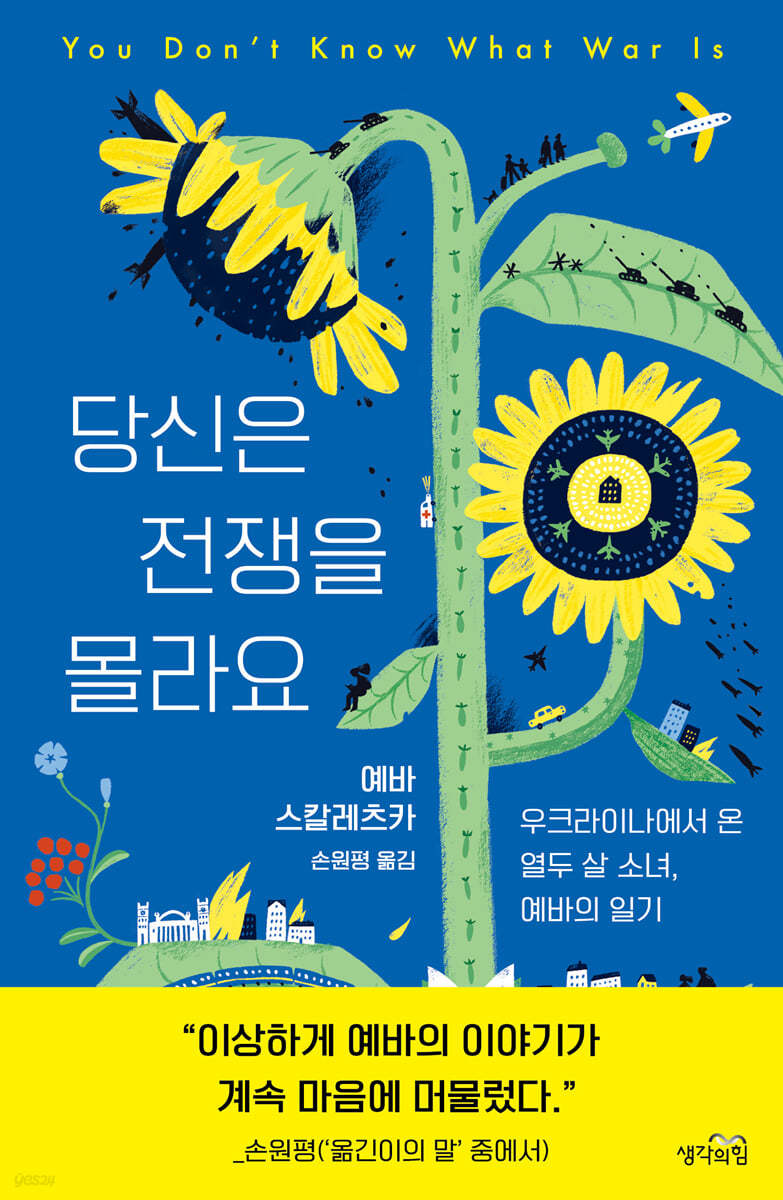
You don't know war
 |
Description
Book Introduction
Here, the story of a twelve-year-old girl is published, a story that will haunt readers for a very long time.
From Ukraine to Hungary to Ireland, you don't know war is a tense and heart-pounding chronicle of the aftermath of the Russian invasion.
On February 24, 2022, Yeba's life, "peaceful until the early morning hours," is forever changed when she wakes to the terrifying sound of bombing.
Kharkiv, the home Yeva loved, was no longer a safe place.
Yeba and her grandmother head into the damp, cramped basement, tears welling up in their eyes.
This whole story was the beginning of hell.
From then on, Yeba decided to write 'her own story'.
To tell the truth we all need to hear.
From Ukraine to Hungary to Ireland, you don't know war is a tense and heart-pounding chronicle of the aftermath of the Russian invasion.
On February 24, 2022, Yeba's life, "peaceful until the early morning hours," is forever changed when she wakes to the terrifying sound of bombing.
Kharkiv, the home Yeva loved, was no longer a safe place.
Yeba and her grandmother head into the damp, cramped basement, tears welling up in their eyes.
This whole story was the beginning of hell.
From then on, Yeba decided to write 'her own story'.
To tell the truth we all need to hear.
- You can preview some of the book's contents.
Preview
index
introduction
Entering
Before that happened
War breaks out in Ukraine
Hungary
Ireland
After that
Friends' stories
Last diary
Read more
Acknowledgements
Translator's Note
Entering
Before that happened
War breaks out in Ukraine
Hungary
Ireland
After that
Friends' stories
Last diary
Read more
Acknowledgements
Translator's Note
Detailed image
.jpg)
Into the book
On the morning of February 14th, I woke up early.
Today is my birthday.
I turned twelve.
I'm almost a teenager now! There's a surprise gift in my room.
Balloons! There are five of them.
There are also two silver, pink, gold and turquoise balloons.
My heart is pounding as I think about the more surprising things that await me in the future.
The birthday messages keep coming in nonstop.
Before I left the house, I already had texts from seven people.
I want to go to school quickly.
--- p.21
I checked my phone.
In the school group chat, people were talking about what had just happened.
As soon as we were ready, we headed to the basement.
As I entered the basement, I felt panic attacks again.
I couldn't breathe and my hands were cold and clammy.
The war has begun.
Explosions, noise, my heart pounding… … .
I couldn't think of anything in the midst of fear and noise.
Tears welled up in my eyes.
When I thought of myself and my loved ones, fear came over me.
--- p.35
This is the first time I've felt time passing so slowly.
There is continuous shelling.
Russia is said to have surrounded Ukraine.
Russia wants Kharkiv to surrender.
Another bombardment.
I'm about to have another panic attack.
I sit next to my grandmother and she hugs me tightly.
We were terrified.
There are rumors going around that the city may have to cut off electricity and water tomorrow due to the wartime situation, but we will not despair.
All we can do is pray.
--- p.42
I packed my bags.
The moment I thought, "Has the bombing stopped?", I heard an explosion.
Yes, that's right.
The bombing didn't stop.
We ran into the basement.
It was very cold.
The word 'shelter' is written at the entrance to the basement.
Surprisingly, it's snowing.
They say it's going to snow for the next few days.
I'm afraid that the bombing will start again, but I walk as if nothing happened.
Thankfully it was a quiet morning.
I scroll down the screen to read 180 group chat messages that arrived from my friends overnight.
--- p.48
Messages keep popping up in the group chat.
Polina sent a message that tanks were advancing on Hvardičiu-Sironinčiu street, northeast of Kharkiv.
When I told this news to Grandma and Aunt Ina, they said, “Don’t worry, there’s nothing we can do.
The only answer I get is, “It’s just something that has already happened.”
We decide not to be afraid.
--- p.54
The sun sets.
We want peace.
We no longer remember what dreams we once had or what we once considered important.
I don't even remember the arguments we had in the past or the problems that were troubling us.
Those worries I had in the past are no longer important.
In war, there is only one goal left.
Surviving.
All the hard and difficult things become trivial.
You worry about the lives of your loved ones, and your daily life is shattered by a loud bang.
Forcing myself to hide the fear that grips my heart, I begin to think that it would be fortunate if the rocket landed far away from me.
I pray all day long, asking God for peace.
I desperately cling to every minute, every second of my life.
--- p.66
My heart hurts so much.
That house is where I spent my childhood.
Attacking my home is like attacking a part of me.
I feel like my heart has been crushed.
It was a place filled with countless memories! Our Italian furniture, beautiful dishes and plates, glass tables…
All those memories were shattered.
The overflowing tears are only a part of my sadness.
The things themselves are not important.
The objects themselves are unimportant compared to the memories they contain.
The place where I spent my childhood has completely collapsed!
--- p.93
It's dark outside.
Lira made me laugh by telling me how beautiful the reeds outside the window were.
Some people worry about where to go and what to do next, while others simply admire the reeds.
haha!
There were some scary moments.
The train repeatedly slowed down and sometimes came to a complete stop.
The lights in the room kept going out, and every time they came back on, everyone breathed a sigh of relief.
There were many moments when I was afraid to even utter a single word.
My grandmother later confessed that she had seen an explosion in the distance outside the window, but didn't tell me because she was afraid I would be more scared.
The train stopped intermittently, probably because of those explosions.
You had to stop until the situation became safe and you received a signal to continue driving.
--- p.114
As I was looking around, trying to collect myself, my grandmother told the man who had been filming us earlier that I was writing a book.
It remains a mystery how the grandmother explained this to the man who could not speak Russian at all.
Anyway, our work caught the old man's attention.
I approached him and said hello.
The man's name is Flavian.
He works for Channel 4, a British terrestrial broadcaster.
I told him everything that had happened to me.
The man asked if he could film me and interview me.
--- p.125
We're almost in Budapest.
When I looked out the train window at the city, it just felt ordinary and stiff.
It soon became clear that I was wrong.
The train stopped on the platform just outside the station building.
The moment I got off the train, I was overwhelmed by the scenery that caught my eye.
Keleti Station is a beautiful train station with huge pillars supporting a large glass roof.
The reporters started taking pictures of me.
As we entered the main building of the central station, there were stone statues lined up along the walls.
Volunteers were distributing various necessities.
Things like shampoo, sanitary pads, and diapers.
We were able to receive toothpaste, toothbrushes, and food.
I got out of the train station and looked around.
It was amazing! I think I'll keep saying this.
Budapest is truly a beautiful city! Huge shopping centers, old buildings, and the bustle of people and cars all around me.
It's hard to suppress your emotions.
I came to Europe.
For the first time in my life!
--- p.153
I decided to go for a walk with my grandmother, and this time I felt a little more confident than last time.
We took a walk near the park.
Today was a warm and sunny day.
After finishing my walk, I returned to my lodging.
Delara and Tom came and filmed me reading my diary.
I text and call my friends every day.
I ask them what the situation is in Kharkiv.
I also talk to Grandma Gina and Grandpa Josef, who are still staying there.
Tomorrow is a very important day.
After meeting the reporters, I kept this fact a secret, even in my diary.
Tomorrow I will be able to tell you everything.
--- p.167
Then I met a couple wrapped in the Ukrainian flag.
My grandmother and I spoke to them.
They said they had just arrived in Dublin a few days ago.
What I was most curious about was, "Were there a lot of fighter jets where you were? How did you survive in that terrible noise?"
They said, “On the first day of the war, as I was running down the street, I saw fighter planes flying overhead.
“After that we moved to five countries and finally came to Dublin,” he replied.
It wasn't a long conversation, but it was enough to bring everything back to mind.
Both good and bad.
Then sadness and pain came rushing in.
Tears welled up in my eyes.
I remembered moments when I prayed that my house would be safe from the bombing.
I thought about Kharkiv and everything that was once important in Kharkiv but has now been destroyed.
As I got into the taxi to go home, tears started to flow.
--- p.192
A month has passed since the war began.
The war brought so much pain to my friends, my family, and everyone else.
How many lives have already been lost in this war, and how many more will be lost in the future?
No one knows what will happen tomorrow, or in the next hour, or even in the next minute.
The more people who don't know what war is, the better.
Then the world will be a happier place.
Because there is nothing more terrible than war.
--- p.209
It's hard to bear the word 'refugee'.
I think it will be like that forever.
When my grandmother started calling ourselves refugees, I told her to stop saying that right away.
I felt ashamed inside.
I think I finally understand why I was embarrassed.
It's embarrassing to admit that I don't have a home.
From the moment I left home and fled to the underground shelter, I felt unbearable.
My dream is that in the near future we will have our own home again.
--- p.222
I was fortunate to have friendly people close to me and my friends.
Whether it's family or pets.
A piece of sugar-dusted bread or a cozy hug with a fluffy doll brought us great comfort.
But the war never went away.
I miss my friends so much.
I hope we can see each other again someday.
I hope all their hopes and dreams come true.
I would like to end this article like this.
We are still children, so we should live peaceful and happy lives!
Today is my birthday.
I turned twelve.
I'm almost a teenager now! There's a surprise gift in my room.
Balloons! There are five of them.
There are also two silver, pink, gold and turquoise balloons.
My heart is pounding as I think about the more surprising things that await me in the future.
The birthday messages keep coming in nonstop.
Before I left the house, I already had texts from seven people.
I want to go to school quickly.
--- p.21
I checked my phone.
In the school group chat, people were talking about what had just happened.
As soon as we were ready, we headed to the basement.
As I entered the basement, I felt panic attacks again.
I couldn't breathe and my hands were cold and clammy.
The war has begun.
Explosions, noise, my heart pounding… … .
I couldn't think of anything in the midst of fear and noise.
Tears welled up in my eyes.
When I thought of myself and my loved ones, fear came over me.
--- p.35
This is the first time I've felt time passing so slowly.
There is continuous shelling.
Russia is said to have surrounded Ukraine.
Russia wants Kharkiv to surrender.
Another bombardment.
I'm about to have another panic attack.
I sit next to my grandmother and she hugs me tightly.
We were terrified.
There are rumors going around that the city may have to cut off electricity and water tomorrow due to the wartime situation, but we will not despair.
All we can do is pray.
--- p.42
I packed my bags.
The moment I thought, "Has the bombing stopped?", I heard an explosion.
Yes, that's right.
The bombing didn't stop.
We ran into the basement.
It was very cold.
The word 'shelter' is written at the entrance to the basement.
Surprisingly, it's snowing.
They say it's going to snow for the next few days.
I'm afraid that the bombing will start again, but I walk as if nothing happened.
Thankfully it was a quiet morning.
I scroll down the screen to read 180 group chat messages that arrived from my friends overnight.
--- p.48
Messages keep popping up in the group chat.
Polina sent a message that tanks were advancing on Hvardičiu-Sironinčiu street, northeast of Kharkiv.
When I told this news to Grandma and Aunt Ina, they said, “Don’t worry, there’s nothing we can do.
The only answer I get is, “It’s just something that has already happened.”
We decide not to be afraid.
--- p.54
The sun sets.
We want peace.
We no longer remember what dreams we once had or what we once considered important.
I don't even remember the arguments we had in the past or the problems that were troubling us.
Those worries I had in the past are no longer important.
In war, there is only one goal left.
Surviving.
All the hard and difficult things become trivial.
You worry about the lives of your loved ones, and your daily life is shattered by a loud bang.
Forcing myself to hide the fear that grips my heart, I begin to think that it would be fortunate if the rocket landed far away from me.
I pray all day long, asking God for peace.
I desperately cling to every minute, every second of my life.
--- p.66
My heart hurts so much.
That house is where I spent my childhood.
Attacking my home is like attacking a part of me.
I feel like my heart has been crushed.
It was a place filled with countless memories! Our Italian furniture, beautiful dishes and plates, glass tables…
All those memories were shattered.
The overflowing tears are only a part of my sadness.
The things themselves are not important.
The objects themselves are unimportant compared to the memories they contain.
The place where I spent my childhood has completely collapsed!
--- p.93
It's dark outside.
Lira made me laugh by telling me how beautiful the reeds outside the window were.
Some people worry about where to go and what to do next, while others simply admire the reeds.
haha!
There were some scary moments.
The train repeatedly slowed down and sometimes came to a complete stop.
The lights in the room kept going out, and every time they came back on, everyone breathed a sigh of relief.
There were many moments when I was afraid to even utter a single word.
My grandmother later confessed that she had seen an explosion in the distance outside the window, but didn't tell me because she was afraid I would be more scared.
The train stopped intermittently, probably because of those explosions.
You had to stop until the situation became safe and you received a signal to continue driving.
--- p.114
As I was looking around, trying to collect myself, my grandmother told the man who had been filming us earlier that I was writing a book.
It remains a mystery how the grandmother explained this to the man who could not speak Russian at all.
Anyway, our work caught the old man's attention.
I approached him and said hello.
The man's name is Flavian.
He works for Channel 4, a British terrestrial broadcaster.
I told him everything that had happened to me.
The man asked if he could film me and interview me.
--- p.125
We're almost in Budapest.
When I looked out the train window at the city, it just felt ordinary and stiff.
It soon became clear that I was wrong.
The train stopped on the platform just outside the station building.
The moment I got off the train, I was overwhelmed by the scenery that caught my eye.
Keleti Station is a beautiful train station with huge pillars supporting a large glass roof.
The reporters started taking pictures of me.
As we entered the main building of the central station, there were stone statues lined up along the walls.
Volunteers were distributing various necessities.
Things like shampoo, sanitary pads, and diapers.
We were able to receive toothpaste, toothbrushes, and food.
I got out of the train station and looked around.
It was amazing! I think I'll keep saying this.
Budapest is truly a beautiful city! Huge shopping centers, old buildings, and the bustle of people and cars all around me.
It's hard to suppress your emotions.
I came to Europe.
For the first time in my life!
--- p.153
I decided to go for a walk with my grandmother, and this time I felt a little more confident than last time.
We took a walk near the park.
Today was a warm and sunny day.
After finishing my walk, I returned to my lodging.
Delara and Tom came and filmed me reading my diary.
I text and call my friends every day.
I ask them what the situation is in Kharkiv.
I also talk to Grandma Gina and Grandpa Josef, who are still staying there.
Tomorrow is a very important day.
After meeting the reporters, I kept this fact a secret, even in my diary.
Tomorrow I will be able to tell you everything.
--- p.167
Then I met a couple wrapped in the Ukrainian flag.
My grandmother and I spoke to them.
They said they had just arrived in Dublin a few days ago.
What I was most curious about was, "Were there a lot of fighter jets where you were? How did you survive in that terrible noise?"
They said, “On the first day of the war, as I was running down the street, I saw fighter planes flying overhead.
“After that we moved to five countries and finally came to Dublin,” he replied.
It wasn't a long conversation, but it was enough to bring everything back to mind.
Both good and bad.
Then sadness and pain came rushing in.
Tears welled up in my eyes.
I remembered moments when I prayed that my house would be safe from the bombing.
I thought about Kharkiv and everything that was once important in Kharkiv but has now been destroyed.
As I got into the taxi to go home, tears started to flow.
--- p.192
A month has passed since the war began.
The war brought so much pain to my friends, my family, and everyone else.
How many lives have already been lost in this war, and how many more will be lost in the future?
No one knows what will happen tomorrow, or in the next hour, or even in the next minute.
The more people who don't know what war is, the better.
Then the world will be a happier place.
Because there is nothing more terrible than war.
--- p.209
It's hard to bear the word 'refugee'.
I think it will be like that forever.
When my grandmother started calling ourselves refugees, I told her to stop saying that right away.
I felt ashamed inside.
I think I finally understand why I was embarrassed.
It's embarrassing to admit that I don't have a home.
From the moment I left home and fled to the underground shelter, I felt unbearable.
My dream is that in the near future we will have our own home again.
--- p.222
I was fortunate to have friendly people close to me and my friends.
Whether it's family or pets.
A piece of sugar-dusted bread or a cozy hug with a fluffy doll brought us great comfort.
But the war never went away.
I miss my friends so much.
I hope we can see each other again someday.
I hope all their hopes and dreams come true.
I would like to end this article like this.
We are still children, so we should live peaceful and happy lives!
--- p.250
Publisher's Review
Recommended by The Irish Times, The Telegraph, The Daily Mail, Kirkus Reviews, and Library Journal
"A Chronicle of War Through the Eyes of a Child" - Selected as a "Book of the Year 2022" by The Sunday Times
Translated and published in over 20 countries, including the UK, US, Italy, Germany, France, Spain, and Finland.
A story told by Yeva, a twelve-year-old Ukrainian girl
A heart-stopping war story
On February 24, 2022, twelve-year-old Yeva's life was turned upside down with "that thing."
Russia invaded Ukraine.
There were many rumors and whispers, but few people really thought that war would break out.
This diary, which records the journey of about two months from Kharkiv, Ukraine's second largest city, where he lived with his grandmother, to Dublin, Ireland, is a powerful, vivid, and incredibly important and surprising chronicle of the war as seen through the eyes of a child.
Here, the story of a twelve-year-old girl is published, a story that will haunt readers for a very long time.
"You Don't Know War" is a tense and heart-pounding account of the aftermath of the Russian invasion.
The author and diary owner, Jeva Skalecka, is an ordinary twelve-year-old girl who, like many children around the world, loves to draw, plays the piano, and learns English.
Such a scenario leads us into the middle of war.
Yeba's story, shocking, heartbreaking, and brilliantly brilliant, speaks a truth every generation needs to hear.
This book is for all young readers of Yeba's age, as well as all adults in this land who need to know more about "war" and its impact on children—those who have a responsibility to care for those around them.
The bravest voices of our time lead us on a journey of solidarity to read, understand, and remember.
From Ukraine to Ireland,
Follow Yeba's journey, clinging tightly to hope.
The book begins with Yeva's twelfth birthday (February 14, 2022).
“What kind of surprising things await me in the future?” Yeba’s life, which had been pounding with excitement, is turned upside down forever when she wakes up to the terrifying sound of bombing.
Kharkiv, the home Yeva loved, was no longer a safe place.
The moment a giant missile passes by the house and explodes, Yeba's heart freezes cold.
Yeba and her grandmother head into the damp, cramped basement, tears welling up in their eyes.
This whole story was the beginning of hell.
From then on, Yeba decided to write 'her own story'.
To tell the truth we all need to hear.
Although Yeba's story follows events reported in the news, this powerful reading experience sends a thrilling ripple through the air.
It's one thing to watch the news and read the newspapers to understand the war, but it's another thing entirely to read the raw diary of a twelve-year-old girl who was right in the middle of it all.
It's a completely different matter.
The book chronicles the events and encounters of Yeva and her grandmother as they search for a safer place, from the outbreak of the war to their twelve days in Ukraine and their subsequent journey through Hungary to Ireland.
It was also a time when they made the difficult decision to leave behind everything they loved.
The pages, which include photographs, messages exchanged with friends, and headlines from leading international media outlets, help readers trace Yeba and her grandmother's journey.
Additionally, detailed explanations of Ukrainian place names and culture are provided in 'Read More', allowing you to understand and experience Ukraine, a country that may have been somewhat unfamiliar to you.
“I would like to end this article like this.
We are still children,
Therefore, we must live peaceful and happy lives!”
Yeba is a girl with a pure, lively and transparent soul.
Yeba's diary clearly shows this.
Even as tears flow like a river over the collapse of their daily lives and their hearts sink in shock, the war does not break the children's spirit.
There are anecdotes such as the one where he almost fell out of bed laughing so hard at a funny video sent by a friend (page 79), the one where he was amazed by the beautiful reeds outside the window with a friend of the same age he met on a train heading west to Ukraine (page 114), and the one where he was endlessly happy to hear that his stuffed cat was safely rescued from a house that had been in shambles after being bombed (page 225).
The task of thoughtfully translating the child's writing, which shines even in sorrow, was taken on by novelist Son Won-pyeong.
“Finally, I hope that Yeva and her friends will be freed from the memories of war, and that all children living on this land will grow into healthy individuals.
Children have no right to know about war.
“In order to protect that natural right to ignorance, that is, for the sake of the fragile and beautiful beings who should not know what war is, paradoxically, we must know what war is.” _From the ‘Translator’s Note’
War is terrible and horrific.
We can say that.
But, as Yeba says, “we will never know the true horror of war.”
Michael Morpurgo, Britain's most beloved children's author, writes in his foreword:
“If you read the book, you will be in a state of war with her through Yeba.
Once we read a book, we will never forget it.
The story of Yeba, which is literally intense, stays with us.
“It is the story of a young writer who descends into hell in her daily life and then finds salvation again.” It is at this point that Yeba’s voice becomes valuable.
Readers who are “lucky” enough to know nothing about war will realize how precious and valuable our ignorance is by reading about Yeva’s experiences, witnessing her courage, and seeing her family and friends clinging to hope and faith wherever they are.
You don't know war.
"A Chronicle of War Through the Eyes of a Child" - Selected as a "Book of the Year 2022" by The Sunday Times
Translated and published in over 20 countries, including the UK, US, Italy, Germany, France, Spain, and Finland.
A story told by Yeva, a twelve-year-old Ukrainian girl
A heart-stopping war story
On February 24, 2022, twelve-year-old Yeva's life was turned upside down with "that thing."
Russia invaded Ukraine.
There were many rumors and whispers, but few people really thought that war would break out.
This diary, which records the journey of about two months from Kharkiv, Ukraine's second largest city, where he lived with his grandmother, to Dublin, Ireland, is a powerful, vivid, and incredibly important and surprising chronicle of the war as seen through the eyes of a child.
Here, the story of a twelve-year-old girl is published, a story that will haunt readers for a very long time.
"You Don't Know War" is a tense and heart-pounding account of the aftermath of the Russian invasion.
The author and diary owner, Jeva Skalecka, is an ordinary twelve-year-old girl who, like many children around the world, loves to draw, plays the piano, and learns English.
Such a scenario leads us into the middle of war.
Yeba's story, shocking, heartbreaking, and brilliantly brilliant, speaks a truth every generation needs to hear.
This book is for all young readers of Yeba's age, as well as all adults in this land who need to know more about "war" and its impact on children—those who have a responsibility to care for those around them.
The bravest voices of our time lead us on a journey of solidarity to read, understand, and remember.
From Ukraine to Ireland,
Follow Yeba's journey, clinging tightly to hope.
The book begins with Yeva's twelfth birthday (February 14, 2022).
“What kind of surprising things await me in the future?” Yeba’s life, which had been pounding with excitement, is turned upside down forever when she wakes up to the terrifying sound of bombing.
Kharkiv, the home Yeva loved, was no longer a safe place.
The moment a giant missile passes by the house and explodes, Yeba's heart freezes cold.
Yeba and her grandmother head into the damp, cramped basement, tears welling up in their eyes.
This whole story was the beginning of hell.
From then on, Yeba decided to write 'her own story'.
To tell the truth we all need to hear.
Although Yeba's story follows events reported in the news, this powerful reading experience sends a thrilling ripple through the air.
It's one thing to watch the news and read the newspapers to understand the war, but it's another thing entirely to read the raw diary of a twelve-year-old girl who was right in the middle of it all.
It's a completely different matter.
The book chronicles the events and encounters of Yeva and her grandmother as they search for a safer place, from the outbreak of the war to their twelve days in Ukraine and their subsequent journey through Hungary to Ireland.
It was also a time when they made the difficult decision to leave behind everything they loved.
The pages, which include photographs, messages exchanged with friends, and headlines from leading international media outlets, help readers trace Yeba and her grandmother's journey.
Additionally, detailed explanations of Ukrainian place names and culture are provided in 'Read More', allowing you to understand and experience Ukraine, a country that may have been somewhat unfamiliar to you.
“I would like to end this article like this.
We are still children,
Therefore, we must live peaceful and happy lives!”
Yeba is a girl with a pure, lively and transparent soul.
Yeba's diary clearly shows this.
Even as tears flow like a river over the collapse of their daily lives and their hearts sink in shock, the war does not break the children's spirit.
There are anecdotes such as the one where he almost fell out of bed laughing so hard at a funny video sent by a friend (page 79), the one where he was amazed by the beautiful reeds outside the window with a friend of the same age he met on a train heading west to Ukraine (page 114), and the one where he was endlessly happy to hear that his stuffed cat was safely rescued from a house that had been in shambles after being bombed (page 225).
The task of thoughtfully translating the child's writing, which shines even in sorrow, was taken on by novelist Son Won-pyeong.
“Finally, I hope that Yeva and her friends will be freed from the memories of war, and that all children living on this land will grow into healthy individuals.
Children have no right to know about war.
“In order to protect that natural right to ignorance, that is, for the sake of the fragile and beautiful beings who should not know what war is, paradoxically, we must know what war is.” _From the ‘Translator’s Note’
War is terrible and horrific.
We can say that.
But, as Yeba says, “we will never know the true horror of war.”
Michael Morpurgo, Britain's most beloved children's author, writes in his foreword:
“If you read the book, you will be in a state of war with her through Yeba.
Once we read a book, we will never forget it.
The story of Yeba, which is literally intense, stays with us.
“It is the story of a young writer who descends into hell in her daily life and then finds salvation again.” It is at this point that Yeba’s voice becomes valuable.
Readers who are “lucky” enough to know nothing about war will realize how precious and valuable our ignorance is by reading about Yeva’s experiences, witnessing her courage, and seeing her family and friends clinging to hope and faith wherever they are.
You don't know war.
GOODS SPECIFICS
- Date of issue: February 24, 2023
- Page count, weight, size: 272 pages | 356g | 128*196*16mm
- ISBN13: 9791190955874
- ISBN10: 1190955873
You may also like
카테고리
korean


korean

![GQ KOREA Mark (Monthly): December [2025]](http://librairie.coreenne.fr/cdn/shop/files/8ef265dbbfbf186523ed75ba7319009d.jpg?v=1765340328&width=3840)


