

Lean UX
 |
Description
Book Introduction
How to Build a Team That Responds Quickly to Change Using Lean UX
Lean UX, which brings together experts from various fields and develops products through short iterations, is the best way to respond to a rapidly changing market environment.
However, many companies are unable to break away from the handoff method, where independent teams work independently and pass work to each other.
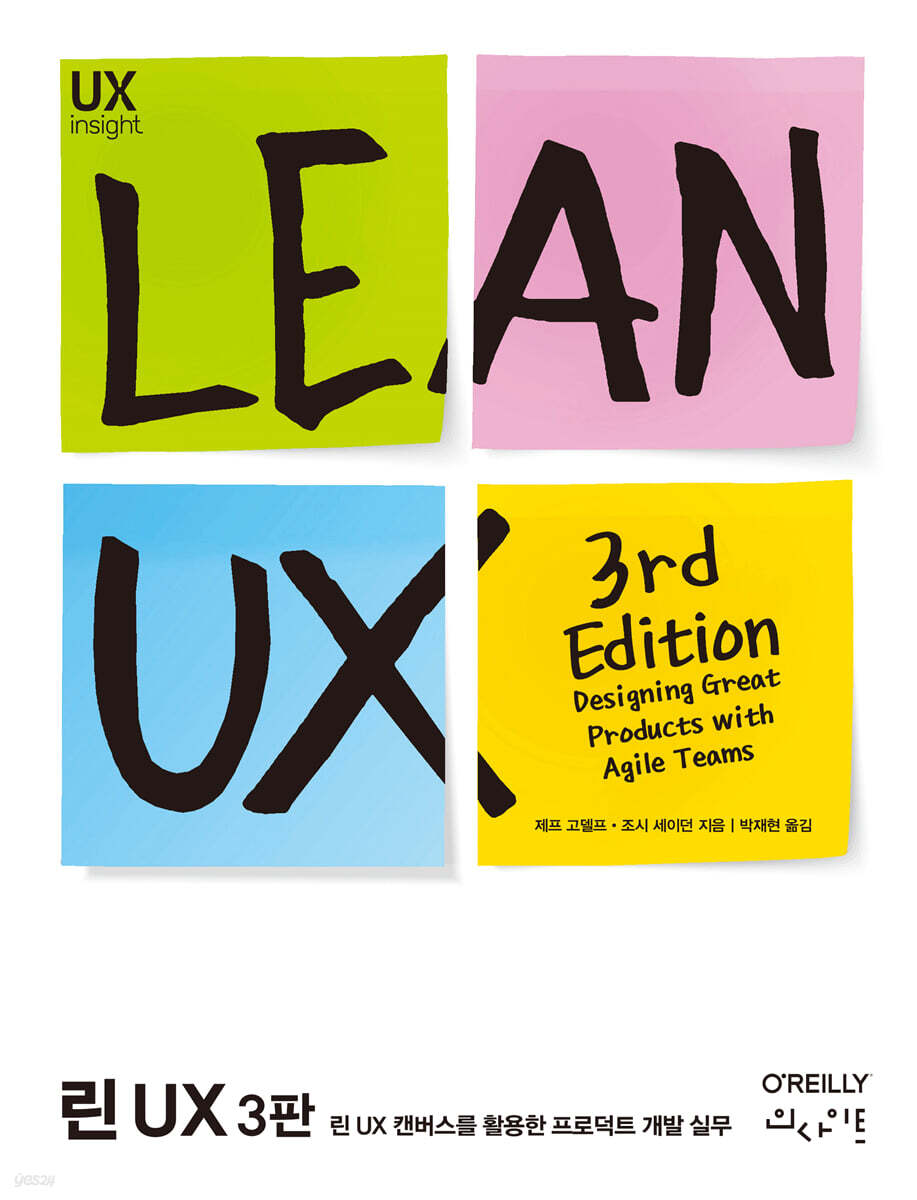
The 3rd edition of Lean UX proposes a process of developing a product by forming an agile team of developers, designers, and product managers, and then identifying and correcting problems through continuous learning and experimentation.
In this book, the authors detail how to build a Lean UX team, how to use the Lean UX Canvas to drive the product development process in an agile manner, and offer advice on how to apply Lean UX teams and processes in your business.
The authors draw on their extensive experience to provide a variety of examples and practical tips.
Lean UX, which brings together experts from various fields and develops products through short iterations, is the best way to respond to a rapidly changing market environment.
However, many companies are unable to break away from the handoff method, where independent teams work independently and pass work to each other.
The 3rd edition of Lean UX proposes a process of developing a product by forming an agile team of developers, designers, and product managers, and then identifying and correcting problems through continuous learning and experimentation.
In this book, the authors detail how to build a Lean UX team, how to use the Lean UX Canvas to drive the product development process in an agile manner, and offer advice on how to apply Lean UX teams and processes in your business.
The authors draw on their extensive experience to provide a variety of examples and practical tips.
- You can preview some of the book's contents.
Preview
index
Part 1: Introduction and Principles
Chapter 1: A Time More Important Than Ever
constantly evolving design
Chapter 2 Principles
The foundation on which Lean UX is built
What is the definition of Lean UX?
principle
---Principles on team composition
---Principles on organizational culture
---Principles that will guide the process
finish
Chapter 3 Results
What business are we in?
---A story about the results
---Finding Hidden Meaning in Stories: Products, Results, and Achievements
Results, iteration, verification
Part 2 Process
Chapter 4: Lean UX Canvas
Hypothesis is a new requirement
Lean UX Canvas
Using Canvas
---When should you use Lean UX Canvas?
---Is Canvas suitable for early-stage ideas or for sustained innovation?
---Who should work on the canvas?
---How much time should I invest?
---Do I have to use Canvas to achieve lean UX?
---Facilitate each section
finish
Chapter 5, Box 1: Business Issues
Facilitating the activity
Example of a problem statement
caution
Chapter 6, Box 2: Business Results
Using User Journeys
---User Journey Type: Pirate Metrics
---User Journey Type: Surface Mountain Range
---Using the Indicator Mountains to facilitate conversations about business outcomes
---User Journey Types: Service Journey and User Story Map
Results-Performance Mapping
caution
Chapter 7, Box 3: User
Protopersona Template
Activity Facilitation
---Quick Verification
caution
Chapter 8, Box 4: User Outcomes and Benefits
Activity Facilitation
caution
Chapter 9, Box 5: Solutions
Activity Facilitation
---Affinity Mapping
---Collaborative Design: A More Systematic Approach
Running a design studio
---The environment in which the process is taking place
---team
---process
---Required Items
---Problem definition and constraint summary (15 minutes)
---Each person presents an idea (10 minutes)
---Presentation and feedback (3 minutes per person)
---Pair up and repeat, refining ideas (10 minutes)
---Team Idea Generation (45 minutes)
---Using the product
caution
Chapter 10, Box 6: Hypothesis
Activity Facilitation
Prioritizing hypotheses
caution
Chapter 11, Box 7: What important points should I learn first?
Facilitating the activity
caution
Chapter 12, Box 8: MVPs and Experiments
What is MVP?
---Example: Should I start a newsletter?
Creating an MVP
---Building an MVP to Understand Value
---Creating an MVP to understand implementation
---Final Guidelines for Creating an MVP
---The Curve of Truth
MVP Case
---Landing Page Testing
---Fake functions (aka buttons that don't go anywhere)
---The Wizard of Oz
---Case: Taproot Plus' Wizard of Oz MVP
Prototyping
---Paper prototype
---Low-quality screen mockup
---Highly complete screen prototype
---No-code MVP
---Prototypes that work with code and real-time data
---What to put in the prototype
---Demo and Preview
---Case: Using a Prototype MVP
Consolidate Chapter 13 into One
Leveraging the Lean UX Canvas in a Corporate Environment
Validately: Validating the product with customer interviews and a two-day prototype.
Kaplan: Using Lean UX to Launch a New Business
Part 3 Collaboration
Chapter 14 Collaborative Design
Collaborative Design
---Collaborative Design: An Informal Approach
---Lean UX and Design Sprints
---Using Design Sprints in a Lean UX Process
design system
---Design Systems: What Matters is the Essence
---The value of a design system
---The design system team is the product team
---Don't skip the board markers
Collaboration across geographically distributed teams
---Collaboration with distributed teams
---Collaborating Effectively
finish
Chapter 15: Feedback and Research
Continuous and collaborative research
---Collaborative discovery
---Continuous learning
---Understanding Research: Team Activities
---Check for patterns that emerge over time
---Monitoring technology for continuous and collaborative exploration
finish
Chapter 16: Integrating Lean UX and Agile
Create your own agile process
---Redefining 'Complete'
---Why are we still staggering our sprints?
---Dual Track Agile
Building Lean UX Practices Using the Rhythm of Scrum
---Sprint Goal, Product Goal, Multi-Sprint Theme
---Designers must be involved in planning.
Stakeholder and Risk Dashboard
Results-Driven Roadmap
---Review frequency
---Measuring progress
Lean UX and Agile in the Enterprise
finish
Part 4: Lean UX in Organizations
Chapter 17: Creating Organizational Change
conversion
---Changing the culture
---Change team composition
---Change process
Chapter 18: Lean UX in an Agency Environment
What kind of business would you like to be in?
When proposing lean UX, setting customer expectations is paramount.
No one wants to buy an experiment
We've successfully completed the sale! Now, let's move on to the purchasing process.
No longer just an outsourcing partner
A quick note about development partners and third-party vendors
finish
Chapter 19: Final Words
Products that make products
Chapter 1: A Time More Important Than Ever
constantly evolving design
Chapter 2 Principles
The foundation on which Lean UX is built
What is the definition of Lean UX?
principle
---Principles on team composition
---Principles on organizational culture
---Principles that will guide the process
finish
Chapter 3 Results
What business are we in?
---A story about the results
---Finding Hidden Meaning in Stories: Products, Results, and Achievements
Results, iteration, verification
Part 2 Process
Chapter 4: Lean UX Canvas
Hypothesis is a new requirement
Lean UX Canvas
Using Canvas
---When should you use Lean UX Canvas?
---Is Canvas suitable for early-stage ideas or for sustained innovation?
---Who should work on the canvas?
---How much time should I invest?
---Do I have to use Canvas to achieve lean UX?
---Facilitate each section
finish
Chapter 5, Box 1: Business Issues
Facilitating the activity
Example of a problem statement
caution
Chapter 6, Box 2: Business Results
Using User Journeys
---User Journey Type: Pirate Metrics
---User Journey Type: Surface Mountain Range
---Using the Indicator Mountains to facilitate conversations about business outcomes
---User Journey Types: Service Journey and User Story Map
Results-Performance Mapping
caution
Chapter 7, Box 3: User
Protopersona Template
Activity Facilitation
---Quick Verification
caution
Chapter 8, Box 4: User Outcomes and Benefits
Activity Facilitation
caution
Chapter 9, Box 5: Solutions
Activity Facilitation
---Affinity Mapping
---Collaborative Design: A More Systematic Approach
Running a design studio
---The environment in which the process is taking place
---team
---process
---Required Items
---Problem definition and constraint summary (15 minutes)
---Each person presents an idea (10 minutes)
---Presentation and feedback (3 minutes per person)
---Pair up and repeat, refining ideas (10 minutes)
---Team Idea Generation (45 minutes)
---Using the product
caution
Chapter 10, Box 6: Hypothesis
Activity Facilitation
Prioritizing hypotheses
caution
Chapter 11, Box 7: What important points should I learn first?
Facilitating the activity
caution
Chapter 12, Box 8: MVPs and Experiments
What is MVP?
---Example: Should I start a newsletter?
Creating an MVP
---Building an MVP to Understand Value
---Creating an MVP to understand implementation
---Final Guidelines for Creating an MVP
---The Curve of Truth
MVP Case
---Landing Page Testing
---Fake functions (aka buttons that don't go anywhere)
---The Wizard of Oz
---Case: Taproot Plus' Wizard of Oz MVP
Prototyping
---Paper prototype
---Low-quality screen mockup
---Highly complete screen prototype
---No-code MVP
---Prototypes that work with code and real-time data
---What to put in the prototype
---Demo and Preview
---Case: Using a Prototype MVP
Consolidate Chapter 13 into One
Leveraging the Lean UX Canvas in a Corporate Environment
Validately: Validating the product with customer interviews and a two-day prototype.
Kaplan: Using Lean UX to Launch a New Business
Part 3 Collaboration
Chapter 14 Collaborative Design
Collaborative Design
---Collaborative Design: An Informal Approach
---Lean UX and Design Sprints
---Using Design Sprints in a Lean UX Process
design system
---Design Systems: What Matters is the Essence
---The value of a design system
---The design system team is the product team
---Don't skip the board markers
Collaboration across geographically distributed teams
---Collaboration with distributed teams
---Collaborating Effectively
finish
Chapter 15: Feedback and Research
Continuous and collaborative research
---Collaborative discovery
---Continuous learning
---Understanding Research: Team Activities
---Check for patterns that emerge over time
---Monitoring technology for continuous and collaborative exploration
finish
Chapter 16: Integrating Lean UX and Agile
Create your own agile process
---Redefining 'Complete'
---Why are we still staggering our sprints?
---Dual Track Agile
Building Lean UX Practices Using the Rhythm of Scrum
---Sprint Goal, Product Goal, Multi-Sprint Theme
---Designers must be involved in planning.
Stakeholder and Risk Dashboard
Results-Driven Roadmap
---Review frequency
---Measuring progress
Lean UX and Agile in the Enterprise
finish
Part 4: Lean UX in Organizations
Chapter 17: Creating Organizational Change
conversion
---Changing the culture
---Change team composition
---Change process
Chapter 18: Lean UX in an Agency Environment
What kind of business would you like to be in?
When proposing lean UX, setting customer expectations is paramount.
No one wants to buy an experiment
We've successfully completed the sale! Now, let's move on to the purchasing process.
No longer just an outsourcing partner
A quick note about development partners and third-party vendors
finish
Chapter 19: Final Words
Products that make products
Publisher's Review
[What this book covers]
- Use the Lean UX Canvas to implement the Lean UX process with your team.
- View all projects from the perspective of 'customer success'
- Understanding the designer's role in an agile team
- Write and contribute design and experiment stories to the backlog.
- Ensure design work is done in every sprint
- Build a product discovery process that fits your team's pace.
- Use the Lean UX Canvas to implement the Lean UX process with your team.
- View all projects from the perspective of 'customer success'
- Understanding the designer's role in an agile team
- Write and contribute design and experiment stories to the backlog.
- Ensure design work is done in every sprint
- Build a product discovery process that fits your team's pace.
GOODS SPECIFICS
- Date of issue: December 19, 2023
- Page count, weight, size: 312 pages | 534g | 172*225*15mm
- ISBN13: 9788966264193
- ISBN10: 8966264190
You may also like
카테고리
korean


korean

![GQ KOREA Mark (Monthly): December [2025]](http://librairie.coreenne.fr/cdn/shop/files/8ef265dbbfbf186523ed75ba7319009d.jpg?v=1765340328&width=3840)


