

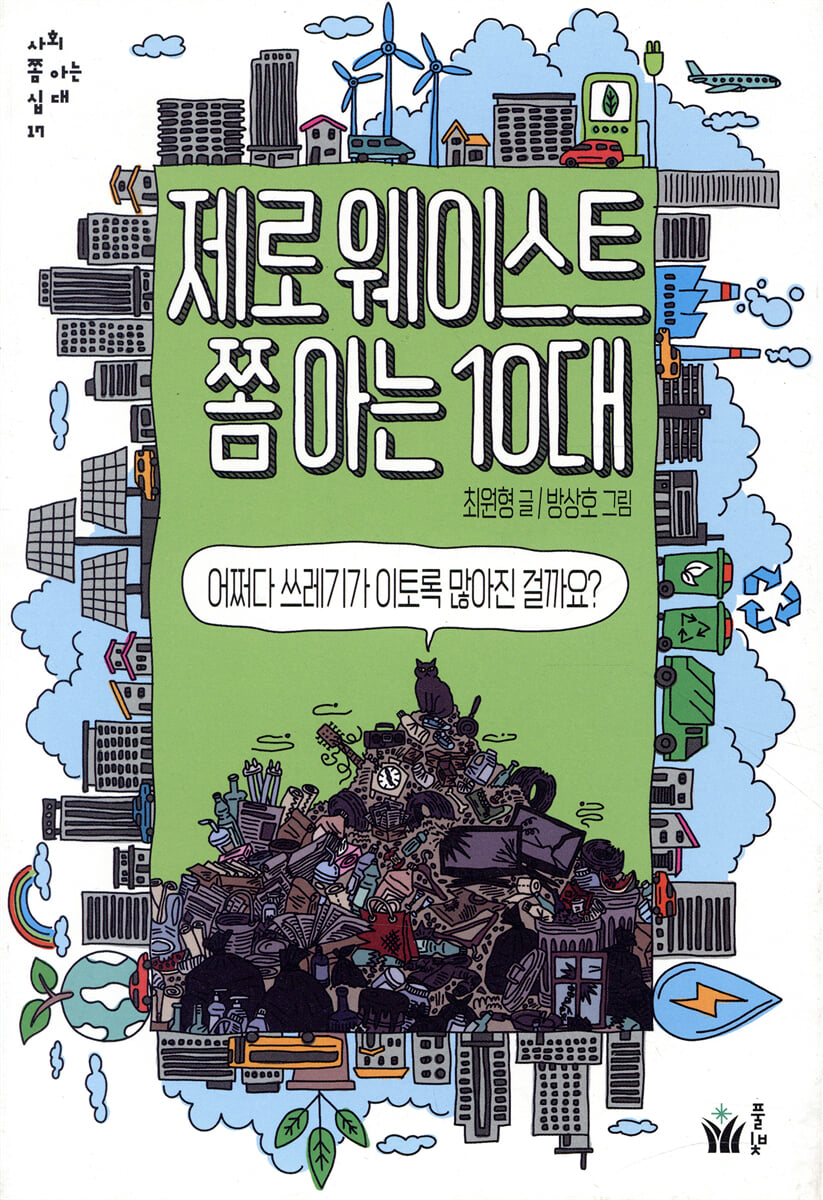
10 teenagers who know a little about zero waste
 |
Description
Book Introduction
How did there end up being so much trash?
Where did the things I threw away today go?
Zero Waste is the answer to slowing down the climate crisis!
In the meantime, humanity has been mass-producing everything in pursuit of a convenient life, consuming endlessly, and creating a tremendous amount of waste.
As a result, the Earth became polluted and faced unpredictable climate phenomena, a climate crisis.
Is there no way to stop the current situation that threatens human life and property? Choi Won-hyung, an expert in ecology, environment, and energy, suggests that zero-waste could be the solution.
Zero waste is more than just reducing waste; it's about dieting your life and slowing down the climate crisis.
The 'zero-waste' lifestyle recommended in this book is so concrete and feasible that anyone, even a teenager, can try it, and it's novel and excellent in terms of ideas.
It shows that a life like this is entirely possible: reducing consumption, owning only the essentials, using second-hand goods, using electronics for as long as possible, repairing broken items, using shared vehicles or public transportation instead of private vehicles, living a plant-based diet, and strictly following waste separation and recycling.
The biggest feature of 『10 Things Teens Know About Zero Waste』 is that it is written in a way that is easy for teenagers to understand.
Even a 'zero waste beginner' who was only thinking ahead can understand the importance of reducing overconsumption, pollution, and energy waste through illustrations alone.
Additionally, we have designed the site to allow people to directly participate in environmental movements by introducing currently active environmental organizations through QR codes and providing information on how to find their names in the search bar.
Therefore, it is great for use in environmental education classes and special activities at school, and it is also very useful at home for children and parents to discuss environmental issues and practice zero waste by visiting related organizations or zero waste stores.
*This book was printed using recycled paper and eco-friendly soy ink.
Where did the things I threw away today go?
Zero Waste is the answer to slowing down the climate crisis!
In the meantime, humanity has been mass-producing everything in pursuit of a convenient life, consuming endlessly, and creating a tremendous amount of waste.
As a result, the Earth became polluted and faced unpredictable climate phenomena, a climate crisis.
Is there no way to stop the current situation that threatens human life and property? Choi Won-hyung, an expert in ecology, environment, and energy, suggests that zero-waste could be the solution.
Zero waste is more than just reducing waste; it's about dieting your life and slowing down the climate crisis.
The 'zero-waste' lifestyle recommended in this book is so concrete and feasible that anyone, even a teenager, can try it, and it's novel and excellent in terms of ideas.
It shows that a life like this is entirely possible: reducing consumption, owning only the essentials, using second-hand goods, using electronics for as long as possible, repairing broken items, using shared vehicles or public transportation instead of private vehicles, living a plant-based diet, and strictly following waste separation and recycling.
The biggest feature of 『10 Things Teens Know About Zero Waste』 is that it is written in a way that is easy for teenagers to understand.
Even a 'zero waste beginner' who was only thinking ahead can understand the importance of reducing overconsumption, pollution, and energy waste through illustrations alone.
Additionally, we have designed the site to allow people to directly participate in environmental movements by introducing currently active environmental organizations through QR codes and providing information on how to find their names in the search bar.
Therefore, it is great for use in environmental education classes and special activities at school, and it is also very useful at home for children and parents to discuss environmental issues and practice zero waste by visiting related organizations or zero waste stores.
*This book was printed using recycled paper and eco-friendly soy ink.
- You can preview some of the book's contents.
Preview
index
Prologue: Zero Waste is Slowing the Climate Crisis
Chapter 1: The True Face of Our Civilization
_ A garbage civilization that is neither Egyptian nor Huang He civilization?
Garbage created by disaster
Man-made garbage islands and garbage mountains
Consumption fuels 'great acceleration'
Plastic waste, a global headache
Chapter 2: I consume, therefore I exist
_Why is there so much trash?
Infinite growth is the truth?
Advertisements that make you buy things even if you don't need them
A strange world that boasts of overconsumption
Are consumers the only ones responsible?
The producers bear the greatest responsibility for waste plastic.
Chapter 3: The Whereabouts of the Things I Abandoned
_ Trash that is cleaned up without anyone noticing
Why is trash collected at night?
What's in your bag! I wonder what's in your bag.
The whereabouts of the things I threw away
Is it possible to reduce it to 4 chapters?
_ Don't throw it away, let it continue to survive!
A culture of rewriting, a culture of throwing away
Zero waste also has principles?
The right not to buy garbage
The Birth of Urban Mining: Junk Becomes Treasure
Eco-friendly or greenwashing?
Chapter 5 Efforts to Lead Change
_ A sustainable world is possible!
The sharing economy: From the era of ownership to the era of access
If we enjoy and manage common goods together,
Advances in Recycling, Upcycling
demand the right to repair
International Agreement to End Plastic Pollution
Attack the plastic!
Chapter 6: Zero Waste is a Good Life
_ Life needs a diet too!
6 Lifestyle Changes That Save the Earth
Waste systems in various countries around the world
The meeting of future-thinking minds and technology
Why we need to study the environment and ecology
Epilogue: Zero Waste is a Good Life
Chapter 1: The True Face of Our Civilization
_ A garbage civilization that is neither Egyptian nor Huang He civilization?
Garbage created by disaster
Man-made garbage islands and garbage mountains
Consumption fuels 'great acceleration'
Plastic waste, a global headache
Chapter 2: I consume, therefore I exist
_Why is there so much trash?
Infinite growth is the truth?
Advertisements that make you buy things even if you don't need them
A strange world that boasts of overconsumption
Are consumers the only ones responsible?
The producers bear the greatest responsibility for waste plastic.
Chapter 3: The Whereabouts of the Things I Abandoned
_ Trash that is cleaned up without anyone noticing
Why is trash collected at night?
What's in your bag! I wonder what's in your bag.
The whereabouts of the things I threw away
Is it possible to reduce it to 4 chapters?
_ Don't throw it away, let it continue to survive!
A culture of rewriting, a culture of throwing away
Zero waste also has principles?
The right not to buy garbage
The Birth of Urban Mining: Junk Becomes Treasure
Eco-friendly or greenwashing?
Chapter 5 Efforts to Lead Change
_ A sustainable world is possible!
The sharing economy: From the era of ownership to the era of access
If we enjoy and manage common goods together,
Advances in Recycling, Upcycling
demand the right to repair
International Agreement to End Plastic Pollution
Attack the plastic!
Chapter 6: Zero Waste is a Good Life
_ Life needs a diet too!
6 Lifestyle Changes That Save the Earth
Waste systems in various countries around the world
The meeting of future-thinking minds and technology
Why we need to study the environment and ecology
Epilogue: Zero Waste is a Good Life
Detailed image
.jpg)
Into the book
Zero waste isn't just about reducing waste; it's also about slowing down the climate crisis.
The practice of daily life has been overlooked for several reasons.
There are opinions that it is too inconvenient to put into practice, and that individual practice is too weak to change the world.
I cannot agree with either of these opinions.
If we realize that a comfortable life is one of endless consumption and waste production, the choices we must make in order to survive in the future will inevitably lead to a more uncomfortable life than we have now.
--- From "Zero Waste is Slowing the Climate Crisis"
The trash mountains are an international embarrassment, and they're not limited to Uiseong. Following the CNN report, the Ministry of Environment identified illegally formed trash mountains across the country, and a newspaper created a map based on these findings. As of August 2020, there were 356 such mountains, totaling 1,521,494 tons.
Even if we find the person responsible for the illegal dumping, the cost of dealing with it is so high that it will ultimately have to be covered by taxes, and the cost alone is said to exceed 100 billion won.
So why are there so many mountains of garbage? It's because we produce so much waste, don't dispose of it properly, and lack adequate treatment facilities.
Experts say it's because of overproduction and a malfunctioning resource circulation system.
--- From "The Garbage Island and Garbage Mountain Created by Humans"
Zero waste starts with boldly reducing waste, and it has its own set of principles.
There are 3Rs and 5Rs in the principles.
The first letters of the words Reduce, Reuse, and Recycle are called 3R.
If we want to reduce waste, we must first reduce the number of things we buy.
The idea is to fix and reuse broken items, use them for a long time, and then recycle them instead of throwing them away when they can no longer be used.
5R is 3R plus Refuse and Rot.
"Reject"? What does that mean? Rejecting trash? That's right! I think you should think twice before accepting something someone gives you even if you don't need it.
Let's reject things that we don't think we'll use, things that seem like they'll just be thrown away somewhere, and things that will eventually become trash.
--- From "Zero Waste Also Has Principles?"
According to the UN's 2020 World E-Waste Report, the total global e-waste in 2019 was 52.6 million tons, which translates to an average of 7.3 kg of waste per person per year.
South Korea accounts for 818,000 tons, or 1.6 percent of the total, and waste per capita is approximately 15.8 kg, more than double the world average.
Electronic waste is increasing significantly because products are designed to be difficult to repair and break down after a certain period of time (planned obsolescence).
As criticisms are raised that this type of corporate behavior is problematic, voices are growing louder demanding that the "right to repair" be recognized.
The right to repair literally means the right of the product owner to repair the product.
Until now, people who bought something with money had the right to repair it, even if they owned it, but people are only now starting to realize that this is nonsense.
The practice of daily life has been overlooked for several reasons.
There are opinions that it is too inconvenient to put into practice, and that individual practice is too weak to change the world.
I cannot agree with either of these opinions.
If we realize that a comfortable life is one of endless consumption and waste production, the choices we must make in order to survive in the future will inevitably lead to a more uncomfortable life than we have now.
--- From "Zero Waste is Slowing the Climate Crisis"
The trash mountains are an international embarrassment, and they're not limited to Uiseong. Following the CNN report, the Ministry of Environment identified illegally formed trash mountains across the country, and a newspaper created a map based on these findings. As of August 2020, there were 356 such mountains, totaling 1,521,494 tons.
Even if we find the person responsible for the illegal dumping, the cost of dealing with it is so high that it will ultimately have to be covered by taxes, and the cost alone is said to exceed 100 billion won.
So why are there so many mountains of garbage? It's because we produce so much waste, don't dispose of it properly, and lack adequate treatment facilities.
Experts say it's because of overproduction and a malfunctioning resource circulation system.
--- From "The Garbage Island and Garbage Mountain Created by Humans"
Zero waste starts with boldly reducing waste, and it has its own set of principles.
There are 3Rs and 5Rs in the principles.
The first letters of the words Reduce, Reuse, and Recycle are called 3R.
If we want to reduce waste, we must first reduce the number of things we buy.
The idea is to fix and reuse broken items, use them for a long time, and then recycle them instead of throwing them away when they can no longer be used.
5R is 3R plus Refuse and Rot.
"Reject"? What does that mean? Rejecting trash? That's right! I think you should think twice before accepting something someone gives you even if you don't need it.
Let's reject things that we don't think we'll use, things that seem like they'll just be thrown away somewhere, and things that will eventually become trash.
--- From "Zero Waste Also Has Principles?"
According to the UN's 2020 World E-Waste Report, the total global e-waste in 2019 was 52.6 million tons, which translates to an average of 7.3 kg of waste per person per year.
South Korea accounts for 818,000 tons, or 1.6 percent of the total, and waste per capita is approximately 15.8 kg, more than double the world average.
Electronic waste is increasing significantly because products are designed to be difficult to repair and break down after a certain period of time (planned obsolescence).
As criticisms are raised that this type of corporate behavior is problematic, voices are growing louder demanding that the "right to repair" be recognized.
The right to repair literally means the right of the product owner to repair the product.
Until now, people who bought something with money had the right to repair it, even if they owned it, but people are only now starting to realize that this is nonsense.
--- From "Demanding the Right to Repair"
Publisher's Review
“Business owners, please pay the plastic tax!”
We have the right not to buy garbage!
Who's going to change the world? Yes, it's me!
Our country produces the most waste per unit area in the world.
There are already more than 300 garbage dumps across the country, and the problem remains unresolved.
If we do not boldly reduce the amount of waste we generate now, the indiscriminate destruction of nature may push humanity to the brink.
So what should we do, and what can we do? This book argues that the transition to a circular economy, where materials and products are reused rather than wasted, is crucial right now.
That is, we must change to a zero-waste lifestyle.
The author asks, "Is this really so obvious?" about things we have taken for granted, and suggests that we look at the "waste problem" from a slightly different perspective.
In other words, rather than simply accepting the convenience of corporations, let's find our own 'right not to buy trash.'
For example, this book is full of novel yet immediately applicable ideas, such as not accepting paper receipts, sharing textbooks for some subjects, requiring companies to research recyclable and reusable packaging, applying a deposit system to credit cards, requesting collection of cosmetic containers, demanding a plastic tax from companies, not buying new clothes, and participating in environmental campaigns instead of purchasing goods.
Zero Waste also says that it is a 'good life' and emphasizes that the main agents of all changes that have changed the world so far have been citizens.
Although these citizens are a small number compared to the entire population of our country, they came together with a common purpose, joined forces, and ultimately led to change, and they continue to lead to change today. I encourage you to join them in their actions.
For example, the implementation of the ban on repackaging, the demand for Brita to recycle its filters, the demand for the elimination of trays for home run balls and packaged seaweed, the reinstatement of the disposable cup deposit system, and the activation of the plastic-free platform are all results of citizen participation.
How about actively participating as an 'active citizen' in matters that you deem unfair or in need of change?
A strange world where people boast about overconsumption!
Are there only the essentials in my bag?
For a life on Earth that uses less and wastes less
There are countless new words related to consumption, and they are constantly being created.
Howl, mukbang, flex, imitation consumption, logo play, Janus consumption, revenge consumption, etc…
The things we buy after seeing advertisements are discarded when they've worn out, become unusable, or become worn out. But where do all those things go and what happens to them? This book makes me, someone who has always consumed out of desire or habit and created waste, ask myself, "How much (what percentage) of the things I own do I really need?"
The author says that the reason why so much waste has been generated that it is difficult to dispose of is due to our ignorance, but above all, the greatest responsibility lies with companies that have turned a blind eye to the waste problem in pursuit of profit.
He also emphasized that national policies and systems to reduce waste are still insufficient and that citizen education is also necessary.
And above all, I repeat that we must properly understand the cause of the problem and that more citizens must speak with one voice to solve the problem.
Because the individual and the world are not two separate entities, but are interconnected.
The author says that anyone can live a zero-waste life as long as they have the heart to love and care for the community they live in and the Earth.
If you agree with this idea, why not join us in the world of zero waste?
We have the right not to buy garbage!
Who's going to change the world? Yes, it's me!
Our country produces the most waste per unit area in the world.
There are already more than 300 garbage dumps across the country, and the problem remains unresolved.
If we do not boldly reduce the amount of waste we generate now, the indiscriminate destruction of nature may push humanity to the brink.
So what should we do, and what can we do? This book argues that the transition to a circular economy, where materials and products are reused rather than wasted, is crucial right now.
That is, we must change to a zero-waste lifestyle.
The author asks, "Is this really so obvious?" about things we have taken for granted, and suggests that we look at the "waste problem" from a slightly different perspective.
In other words, rather than simply accepting the convenience of corporations, let's find our own 'right not to buy trash.'
For example, this book is full of novel yet immediately applicable ideas, such as not accepting paper receipts, sharing textbooks for some subjects, requiring companies to research recyclable and reusable packaging, applying a deposit system to credit cards, requesting collection of cosmetic containers, demanding a plastic tax from companies, not buying new clothes, and participating in environmental campaigns instead of purchasing goods.
Zero Waste also says that it is a 'good life' and emphasizes that the main agents of all changes that have changed the world so far have been citizens.
Although these citizens are a small number compared to the entire population of our country, they came together with a common purpose, joined forces, and ultimately led to change, and they continue to lead to change today. I encourage you to join them in their actions.
For example, the implementation of the ban on repackaging, the demand for Brita to recycle its filters, the demand for the elimination of trays for home run balls and packaged seaweed, the reinstatement of the disposable cup deposit system, and the activation of the plastic-free platform are all results of citizen participation.
How about actively participating as an 'active citizen' in matters that you deem unfair or in need of change?
A strange world where people boast about overconsumption!
Are there only the essentials in my bag?
For a life on Earth that uses less and wastes less
There are countless new words related to consumption, and they are constantly being created.
Howl, mukbang, flex, imitation consumption, logo play, Janus consumption, revenge consumption, etc…
The things we buy after seeing advertisements are discarded when they've worn out, become unusable, or become worn out. But where do all those things go and what happens to them? This book makes me, someone who has always consumed out of desire or habit and created waste, ask myself, "How much (what percentage) of the things I own do I really need?"
The author says that the reason why so much waste has been generated that it is difficult to dispose of is due to our ignorance, but above all, the greatest responsibility lies with companies that have turned a blind eye to the waste problem in pursuit of profit.
He also emphasized that national policies and systems to reduce waste are still insufficient and that citizen education is also necessary.
And above all, I repeat that we must properly understand the cause of the problem and that more citizens must speak with one voice to solve the problem.
Because the individual and the world are not two separate entities, but are interconnected.
The author says that anyone can live a zero-waste life as long as they have the heart to love and care for the community they live in and the Earth.
If you agree with this idea, why not join us in the world of zero waste?
GOODS SPECIFICS
- Publication date: November 21, 2022
- Page count, weight, size: 188 pages | 272g | 140*203*14mm
- ISBN13: 9791161728520
- ISBN10: 116172852X
You may also like
카테고리
korean


korean

![GQ KOREA Mark (Monthly): December [2025]](http://librairie.coreenne.fr/cdn/shop/files/8ef265dbbfbf186523ed75ba7319009d.jpg?v=1765340328&width=3840)


