

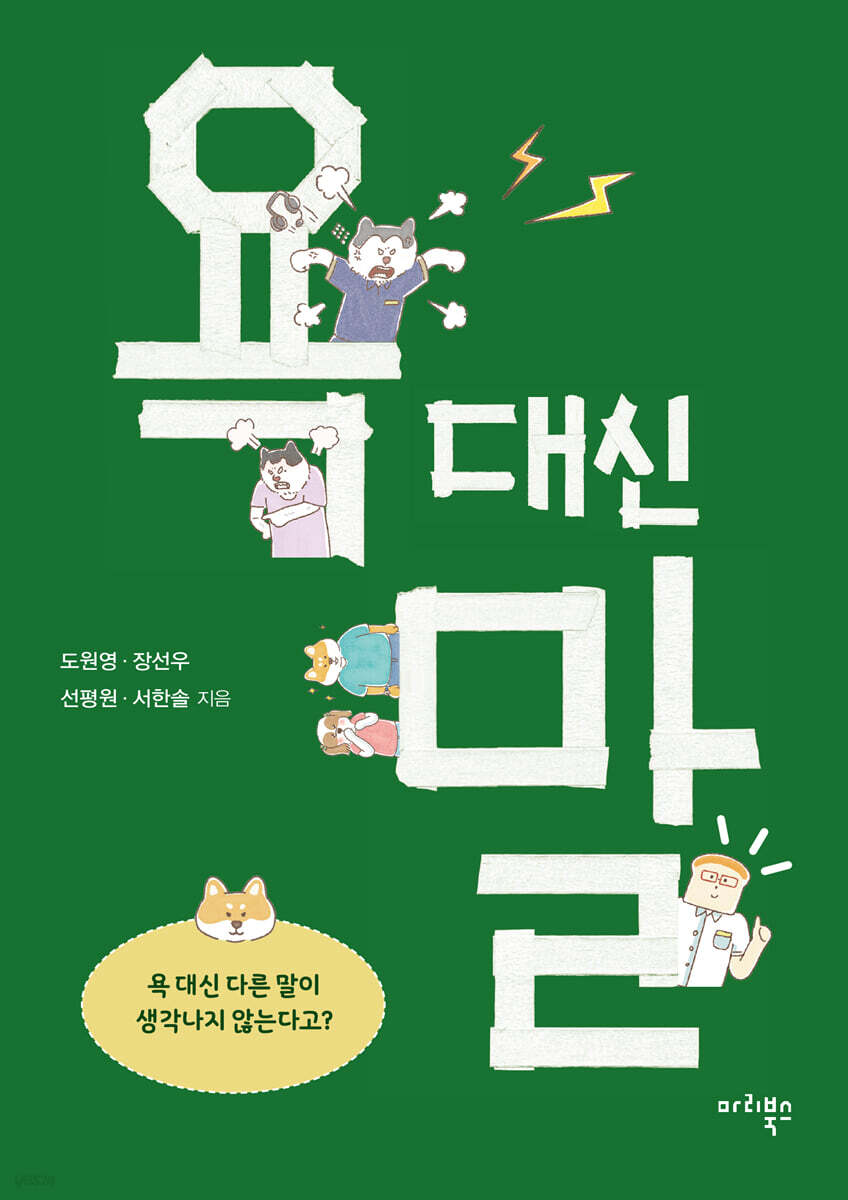
Talk instead of swearing
 |
Description
Book Introduction
Curse this way! Curse that way! Can't think of anything else to say instead of swearing? At some point, we became accustomed to swearing in everyday life, seemingly without a second thought. Whether on TV, in movies, on the street, or at home, people seemed to think a little swearing was nothing special. Even in schools, which are places of education, swearing abounds in students' conversations. When someone tells you that you shouldn't swear, you look at them and ask why they are scolding you without understanding the mood. But did you know a shocking fact? A significant number of teenagers swear because they can't think of anything else to say. The four authors, who majored in Korean language or linguistics at the same university or met through dictionary compilation work together, were also shocked by this fact and came together. As the authors are very firm in their belief that we should always use proper language, they wanted to do something for teenagers who swear because they can't think of anything else to say instead of swearing. The four authors, who are both parents and teachers, had a strong desire to create a book that would empathize with students' swearing and language habits. Rather than simply searching for materials related to swearing, I continued to research teenagers' swearing habits by meeting and interviewing students in person, writing manuscripts, and listening to students' opinions. Thanks to this, I was able to understand why teenagers today swear and write "Speaking Instead of Swearing," a language guidebook that is more approachable to teenagers. This book provides a glimpse into the inner thoughts and vivid situations of teenagers who curse and are cursed at. From the perspective of a language expert, it explains the meaning and origin of swear words and vulgar language in an easy and fun way that is suitable for teenagers. The detailed instructions that elementary school readers are encouraged to read under the guidance of a teacher or guardian also draw attention. This book is divided into three parts. In Part 1, I looked at the situation in which I cursed from the perspective of someone who curses without thinking. Part 2 made me think about the various emotions and coping methods that I feel as a person who is being cursed at, regardless of my intention. And in Part 3, the core of this book, we will guide you through various ways to express your feelings and what you want to say, using specific expressions rather than cursing, and using flavorful Korean expressions instead of cursing. The text's 'add imagination' and 'broaden your thinking' also add to the fun. 'Imagination Plus' presents situations that can occur in everyday life and helps you imagine what you would say if you were in that situation. 'Broadening Your Mind' contains useful information, such as the effects of swearing on the brain. In addition, you can look back on your language habits through self-diagnosis in the prologue, such as how often you swear and how you respond to various situations. Additionally, the etymology and meaning of swear words and vulgar language are included as an appendix, instilling awareness about swearing. |
- You can preview some of the book's contents.
Preview
index
Author's Note | Do you want to curse? What if you get to hear that curse?
Prologue|Self-diagnosis is necessary even in language life!
Part 1: This is a curse, that is a curse
I'm angry!
I like it, that's why!
It's a joke, so what! We're close.
Senkae, I'm cool when I curse!
Come on, try it! Curse after curse!
Part 2 You swear, but you don't want to listen?
I'm confused whether this is a compliment or a joke!
I'm already in a bad mood, but I'm even more annoyed
I feel wronged and resentful
I feel ignored
I feel so suffocated and suffocated
Instead of swearing in part 3, do this!
Give me a nickname and call me by my name
Speaking with my thoughts and feelings at the center
Find your own universal word
Using adverbs to express different emotions
Fun and cheerful with imitation
Retort wittily with an idiomatic expression
With sensual and creative expression
Oh, that's what it means! Thank you, ancestors.
How to move on wisely without responding
Epilogue|We didn't all start out cursing!
Appendix | Profanity and Vulgarity
Prologue|Self-diagnosis is necessary even in language life!
Part 1: This is a curse, that is a curse
I'm angry!
I like it, that's why!
It's a joke, so what! We're close.
Senkae, I'm cool when I curse!
Come on, try it! Curse after curse!
Part 2 You swear, but you don't want to listen?
I'm confused whether this is a compliment or a joke!
I'm already in a bad mood, but I'm even more annoyed
I feel wronged and resentful
I feel ignored
I feel so suffocated and suffocated
Instead of swearing in part 3, do this!
Give me a nickname and call me by my name
Speaking with my thoughts and feelings at the center
Find your own universal word
Using adverbs to express different emotions
Fun and cheerful with imitation
Retort wittily with an idiomatic expression
With sensual and creative expression
Oh, that's what it means! Thank you, ancestors.
How to move on wisely without responding
Epilogue|We didn't all start out cursing!
Appendix | Profanity and Vulgarity
Detailed image
.jpg)
Into the book
The habit of swearing without warning is a problem, but the meaning of the swear words we use is also a problem.
If you think about it, most of these words are very insulting to the speaker or listener.
--- p.23
On the Internet, you can't see facial expressions, hand gestures, or footsteps.
So, when communicating on the web, I try to mix in expressions that convey my feelings.
I like exclamations and words.
Sometimes just adding punctuation helps me convey my feelings.
--- p.78
Don't you feel a pity that we express the diverse emotions we feel with simple curses? Perhaps curses are too crude and inadequate a tool to express our delicate emotions.
--- p.114
So, you shouldn't say things easily, thinking, 'I was just joking' or 'I did it because I'm close.'
Because the playful insults I throw at someone, the negative words I say without thinking, can leave an indelible scar on someone.
If you think about it, most of these words are very insulting to the speaker or listener.
--- p.23
On the Internet, you can't see facial expressions, hand gestures, or footsteps.
So, when communicating on the web, I try to mix in expressions that convey my feelings.
I like exclamations and words.
Sometimes just adding punctuation helps me convey my feelings.
--- p.78
Don't you feel a pity that we express the diverse emotions we feel with simple curses? Perhaps curses are too crude and inadequate a tool to express our delicate emotions.
--- p.114
So, you shouldn't say things easily, thinking, 'I was just joking' or 'I did it because I'm close.'
Because the playful insults I throw at someone, the negative words I say without thinking, can leave an indelible scar on someone.
--- p.159
Publisher's Review
You want to swear? What if you get to hear that swearing?
A warning about the curses that have strong meaning and nuance, and that are encroaching on other languages!
The reason why swearing is swearing is because it is socially agreed that it is a word that disregards the other person's personality.
Even if you look at the dictionary definition of swearing, it is 'insulting words that disregard another person's personality.
Or it comes out as 'words that curse others'.
While the meaning of swearing is problematic, a more serious problem with swearing is its powerful imprinting effect due to its harsh pronunciation. As one EBS documentary experiment demonstrated, swearing gradually erodes and erases other languages from our brains.
That's why, when you start swearing, other expressions that aren't swear words start to come to mind less and less.
If you think about it, we didn't start swearing from the beginning.
We can't all picture a three-year-old swearing.
This is because children's language world expresses their true feelings as they are, such as saying "I don't like something" when they don't like it, "I'm hungry" when they are hungry, and "I hate something" when they dislike it.
Parents also try to show their children good things and say good things to them.
However, as children become teenagers and begin to socialize with peers, they are exposed to a culture of swearing.
At school, they imitate the curses their friends use, and on personal broadcasts, they imitate the curses that the host blurts out because they think it's cool.
Cursing like this without any sense—how would I feel if I were the one hearing it? The person cursing might be doing it without much thought, but the person hearing it is in a different situation.
If a person is exposed to abuse or verbally abused for a long time, not only will their body and mind be damaged, but they will also become depressed and have low self-esteem.
Patience also reaches its limit, and you may lose control of your anger in moments or become angry over small things.
What this means is that if your heart is hurt, it can become that much more dangerous.
If my friends become depressed and lose their will to live because of a careless, playful curse I say, I should remember that I may have become an unintentional perpetrator in their lives.
This is the warning of swearing! When you feel like swearing, you must consider what it would be like to hear that swearing.
Cursing can't beat honest expression!
Instead of lumping it all together with curses, try to express it specifically with adverbs, exclamations, and idiomatic expressions!
So, what words should we use instead of swearing? The highlight of this book is the section titled "Saying These Instead of Swearing," which provides tips on how to use words instead of swearing.
Korean is a language rich in emotional expression, and has developed adverbs, exclamations, adjectives, and onomatopoeia (mimetic words) that express sounds and states.
In addition, there are various linguistic expressions, such as proverbs, that contain the wisdom and humor of our ancestors that have been passed down from ancient times.
Once you step into the world of that language, you will discover a surprisingly interesting world.
This is precisely what the four authors want to talk about through this book.
That there are countless other words that can express my feelings more appropriately, funnily, and pleasantly, even without swearing!
We were all very cute babies when we were born.
Just thinking about baby animals, like baby rabbits, baby otters, and baby kangaroos, is cute.
However, comparing a person to a young animal is simply an attempt to belittle or insult that person.
Instead of calling them "baby animals," how about giving them nicknames and calling them by their names? In Kim Chun-su's poem "Flower," the poet writes, "When I called his name, he came to me and became a flower."
Calling someone by their name or a friendly nickname is like breathing life into them.
Did you know that there's a secret word hidden in swear words? It's the word "you," the object of the swearing.
‘(You are) an idiot!’ ‘(You are) so annoying!’ In this way, insults are nothing more than open criticism of the person who is the target of ‘you.’
Instead of saying "you," use "I" as the subject! Imagine if, before a dance competition, the leader of a team said to a team member, "I'm frustrated because you keep making mistakes." "I'm depressed when I hear you complaining." Rather than taking this as criticism, like, "Why can't you do it?" the team member would likely accept it as encouragement, like, "Let's do our best together!"
Miracles only happen when we focus on 'me' rather than 'you'.
A prescription for cursing from educators, linguists, and Korean language experts
Various ways to overcome swearing, cheerful and light-hearted words and language life that go beyond swearing like "ㅅㅂ·ㅈㄴ"
The four authors are educators, linguists, and dictionary editors who are experts in the Korean language and offer various prescriptions for eliminating swearing.
This is a prescription for various ways to overcome swearing, with specific and flavorful Korean expressions that can effectively convey your feelings and what you want to say, even if they are not swearing.
First, how about using adverbs that convey different emotions? Instead of saying "It's so hard!", try "It's really hard!", "It's incredibly hard!", or "It's terribly hard!"
Expressions that include exclamations like 'wow', 'wow', and 'daebak' can also sufficiently convey my feelings.
Or how about a lighthearted and humorous imitation? If you want to express your frustration because food spilled on your new uniform, instead of saying "This is so annoying!" try something like "This is a new uniform, I'm about to jump up and down with frustration" or "Thunder and lightning are pounding inside my head."
Although you may be hurt, some humorous expressions can make the situation less upsetting and more enjoyable.
Come to think of it, there are many witty Korean idiomatic expressions that fit perfectly in that situation, such as ‘the sound of a crow’s chin dropping’, ‘the sound of a boiled pumpkin not fitting into a pot’, ‘a guy who eats a prestigious school and shits on toilet paper’, and ‘a gong struck by lightning’.
If you learn a lot of idiomatic expressions and use them appropriately for each situation, you might unexpectedly receive a lot of attention from your friends.
The legacy of our ancestors, which taught us the wisdom of language life with sayings like, "A tongue that is three inches long can kill a person," "A sharp tongue that kills with one stroke," and "Even if you go to a coffin, don't speak badly," also arouses our vigilance.
Words have power.
They say that people really think that way depending on how I'm called by other people and what stories I've heard.
Let's always remember that the curses we use destroy our language, and the curses we hear destroy our self-concept! Even if it's not cursing, let's learn various ways to better express our emotions! You'll discover that there are many Korean expressions that are more powerful than curses.
A warning about the curses that have strong meaning and nuance, and that are encroaching on other languages!
The reason why swearing is swearing is because it is socially agreed that it is a word that disregards the other person's personality.
Even if you look at the dictionary definition of swearing, it is 'insulting words that disregard another person's personality.
Or it comes out as 'words that curse others'.
While the meaning of swearing is problematic, a more serious problem with swearing is its powerful imprinting effect due to its harsh pronunciation. As one EBS documentary experiment demonstrated, swearing gradually erodes and erases other languages from our brains.
That's why, when you start swearing, other expressions that aren't swear words start to come to mind less and less.
If you think about it, we didn't start swearing from the beginning.
We can't all picture a three-year-old swearing.
This is because children's language world expresses their true feelings as they are, such as saying "I don't like something" when they don't like it, "I'm hungry" when they are hungry, and "I hate something" when they dislike it.
Parents also try to show their children good things and say good things to them.
However, as children become teenagers and begin to socialize with peers, they are exposed to a culture of swearing.
At school, they imitate the curses their friends use, and on personal broadcasts, they imitate the curses that the host blurts out because they think it's cool.
Cursing like this without any sense—how would I feel if I were the one hearing it? The person cursing might be doing it without much thought, but the person hearing it is in a different situation.
If a person is exposed to abuse or verbally abused for a long time, not only will their body and mind be damaged, but they will also become depressed and have low self-esteem.
Patience also reaches its limit, and you may lose control of your anger in moments or become angry over small things.
What this means is that if your heart is hurt, it can become that much more dangerous.
If my friends become depressed and lose their will to live because of a careless, playful curse I say, I should remember that I may have become an unintentional perpetrator in their lives.
This is the warning of swearing! When you feel like swearing, you must consider what it would be like to hear that swearing.
Cursing can't beat honest expression!
Instead of lumping it all together with curses, try to express it specifically with adverbs, exclamations, and idiomatic expressions!
So, what words should we use instead of swearing? The highlight of this book is the section titled "Saying These Instead of Swearing," which provides tips on how to use words instead of swearing.
Korean is a language rich in emotional expression, and has developed adverbs, exclamations, adjectives, and onomatopoeia (mimetic words) that express sounds and states.
In addition, there are various linguistic expressions, such as proverbs, that contain the wisdom and humor of our ancestors that have been passed down from ancient times.
Once you step into the world of that language, you will discover a surprisingly interesting world.
This is precisely what the four authors want to talk about through this book.
That there are countless other words that can express my feelings more appropriately, funnily, and pleasantly, even without swearing!
We were all very cute babies when we were born.
Just thinking about baby animals, like baby rabbits, baby otters, and baby kangaroos, is cute.
However, comparing a person to a young animal is simply an attempt to belittle or insult that person.
Instead of calling them "baby animals," how about giving them nicknames and calling them by their names? In Kim Chun-su's poem "Flower," the poet writes, "When I called his name, he came to me and became a flower."
Calling someone by their name or a friendly nickname is like breathing life into them.
Did you know that there's a secret word hidden in swear words? It's the word "you," the object of the swearing.
‘(You are) an idiot!’ ‘(You are) so annoying!’ In this way, insults are nothing more than open criticism of the person who is the target of ‘you.’
Instead of saying "you," use "I" as the subject! Imagine if, before a dance competition, the leader of a team said to a team member, "I'm frustrated because you keep making mistakes." "I'm depressed when I hear you complaining." Rather than taking this as criticism, like, "Why can't you do it?" the team member would likely accept it as encouragement, like, "Let's do our best together!"
Miracles only happen when we focus on 'me' rather than 'you'.
A prescription for cursing from educators, linguists, and Korean language experts
Various ways to overcome swearing, cheerful and light-hearted words and language life that go beyond swearing like "ㅅㅂ·ㅈㄴ"
The four authors are educators, linguists, and dictionary editors who are experts in the Korean language and offer various prescriptions for eliminating swearing.
This is a prescription for various ways to overcome swearing, with specific and flavorful Korean expressions that can effectively convey your feelings and what you want to say, even if they are not swearing.
First, how about using adverbs that convey different emotions? Instead of saying "It's so hard!", try "It's really hard!", "It's incredibly hard!", or "It's terribly hard!"
Expressions that include exclamations like 'wow', 'wow', and 'daebak' can also sufficiently convey my feelings.
Or how about a lighthearted and humorous imitation? If you want to express your frustration because food spilled on your new uniform, instead of saying "This is so annoying!" try something like "This is a new uniform, I'm about to jump up and down with frustration" or "Thunder and lightning are pounding inside my head."
Although you may be hurt, some humorous expressions can make the situation less upsetting and more enjoyable.
Come to think of it, there are many witty Korean idiomatic expressions that fit perfectly in that situation, such as ‘the sound of a crow’s chin dropping’, ‘the sound of a boiled pumpkin not fitting into a pot’, ‘a guy who eats a prestigious school and shits on toilet paper’, and ‘a gong struck by lightning’.
If you learn a lot of idiomatic expressions and use them appropriately for each situation, you might unexpectedly receive a lot of attention from your friends.
The legacy of our ancestors, which taught us the wisdom of language life with sayings like, "A tongue that is three inches long can kill a person," "A sharp tongue that kills with one stroke," and "Even if you go to a coffin, don't speak badly," also arouses our vigilance.
Words have power.
They say that people really think that way depending on how I'm called by other people and what stories I've heard.
Let's always remember that the curses we use destroy our language, and the curses we hear destroy our self-concept! Even if it's not cursing, let's learn various ways to better express our emotions! You'll discover that there are many Korean expressions that are more powerful than curses.
GOODS SPECIFICS
- Publication date: November 10, 2022
- Page count, weight, size: 204 pages | 334g | 145*205*20mm
- ISBN13: 9791189943844
- ISBN10: 1189943840
You may also like
카테고리
korean


korean

![GQ KOREA Mark (Monthly): December [2025]](http://librairie.coreenne.fr/cdn/shop/files/8ef265dbbfbf186523ed75ba7319009d.jpg?v=1765340328&width=3840)


