

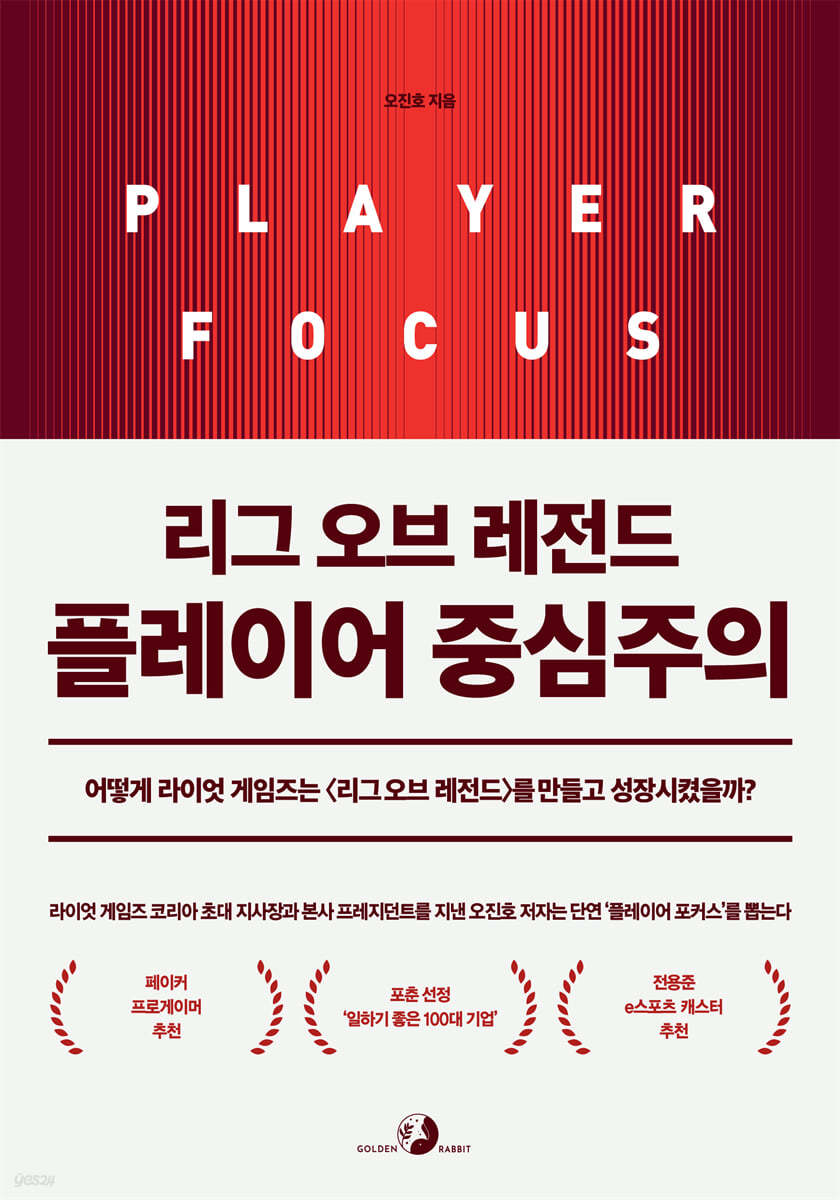
League of Legends player-centricity
 |
Description
Book Introduction
From Gaming to Culture: The First Inside Story of League of Legends
- What is Riot Games' 'player-centricity'?
How did League of Legends grow beyond eSports into a cultural phenomenon? The answer lies in "player focus," or "player-centricity."
'Player Focus' has provided fertile ground for Riot Games, League of Legends, and the community to establish themselves as a global culture.
Many companies use the same slogan, but not all of them produce the same results.
So how did Riot Games create this ecosystem? Let's explore the expertise gained from the experiences and practices of author Jin-ho Oh, who began his career as the first CEO of Riot Games Korea and later served as its president.
- What is Riot Games' 'player-centricity'?
How did League of Legends grow beyond eSports into a cultural phenomenon? The answer lies in "player focus," or "player-centricity."
'Player Focus' has provided fertile ground for Riot Games, League of Legends, and the community to establish themselves as a global culture.
Many companies use the same slogan, but not all of them produce the same results.
So how did Riot Games create this ecosystem? Let's explore the expertise gained from the experiences and practices of author Jin-ho Oh, who began his career as the first CEO of Riot Games Korea and later served as its president.
- You can preview some of the book's contents.
Preview
index
prolog
[PART 1: What kind of company is Riot Games?]
Chapter 1 From Blizzard to Riot Games
__Dream job, a connection to the gaming industry
__Do you know Riot Games?
__Young Leaders
__The moment that determines your life
__My first office filled with used furniture
Chapter 2: Dynamic Duo Mark and Brandon
__Riot PC Room
Brandon Beck and Marc Merrill
__The Beginning of Riot Games
League of Legends launches
Chapter 3 Player-Centricity
__Riot Games' Mission
Riot Manifesto 2012
Riot Core Values 2019
__The difference between Blizzard and Riot Games
Chapter 4: Tools for Maintaining Riot Culture
__Monthly Show and Tell
__Fail and Tell
__Play Like a Player
__Support or Feed
__Culture Team
__Culture Awards
__Denuviation
__Personnel Evaluation and Compensation
Chapter 5: Riot-Style Management
__Players over money
__Communication with warrior players
__True Empowerment
__Attitudes toward coping with a hole in empowerment
Overcoming the Limitations of Empowerment
Efficiency vs. Effectiveness Framework
__Leading in a Bottom-Up Culture
__A terrible horizontal organizational culture
Chapter 6: Human-Centered Philosophy
__Invest in people
__Check Self-Awareness
__Recruitment is the most important thing
__Consideration for the writer
[PART 2: How did LoL become successful in Korea?]
Chapter 7: Preparing for the Korean Launch of League of Legends
__First day at work
__Start recruiting
__talented people gather
__Conflict with headquarters begins
__I came to succeed
__Nicolo, keep your promise
Chapter 8: Why League of Legends is Challenging the Korean Market
__The Graveyard of Foreign Games
__Status of domestic games before release
__Game EPL, Korea
Chapter 9: League of Legends Finally Launches in Korea
__Flying with engine changes
__PC Room Coexistence Operation
__Marketing, Ask the Stars
__Closed Beta Test
__Time of Destiny: Open Beta Service
__Is this a dream or reality?
Chapter 10: Riot Games Korea: The Reason for Existence
__Working as a branch manager at Riot Games
__Ari, for Korean players
__The reason for the existence of Riot Games Korea
__Dunggi Dunggi Shinnara Shinbaram Tal Shako~
Chapter 11: The Moment of Crisis
__Repeated server failures
__Controversy over the 2014 World Championships being held in a distributed format
__Roll Helper, Bystander Situation
Chapter 12: Taking Root in the Korean Heart
__Homecoming after 100 years
__ Social contribution of a company with zero sales
__Ryan? Is this company affiliated with Samsung?
Building Sustainability Through Structures and Systems
__Support for the recovery of cultural assets overseas
Chapter 13: Beyond the Back Alley Office to the World
__From Samseong-dong to Sinsa-dong
Mission Impossible Operation
__Resigned and then re-joined the company
[PART 3: League of Legends Becomes Culture]
Chapter 14: The Rekindling of Esports
__Faker, Legend of LoL
__World Cup, a moment of telephone reversal
__The World Championship that Overcame Corona
__eSports Spreads Globally
__World Cup: Experience Comes Before Calculator
__You need to know esports to captivate millennials.
Chapter 15 Film Music Art, What Don't You Do?
__〈Arcane〉 wins Emmy
League of Legends Live: The Orchestra
__Champion in the Art Museum
__Ring the victory news, ㄷㄷㄷㅈ!
[PART 4: Working Like Riot Games]
Chapter 16: Player-Focused Game Development
Defining a Core Gamer
Planning League of Legends
__Test and reflect feedback
__Escape the trap of perfection
__Developing a new IP: 〈Valorant〉
Chapter 17 Player Focus Publishing
__Published by Riot Games
__Targeting Marketing
__Establishment of a branch office that leverages the strengths of both the headquarters and the local area
__Independently, sometimes together
__South America is soccer, the Middle East is rap
__10th Anniversary Event and Goodbye Junkyu
18 Player Focus Support
__But why did you ask here?
__Our first priority is player support
__More emotion than response
__Responsiveness is not a cost, it's an investment.
Chapter 19 Beyond League of Legends
__Current Riot
__Changes in leadership
__〈Arcane〉 Season 2 in production
__New releases in various genres
__Future, but still unchanging values
Epilogue
[PART 1: What kind of company is Riot Games?]
Chapter 1 From Blizzard to Riot Games
__Dream job, a connection to the gaming industry
__Do you know Riot Games?
__Young Leaders
__The moment that determines your life
__My first office filled with used furniture
Chapter 2: Dynamic Duo Mark and Brandon
__Riot PC Room
Brandon Beck and Marc Merrill
__The Beginning of Riot Games
League of Legends launches
Chapter 3 Player-Centricity
__Riot Games' Mission
Riot Manifesto 2012
Riot Core Values 2019
__The difference between Blizzard and Riot Games
Chapter 4: Tools for Maintaining Riot Culture
__Monthly Show and Tell
__Fail and Tell
__Play Like a Player
__Support or Feed
__Culture Team
__Culture Awards
__Denuviation
__Personnel Evaluation and Compensation
Chapter 5: Riot-Style Management
__Players over money
__Communication with warrior players
__True Empowerment
__Attitudes toward coping with a hole in empowerment
Overcoming the Limitations of Empowerment
Efficiency vs. Effectiveness Framework
__Leading in a Bottom-Up Culture
__A terrible horizontal organizational culture
Chapter 6: Human-Centered Philosophy
__Invest in people
__Check Self-Awareness
__Recruitment is the most important thing
__Consideration for the writer
[PART 2: How did LoL become successful in Korea?]
Chapter 7: Preparing for the Korean Launch of League of Legends
__First day at work
__Start recruiting
__talented people gather
__Conflict with headquarters begins
__I came to succeed
__Nicolo, keep your promise
Chapter 8: Why League of Legends is Challenging the Korean Market
__The Graveyard of Foreign Games
__Status of domestic games before release
__Game EPL, Korea
Chapter 9: League of Legends Finally Launches in Korea
__Flying with engine changes
__PC Room Coexistence Operation
__Marketing, Ask the Stars
__Closed Beta Test
__Time of Destiny: Open Beta Service
__Is this a dream or reality?
Chapter 10: Riot Games Korea: The Reason for Existence
__Working as a branch manager at Riot Games
__Ari, for Korean players
__The reason for the existence of Riot Games Korea
__Dunggi Dunggi Shinnara Shinbaram Tal Shako~
Chapter 11: The Moment of Crisis
__Repeated server failures
__Controversy over the 2014 World Championships being held in a distributed format
__Roll Helper, Bystander Situation
Chapter 12: Taking Root in the Korean Heart
__Homecoming after 100 years
__ Social contribution of a company with zero sales
__Ryan? Is this company affiliated with Samsung?
Building Sustainability Through Structures and Systems
__Support for the recovery of cultural assets overseas
Chapter 13: Beyond the Back Alley Office to the World
__From Samseong-dong to Sinsa-dong
Mission Impossible Operation
__Resigned and then re-joined the company
[PART 3: League of Legends Becomes Culture]
Chapter 14: The Rekindling of Esports
__Faker, Legend of LoL
__World Cup, a moment of telephone reversal
__The World Championship that Overcame Corona
__eSports Spreads Globally
__World Cup: Experience Comes Before Calculator
__You need to know esports to captivate millennials.
Chapter 15 Film Music Art, What Don't You Do?
__〈Arcane〉 wins Emmy
League of Legends Live: The Orchestra
__Champion in the Art Museum
__Ring the victory news, ㄷㄷㄷㅈ!
[PART 4: Working Like Riot Games]
Chapter 16: Player-Focused Game Development
Defining a Core Gamer
Planning League of Legends
__Test and reflect feedback
__Escape the trap of perfection
__Developing a new IP: 〈Valorant〉
Chapter 17 Player Focus Publishing
__Published by Riot Games
__Targeting Marketing
__Establishment of a branch office that leverages the strengths of both the headquarters and the local area
__Independently, sometimes together
__South America is soccer, the Middle East is rap
__10th Anniversary Event and Goodbye Junkyu
18 Player Focus Support
__But why did you ask here?
__Our first priority is player support
__More emotion than response
__Responsiveness is not a cost, it's an investment.
Chapter 19 Beyond League of Legends
__Current Riot
__Changes in leadership
__〈Arcane〉 Season 2 in production
__New releases in various genres
__Future, but still unchanging values
Epilogue
Detailed image

Into the book
The launch of League of Legends took every second, and I had to explain and convince people who didn't speak the language.
I had expected it since I had had many similar experiences before, but it was still true that the situation was frustrating.
Anyway, I thought that my role was to achieve important results quickly and wisely without major conflict, so I worked hard at communicating.
As the representative of Korea, I knew very well how important it was for me to establish a relationship with headquarters.
The responsibility was heavy, as the status and outcome of the Korean branch depended on how I acted in the beginning.
If I continue to hold onto the Korean position, I may be able to get what I need from Korea in the short term, but in the long term, conflict with headquarters will increase, and in the worst case, headquarters staff may become prejudiced against Korea and uncooperative.
On the other hand, if I go along with the headquarters' wishes, I might be able to survive, but because of the headquarters-centered policies, Korean employees and Korean customers will ultimately suffer.
Then, in the end, it will cause great trouble to Korean businesses.
I kept wondering what would happen if a headquarters-centric system were established.
Instead of releasing the game, communicating with players, and running it successfully, I would spend my time and energy reporting to and pleasing the headquarters staff.
It's the wrong way.
If you set up the wrong structure from the beginning, it will continue that way.
Korean employees' morale will drop, and passionate and capable employees will leave the company.
In the end, only employees who please headquarters will remain.
Ultimately, I thought Riot Games would fail or become just another average company like the countless foreign companies that had previously entered the market.
I didn't take risks and move to Riot Games to fail or to please others.
“I came here to succeed.” My philosophy on that was clear.
I thought that even though they might not understand us now and it might be difficult for us, we could show them through our achievements.
---From "I Came to Succeed"
The server opened on the morning of December 12, 2011.
I haven't had a proper night's sleep since the closed beta ended and we were preparing for the open beta.
I spent six months establishing a branch, recruiting staff, and working with the head office.
A truly murderous schedule flashed before my eyes.
Even the day before the open beta, I went to work without even a wink of sleep.
The time of destiny has come.
Little by little, the number of players connecting increased.
The server, which had been holding up well, became unstable as more players connected in the evening.
Posts about lag were posted all over the community.
First impressions are important, but the problem persisted.
No matter how good a game is, if there are server issues and the environment is difficult to play in, players may turn away.
From the player's perspective, there is no need to wait for a game that cannot even connect to the server.
There were hundreds of games in service.
Many Avengers-level competitive games were waiting for players who had turned away for a moment, their servers tense.
‘Ah, if this keeps up, I’ll just collapse in vain.’ A cold sweat ran down my face.
The server was installed by headquarters staff who stayed in Korea for several months.
If everything went according to plan, I was supposed to leave for my home country right after launch.
They were exhausted from working day and night away from home and family for a long time.
There was a local team to take care of the follow-up work, but they were still lacking in experience and response capabilities compared to the headquarters team.
It seemed like there was no chance of winning at this rate.
I desperately asked them to finish the stabilization work.
Fortunately, the servers have become noticeably more stable over the past few days.
Although this did not seem to cause any major disruption to the immediate service operation, it did not solve the fundamental problem.
---From the "Open Beta Service"
In preparation for the launch of League of Legends, we conducted a survey and FGI consumer in-depth survey targeting PC rooms to establish a strategy for domestic PC rooms.
As a result, the most important value in PC room business was derived from the 'economics of coexistence'.
He also established a practical principle: "We are partners, not sales networks." He believed that the performance of PC rooms would determine the success or failure of League of Legends.
Therefore, a promotion was needed to make it more fun for players to play League of Legends at PC rooms rather than at home.
If the strategy is successful, players will flock to PC rooms and the PC room occupancy rate will increase.
This is the economics of win-win, mutual prosperity.
With the launch of the game service, the premium PC room membership benefits for League of Legends were announced.
PC rooms that subscribe to the paid premium PC room service are given the unprecedented benefit of being able to use all champions.
In addition, we have decided to provide an additional 20 percent bonus IP (Influence Points) to players who play games at affiliated PC rooms.
The most important thing here was to make all champions playable.
There's a story behind this.
Just before launch, when we were still contemplating the appropriate price and other issues, we held a FGI with PC room owners.
It was the end of the PC room boom of the late 1990s and early 2000s.
At that time, what the CEO considered important was not the price of the service.
“I really hope that we can provide meaningful benefits that will make game players come to PC rooms.”
At the time, there were many games that were good to enjoy alone at home, like MMORPGs, and although each game company offered premium benefits for PC rooms, it wasn't enough to change the number of people heading home.
The idea was to offer truly impactful, consistent benefits. After careful consideration and listening to the voices of PC bang users, the solution we developed was to allow players playing League of Legends in PC bangs to select and use all champions for free.
To do this, we had to convince the US headquarters.
In fact, League of Legends is a game that anyone can play for free, and at the time, 7 champions were provided for free in a rotational manner within the game.
However, it was limited to '7 random types'.
At the start of the Korean service, there were 88 champions in the game, including Ahri.
It was a big decision to make these champions available for free just by going to a PC room.
Because in other regions this is a key factor in sales.
However, the Korean office was confident that this method was in line with the characteristics of League of Legends, which is more fun to play with friends and acquaintances, and that it was also a direction in which we could coexist and grow together with PC rooms.
Eventually, I succeeded in persuading the headquarters management.
League of Legends is a game that continuously plans and adds champions to make the game more fun.
As such, the fact that you can play a new champion in a PC room whenever it is released has been a very attractive factor for actual players.
It was the best symbiosis that satisfied all three parties: Riot Games, PC rooms, and players.
As part of the PC room coexistence operation, a 'PC room tournament' was also planned.
The 'PC Room Tournament', first held in the summer of 2012, was an amateur event prepared to expand the base of e-sports and allow any player to participate.
Any League of Legends player can apply, and the tournament event is not held at a separate venue, but at a local PC room that has expressed interest in participating.
It has fulfilled its role as a grassroots local league that can literally see the momentum of League of Legends from the ground up.
In June 2014, the second year of the PC Bang Tournament, the competition rate was 310 percent, with more than three times the number of participants in each tournament, making it a great success.
PC room owners, in particular, reported high satisfaction. PC room tournaments offered users a new and exciting experience, while PC room owners saw increased sales, creating a virtuous cycle that satisfied both PC rooms and their customers.
“It helped promote the store and improve customer service,” “Customers like it, and it’s a good opportunity to promote the PC room,” “This kind of competition was a great help to business during the off-season.” These are the words of the owners at the time.
---From "PC Room Mutual Growth Operation"
As is the ultimate goal of many companies, Riot Games planned to enter the global market even before launching League of Legends.
Riot Games is headquartered in Los Angeles, but its players are located all over the world.
Because the cultures and needs of the regions they live in are different and unique, Riot Games strives to reach and satisfy players in ways that are appropriate for each region.
Fortunately, it was a huge hit and successfully established its name in the global market.
Initially, we planned to partner with regional game publishers.
However, we felt that it would be difficult for the publishers we partnered with to provide the best experience to players.
So, Riot Games decided to publish it themselves, except for some regions.
Successfully publishing in other regions is extremely difficult and there are not many successful cases.
The biggest issue is the operational aspect.
As time goes by, confusion and conflict between headquarters and branches are likely to worsen.
Headquarters employees want to make decisions and lead at a global level, while branch employees want to be empowered as local experts.
If the game itself is so good that it is so fun that players cannot ignore it, it may succeed in the market in the short term, but in the medium to long term, internal issues may lead to external impacts.
Therefore, it is very important to clearly define the areas in which the headquarters has ownership and the areas in which the branch has ownership.
From the beginning, Riot Games has strived to clearly define the 'roles and responsibilities' between headquarters and branch offices.
Although we don't use it now, we used a framework called central and local in the beginning.
Central refers to the team at the Los Angeles headquarters that does global work, and local refers to each branch office (local also includes the North American publishing team).
Central was responsible for maintaining global consistency, while Local was responsible for areas that needed to vary by region.
For example, characters, skins, maps, and gameplay should be the same everywhere.
The headquarters development team is responsible for ‘in-game content’ that must be globally consistent.
And the positioning and assets of each character had to be the same globally.
This area was handled by the global marketing team located at headquarters.
We wanted players on the other side of the world to feel like they were still playing the same game.
And there were practical reasons too.
To run an esports tournament, players all over the world had to be playing the same game.
If the games, characters, and maps are different for each region, there are many more things to consider in a global competition.
The branch office was responsible for what needed to be localized and what needed to be different for each region.
For example, branches can utilize marketing guides and assets created by headquarters to conduct marketing tailored to each region.
For example, the Seoul office could create YouTube videos about new characters with Korean influencers, the Mexico City office could run a skin sale event, and the Paris office could host a player tournament.
---From "The 'Central and Local' Framework"
The early World Championship champions were a mixed bag, changing every season.
A professional gamer has appeared, putting an end to such a chaotic era.
He has won the World Championship three times, the Mid Season Invitational (MSI) twice, and the LCK ten times, and is ranked first in the world in cumulative prize money among League of Legends esports professional gamers.
It's Faker.
There is no one who has ever played League of Legends who does not know Faker.
This is true not only for Korea but for people all over the world.
Nearly 200 million people around the world play LoL and know Faker as the world's number one player.
This is enough to qualify as world-class.
The first match that made Faker, a rookie, famous overseas was the finals of the 'League of Legends Champions Summer 2013' held at the Jamsil Olympic Auxiliary Stadium.
At the time, with the score tied at 2:2 with KT, he was chosen as the blind pick in the 5th set.
Most of the audience thought that Zed, who was overpowered at the time, would come out, and as expected, the two teams' best players went Zed vs. Zed, providing a spectacular spectacle.
Here, Faker became famous as a video of him overcoming an unfavorable situation and killing the opposing Zed went viral around the world.
Riding that momentum, Faker went on to win the World Championship, and over the next 10 years, he enjoyed a reputation as the 'best pro gamer among pro gamers.'
A good example of Faker's status overseas is the World Championship qualifiers held in New York.
The game began with a large crowd, and several New York police officers entered the stadium.
The American police were very terrified of the fights because they could physically restrain anyone if they felt it was necessary and stop the fight at any time.
Eventually, the site manager came forward and cautiously asked, “What’s the problem?”
Then the police officer excitedly replied, "I'm here to see Faker."
The World Championships were being held in New York, so I couldn't miss the opportunity and stopped by in my work uniform.
Another rare scene occurred at the 2014 Paris All-Star Game.
That day happened to be Faker's birthday, and when someone started singing "Happy birthday to Faker," the entire crowd joined in, filling the stadium with songs celebrating Faker's birthday.
I had expected it since I had had many similar experiences before, but it was still true that the situation was frustrating.
Anyway, I thought that my role was to achieve important results quickly and wisely without major conflict, so I worked hard at communicating.
As the representative of Korea, I knew very well how important it was for me to establish a relationship with headquarters.
The responsibility was heavy, as the status and outcome of the Korean branch depended on how I acted in the beginning.
If I continue to hold onto the Korean position, I may be able to get what I need from Korea in the short term, but in the long term, conflict with headquarters will increase, and in the worst case, headquarters staff may become prejudiced against Korea and uncooperative.
On the other hand, if I go along with the headquarters' wishes, I might be able to survive, but because of the headquarters-centered policies, Korean employees and Korean customers will ultimately suffer.
Then, in the end, it will cause great trouble to Korean businesses.
I kept wondering what would happen if a headquarters-centric system were established.
Instead of releasing the game, communicating with players, and running it successfully, I would spend my time and energy reporting to and pleasing the headquarters staff.
It's the wrong way.
If you set up the wrong structure from the beginning, it will continue that way.
Korean employees' morale will drop, and passionate and capable employees will leave the company.
In the end, only employees who please headquarters will remain.
Ultimately, I thought Riot Games would fail or become just another average company like the countless foreign companies that had previously entered the market.
I didn't take risks and move to Riot Games to fail or to please others.
“I came here to succeed.” My philosophy on that was clear.
I thought that even though they might not understand us now and it might be difficult for us, we could show them through our achievements.
---From "I Came to Succeed"
The server opened on the morning of December 12, 2011.
I haven't had a proper night's sleep since the closed beta ended and we were preparing for the open beta.
I spent six months establishing a branch, recruiting staff, and working with the head office.
A truly murderous schedule flashed before my eyes.
Even the day before the open beta, I went to work without even a wink of sleep.
The time of destiny has come.
Little by little, the number of players connecting increased.
The server, which had been holding up well, became unstable as more players connected in the evening.
Posts about lag were posted all over the community.
First impressions are important, but the problem persisted.
No matter how good a game is, if there are server issues and the environment is difficult to play in, players may turn away.
From the player's perspective, there is no need to wait for a game that cannot even connect to the server.
There were hundreds of games in service.
Many Avengers-level competitive games were waiting for players who had turned away for a moment, their servers tense.
‘Ah, if this keeps up, I’ll just collapse in vain.’ A cold sweat ran down my face.
The server was installed by headquarters staff who stayed in Korea for several months.
If everything went according to plan, I was supposed to leave for my home country right after launch.
They were exhausted from working day and night away from home and family for a long time.
There was a local team to take care of the follow-up work, but they were still lacking in experience and response capabilities compared to the headquarters team.
It seemed like there was no chance of winning at this rate.
I desperately asked them to finish the stabilization work.
Fortunately, the servers have become noticeably more stable over the past few days.
Although this did not seem to cause any major disruption to the immediate service operation, it did not solve the fundamental problem.
---From the "Open Beta Service"
In preparation for the launch of League of Legends, we conducted a survey and FGI consumer in-depth survey targeting PC rooms to establish a strategy for domestic PC rooms.
As a result, the most important value in PC room business was derived from the 'economics of coexistence'.
He also established a practical principle: "We are partners, not sales networks." He believed that the performance of PC rooms would determine the success or failure of League of Legends.
Therefore, a promotion was needed to make it more fun for players to play League of Legends at PC rooms rather than at home.
If the strategy is successful, players will flock to PC rooms and the PC room occupancy rate will increase.
This is the economics of win-win, mutual prosperity.
With the launch of the game service, the premium PC room membership benefits for League of Legends were announced.
PC rooms that subscribe to the paid premium PC room service are given the unprecedented benefit of being able to use all champions.
In addition, we have decided to provide an additional 20 percent bonus IP (Influence Points) to players who play games at affiliated PC rooms.
The most important thing here was to make all champions playable.
There's a story behind this.
Just before launch, when we were still contemplating the appropriate price and other issues, we held a FGI with PC room owners.
It was the end of the PC room boom of the late 1990s and early 2000s.
At that time, what the CEO considered important was not the price of the service.
“I really hope that we can provide meaningful benefits that will make game players come to PC rooms.”
At the time, there were many games that were good to enjoy alone at home, like MMORPGs, and although each game company offered premium benefits for PC rooms, it wasn't enough to change the number of people heading home.
The idea was to offer truly impactful, consistent benefits. After careful consideration and listening to the voices of PC bang users, the solution we developed was to allow players playing League of Legends in PC bangs to select and use all champions for free.
To do this, we had to convince the US headquarters.
In fact, League of Legends is a game that anyone can play for free, and at the time, 7 champions were provided for free in a rotational manner within the game.
However, it was limited to '7 random types'.
At the start of the Korean service, there were 88 champions in the game, including Ahri.
It was a big decision to make these champions available for free just by going to a PC room.
Because in other regions this is a key factor in sales.
However, the Korean office was confident that this method was in line with the characteristics of League of Legends, which is more fun to play with friends and acquaintances, and that it was also a direction in which we could coexist and grow together with PC rooms.
Eventually, I succeeded in persuading the headquarters management.
League of Legends is a game that continuously plans and adds champions to make the game more fun.
As such, the fact that you can play a new champion in a PC room whenever it is released has been a very attractive factor for actual players.
It was the best symbiosis that satisfied all three parties: Riot Games, PC rooms, and players.
As part of the PC room coexistence operation, a 'PC room tournament' was also planned.
The 'PC Room Tournament', first held in the summer of 2012, was an amateur event prepared to expand the base of e-sports and allow any player to participate.
Any League of Legends player can apply, and the tournament event is not held at a separate venue, but at a local PC room that has expressed interest in participating.
It has fulfilled its role as a grassroots local league that can literally see the momentum of League of Legends from the ground up.
In June 2014, the second year of the PC Bang Tournament, the competition rate was 310 percent, with more than three times the number of participants in each tournament, making it a great success.
PC room owners, in particular, reported high satisfaction. PC room tournaments offered users a new and exciting experience, while PC room owners saw increased sales, creating a virtuous cycle that satisfied both PC rooms and their customers.
“It helped promote the store and improve customer service,” “Customers like it, and it’s a good opportunity to promote the PC room,” “This kind of competition was a great help to business during the off-season.” These are the words of the owners at the time.
---From "PC Room Mutual Growth Operation"
As is the ultimate goal of many companies, Riot Games planned to enter the global market even before launching League of Legends.
Riot Games is headquartered in Los Angeles, but its players are located all over the world.
Because the cultures and needs of the regions they live in are different and unique, Riot Games strives to reach and satisfy players in ways that are appropriate for each region.
Fortunately, it was a huge hit and successfully established its name in the global market.
Initially, we planned to partner with regional game publishers.
However, we felt that it would be difficult for the publishers we partnered with to provide the best experience to players.
So, Riot Games decided to publish it themselves, except for some regions.
Successfully publishing in other regions is extremely difficult and there are not many successful cases.
The biggest issue is the operational aspect.
As time goes by, confusion and conflict between headquarters and branches are likely to worsen.
Headquarters employees want to make decisions and lead at a global level, while branch employees want to be empowered as local experts.
If the game itself is so good that it is so fun that players cannot ignore it, it may succeed in the market in the short term, but in the medium to long term, internal issues may lead to external impacts.
Therefore, it is very important to clearly define the areas in which the headquarters has ownership and the areas in which the branch has ownership.
From the beginning, Riot Games has strived to clearly define the 'roles and responsibilities' between headquarters and branch offices.
Although we don't use it now, we used a framework called central and local in the beginning.
Central refers to the team at the Los Angeles headquarters that does global work, and local refers to each branch office (local also includes the North American publishing team).
Central was responsible for maintaining global consistency, while Local was responsible for areas that needed to vary by region.
For example, characters, skins, maps, and gameplay should be the same everywhere.
The headquarters development team is responsible for ‘in-game content’ that must be globally consistent.
And the positioning and assets of each character had to be the same globally.
This area was handled by the global marketing team located at headquarters.
We wanted players on the other side of the world to feel like they were still playing the same game.
And there were practical reasons too.
To run an esports tournament, players all over the world had to be playing the same game.
If the games, characters, and maps are different for each region, there are many more things to consider in a global competition.
The branch office was responsible for what needed to be localized and what needed to be different for each region.
For example, branches can utilize marketing guides and assets created by headquarters to conduct marketing tailored to each region.
For example, the Seoul office could create YouTube videos about new characters with Korean influencers, the Mexico City office could run a skin sale event, and the Paris office could host a player tournament.
---From "The 'Central and Local' Framework"
The early World Championship champions were a mixed bag, changing every season.
A professional gamer has appeared, putting an end to such a chaotic era.
He has won the World Championship three times, the Mid Season Invitational (MSI) twice, and the LCK ten times, and is ranked first in the world in cumulative prize money among League of Legends esports professional gamers.
It's Faker.
There is no one who has ever played League of Legends who does not know Faker.
This is true not only for Korea but for people all over the world.
Nearly 200 million people around the world play LoL and know Faker as the world's number one player.
This is enough to qualify as world-class.
The first match that made Faker, a rookie, famous overseas was the finals of the 'League of Legends Champions Summer 2013' held at the Jamsil Olympic Auxiliary Stadium.
At the time, with the score tied at 2:2 with KT, he was chosen as the blind pick in the 5th set.
Most of the audience thought that Zed, who was overpowered at the time, would come out, and as expected, the two teams' best players went Zed vs. Zed, providing a spectacular spectacle.
Here, Faker became famous as a video of him overcoming an unfavorable situation and killing the opposing Zed went viral around the world.
Riding that momentum, Faker went on to win the World Championship, and over the next 10 years, he enjoyed a reputation as the 'best pro gamer among pro gamers.'
A good example of Faker's status overseas is the World Championship qualifiers held in New York.
The game began with a large crowd, and several New York police officers entered the stadium.
The American police were very terrified of the fights because they could physically restrain anyone if they felt it was necessary and stop the fight at any time.
Eventually, the site manager came forward and cautiously asked, “What’s the problem?”
Then the police officer excitedly replied, "I'm here to see Faker."
The World Championships were being held in New York, so I couldn't miss the opportunity and stopped by in my work uniform.
Another rare scene occurred at the 2014 Paris All-Star Game.
That day happened to be Faker's birthday, and when someone started singing "Happy birthday to Faker," the entire crowd joined in, filling the stadium with songs celebrating Faker's birthday.
---From "Faker, the Birth of a Legend of LoL"
Publisher's Review
Why should we focus on 'player focus'?
'Player Focus' is the philosophy and value that runs through Riot Games' mission.
At Riot Games, player focus is a ubiquitous presence that drives decisions and actions.
Every time Riot Games members make a decision, they ask themselves and each other:
“Does this fit the player focus?” League of Legends, created with this philosophy, has become a part of the culture in games, e-sports, music/art, and daily life today.
As of August 14, 2023, League of Legends is ranked first in the Korean PC room game rankings with a market share of around 40%.
It is a record of over 200 consecutive weeks at number one.
This is part of the record, which previously held the number one spot for 204 consecutive weeks from late July 2012 to June 2016.
Riot Games also showcased games such as Valorant, Legends of Runeterra, and Teamfight Tactics.
Valorant, a 5v5 tactical FPS game where players compete to plant and defuse explosive spikes, is consistently ranked 3rd to 5th on the Gametrics rankings.
These amazing achievements were possible because of the core mission, 'Player Focus'!
What kind of company is Riot Games, the company that created League of Legends?
In 2006, Brandon and Mark founded Riot Games.
The mission was to become the world's most player-centric game developer.
The two founders firmly believed that players should be at the center of everything.
Player-centricity led to people-centricity.
Riot Games' people-centered philosophy doesn't stop at words.
We developed and operated the player-focused League of Legends, and we have been working sincerely to continuously provide a better work environment internally.
As a result, the company was certified as a good company to work for in 2023-2024.
Previously, it was selected as one of Fortune's "Best Workplaces for Parents" in 2022, Fortune's "Best Workplaces for Millennials" in 2021, and Fortune's "100 Best Companies to Work For" in 2016.
Behind Riot Games' success and growth as a leading company lies its founder's persistent, people-centered philosophy.
Let's take a look at strategies to expand player experience using IP.
Riot Games is expanding its player experience beyond games, encompassing music, film, and esports. In an April 2019 article, CNBC reported that the League of Legends World Championship, known colloquially as Worlds, attracted more viewers than the Super Bowl finals.
The 2021 League of Legends World Championship finals attracted a whopping 73.87 million viewers.
As its popularity shows no signs of abating, records will likely be broken in the future.
Additionally, the film "Arcane," which was released in the fall of 2021, was released through the online streaming service Netflix and achieved massive popular expansion, ranking first in 52 countries, including Korea, in its first week of release.
At the 74th Primetime Emmy Awards in 2022, Arcane won the Outstanding Animated Program award, and three staff members from Portische Productions who participated in the production received individual awards for production design, background design, and color.
At the 49th Annual Annie Awards, it won nine awards, including TV/Media, Character Design, and Screenplay.
All of this is part of an expansion of the 'player-focused' experience.
In this book, we hope you'll discover Riot Games' strategies for expanding player experiences.
Explore Riot Games' tools that support 'player focus'
Riot Games has maintained its player-focused Riot culture effectively even as it has grown rapidly.
This was possible because there were various tools (systems) behind it that supported the strong will to carry out the mission.
For example, in the early days, we had an all-staff meeting called 'Show and Tell' every month.
At this meeting, leaders from each department take turns presenting to all employees the progress made over the past month and the goals for the next month.
Then comes the free Q&A session, where writers feel free to ask questions and share them with other writers.
Initially, 'Show and Tell' served as an effective tool for sharing and resolving various issues with all employees.
Other tools used include 'Fail and Tell', 'Play Like a Player', 'Culture Awards', and 'Denewbification'.
Structure of this book
_Part 1: What kind of company is Riot Games?
Riot Games is a bit of an odd company.
Focus on the player, not the product (game).
Founders and hardcore gamers Mark and Brandon are the ones who created a "player-focused" company and truly established Riot culture.
Part 1 tells the story of how the author came to be associated with Riot Games and provides the reader with the basics needed to understand Riot Games in general.
You can see player-centricity, Riot culture, and various tools and management styles.
__Part 2: How did LoL become successful in Korea?
Success is partly due to players loving the graphics, worldview, characters, and certain elements within the game, but the biggest factor in success is actually the hard work of the writers who shed blood, sweat, and tears to achieve success.
Twelve years ago, few people believed League of Legends would become the success it is today.
I thought that even just getting into the rankings, let alone first place, would be considered a success.
The author also never expected that he would be ranked first in PC room market share.
So I didn't move with the goal of ranking.
I just worked hard with other writers and ended up in first place.
Our 'hard work' and 'player focus' were the lighthouses.
Part 2 tells the story of the challenges he faced since taking office as the president of Riot Games Korea.
Part 3: League of Legends Becomes Culture
Let's ring out the victory news, ㄷㄷㄷㅈ! 'ㄷㄷㄷㅈ' is a word derived from the initial consonants of 'dudungdeungjang'.
This is the title of a hip-hop song featured in a promotional video advertising the mobile version of Teamfight Tactics (TFT), released by Riot Games in 2019.
Not only is it a title, but it's also a rhyme that's used repeatedly throughout the song, and it's gained popularity, becoming one of the funniest gaming-related memes of 2020.
League of Legends is popular not only as a game itself, but also as an eSport, and its IP has been utilized in various fields such as music, art, and film. For the MZ generation, it has become a culture in itself. Let's examine League of Legends as part of MZ culture.
Part 4: Working Like Riot Games
How do Riot Games employees (Rioters) work? They're known for their horizontal culture, but is that really the case? Part 4 explores Riot's style: "player-focused game development," "player-focused publishing," and "player-focused support."
Riot Games was founded in 2006.
As of 2023, it has been 17 years since its founding and has released other games in addition to League of Legends.
We have achieved dramatic growth so far, but we expect to see even greater results in the future.
It's a well-founded expectation, as good people are running for a clear vision and there's ample funding.
Finally, let's look at the basis for expectations in Chapter 19, "Beyond League of Legends."
'Player Focus' is the philosophy and value that runs through Riot Games' mission.
At Riot Games, player focus is a ubiquitous presence that drives decisions and actions.
Every time Riot Games members make a decision, they ask themselves and each other:
“Does this fit the player focus?” League of Legends, created with this philosophy, has become a part of the culture in games, e-sports, music/art, and daily life today.
As of August 14, 2023, League of Legends is ranked first in the Korean PC room game rankings with a market share of around 40%.
It is a record of over 200 consecutive weeks at number one.
This is part of the record, which previously held the number one spot for 204 consecutive weeks from late July 2012 to June 2016.
Riot Games also showcased games such as Valorant, Legends of Runeterra, and Teamfight Tactics.
Valorant, a 5v5 tactical FPS game where players compete to plant and defuse explosive spikes, is consistently ranked 3rd to 5th on the Gametrics rankings.
These amazing achievements were possible because of the core mission, 'Player Focus'!
What kind of company is Riot Games, the company that created League of Legends?
In 2006, Brandon and Mark founded Riot Games.
The mission was to become the world's most player-centric game developer.
The two founders firmly believed that players should be at the center of everything.
Player-centricity led to people-centricity.
Riot Games' people-centered philosophy doesn't stop at words.
We developed and operated the player-focused League of Legends, and we have been working sincerely to continuously provide a better work environment internally.
As a result, the company was certified as a good company to work for in 2023-2024.
Previously, it was selected as one of Fortune's "Best Workplaces for Parents" in 2022, Fortune's "Best Workplaces for Millennials" in 2021, and Fortune's "100 Best Companies to Work For" in 2016.
Behind Riot Games' success and growth as a leading company lies its founder's persistent, people-centered philosophy.
Let's take a look at strategies to expand player experience using IP.
Riot Games is expanding its player experience beyond games, encompassing music, film, and esports. In an April 2019 article, CNBC reported that the League of Legends World Championship, known colloquially as Worlds, attracted more viewers than the Super Bowl finals.
The 2021 League of Legends World Championship finals attracted a whopping 73.87 million viewers.
As its popularity shows no signs of abating, records will likely be broken in the future.
Additionally, the film "Arcane," which was released in the fall of 2021, was released through the online streaming service Netflix and achieved massive popular expansion, ranking first in 52 countries, including Korea, in its first week of release.
At the 74th Primetime Emmy Awards in 2022, Arcane won the Outstanding Animated Program award, and three staff members from Portische Productions who participated in the production received individual awards for production design, background design, and color.
At the 49th Annual Annie Awards, it won nine awards, including TV/Media, Character Design, and Screenplay.
All of this is part of an expansion of the 'player-focused' experience.
In this book, we hope you'll discover Riot Games' strategies for expanding player experiences.
Explore Riot Games' tools that support 'player focus'
Riot Games has maintained its player-focused Riot culture effectively even as it has grown rapidly.
This was possible because there were various tools (systems) behind it that supported the strong will to carry out the mission.
For example, in the early days, we had an all-staff meeting called 'Show and Tell' every month.
At this meeting, leaders from each department take turns presenting to all employees the progress made over the past month and the goals for the next month.
Then comes the free Q&A session, where writers feel free to ask questions and share them with other writers.
Initially, 'Show and Tell' served as an effective tool for sharing and resolving various issues with all employees.
Other tools used include 'Fail and Tell', 'Play Like a Player', 'Culture Awards', and 'Denewbification'.
Structure of this book
_Part 1: What kind of company is Riot Games?
Riot Games is a bit of an odd company.
Focus on the player, not the product (game).
Founders and hardcore gamers Mark and Brandon are the ones who created a "player-focused" company and truly established Riot culture.
Part 1 tells the story of how the author came to be associated with Riot Games and provides the reader with the basics needed to understand Riot Games in general.
You can see player-centricity, Riot culture, and various tools and management styles.
__Part 2: How did LoL become successful in Korea?
Success is partly due to players loving the graphics, worldview, characters, and certain elements within the game, but the biggest factor in success is actually the hard work of the writers who shed blood, sweat, and tears to achieve success.
Twelve years ago, few people believed League of Legends would become the success it is today.
I thought that even just getting into the rankings, let alone first place, would be considered a success.
The author also never expected that he would be ranked first in PC room market share.
So I didn't move with the goal of ranking.
I just worked hard with other writers and ended up in first place.
Our 'hard work' and 'player focus' were the lighthouses.
Part 2 tells the story of the challenges he faced since taking office as the president of Riot Games Korea.
Part 3: League of Legends Becomes Culture
Let's ring out the victory news, ㄷㄷㄷㅈ! 'ㄷㄷㄷㅈ' is a word derived from the initial consonants of 'dudungdeungjang'.
This is the title of a hip-hop song featured in a promotional video advertising the mobile version of Teamfight Tactics (TFT), released by Riot Games in 2019.
Not only is it a title, but it's also a rhyme that's used repeatedly throughout the song, and it's gained popularity, becoming one of the funniest gaming-related memes of 2020.
League of Legends is popular not only as a game itself, but also as an eSport, and its IP has been utilized in various fields such as music, art, and film. For the MZ generation, it has become a culture in itself. Let's examine League of Legends as part of MZ culture.
Part 4: Working Like Riot Games
How do Riot Games employees (Rioters) work? They're known for their horizontal culture, but is that really the case? Part 4 explores Riot's style: "player-focused game development," "player-focused publishing," and "player-focused support."
Riot Games was founded in 2006.
As of 2023, it has been 17 years since its founding and has released other games in addition to League of Legends.
We have achieved dramatic growth so far, but we expect to see even greater results in the future.
It's a well-founded expectation, as good people are running for a clear vision and there's ample funding.
Finally, let's look at the basis for expectations in Chapter 19, "Beyond League of Legends."
GOODS SPECIFICS
- Date of issue: September 10, 2023
- Page count, weight, size: 288 pages | 400g | 147*210*14mm
- ISBN13: 9791191905373
You may also like
카테고리
korean


korean

![GQ KOREA Mark (Monthly): December [2025]](http://librairie.coreenne.fr/cdn/shop/files/8ef265dbbfbf186523ed75ba7319009d.jpg?v=1765340328&width=3840)


