

Do it! Jump to Java
 |
Description
Book Introduction
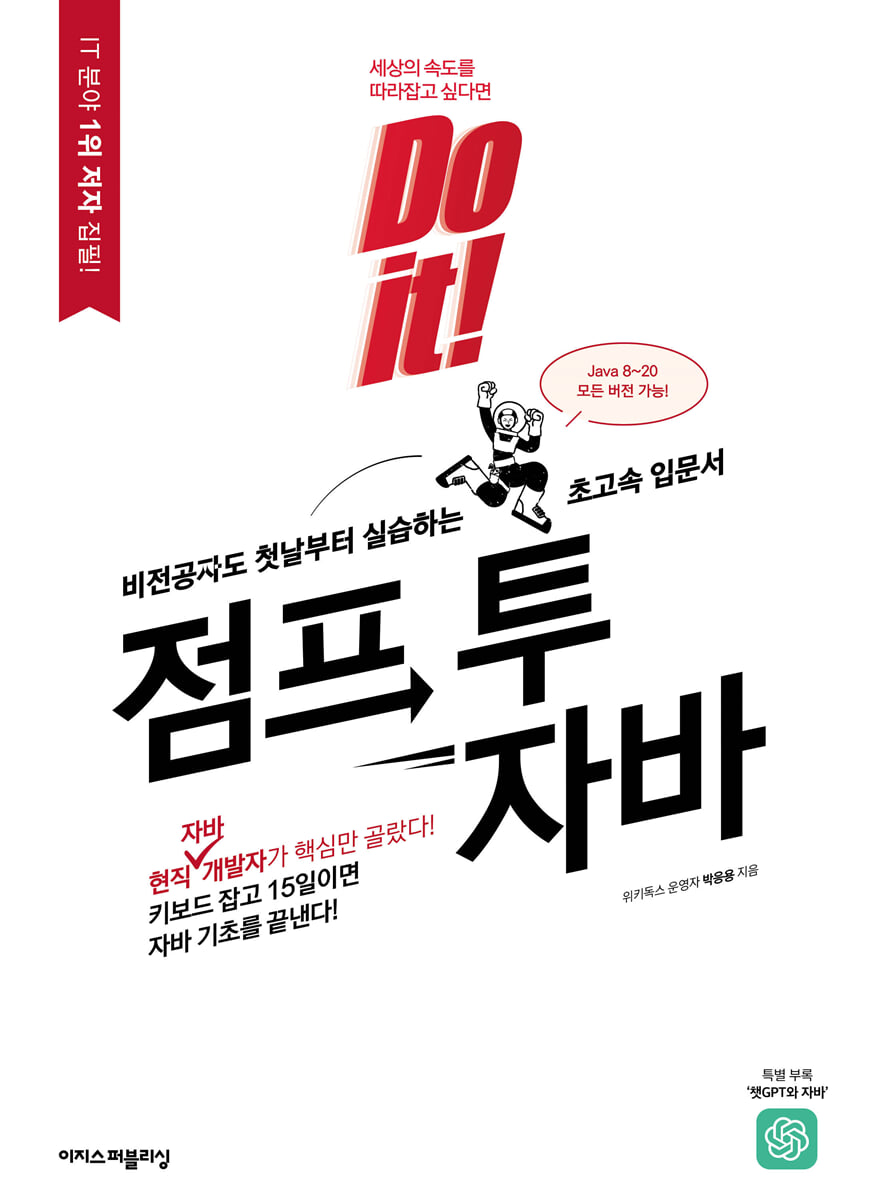
A developer with 20 years of experience has compiled only the essentials of Java!
Let's start Java with "Jump to Java" written by Park Eung-yong, the #1 author in the IT field!
Author Park Eung-yong, author of Korea's first Python book and the number-one computer/IT book in Korea, has now published "Do it! Jump to Java"! While better known as a Python author, Park is actually a working Java developer with over 20 years of experience working with Java, not Python.
This time, I have put all the Java development knowledge and know-how I have accumulated over time into this one book.
The goal of this book is to make learning Java as easy and fast as learning Python.
Covering everything from data types to functional programming like lambdas and streams, it's packed with only the essentials for development.
Let's help you overcome the Java beginner stage through this book!
Let's start Java with "Jump to Java" written by Park Eung-yong, the #1 author in the IT field!
Author Park Eung-yong, author of Korea's first Python book and the number-one computer/IT book in Korea, has now published "Do it! Jump to Java"! While better known as a Python author, Park is actually a working Java developer with over 20 years of experience working with Java, not Python.
This time, I have put all the Java development knowledge and know-how I have accumulated over time into this one book.
The goal of this book is to make learning Java as easy and fast as learning Python.
Covering everything from data types to functional programming like lambdas and streams, it's packed with only the essentials for development.
Let's help you overcome the Java beginner stage through this book!
- You can preview some of the book's contents.
Preview
index
First Yard: Learning Java Basics
Chapter 1 What is Java?
__01-1 What is Java?
__01-2 What can you do with Java?
______ Things you can do with Java
______ Things you can't do with Java
__01-3 Java Tour
Installing ______ JDK
______ Understanding Java files and compilation
______ Writing a simple program
Installing IntelliJ ______
Understanding the ______ main method
Chapter 2 Getting Started with Java
__02-1 Examining the structure of Java code
______ Java code example
__02-2 Variables and data types
Learn about the ______ variable
Learn about ______ data types
Assign a value to a ______ variable
______ frequently used data types
______ custom data type
__02-3 Naming Rules
______ class name
______ Method Naming
Naming ______ variables
__02-4 What is a comment?
______ block comment
______ line comment
How to use ______ comments correctly
Chapter 3: Java Basics - Data Types
__03-1 number
______ integer
______ mistake
______ octal and hexadecimal
______ numeric operations
______ increment/decrement operation
__03-2 Fire
______ Boolean operation
Example of using ______ Boolean operator - Conditional statement
__03-3 characters
__03-4 string
______ primitive data type
______ string built-in methods
______ string formatting
______ string format code
__03-5 StringBuffer
______ append
______ insert
______ substring
__03-6 array
Setting the length of the ______ array
Accessing array values ______
Find the length of the ______ array
______ array error
__03-7 List
______ ArrayList
______ Generics
______ Creating an ArrayList in various ways
______ String.join
Sort the ______ list
__03-8 map
______ HashMap
__03-9 set
Two characteristics of the ______ set data type
Finding the intersection, union, and difference of ______ sets
Methods related to the ______ set data type - add, addAll, remove
__03-10 constant set
Why we need ______ enum
__03-11 Type Conversion and Final
______ type conversion
______ final
Chapter 3 Reflection Problem
Chapter 4 Understanding Control Statements
__04-1 if statement
Basic structure of ______ if and else statements
______ comparison operator
______ and, or, not operators
______ contains
______ else if
__04-2 switch/case statement
__04-3 while statement
Basic structure of the ______ while statement
______ What is an infinite loop?
______ while exiting the statement - break
________ Return to the while loop - continue
__04-4 for statement
Basic structure of the ______ for statement
Return to ______ for loop - continue
______ double for statement
__04-5 for each statement
Chapter 4 Reflection Problem
Second Yard: Improving Java Skills
Chapter 5 Object-Oriented Programming
__05-1 What is object-oriented programming?
__05-2 class
______ classes and objects
What is a ______ object variable?
What is the ______ method?
______ object variables are not shared
__05-3 More on Methods
Why use the ______ method?
______ parameters and arguments
Input and return values of the ______ method
Another use of ______ return
Scope of variables declared within ______ method
__05-4 Call by value and call by object
__05-5 Inheritance
Extending the functionality of ______ child classes
______ What is an IS-A relationship?
______ method overriding
______ method overloading
______ What is multiple inheritance?
__05-6 constructor
______ default constructor
______ constructor overloading
__05-7 interface
Why is the ______ interface needed?
Writing a ______ interface
Methods of the ______ interface
Digging deeper into the ______ interface
______ default method
______ static method
__05-8 Polymorphism
__05-9 Abstract class
Chapter 5 Reflection Problem
Chapter 6 Java Input/Output
__06-1 Console input/output
______ console input
______ console output
__06-2 File input/output
Write ______ file
Read ______ file
Chapter 6 Reflection Problem
Chapter 7: Gaining Wings with Java
__07-1 package
Create a ______ package
What is a ______ subpackage?
Using the ______ package
Why use the ______ package?
__07-2 Access controller
______ private
______ default
______ protected
______ public
__07-3 static
______ static variable
______ static method
______ Singleton Pattern
__07-4 Exception Handling
When does the ______ exception occur?
Handling ______ exceptions
______ finally
Using ______ exceptions - RuntimeException and Exception
Throwing an exception ______
______ transaction
__07-5 thread
______ Thread
______ Join
______ Runnable
__07-6 Functional Programming
______ Lambda
______ stream
Chapter 7 Reflection Problem
Chapter 8: Java Programming: How to Get Started
__08-1 Can I create a program?
__08-2 Adding multiples of 3 and 5
__08-3 Paging the bulletin board
__08-4 Finding the digits
__08-5 Counting characters excluding spaces
supplement
__Do it! Java Coding License Exam 15 Questions
__Do it! Study Java with ChatGPT
__Answers and Solutions - Review Questions and Java Coding License Exam
Search
Chapter 1 What is Java?
__01-1 What is Java?
__01-2 What can you do with Java?
______ Things you can do with Java
______ Things you can't do with Java
__01-3 Java Tour
Installing ______ JDK
______ Understanding Java files and compilation
______ Writing a simple program
Installing IntelliJ ______
Understanding the ______ main method
Chapter 2 Getting Started with Java
__02-1 Examining the structure of Java code
______ Java code example
__02-2 Variables and data types
Learn about the ______ variable
Learn about ______ data types
Assign a value to a ______ variable
______ frequently used data types
______ custom data type
__02-3 Naming Rules
______ class name
______ Method Naming
Naming ______ variables
__02-4 What is a comment?
______ block comment
______ line comment
How to use ______ comments correctly
Chapter 3: Java Basics - Data Types
__03-1 number
______ integer
______ mistake
______ octal and hexadecimal
______ numeric operations
______ increment/decrement operation
__03-2 Fire
______ Boolean operation
Example of using ______ Boolean operator - Conditional statement
__03-3 characters
__03-4 string
______ primitive data type
______ string built-in methods
______ string formatting
______ string format code
__03-5 StringBuffer
______ append
______ insert
______ substring
__03-6 array
Setting the length of the ______ array
Accessing array values ______
Find the length of the ______ array
______ array error
__03-7 List
______ ArrayList
______ Generics
______ Creating an ArrayList in various ways
______ String.join
Sort the ______ list
__03-8 map
______ HashMap
__03-9 set
Two characteristics of the ______ set data type
Finding the intersection, union, and difference of ______ sets
Methods related to the ______ set data type - add, addAll, remove
__03-10 constant set
Why we need ______ enum
__03-11 Type Conversion and Final
______ type conversion
______ final
Chapter 3 Reflection Problem
Chapter 4 Understanding Control Statements
__04-1 if statement
Basic structure of ______ if and else statements
______ comparison operator
______ and, or, not operators
______ contains
______ else if
__04-2 switch/case statement
__04-3 while statement
Basic structure of the ______ while statement
______ What is an infinite loop?
______ while exiting the statement - break
________ Return to the while loop - continue
__04-4 for statement
Basic structure of the ______ for statement
Return to ______ for loop - continue
______ double for statement
__04-5 for each statement
Chapter 4 Reflection Problem
Second Yard: Improving Java Skills
Chapter 5 Object-Oriented Programming
__05-1 What is object-oriented programming?
__05-2 class
______ classes and objects
What is a ______ object variable?
What is the ______ method?
______ object variables are not shared
__05-3 More on Methods
Why use the ______ method?
______ parameters and arguments
Input and return values of the ______ method
Another use of ______ return
Scope of variables declared within ______ method
__05-4 Call by value and call by object
__05-5 Inheritance
Extending the functionality of ______ child classes
______ What is an IS-A relationship?
______ method overriding
______ method overloading
______ What is multiple inheritance?
__05-6 constructor
______ default constructor
______ constructor overloading
__05-7 interface
Why is the ______ interface needed?
Writing a ______ interface
Methods of the ______ interface
Digging deeper into the ______ interface
______ default method
______ static method
__05-8 Polymorphism
__05-9 Abstract class
Chapter 5 Reflection Problem
Chapter 6 Java Input/Output
__06-1 Console input/output
______ console input
______ console output
__06-2 File input/output
Write ______ file
Read ______ file
Chapter 6 Reflection Problem
Chapter 7: Gaining Wings with Java
__07-1 package
Create a ______ package
What is a ______ subpackage?
Using the ______ package
Why use the ______ package?
__07-2 Access controller
______ private
______ default
______ protected
______ public
__07-3 static
______ static variable
______ static method
______ Singleton Pattern
__07-4 Exception Handling
When does the ______ exception occur?
Handling ______ exceptions
______ finally
Using ______ exceptions - RuntimeException and Exception
Throwing an exception ______
______ transaction
__07-5 thread
______ Thread
______ Join
______ Runnable
__07-6 Functional Programming
______ Lambda
______ stream
Chapter 7 Reflection Problem
Chapter 8: Java Programming: How to Get Started
__08-1 Can I create a program?
__08-2 Adding multiples of 3 and 5
__08-3 Paging the bulletin board
__08-4 Finding the digits
__08-5 Counting characters excluding spaces
supplement
__Do it! Java Coding License Exam 15 Questions
__Do it! Study Java with ChatGPT
__Answers and Solutions - Review Questions and Java Coding License Exam
Search
Detailed image

Publisher's Review
"How much do I need to learn to develop in Java?" Put your worries aside and open this book right now!
To survive as a developer in Korea, Java isn't an option, it's a necessity! However, learning Java isn't easy, and the books available are so thick that it's questionable whether you'll ever be able to finish them all.
It's object-oriented, full of interfaces and concepts that are difficult to grasp.
This book will help you get started with Java quickly and easily, with hands-on practice from day one.
Also, rather than just teaching Java grammar, it provides the core knowledge necessary to start developing in Java through practice.
It is composed mainly of content necessary for development, and non-mainstream content is boldly omitted.
Jump to Java, which has grown with readers on Wikidocs for 10 years.
In fact, this book is not something that was created recently.
This is the publication of 'Jump to Java', which was first made public through 'Wikidocs', an online site created by the author in 2013.
As Java has evolved through version upgrades, this book has also continued to evolve to meet the needs of readers as well as the changes in Java.
So, this book can be said to be a book created not by one author but by many readers.
"What makes it different from other books?" This is the unique feature of "Do it! Jump to Java"!
It explains difficult Java in a friendly way, as if you were studying alongside a friend or senior, and makes it easy and fun to learn, and it also goes over parts that are easy to miss.
It consists of 'Review Problems' that can be reviewed immediately after completing each chapter, and '15 Java Coding License Questions' that allow you to review what you have learned and develop a practical sense after completing all studies.
It covers new features in modern Java (Java 8 and later), such as generics, lambdas, and streams, and can be studied in all versions from Java 8 to 20.
In keeping with the era of generative AI that began with ChatGPT, we offer 'Study Java with ChatGPT', which allows you to learn Java programming and ChatGPT usage at the same time.
I recommend this to these people!
- Beginner coding student who wants to learn Java but is not a major in Java
- Beginners who have learned Java but want to learn how to actually use it.
- Computer science majors who want to learn Java
-Developers who want to review Java and learn the latest technologies
"Can you learn Java on your own?" With "Do it! Jump to Java," you can connect with the author!
'Jump to Java' is a textbook that has already been verified by numerous self-students.
Comments from people who first encountered this book on Wikidocs prove this.
This book was created with independent learners in mind, and is designed to help them learn without difficulty.
This book provides a '30-day plan for self-study'.
Anyone can overcome Java beginner level in one month by learning one hour a day.
And that's not all! At the author's website, "Coding Dojang (codingdojang.com)," you can work on over 230 problems to hone your programming skills. At "Pybo (pybo.kr)," you can ask Java-related questions and get answers directly from the author.
Learning design that can also be used as a college textbook for a semester-long class
This book provides a '15-lesson progress chart for lectures and intermediate learners' tailored to one semester (15 weeks) of classes, suitable for use in universities and educational institutions.
This course is designed to be taught by intermediate learners who already have a basic understanding of programming or Java.
In chapters 1 to 7, you will learn Java, and in chapter 8, you will be able to create a simple Java program.
Additionally, you can check your skills on your own and even systematically review them through 'Reflection Problems' and '15 Java Coding License Exam Questions'.
Come to the 'Do it! Study Room' where we learn, share, and grow together!
If you plan and study alone, you will quickly become tired.
Let's meet readers who have similar concerns and study together.
It is more rewarding to study by asking and answering questions with each other.
In addition, visit the 'Do it! Study Room' and apply for a study group.
If you complete and verify 'Jump to Java', you can also receive a free book.
- Do it! Study Room: cafe.naver.com/doitstudyroom
Provides source files required for learning
The source files for 'Try Coding', 'Reflection Problems', and 'Coding License Exam 15 Questions' can be downloaded from the data room on the Aegis Publishing website or from author Park Eung-yong's GitHub.
- Easys Publishing website: www.easyspub.co.kr → Click [Data Room] → Search for book title
-Author's GitHub: github.com/pahkey/jump2java
To survive as a developer in Korea, Java isn't an option, it's a necessity! However, learning Java isn't easy, and the books available are so thick that it's questionable whether you'll ever be able to finish them all.
It's object-oriented, full of interfaces and concepts that are difficult to grasp.
This book will help you get started with Java quickly and easily, with hands-on practice from day one.
Also, rather than just teaching Java grammar, it provides the core knowledge necessary to start developing in Java through practice.
It is composed mainly of content necessary for development, and non-mainstream content is boldly omitted.
Jump to Java, which has grown with readers on Wikidocs for 10 years.
In fact, this book is not something that was created recently.
This is the publication of 'Jump to Java', which was first made public through 'Wikidocs', an online site created by the author in 2013.
As Java has evolved through version upgrades, this book has also continued to evolve to meet the needs of readers as well as the changes in Java.
So, this book can be said to be a book created not by one author but by many readers.
"What makes it different from other books?" This is the unique feature of "Do it! Jump to Java"!
It explains difficult Java in a friendly way, as if you were studying alongside a friend or senior, and makes it easy and fun to learn, and it also goes over parts that are easy to miss.
It consists of 'Review Problems' that can be reviewed immediately after completing each chapter, and '15 Java Coding License Questions' that allow you to review what you have learned and develop a practical sense after completing all studies.
It covers new features in modern Java (Java 8 and later), such as generics, lambdas, and streams, and can be studied in all versions from Java 8 to 20.
In keeping with the era of generative AI that began with ChatGPT, we offer 'Study Java with ChatGPT', which allows you to learn Java programming and ChatGPT usage at the same time.
I recommend this to these people!
- Beginner coding student who wants to learn Java but is not a major in Java
- Beginners who have learned Java but want to learn how to actually use it.
- Computer science majors who want to learn Java
-Developers who want to review Java and learn the latest technologies
"Can you learn Java on your own?" With "Do it! Jump to Java," you can connect with the author!
'Jump to Java' is a textbook that has already been verified by numerous self-students.
Comments from people who first encountered this book on Wikidocs prove this.
This book was created with independent learners in mind, and is designed to help them learn without difficulty.
This book provides a '30-day plan for self-study'.
Anyone can overcome Java beginner level in one month by learning one hour a day.
And that's not all! At the author's website, "Coding Dojang (codingdojang.com)," you can work on over 230 problems to hone your programming skills. At "Pybo (pybo.kr)," you can ask Java-related questions and get answers directly from the author.
Learning design that can also be used as a college textbook for a semester-long class
This book provides a '15-lesson progress chart for lectures and intermediate learners' tailored to one semester (15 weeks) of classes, suitable for use in universities and educational institutions.
This course is designed to be taught by intermediate learners who already have a basic understanding of programming or Java.
In chapters 1 to 7, you will learn Java, and in chapter 8, you will be able to create a simple Java program.
Additionally, you can check your skills on your own and even systematically review them through 'Reflection Problems' and '15 Java Coding License Exam Questions'.
Come to the 'Do it! Study Room' where we learn, share, and grow together!
If you plan and study alone, you will quickly become tired.
Let's meet readers who have similar concerns and study together.
It is more rewarding to study by asking and answering questions with each other.
In addition, visit the 'Do it! Study Room' and apply for a study group.
If you complete and verify 'Jump to Java', you can also receive a free book.
- Do it! Study Room: cafe.naver.com/doitstudyroom
Provides source files required for learning
The source files for 'Try Coding', 'Reflection Problems', and 'Coding License Exam 15 Questions' can be downloaded from the data room on the Aegis Publishing website or from author Park Eung-yong's GitHub.
- Easys Publishing website: www.easyspub.co.kr → Click [Data Room] → Search for book title
-Author's GitHub: github.com/pahkey/jump2java
GOODS SPECIFICS
- Date of issue: July 15, 2023
- Page count, weight, size: 368 pages | 188*257*30mm
- ISBN13: 9791163034872
- ISBN10: 1163034878
You may also like
카테고리
korean


korean

![GQ KOREA Mark (Monthly): December [2025]](http://librairie.coreenne.fr/cdn/shop/files/8ef265dbbfbf186523ed75ba7319009d.jpg?v=1765340328&width=3840)


