

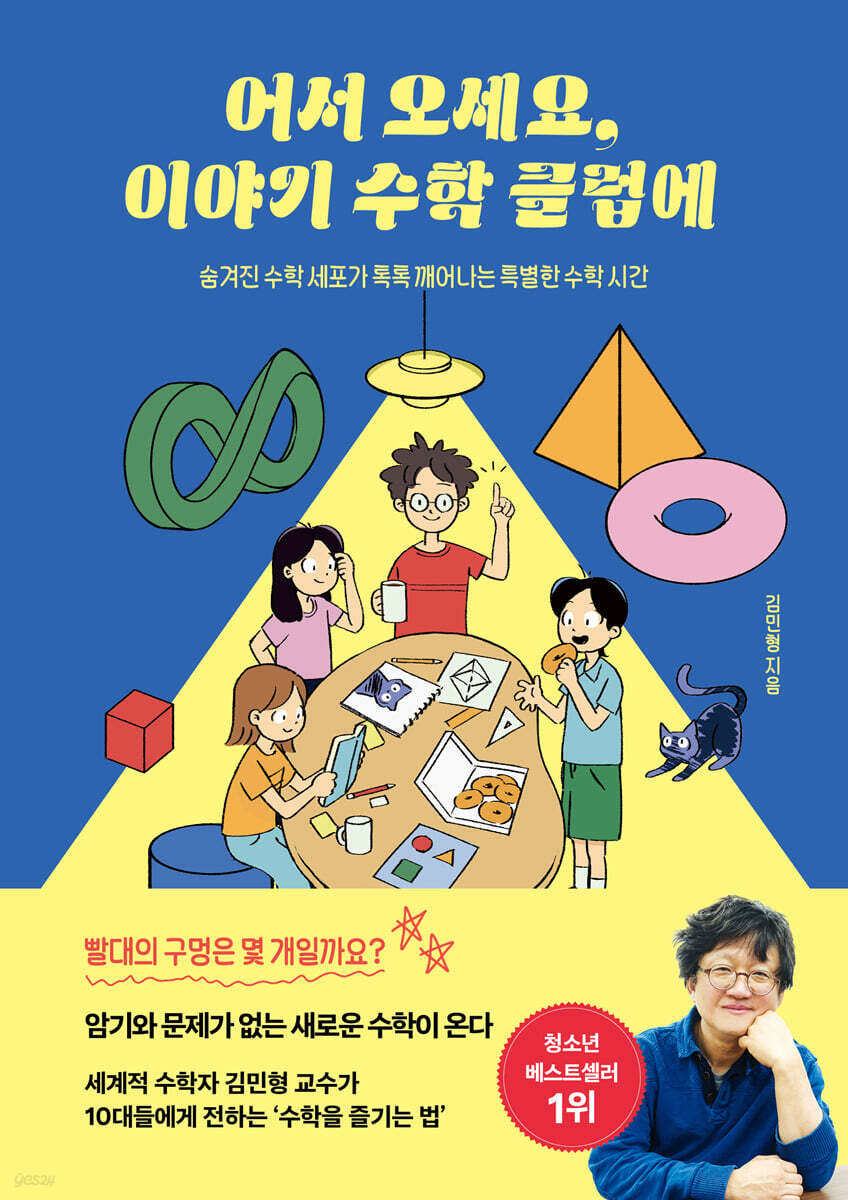
Welcome to the Story Math Club
 |
Description
Book Introduction
Questions are unlimited! It's okay to make mistakes! A special math class that will make you love math starting today. A new math without memorization and problems is coming! World-renowned mathematician Professor Kim Min-hyung shares tips for teenagers on how to enjoy math. “Do you like math, everyone?” It all started with this question, which no one could readily answer. Professor Minhyung Kim, a world-renowned mathematician who is the author of the first bestseller in the field of mathematics, “When You Need Math,” and who boasts an impressive resume as the first Korean professor of mathematics at Oxford University and the world’s first professor of popularizing mathematics (at the University of Warwick), tells a “math story” for teenagers. Professor Kim Min-hyung met with middle school students who were just beginning to find math difficult and created a math club that was uniquely fun. This book, “Welcome to the Story Math Club,” vividly captures that scene in story form. In 'Professor Kim Min-hyung's Math Club', there are no formulas to memorize or problems with points at stake. The more questions you ask, the more applause you get, and the more you make mistakes, the happier you are because you learn from them. 'How many holes does a straw have?' 'How can a computer that only knows 0 and 1 store mountains of information?' 'Can we create the strongest, most impenetrable password?' Every class begins with absurd questions that seem to have nothing to do with mathematics. In the process of finding the answer, you will approach the 'core of mathematics' such as topology, Euler's theorem, Fermat's last theorem, and remainder operation. As you experience the profound world of mathematics, you will repeatedly encounter surprising moments where mathematics becomes more enjoyable. "Welcome to the Story Math Club" is an invitation from Professor Kim Min-hyung for those who want to enjoy math more. “No one should give up on math. "There are only people who find math boring." Will reading this book truly make you say you enjoy math because it's fun? Join Professor Kim Min-hyung's Math Club and find out for yourself. |
- You can preview some of the book's contents.
Preview
index
Entering
prolog
First class
: Even if we look different, we can be friends_Topology and Euler numbers
Part 1
How many holes does a straw have?
[Math Magnifier] When did topology begin?
We may look different, but we are friends
Find the edge of the t-shirt
What happens when you cut a Möbius strip?
Part 2
To put the round Earth on a flat piece of paper
That's really weird. Why are you adding and subtracting that?
[Math Magnifier] Who is Euler?
Euler's dilemma
Find the Stanford Rabbit
[Brief thought] But… …where do you use topology?
Second class
: If you could read the mind of a number_The Pythagorean theorem and the shoelace formula
Play with coordinates
[Math Magnifier] Who is Pythagoras?
Pythagorean magic to figure out shapes with numbers
Tie the numbers together like shoelaces.
How do airplanes find their way in the sky?
Do I still look curved?
[Brief thought] How far away did that lightning strike?
Third class
: Do I still only see numbers?_Pythagorean Triplets and Fermat's Last Theorem
Part 1
What do we study in mathematics?
Find Pythagoras' Three Friends 1
[Math Magnifier] What does an equation mean?
Find Pythagoras' Three Friends 2
Part 2
If you ask what a circle is,
Clue 1: Open your eyes wide and look.
Clue 2: Make the line and circle meet.
Clue 3: Unravel the mystery of Root's disappearance.
Fermat's Last Theorem: Who Will Be the Final King?
[Math Magnifier] Who is Fermat?
[Brief thought] From clouds to fish, if you put a question mark on the world outside the window
Fourth class
: Challenge! Creating the Strongest Password_Public Key Cryptography and Modulus Operations
Number magic that reads your mind
[Math Magnifier] The World of Decimal Systems That Drive Our Lives
Welcome to Dongdaemun Bank
Encryption Exercise 1: Convert all messages to numbers
Cryptography Training 2: Remainder Operations
Our own secret password, public key encryption
A code that only I can solve in this world
[Brief thought] How do hackers find out passwords?
Fifth class
: Solve it! Cryptography Operation: Fermat's Little Theorem, Euler's Theorem, and Remainder Operation 2
My password is ironclad with remainder arithmetic!
Key to Decryption 1: Fermat's Little Theorem
[Math Magnifier] Why is binary important?
Key to Decryption 2: Euler's Theorem
The secret of number magic has finally been revealed.
New magicians at Dongdaemun Magic Theater
[Brief thought] What will happen if quantum computers actually come into existence?
Epilogue
prolog
First class
: Even if we look different, we can be friends_Topology and Euler numbers
Part 1
How many holes does a straw have?
[Math Magnifier] When did topology begin?
We may look different, but we are friends
Find the edge of the t-shirt
What happens when you cut a Möbius strip?
Part 2
To put the round Earth on a flat piece of paper
That's really weird. Why are you adding and subtracting that?
[Math Magnifier] Who is Euler?
Euler's dilemma
Find the Stanford Rabbit
[Brief thought] But… …where do you use topology?
Second class
: If you could read the mind of a number_The Pythagorean theorem and the shoelace formula
Play with coordinates
[Math Magnifier] Who is Pythagoras?
Pythagorean magic to figure out shapes with numbers
Tie the numbers together like shoelaces.
How do airplanes find their way in the sky?
Do I still look curved?
[Brief thought] How far away did that lightning strike?
Third class
: Do I still only see numbers?_Pythagorean Triplets and Fermat's Last Theorem
Part 1
What do we study in mathematics?
Find Pythagoras' Three Friends 1
[Math Magnifier] What does an equation mean?
Find Pythagoras' Three Friends 2
Part 2
If you ask what a circle is,
Clue 1: Open your eyes wide and look.
Clue 2: Make the line and circle meet.
Clue 3: Unravel the mystery of Root's disappearance.
Fermat's Last Theorem: Who Will Be the Final King?
[Math Magnifier] Who is Fermat?
[Brief thought] From clouds to fish, if you put a question mark on the world outside the window
Fourth class
: Challenge! Creating the Strongest Password_Public Key Cryptography and Modulus Operations
Number magic that reads your mind
[Math Magnifier] The World of Decimal Systems That Drive Our Lives
Welcome to Dongdaemun Bank
Encryption Exercise 1: Convert all messages to numbers
Cryptography Training 2: Remainder Operations
Our own secret password, public key encryption
A code that only I can solve in this world
[Brief thought] How do hackers find out passwords?
Fifth class
: Solve it! Cryptography Operation: Fermat's Little Theorem, Euler's Theorem, and Remainder Operation 2
My password is ironclad with remainder arithmetic!
Key to Decryption 1: Fermat's Little Theorem
[Math Magnifier] Why is binary important?
Key to Decryption 2: Euler's Theorem
The secret of number magic has finally been revealed.
New magicians at Dongdaemun Magic Theater
[Brief thought] What will happen if quantum computers actually come into existence?
Epilogue
Detailed image

Publisher's Review
The first Korean to hold a professorship in mathematics at Oxford University.
Director of the International Institute for Mathematical Sciences in Edinburgh, UK, and Distinguished Professor at the Korea Institute for Advanced Study
A new book by Professor Minhyung Kim, author of the first bestseller in the field of mathematics, "When You Need Math."
“How many holes does a straw have?”
- A special math class that cultivates 'math skills' through stories, not formulas.
In the summer of 2021, Professor Minhyung Kim, a world-renowned mathematician, met with teenage students seven times at the Korea Institute for Advanced Study in Dongdaemun-gu to discuss mathematics.
Professor Kim Min-hyung, who developed a theory to solve difficult problems arising from 'Fermat's Last Theorem', became famous in the world of mathematics.
In the lab of a world-renowned mathematician who grapples with mathematical challenges spanning centuries, students ask all sorts of questions, and Professor Kim Min-hyung, with sparkling eyes, unfolds the vast universe of mathematics.
"How many holes does a straw have?" This class begins with a somewhat odd question. Since there is no set curriculum, students freely explore the various aspects of the "world of mathematics."
"How do you transfer the round Earth onto a flat piece of paper?" "How do airplanes find their way in the sky?" "How do hackers figure out passwords?" In this journey that crosses the basic concepts of middle school mathematics, such as the shape of shapes, the Pythagorean theorem, Euler's theorem, and Fermat's last theorem, to the profound world of advanced mathematics, Professor Kim Min-hyung helps students find the answers on their own with his infinite tolerance.
In some ways, it's natural that math is difficult.
As you advance in grade level and learn more advanced content, it becomes increasingly difficult to keep up with just memorization.
However, the charm of mathematics is that it gives you greater achievement than any other subject if you develop the basic stamina to endure the difficult 'process' of reaching the correct answer.
I hope that we can learn together how Professor Kim Min-hyung, as a pacemaker, fosters the "math power" of teenagers who must continue studying math with the long breath of a marathon, not a sprint.
“No one should give up on math.
“There are only people who learn math without any fun.”
- A fun math book tailored to teenagers' level and based on actual classes.
“If you can live well in this world just by knowing addition, subtraction, multiplication, and division, why do you need to study complicated math?” This may be the question that students have the most when studying math.
Professor Kim Min-hyung answers this question, which always follows him in every class, with, "To better understand the world."
The attempt to create a math club with teenage students and explore the world of mathematics with boundless curiosity also adds an accent to the answer.
Professor Kim Min-hyung sees mathematics in everything in the world, from Mondrian's paintings to bank account passwords and airplane paths.
The moment students accept mathematics not as a problem to be solved but as another language to explain the world, their attitudes also change.
Those who were reluctant to raise their hands in the classroom were shy and reserved when they first visited the math club, but as they met more and more, they began to ask questions more and more.
During class, when it rains heavily and lightning strikes, we start by asking, “How far away do you think that lightning struck?” and then we all calculate the distance to where the lightning struck. Or, while looking out the window, we ask, “Are there a lot of clouds because it’s summer?” and learn about the principles of clouds.
More in-depth knowledge related to the class is organized in the [Math Magnifier] corner, and episodes of interesting exploration activities that took place during class while taking a side trip are organized in the [Brief Thought] corner to add to the fun.
As the student said, “I didn’t know math was used in so many places,” once you discover the joy of looking at the world through mathematical eyes, the meaning of studying math is bound to be different.
“It’s okay if you don’t understand everything.
“Just feel the math a little bit.”
- From the Pythagorean theorem to the properties of circles, middle school math is learned naturally in the ocean of mathematics.
How does a world-renowned mathematician, who grapples with challenging mathematical problems, study mathematics? The tips Professor Kim Min-hyung shares with his math club students are surprisingly simple.
They say to just ignore things you don't understand and not try to understand everything.
For example, Professor Kim Min-hyung tells students who are faced with the Pythagorean theorem this:
“It’s okay if you don’t understand everything.
“Just feel the Pythagorean theorem even a little bit.” What does it mean to feel the Pythagorean theorem, which is like a code?
Just as we learned how to use words by first writing them out without knowing what they meant when we first learned them as children, the advice is to approach math in the same way.
So, even though students don't yet know exactly what the Pythagorean theorem is, they first explore what they can do with it by putting in various numbers and practicing.
In doing so, you will learn how amazing it is to be able to guess a shape using only numbers, and what significance the Pythagorean theorem holds in the history of mathematics.
In this way, I sometimes feel dizzy in front of Professor Kim Min-hyung, who casually brings out dizzying topics of "advanced mathematics" such as topology, Fermat's last theorem, and remainder operations from his pocket, but as I follow his stories, I soon feel like I understand something.
Although I didn't intentionally follow the curriculum, I naturally learned basic concepts covered in middle school mathematics, such as prime factorization, shapes, linear functions, quadratic equations, and square roots, by taking Professor Kim Min-hyung's class.
By immersing myself deep into the ocean of mathematics, I naturally learned how to swim bravely in the deep sea.
Will reading this book really make math fun? The moment you find yourself wondering, you're ready to receive Professor Kim Min-hyung's invitation.
Forget about the burden of memorization and problems and just give yourself over to the math club.
“Welcome to the Story Math Club.”
Director of the International Institute for Mathematical Sciences in Edinburgh, UK, and Distinguished Professor at the Korea Institute for Advanced Study
A new book by Professor Minhyung Kim, author of the first bestseller in the field of mathematics, "When You Need Math."
“How many holes does a straw have?”
- A special math class that cultivates 'math skills' through stories, not formulas.
In the summer of 2021, Professor Minhyung Kim, a world-renowned mathematician, met with teenage students seven times at the Korea Institute for Advanced Study in Dongdaemun-gu to discuss mathematics.
Professor Kim Min-hyung, who developed a theory to solve difficult problems arising from 'Fermat's Last Theorem', became famous in the world of mathematics.
In the lab of a world-renowned mathematician who grapples with mathematical challenges spanning centuries, students ask all sorts of questions, and Professor Kim Min-hyung, with sparkling eyes, unfolds the vast universe of mathematics.
"How many holes does a straw have?" This class begins with a somewhat odd question. Since there is no set curriculum, students freely explore the various aspects of the "world of mathematics."
"How do you transfer the round Earth onto a flat piece of paper?" "How do airplanes find their way in the sky?" "How do hackers figure out passwords?" In this journey that crosses the basic concepts of middle school mathematics, such as the shape of shapes, the Pythagorean theorem, Euler's theorem, and Fermat's last theorem, to the profound world of advanced mathematics, Professor Kim Min-hyung helps students find the answers on their own with his infinite tolerance.
In some ways, it's natural that math is difficult.
As you advance in grade level and learn more advanced content, it becomes increasingly difficult to keep up with just memorization.
However, the charm of mathematics is that it gives you greater achievement than any other subject if you develop the basic stamina to endure the difficult 'process' of reaching the correct answer.
I hope that we can learn together how Professor Kim Min-hyung, as a pacemaker, fosters the "math power" of teenagers who must continue studying math with the long breath of a marathon, not a sprint.
“No one should give up on math.
“There are only people who learn math without any fun.”
- A fun math book tailored to teenagers' level and based on actual classes.
“If you can live well in this world just by knowing addition, subtraction, multiplication, and division, why do you need to study complicated math?” This may be the question that students have the most when studying math.
Professor Kim Min-hyung answers this question, which always follows him in every class, with, "To better understand the world."
The attempt to create a math club with teenage students and explore the world of mathematics with boundless curiosity also adds an accent to the answer.
Professor Kim Min-hyung sees mathematics in everything in the world, from Mondrian's paintings to bank account passwords and airplane paths.
The moment students accept mathematics not as a problem to be solved but as another language to explain the world, their attitudes also change.
Those who were reluctant to raise their hands in the classroom were shy and reserved when they first visited the math club, but as they met more and more, they began to ask questions more and more.
During class, when it rains heavily and lightning strikes, we start by asking, “How far away do you think that lightning struck?” and then we all calculate the distance to where the lightning struck. Or, while looking out the window, we ask, “Are there a lot of clouds because it’s summer?” and learn about the principles of clouds.
More in-depth knowledge related to the class is organized in the [Math Magnifier] corner, and episodes of interesting exploration activities that took place during class while taking a side trip are organized in the [Brief Thought] corner to add to the fun.
As the student said, “I didn’t know math was used in so many places,” once you discover the joy of looking at the world through mathematical eyes, the meaning of studying math is bound to be different.
“It’s okay if you don’t understand everything.
“Just feel the math a little bit.”
- From the Pythagorean theorem to the properties of circles, middle school math is learned naturally in the ocean of mathematics.
How does a world-renowned mathematician, who grapples with challenging mathematical problems, study mathematics? The tips Professor Kim Min-hyung shares with his math club students are surprisingly simple.
They say to just ignore things you don't understand and not try to understand everything.
For example, Professor Kim Min-hyung tells students who are faced with the Pythagorean theorem this:
“It’s okay if you don’t understand everything.
“Just feel the Pythagorean theorem even a little bit.” What does it mean to feel the Pythagorean theorem, which is like a code?
Just as we learned how to use words by first writing them out without knowing what they meant when we first learned them as children, the advice is to approach math in the same way.
So, even though students don't yet know exactly what the Pythagorean theorem is, they first explore what they can do with it by putting in various numbers and practicing.
In doing so, you will learn how amazing it is to be able to guess a shape using only numbers, and what significance the Pythagorean theorem holds in the history of mathematics.
In this way, I sometimes feel dizzy in front of Professor Kim Min-hyung, who casually brings out dizzying topics of "advanced mathematics" such as topology, Fermat's last theorem, and remainder operations from his pocket, but as I follow his stories, I soon feel like I understand something.
Although I didn't intentionally follow the curriculum, I naturally learned basic concepts covered in middle school mathematics, such as prime factorization, shapes, linear functions, quadratic equations, and square roots, by taking Professor Kim Min-hyung's class.
By immersing myself deep into the ocean of mathematics, I naturally learned how to swim bravely in the deep sea.
Will reading this book really make math fun? The moment you find yourself wondering, you're ready to receive Professor Kim Min-hyung's invitation.
Forget about the burden of memorization and problems and just give yourself over to the math club.
“Welcome to the Story Math Club.”
GOODS SPECIFICS
- Publication date: August 29, 2022
- Page count, weight, size: 280 pages | 504g | 152*215*20mm
- ISBN13: 9791168340558
- ISBN10: 1168340551
You may also like
카테고리
korean


korean

![GQ KOREA Mark (Monthly): December [2025]](http://librairie.coreenne.fr/cdn/shop/files/8ef265dbbfbf186523ed75ba7319009d.jpg?v=1765340328&width=3840)


