

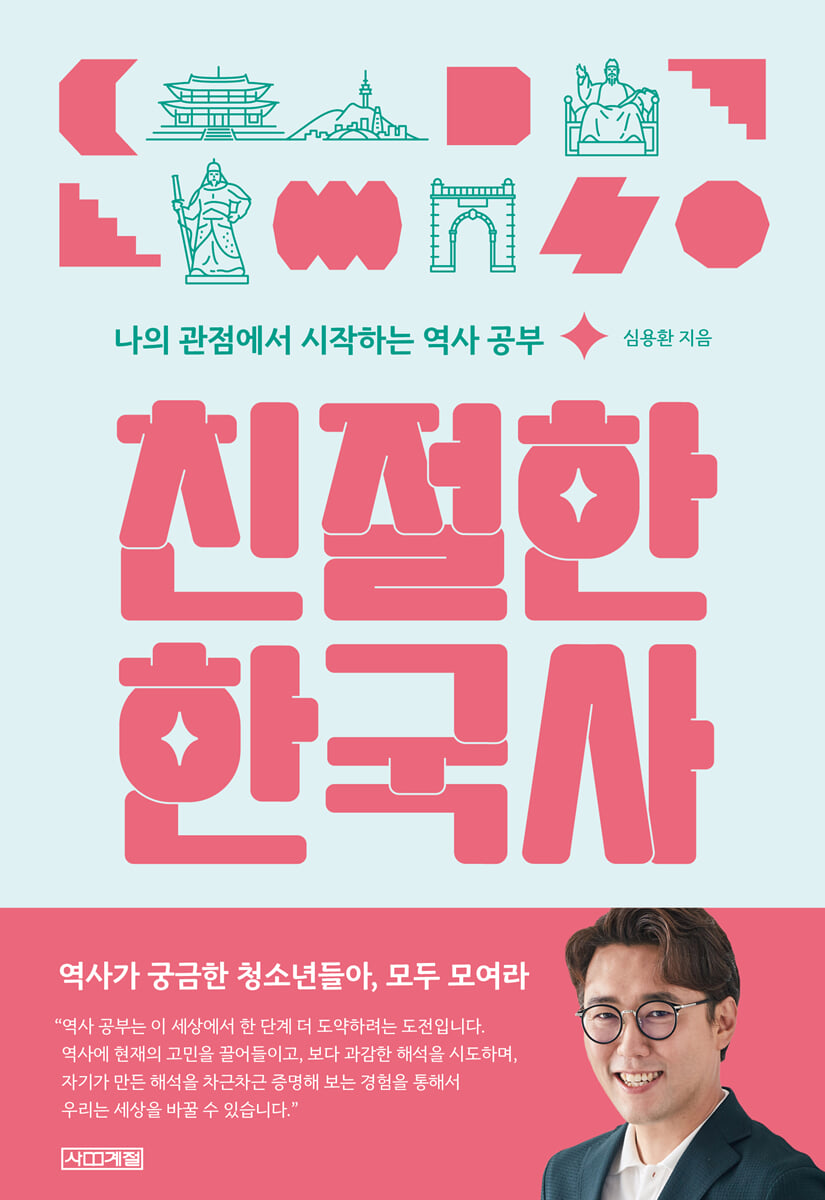
Friendly Korean History
 |
Description
Book Introduction
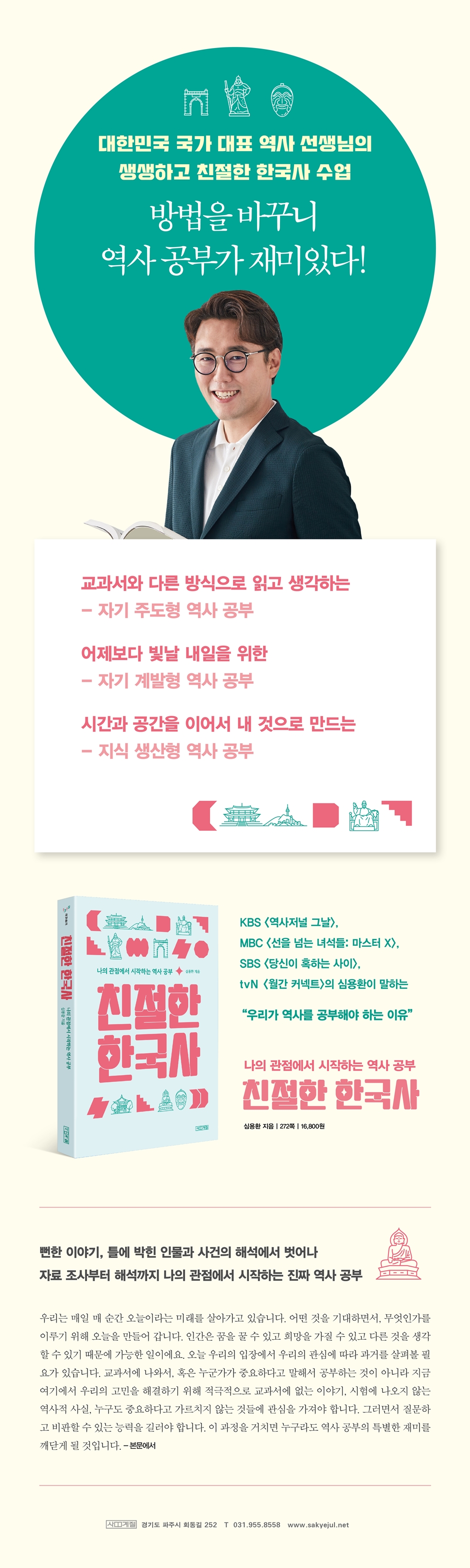
Representative history teacher of the Republic of Korea,
KBS [History Journal That Day], MBC [Guys Who Cross the Line: Master X], SBS [While You Were Seducing Me],
A lively and friendly Korean history lesson from Sim Yong-hwan of tvN's [Monthly Connect].
Whether learning about our country's history in school or studying the history of other regions, the sheer volume of time and the vast number of people and events contained within the thick book often leaves us breathless.
‘When will I ever memorize all this…’ History became a tiresome subject that required a lot of study, even though it was less important than Korean, English, or math. It became a subject that I regretted studying more only when I occasionally heard the saying, “A nation that forgets its history has no future.”
But how great would it be if we could understand history without having to memorize timelines?
History is a very useful tool for living in the present.
I just forgot about that fact for a moment because I was so busy with my schoolwork.
Shim Yong-hwan, who has been struggling to solve current problems through historical imagination through broadcasting, publishing, lectures, and YouTube, has now transformed into a Korean history teacher for teenagers.
In his new book, “Friendly Korean History,” he proposes transforming the boring study of history into an active and experimental approach.
Breaking away from the clichés and stereotypical characters and events, studying history from my own perspective, from research to interpretation, will reawaken a special sense of history we've forgotten.
That doesn't mean you need to sharpen your gaze or sharpen your senses.
Slowly, again, we prepared a friendly Korean history class where we can study history together.
Let's relax and follow the kind teacher Sim Yong-hwan.
KBS [History Journal That Day], MBC [Guys Who Cross the Line: Master X], SBS [While You Were Seducing Me],
A lively and friendly Korean history lesson from Sim Yong-hwan of tvN's [Monthly Connect].
Whether learning about our country's history in school or studying the history of other regions, the sheer volume of time and the vast number of people and events contained within the thick book often leaves us breathless.
‘When will I ever memorize all this…’ History became a tiresome subject that required a lot of study, even though it was less important than Korean, English, or math. It became a subject that I regretted studying more only when I occasionally heard the saying, “A nation that forgets its history has no future.”
But how great would it be if we could understand history without having to memorize timelines?
History is a very useful tool for living in the present.
I just forgot about that fact for a moment because I was so busy with my schoolwork.
Shim Yong-hwan, who has been struggling to solve current problems through historical imagination through broadcasting, publishing, lectures, and YouTube, has now transformed into a Korean history teacher for teenagers.
In his new book, “Friendly Korean History,” he proposes transforming the boring study of history into an active and experimental approach.
Breaking away from the clichés and stereotypical characters and events, studying history from my own perspective, from research to interpretation, will reawaken a special sense of history we've forgotten.
That doesn't mean you need to sharpen your gaze or sharpen your senses.
Slowly, again, we prepared a friendly Korean history class where we can study history together.
Let's relax and follow the kind teacher Sim Yong-hwan.
- You can preview some of the book's contents.
Preview
index
Introduction · 4
Chapter 1 There is another story within the story!
1-1 Why did King Sejong create Hangul?
→ Why Interpretation Matters in History · 12
Yi Sun-sin's inner thoughts as recorded in the 1-2 diary
→ Stories you can only hear when you look deeply · 24
1-3 Was Goryeo really a society where men and women were equal?
→ Interpretation can change at any time · 36
1-4 There are pro-Japanese graves in the National Cemetery?
→ The process of finding a better idea, not the right answer · 48
1-5 Samilcheonha Kim Ok-gyun
→ What role do individuals play in history? · 60
1-6 Shin Chae-ho is so complicated
→ The Zeitgeist Reflected in One Life · 70
1-7 Genealogy of the Hague Special Envoy
→ There is no story that has ended in history · 83
Chapter 2: Reading and Writing History Today
2-1 Is it the March 1st Movement or the March 1st Revolution?
→ The Meaning of the Word Revolution · 96
2-2 What happened at Namhansanseong in 1637
→ Escaping the Trap of Dualism · 109
2-3 The Demise of the Joseon Dynasty College Entrance Exam
→ A historical exploration to find precedents for the problem · 120
2-4 Reading Natural Disasters and Epidemics in History
→ New interests create new perspectives · 131
2-5 The Birth of a Nurse
→ A story so obvious it was invisible · 141
2-6 The Liberation Army is not the exclusive domain of men!
→ Stories of Women in the Independence Movement · 151
2-7 There is a woman here
→ History of the Women's Rights Struggle · 160
2-8 Remembering Gwangju in May 1980
→ History Slowly Rewritten Over Time · 171
2-9 The Republic of Korea is a democratic republic.
→ History of the Constitution · 181
Chapter 3: Enjoying My Cultural Heritage
3-1 What I learned in Croatia
→ Time cannot be created · 194
3-2 Since when have people started making songpyeon for Chuseok?
→ Every lifestyle has a reason · 207
3-3 I'll cut the rice cake, you write.
→ Cultural History of Food · 217
3-4 What is a national flag?
→ A History of Symbols Seen Through the Taegeukgi · 227
3-5 The Taste and Style of 18th Century Joseon Intellectuals
→ The World of Customs and Life History · 238
3-6 Do you know Seoul?
→ History of Space · 248
3-7 Now is the era of world heritage
→ Let's erase the illusion that ours is the best · 260
Chapter 1 There is another story within the story!
1-1 Why did King Sejong create Hangul?
→ Why Interpretation Matters in History · 12
Yi Sun-sin's inner thoughts as recorded in the 1-2 diary
→ Stories you can only hear when you look deeply · 24
1-3 Was Goryeo really a society where men and women were equal?
→ Interpretation can change at any time · 36
1-4 There are pro-Japanese graves in the National Cemetery?
→ The process of finding a better idea, not the right answer · 48
1-5 Samilcheonha Kim Ok-gyun
→ What role do individuals play in history? · 60
1-6 Shin Chae-ho is so complicated
→ The Zeitgeist Reflected in One Life · 70
1-7 Genealogy of the Hague Special Envoy
→ There is no story that has ended in history · 83
Chapter 2: Reading and Writing History Today
2-1 Is it the March 1st Movement or the March 1st Revolution?
→ The Meaning of the Word Revolution · 96
2-2 What happened at Namhansanseong in 1637
→ Escaping the Trap of Dualism · 109
2-3 The Demise of the Joseon Dynasty College Entrance Exam
→ A historical exploration to find precedents for the problem · 120
2-4 Reading Natural Disasters and Epidemics in History
→ New interests create new perspectives · 131
2-5 The Birth of a Nurse
→ A story so obvious it was invisible · 141
2-6 The Liberation Army is not the exclusive domain of men!
→ Stories of Women in the Independence Movement · 151
2-7 There is a woman here
→ History of the Women's Rights Struggle · 160
2-8 Remembering Gwangju in May 1980
→ History Slowly Rewritten Over Time · 171
2-9 The Republic of Korea is a democratic republic.
→ History of the Constitution · 181
Chapter 3: Enjoying My Cultural Heritage
3-1 What I learned in Croatia
→ Time cannot be created · 194
3-2 Since when have people started making songpyeon for Chuseok?
→ Every lifestyle has a reason · 207
3-3 I'll cut the rice cake, you write.
→ Cultural History of Food · 217
3-4 What is a national flag?
→ A History of Symbols Seen Through the Taegeukgi · 227
3-5 The Taste and Style of 18th Century Joseon Intellectuals
→ The World of Customs and Life History · 238
3-6 Do you know Seoul?
→ History of Space · 248
3-7 Now is the era of world heritage
→ Let's erase the illusion that ours is the best · 260
Detailed image
Into the book
Sometimes people say that studying history is useless, saying, “What’s the point of looking back on the past?”
That's because the world is changing faster and faster.
Today, we must address issues that were unthinkable in the past: environmental and ecological destruction, globalization and neoliberalism, and gender conflict.
However, those who criticize the usefulness of history say that studying history cannot be an alternative because today is a completely different era and world from yesterday.
But I don't think so.
The reason we look back on the path humanity has taken is to overcome today's chaos and foster future development.
Studying history is a challenge to take a leap forward in this world.
--- p.5
The history textbooks we studied in school contain the most recognized interpretations of history.
So, can we truly understand history by simply reading textbooks? Is memorizing the material enough? No.
We need to practice expanding our thinking and finding better conclusions based on the knowledge we learn from textbooks.
Going beyond textbook knowledge to explore new knowledge and develop new ideas—that is the true study of history.
--- p.10
If you read 『Nanjung Ilgi』 carefully, you can get a glimpse of Yi Sun-sin's self-consciousness.
I am not talking about someone's thoughts about Yi Sun-sin, but about Yi Sun-sin himself as a person.
What I mean is that, rather than the image of a hero created by the public's expectations, which have been formed and accumulated over a long period of time, we can discover the deeply subjective, intimate consciousness of a human being who faced the circumstances of the time and struggled to find answers.
If we change the way we understand Yi Sun-sin in this way, we will reach a conclusion that is different from conventional wisdom.
--- p.33~34
Reading an individual in history is not simply a matter of sharply criticizing his life.
I believe this should be a process of training my thoughts and reflections in preparation for my historical choices.
What good is it for us to discuss a life that someone has lived with all their might, but which has only limitations?
But we too live through history and have moments in it where we have to make decisions.
Kim Ok-gyun's life advises us on what choices we should make at that very moment.
Because we today, like Kim Ok-gyun of the past, are beings who live through history.
--- p.69
The word revolution does not always have a positive meaning.
Revolutions, such as the French Revolution, the Russian Revolution, the Civil Revolution, and the Industrial Revolution, are usually great events that create turning points in history.
However, revolutions bring about rapid social change and are followed by enormous social shock and chaos.
The civil and industrial revolutions changed human history.
Because the caste system and class system disappeared and capitalism emerged.
However, during the revolution, many people died and many countries fell into serious chaos.
French nobles raised troops and attacked the revolutionary army, calling for counter-revolution, while radical revolutionaries such as Robespierre implemented a reign of terror to prevent counter-revolution, sending countless people to the guillotine.
The Industrial Revolution brought about labor problems.
Twelve-year-old children were forced to work in coal mines, and infant mortality rates among workers' families soared to 97 percent.
--- p.102
The history of nursing in our country is closely related to the history of the independence movement.
In fact, the history of women in our country has a strong tendency to be connected to the independence movement in all fields.
In Europe, women created their identity by demanding suffrage, that is, political rights, while we could say that we created our identity through the national salvation movement.
Women have realized that they will face the problems of the times and dedicate themselves to the nation.
As a result, awareness of themselves as women and national consciousness sprouted together, and female nurses are pioneering figures from the perspective of women's history.
--- p.147
A constitution is a document that encapsulates the direction of a country.
(…) The Constitution of the Republic of Korea is modeled after modern constitutions developed in the West.
In addition, the Constitution succeeded the Provisional Charter of the Republic of Korea, which was created by the Provisional Government of the Republic of Korea in 1919.
Article 1, Paragraph 1 of the Constitution, which states, “The Republic of Korea shall be a democratic republic,” is a direct translation of Article 1 of the Provisional Charter, and has never been changed even during the nine amendments to the Constitution.
It can be seen that the ideals of a democratic republic were not abandoned, but rather inherited and developed, even while going through great historical changes.
Furthermore, the provisional government announced the Republic of Korea's founding principles in 1941, declaring strong social reforms such as land reform, which were also fully reflected in the Constitution.
--- p.182
Currently, the Independence Gate stands under the Seodaemun overpass, measuring 14.28 meters high and 11.48 meters wide.
This building was built in 1896 by the Independence Association led by Seo Jae-pil and others. There is a Taegeukgi on both sides of the signboard with the name engraved on it.
As the invasion of Western powers intensified, those who wanted to protect Joseon's sovereignty at all costs utilized the Taegeukgi.
The anguish of intellectuals in the late 19th century, who sought to create a modern nation while protecting national sovereignty, was expressed in the Taegeukgi.
In 1897, Gojong established Wongudan and declared himself emperor, changing the national title to the Korean Empire.
Records from that time show that the Taegeukgi, celebrating the emperor's ascension to the throne, waved throughout the capital.
This is where the meaning of the Taegeukgi becomes complicated.
That's because the world is changing faster and faster.
Today, we must address issues that were unthinkable in the past: environmental and ecological destruction, globalization and neoliberalism, and gender conflict.
However, those who criticize the usefulness of history say that studying history cannot be an alternative because today is a completely different era and world from yesterday.
But I don't think so.
The reason we look back on the path humanity has taken is to overcome today's chaos and foster future development.
Studying history is a challenge to take a leap forward in this world.
--- p.5
The history textbooks we studied in school contain the most recognized interpretations of history.
So, can we truly understand history by simply reading textbooks? Is memorizing the material enough? No.
We need to practice expanding our thinking and finding better conclusions based on the knowledge we learn from textbooks.
Going beyond textbook knowledge to explore new knowledge and develop new ideas—that is the true study of history.
--- p.10
If you read 『Nanjung Ilgi』 carefully, you can get a glimpse of Yi Sun-sin's self-consciousness.
I am not talking about someone's thoughts about Yi Sun-sin, but about Yi Sun-sin himself as a person.
What I mean is that, rather than the image of a hero created by the public's expectations, which have been formed and accumulated over a long period of time, we can discover the deeply subjective, intimate consciousness of a human being who faced the circumstances of the time and struggled to find answers.
If we change the way we understand Yi Sun-sin in this way, we will reach a conclusion that is different from conventional wisdom.
--- p.33~34
Reading an individual in history is not simply a matter of sharply criticizing his life.
I believe this should be a process of training my thoughts and reflections in preparation for my historical choices.
What good is it for us to discuss a life that someone has lived with all their might, but which has only limitations?
But we too live through history and have moments in it where we have to make decisions.
Kim Ok-gyun's life advises us on what choices we should make at that very moment.
Because we today, like Kim Ok-gyun of the past, are beings who live through history.
--- p.69
The word revolution does not always have a positive meaning.
Revolutions, such as the French Revolution, the Russian Revolution, the Civil Revolution, and the Industrial Revolution, are usually great events that create turning points in history.
However, revolutions bring about rapid social change and are followed by enormous social shock and chaos.
The civil and industrial revolutions changed human history.
Because the caste system and class system disappeared and capitalism emerged.
However, during the revolution, many people died and many countries fell into serious chaos.
French nobles raised troops and attacked the revolutionary army, calling for counter-revolution, while radical revolutionaries such as Robespierre implemented a reign of terror to prevent counter-revolution, sending countless people to the guillotine.
The Industrial Revolution brought about labor problems.
Twelve-year-old children were forced to work in coal mines, and infant mortality rates among workers' families soared to 97 percent.
--- p.102
The history of nursing in our country is closely related to the history of the independence movement.
In fact, the history of women in our country has a strong tendency to be connected to the independence movement in all fields.
In Europe, women created their identity by demanding suffrage, that is, political rights, while we could say that we created our identity through the national salvation movement.
Women have realized that they will face the problems of the times and dedicate themselves to the nation.
As a result, awareness of themselves as women and national consciousness sprouted together, and female nurses are pioneering figures from the perspective of women's history.
--- p.147
A constitution is a document that encapsulates the direction of a country.
(…) The Constitution of the Republic of Korea is modeled after modern constitutions developed in the West.
In addition, the Constitution succeeded the Provisional Charter of the Republic of Korea, which was created by the Provisional Government of the Republic of Korea in 1919.
Article 1, Paragraph 1 of the Constitution, which states, “The Republic of Korea shall be a democratic republic,” is a direct translation of Article 1 of the Provisional Charter, and has never been changed even during the nine amendments to the Constitution.
It can be seen that the ideals of a democratic republic were not abandoned, but rather inherited and developed, even while going through great historical changes.
Furthermore, the provisional government announced the Republic of Korea's founding principles in 1941, declaring strong social reforms such as land reform, which were also fully reflected in the Constitution.
--- p.182
Currently, the Independence Gate stands under the Seodaemun overpass, measuring 14.28 meters high and 11.48 meters wide.
This building was built in 1896 by the Independence Association led by Seo Jae-pil and others. There is a Taegeukgi on both sides of the signboard with the name engraved on it.
As the invasion of Western powers intensified, those who wanted to protect Joseon's sovereignty at all costs utilized the Taegeukgi.
The anguish of intellectuals in the late 19th century, who sought to create a modern nation while protecting national sovereignty, was expressed in the Taegeukgi.
In 1897, Gojong established Wongudan and declared himself emperor, changing the national title to the Korean Empire.
Records from that time show that the Taegeukgi, celebrating the emperor's ascension to the throne, waved throughout the capital.
This is where the meaning of the Taegeukgi becomes complicated.
--- p.231
Publisher's Review
“Studying history is a challenge to take a leap forward in this world.
“We can change the world by incorporating current concerns into history, attempting bolder interpretations, and gradually proving our own interpretations.”
Studying history becomes more fun when you change your approach.
Reorganizing, understanding, and imagining history from my perspective
History, it takes a long time to learn.
From elementary school social studies classes to middle school history classes and high school Korean history and integrated social studies classes, we read and listen to history for hundreds of hours in total.
So what was the result?
“Isn’t history a subject that you can do well on tests if you just memorize it?”
“I learned it in school, but I don’t really know it.”
“I never really studied history because I didn’t have enough time for English and math.”
Before we can say that history is a great tool to help us live in the present, there is something urgent that needs to be done first.
Studying history should be made easier.
It should be easy yet useful.
With these two goals in mind, Sim Yong-hwan wrote a new book, “Friendly Korean History,” for teenagers.
The first thing to do to reduce the burden of studying history is to not confine history to a syntactic structure and a single interpretation.
Shim Yong-hwan says that rather than focusing on the flow of time and explanations in textbooks or history books, we should “be interested in stories that aren’t in textbooks, historical facts that don’t appear on tests, and things that no one teaches are important,” and “develop the ability to question and criticize.”
Let's not be stingy with our imagination about history.
Depending on the assumptions made, the approach and interpretation of the results will differ.
And the real power of studying history lies in selecting the best ideas from among the different results that come from different perspectives.
Re-organizing, understanding, and imagining history from my perspective.
This is the secret to studying history that Sim Yong-hwan proposes in this book.
First, let's change the way we study and find something fun.
Then the meaning will follow one after another.
Interpretation can change at any time,
Studying history isn't about finding definitive answers, but rather finding better interpretations.
Chapter 1 of the book re-examines Korean history, which had been presented in a linear fashion on a chronological table, in a deeper and broader way.
Even the history that Sim Yong-hwan shows again has multiple sides at the same time, like a dice.
In 『Nanjung Ilgi』, we can see not only Yi Sun-sin's brilliant military exploits but also his complex inner thoughts, and if we expand the aftermath of the Imjin War, in which Joseon and Ming China in East Asia fought an all-out war against Japan, into the context of world history, we can see a different side of history than the 'common sense that I learned and thought was history'.
The story of Lee Jun, Lee Sang-seol, and Lee Wi-jong does not end in The Hague, but continues with new events and characters.
I thought it was the end of my role as a special envoy, but as a new story was created, the foundation for the independence movement that would unfold later was formed.
The history of the independence movement continues like a butterfly effect, with the Hague envoy, Dr. Lee Jae-myung's assassination of Lee Wan-yong, Dr. Jang In-hwan and Dr. Jeon Myeong-un's assassination of Stevens, and Dr. Ahn Jung-geun's assassination of Ito Hirobumi.
And this trend became the most important foundation for the independence movement after the Japan-Korea annexation.
Beyond King Gojong's intentions, the will and determination of countless people continued to write history.
_Page 92, “The Genealogy of the Hague Envoys - There is no story that has ended in history.”
The story of the Hague Special Envoy, who was dispatched to The Hague by order of Emperor Gojong to protest the Japan-Korea Treaty of 1905, but failed to achieve their goal, does not actually end in The Hague, but continues through England to the United States, and then to Manchuria and the Maritime Province, and finally reaches Ahn Jung-geun's assassination of Ito Hirobumi in 1909.
This is a clearly different way of studying history than simply memorizing the order of '1905 Eulsa Treaty - 1907 dispatch of special envoy to The Hague, martyrdom of Lee Jun - 1909 Ahn Jung-geun assassination of Ito Hirobumi at Harbin Station'.
In it, we must reconsider how we, now, view and judge the preceding events from what perspective.
Finding what we need now
Reading and Writing History Today
Chapter 2 actively attempts to tie the knot between the past and the present.
He argues that history can help us find precedents for the problems we face, understand the way we live now, and even map out the blueprints for the future.
In fact, this is not a completely new or special claim.
The usefulness of history, one of the oldest disciplines in human history, has always been here.
However, Sim Yong-hwan has moved the stage of history to the present, showing that problems in Korean society today, such as overheated nationalism, excessive educational fervor, and unprecedented infectious diseases, can be solved by studying historical precedents and seeking solutions.
With the full-scale introduction of modern Western medicine in the late Joseon Dynasty, concrete efforts to overcome infectious diseases began to develop.
In 1888, Park Yeong-hyo, who was in exile in Japan, presented the “Proclamation of Enlightenment” to Emperor Gojong, arguing that both humans and livestock should be protected from zoonotic diseases through smallpox vaccination.
It also emphasizes the need to establish regulations for the disposal and removal of waste such as manure, dust, and rags, to benefit health and agriculture.
Now, epidemics are no longer considered to be a colossal disaster beyond human control or a harsh divine punishment, but rather diseases that can be prevented and treated, and problems that must be addressed through the state's administrative systems.
_Pages 138-139, from “Reading Natural Disasters and Epidemics in History - New Interests Create New Perspectives”
In this way, the study of history becomes the foundation of civic education that broadens one's understanding of modern society as a whole, including the constitution, democracy, national institutions, labor issues, and women's rights.
I simply took the time that was inside the textbook and took it outside the textbook to reflect on the present, and it became the story of my life today.
Let's connect time and space at a glance.
As if I were studying history for the first time
“History is the story of people living through time.
The final chapter, which begins with the words, “And humanity lives in a space called Earth,” expands the reach of history’s magnetic field to space.
The author informs us that records of the past are not only passed down through words and writing, but also through traces left in space. In this case, space does not only refer to historical sites such as Gyeongbokgung Palace or Bulguksa Temple.
The space that Sim Yong-hwan speaks of is a concept that includes not only cultural assets but also the customs and culture that remain in each region and locality.
The moment you recognize the history of a space by asking questions like where the "Paradise Rice Cake Shop" in every neighborhood came from, or why there is an Independence Movement Memorial Park next to Hyochang Stadium in Yongsan, Seoul, your study of history is sucked into a deeper level.
Japanese people lived mainly in the south of Cheonggyecheon, around Namchon, Myeongdong, and Euljiro.
For generations, the Joseon yangban class lived in Bukchon and enjoyed their power, while commoners lived in the Cheonggyecheon area and Namchon. However, during the Enlightenment Period, a large number of foreign merchants, including Japanese, flocked to Namchon, and the status of Namchon began to overwhelm that of Bukchon.
And soon after, the important commercial district expanded to the Namdaemun area.
It's not far from Seoul Station.
When you get off at Seoul Station, the road in front of you passes Namdaemun Market and leads to Myeongdong and Euljiro.
The opposite direction leads to Jongno or Seodaemun.
Anyone who arrives at Seoul Station by train can go anywhere in Seoul.
The combination of ships, railways, and roads made it possible to transport people and goods anywhere.
_Page 251, from “Do You Know Seoul? - History of Space”
People, events, accidents, phenomena, and changes from the distant past... Let's not allow all that content to remain limited to a single interpretation, limited to the answers in textbooks.
You can roll it like a dice and look at each side, find the story you need and eat it like ice cream, and change the commands and result values countless times like coding.
What is important is ‘my interpretation’ and ‘the explanation that serves as the basis for my life.’
From now on, let's begin studying history, which starts from me, continues on, and returns to me again.
As if you were studying history for the first time, have fun!
“We can change the world by incorporating current concerns into history, attempting bolder interpretations, and gradually proving our own interpretations.”
Studying history becomes more fun when you change your approach.
Reorganizing, understanding, and imagining history from my perspective
History, it takes a long time to learn.
From elementary school social studies classes to middle school history classes and high school Korean history and integrated social studies classes, we read and listen to history for hundreds of hours in total.
So what was the result?
“Isn’t history a subject that you can do well on tests if you just memorize it?”
“I learned it in school, but I don’t really know it.”
“I never really studied history because I didn’t have enough time for English and math.”
Before we can say that history is a great tool to help us live in the present, there is something urgent that needs to be done first.
Studying history should be made easier.
It should be easy yet useful.
With these two goals in mind, Sim Yong-hwan wrote a new book, “Friendly Korean History,” for teenagers.
The first thing to do to reduce the burden of studying history is to not confine history to a syntactic structure and a single interpretation.
Shim Yong-hwan says that rather than focusing on the flow of time and explanations in textbooks or history books, we should “be interested in stories that aren’t in textbooks, historical facts that don’t appear on tests, and things that no one teaches are important,” and “develop the ability to question and criticize.”
Let's not be stingy with our imagination about history.
Depending on the assumptions made, the approach and interpretation of the results will differ.
And the real power of studying history lies in selecting the best ideas from among the different results that come from different perspectives.
Re-organizing, understanding, and imagining history from my perspective.
This is the secret to studying history that Sim Yong-hwan proposes in this book.
First, let's change the way we study and find something fun.
Then the meaning will follow one after another.
Interpretation can change at any time,
Studying history isn't about finding definitive answers, but rather finding better interpretations.
Chapter 1 of the book re-examines Korean history, which had been presented in a linear fashion on a chronological table, in a deeper and broader way.
Even the history that Sim Yong-hwan shows again has multiple sides at the same time, like a dice.
In 『Nanjung Ilgi』, we can see not only Yi Sun-sin's brilliant military exploits but also his complex inner thoughts, and if we expand the aftermath of the Imjin War, in which Joseon and Ming China in East Asia fought an all-out war against Japan, into the context of world history, we can see a different side of history than the 'common sense that I learned and thought was history'.
The story of Lee Jun, Lee Sang-seol, and Lee Wi-jong does not end in The Hague, but continues with new events and characters.
I thought it was the end of my role as a special envoy, but as a new story was created, the foundation for the independence movement that would unfold later was formed.
The history of the independence movement continues like a butterfly effect, with the Hague envoy, Dr. Lee Jae-myung's assassination of Lee Wan-yong, Dr. Jang In-hwan and Dr. Jeon Myeong-un's assassination of Stevens, and Dr. Ahn Jung-geun's assassination of Ito Hirobumi.
And this trend became the most important foundation for the independence movement after the Japan-Korea annexation.
Beyond King Gojong's intentions, the will and determination of countless people continued to write history.
_Page 92, “The Genealogy of the Hague Envoys - There is no story that has ended in history.”
The story of the Hague Special Envoy, who was dispatched to The Hague by order of Emperor Gojong to protest the Japan-Korea Treaty of 1905, but failed to achieve their goal, does not actually end in The Hague, but continues through England to the United States, and then to Manchuria and the Maritime Province, and finally reaches Ahn Jung-geun's assassination of Ito Hirobumi in 1909.
This is a clearly different way of studying history than simply memorizing the order of '1905 Eulsa Treaty - 1907 dispatch of special envoy to The Hague, martyrdom of Lee Jun - 1909 Ahn Jung-geun assassination of Ito Hirobumi at Harbin Station'.
In it, we must reconsider how we, now, view and judge the preceding events from what perspective.
Finding what we need now
Reading and Writing History Today
Chapter 2 actively attempts to tie the knot between the past and the present.
He argues that history can help us find precedents for the problems we face, understand the way we live now, and even map out the blueprints for the future.
In fact, this is not a completely new or special claim.
The usefulness of history, one of the oldest disciplines in human history, has always been here.
However, Sim Yong-hwan has moved the stage of history to the present, showing that problems in Korean society today, such as overheated nationalism, excessive educational fervor, and unprecedented infectious diseases, can be solved by studying historical precedents and seeking solutions.
With the full-scale introduction of modern Western medicine in the late Joseon Dynasty, concrete efforts to overcome infectious diseases began to develop.
In 1888, Park Yeong-hyo, who was in exile in Japan, presented the “Proclamation of Enlightenment” to Emperor Gojong, arguing that both humans and livestock should be protected from zoonotic diseases through smallpox vaccination.
It also emphasizes the need to establish regulations for the disposal and removal of waste such as manure, dust, and rags, to benefit health and agriculture.
Now, epidemics are no longer considered to be a colossal disaster beyond human control or a harsh divine punishment, but rather diseases that can be prevented and treated, and problems that must be addressed through the state's administrative systems.
_Pages 138-139, from “Reading Natural Disasters and Epidemics in History - New Interests Create New Perspectives”
In this way, the study of history becomes the foundation of civic education that broadens one's understanding of modern society as a whole, including the constitution, democracy, national institutions, labor issues, and women's rights.
I simply took the time that was inside the textbook and took it outside the textbook to reflect on the present, and it became the story of my life today.
Let's connect time and space at a glance.
As if I were studying history for the first time
“History is the story of people living through time.
The final chapter, which begins with the words, “And humanity lives in a space called Earth,” expands the reach of history’s magnetic field to space.
The author informs us that records of the past are not only passed down through words and writing, but also through traces left in space. In this case, space does not only refer to historical sites such as Gyeongbokgung Palace or Bulguksa Temple.
The space that Sim Yong-hwan speaks of is a concept that includes not only cultural assets but also the customs and culture that remain in each region and locality.
The moment you recognize the history of a space by asking questions like where the "Paradise Rice Cake Shop" in every neighborhood came from, or why there is an Independence Movement Memorial Park next to Hyochang Stadium in Yongsan, Seoul, your study of history is sucked into a deeper level.
Japanese people lived mainly in the south of Cheonggyecheon, around Namchon, Myeongdong, and Euljiro.
For generations, the Joseon yangban class lived in Bukchon and enjoyed their power, while commoners lived in the Cheonggyecheon area and Namchon. However, during the Enlightenment Period, a large number of foreign merchants, including Japanese, flocked to Namchon, and the status of Namchon began to overwhelm that of Bukchon.
And soon after, the important commercial district expanded to the Namdaemun area.
It's not far from Seoul Station.
When you get off at Seoul Station, the road in front of you passes Namdaemun Market and leads to Myeongdong and Euljiro.
The opposite direction leads to Jongno or Seodaemun.
Anyone who arrives at Seoul Station by train can go anywhere in Seoul.
The combination of ships, railways, and roads made it possible to transport people and goods anywhere.
_Page 251, from “Do You Know Seoul? - History of Space”
People, events, accidents, phenomena, and changes from the distant past... Let's not allow all that content to remain limited to a single interpretation, limited to the answers in textbooks.
You can roll it like a dice and look at each side, find the story you need and eat it like ice cream, and change the commands and result values countless times like coding.
What is important is ‘my interpretation’ and ‘the explanation that serves as the basis for my life.’
From now on, let's begin studying history, which starts from me, continues on, and returns to me again.
As if you were studying history for the first time, have fun!
GOODS SPECIFICS
- Date of issue: May 27, 2022
- Page count, weight, size: 272 pages | 492g | 152*221*17mm
- ISBN13: 9791160949377
- ISBN10: 1160949379
You may also like
카테고리
korean


korean

![GQ KOREA Mark (Monthly): December [2025]](http://librairie.coreenne.fr/cdn/shop/files/8ef265dbbfbf186523ed75ba7319009d.jpg?v=1765340328&width=3840)


