

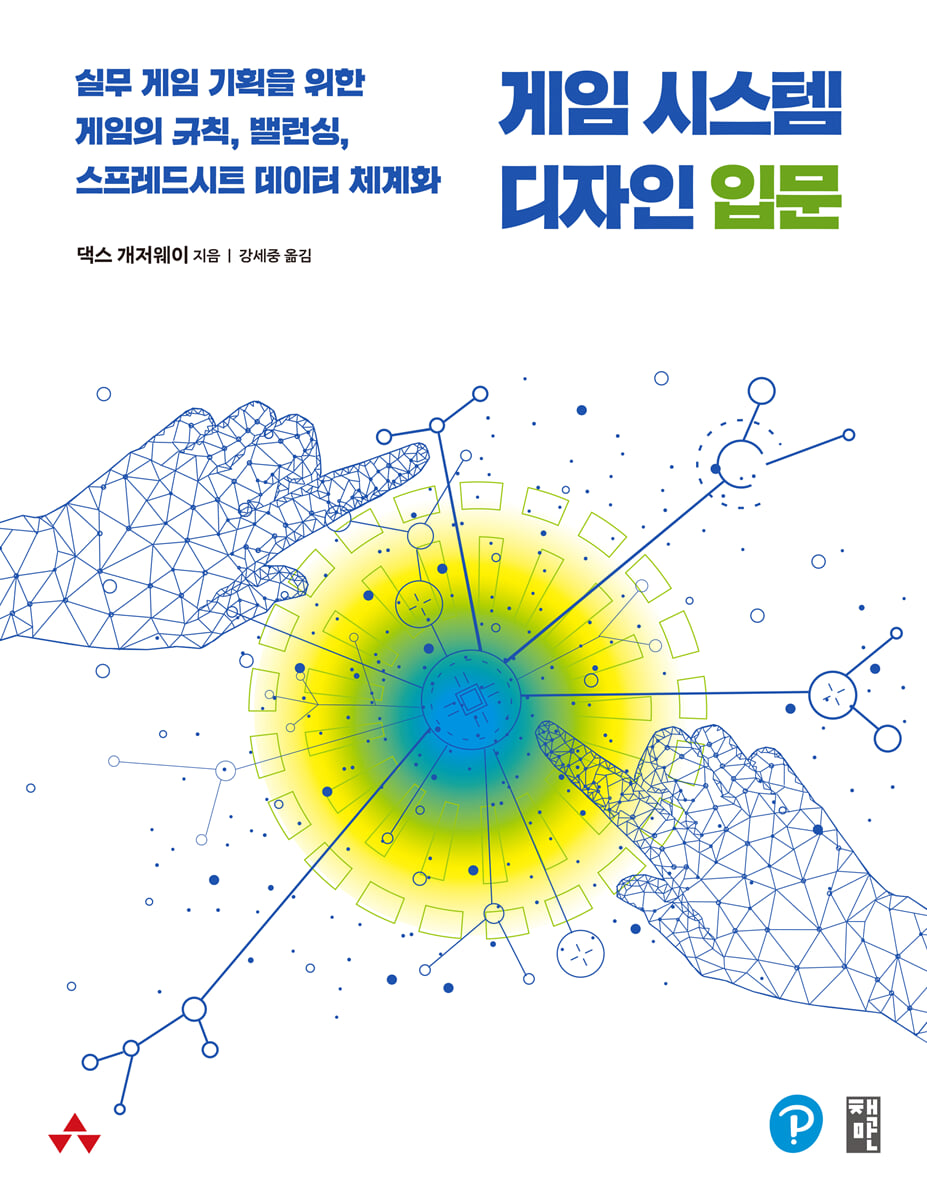
Introduction to Game System Design
 |
Description
Book Introduction
Everything you need to know about game planning for beginner game designers and developers!
The Star Wars game series and Marvel Ultimate Alliance 2, etc.
Decades of producing popular game titles
Practical know-how from game planning professionals, shared by a seasoned lead system designer!
This guide details how to use spreadsheets for game system design, providing a variety of best practices to demonstrate how to easily manage complex game data using spreadsheets.
From systematic game data organization using Google Spreadsheets and MS Excel to game rules, mechanic creation, balancing, testing, and probability calculations, master the fundamentals of practical game system design, the foundation for successful game production!
The Star Wars game series and Marvel Ultimate Alliance 2, etc.
Decades of producing popular game titles
Practical know-how from game planning professionals, shared by a seasoned lead system designer!
This guide details how to use spreadsheets for game system design, providing a variety of best practices to demonstrate how to easily manage complex game data using spreadsheets.
From systematic game data organization using Google Spreadsheets and MS Excel to game rules, mechanic creation, balancing, testing, and probability calculations, master the fundamentals of practical game system design, the foundation for successful game production!
- You can preview some of the book's contents.
Preview
index
Chapter 1 | What is a Game and What is a Player?
Game properties
__Agree on artificial rules
__Players influence the outcome
__You can play games or not.
__Game sessions are finite
__Game rewards have value only within the game.
__After all, it's a game
Game Player Attributes
__age
__gender
__Patience in learning the rules
__Interest in challenges
__Appropriate investment time
__face preference
__competitiveness
__Platform Preference
__Game play skills
__Preferences for genre/art/setting/narrative
Value from players
__Monetary Value: Various Business Models
__Social and cultural values
__Setting target customer values appropriate to the development team's situation
Case Study: Target Customer Profile Analysis by Game
__chess
__〈Gallagher〉
__〈Mario Kart〉
__〈War of Wesnoth〉
__〈Bejeweled〉
__Why Create a Target Customer Profile?
Problems to think about
Chapter 2 | Jobs in the Gaming Industry
Core Management Team
__Visionary
__Lead Engineer
__Lead Artist
__Lead Designer
__Producer
__Lead Sound Designer
Team lower level positions
__Art
__Engineering
__Production
__design
__Sound Team
__QA Team
__Narrative Designer
__Other duties
Problems to think about
Chapter 3 | Questions That Get Good Answers
How to ask logical questions
__Steps of the scientific method
__Define questions for data analysis
How to ask for help
__Why How You Ask Questions Matters
__The process of writing good questions
Problems to think about
Chapter 4 | Software Tools for Game Development
What is data?
Use tools according to your job
__Document Tools
__Image editing tool
__3D modeling tools
__Flowchart tool
__database
__bug tracking software
__game engine
Problems to think about
Chapter 5 | Spreadsheet Basics: An Essential Tool for System Design
Why Use Spreadsheets?
What is a spreadsheet?
Spreadsheet Cells: The Building Blocks of Data
Understanding Cell Structure
__Even complex calculations can be easily done with the formula input line.
__Symbols frequently used in cells
Data storage structure of spreadsheets
__columns and rows
__sheet
__Workbook
How to Get 200% Out of Your Spreadsheets
__Organize data by sheet using separate sheet references
__Keep your sheets clean by hiding data
__If you use a fixed part of the sheet, you don't have to search for the label.
__Leave comments and notes to help your future self.
__Easily fill out simple, repetitive tasks by filling out forms
Let's use __filters to focus on only the data we need now.
Data verification to reduce errors
__Enter the data confirmation dialog box
__The secret hidden in the date confirmation
Prevent incorrect data entry by checking the list of __ items.
__Let's name variables using named scopes.
Problems to think about
Chapter 6 | The Real Power of Spreadsheets: Functions
How to enter arguments
Function structure
Handling tricky functions
Functions that system designers must know
Finding the sum with the __SUM function
Calculating the average with the __AVERAGE function
Finding the median with the __MEDIAN function
Finding the mode with the __MODE function
Finding maximum and minimum values using the __MAX and MIN functions
Ranking with the __RANK function
Counting items with the __COUNT, COUNTA, and COUNTUNIQUE functions
Calculating string length with the __LEN function
Conditional testing with the __IF function
Counting items that meet conditions using the __COUNTIF function
Finding the attribute value of a desired item using the __VLOOKUP function
Finding a specific phrase with the __FIND function
Extracting the middle of text with the __MID function
Measuring time intervals with the __NOW function
Generating random values with the __RAND function
Rounding with the __ROUND function
Specifying a range of random values with the __RANDBETWEEN function
__If you want to learn about other functions too
How to choose the right function
Problems to think about
Chapter 7 | Game Systems that Emulate the Real World
An abstract example of hunting skills
__A throw that allows long-distance hunting
__Swinging a stick is advantageous for close-range hunting
__Running is important in chasing prey
__Cooperation, a characteristic of the human race
__Baseball: A game that combines instinct with mechanics
The story in the game
Problems to think about
Chapter 8 | Idea Generation is Fun
Idea buffet
__Idea Buffet Example
brainstorming session
__Set goals
__Muster the troops
__Secure time
__Don't settle for the first answer
__Avoid criticism
Don't stray too far from the topic
__Capture Creativity
__Keep your expectations reasonable
__Make brainstorming a part of your routine
How to Unleash Your Creativity
__Bad idea storming
__joke
__building blocks
__The past future
__Cascade repetition
__compromise
__opposition
__Random connection
__stream of consciousness
Problems to think about
Chapter 9 | Game Object Properties
Mechanics and Attributes
Let's list the properties
__Initial brainstorming
__Blue Sky Brainstorming
__Attribute Investigation
__Let's take a look at your own personal property bank.
Attribute definitions are tailored to the game.
__Considerations when defining attributes
Attribute grouping
Problems to think about
Chapter 10 | Organizing Data Using Spreadsheets
Spreadsheets are readable by anyone
Avoid numbers as much as possible
Let's label it
Let's use 'Data Verification'
Attributes are in columns, objects are in rows
Visual organization with color coding
No unnecessary columns, rows, or empty cells
Let's separate sheets by data object type.
__Reference Sheet
__Overview Sheet
__Output/Visualization Sheet
__Practice sheet
Example of Spreadsheet Organization
Problems to think about
Chapter 11 | Determining Attribute Values
Understanding the properties
Determining the density of numbers
__Numbers must be linked to probabilities
__When dealing with numbers related to the real world, consider common sense.
__The smaller the number, the easier the calculation becomes.
__Use large numbers when increasing density
__Using numbers that are too large can actually cause confusion.
__Humans hate decimals and fractions, but computers don't care.
Example of inserting __attribute values
Tension trick
Find the right number
Problems to think about
Chapter 12 | Fundamentals of Game System Design
Attribute Weights: The Key to Balancing
How to Balance Intertwined Attributes: A DPS Case Study
Binary Search: Finding Estimates Quickly
__How binary search works
__When there is insufficient scope criteria to apply
Object naming conventions
Naming repeating objects
__The problem with the New label
__Repeated Naming Method 1: Version Number
__Repeated Naming Method 2: Version Letters and Numbers
__Term used in special cases
Estimating the balancing workload using the handshake formula
Problems to think about
Chapter 13 | Three Balancing Principles for Improving Game Perfection
Range balancing
__How range balancing works
__Who controls what?
Data Lever
__What is a lever?
__Making a lever
__Lever Test
__Lock the lever
__Data creation using levers
__Absolutely necessary cross-testing
__Growth lever
Hierarchical design
__Let's set up the hierarchy from the beginning of game production.
__Advantages of hierarchical design
Problems to think about
Chapter 14 | The Exponential Growth Formula
linear growth
exponential growth
__Structure of the basic exponential growth formula
__Components of the Basic Exponential Growth Formula
__Using the basic exponential growth formula
__Note on the number of repetitions
__Exponential chart from a hierarchical design perspective
Problems to think about
Chapter 15 | Game Data Analysis
Overview Analysis
In-depth analysis
Mastering Data Analysis
Comparative Analysis
data canary
Problems to think about
Chapter 16 | Macro System Difficulty Adjustment
Various difficulty adjustment methods
__Flat balancing
__positive feedback loop
__Voice feedback loop
__Dynamic difficulty adjustment
__Multi-layer difficulty adjustment
__Crossfeed
There's no need to stick to just one balancing method.
Problems to think about
Chapter 17 | From Balance Tuning to Testing and Troubleshooting
Game Balance
__Why balance is important
__Methods to check game balance
__Let's mess with the data
Balance issues in contests with judges
__How to start data balancing
Let's do a playtest
__Minimum Viability Test
__Balance Test
__Bug Test
__User Testing
__Beta/Post-Launch Telemetry Testing
Problem solving
__Let's identify the real problem
__Let's remove irrelevant variables
__Provide a solution
__Communication within the team
__Prototype and Testing
__Document changes
Problems to think about
Chapter 18 | Psychological Foundations for Game System Design
Games are a kind of conversation
Linguistic limitations in conveying meaning
noise
reciprocity
Don't cross the line
__shallow relationship
__The right balance
Expectations for reward
Problems to think about
Chapter 19 | He who controls the odds controls the game.
The Basics of Probability
__Probability notation
__1-dimensional uniform distribution probability calculation
__1-dimensional nonuniform distribution probability calculation
__Composite probability calculation
__2D6 Cumulative Probability Calculation
__Calculate the probability of getting a double
__Continuous event calculation
__Calculations in 3 or more dimensions
__Calculating the probability of dependent events
__Calculating the probability of a betrayal event
__Uniform distribution enumeration probability calculation
__Non-uniform distribution enumeration probability calculation
Calculating attribute weights based on __probabilities
__Calculating the probability of incomplete information
__Awareness of probability
__probability uncertainty
Probability survey
__Properties of random events
__Probability Survey Example
Measuring Luck in Games
__Testing if it's a game of pure luck
__Test whether the game is mainly based on luck
__Testing to see if the game is somewhat influenced by luck
__Adjust the influence of luck
__Chaos factor
Problems to think about
Chapter 20 | For Growth
Practice, practice, practice
Analysis of existing games
New gameplay
Modify existing games
Create your own game
Continuous learning
Game properties
__Agree on artificial rules
__Players influence the outcome
__You can play games or not.
__Game sessions are finite
__Game rewards have value only within the game.
__After all, it's a game
Game Player Attributes
__age
__gender
__Patience in learning the rules
__Interest in challenges
__Appropriate investment time
__face preference
__competitiveness
__Platform Preference
__Game play skills
__Preferences for genre/art/setting/narrative
Value from players
__Monetary Value: Various Business Models
__Social and cultural values
__Setting target customer values appropriate to the development team's situation
Case Study: Target Customer Profile Analysis by Game
__chess
__〈Gallagher〉
__〈Mario Kart〉
__〈War of Wesnoth〉
__〈Bejeweled〉
__Why Create a Target Customer Profile?
Problems to think about
Chapter 2 | Jobs in the Gaming Industry
Core Management Team
__Visionary
__Lead Engineer
__Lead Artist
__Lead Designer
__Producer
__Lead Sound Designer
Team lower level positions
__Art
__Engineering
__Production
__design
__Sound Team
__QA Team
__Narrative Designer
__Other duties
Problems to think about
Chapter 3 | Questions That Get Good Answers
How to ask logical questions
__Steps of the scientific method
__Define questions for data analysis
How to ask for help
__Why How You Ask Questions Matters
__The process of writing good questions
Problems to think about
Chapter 4 | Software Tools for Game Development
What is data?
Use tools according to your job
__Document Tools
__Image editing tool
__3D modeling tools
__Flowchart tool
__database
__bug tracking software
__game engine
Problems to think about
Chapter 5 | Spreadsheet Basics: An Essential Tool for System Design
Why Use Spreadsheets?
What is a spreadsheet?
Spreadsheet Cells: The Building Blocks of Data
Understanding Cell Structure
__Even complex calculations can be easily done with the formula input line.
__Symbols frequently used in cells
Data storage structure of spreadsheets
__columns and rows
__sheet
__Workbook
How to Get 200% Out of Your Spreadsheets
__Organize data by sheet using separate sheet references
__Keep your sheets clean by hiding data
__If you use a fixed part of the sheet, you don't have to search for the label.
__Leave comments and notes to help your future self.
__Easily fill out simple, repetitive tasks by filling out forms
Let's use __filters to focus on only the data we need now.
Data verification to reduce errors
__Enter the data confirmation dialog box
__The secret hidden in the date confirmation
Prevent incorrect data entry by checking the list of __ items.
__Let's name variables using named scopes.
Problems to think about
Chapter 6 | The Real Power of Spreadsheets: Functions
How to enter arguments
Function structure
Handling tricky functions
Functions that system designers must know
Finding the sum with the __SUM function
Calculating the average with the __AVERAGE function
Finding the median with the __MEDIAN function
Finding the mode with the __MODE function
Finding maximum and minimum values using the __MAX and MIN functions
Ranking with the __RANK function
Counting items with the __COUNT, COUNTA, and COUNTUNIQUE functions
Calculating string length with the __LEN function
Conditional testing with the __IF function
Counting items that meet conditions using the __COUNTIF function
Finding the attribute value of a desired item using the __VLOOKUP function
Finding a specific phrase with the __FIND function
Extracting the middle of text with the __MID function
Measuring time intervals with the __NOW function
Generating random values with the __RAND function
Rounding with the __ROUND function
Specifying a range of random values with the __RANDBETWEEN function
__If you want to learn about other functions too
How to choose the right function
Problems to think about
Chapter 7 | Game Systems that Emulate the Real World
An abstract example of hunting skills
__A throw that allows long-distance hunting
__Swinging a stick is advantageous for close-range hunting
__Running is important in chasing prey
__Cooperation, a characteristic of the human race
__Baseball: A game that combines instinct with mechanics
The story in the game
Problems to think about
Chapter 8 | Idea Generation is Fun
Idea buffet
__Idea Buffet Example
brainstorming session
__Set goals
__Muster the troops
__Secure time
__Don't settle for the first answer
__Avoid criticism
Don't stray too far from the topic
__Capture Creativity
__Keep your expectations reasonable
__Make brainstorming a part of your routine
How to Unleash Your Creativity
__Bad idea storming
__joke
__building blocks
__The past future
__Cascade repetition
__compromise
__opposition
__Random connection
__stream of consciousness
Problems to think about
Chapter 9 | Game Object Properties
Mechanics and Attributes
Let's list the properties
__Initial brainstorming
__Blue Sky Brainstorming
__Attribute Investigation
__Let's take a look at your own personal property bank.
Attribute definitions are tailored to the game.
__Considerations when defining attributes
Attribute grouping
Problems to think about
Chapter 10 | Organizing Data Using Spreadsheets
Spreadsheets are readable by anyone
Avoid numbers as much as possible
Let's label it
Let's use 'Data Verification'
Attributes are in columns, objects are in rows
Visual organization with color coding
No unnecessary columns, rows, or empty cells
Let's separate sheets by data object type.
__Reference Sheet
__Overview Sheet
__Output/Visualization Sheet
__Practice sheet
Example of Spreadsheet Organization
Problems to think about
Chapter 11 | Determining Attribute Values
Understanding the properties
Determining the density of numbers
__Numbers must be linked to probabilities
__When dealing with numbers related to the real world, consider common sense.
__The smaller the number, the easier the calculation becomes.
__Use large numbers when increasing density
__Using numbers that are too large can actually cause confusion.
__Humans hate decimals and fractions, but computers don't care.
Example of inserting __attribute values
Tension trick
Find the right number
Problems to think about
Chapter 12 | Fundamentals of Game System Design
Attribute Weights: The Key to Balancing
How to Balance Intertwined Attributes: A DPS Case Study
Binary Search: Finding Estimates Quickly
__How binary search works
__When there is insufficient scope criteria to apply
Object naming conventions
Naming repeating objects
__The problem with the New label
__Repeated Naming Method 1: Version Number
__Repeated Naming Method 2: Version Letters and Numbers
__Term used in special cases
Estimating the balancing workload using the handshake formula
Problems to think about
Chapter 13 | Three Balancing Principles for Improving Game Perfection
Range balancing
__How range balancing works
__Who controls what?
Data Lever
__What is a lever?
__Making a lever
__Lever Test
__Lock the lever
__Data creation using levers
__Absolutely necessary cross-testing
__Growth lever
Hierarchical design
__Let's set up the hierarchy from the beginning of game production.
__Advantages of hierarchical design
Problems to think about
Chapter 14 | The Exponential Growth Formula
linear growth
exponential growth
__Structure of the basic exponential growth formula
__Components of the Basic Exponential Growth Formula
__Using the basic exponential growth formula
__Note on the number of repetitions
__Exponential chart from a hierarchical design perspective
Problems to think about
Chapter 15 | Game Data Analysis
Overview Analysis
In-depth analysis
Mastering Data Analysis
Comparative Analysis
data canary
Problems to think about
Chapter 16 | Macro System Difficulty Adjustment
Various difficulty adjustment methods
__Flat balancing
__positive feedback loop
__Voice feedback loop
__Dynamic difficulty adjustment
__Multi-layer difficulty adjustment
__Crossfeed
There's no need to stick to just one balancing method.
Problems to think about
Chapter 17 | From Balance Tuning to Testing and Troubleshooting
Game Balance
__Why balance is important
__Methods to check game balance
__Let's mess with the data
Balance issues in contests with judges
__How to start data balancing
Let's do a playtest
__Minimum Viability Test
__Balance Test
__Bug Test
__User Testing
__Beta/Post-Launch Telemetry Testing
Problem solving
__Let's identify the real problem
__Let's remove irrelevant variables
__Provide a solution
__Communication within the team
__Prototype and Testing
__Document changes
Problems to think about
Chapter 18 | Psychological Foundations for Game System Design
Games are a kind of conversation
Linguistic limitations in conveying meaning
noise
reciprocity
Don't cross the line
__shallow relationship
__The right balance
Expectations for reward
Problems to think about
Chapter 19 | He who controls the odds controls the game.
The Basics of Probability
__Probability notation
__1-dimensional uniform distribution probability calculation
__1-dimensional nonuniform distribution probability calculation
__Composite probability calculation
__2D6 Cumulative Probability Calculation
__Calculate the probability of getting a double
__Continuous event calculation
__Calculations in 3 or more dimensions
__Calculating the probability of dependent events
__Calculating the probability of a betrayal event
__Uniform distribution enumeration probability calculation
__Non-uniform distribution enumeration probability calculation
Calculating attribute weights based on __probabilities
__Calculating the probability of incomplete information
__Awareness of probability
__probability uncertainty
Probability survey
__Properties of random events
__Probability Survey Example
Measuring Luck in Games
__Testing if it's a game of pure luck
__Test whether the game is mainly based on luck
__Testing to see if the game is somewhat influenced by luck
__Adjust the influence of luck
__Chaos factor
Problems to think about
Chapter 20 | For Growth
Practice, practice, practice
Analysis of existing games
New gameplay
Modify existing games
Create your own game
Continuous learning
Detailed image

Publisher's Review
| What this book covers |
ㆍ Game design job groups and fields required for game development
ㆍ The right way to ask questions for better game design
ㆍ The latest game design tools, from flowcharts to game engines
ㆍ How to easily manage complex game data with a spreadsheet
ㆍ How to create new game ideas and realize them with systems and data
ㆍ Extract various aspects of the 'real world' and quantify them as attributes of game data.
ㆍTesting, tuning, and troubleshooting game balance
ㆍ Balancing complex games with a large number of objects
ㆍ Creating a campaign mechanic using exponential growth
ㆍ Balancing work to accurately match the game's difficulty to the target audience
ㆍ Emotional balancing work using communication, psychology, and rewards
ㆍ From the basics of probability to its practical use in games
| Target audience for this book |
This book is primarily intended for aspiring game designers who are new to game system design and want to learn more.
I assumed everyone reading this book already had a basic understanding of mathematics, but beyond that, I assumed readers had learned nothing about game design.
It was therefore created to take someone with a basic high school education from being a complete beginner to a working systems designer.
- Aspiring professional video game system designer
- Game Master/Dungeon Master - A designer who makes video games as a hobby.
- Analog game designer such as TRPG
- Experienced level designers who want to learn more about game system design
- Game programmer/engineer working with game system designers
- Teachers who want to teach students by connecting games and math.
- Producers/Lead Designers who want to better understand game systems
| Structure of this book |
Chapter 1: "What is a Game and What is a Player?"
It defines key terms and clarifies some important topics covered in this book.
Chapter 2 'Jobs in the Game Industry'The game industry has a variety of job titles and sub-job titles, which can be confusing for those new to game design.
This chapter describes common job duties in the industry.
Chapter 3 'Questions that Get Good Answers' Game designers must constantly ask questions and creatively interpret the answers.
This chapter will help you rethink how you ask questions.
Chapter 4 'Software Tools for Game Development'As you may have guessed, the gaming industry is full of computer software tools.
This chapter covers the types of tools you'll use and which tools are most commonly used in each profession.
Chapter 5 'Spreadsheet Basics: An Essential Tool for System Design' Spreadsheets are a tool we encounter in most jobs and are especially useful for game system designers.
This chapter covers the basics of using spreadsheets.
Chapter 6, "The True Power of Spreadsheets: Functions," continues the exploration of the power of spreadsheets, focusing on functions.
Chapter 7 'Game Systems that Imitate the Real World' If you look closely at the mechanisms that make up any game, you will see that they are derived from various aspects of real life, even if they are abstract.
This chapter explains how to use these abstractions to create game components.
Chapter 8: 'Idea Generation is Fun' This chapter will help you develop your creativity, especially when it comes to coming up with new ideas for games.
Chapter 9 'Game Object Properties'One of the very common initial tasks that a system designer performs is creating properties for game objects.
This chapter covers what attributes are and how to get started creating attributes for your game.
Chapter 10 'Organizing Data Using Spreadsheets' Once you start creating properties for your game objects, you need to organize them and eventually analyze them.
The best way to do this is with a spreadsheet.
This chapter covers how to organize your ideas into a useful format.
Chapter 11: Determining Attribute Values
Explains how to quantify attributes numerically.
We also cover the scale of numbers and the type of number density that is best suited for your game.
Chapter 12, "Fundamentals of Game System Design," covers attribute weighting, considerations for entangled attributes, binary search for finding the right number, and naming conventions.
Chapter 13, "Three Balancing Principles for a Complete Game," explains how to turn a small number of data objects into a complete game data set.
Chapter 14: The Exponential Growth Formula Exponential growth is one of the most powerful ways to balance modern games.
This chapter explains why we use this method and describes a formula that can be used to quickly generate a nearly infinite number of exponential growth variations in the game.
Chapter 15 'Game Data Analysis' One important step in understanding the entire game is to place all objects together and evaluate them.
It doesn't matter if you have a small set of 10 objects or tens of thousands of objects.
This chapter covers how to collect data in a spreadsheet and begin basic analysis.
Chapter 16 'Macro System Difficulty Adjustment' Several difficulty adjustment methods can be used to adjust the game's difficulty or to tailor the game to the specific needs of the player.
This chapter provides an overview of several methods and gives examples of how they can be used to properly balance the game in various situations.
Chapter 17: 'From Balance Tuning to Testing and Troubleshooting' Game designers spend most of their time balancing, testing, and troubleshooting, not designing.
This chapter covers how to make this important task easier and more productive.
Chapter 18: 'Psychological Foundations for Game System Design' Games can be delivered to customers in a variety of ways.
Designers must consider how a particular game communicates information to the player.
This chapter covers many aspects of player communication.
Chapter 19: 'He who controls the odds controls the game'Not everything is predictable, whether in real life or in games.
However, some unpredictability is understandable.
This chapter introduces basic methods for calculating and understanding game probabilities.
Chapter 20, "For Growth," the final chapter, offers some directions for further growth in the world of game system design.
[Author's Note]
This book was written so that even beginners without any prior knowledge of the game system can read it from beginning to end.
It was also created as a reference book for experienced system designers to read, picking out only the useful information they need.
The best way to learn this book is to read it through once, work through the spreadsheets at your own pace, and then come back to it when you're ready to build your actual game, gleaning guidance on the complex tasks required to properly implement that game.
This book uses examples and references from various existing games, so it will be helpful to read the book if you have some knowledge of games.
Before reading the rest of this book, it might be helpful to familiarize yourself with the following games by watching online video reviews or finding free web apps and playing them a few times.
Play backgammon, chess, and the Royal Game of Ur.
Pay attention to the types of dice rolls used in these games, the way pieces move, and how each game mechanic interacts with game objects.
Playing Battle for Wesnoth will give you a better understanding of what turn-based games and RPGs are like.
The property-based data objects and game mechanics found in Wesnoth illustrate many of the concepts covered in this book.
Additionally, the game has an active community supporting it, which keeps it well documented and up-to-date.
Play Pac-Man, Galaga, and other classic arcade games, or at least watch video reviews.
This book explains in great detail many of the methods used in working with game systems.
It may seem like I'm only recommending the methods in this book, but that's not necessarily the case.
Game systems designers use endless methods, tricks, and techniques to accomplish their tasks.
In fact, there are so many that they cannot be contained in one book.
This book is designed to serve as a starting point, providing examples of useful methods for any system designer.
After you've finished reading, I encourage you to explore other books, learn more techniques from your peers, and your own personal experiences.
There are as many ways to design a game system as there are system designers, and experimentation will help you find your own style.
[Translator's Note]
This happened on my first day at a mobile game company.
A programmer (who had no title but was effectively a project manager) showed me a battle screen from a fully functional tactical RPG and asked me to 'plan' this game.
After figuring out the project for a few days, I printed out the main and enemy characters, which already had art assets (the word "assets" wasn't used back then), and added background settings and stats before joining the company, and showed them to my team members during a meeting.
After the meeting, I still remember the sparkling look in the eyes of the artist who had drawn all those characters when he cautiously asked, “Can I have this plan?”
Perhaps my eyes would have sparkled that way when I saw the work of my teammates who, on countless projects since, had beautifully transformed my crude design documents into drawings and programs.
If there had been a book like "Introduction to Game System Design" back then, the time wasted trying to find answers by rule of thumb would have been cut by more than half.
While translating this book, I was quite surprised to see that the practical knowledge I had acquired through trial and error, along with the know-how I had considered my own "intuition," were systematically and perfectly organized in a single book.
It's been a long time since good foreign books were introduced to the game industry, which was just starting from scratch, and now there are many excellent domestic books, but there are not many books that teach the 'practices' of game design as specifically as this book.
Even the definition of a game, which is the very essence of the original theory, is written with a focus on the player experience and developers.
I dare say that this book is 'a book that compresses 10 years of know-how from a working game system designer into a one-month training course.'
This book is great for understanding the big picture of game development, as it clearly organizes the various duties and tools of the game development team. It also neatly explains all the knowledge necessary for practical work, from how to find answers by asking appropriate questions and generating ideas, to how to create, analyze, and test data such as attributes, to understanding and calculating probability, interacting with players, and even business models.
And all of this knowledge is woven into one concept: 'balancing.'
Broadly speaking, the job of a game system designer is twofold.
One is to create the rules of the game, or mechanics, and the other is to find the optimal point where those rules become the most fun.
If the former is idea generation, the latter is balance.
Readers who fully grasp the contents of this book will be able to intentionally disrupt the balance to enhance the game's enjoyment, but they will never struggle to find the balance necessary for game progression. Of course, development methodologies have become somewhat established in the game industry.
However, it is not easy for aspiring game developers, let alone already employed game designers, to quickly develop practical skills without a mentor who provides one-on-one guidance.
Meanwhile, even experienced senior game designers have difficulty properly passing on the know-how they have acquired to their juniors or team members.
This book will serve as the perfect medium for passing on the knowledge accumulated by industry veterans to younger generations. While we live in different countries and work in different platforms, I believe the author's heart, embodied in the words, "My greatest wish is to make the next generation's journey easier than my own," is no different from the translator's.
I translated this book in the hope that the heart of the book would be conveyed 100% as is.
We hope that instead of wasting your energy wading through the rough undergrowth, you can devote your full efforts to exploring the world, filled with joy and wonder.
ㆍ Game design job groups and fields required for game development
ㆍ The right way to ask questions for better game design
ㆍ The latest game design tools, from flowcharts to game engines
ㆍ How to easily manage complex game data with a spreadsheet
ㆍ How to create new game ideas and realize them with systems and data
ㆍ Extract various aspects of the 'real world' and quantify them as attributes of game data.
ㆍTesting, tuning, and troubleshooting game balance
ㆍ Balancing complex games with a large number of objects
ㆍ Creating a campaign mechanic using exponential growth
ㆍ Balancing work to accurately match the game's difficulty to the target audience
ㆍ Emotional balancing work using communication, psychology, and rewards
ㆍ From the basics of probability to its practical use in games
| Target audience for this book |
This book is primarily intended for aspiring game designers who are new to game system design and want to learn more.
I assumed everyone reading this book already had a basic understanding of mathematics, but beyond that, I assumed readers had learned nothing about game design.
It was therefore created to take someone with a basic high school education from being a complete beginner to a working systems designer.
- Aspiring professional video game system designer
- Game Master/Dungeon Master - A designer who makes video games as a hobby.
- Analog game designer such as TRPG
- Experienced level designers who want to learn more about game system design
- Game programmer/engineer working with game system designers
- Teachers who want to teach students by connecting games and math.
- Producers/Lead Designers who want to better understand game systems
| Structure of this book |
Chapter 1: "What is a Game and What is a Player?"
It defines key terms and clarifies some important topics covered in this book.
Chapter 2 'Jobs in the Game Industry'The game industry has a variety of job titles and sub-job titles, which can be confusing for those new to game design.
This chapter describes common job duties in the industry.
Chapter 3 'Questions that Get Good Answers' Game designers must constantly ask questions and creatively interpret the answers.
This chapter will help you rethink how you ask questions.
Chapter 4 'Software Tools for Game Development'As you may have guessed, the gaming industry is full of computer software tools.
This chapter covers the types of tools you'll use and which tools are most commonly used in each profession.
Chapter 5 'Spreadsheet Basics: An Essential Tool for System Design' Spreadsheets are a tool we encounter in most jobs and are especially useful for game system designers.
This chapter covers the basics of using spreadsheets.
Chapter 6, "The True Power of Spreadsheets: Functions," continues the exploration of the power of spreadsheets, focusing on functions.
Chapter 7 'Game Systems that Imitate the Real World' If you look closely at the mechanisms that make up any game, you will see that they are derived from various aspects of real life, even if they are abstract.
This chapter explains how to use these abstractions to create game components.
Chapter 8: 'Idea Generation is Fun' This chapter will help you develop your creativity, especially when it comes to coming up with new ideas for games.
Chapter 9 'Game Object Properties'One of the very common initial tasks that a system designer performs is creating properties for game objects.
This chapter covers what attributes are and how to get started creating attributes for your game.
Chapter 10 'Organizing Data Using Spreadsheets' Once you start creating properties for your game objects, you need to organize them and eventually analyze them.
The best way to do this is with a spreadsheet.
This chapter covers how to organize your ideas into a useful format.
Chapter 11: Determining Attribute Values
Explains how to quantify attributes numerically.
We also cover the scale of numbers and the type of number density that is best suited for your game.
Chapter 12, "Fundamentals of Game System Design," covers attribute weighting, considerations for entangled attributes, binary search for finding the right number, and naming conventions.
Chapter 13, "Three Balancing Principles for a Complete Game," explains how to turn a small number of data objects into a complete game data set.
Chapter 14: The Exponential Growth Formula Exponential growth is one of the most powerful ways to balance modern games.
This chapter explains why we use this method and describes a formula that can be used to quickly generate a nearly infinite number of exponential growth variations in the game.
Chapter 15 'Game Data Analysis' One important step in understanding the entire game is to place all objects together and evaluate them.
It doesn't matter if you have a small set of 10 objects or tens of thousands of objects.
This chapter covers how to collect data in a spreadsheet and begin basic analysis.
Chapter 16 'Macro System Difficulty Adjustment' Several difficulty adjustment methods can be used to adjust the game's difficulty or to tailor the game to the specific needs of the player.
This chapter provides an overview of several methods and gives examples of how they can be used to properly balance the game in various situations.
Chapter 17: 'From Balance Tuning to Testing and Troubleshooting' Game designers spend most of their time balancing, testing, and troubleshooting, not designing.
This chapter covers how to make this important task easier and more productive.
Chapter 18: 'Psychological Foundations for Game System Design' Games can be delivered to customers in a variety of ways.
Designers must consider how a particular game communicates information to the player.
This chapter covers many aspects of player communication.
Chapter 19: 'He who controls the odds controls the game'Not everything is predictable, whether in real life or in games.
However, some unpredictability is understandable.
This chapter introduces basic methods for calculating and understanding game probabilities.
Chapter 20, "For Growth," the final chapter, offers some directions for further growth in the world of game system design.
[Author's Note]
This book was written so that even beginners without any prior knowledge of the game system can read it from beginning to end.
It was also created as a reference book for experienced system designers to read, picking out only the useful information they need.
The best way to learn this book is to read it through once, work through the spreadsheets at your own pace, and then come back to it when you're ready to build your actual game, gleaning guidance on the complex tasks required to properly implement that game.
This book uses examples and references from various existing games, so it will be helpful to read the book if you have some knowledge of games.
Before reading the rest of this book, it might be helpful to familiarize yourself with the following games by watching online video reviews or finding free web apps and playing them a few times.
Play backgammon, chess, and the Royal Game of Ur.
Pay attention to the types of dice rolls used in these games, the way pieces move, and how each game mechanic interacts with game objects.
Playing Battle for Wesnoth will give you a better understanding of what turn-based games and RPGs are like.
The property-based data objects and game mechanics found in Wesnoth illustrate many of the concepts covered in this book.
Additionally, the game has an active community supporting it, which keeps it well documented and up-to-date.
Play Pac-Man, Galaga, and other classic arcade games, or at least watch video reviews.
This book explains in great detail many of the methods used in working with game systems.
It may seem like I'm only recommending the methods in this book, but that's not necessarily the case.
Game systems designers use endless methods, tricks, and techniques to accomplish their tasks.
In fact, there are so many that they cannot be contained in one book.
This book is designed to serve as a starting point, providing examples of useful methods for any system designer.
After you've finished reading, I encourage you to explore other books, learn more techniques from your peers, and your own personal experiences.
There are as many ways to design a game system as there are system designers, and experimentation will help you find your own style.
[Translator's Note]
This happened on my first day at a mobile game company.
A programmer (who had no title but was effectively a project manager) showed me a battle screen from a fully functional tactical RPG and asked me to 'plan' this game.
After figuring out the project for a few days, I printed out the main and enemy characters, which already had art assets (the word "assets" wasn't used back then), and added background settings and stats before joining the company, and showed them to my team members during a meeting.
After the meeting, I still remember the sparkling look in the eyes of the artist who had drawn all those characters when he cautiously asked, “Can I have this plan?”
Perhaps my eyes would have sparkled that way when I saw the work of my teammates who, on countless projects since, had beautifully transformed my crude design documents into drawings and programs.
If there had been a book like "Introduction to Game System Design" back then, the time wasted trying to find answers by rule of thumb would have been cut by more than half.
While translating this book, I was quite surprised to see that the practical knowledge I had acquired through trial and error, along with the know-how I had considered my own "intuition," were systematically and perfectly organized in a single book.
It's been a long time since good foreign books were introduced to the game industry, which was just starting from scratch, and now there are many excellent domestic books, but there are not many books that teach the 'practices' of game design as specifically as this book.
Even the definition of a game, which is the very essence of the original theory, is written with a focus on the player experience and developers.
I dare say that this book is 'a book that compresses 10 years of know-how from a working game system designer into a one-month training course.'
This book is great for understanding the big picture of game development, as it clearly organizes the various duties and tools of the game development team. It also neatly explains all the knowledge necessary for practical work, from how to find answers by asking appropriate questions and generating ideas, to how to create, analyze, and test data such as attributes, to understanding and calculating probability, interacting with players, and even business models.
And all of this knowledge is woven into one concept: 'balancing.'
Broadly speaking, the job of a game system designer is twofold.
One is to create the rules of the game, or mechanics, and the other is to find the optimal point where those rules become the most fun.
If the former is idea generation, the latter is balance.
Readers who fully grasp the contents of this book will be able to intentionally disrupt the balance to enhance the game's enjoyment, but they will never struggle to find the balance necessary for game progression. Of course, development methodologies have become somewhat established in the game industry.
However, it is not easy for aspiring game developers, let alone already employed game designers, to quickly develop practical skills without a mentor who provides one-on-one guidance.
Meanwhile, even experienced senior game designers have difficulty properly passing on the know-how they have acquired to their juniors or team members.
This book will serve as the perfect medium for passing on the knowledge accumulated by industry veterans to younger generations. While we live in different countries and work in different platforms, I believe the author's heart, embodied in the words, "My greatest wish is to make the next generation's journey easier than my own," is no different from the translator's.
I translated this book in the hope that the heart of the book would be conveyed 100% as is.
We hope that instead of wasting your energy wading through the rough undergrowth, you can devote your full efforts to exploring the world, filled with joy and wonder.
GOODS SPECIFICS
- Date of issue: March 31, 2023
- Page count, weight, size: 384 pages | 898g | 185*240*22mm
- ISBN13: 9791189909512
- ISBN10: 1189909510
You may also like
카테고리
korean


korean

![GQ KOREA Mark (Monthly): December [2025]](http://librairie.coreenne.fr/cdn/shop/files/8ef265dbbfbf186523ed75ba7319009d.jpg?v=1765340328&width=3840)


