

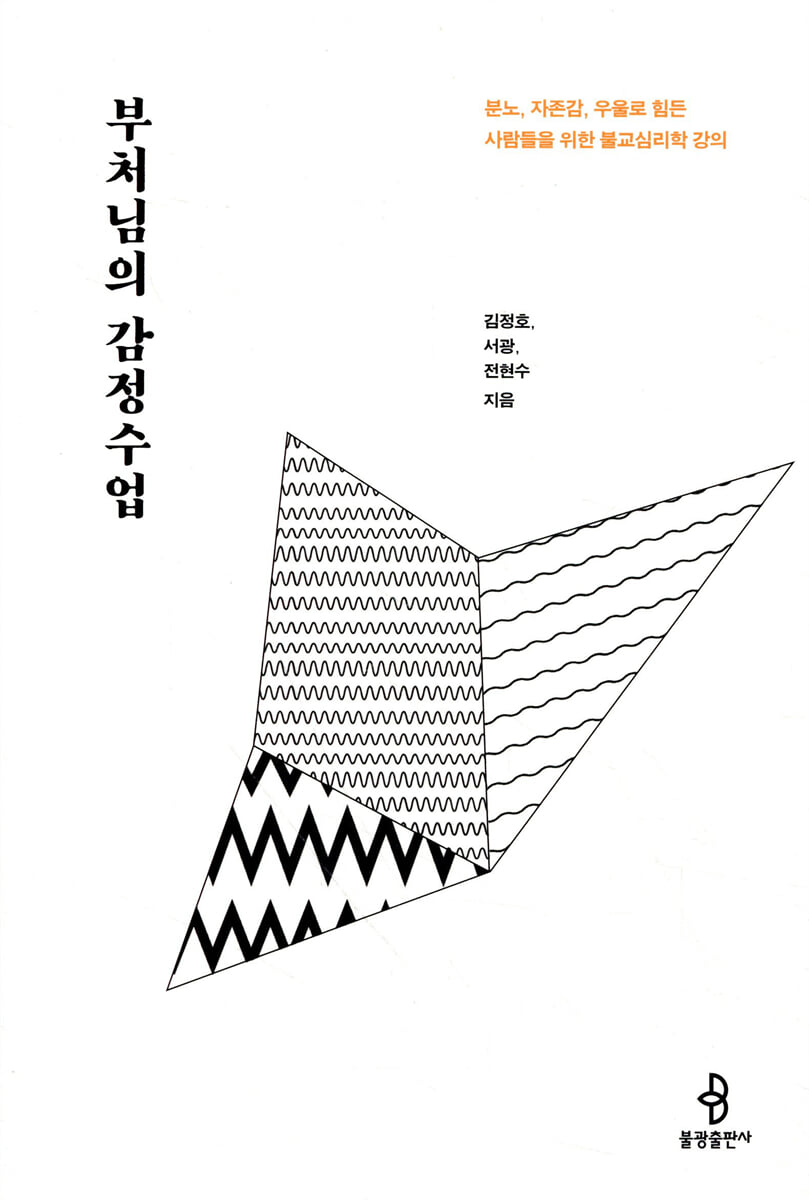
Buddha's Emotional Lessons
 |
Description
Book Introduction
The three emotions that most burden modern people: anger, self-esteem, and depression.
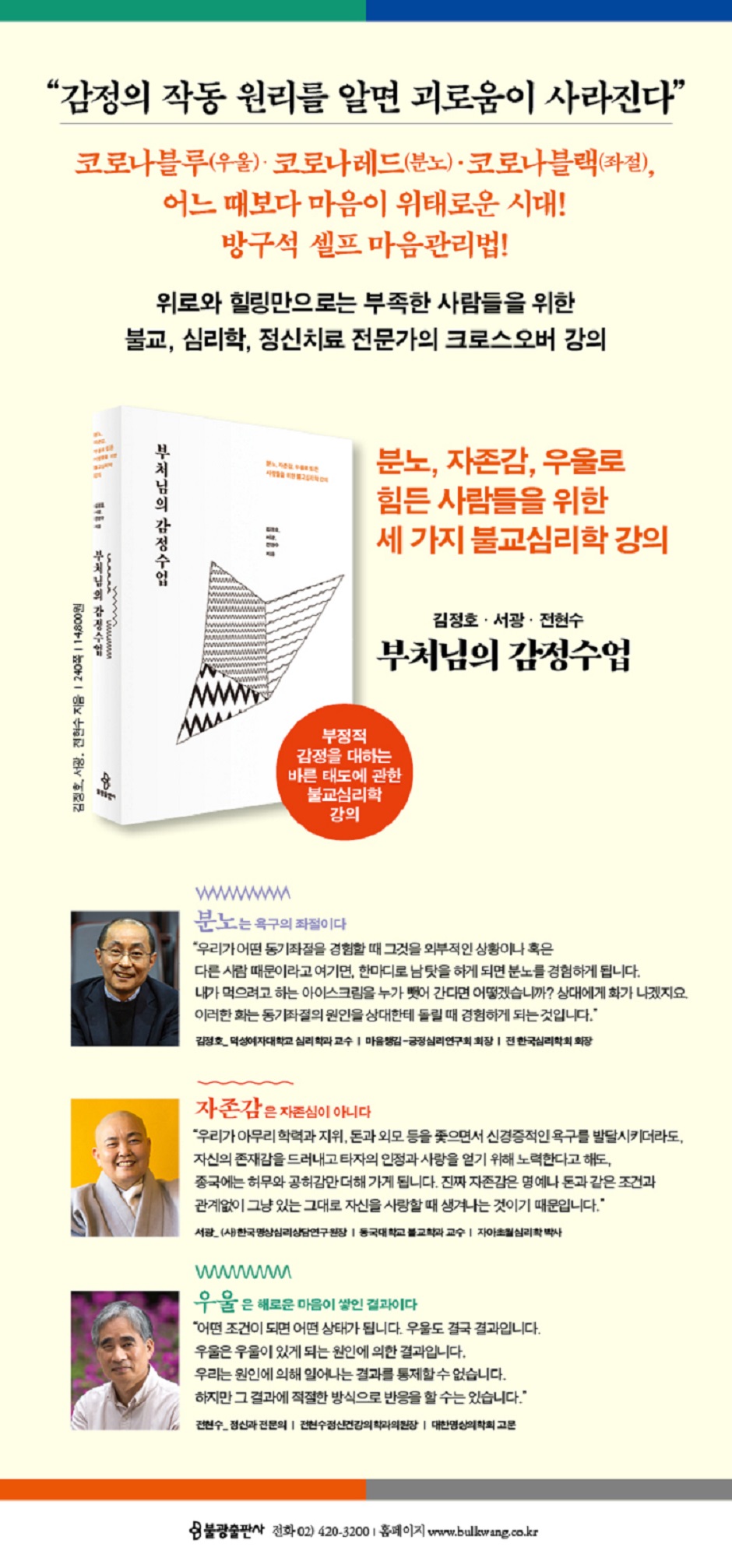
When you understand how emotions work, suffering disappears!
Directly pointing to the human heart (Jikjiinsim) means pointing directly to the human heart.
In other words, it is a Buddhist teaching to not turn one's eyes outward, but to straighten one's mind, to look at it properly, and to understand it.
Most modern people have at least one mental illness, whether it is small or big.
It mainly comes from three things: anger, self-esteem, and depression.
The purpose of Buddhism is to eliminate human suffering.
The beginning is to 'see things as they are', and for this purpose, numerous scriptures and treatises explain in detail the operating principles of the mind (emotions).
These Buddhist teachings are actively applied today in the fields of psychology and psychotherapy, as well as scientific research.
This book is based on the most popular lecture of all time, “Buddha’s Emotional Lessons,” from the 12th [Buddha Big Questions] lecture series that began in 2016.
Psychologist Professor Kim Jeong-ho, Monk Seo Gwang, and psychiatrist Dr. Jeon Hyeon-su, who are receiving attention in the field of psychology for their research incorporating Buddhism, presented the principles of how emotions work and how to deal with them, focusing on the topics of 'anger', 'self-esteem', and 'depression', respectively.
The stories that were not fully told in the lecture at the time were enriched with the research results of the three lecturers that have deepened over the years.
This book, which gathers the essence of Buddhist psychology, contains clear and definite solutions to relieve mental suffering, rather than one-time comfort, healing, or cure.
When you understand how emotions work, suffering disappears!
Directly pointing to the human heart (Jikjiinsim) means pointing directly to the human heart.
In other words, it is a Buddhist teaching to not turn one's eyes outward, but to straighten one's mind, to look at it properly, and to understand it.
Most modern people have at least one mental illness, whether it is small or big.
It mainly comes from three things: anger, self-esteem, and depression.
The purpose of Buddhism is to eliminate human suffering.
The beginning is to 'see things as they are', and for this purpose, numerous scriptures and treatises explain in detail the operating principles of the mind (emotions).
These Buddhist teachings are actively applied today in the fields of psychology and psychotherapy, as well as scientific research.
This book is based on the most popular lecture of all time, “Buddha’s Emotional Lessons,” from the 12th [Buddha Big Questions] lecture series that began in 2016.
Psychologist Professor Kim Jeong-ho, Monk Seo Gwang, and psychiatrist Dr. Jeon Hyeon-su, who are receiving attention in the field of psychology for their research incorporating Buddhism, presented the principles of how emotions work and how to deal with them, focusing on the topics of 'anger', 'self-esteem', and 'depression', respectively.
The stories that were not fully told in the lecture at the time were enriched with the research results of the three lecturers that have deepened over the years.
This book, which gathers the essence of Buddhist psychology, contains clear and definite solutions to relieve mental suffering, rather than one-time comfort, healing, or cure.
- You can preview some of the book's contents.
Preview
index
Lecture 1
Anger is my teacher
- Managing Anger with MPPT
A society that produces anger
The experience and expression of anger
The Need for Anger Management
Constructivism: Experience is something that I and my environment create together.
Motivational State Theory: No Motivation, No Pain, No Pleasure
Information processing capacity limitations: My judgment is unlikely to be fair.
Mind-Society Theory: My Mind is Society
Upper medical doctor
Overview of Mind Technology
Meditation: Resting the Mind
Mindfulness: Observing the Mind as It Is
Positive Psychology: Using Your Mind
Happiness begins with the motivation for self-growth.
Sanggubori lower flower regeneration (上求菩提 lower transformation life)
Lecture 2
Is your self-esteem okay?
Buddhist Psychology for Wounded Self-Esteem
What is self-esteem
Why do we thirst for love?
Self-esteem determines attitude
How does self-esteem develop?
Individual self-esteem and collective self-esteem
In an age of anxiety, all that remains is pride.
When your thoughts change, your self-esteem changes too.
Self-esteem is not a feeling of superiority or inferiority.
To love, you must come into contact with pain.
The Way to Contact Inner Pain
Why is it so hard for me to love myself?
Savor, appreciate, and be thankful
The more I forget myself, the more familiar I become with the world.
Stay in a human state of mind
Healing begins with faith
For perfect love
Lecture 3
If you know the heart, you can see the depression.
Analyzing the Mind through Early Buddhism
Why do feelings of depression arise?
How does Buddhism view emotions?
My body is not my own
What is the mind?
We can't control our emotions
You have to look closely to see the answer.
Depression is the mind of anger
Three Principles of Buddhist Psychotherapy
A depressed person lives two lives
My heart is not my own
How to get out of depression
Anger is my teacher
- Managing Anger with MPPT
A society that produces anger
The experience and expression of anger
The Need for Anger Management
Constructivism: Experience is something that I and my environment create together.
Motivational State Theory: No Motivation, No Pain, No Pleasure
Information processing capacity limitations: My judgment is unlikely to be fair.
Mind-Society Theory: My Mind is Society
Upper medical doctor
Overview of Mind Technology
Meditation: Resting the Mind
Mindfulness: Observing the Mind as It Is
Positive Psychology: Using Your Mind
Happiness begins with the motivation for self-growth.
Sanggubori lower flower regeneration (上求菩提 lower transformation life)
Lecture 2
Is your self-esteem okay?
Buddhist Psychology for Wounded Self-Esteem
What is self-esteem
Why do we thirst for love?
Self-esteem determines attitude
How does self-esteem develop?
Individual self-esteem and collective self-esteem
In an age of anxiety, all that remains is pride.
When your thoughts change, your self-esteem changes too.
Self-esteem is not a feeling of superiority or inferiority.
To love, you must come into contact with pain.
The Way to Contact Inner Pain
Why is it so hard for me to love myself?
Savor, appreciate, and be thankful
The more I forget myself, the more familiar I become with the world.
Stay in a human state of mind
Healing begins with faith
For perfect love
Lecture 3
If you know the heart, you can see the depression.
Analyzing the Mind through Early Buddhism
Why do feelings of depression arise?
How does Buddhism view emotions?
My body is not my own
What is the mind?
We can't control our emotions
You have to look closely to see the answer.
Depression is the mind of anger
Three Principles of Buddhist Psychotherapy
A depressed person lives two lives
My heart is not my own
How to get out of depression
Detailed image
Into the book
When what you want is frustrated, a strong angry energy is generated to make it happen as you want.
However, in modern society, where individualism is strong, there is a strong tendency to attribute all causes to individuals, so the anger is often directed at oneself.
You end up blaming your own incompetence for the frustrating results.
This is bound to make you depressed.
It is no coincidence that the number of depressed people increases in industrialized societies.
--- p.14~15
In his book, Anger Kills, Professor William Redford of Vanderbilt University shows that anger can kill us.
People who scored high on anger measures while in college were four to seven times more likely to die in their 50s than those who didn't.
Anger can lead to death.
Managing your anger is very important.
Anger not only harms those around us, it also harms ourselves.
--- p.20
No desire, no stress.
In Buddhist terms, if there is no desire, there is no suffering.
If you don't want to experience stress or pain, just eliminate the desire.
But there is one dilemma.
When you eliminate desires, you also lose your well-being.
--- p.31~32
When you're depressed, memories related to your depression tend to come to mind.
This can make you more depressed, and as a result, the depression can worsen as depressing memories come back more easily.
(…) Even when you feel good, you feel better through the same mechanism.
This is a memory mechanism that evolved to process contextual information within the constraints of information processing capacity, but we must not forget that it has a negative side.
--- p.35~36
There are many 'me's living inside me.
Many 'me's' are working hard to take care of their health, study, work, and fulfill various roles.
I need to be grateful to myself and show my appreciation.
When you take a break from studying or working, before you get up from your seat, express your gratitude to yourself silently, or out loud if no one else is around.
You can also do it by calling your name.
“Hey, you worked hard! You worked hard! Thanks to you! Thank you!” I hope you make it a habit.
There is always an 'I' who listens.
--- p.69
Ironically, it is because someone has made me angry that I am given the opportunity to study anger.
On the one hand, you might be angry, but isn't that very moment of anger an opportunity to learn about anger? Everyone is generous when they're at peace.
When you're angry, when your heart becomes so narrow that you can't even stick a needle in it, that's the perfect opportunity to control your anger.
--- p.79
What's the biggest problem with self-esteem? It's that I genuinely want to love and respect myself, but I can't seem to get it to work.
No one would disagree with the fact that the most precious and valuable being in the world is 'me'.
If that's the case, we should all have very high self-esteem.
Because we believe that we love and cherish ourselves more than anyone else in this world.
But that is only an illusion at the conscious level, our unconscious is not like that.
--- p.98
It turns out that psychological factors such as abusive behavior, superiority complex, and a sense of authority all stem from low self-esteem.
Deep in their subconscious lies a low self-image and an inferiority complex that prevents them from respecting and loving themselves.
They have an irrational desire to show off their superiority and power by ignoring and looking down on others, and through this, to confirm that they are good.
Because true self-esteem does not come from relative comparisons based on abilities or possessions.
--- p.108
Frances Vaughan, a renowned transpersonal psychologist, has counseled countless people, including immigrants from diverse cultures and traditions, for many years in the California area.
Through his extensive counseling experience, he discovered one commonality among people.
The suffering that most people experience, regardless of time or place, stems from the desire to love and be loved, but not being able to do so as desired.
--- p.125
From an acting perspective, the very idea of having high or low self-esteem is meaningless.
The very concept of high and low self-esteem is foolish and delusional.
To be more honest, feeling that your self-esteem is high or low when compared to others is foolishness and arrogance that sees yourself and others as dualistic and separate beings.
True self-esteem is realizing one's true identity as a living being and being free from the high and low of self-esteem.
--- p.138
True self-esteem is not gained through comparison or competition, but through a life of giving and service.
Simply put, when I feel helpful and needed by others, I feel positive and good about myself.
You will also gain self-worth and self-esteem.
In short, true self-esteem is created.
As a simple example, don't well-known celebrities who volunteer for the underprivileged and consistently help such organizations live healthier and more comfortable lives than those who don't?
--- p.152
Depression can be defined as a state of low physical and mental energy.
For example, when you feel depressed, you lose motivation and everything seems negative.
Then, your appetite may decrease or, on the contrary, your appetite may increase excessively, and you may have trouble sleeping or, on the contrary, sleep excessively.
I feel helpless and can't move much.
You won't be able to think clearly, you'll keep thinking negatively, and you'll be preoccupied with your own worthlessness.
In psychiatric terms, these symptoms must persist for two weeks to be considered depression.
--- p.180
The substances that make up the body arise and disappear moment by moment.
We have no control over what happens and what disappears.
The body is not mine, for it changes and I cannot do with it as I wish.
Again, because the body inevitably undergoes these changes, it can be seen as suffering.
Because what we wish would stay the way it is now will disappear, and what we wish would not come, like a disease, will come.
--- p.190
Usually when we feel sad or angry, we think that we feel that way, but that is not true.
It is sad because there are sad conditions.
The same goes for joy.
If I say that I was happy, that I intentionally felt happy, then I am not accurately knowing what I was feeling or feeling.
It happened because those conditions were met.
Emotions can be seen as corresponding to outcomes.
--- p.205
When certain conditions are met, a certain state occurs.
Depression is ultimately a consequence.
Depression is a result of a cause that causes depression.
We cannot control the effects that occur from causes.
But you can react to the results in an appropriate way.
So, rather than trying to change the outcome, we should try to respond appropriately to the outcome.
--- p.218
As we live, there are times when no matter how hard we try to use our minds in a positive way, things don't go well.
In that case, you need to take medicine.
The important thing when using medication is not to become dependent on it.
You should take the medication with the intention of setting the stage for doing the right thing.
As I said before, whenever we fall into a certain state, there is a reason why we become that way.
That has to change so that we can get out of the current situation and achieve fundamental treatment to never fall into that situation again.
However, in modern society, where individualism is strong, there is a strong tendency to attribute all causes to individuals, so the anger is often directed at oneself.
You end up blaming your own incompetence for the frustrating results.
This is bound to make you depressed.
It is no coincidence that the number of depressed people increases in industrialized societies.
--- p.14~15
In his book, Anger Kills, Professor William Redford of Vanderbilt University shows that anger can kill us.
People who scored high on anger measures while in college were four to seven times more likely to die in their 50s than those who didn't.
Anger can lead to death.
Managing your anger is very important.
Anger not only harms those around us, it also harms ourselves.
--- p.20
No desire, no stress.
In Buddhist terms, if there is no desire, there is no suffering.
If you don't want to experience stress or pain, just eliminate the desire.
But there is one dilemma.
When you eliminate desires, you also lose your well-being.
--- p.31~32
When you're depressed, memories related to your depression tend to come to mind.
This can make you more depressed, and as a result, the depression can worsen as depressing memories come back more easily.
(…) Even when you feel good, you feel better through the same mechanism.
This is a memory mechanism that evolved to process contextual information within the constraints of information processing capacity, but we must not forget that it has a negative side.
--- p.35~36
There are many 'me's living inside me.
Many 'me's' are working hard to take care of their health, study, work, and fulfill various roles.
I need to be grateful to myself and show my appreciation.
When you take a break from studying or working, before you get up from your seat, express your gratitude to yourself silently, or out loud if no one else is around.
You can also do it by calling your name.
“Hey, you worked hard! You worked hard! Thanks to you! Thank you!” I hope you make it a habit.
There is always an 'I' who listens.
--- p.69
Ironically, it is because someone has made me angry that I am given the opportunity to study anger.
On the one hand, you might be angry, but isn't that very moment of anger an opportunity to learn about anger? Everyone is generous when they're at peace.
When you're angry, when your heart becomes so narrow that you can't even stick a needle in it, that's the perfect opportunity to control your anger.
--- p.79
What's the biggest problem with self-esteem? It's that I genuinely want to love and respect myself, but I can't seem to get it to work.
No one would disagree with the fact that the most precious and valuable being in the world is 'me'.
If that's the case, we should all have very high self-esteem.
Because we believe that we love and cherish ourselves more than anyone else in this world.
But that is only an illusion at the conscious level, our unconscious is not like that.
--- p.98
It turns out that psychological factors such as abusive behavior, superiority complex, and a sense of authority all stem from low self-esteem.
Deep in their subconscious lies a low self-image and an inferiority complex that prevents them from respecting and loving themselves.
They have an irrational desire to show off their superiority and power by ignoring and looking down on others, and through this, to confirm that they are good.
Because true self-esteem does not come from relative comparisons based on abilities or possessions.
--- p.108
Frances Vaughan, a renowned transpersonal psychologist, has counseled countless people, including immigrants from diverse cultures and traditions, for many years in the California area.
Through his extensive counseling experience, he discovered one commonality among people.
The suffering that most people experience, regardless of time or place, stems from the desire to love and be loved, but not being able to do so as desired.
--- p.125
From an acting perspective, the very idea of having high or low self-esteem is meaningless.
The very concept of high and low self-esteem is foolish and delusional.
To be more honest, feeling that your self-esteem is high or low when compared to others is foolishness and arrogance that sees yourself and others as dualistic and separate beings.
True self-esteem is realizing one's true identity as a living being and being free from the high and low of self-esteem.
--- p.138
True self-esteem is not gained through comparison or competition, but through a life of giving and service.
Simply put, when I feel helpful and needed by others, I feel positive and good about myself.
You will also gain self-worth and self-esteem.
In short, true self-esteem is created.
As a simple example, don't well-known celebrities who volunteer for the underprivileged and consistently help such organizations live healthier and more comfortable lives than those who don't?
--- p.152
Depression can be defined as a state of low physical and mental energy.
For example, when you feel depressed, you lose motivation and everything seems negative.
Then, your appetite may decrease or, on the contrary, your appetite may increase excessively, and you may have trouble sleeping or, on the contrary, sleep excessively.
I feel helpless and can't move much.
You won't be able to think clearly, you'll keep thinking negatively, and you'll be preoccupied with your own worthlessness.
In psychiatric terms, these symptoms must persist for two weeks to be considered depression.
--- p.180
The substances that make up the body arise and disappear moment by moment.
We have no control over what happens and what disappears.
The body is not mine, for it changes and I cannot do with it as I wish.
Again, because the body inevitably undergoes these changes, it can be seen as suffering.
Because what we wish would stay the way it is now will disappear, and what we wish would not come, like a disease, will come.
--- p.190
Usually when we feel sad or angry, we think that we feel that way, but that is not true.
It is sad because there are sad conditions.
The same goes for joy.
If I say that I was happy, that I intentionally felt happy, then I am not accurately knowing what I was feeling or feeling.
It happened because those conditions were met.
Emotions can be seen as corresponding to outcomes.
--- p.205
When certain conditions are met, a certain state occurs.
Depression is ultimately a consequence.
Depression is a result of a cause that causes depression.
We cannot control the effects that occur from causes.
But you can react to the results in an appropriate way.
So, rather than trying to change the outcome, we should try to respond appropriately to the outcome.
--- p.218
As we live, there are times when no matter how hard we try to use our minds in a positive way, things don't go well.
In that case, you need to take medicine.
The important thing when using medication is not to become dependent on it.
You should take the medication with the intention of setting the stage for doing the right thing.
As I said before, whenever we fall into a certain state, there is a reason why we become that way.
That has to change so that we can get out of the current situation and achieve fundamental treatment to never fall into that situation again.
--- p.227
Publisher's Review
A renowned lecture on Buddhist psychology by Kim Jeong-ho, Seo Gwang, and Jeon Hyeon-su
These days, as everyone is going through difficult times due to the seemingly endless spread of the coronavirus, the number of people suffering from mental illness is increasing.
Our state of mind today is so precarious that new words like corona blue (depression), corona red (anger), and corona black (frustration) have been coined.
Among the teachings of Buddhism, there is something called the Eightfold Path.
Eight ways to overcome the suffering of life and reach enlightenment.
The first of these is right view.
It means to see things correctly soon.
In Buddhist psychology, this ‘right view’ is considered the top priority in psychotherapy.
This is because we believe that healing any mental illness, including anger, self-esteem, and depression, begins with facing it squarely.
As we live, there are countless painful things that happen, and each time, our hearts are wounded.
But we have the power to heal our broken hearts.
Instead of running away from reality, ignoring the situation in front of you, or becoming numb to the pain, you can care for your wounded heart with a healthy and mature attitude.
That way we can get sick less.
You can have a strong heart that doesn't waver even when you're in pain.
This book, “Buddha’s Emotional Lessons,” guides us along that path.
A lecture by an expert in Buddhism and psychology on healthy and correct attitudes toward negative emotions within oneself.
fury
It's not me, it's not that person
In the first hour, Professor Kim Jeong-ho of the Department of Psychology at Deoksung Women's University will teach us how to manage anger through the topic of 'anger.'
Professor Kim Jeong-ho, who has studied people's mental problems based on Buddhism and positive psychology, has always said, "Anger is my teacher."
This book also advises that we should manage our anger well and use it as a teacher in life. What does this mean?
Before that, let's first look at anger.
We usually think that anger is caused by external circumstances.
I believe that I am angry because of someone or some situation.
But this statement is half true and half false.
All emotions, including anger, are certainly influenced by external conditions, but they are also influenced by our inner selves.
Rather, the Buddhist psychology view is that the latter exerts greater power.
Professor Kim Jeong-ho also emphasizes this point.
Anger is caused by inner desires (frustrated desires), and therefore, it is said that managing desires well is the first step to managing anger.
We feel angry when our needs are frustrated.
For example, I get angry if someone takes away the ice cream I was eating.
The problem is that situations like this happen from time to time in life.
Because we do not live alone, we inevitably run into someone every time, and we often experience frustration of our desires.
If we get angry every time we do that, we won't be able to have good relationships and our daily lives will become difficult.
However, if you leave the anger that has arisen alone, your mind will become sick.
What should I do about this anger?
Professor Kim Jeong-ho suggests two main ways to deal with anger properly.
One is to carefully consider whether your anger is justified.
That is, I check for myself whether my desire is important enough to make me angry when it is frustrated.
Often times we get really angry and then regret it later.
At the time, I was angry because I thought I had suffered a loss, but looking back, I often blame myself for realizing that it wasn't something to be so angry about.
To avoid repeating this mistake, you need to step away from the anger for a moment and reflect on yourself.
Another way to deal with anger properly is to express it appropriately.
Even if it is justified anger, the results can be 180 degrees different depending on when and how it is expressed.
To acquire these two attitudes requires constant mental training.
To this end, Professor Kim Jeong-ho recommends practicing mind control through meditation, mindfulness, and positive psychology behaviors (taking well-being actions, writing well-being statements, and practicing gratitude and compassion).
These exercises help us create space in our minds when negative emotions arise, such as anger, depression, or anxiety.
By staying in that space, we can calmly look within ourselves, freeing ourselves from automatic reactions and discovering the causes and solutions to our anger.
The reason we say that anger is a teacher in life is because by managing anger well, we can reduce self-destructive behavior (regret, self-blame).
Furthermore, by developing the habit of properly observing one's own emotions, one can develop the ability to correctly observe the emotions of others.
Just as my emotions don't always go as I want them to, and just as a momentary expression of emotion isn't everything to me, I'm learning that the other person can be like that too.
Self-esteem is
Grow as much as your love for me
The second hour will be on the topic of 'self-esteem', with Monk Seo Gwang, the director of the Korea Meditation Psychology Counseling Research Institute, explaining the true nature of self-esteem from the perspective of Buddhist psychology and how to restore wounded self-esteem.
Monk Seogwang, who has long explored the intersection between Buddhism and psychology and laid the foundation for Korean Buddhist psychology, unfolds the story from the perspective of, "How would Buddha explain self-esteem?"
The monk analyzes that the reason modern people suffer from low self-esteem is because of the social environment that makes it inevitable.
In the capitalist era, modern people, living in constant comparison and competition, always crave recognition and respect from outside sources.
I want to become a better person than others and receive all the attention and love.
But the recognition, respect, and love that come from relative superiority do not last long.
Because I can't always be better than others.
We live more abundant lives than ever before, but ironically, our self-esteem continues to decline.
How can we boost our self-esteem in this day and age? How can we heal self-esteem wounded by feelings of falling behind others and failure? The path to restoring damaged self-esteem, as Monk Seogwang suggests, begins with understanding what "true self-esteem" is.
Self-esteem is an abbreviation for self-respect and refers to the feeling or emotion of respecting oneself.
As the definition of the word suggests, self-esteem is not something given from outside.
It is not something that can be raised or lowered due to relative evaluation.
Many people confuse self-esteem with self-worth.
It is pride (superiority, inferiority) that is influenced by relative advantage and external evaluation, not self-esteem.
The moment you break free from these misunderstandings, the path to restoring your self-esteem opens.
And the path is surprisingly simple.
All you have to do is change your thoughts and attitude towards yourself.
Because self-esteem is a subjective feeling about oneself.
Changing your attitude toward yourself doesn't mean you should overthink yourself and become self-absorbed.
It means to look closely.
Buddhist psychology says that people with high self-esteem have a greater ability to accurately perceive themselves as they are, without adding or subtracting anything.
In other words, it is accepting that no human is perfect and has both strengths and weaknesses.
Often, we deny our own shortcomings rather than acknowledging or accepting them.
The reason is that they are embarrassed to reveal their shortcomings and are worried that others will notice.
The person in the world who is most difficult to accept and love is oneself.
It's hard to love yourself, so you keep looking for it from outside.
But true self-esteem comes from within, not from without.
That's why we need to learn to accept and love ourselves.
So how can we accept and love ourselves?
Monk Seogwang says that to love yourself, you must have faith in your own existence.
In Buddhist terms, it is the belief that Buddha nature exists within me.
Even though I don't yet look like a Buddha.
And I must face the hearts that cause suffering within me and have compassion for them.
I must accept that the 'me' I don't want to acknowledge, the 'me' that is lacking, is all a part of me and embrace them with love.
Depression is
It is the result of accumulated harmful thoughts.
In the final hour, psychiatrist Dr. Jeon Hyeon-su analyzes 'depression' from the perspective of early Buddhism and Buddhist psychotherapy.
Specifically, we will examine how the human mind and spirit are structured and what functions they perform based on the Abhidhamma, a systematic record of the Buddha's enlightenment.
Through this, it informs us of the reality of emotions, including depression, and the desirable attitude toward dealing with negative emotions.
Basically, Buddhism says that everything that exists has no substance.
Everything comes into being and disappears according to conditions, and nothing remains the same forever.
The same goes for the body and mind.
The substances that make up my body and mind arise and disappear every moment.
We cannot call our bodies and minds 'our own' because we cannot control such changes.
To be able to say that something is mine, I must be able to manipulate it as I wish.
It is impossible to change my appearance at will or change my mood to the state I want, that is, it is only by recognizing and looking at the fact that my body and mind are not my own that I can escape suffering in life.
When we firmly believe that our body and mind are ours and try to control things we cannot control, the pain we feel is proportional to the futile effort.
This Buddhist perspective also applies to emotions.
Whether positive or negative, the emotions we feel are not permanent; they are the result of a cause that gave rise to them.
Dr. Jeon Hyeon-su says that depression is a negative outcome that occurs when harmful thoughts accumulate.
We have a mind called the mind-body, which performs various functions of the mind.
Broadly speaking, the mind can be divided into beneficial mind (no greed, no anger, no foolishness, wise attention) and harmful mind (greed, anger, foolishness, foolish attention). Depression is a result of the angry mind among the harmful mind.
Mental problems arise as a result of the accumulated anger in the mind over a long period of time.
The answer that Buddhism gives to emotional problems, including depression, is, of course, right view.
When we are happy or sad, we think that we are happy or sad, but that is not the right view of emotions.
We must know that emotions are the result of conditions, and that emotions also arise and disappear according to the law of cause and effect.
The reason it is important to see accurately is because it allows you to prescribe the right treatment for the problem.
You can't change the outcome of something that has already happened.
Instead, after understanding and accepting what caused it, you can change the conditions to prevent it from happening again.
Buddhist psychotherapy, which combines Buddhist teachings and psychotherapy, also takes these two as its core principles.
When you establish the right perspective on your emotions, you will naturally learn how to overcome them.
The actions that created the situation that is making me suffer now should be the exact opposite of that life.
If depression is caused by a harmful mind, you can create more beneficial minds.
The way to develop a beneficial mind is to focus on the present.
This is because harmful thoughts mainly occur when the mind is focused on the past or future, or when there are too many thoughts.
You can develop the habit of focusing on the present in your daily life by practicing quiet behavior throughout the day, meditating, etc.
At the end of the lecture, Dr. Jeon Hyun-soo advises people around people suffering from depression on what they can do.
Put yourself in that person's shoes and be there for them.
They say that this alone can be a huge help to someone who is depressed.
Because a depressed person is an extremely lonely person who feels alone in the world.
These days, as everyone is going through difficult times due to the seemingly endless spread of the coronavirus, the number of people suffering from mental illness is increasing.
Our state of mind today is so precarious that new words like corona blue (depression), corona red (anger), and corona black (frustration) have been coined.
Among the teachings of Buddhism, there is something called the Eightfold Path.
Eight ways to overcome the suffering of life and reach enlightenment.
The first of these is right view.
It means to see things correctly soon.
In Buddhist psychology, this ‘right view’ is considered the top priority in psychotherapy.
This is because we believe that healing any mental illness, including anger, self-esteem, and depression, begins with facing it squarely.
As we live, there are countless painful things that happen, and each time, our hearts are wounded.
But we have the power to heal our broken hearts.
Instead of running away from reality, ignoring the situation in front of you, or becoming numb to the pain, you can care for your wounded heart with a healthy and mature attitude.
That way we can get sick less.
You can have a strong heart that doesn't waver even when you're in pain.
This book, “Buddha’s Emotional Lessons,” guides us along that path.
A lecture by an expert in Buddhism and psychology on healthy and correct attitudes toward negative emotions within oneself.
fury
It's not me, it's not that person
In the first hour, Professor Kim Jeong-ho of the Department of Psychology at Deoksung Women's University will teach us how to manage anger through the topic of 'anger.'
Professor Kim Jeong-ho, who has studied people's mental problems based on Buddhism and positive psychology, has always said, "Anger is my teacher."
This book also advises that we should manage our anger well and use it as a teacher in life. What does this mean?
Before that, let's first look at anger.
We usually think that anger is caused by external circumstances.
I believe that I am angry because of someone or some situation.
But this statement is half true and half false.
All emotions, including anger, are certainly influenced by external conditions, but they are also influenced by our inner selves.
Rather, the Buddhist psychology view is that the latter exerts greater power.
Professor Kim Jeong-ho also emphasizes this point.
Anger is caused by inner desires (frustrated desires), and therefore, it is said that managing desires well is the first step to managing anger.
We feel angry when our needs are frustrated.
For example, I get angry if someone takes away the ice cream I was eating.
The problem is that situations like this happen from time to time in life.
Because we do not live alone, we inevitably run into someone every time, and we often experience frustration of our desires.
If we get angry every time we do that, we won't be able to have good relationships and our daily lives will become difficult.
However, if you leave the anger that has arisen alone, your mind will become sick.
What should I do about this anger?
Professor Kim Jeong-ho suggests two main ways to deal with anger properly.
One is to carefully consider whether your anger is justified.
That is, I check for myself whether my desire is important enough to make me angry when it is frustrated.
Often times we get really angry and then regret it later.
At the time, I was angry because I thought I had suffered a loss, but looking back, I often blame myself for realizing that it wasn't something to be so angry about.
To avoid repeating this mistake, you need to step away from the anger for a moment and reflect on yourself.
Another way to deal with anger properly is to express it appropriately.
Even if it is justified anger, the results can be 180 degrees different depending on when and how it is expressed.
To acquire these two attitudes requires constant mental training.
To this end, Professor Kim Jeong-ho recommends practicing mind control through meditation, mindfulness, and positive psychology behaviors (taking well-being actions, writing well-being statements, and practicing gratitude and compassion).
These exercises help us create space in our minds when negative emotions arise, such as anger, depression, or anxiety.
By staying in that space, we can calmly look within ourselves, freeing ourselves from automatic reactions and discovering the causes and solutions to our anger.
The reason we say that anger is a teacher in life is because by managing anger well, we can reduce self-destructive behavior (regret, self-blame).
Furthermore, by developing the habit of properly observing one's own emotions, one can develop the ability to correctly observe the emotions of others.
Just as my emotions don't always go as I want them to, and just as a momentary expression of emotion isn't everything to me, I'm learning that the other person can be like that too.
Self-esteem is
Grow as much as your love for me
The second hour will be on the topic of 'self-esteem', with Monk Seo Gwang, the director of the Korea Meditation Psychology Counseling Research Institute, explaining the true nature of self-esteem from the perspective of Buddhist psychology and how to restore wounded self-esteem.
Monk Seogwang, who has long explored the intersection between Buddhism and psychology and laid the foundation for Korean Buddhist psychology, unfolds the story from the perspective of, "How would Buddha explain self-esteem?"
The monk analyzes that the reason modern people suffer from low self-esteem is because of the social environment that makes it inevitable.
In the capitalist era, modern people, living in constant comparison and competition, always crave recognition and respect from outside sources.
I want to become a better person than others and receive all the attention and love.
But the recognition, respect, and love that come from relative superiority do not last long.
Because I can't always be better than others.
We live more abundant lives than ever before, but ironically, our self-esteem continues to decline.
How can we boost our self-esteem in this day and age? How can we heal self-esteem wounded by feelings of falling behind others and failure? The path to restoring damaged self-esteem, as Monk Seogwang suggests, begins with understanding what "true self-esteem" is.
Self-esteem is an abbreviation for self-respect and refers to the feeling or emotion of respecting oneself.
As the definition of the word suggests, self-esteem is not something given from outside.
It is not something that can be raised or lowered due to relative evaluation.
Many people confuse self-esteem with self-worth.
It is pride (superiority, inferiority) that is influenced by relative advantage and external evaluation, not self-esteem.
The moment you break free from these misunderstandings, the path to restoring your self-esteem opens.
And the path is surprisingly simple.
All you have to do is change your thoughts and attitude towards yourself.
Because self-esteem is a subjective feeling about oneself.
Changing your attitude toward yourself doesn't mean you should overthink yourself and become self-absorbed.
It means to look closely.
Buddhist psychology says that people with high self-esteem have a greater ability to accurately perceive themselves as they are, without adding or subtracting anything.
In other words, it is accepting that no human is perfect and has both strengths and weaknesses.
Often, we deny our own shortcomings rather than acknowledging or accepting them.
The reason is that they are embarrassed to reveal their shortcomings and are worried that others will notice.
The person in the world who is most difficult to accept and love is oneself.
It's hard to love yourself, so you keep looking for it from outside.
But true self-esteem comes from within, not from without.
That's why we need to learn to accept and love ourselves.
So how can we accept and love ourselves?
Monk Seogwang says that to love yourself, you must have faith in your own existence.
In Buddhist terms, it is the belief that Buddha nature exists within me.
Even though I don't yet look like a Buddha.
And I must face the hearts that cause suffering within me and have compassion for them.
I must accept that the 'me' I don't want to acknowledge, the 'me' that is lacking, is all a part of me and embrace them with love.
Depression is
It is the result of accumulated harmful thoughts.
In the final hour, psychiatrist Dr. Jeon Hyeon-su analyzes 'depression' from the perspective of early Buddhism and Buddhist psychotherapy.
Specifically, we will examine how the human mind and spirit are structured and what functions they perform based on the Abhidhamma, a systematic record of the Buddha's enlightenment.
Through this, it informs us of the reality of emotions, including depression, and the desirable attitude toward dealing with negative emotions.
Basically, Buddhism says that everything that exists has no substance.
Everything comes into being and disappears according to conditions, and nothing remains the same forever.
The same goes for the body and mind.
The substances that make up my body and mind arise and disappear every moment.
We cannot call our bodies and minds 'our own' because we cannot control such changes.
To be able to say that something is mine, I must be able to manipulate it as I wish.
It is impossible to change my appearance at will or change my mood to the state I want, that is, it is only by recognizing and looking at the fact that my body and mind are not my own that I can escape suffering in life.
When we firmly believe that our body and mind are ours and try to control things we cannot control, the pain we feel is proportional to the futile effort.
This Buddhist perspective also applies to emotions.
Whether positive or negative, the emotions we feel are not permanent; they are the result of a cause that gave rise to them.
Dr. Jeon Hyeon-su says that depression is a negative outcome that occurs when harmful thoughts accumulate.
We have a mind called the mind-body, which performs various functions of the mind.
Broadly speaking, the mind can be divided into beneficial mind (no greed, no anger, no foolishness, wise attention) and harmful mind (greed, anger, foolishness, foolish attention). Depression is a result of the angry mind among the harmful mind.
Mental problems arise as a result of the accumulated anger in the mind over a long period of time.
The answer that Buddhism gives to emotional problems, including depression, is, of course, right view.
When we are happy or sad, we think that we are happy or sad, but that is not the right view of emotions.
We must know that emotions are the result of conditions, and that emotions also arise and disappear according to the law of cause and effect.
The reason it is important to see accurately is because it allows you to prescribe the right treatment for the problem.
You can't change the outcome of something that has already happened.
Instead, after understanding and accepting what caused it, you can change the conditions to prevent it from happening again.
Buddhist psychotherapy, which combines Buddhist teachings and psychotherapy, also takes these two as its core principles.
When you establish the right perspective on your emotions, you will naturally learn how to overcome them.
The actions that created the situation that is making me suffer now should be the exact opposite of that life.
If depression is caused by a harmful mind, you can create more beneficial minds.
The way to develop a beneficial mind is to focus on the present.
This is because harmful thoughts mainly occur when the mind is focused on the past or future, or when there are too many thoughts.
You can develop the habit of focusing on the present in your daily life by practicing quiet behavior throughout the day, meditating, etc.
At the end of the lecture, Dr. Jeon Hyun-soo advises people around people suffering from depression on what they can do.
Put yourself in that person's shoes and be there for them.
They say that this alone can be a huge help to someone who is depressed.
Because a depressed person is an extremely lonely person who feels alone in the world.
GOODS SPECIFICS
- Publication date: October 14, 2020
- Page count, weight, size: 240 pages | 370g | 137*202*20mm
- ISBN13: 9788974798635
- ISBN10: 8974798638
You may also like
카테고리
korean


korean

![GQ KOREA Mark (Monthly): December [2025]](http://librairie.coreenne.fr/cdn/shop/files/8ef265dbbfbf186523ed75ba7319009d.jpg?v=1765340328&width=3840)


