

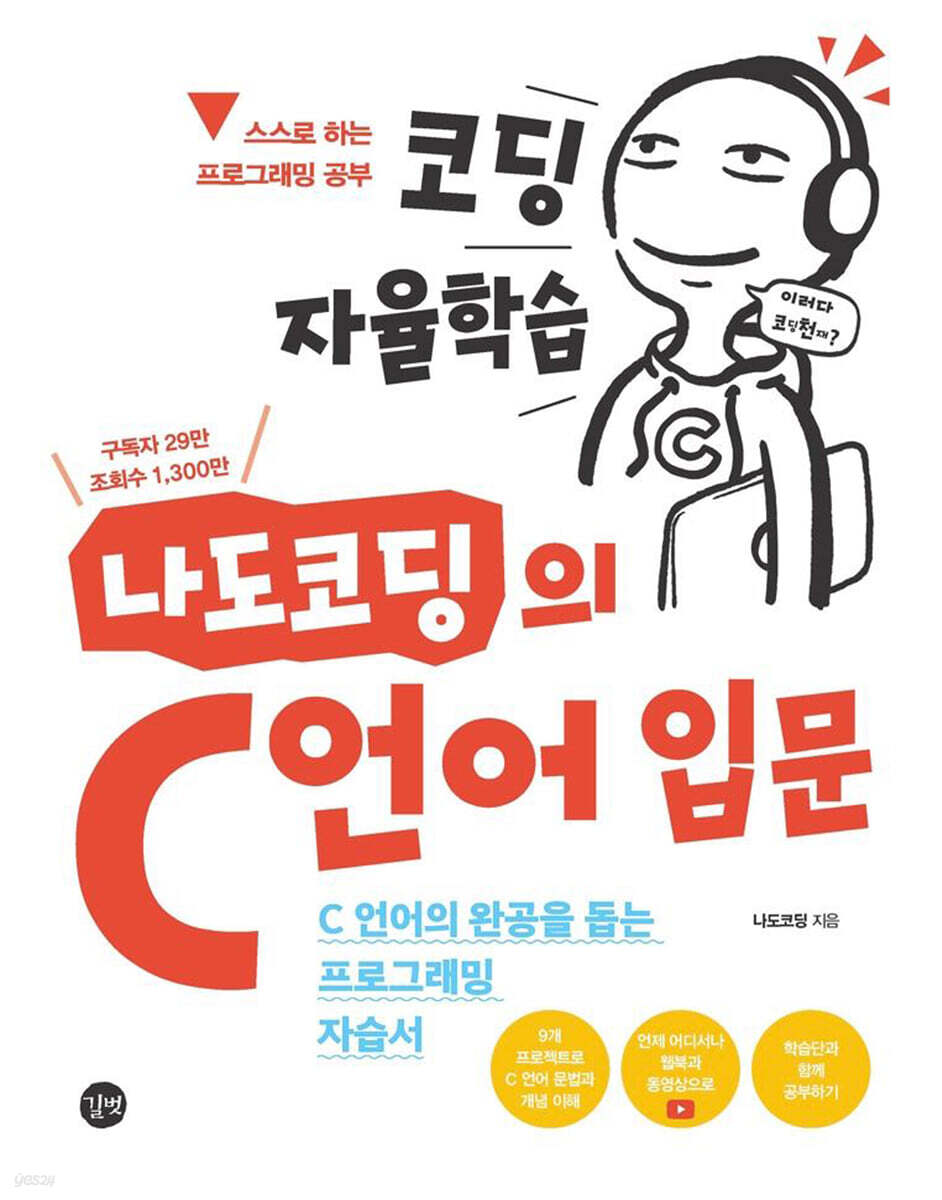
Introduction to C Language by I Can Code, a self-study course on coding
 |
Description
Book Introduction
The best C language course, proven by 290,000 subscribers and 20,000 students. I also learned the programming learning know-how of Coding! Don't be frustrated by pointers, let's learn C! Popular lectures from YouTube and Infraon are compiled into one book. You can learn loops, conditional statements, functions, arrays, structures, and even pointers, which everyone says are difficult, in an easy and fun way by completing nine projects with fun examples from everyday life. If you follow the examples, you will soon find yourself mastering the concepts and principles of the C language. This book is easy to follow, with step-by-step terminology explanations and friendly instructions, even for beginners and those who have given up on coding. In addition to the lecture content, tips and notes are also placed in appropriate places to help you achieve perfect self-directed coding learning without having to worry about it alone. Once you master the C language, you will be able to understand other languages faster. Stop being frustrated by pointers and master the C language! This one book is all you need for a thorough introduction. |
- You can preview some of the book's contents.
Preview
index
Chapter 1 Hello, C!
1.1 Setting up the development environment
1.2 Writing Your First C Program
Chapter 2: Fundamentals of Programming: Variables and Constants, Input and Output
2.1 Programs created in this chapter
2.2 Variables
2.3 Constants
2.4 Printing with printf( )
2.5 Receiving input with scanf( )
2.6 Project: Writing a Police Report
Chapter 3: Repeating Conditionally: Loops
3.1 Programs created in this chapter
3.2 ++ operator
3.3 Types of loops
3.4 Using double loops
3.5 Project: Build a Pyramid
Chapter 4 Doing Different Things Depending on Conditions: Conditional Statements
4.1 Programs created in this chapter
4.2 Branching based on conditions
4.3 Stopping execution
4.4 Branching in multiple directions
4.5 Project: Guess the Numbers
Chapter 5: Doing the Same Thing in One Place: Functions
5.1 Programs Created in This Chapter
5.2 What is a function?
5.3 Types of functions
5.4 Creating arithmetic operations functions
5.5 Project: Password Master
Chapter 6: Storing Multiple Data at Once: Arrays and Strings
6.1 Programs Created in This Chapter
6.2 What is an array?
6.3 Initializing an array
6.4 Handling Strings
6.5 Deeper String Handling
6.6 Project: Grow Your Hair
Chapter 7 Managing Memory Addresses: Pointers
7.1 Programs Created in This Chapter
7.2 What is a pointer?
7.3 Handling arrays with pointers
7.4 Project: Fish Farming
Chapter 8 Adding Arrays to Arrays: Multidimensional Arrays
8.1 Programs Created in This Chapter
8.2 What is a multidimensional array?
8.3 Handling Multidimensional Arrays
8.4 Project: Flipping Animal Cards
Chapter 9: Combining Different Data Types: Structures
9.1 Programs Created in This Chapter
9.2 What is a structure?
9.3 Using Structures
9.4 Declaring a structure with typedef
9.5 Project: You, Be My Butler
Chapter 10 Saving Data to Files: File Input/Output
10.1 Programs Created in This Chapter
10.2 Inputting and outputting files in string units
10.3 Specifying the format for file input/output
10.4 Project: Creating a Secret Diary Program
1.1 Setting up the development environment
1.2 Writing Your First C Program
Chapter 2: Fundamentals of Programming: Variables and Constants, Input and Output
2.1 Programs created in this chapter
2.2 Variables
2.3 Constants
2.4 Printing with printf( )
2.5 Receiving input with scanf( )
2.6 Project: Writing a Police Report
Chapter 3: Repeating Conditionally: Loops
3.1 Programs created in this chapter
3.2 ++ operator
3.3 Types of loops
3.4 Using double loops
3.5 Project: Build a Pyramid
Chapter 4 Doing Different Things Depending on Conditions: Conditional Statements
4.1 Programs created in this chapter
4.2 Branching based on conditions
4.3 Stopping execution
4.4 Branching in multiple directions
4.5 Project: Guess the Numbers
Chapter 5: Doing the Same Thing in One Place: Functions
5.1 Programs Created in This Chapter
5.2 What is a function?
5.3 Types of functions
5.4 Creating arithmetic operations functions
5.5 Project: Password Master
Chapter 6: Storing Multiple Data at Once: Arrays and Strings
6.1 Programs Created in This Chapter
6.2 What is an array?
6.3 Initializing an array
6.4 Handling Strings
6.5 Deeper String Handling
6.6 Project: Grow Your Hair
Chapter 7 Managing Memory Addresses: Pointers
7.1 Programs Created in This Chapter
7.2 What is a pointer?
7.3 Handling arrays with pointers
7.4 Project: Fish Farming
Chapter 8 Adding Arrays to Arrays: Multidimensional Arrays
8.1 Programs Created in This Chapter
8.2 What is a multidimensional array?
8.3 Handling Multidimensional Arrays
8.4 Project: Flipping Animal Cards
Chapter 9: Combining Different Data Types: Structures
9.1 Programs Created in This Chapter
9.2 What is a structure?
9.3 Using Structures
9.4 Declaring a structure with typedef
9.5 Project: You, Be My Butler
Chapter 10 Saving Data to Files: File Input/Output
10.1 Programs Created in This Chapter
10.2 Inputting and outputting files in string units
10.3 Specifying the format for file input/output
10.4 Project: Creating a Secret Diary Program
Detailed image

Publisher's Review
This book is designed to help anyone learn the C language without any prior knowledge.
It also helped me a lot in organizing C language concepts.
The projects that were carried out in each chapter were interesting, so I was able to follow along with enjoyment until the end.
I highly recommend this book as an introductory book to the C language.
_Yoonran
It provides detailed explanations of unfamiliar terms or terms you know but don't know the meaning of.
The examples are from everyday life, so even beginners can easily approach them.
I think programming requires a lot of practice, and I liked that there were a lot of examples and projects.
I highly recommend this book to anyone who is new to or looking to review the C language! _Lee Seong-hee
Each chapter consists of concepts, examples, and projects, so I learned the concepts, read detailed explanations, and created projects based on what I learned. This helped me remember the content for a long time and identify areas where I was lacking.
I was at a loss when it came to studying the C language, but this book helped me learn it without any problems.
_Kwon Hyung-seung
As a non-major, this book is simply a blessing! It not only explains concepts I've learned in various places in an easy-to-understand manner, but also provides practical exercises for each chapter to help you master the concepts. It's packed with valuable information.
There is no better book to learn the C language in a fun and proper way.
_Kim Chan-jin
Introductory books on the C language either omit explanations or do not describe in detail the parts I was curious about.
However, this book seems to have been well-written, capturing in detail the content that readers might be curious about.
Since the projects are organized by chapter, I was able to study the advanced course without any problems.
As a computer engineering student, I highly recommend this book.
_Kwon Oh-hui
Unlike other books, this one covers even the smallest details, such as how to create files or how to write code, making it very easy to study.
I also liked the fact that the 1-minute quiz included many elements that encouraged readers to think and solve the problem, which helped them grow on their own.
And what helped me the most was doing a project at the end of each chapter to practice the concepts and grammar.
_Hwang Eul-seon
I had never learned coding before, so I was worried that it would be too difficult.
However, as I studied along with the contents of the book, I was able to answer almost all of the 1-minute quizzes correctly, and I felt a sense of accomplishment when the results came out accurately.
_Kim Ye-won
Each chapter introduces a project to be created, explains the concepts needed for the functions required for the project, takes a simple 1-minute quiz to check what you've learned, and finally, at the end, a project step where you can create the project introduced at the beginning, making it easy and fun to study the C language.
I studied every day without even realizing how much time had passed.
_Kim Young-heon
I once lost interest in learning the C language at school and gave up.
I became interested again, and by chance I came across this book.
It started to become fun as the principles and applications that I didn't know at the time were explained in an easy and clear way, and the knowledge gradually became organized in my head.
If you follow this book slowly, you will find yourself easily writing multiple lines of code and will naturally become interested in programming.
_Go Min-ji
The strength of this book is that it explains everything in great detail, starting from the basics.
Even if you are new to the C language, you can take on the challenge without any burden, and the difficulty level increases as you progress from the basics to the project part, so you can study up to advanced learning all at once.
_Lee Yoon-woo
It also helped me a lot in organizing C language concepts.
The projects that were carried out in each chapter were interesting, so I was able to follow along with enjoyment until the end.
I highly recommend this book as an introductory book to the C language.
_Yoonran
It provides detailed explanations of unfamiliar terms or terms you know but don't know the meaning of.
The examples are from everyday life, so even beginners can easily approach them.
I think programming requires a lot of practice, and I liked that there were a lot of examples and projects.
I highly recommend this book to anyone who is new to or looking to review the C language! _Lee Seong-hee
Each chapter consists of concepts, examples, and projects, so I learned the concepts, read detailed explanations, and created projects based on what I learned. This helped me remember the content for a long time and identify areas where I was lacking.
I was at a loss when it came to studying the C language, but this book helped me learn it without any problems.
_Kwon Hyung-seung
As a non-major, this book is simply a blessing! It not only explains concepts I've learned in various places in an easy-to-understand manner, but also provides practical exercises for each chapter to help you master the concepts. It's packed with valuable information.
There is no better book to learn the C language in a fun and proper way.
_Kim Chan-jin
Introductory books on the C language either omit explanations or do not describe in detail the parts I was curious about.
However, this book seems to have been well-written, capturing in detail the content that readers might be curious about.
Since the projects are organized by chapter, I was able to study the advanced course without any problems.
As a computer engineering student, I highly recommend this book.
_Kwon Oh-hui
Unlike other books, this one covers even the smallest details, such as how to create files or how to write code, making it very easy to study.
I also liked the fact that the 1-minute quiz included many elements that encouraged readers to think and solve the problem, which helped them grow on their own.
And what helped me the most was doing a project at the end of each chapter to practice the concepts and grammar.
_Hwang Eul-seon
I had never learned coding before, so I was worried that it would be too difficult.
However, as I studied along with the contents of the book, I was able to answer almost all of the 1-minute quizzes correctly, and I felt a sense of accomplishment when the results came out accurately.
_Kim Ye-won
Each chapter introduces a project to be created, explains the concepts needed for the functions required for the project, takes a simple 1-minute quiz to check what you've learned, and finally, at the end, a project step where you can create the project introduced at the beginning, making it easy and fun to study the C language.
I studied every day without even realizing how much time had passed.
_Kim Young-heon
I once lost interest in learning the C language at school and gave up.
I became interested again, and by chance I came across this book.
It started to become fun as the principles and applications that I didn't know at the time were explained in an easy and clear way, and the knowledge gradually became organized in my head.
If you follow this book slowly, you will find yourself easily writing multiple lines of code and will naturally become interested in programming.
_Go Min-ji
The strength of this book is that it explains everything in great detail, starting from the basics.
Even if you are new to the C language, you can take on the challenge without any burden, and the difficulty level increases as you progress from the basics to the project part, so you can study up to advanced learning all at once.
_Lee Yoon-woo
GOODS SPECIFICS
- Publication date: October 10, 2022
- Page count, weight, size: 416 pages | 752g | 183*235*17mm
- ISBN13: 9791140701551
You may also like
카테고리
korean


korean

![GQ KOREA Mark (Monthly): December [2025]](http://librairie.coreenne.fr/cdn/shop/files/8ef265dbbfbf186523ed75ba7319009d.jpg?v=1765340328&width=3840)


