

Deep Learning from the Creator of Keras, 2nd Edition
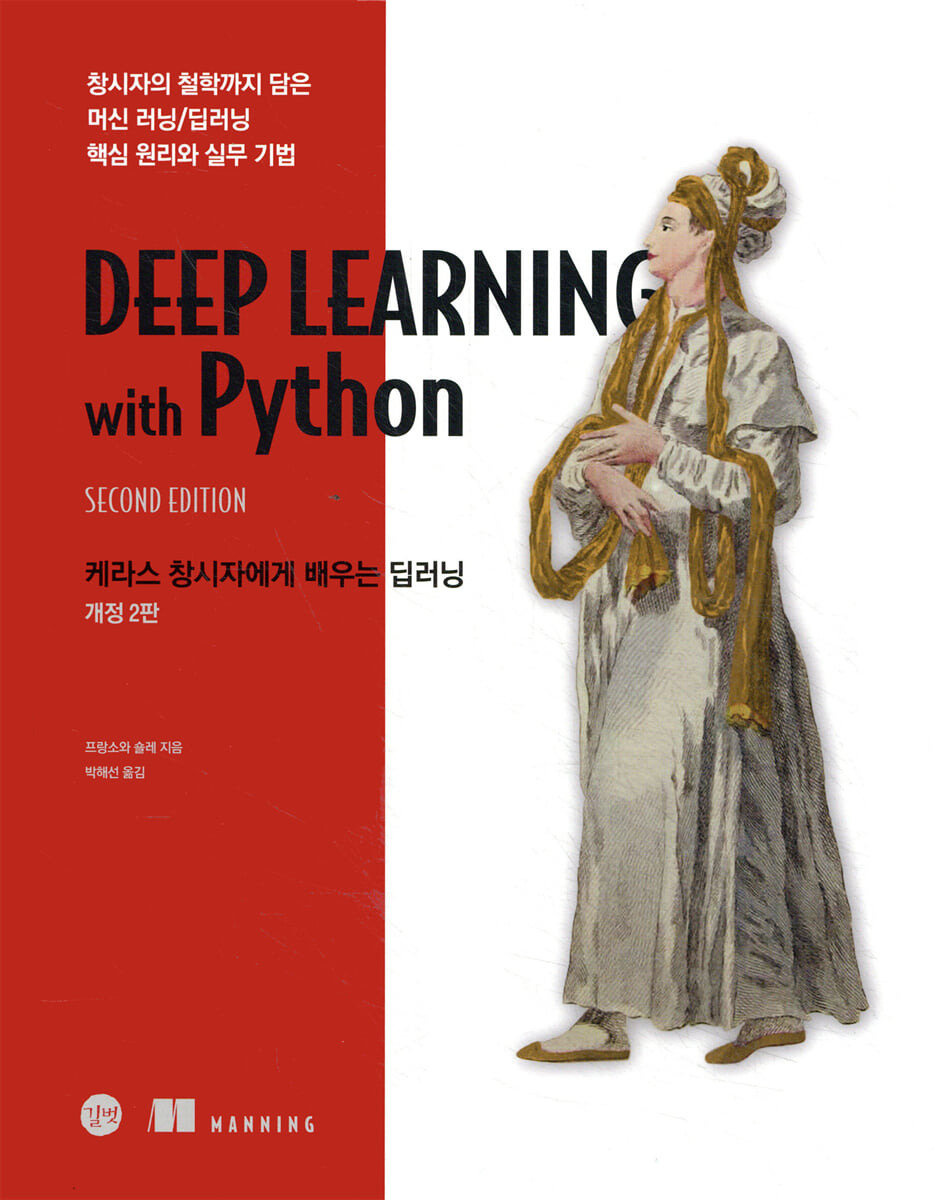 |
Description
Book Introduction
Not a single word, not a single line of code is wasted!
If you choose only one deep learning book, make it this one!
The author, the founder of Keras and a Google deep learning researcher, emphasizes the ‘democratization of artificial intelligence.’
This book is another way to introduce deep learning to a wider audience, focusing on making the concepts and implementation behind deep learning as easy to understand as possible.
Revised by over 75% and expanded by over a third compared to the first edition, the second edition is designed to help you quickly acquire the skills you need to start developing deep learning applications, with intuitive explanations, color illustrations, and clear examples.
Covering both practical techniques that can be easily applied in real life and the essential theories needed to master neural networks, the book offers insights and the author's philosophy, from getting started with deep learning to practical techniques.
Additionally, to eliminate the mathematical barrier, concepts are explained in intuitive and concise code without mathematical notation.
Recommended for anyone interested in deep learning or looking to broaden their understanding.
If you choose only one deep learning book, make it this one!
The author, the founder of Keras and a Google deep learning researcher, emphasizes the ‘democratization of artificial intelligence.’
This book is another way to introduce deep learning to a wider audience, focusing on making the concepts and implementation behind deep learning as easy to understand as possible.
Revised by over 75% and expanded by over a third compared to the first edition, the second edition is designed to help you quickly acquire the skills you need to start developing deep learning applications, with intuitive explanations, color illustrations, and clear examples.
Covering both practical techniques that can be easily applied in real life and the essential theories needed to master neural networks, the book offers insights and the author's philosophy, from getting started with deep learning to practical techniques.
Additionally, to eliminate the mathematical barrier, concepts are explained in intuitive and concise code without mathematical notation.
Recommended for anyone interested in deep learning or looking to broaden their understanding.
- You can preview some of the book's contents.
Preview
index
Chapter 1: What is Deep Learning?
1.1 Artificial Intelligence, Machine Learning, and Deep Learning
__1.1.1 Artificial Intelligence
__1.1.2 Machine Learning
__1.1.3 Learning Representations from Data
__1.1.4 What does 'deep' mean in deep learning?
__1.1.5 Understanding the working principles of deep learning with three figures
__1.1.6 Deep learning achievements to date
__1.1.7 Don't believe short-term hype
__1.1.8 Outlook on AI
1.2 Before Deep Learning: A Brief History of Machine Learning
__1.2.1 Probabilistic Modeling
__1.2.2 Early Neural Networks
__1.2.3 Kernel method
__1.2.4 Decision Trees, Random Forests, and Gradient Boosting Machines
__1.2.5 Back to neural networks
__1.2.6 Characteristics of Deep Learning
__1.2.7 Recent Trends in Machine Learning
1.3 Why Deep Learning? Why Now?
__1.3.1 Hardware
__1.3.2 data
__1.3.3 Algorithm
__1.3.4 A new wind of investment
__1.3.5 Popularization of Deep Learning
__1.3.6 Will it last?
Chapter 2: Mathematical Components of Neural Networks
2.1 First Encounter with Neural Networks
2.2 Data Representation for Neural Networks
__2.2.1 Scalar (Rank-0 Tensor)
__2.2.2 Vectors (Rank-1 Tensors)
__2.2.3 Matrix (Rank-2 Tensor)
__2.2.4 Rank-3 tensors and higher-rank tensors
__2.2.5 Core Properties
__2.2.6 Manipulating Tensors with NumPy
__2.2.7 Batch Data
__2.2.8 Real-world examples of tensors
__2.2.9 Vector data
__2.2.10 Time series data or sequence data
__2.2.11 Image data
__2.2.12 Video Data
2.3 The Cogs of Neural Networks: Tensor Operations
__2.3.1 Element-wise operations
__2.3.2 Broadcasting
__2.3.3 Tensor multiplication
__2.3.4 Tensor size conversion
__2.3.5 Geometric Interpretation of Tensor Operations
__2.3.6 Geometric Interpretation of Deep Learning
2.4 The Engine of Neural Networks: Gradient-Based Optimization
__2.4.1 What is a derivative?
__2.4.2 Derivatives of Tensor Operations: Gradients
__2.4.3 Stochastic Gradient Descent
__2.4.4 Derivative Connection: Backpropagation Algorithm
2.5 Revisiting the First Example
__2.5.1 Reimplementing the first example from scratch using TensorFlow
__2.5.2 Running the training step
__2.5.3 Full training loop
__2.5.4 Evaluating the Model
2.6 Summary
Chapter 3: Introduction to Keras and TensorFlow
3.1 What is TensorFlow?
3.2 What is Keras?
3.3 A Brief History of Keras and TensorFlow
3.4 Setting up the deep learning working environment
__3.4.1 Jupyter Notebook: A Recommended Deep Learning Experimentation Tool
__3.4.2 Using Colab
3.5 Getting Started with TensorFlow
__3.5.1 Constant tensors and variables
__3.5.2 Tensor Operations: Computing Math in TensorFlow
__3.5.3 Revisiting the GradientTape API
__3.5.4 End-to-End Example: TensorFlow Linear Classifier
3.6 Neural Network Structure: Understanding the Core Keras API
__3.6.1 Layer: Components of Deep Learning
__3.6.2 model on the floor
__3.6.3 'Compile' Step: Setting Up the Learning Process
__3.6.4 Choosing a Loss Function
__3.6.5 Understanding the fit( ) method
__3.6.6 Monitoring Loss and Metrics in Validation Data
__3.6.7 Inference: Using the Trained Model
3.7 Summary
Chapter 4: Getting Started with Neural Networks: Classification and Regression
4.1 Movie Review Classification: A Binary Classification Problem
__4.1.1 IMDB dataset
__4.1.2 Data Preparation
__4.1.3 Creating a Neural Network Model
__4.1.4 Training Validation
__4.1.5 Predicting New Data with a Trained Model
__4.1.6 Additional Experiments
__4.1.7 Summary
4.2 News Article Classification: A Multi-Classification Problem
__4.2.1 Reuters Dataset
__4.2.2 Data Preparation
__4.2.3 Model Configuration
__4.2.4 Training Validation
__4.2.5 Predicting on New Data
__4.2.6 Other ways to deal with labels and losses
__4.2.7 Why you need a sufficiently large intermediate layer
__4.2.8 Additional Experiments
__4.2.9 Summary
4.3 Predicting House Prices: A Regression Problem
__4.3.1 Boston Housing Price Dataset
__4.3.2 Data Preparation
__4.3.3 Model Configuration
__4.3.4 Training validation using K-fold validation
__4.3.5 Predicting on New Data
__4.3.6 Summary
4.4 Summary
Chapter 5: Fundamentals of Machine Learning
5.1 Generalization: The Goal of Machine Learning
__5.1.1 Underfitting and Overfitting
__5.1.2 The essence of generalization in deep learning
5.2 Machine Learning Model Evaluation
__5.2.1 Training, validation, and test sets
__5.2.2 Exceeding the common sense threshold
__5.2.3 Things to keep in mind about model evaluation
5.3 Improving Training Performance
__5.3.1 Tuning the Key Parameters of Gradient Descent
__5.3.2 Making Better Assumptions About Structure
__5.3.3 Increasing model capacity
5.4 Improving generalization performance
__5.4.1 Dataset Curation
__5.4.2 Characteristic Engineering
__5.4.3 Using Early Termination
__5.4.4 Regulating the Model
5.5 Summary
Chapter 6: A General Machine Learning Workflow
6.1 Task Definition
__6.1.1 Problem Definition
__6.1.2 Data Collection
__6.1.3 Understanding Data
__6.1.4 Selecting success metrics
6.2 Model Development
__6.2.1 Data Preparation
__6.2.2 Choosing an Evaluation Method
__6.2.3 Going beyond the baseline model
__6.2.4 Increasing Model Capacity: Creating an Overfit Model
__6.2.5 Model Regularization and Hyperparameter Tuning
6.3 Model Deployment
__6.3.1 Explaining the Work to the Client and Setting Expectations
__6.3.2 Deploying the Inference Model
__6.3.3 Monitoring the model while it is running
__6.3.4 Model Maintenance
6.4 Summary
Chapter 7: Mastering Keras
7.1 Various Workflows
7.2 Multiple Ways to Create a Keras Model
__7.2.1 Sequential Model
__7.2.2 Functional API
__7.2.3 Model Subclassing
__7.2.4 Mixing multiple methods
__7.2.5 Using the Right Tool for the Job
7.3 Using the built-in training and evaluation loops
__7.3.1 Creating a Custom Indicator
__7.3.2 Using callbacks
__7.3.3 Creating a Custom Callback
__7.3.4 Monitoring and Visualization with TensorBoard
7.4 Creating Custom Training and Evaluation Loops
__7.4.1 Training vs. Inference
__7.4.2 Low-Level Usage of Measurement Indicators
__7.4.3 Complete training and evaluation loop
__7.4.4 Improving Performance with tf.function
__7.4.5 Using the fit( ) method as a custom loop
7.5 Summary
Chapter 8: Deep Learning for Computer Vision
8.1 Introduction to Convolutional Neural Networks
__8.1.1 Convolution Operation
__8.1.2 Max pooling operation
8.2 Training a Convnet from Scratch on a Small Dataset
__8.2.1 The Feasibility of Deep Learning in Small Dataset Problems
__8.2.2 Downloading data
__8.2.3 Creating a Model
__8.2.4 Data Preprocessing
__8.2.5 Using data augmentation
8.3 Using Pretrained Models
__8.3.1 Feature Extraction Using a Pretrained Model
__8.3.2 Fine-tuning a pre-trained model
8.4 Summary
Chapter 9: Advanced Deep Learning for Computer Vision
9.1 Three Major Computer Vision Tasks
9.2 Image Segmentation Example
9.3 Modern ConvNet Architecture Patterns
__9.3.1 Modularization, Layering, and Reuse
__9.3.2 Residual Linkage
__9.3.3 Batch Normalization
__9.3.4 Depth-wise Separate Convolution
__9.3.5 Apply to all Xception-like models
9.4 Interpreting What ConvNets Learn
__9.4.1 Intermediate Activation Visualization
__9.4.2 Visualizing ConvNet Filters
__9.4.3 Visualizing a heatmap of class activations
9.5 Summary
Chapter 10: Deep Learning for Time Series
10.1 Various types of time series operations
10.2 Temperature Prediction Problem
__10.2.1 Data Preparation
__10.2.2 Common sense level benchmark
__10.2.3 Trying a Basic Machine Learning Model
__10.2.4 Trying a 1D convolutional model
__10.2.5 The First Recurrent Neural Network
10.3 Understanding Recurrent Neural Networks
__10.3.1 Recurrent Layers in Keras
__10.4 Advanced Uses of Recurrent Neural Networks
__10.4.1 Using recurrent dropout to reduce overfitting
__10.4.2 Stacking Circular Layer
__10.4.3 Using Bidirectional RNNs
__10.4.4 Further
10.5 Summary
Chapter 11: Deep Learning for Text
11.1 Introduction to Natural Language Processing
11.2 Preparing Text Data
__11.2.1 Text Standardization
__11.2.2 Text Segmentation (Tokenization)
__11.2.3 Lexical Dictionary Indexing
__11.2.4 Using the TextVectorization Layer
11.3 Two ways to represent groups of words: sets and sequences
__11.3.1 Preparing IMDB Movie Review Data
__11.3.2 Treating words as sets: BoW method
__11.3.3 Processing Words as Sequences: The Sequence Model Approach
11.4 Transformer Architecture
__11.4.1 Understanding Self-Attention
__11.4.2 Multi-head attention
__11.4.3 Transformer Encoder
__11.4.4 When should I use a sequence model instead of a BoW model?
11.5 Beyond Text Classification: Sequence-to-Sequence Learning
__11.5.1 Machine Translation Example
__11.5.2 Sequence-to-sequence model using RNN
__11.5.3 Sequence-to-sequence model using transformers
11.6 Summary
Chapter 12: Deep Learning for Generative Models
12.1 Text Generation
__12.1.1 A Brief History of Deep Learning Models for Sequence Generation
__12.1.2 How to generate sequence data?
__12.1.3 The Importance of Sampling Strategy
__12.1.4 Implementing a Text Generation Model Using Keras
__12.1.5 Text Generation Callback Using Variable Temperature Sampling
__12.1.6 Summary
12.2 Deep Dream
__12.2.1 Keras DeepDream Implementation
__12.2.2 Summary
12.3 Neural Style Transfer
__12.3.1 Content Loss
__12.3.2 Style Loss
__12.3.3 Implementing Neural Style Transfer with Keras
__12.3.4 Summary
12.4 Image Generation Using Variational Autoencoders
__12.4.1 Sampling from the latent space of an image
__12.4.2 Concept vector for image transformation
__12.4.3 Variational Autoencoder
__12.4.4 Implementing VAE with Keras
__12.4.5 Summary
12.5 Introduction to Generative Adversarial Networks
__12.5.1 How to implement GAN
__12.5.2 Training Methods
__12.5.3 Preparing the CelebA Dataset
__12.5.4 Discriminator
__12.5.5 Constructor
__12.5.6 Hostile Networks
__12.5.7 Summary
12.6 Summary
Chapter 13: Best Practices for Solving Real-World Problems
13.1 Unleashing the full potential of your model
__13.1.1 Hyperparameter Optimization
__13.1.2 Model Ensemble
13.2 Training a Large-Scale Model
__13.2.1 Speeding up training on GPUs with mixed precision
__13.2.2 Multi-GPU Training
__13.2.3 TPU Training
13.3 Summary
Chapter 14 Conclusion
14.1 Review of Key Concepts
__14.1.1 Various Methods for AI
__14.1.2 Why Deep Learning is Special in the Field of Machine Learning
__14.1.3 About Deep Learning
__14.1.4 Core Technologies
__14.1.5 General Machine Learning Workflow
__14.1.6 Main network structure
__14.1.7 The Potential of Deep Learning
14.2 Limitations of Deep Learning
__14.2.1 The Risk of Anthropomorphism in Machine Learning Models
__14.2.2 Autonomous Machines vs. Intelligent Agents
__14.2.3 Local Generalization vs. Ultimate Generalization
__14.2.4 The Purpose of Intelligence
__14.2.5 Spectrum of Generalization
14.3 Methods for Improving Generalization in AI
__14.3.1 The Importance of Setting Proper Goals: The Shortcut Rule
__14.3.2 New Goals
14.4 Implementing Intelligence: The Missing Components
__14.4.1 Intelligence superior to abstract metaphors
__14.4.2 Two kinds of abstraction
__14.4.3 Missing Half of the Figure
14.5 The Future of Deep Learning
__14.5.1 Program-like model
__14.5.2 Mixing Deep Learning and Program Synthesis
__14.5.3 Persistent Learning and Modular Subroutine Reuse
__14.5.4 Long-term Vision
14.6 Keeping up with rapid changes
__14.6.1 Practice with Kaggle's real-world problems
__14.6.2 Read the latest papers through the archive (arXiv)
__14.6.3 Exploring the Keras Ecosystem
14.7 Conclusion
1.1 Artificial Intelligence, Machine Learning, and Deep Learning
__1.1.1 Artificial Intelligence
__1.1.2 Machine Learning
__1.1.3 Learning Representations from Data
__1.1.4 What does 'deep' mean in deep learning?
__1.1.5 Understanding the working principles of deep learning with three figures
__1.1.6 Deep learning achievements to date
__1.1.7 Don't believe short-term hype
__1.1.8 Outlook on AI
1.2 Before Deep Learning: A Brief History of Machine Learning
__1.2.1 Probabilistic Modeling
__1.2.2 Early Neural Networks
__1.2.3 Kernel method
__1.2.4 Decision Trees, Random Forests, and Gradient Boosting Machines
__1.2.5 Back to neural networks
__1.2.6 Characteristics of Deep Learning
__1.2.7 Recent Trends in Machine Learning
1.3 Why Deep Learning? Why Now?
__1.3.1 Hardware
__1.3.2 data
__1.3.3 Algorithm
__1.3.4 A new wind of investment
__1.3.5 Popularization of Deep Learning
__1.3.6 Will it last?
Chapter 2: Mathematical Components of Neural Networks
2.1 First Encounter with Neural Networks
2.2 Data Representation for Neural Networks
__2.2.1 Scalar (Rank-0 Tensor)
__2.2.2 Vectors (Rank-1 Tensors)
__2.2.3 Matrix (Rank-2 Tensor)
__2.2.4 Rank-3 tensors and higher-rank tensors
__2.2.5 Core Properties
__2.2.6 Manipulating Tensors with NumPy
__2.2.7 Batch Data
__2.2.8 Real-world examples of tensors
__2.2.9 Vector data
__2.2.10 Time series data or sequence data
__2.2.11 Image data
__2.2.12 Video Data
2.3 The Cogs of Neural Networks: Tensor Operations
__2.3.1 Element-wise operations
__2.3.2 Broadcasting
__2.3.3 Tensor multiplication
__2.3.4 Tensor size conversion
__2.3.5 Geometric Interpretation of Tensor Operations
__2.3.6 Geometric Interpretation of Deep Learning
2.4 The Engine of Neural Networks: Gradient-Based Optimization
__2.4.1 What is a derivative?
__2.4.2 Derivatives of Tensor Operations: Gradients
__2.4.3 Stochastic Gradient Descent
__2.4.4 Derivative Connection: Backpropagation Algorithm
2.5 Revisiting the First Example
__2.5.1 Reimplementing the first example from scratch using TensorFlow
__2.5.2 Running the training step
__2.5.3 Full training loop
__2.5.4 Evaluating the Model
2.6 Summary
Chapter 3: Introduction to Keras and TensorFlow
3.1 What is TensorFlow?
3.2 What is Keras?
3.3 A Brief History of Keras and TensorFlow
3.4 Setting up the deep learning working environment
__3.4.1 Jupyter Notebook: A Recommended Deep Learning Experimentation Tool
__3.4.2 Using Colab
3.5 Getting Started with TensorFlow
__3.5.1 Constant tensors and variables
__3.5.2 Tensor Operations: Computing Math in TensorFlow
__3.5.3 Revisiting the GradientTape API
__3.5.4 End-to-End Example: TensorFlow Linear Classifier
3.6 Neural Network Structure: Understanding the Core Keras API
__3.6.1 Layer: Components of Deep Learning
__3.6.2 model on the floor
__3.6.3 'Compile' Step: Setting Up the Learning Process
__3.6.4 Choosing a Loss Function
__3.6.5 Understanding the fit( ) method
__3.6.6 Monitoring Loss and Metrics in Validation Data
__3.6.7 Inference: Using the Trained Model
3.7 Summary
Chapter 4: Getting Started with Neural Networks: Classification and Regression
4.1 Movie Review Classification: A Binary Classification Problem
__4.1.1 IMDB dataset
__4.1.2 Data Preparation
__4.1.3 Creating a Neural Network Model
__4.1.4 Training Validation
__4.1.5 Predicting New Data with a Trained Model
__4.1.6 Additional Experiments
__4.1.7 Summary
4.2 News Article Classification: A Multi-Classification Problem
__4.2.1 Reuters Dataset
__4.2.2 Data Preparation
__4.2.3 Model Configuration
__4.2.4 Training Validation
__4.2.5 Predicting on New Data
__4.2.6 Other ways to deal with labels and losses
__4.2.7 Why you need a sufficiently large intermediate layer
__4.2.8 Additional Experiments
__4.2.9 Summary
4.3 Predicting House Prices: A Regression Problem
__4.3.1 Boston Housing Price Dataset
__4.3.2 Data Preparation
__4.3.3 Model Configuration
__4.3.4 Training validation using K-fold validation
__4.3.5 Predicting on New Data
__4.3.6 Summary
4.4 Summary
Chapter 5: Fundamentals of Machine Learning
5.1 Generalization: The Goal of Machine Learning
__5.1.1 Underfitting and Overfitting
__5.1.2 The essence of generalization in deep learning
5.2 Machine Learning Model Evaluation
__5.2.1 Training, validation, and test sets
__5.2.2 Exceeding the common sense threshold
__5.2.3 Things to keep in mind about model evaluation
5.3 Improving Training Performance
__5.3.1 Tuning the Key Parameters of Gradient Descent
__5.3.2 Making Better Assumptions About Structure
__5.3.3 Increasing model capacity
5.4 Improving generalization performance
__5.4.1 Dataset Curation
__5.4.2 Characteristic Engineering
__5.4.3 Using Early Termination
__5.4.4 Regulating the Model
5.5 Summary
Chapter 6: A General Machine Learning Workflow
6.1 Task Definition
__6.1.1 Problem Definition
__6.1.2 Data Collection
__6.1.3 Understanding Data
__6.1.4 Selecting success metrics
6.2 Model Development
__6.2.1 Data Preparation
__6.2.2 Choosing an Evaluation Method
__6.2.3 Going beyond the baseline model
__6.2.4 Increasing Model Capacity: Creating an Overfit Model
__6.2.5 Model Regularization and Hyperparameter Tuning
6.3 Model Deployment
__6.3.1 Explaining the Work to the Client and Setting Expectations
__6.3.2 Deploying the Inference Model
__6.3.3 Monitoring the model while it is running
__6.3.4 Model Maintenance
6.4 Summary
Chapter 7: Mastering Keras
7.1 Various Workflows
7.2 Multiple Ways to Create a Keras Model
__7.2.1 Sequential Model
__7.2.2 Functional API
__7.2.3 Model Subclassing
__7.2.4 Mixing multiple methods
__7.2.5 Using the Right Tool for the Job
7.3 Using the built-in training and evaluation loops
__7.3.1 Creating a Custom Indicator
__7.3.2 Using callbacks
__7.3.3 Creating a Custom Callback
__7.3.4 Monitoring and Visualization with TensorBoard
7.4 Creating Custom Training and Evaluation Loops
__7.4.1 Training vs. Inference
__7.4.2 Low-Level Usage of Measurement Indicators
__7.4.3 Complete training and evaluation loop
__7.4.4 Improving Performance with tf.function
__7.4.5 Using the fit( ) method as a custom loop
7.5 Summary
Chapter 8: Deep Learning for Computer Vision
8.1 Introduction to Convolutional Neural Networks
__8.1.1 Convolution Operation
__8.1.2 Max pooling operation
8.2 Training a Convnet from Scratch on a Small Dataset
__8.2.1 The Feasibility of Deep Learning in Small Dataset Problems
__8.2.2 Downloading data
__8.2.3 Creating a Model
__8.2.4 Data Preprocessing
__8.2.5 Using data augmentation
8.3 Using Pretrained Models
__8.3.1 Feature Extraction Using a Pretrained Model
__8.3.2 Fine-tuning a pre-trained model
8.4 Summary
Chapter 9: Advanced Deep Learning for Computer Vision
9.1 Three Major Computer Vision Tasks
9.2 Image Segmentation Example
9.3 Modern ConvNet Architecture Patterns
__9.3.1 Modularization, Layering, and Reuse
__9.3.2 Residual Linkage
__9.3.3 Batch Normalization
__9.3.4 Depth-wise Separate Convolution
__9.3.5 Apply to all Xception-like models
9.4 Interpreting What ConvNets Learn
__9.4.1 Intermediate Activation Visualization
__9.4.2 Visualizing ConvNet Filters
__9.4.3 Visualizing a heatmap of class activations
9.5 Summary
Chapter 10: Deep Learning for Time Series
10.1 Various types of time series operations
10.2 Temperature Prediction Problem
__10.2.1 Data Preparation
__10.2.2 Common sense level benchmark
__10.2.3 Trying a Basic Machine Learning Model
__10.2.4 Trying a 1D convolutional model
__10.2.5 The First Recurrent Neural Network
10.3 Understanding Recurrent Neural Networks
__10.3.1 Recurrent Layers in Keras
__10.4 Advanced Uses of Recurrent Neural Networks
__10.4.1 Using recurrent dropout to reduce overfitting
__10.4.2 Stacking Circular Layer
__10.4.3 Using Bidirectional RNNs
__10.4.4 Further
10.5 Summary
Chapter 11: Deep Learning for Text
11.1 Introduction to Natural Language Processing
11.2 Preparing Text Data
__11.2.1 Text Standardization
__11.2.2 Text Segmentation (Tokenization)
__11.2.3 Lexical Dictionary Indexing
__11.2.4 Using the TextVectorization Layer
11.3 Two ways to represent groups of words: sets and sequences
__11.3.1 Preparing IMDB Movie Review Data
__11.3.2 Treating words as sets: BoW method
__11.3.3 Processing Words as Sequences: The Sequence Model Approach
11.4 Transformer Architecture
__11.4.1 Understanding Self-Attention
__11.4.2 Multi-head attention
__11.4.3 Transformer Encoder
__11.4.4 When should I use a sequence model instead of a BoW model?
11.5 Beyond Text Classification: Sequence-to-Sequence Learning
__11.5.1 Machine Translation Example
__11.5.2 Sequence-to-sequence model using RNN
__11.5.3 Sequence-to-sequence model using transformers
11.6 Summary
Chapter 12: Deep Learning for Generative Models
12.1 Text Generation
__12.1.1 A Brief History of Deep Learning Models for Sequence Generation
__12.1.2 How to generate sequence data?
__12.1.3 The Importance of Sampling Strategy
__12.1.4 Implementing a Text Generation Model Using Keras
__12.1.5 Text Generation Callback Using Variable Temperature Sampling
__12.1.6 Summary
12.2 Deep Dream
__12.2.1 Keras DeepDream Implementation
__12.2.2 Summary
12.3 Neural Style Transfer
__12.3.1 Content Loss
__12.3.2 Style Loss
__12.3.3 Implementing Neural Style Transfer with Keras
__12.3.4 Summary
12.4 Image Generation Using Variational Autoencoders
__12.4.1 Sampling from the latent space of an image
__12.4.2 Concept vector for image transformation
__12.4.3 Variational Autoencoder
__12.4.4 Implementing VAE with Keras
__12.4.5 Summary
12.5 Introduction to Generative Adversarial Networks
__12.5.1 How to implement GAN
__12.5.2 Training Methods
__12.5.3 Preparing the CelebA Dataset
__12.5.4 Discriminator
__12.5.5 Constructor
__12.5.6 Hostile Networks
__12.5.7 Summary
12.6 Summary
Chapter 13: Best Practices for Solving Real-World Problems
13.1 Unleashing the full potential of your model
__13.1.1 Hyperparameter Optimization
__13.1.2 Model Ensemble
13.2 Training a Large-Scale Model
__13.2.1 Speeding up training on GPUs with mixed precision
__13.2.2 Multi-GPU Training
__13.2.3 TPU Training
13.3 Summary
Chapter 14 Conclusion
14.1 Review of Key Concepts
__14.1.1 Various Methods for AI
__14.1.2 Why Deep Learning is Special in the Field of Machine Learning
__14.1.3 About Deep Learning
__14.1.4 Core Technologies
__14.1.5 General Machine Learning Workflow
__14.1.6 Main network structure
__14.1.7 The Potential of Deep Learning
14.2 Limitations of Deep Learning
__14.2.1 The Risk of Anthropomorphism in Machine Learning Models
__14.2.2 Autonomous Machines vs. Intelligent Agents
__14.2.3 Local Generalization vs. Ultimate Generalization
__14.2.4 The Purpose of Intelligence
__14.2.5 Spectrum of Generalization
14.3 Methods for Improving Generalization in AI
__14.3.1 The Importance of Setting Proper Goals: The Shortcut Rule
__14.3.2 New Goals
14.4 Implementing Intelligence: The Missing Components
__14.4.1 Intelligence superior to abstract metaphors
__14.4.2 Two kinds of abstraction
__14.4.3 Missing Half of the Figure
14.5 The Future of Deep Learning
__14.5.1 Program-like model
__14.5.2 Mixing Deep Learning and Program Synthesis
__14.5.3 Persistent Learning and Modular Subroutine Reuse
__14.5.4 Long-term Vision
14.6 Keeping up with rapid changes
__14.6.1 Practice with Kaggle's real-world problems
__14.6.2 Read the latest papers through the archive (arXiv)
__14.6.3 Exploring the Keras Ecosystem
14.7 Conclusion
Detailed image
.jpg)
Publisher's Review
This book is written for anyone who wants to learn deep learning from scratch or broaden their understanding.
Whether you're a machine learning engineer, a software engineer, or a college student, you'll learn something from this book.
Let's explore deep learning by starting simple and then moving on to the latest technologies.
This book strikes a balance between intuition, theory, and practice.
We avoid mathematical notation and instead explain the core ideas of machine learning and deep learning with detailed code and intuitive analogies.
There are many code examples with detailed comments and practical guidelines.
It also includes a simple, high-level explanation of everything you need to know to get started with deep learning to solve specific problems.
The example code uses the Python deep learning framework Keras.
Keras uses TensorFlow 2 as its computational engine.
We will show you the latest best practices in Keras and TensorFlow 2.
After reading this book, you will have a clear understanding of what deep learning is, when to apply it, and what its limitations are.
Familiarize yourself with standard workflows for structuring and solving machine learning problems, and learn how to address common issues.
Therefore, you will be able to use Keras to tackle a wide range of real-world problems, from computer vision to natural language processing, image classification, image segmentation, time series forecasting, text classification, machine translation, and text generation.
What's changed in the 2nd edition:
- Reflects the latest TensorFlow and Keras APIs
- Implementing the transformer structure from scratch, including attention
- Added advanced models such as image segmentation, machine translation, text generation, and face image generation.
- Implement custom metrics, custom callbacks, and custom training loops
- Model implementation using gradient tape and subclassing
- Description of the entire machine learning workflow, including problem definition, deployment, and optimization.
- Use functional APIs in most of your code
- Introducing an image augmentation technique using a new image augmentation layer.
- Training methods using KerasTuner, mixed precision, multi-GPU, and TPU
- Reflecting on intelligence and generalization and envisioning the future of deep learning.
Pros of this book:
- Explains everything from basics to the latest advanced algorithms using Python code without using difficult formulas.
- It uses concise Keras code, so developers familiar with Python can easily understand it.
- Covers a wide range of applications, including convolutional neural networks, recurrent neural networks, transformers, and generative models.
- Learn the complete workflow and caveats for machine learning projects.
- For beginners: You can learn deep learning from the basics even if you don't know math.
- For developers: If you are familiar with Python, you can implement all the advanced models.
- For researchers: Learn how to create custom models with Keras.
Whether you're a machine learning engineer, a software engineer, or a college student, you'll learn something from this book.
Let's explore deep learning by starting simple and then moving on to the latest technologies.
This book strikes a balance between intuition, theory, and practice.
We avoid mathematical notation and instead explain the core ideas of machine learning and deep learning with detailed code and intuitive analogies.
There are many code examples with detailed comments and practical guidelines.
It also includes a simple, high-level explanation of everything you need to know to get started with deep learning to solve specific problems.
The example code uses the Python deep learning framework Keras.
Keras uses TensorFlow 2 as its computational engine.
We will show you the latest best practices in Keras and TensorFlow 2.
After reading this book, you will have a clear understanding of what deep learning is, when to apply it, and what its limitations are.
Familiarize yourself with standard workflows for structuring and solving machine learning problems, and learn how to address common issues.
Therefore, you will be able to use Keras to tackle a wide range of real-world problems, from computer vision to natural language processing, image classification, image segmentation, time series forecasting, text classification, machine translation, and text generation.
What's changed in the 2nd edition:
- Reflects the latest TensorFlow and Keras APIs
- Implementing the transformer structure from scratch, including attention
- Added advanced models such as image segmentation, machine translation, text generation, and face image generation.
- Implement custom metrics, custom callbacks, and custom training loops
- Model implementation using gradient tape and subclassing
- Description of the entire machine learning workflow, including problem definition, deployment, and optimization.
- Use functional APIs in most of your code
- Introducing an image augmentation technique using a new image augmentation layer.
- Training methods using KerasTuner, mixed precision, multi-GPU, and TPU
- Reflecting on intelligence and generalization and envisioning the future of deep learning.
Pros of this book:
- Explains everything from basics to the latest advanced algorithms using Python code without using difficult formulas.
- It uses concise Keras code, so developers familiar with Python can easily understand it.
- Covers a wide range of applications, including convolutional neural networks, recurrent neural networks, transformers, and generative models.
- Learn the complete workflow and caveats for machine learning projects.
- For beginners: You can learn deep learning from the basics even if you don't know math.
- For developers: If you are familiar with Python, you can implement all the advanced models.
- For researchers: Learn how to create custom models with Keras.
GOODS SPECIFICS
- Publication date: August 30, 2022
- Page count, weight, size: 628 pages | 1,590g | 183*235*37mm
- ISBN13: 9791140701001
You may also like
카테고리
korean


korean

![GQ KOREA Mark (Monthly): December [2025]](http://librairie.coreenne.fr/cdn/shop/files/8ef265dbbfbf186523ed75ba7319009d.jpg?v=1765340328&width=3840)


