

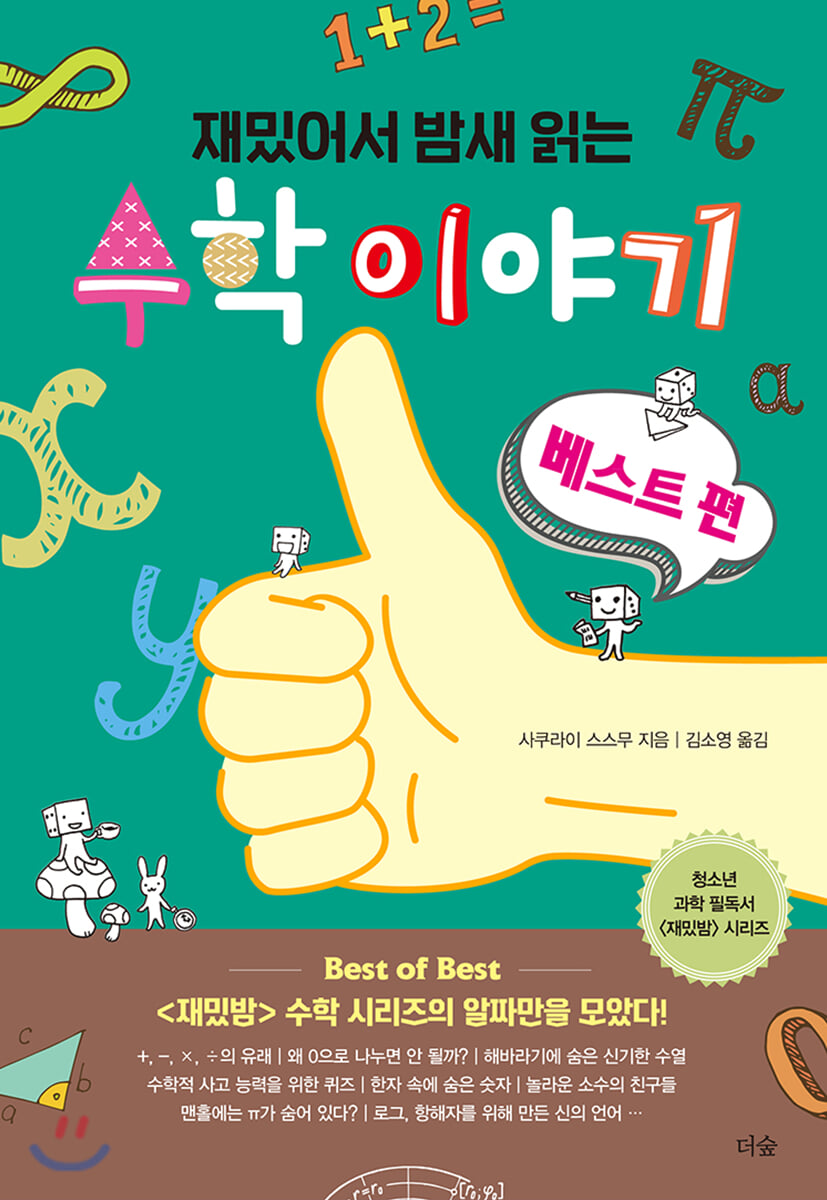
Math Stories That Are So Fun You'll Read Them All Night: The Best
 |
Description
Book Introduction
The 'Best of the Math Series' [Fun to Read All Night] has been published.
Among the four previously published books, 『Fun Math Stories You'll Read All Night』, 『Super Fun Math Stories You'll Read All Night』, 『Super Super Fun Math Stories You'll Read All Night』, and 『Fun Math Stories You'll Read All Night: Premium Edition』, we've compiled the best editions by selecting only the content that anyone can enjoy math with.
The best-selling book, published this time, is comprised of particularly interesting and essential content from among the many stories written so far, living up to the author's reputation for teaching mathematics in an easy-to-understand manner.
It also contains content that is encountered in academic subjects, such as finding the hidden sequence in a sunflower, the probability of having a friend with the same birthday as you, the logarithm of the language of God created for navigators, and questions about the number '0', so you can easily understand difficult concepts that you may not have understood in textbooks.
The best part is also composed of short stories, which is a characteristic of the [Fun Night] series.
As we follow each story with interest, we will soon find ourselves comfortably encountering mathematics and even embarking on a journey to discover more in-depth mathematical stories.
Among the four previously published books, 『Fun Math Stories You'll Read All Night』, 『Super Fun Math Stories You'll Read All Night』, 『Super Super Fun Math Stories You'll Read All Night』, and 『Fun Math Stories You'll Read All Night: Premium Edition』, we've compiled the best editions by selecting only the content that anyone can enjoy math with.
The best-selling book, published this time, is comprised of particularly interesting and essential content from among the many stories written so far, living up to the author's reputation for teaching mathematics in an easy-to-understand manner.
It also contains content that is encountered in academic subjects, such as finding the hidden sequence in a sunflower, the probability of having a friend with the same birthday as you, the logarithm of the language of God created for navigators, and questions about the number '0', so you can easily understand difficult concepts that you may not have understood in textbooks.
The best part is also composed of short stories, which is a characteristic of the [Fun Night] series.
As we follow each story with interest, we will soon find ourselves comfortably encountering mathematics and even embarking on a journey to discover more in-depth mathematical stories.
- You can preview some of the book's contents.
Preview
index
preface
Beautiful text story
A formula that seems readable but isn't
Farts smell half as bad?
The secret of your credit card number
Why are manholes round?
The mystical number 12
Lottery or Casino: Which is More Profitable?
Is there a surefire way to win at gambling?
Become beautiful with math! Beauty angle
Guess the secret number
Numbers hidden in Chinese characters
The Wonderful World of Magic Squares
Why do we write addition as +?
Why can't we divide by zero?
Numbers that have been connected
Probability of having a friend with the same birthday in your class
How many seconds have I lived so far?
Palindrome in the Looking Glass
Sei Shonagon's Wisdom Board and Square Puzzle
Prime numbers in Wonderland
Hidden sequence in sunflowers
Quizzes for mathematical thinking skills
Log, the language of the gods for navigators
36 multiplication tables instead of 81?
Even if you read it backwards, it's still a minority - Amazing minority friends
The probability that something wonderful will happen in your life
Conclusion
References
Beautiful text story
A formula that seems readable but isn't
Farts smell half as bad?
The secret of your credit card number
Why are manholes round?
The mystical number 12
Lottery or Casino: Which is More Profitable?
Is there a surefire way to win at gambling?
Become beautiful with math! Beauty angle
Guess the secret number
Numbers hidden in Chinese characters
The Wonderful World of Magic Squares
Why do we write addition as +?
Why can't we divide by zero?
Numbers that have been connected
Probability of having a friend with the same birthday in your class
How many seconds have I lived so far?
Palindrome in the Looking Glass
Sei Shonagon's Wisdom Board and Square Puzzle
Prime numbers in Wonderland
Hidden sequence in sunflowers
Quizzes for mathematical thinking skills
Log, the language of the gods for navigators
36 multiplication tables instead of 81?
Even if you read it backwards, it's still a minority - Amazing minority friends
The probability that something wonderful will happen in your life
Conclusion
References
Detailed image
.jpg)
Into the book
The symbols +, -, ×, ÷ that are so familiar to us.
These are symbols for the four basic arithmetic operations that are used quite naturally.
So why did we come to write plus with the symbol +? + was first used in a book written by the German Johannes Widman (1460-1498) in 1489.
The + in this book did not mean to add, but to exceed.
When adding, the Latin word et (and in English) was used to express 'add 5 to 3' as '3 et 5'.
There is a theory that the symbol + was formed when the cursive writing of et became disordered and became t, and later became +.
It is said that the first appearance of the + as an arithmetic symbol meaning addition was in an arithmetic book written by the Dutch Gielis van der Hoecke in 1514.
--- "Why is addition written as +?" from 'The Origin of the Arithmetic Operation Symbols'
We live every second of our lives.
Let's look back on the time that has passed and calculate how many seconds we have lived since we were born.
There are 24 hours in a day, 60 minutes in an hour, and 60 seconds in a minute.
So, one day is 24 (hours) x 60 (minutes) x 60 (seconds) = 86,400 (seconds).
Also, since there are 365 days in a year, it becomes 86,400 (seconds/day) x 365 (days) = 31,536,000 (seconds/year).
Based on this calculation, let's express the length of time we have lived in seconds.
Of course, to calculate accurately, you have to consider whether it is a leap year or whether a month has 30 or 31 days, but for now, let's assume a year has 365 days and a month has 30 days.
(…) How many seconds has a three-year-old child lived so far? 31,536,000 (seconds/year) x 3 (years) = 94,608,000 (seconds), so it is almost 100 million seconds.
When I was young, even 10 seconds felt like a very long time, but in comparison, 100 million seconds is a dizzying amount of time.
Although he is only three years old, he has lived this long in terms of seconds.
I want you to calculate 'How many seconds did I live'.
An ordinary day with nothing happening could become an anniversary of living for hundreds of millions of seconds.
--- "How many seconds have I lived so far?" From 'Let's think about age in seconds'
Let's say you've cut your bad breath and flatulence by half with deodorizers and air purifiers.
But we don't feel like, 'Oh, the smell is reduced by half.'
Rather, I feel like 'nothing has changed' and 'it still smells'.
To feel like you've reduced it by half, you need to eliminate 90% of the actual odor.
The same goes for sound.
We can hear (and feel) the sound of an insect crying and the loud music of a concert in similar ways.
If people could perceive the absolute value of loudness, the small sound of an insect would be perceived as small, and the loud music of a concert would be perceived as large.
But that's not the truth.
We feel both small and loud sounds equally.
Whether it's a loud or soft sound, the way we feel it (the sensation) is the same.
If a sound has an energy value of 10, how many times louder does it have to be before people perceive it as twice as loud? Normally, you'd think, "Since it's twice as loud, wouldn't its energy be 20?"
But human ears are not that sensitive.
To feel like it's doubled, you actually have to make the sound ten times louder.
It is only when we make the sound of 10 into 100 that we feel it is twice as loud.
To feel 4 times bigger, you need 100 times more energy (10×10).
In other words, the human senses perceive through multiplication, not addition.
This is the 'Weber-Fechner law' that came out in 1860.
These are symbols for the four basic arithmetic operations that are used quite naturally.
So why did we come to write plus with the symbol +? + was first used in a book written by the German Johannes Widman (1460-1498) in 1489.
The + in this book did not mean to add, but to exceed.
When adding, the Latin word et (and in English) was used to express 'add 5 to 3' as '3 et 5'.
There is a theory that the symbol + was formed when the cursive writing of et became disordered and became t, and later became +.
It is said that the first appearance of the + as an arithmetic symbol meaning addition was in an arithmetic book written by the Dutch Gielis van der Hoecke in 1514.
--- "Why is addition written as +?" from 'The Origin of the Arithmetic Operation Symbols'
We live every second of our lives.
Let's look back on the time that has passed and calculate how many seconds we have lived since we were born.
There are 24 hours in a day, 60 minutes in an hour, and 60 seconds in a minute.
So, one day is 24 (hours) x 60 (minutes) x 60 (seconds) = 86,400 (seconds).
Also, since there are 365 days in a year, it becomes 86,400 (seconds/day) x 365 (days) = 31,536,000 (seconds/year).
Based on this calculation, let's express the length of time we have lived in seconds.
Of course, to calculate accurately, you have to consider whether it is a leap year or whether a month has 30 or 31 days, but for now, let's assume a year has 365 days and a month has 30 days.
(…) How many seconds has a three-year-old child lived so far? 31,536,000 (seconds/year) x 3 (years) = 94,608,000 (seconds), so it is almost 100 million seconds.
When I was young, even 10 seconds felt like a very long time, but in comparison, 100 million seconds is a dizzying amount of time.
Although he is only three years old, he has lived this long in terms of seconds.
I want you to calculate 'How many seconds did I live'.
An ordinary day with nothing happening could become an anniversary of living for hundreds of millions of seconds.
--- "How many seconds have I lived so far?" From 'Let's think about age in seconds'
Let's say you've cut your bad breath and flatulence by half with deodorizers and air purifiers.
But we don't feel like, 'Oh, the smell is reduced by half.'
Rather, I feel like 'nothing has changed' and 'it still smells'.
To feel like you've reduced it by half, you need to eliminate 90% of the actual odor.
The same goes for sound.
We can hear (and feel) the sound of an insect crying and the loud music of a concert in similar ways.
If people could perceive the absolute value of loudness, the small sound of an insect would be perceived as small, and the loud music of a concert would be perceived as large.
But that's not the truth.
We feel both small and loud sounds equally.
Whether it's a loud or soft sound, the way we feel it (the sensation) is the same.
If a sound has an energy value of 10, how many times louder does it have to be before people perceive it as twice as loud? Normally, you'd think, "Since it's twice as loud, wouldn't its energy be 20?"
But human ears are not that sensitive.
To feel like it's doubled, you actually have to make the sound ten times louder.
It is only when we make the sound of 10 into 100 that we feel it is twice as loud.
To feel 4 times bigger, you need 100 times more energy (10×10).
In other words, the human senses perceive through multiplication, not addition.
This is the 'Weber-Fechner law' that came out in 1860.
--- "Fart smells half as bad" From "Human senses can be expressed in numbers"
Publisher's Review
Best of Best.
We've gathered only the best!
The "Best of" edition of the "Fun, All-Night Reading" math series is now available.
The 'Best of the Math Series' [Fun to Read All Night] has been published.
Among the four previously published books, 『Fun Math Stories You'll Read All Night』, 『Super Fun Math Stories You'll Read All Night』, 『Super Super Fun Math Stories You'll Read All Night』, and 『Fun Math Stories You'll Read All Night: Premium Edition』, we've compiled the best editions by selecting only the content that anyone can enjoy math with.
The best-selling book, published this time, is comprised of particularly interesting and essential content from among the many stories written so far, living up to the author's reputation for teaching mathematics in an easy-to-understand manner.
It also contains content that is encountered in academic subjects, such as finding the hidden sequence in a sunflower, the probability of having a friend with the same birthday as you, the logarithm of the language of God created for navigators, and questions about the number '0', so you can easily understand difficult concepts that you may not have understood in textbooks.
The best part is also composed of short stories, which is a characteristic of the [Fun Night] series.
As we follow each story with interest, we will soon find ourselves comfortably encountering mathematics and even embarking on a journey to discover more in-depth mathematical stories.
The best part is a book for those who haven't been able to finish reading the previous [Fun Night] math series or haven't been able to get started.
There are a total of six volumes of math stories in the [Fun Night] series published so far, including the best volume, and the final math book to conclude the [Fun Night] math series is currently in preparation.
Fun math with fun text, easy-to-understand puzzles, and pictures.
The best edition includes vivid explanations by the author, who has given many lectures, along with numerous illustrations.
For readers who haven't yet understood, it makes it easier to understand, and for readers who have already understood, it confirms the content again.
It also includes many problems and puzzles illustrated with pictures, especially those involving origami and tangrams, which bring to mind games from childhood and help lower the barrier to mathematics, which can be perceived as difficult.
In addition, it resolves many questions that can arise in everyday life.
How to catch errors when you enter a credit card number incorrectly, which is more profitable between lotteries and casinos, the secrets of 45 degrees in architecture and art, and whether you can draw a smartphone with just three or one straight line, this book fully satisfies the curiosity you feel in everyday life with illustrations.
The author's approach to mathematics, called 'Fun Math', remains unchanged.
The author says that although mathematics seems to have a high barrier to entry because it has a very long story, it is a universal language that exists within us, so it can be approached with familiarity and enjoyment.
And he shares his ambition as a science navigator to share the joy of mathematics with many people.
A fun and essential reading for teens, consistently chosen by parents and teachers.
The [Fun Night] series is a representative series in which experts explain various fields in an easy-to-understand manner to middle and high school students, and is a must-read for teenagers that is consistently loved by parents and teachers.
It offers a wide range of depth and diversity, from basic scientific inquiry areas learned in subjects such as chemistry, physics, mathematics, and earth science, to in-depth scientific areas such as evolution, elementary particles, anatomy, and human evolution.
As a result, it was selected as an excellent science book certified by the Ministry of Science, ICT and Future Planning (Korea Foundation for the Advancement of Science and Creativity) in 2013, and as a recommended book for youth by the Korea Publication Industry Promotion Agency in 2016. Every time a book is published, it is continuously selected as a recommended book for youth by the Office of Education Library.
(Hanuri Open Education Recommended Books, School Library Journal Recommended Books, etc.)
This series will continue to be published in the future, with faithful content, diverse formats, and meticulous editing.
We've gathered only the best!
The "Best of" edition of the "Fun, All-Night Reading" math series is now available.
The 'Best of the Math Series' [Fun to Read All Night] has been published.
Among the four previously published books, 『Fun Math Stories You'll Read All Night』, 『Super Fun Math Stories You'll Read All Night』, 『Super Super Fun Math Stories You'll Read All Night』, and 『Fun Math Stories You'll Read All Night: Premium Edition』, we've compiled the best editions by selecting only the content that anyone can enjoy math with.
The best-selling book, published this time, is comprised of particularly interesting and essential content from among the many stories written so far, living up to the author's reputation for teaching mathematics in an easy-to-understand manner.
It also contains content that is encountered in academic subjects, such as finding the hidden sequence in a sunflower, the probability of having a friend with the same birthday as you, the logarithm of the language of God created for navigators, and questions about the number '0', so you can easily understand difficult concepts that you may not have understood in textbooks.
The best part is also composed of short stories, which is a characteristic of the [Fun Night] series.
As we follow each story with interest, we will soon find ourselves comfortably encountering mathematics and even embarking on a journey to discover more in-depth mathematical stories.
The best part is a book for those who haven't been able to finish reading the previous [Fun Night] math series or haven't been able to get started.
There are a total of six volumes of math stories in the [Fun Night] series published so far, including the best volume, and the final math book to conclude the [Fun Night] math series is currently in preparation.
Fun math with fun text, easy-to-understand puzzles, and pictures.
The best edition includes vivid explanations by the author, who has given many lectures, along with numerous illustrations.
For readers who haven't yet understood, it makes it easier to understand, and for readers who have already understood, it confirms the content again.
It also includes many problems and puzzles illustrated with pictures, especially those involving origami and tangrams, which bring to mind games from childhood and help lower the barrier to mathematics, which can be perceived as difficult.
In addition, it resolves many questions that can arise in everyday life.
How to catch errors when you enter a credit card number incorrectly, which is more profitable between lotteries and casinos, the secrets of 45 degrees in architecture and art, and whether you can draw a smartphone with just three or one straight line, this book fully satisfies the curiosity you feel in everyday life with illustrations.
The author's approach to mathematics, called 'Fun Math', remains unchanged.
The author says that although mathematics seems to have a high barrier to entry because it has a very long story, it is a universal language that exists within us, so it can be approached with familiarity and enjoyment.
And he shares his ambition as a science navigator to share the joy of mathematics with many people.
A fun and essential reading for teens, consistently chosen by parents and teachers.
The [Fun Night] series is a representative series in which experts explain various fields in an easy-to-understand manner to middle and high school students, and is a must-read for teenagers that is consistently loved by parents and teachers.
It offers a wide range of depth and diversity, from basic scientific inquiry areas learned in subjects such as chemistry, physics, mathematics, and earth science, to in-depth scientific areas such as evolution, elementary particles, anatomy, and human evolution.
As a result, it was selected as an excellent science book certified by the Ministry of Science, ICT and Future Planning (Korea Foundation for the Advancement of Science and Creativity) in 2013, and as a recommended book for youth by the Korea Publication Industry Promotion Agency in 2016. Every time a book is published, it is continuously selected as a recommended book for youth by the Office of Education Library.
(Hanuri Open Education Recommended Books, School Library Journal Recommended Books, etc.)
This series will continue to be published in the future, with faithful content, diverse formats, and meticulous editing.
GOODS SPECIFICS
- Date of publication: July 15, 2020
- Page count, weight, size: 188 pages | 312g | 145*210*12mm
- ISBN13: 9791190357333
- ISBN10: 119035733X
You may also like
카테고리
korean


korean

![GQ KOREA Mark (Monthly): December [2025]](http://librairie.coreenne.fr/cdn/shop/files/8ef265dbbfbf186523ed75ba7319009d.jpg?v=1765340328&width=3840)


