

Ten Commandments
 |
Description
Book Introduction
- A word from MD
-
A special message for those preparing for a working future.From the meaning of labor to how to write an employment contract and how to manage stress, hear about labor rights from experts from all walks of life.
This book will be the first step toward creating a humane work environment, enabling those who will embrace the future of work to work with pride, protect their bodies and minds, and confidently claim their rights.
January 21, 2020. Youth PD Kim Do-hoon
For youth and young adults preparing for a working future
A special message from our society's leading labor experts!
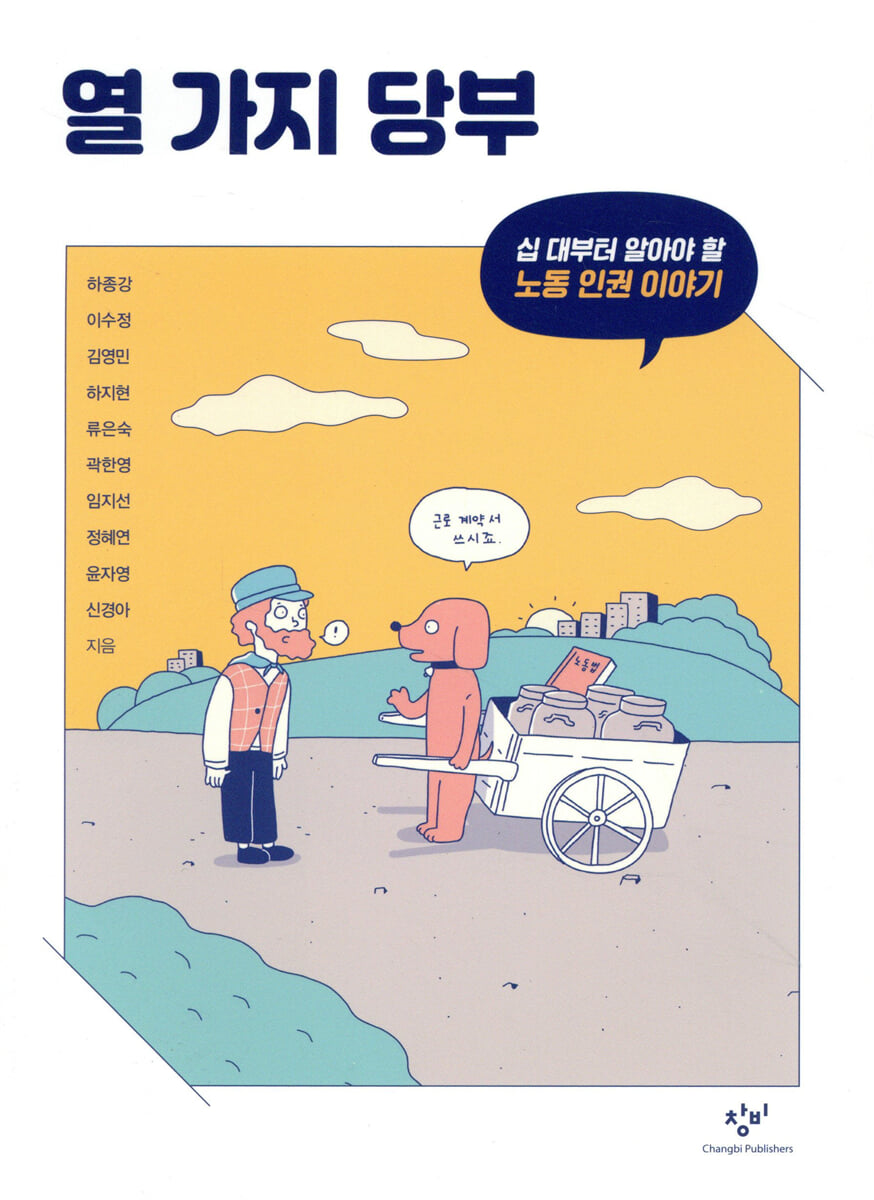
"Ten Commandments" is a labor rights education book for teenagers and young adults.
We have compiled the knowledge and common sense about labor rights that those preparing for a working future and those stepping into the world of work for the first time, whether through part-time jobs, field training, or internships, must keep in mind.
The book is written in the form of a request.
Experts from various fields of our society, including labor attorneys, economists, doctors, and human rights activists, share a message of encouragement they would like to convey to young people.
The ten commands collected in this way are composed of essential advice that can be called the 'Ten Commandments of Workers' in themselves.
It covers basic information that everyone should know, from the meaning of a worker to the history of labor law, how to write an employment contract, and how to manage stress.
This book is a great help in protecting your body and mind, working with pride, and knowing and confidently pursuing your rights, regardless of your occupation.
A special message from our society's leading labor experts!
"Ten Commandments" is a labor rights education book for teenagers and young adults.
We have compiled the knowledge and common sense about labor rights that those preparing for a working future and those stepping into the world of work for the first time, whether through part-time jobs, field training, or internships, must keep in mind.
The book is written in the form of a request.
Experts from various fields of our society, including labor attorneys, economists, doctors, and human rights activists, share a message of encouragement they would like to convey to young people.
The ten commands collected in this way are composed of essential advice that can be called the 'Ten Commandments of Workers' in themselves.
It covers basic information that everyone should know, from the meaning of a worker to the history of labor law, how to write an employment contract, and how to manage stress.
This book is a great help in protecting your body and mind, working with pride, and knowing and confidently pursuing your rights, regardless of your occupation.
- You can preview some of the book's contents.
Preview
index
Entering
First Request: "The Will of the Workers" Don't Be Afraid of the Word "Labor"_Jonggang Ha
Second Request: Don't Give Up on "History of Labor Law," as Those Who Came Before Us Did - Kwak Han-young
Third Request: "Labor and Our Society" - Focus on the Quality of Labor - Lim Ji-seon
Fourth Request: "Labor Unions" - Kim Young-min
Fifth Request: "Labor and Politics" Remember the Usefulness of Politics_Jeong Hye-yeon
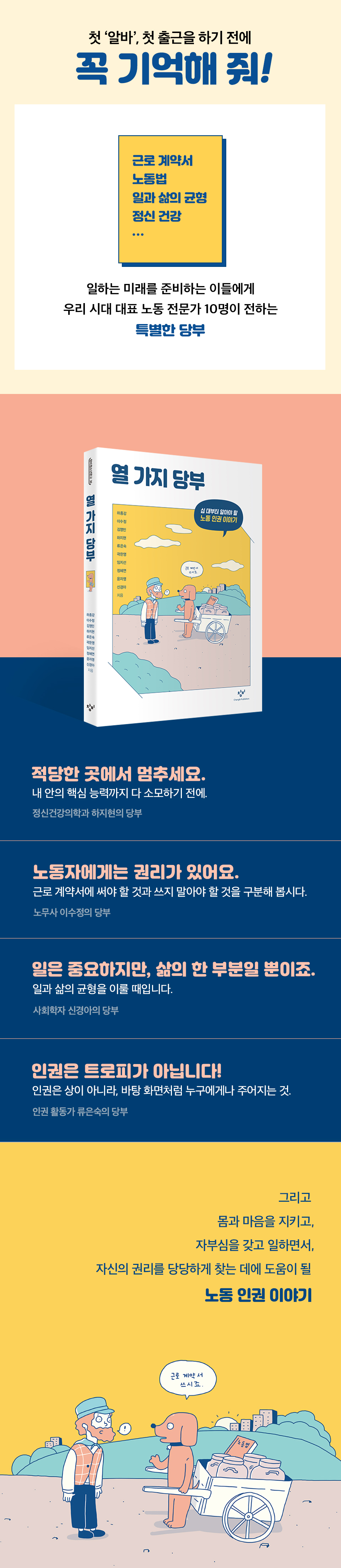
Sixth Request: "Employment Contracts" Workers Have Rights - Lee Soo-jung
Seventh Request: "Work and Mental Health" Stop at the Right Place_Ha Ji-hyun
Eighth Request: "Labor and Economics" Workers Need to Understand Businesses, Too - Yoon Ja-young
Ninth Request: "Labor and Human Rights" Human Rights Are Not a Trophy_Ryu Eun-sook
Tenth Commandment: Work-Life Balance. Work is important, but it's only one part of life. _Shin Kyung-ah
First Request: "The Will of the Workers" Don't Be Afraid of the Word "Labor"_Jonggang Ha
Second Request: Don't Give Up on "History of Labor Law," as Those Who Came Before Us Did - Kwak Han-young
Third Request: "Labor and Our Society" - Focus on the Quality of Labor - Lim Ji-seon
Fourth Request: "Labor Unions" - Kim Young-min
Fifth Request: "Labor and Politics" Remember the Usefulness of Politics_Jeong Hye-yeon
Sixth Request: "Employment Contracts" Workers Have Rights - Lee Soo-jung
Seventh Request: "Work and Mental Health" Stop at the Right Place_Ha Ji-hyun
Eighth Request: "Labor and Economics" Workers Need to Understand Businesses, Too - Yoon Ja-young
Ninth Request: "Labor and Human Rights" Human Rights Are Not a Trophy_Ryu Eun-sook
Tenth Commandment: Work-Life Balance. Work is important, but it's only one part of life. _Shin Kyung-ah
Detailed image
Into the book
In advanced countries, not only ambassadors but also high-ranking officials such as vice ministers can join unions.
This is because high-ranking civil servants are also viewed as ‘workers employed by the government.’
As society develops, this tendency becomes stronger.
In developed countries, the range of people who consider themselves workers tends to expand to higher and higher positions.
---From "Don't Be Afraid of the Word 'Labor'" by Ha Jong-gang
Place, who stayed up all night studying difficult laws in the back of his study, writing persuasive essays and distributing printed materials; Owen, who dedicated his entire fortune to proving that a community where workers' happiness and economic growth coexisted was possible; and Hein, who traveled to the shadows of society to spread the word about the suffering of workers and children. These efforts bore fruit in the form of institutions that we now take for granted: labor laws and labor rights.
---From "Kwak Han-young, Don't Give Up, Just Like Those Who Went Before"
In a society where working people live together, a society's attitude toward 'labor' is ultimately the same as its attitude toward 'humans'.
In a society overflowing with inhumane labor, the idea that only I, who do human labor and am treated with dignity, is close to an illusion.
Conversely, if we live in a society where everyone is treated with dignity and respect while working, I too am more likely to have a decent work environment.
---From "Im Ji-seon, Take an Interest in the Quality of Labor"
70,000 won may seem like a small amount of money, but for a working person, no labor is small.
It is not labor that can be easily thrown away just because it is easily used.
---From "Kim Young-min, there's no such thing"
These days, people often say that teenagers and young adults are indifferent to politics.
Teenagers and young adults themselves say so.
I don't think so.
At least the ones I met were different.
The countless young people I met during the last election period, the young people I met to resolve the issue of getting on and off the train, all wanted to solve their own problems in life, and when politicians wanted to join them, they joined hands without hesitation.
---From "Jeong Hye-yeon, Please Remember the Usefulness of Politics"
Employment contracts should not contain provisions that seek to discipline workers through fines and penalties.
Because this is an act that undermines the dignity of workers.
It's important to remember that employment contracts are meant to clarify working conditions, not create a "slave contract."
---From "Lee Su-jeong, Workers Have Rights"
Trauma can knock me down, but it can't break me or destroy me.
After I fall, I can get back up.
It's not just PTSD, there's also something called 'post-traumatic growth', and that kind of growth happens to a lot of people.
---From "Ha Ji-hyun, Stop at an Appropriate Place"
What do workers, who have no other source of income than wages, want? Most likely, they want work that isn't extremely difficult, pays well, and, if possible, is enjoyable.
On the other hand, what do employers want? Maximizing profits.
Employers control the production process and organize the labor process to extract as much labor service as possible from workers.
---From "Yoon Ja-young, Workers Must Also Understand Companies"
Labor rights are a fundamental mechanism for respecting workers' dignity, not a trophy for high achievement.
It's not like it's some kind of award given for studying well.
Labor rights are fundamental rights, and fundamental rights are like the desktop background of a computer.
Everyone should have a desktop wallpaper.
On top of that, each person reveals their individuality and competes for achievements.
---From "Ryu Eun-sook, Human Rights Are Not a Trophy"
What is quality of life? It can be defined as the goals and standards for a life that humans should enjoy.
It includes not only material consumption but also spiritual happiness.
To improve your quality of life, restoring balance between work and other areas of life is paramount.
This is because high-ranking civil servants are also viewed as ‘workers employed by the government.’
As society develops, this tendency becomes stronger.
In developed countries, the range of people who consider themselves workers tends to expand to higher and higher positions.
---From "Don't Be Afraid of the Word 'Labor'" by Ha Jong-gang
Place, who stayed up all night studying difficult laws in the back of his study, writing persuasive essays and distributing printed materials; Owen, who dedicated his entire fortune to proving that a community where workers' happiness and economic growth coexisted was possible; and Hein, who traveled to the shadows of society to spread the word about the suffering of workers and children. These efforts bore fruit in the form of institutions that we now take for granted: labor laws and labor rights.
---From "Kwak Han-young, Don't Give Up, Just Like Those Who Went Before"
In a society where working people live together, a society's attitude toward 'labor' is ultimately the same as its attitude toward 'humans'.
In a society overflowing with inhumane labor, the idea that only I, who do human labor and am treated with dignity, is close to an illusion.
Conversely, if we live in a society where everyone is treated with dignity and respect while working, I too am more likely to have a decent work environment.
---From "Im Ji-seon, Take an Interest in the Quality of Labor"
70,000 won may seem like a small amount of money, but for a working person, no labor is small.
It is not labor that can be easily thrown away just because it is easily used.
---From "Kim Young-min, there's no such thing"
These days, people often say that teenagers and young adults are indifferent to politics.
Teenagers and young adults themselves say so.
I don't think so.
At least the ones I met were different.
The countless young people I met during the last election period, the young people I met to resolve the issue of getting on and off the train, all wanted to solve their own problems in life, and when politicians wanted to join them, they joined hands without hesitation.
---From "Jeong Hye-yeon, Please Remember the Usefulness of Politics"
Employment contracts should not contain provisions that seek to discipline workers through fines and penalties.
Because this is an act that undermines the dignity of workers.
It's important to remember that employment contracts are meant to clarify working conditions, not create a "slave contract."
---From "Lee Su-jeong, Workers Have Rights"
Trauma can knock me down, but it can't break me or destroy me.
After I fall, I can get back up.
It's not just PTSD, there's also something called 'post-traumatic growth', and that kind of growth happens to a lot of people.
---From "Ha Ji-hyun, Stop at an Appropriate Place"
What do workers, who have no other source of income than wages, want? Most likely, they want work that isn't extremely difficult, pays well, and, if possible, is enjoyable.
On the other hand, what do employers want? Maximizing profits.
Employers control the production process and organize the labor process to extract as much labor service as possible from workers.
---From "Yoon Ja-young, Workers Must Also Understand Companies"
Labor rights are a fundamental mechanism for respecting workers' dignity, not a trophy for high achievement.
It's not like it's some kind of award given for studying well.
Labor rights are fundamental rights, and fundamental rights are like the desktop background of a computer.
Everyone should have a desktop wallpaper.
On top of that, each person reveals their individuality and competes for achievements.
---From "Ryu Eun-sook, Human Rights Are Not a Trophy"
What is quality of life? It can be defined as the goals and standards for a life that humans should enjoy.
It includes not only material consumption but also spiritual happiness.
To improve your quality of life, restoring balance between work and other areas of life is paramount.
---From "Shingyeong-ah, work is important, but it's only a part of life"
Publisher's Review
From the will of workers to labor law
Basic knowledge to prepare in advance
When should education on labor rights begin? In Germany, it begins in elementary school.
German elementary school students participate in mock labor-management negotiations several times a year.
France is similar.
French high school students actively discuss labor market flexibility, the 35-hour workweek, and more in their classrooms.
The reason these classes are possible is because these countries believe that sharing knowledge about labor rights widely among members of society is beneficial to society as a whole.
Recently, awareness of this issue is increasing in Korea, with labor rights education becoming mandatory in high schools.
There is a growing consensus that young people, who must prepare for a working future, need to acquire knowledge about labor rights before entering the workplace.
In this regard, we have compiled the advice that our society's leading experts with similar concerns can offer in their respective fields into "Ten Advices."
For readers who have little or no work experience, we provide comprehensive information ranging from very basic to practical.
The story begins with 'the will of the workers'.
Who is a worker? Professor Ha Jong-kang of Sungkonghoe University, a longtime expert in labor issues, examines the usage of the words "labor" and "work." He shares the story of how even principals in Finland join unions, demonstrating that as society develops, the scope of those who consider themselves workers is expanding.
At the same time, he conveys the message that there is no need to feel awkward about the word ‘labor.’
In addition, legal education scholar Kwak Han-young explains in detail the difficult process through which labor law has developed to reach its current state and how it seeks to protect workers' rights.
And, just because there is a labor law, it does not mean that labor rights are automatically protected, and it is important to convey the message that citizens' awareness is important.
The history of labor law itself tells us why labor law exists.
The reality of our society,
Specific and practical advice based on it
The story continues with a diagnosis and critique of the reality of our society today.
Lim Ji-seon, a reporter for the Hankyoreh, cautiously confesses, based on her long experience covering the labor scene, that the labor situation in our society is still not easy.
At the same time, the fact that positive signs continue to emerge, such as the minimum wage rising and the creation of platform labor solidarity, provides hope.
Kim Young-min, the director of the Youth Union, and Jeong Hye-yeon, a former deputy leader of the Justice Party and a young politician, represent the views of young people of their generation.
By analyzing how the situations and thoughts of today's youth differ from those of the older generation, we build empathy as a generation and emphasize the importance of solidarity and politics.
Labor attorney Lee Su-jeong and psychiatrist Ha Ji-hyeon offer more practical tips.
Labor attorney Lee Su-jeong carefully explains how to write an employment contract.
Starting with what should and should not be included in a contract, it goes into detail about workers' rights, emphasizing that the minimum wage is literally just a minimum standard and that we should aim for higher standards.
Dr. Ha Ji-hyun provides guidance on how to maintain mental health by focusing on stress.
Explaining the mechanisms by which burnout and anxiety emerge, he advises that when working, we need the wisdom to know when to stop at an appropriate point, rather than enduring until we "burn out."
What kind of work and life do you dream of?
To prepare for the future with a broader perspective
There are also exhortations to help you look at work and life from a broader perspective, beyond your immediate needs.
Economist Ja-Young Yoon emphasizes that workers also need to know about companies, and explains the characteristics of companies that would be helpful for workers to know.
Beginning with the question, "Do people really hate their jobs?", the story logically explains why corporate organizations are vertical and why the interests of workers and managers within a company inevitably differ, helping readers understand the situation.
This explanation naturally shows that the idea that workers are lazy is a prejudice.
Human rights activist Ryu Eun-sook views labor rights from a human rights perspective, emphasizing that labor rights are a natural right granted to all workers, like a computer desktop, and not an achievement or trophy based on effort.
Finally, sociologist Shin Kyung-ah explains that awareness of 'work-life balance' is gradually increasing in our society and discusses how it can be achieved.
The message that this chapter emphasizes throughout—that work is important, but only a part of life—is also a message that runs through the entire book.
Basic knowledge to prepare in advance
When should education on labor rights begin? In Germany, it begins in elementary school.
German elementary school students participate in mock labor-management negotiations several times a year.
France is similar.
French high school students actively discuss labor market flexibility, the 35-hour workweek, and more in their classrooms.
The reason these classes are possible is because these countries believe that sharing knowledge about labor rights widely among members of society is beneficial to society as a whole.
Recently, awareness of this issue is increasing in Korea, with labor rights education becoming mandatory in high schools.
There is a growing consensus that young people, who must prepare for a working future, need to acquire knowledge about labor rights before entering the workplace.
In this regard, we have compiled the advice that our society's leading experts with similar concerns can offer in their respective fields into "Ten Advices."
For readers who have little or no work experience, we provide comprehensive information ranging from very basic to practical.
The story begins with 'the will of the workers'.
Who is a worker? Professor Ha Jong-kang of Sungkonghoe University, a longtime expert in labor issues, examines the usage of the words "labor" and "work." He shares the story of how even principals in Finland join unions, demonstrating that as society develops, the scope of those who consider themselves workers is expanding.
At the same time, he conveys the message that there is no need to feel awkward about the word ‘labor.’
In addition, legal education scholar Kwak Han-young explains in detail the difficult process through which labor law has developed to reach its current state and how it seeks to protect workers' rights.
And, just because there is a labor law, it does not mean that labor rights are automatically protected, and it is important to convey the message that citizens' awareness is important.
The history of labor law itself tells us why labor law exists.
The reality of our society,
Specific and practical advice based on it
The story continues with a diagnosis and critique of the reality of our society today.
Lim Ji-seon, a reporter for the Hankyoreh, cautiously confesses, based on her long experience covering the labor scene, that the labor situation in our society is still not easy.
At the same time, the fact that positive signs continue to emerge, such as the minimum wage rising and the creation of platform labor solidarity, provides hope.
Kim Young-min, the director of the Youth Union, and Jeong Hye-yeon, a former deputy leader of the Justice Party and a young politician, represent the views of young people of their generation.
By analyzing how the situations and thoughts of today's youth differ from those of the older generation, we build empathy as a generation and emphasize the importance of solidarity and politics.
Labor attorney Lee Su-jeong and psychiatrist Ha Ji-hyeon offer more practical tips.
Labor attorney Lee Su-jeong carefully explains how to write an employment contract.
Starting with what should and should not be included in a contract, it goes into detail about workers' rights, emphasizing that the minimum wage is literally just a minimum standard and that we should aim for higher standards.
Dr. Ha Ji-hyun provides guidance on how to maintain mental health by focusing on stress.
Explaining the mechanisms by which burnout and anxiety emerge, he advises that when working, we need the wisdom to know when to stop at an appropriate point, rather than enduring until we "burn out."
What kind of work and life do you dream of?
To prepare for the future with a broader perspective
There are also exhortations to help you look at work and life from a broader perspective, beyond your immediate needs.
Economist Ja-Young Yoon emphasizes that workers also need to know about companies, and explains the characteristics of companies that would be helpful for workers to know.
Beginning with the question, "Do people really hate their jobs?", the story logically explains why corporate organizations are vertical and why the interests of workers and managers within a company inevitably differ, helping readers understand the situation.
This explanation naturally shows that the idea that workers are lazy is a prejudice.
Human rights activist Ryu Eun-sook views labor rights from a human rights perspective, emphasizing that labor rights are a natural right granted to all workers, like a computer desktop, and not an achievement or trophy based on effort.
Finally, sociologist Shin Kyung-ah explains that awareness of 'work-life balance' is gradually increasing in our society and discusses how it can be achieved.
The message that this chapter emphasizes throughout—that work is important, but only a part of life—is also a message that runs through the entire book.
GOODS SPECIFICS
- Date of issue: January 3, 2020
- Page count, weight, size: 228 pages | 350g | 152*210*13mm
- ISBN13: 9788936452360
- ISBN10: 8936452363
You may also like
카테고리
korean


korean

![GQ KOREA Mark (Monthly): December [2025]](http://librairie.coreenne.fr/cdn/shop/files/8ef265dbbfbf186523ed75ba7319009d.jpg?v=1765340328&width=3840)


