

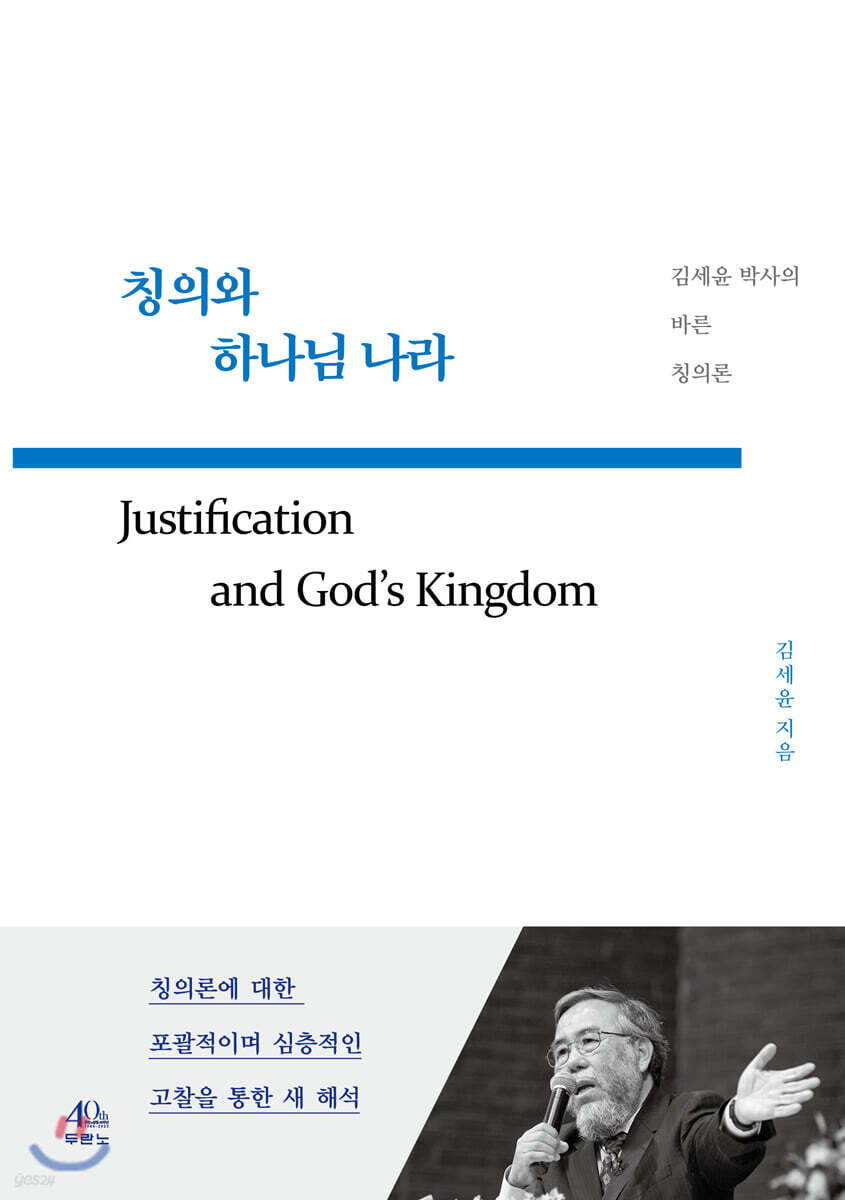
Justification and the Kingdom of God
 |
Description
Book Introduction
Dr. Kim Se-yoon, the world's theological community and church
A Comprehensive Understanding of the New Doctrine of Justification
There has never been a clearer and more correct interpretation of 'justification' and 'the fruit of righteousness', which are still hotly debated in theological circles.
Additionally, the appendix's commentary on Tom Wright's "Paul's Biography" provides a clear understanding of the flaws in "A New Perspective on the Gospel of Paul" and the correct justification.
A Comprehensive Understanding of the New Doctrine of Justification
There has never been a clearer and more correct interpretation of 'justification' and 'the fruit of righteousness', which are still hotly debated in theological circles.
Additionally, the appendix's commentary on Tom Wright's "Paul's Biography" provides a clear understanding of the flaws in "A New Perspective on the Gospel of Paul" and the correct justification.
- You can preview some of the book's contents.
Preview
index
Introduction 8
Introduction 12
Chapter 1
The summative structure of Romans 1:3-4 and 15:7-12, and the two definitions of the gospel in Romans 1:3-4 and 1:16-17. 27
Chapter 2
The Christological Form of the Gospel Concerning Jesus, the Son of God and Messiah 35
Chapter 3
Jesus, the Messiah, the Son of God, through his atonement, present reign, and intercession, will destroy the powers of Satan.
Redeeming Us 47
Chapter 4
The Revelation of God's Righteousness (Romans 1:17; 3:21) 73
Chapter 5
Justification means the restoration of a right relationship with God (i.e., the transfer of sovereignty) along with the declaration of innocence. 81
Chapter 6
Justification and the Transfer of Sovereignty by Faith in Baptism (Romans 10:9-10) 89
Chapter 7
The Present Stage of Justification and Ethical Imperatives 99
Chapter 8
Justification by God's Grace and Judgment According to Our Works 119
Chapter 9
“There is neither Jew nor Greek, there is neither slave nor free, there is neither male nor female” (Galatians 3:28) 145
Chapter 10
Paul's Gospel of Justification, which expressed Jesus' gospel of the kingdom of God in a soteriological form after Easter, 157
Chapter 11
In interpreting the doctrine of justification, the "Kingdom of God" is a more comprehensive category than "Abraham's family."
- N.
Critique of T. Wright's Interpretation 173
Summary and Conclusion 192
Appendix: N.
Commentary on T. Wright, Paul: A Biography (San Francisco: HarperOne, 2018) 198
Abbreviation Table 213
Reference 214
Author Index 233
Bible Verse Index 237
Index of Ancient Literature 257
Introduction 12
Chapter 1
The summative structure of Romans 1:3-4 and 15:7-12, and the two definitions of the gospel in Romans 1:3-4 and 1:16-17. 27
Chapter 2
The Christological Form of the Gospel Concerning Jesus, the Son of God and Messiah 35
Chapter 3
Jesus, the Messiah, the Son of God, through his atonement, present reign, and intercession, will destroy the powers of Satan.
Redeeming Us 47
Chapter 4
The Revelation of God's Righteousness (Romans 1:17; 3:21) 73
Chapter 5
Justification means the restoration of a right relationship with God (i.e., the transfer of sovereignty) along with the declaration of innocence. 81
Chapter 6
Justification and the Transfer of Sovereignty by Faith in Baptism (Romans 10:9-10) 89
Chapter 7
The Present Stage of Justification and Ethical Imperatives 99
Chapter 8
Justification by God's Grace and Judgment According to Our Works 119
Chapter 9
“There is neither Jew nor Greek, there is neither slave nor free, there is neither male nor female” (Galatians 3:28) 145
Chapter 10
Paul's Gospel of Justification, which expressed Jesus' gospel of the kingdom of God in a soteriological form after Easter, 157
Chapter 11
In interpreting the doctrine of justification, the "Kingdom of God" is a more comprehensive category than "Abraham's family."
- N.
Critique of T. Wright's Interpretation 173
Summary and Conclusion 192
Appendix: N.
Commentary on T. Wright, Paul: A Biography (San Francisco: HarperOne, 2018) 198
Abbreviation Table 213
Reference 214
Author Index 233
Bible Verse Index 237
Index of Ancient Literature 257
Into the book
The separation of faith that justifies and righteous living is a serious problem not only among Christians in my home country of Korea, but also among Christians in the United States, where I now live and minister.
Because of this problem, the church, the community of God's righteous people, is not effective in carrying out its mission to realize the "righteousness, peace, and happiness" of God's kingdom on earth (Romans 14:17).
So instead of being the 'salt' and 'light' of the world as Jesus commanded (Matthew 5:14-16), or 'shining lights in the world' as Paul exhorted (Philippians 2:14-16), Christians often darken and corrupt the world, making themselves the butt of ridicule from more educated non-Christians.
So this book was written with pastoral concerns.
But this book is not a sermon, but an academic paper.
Nevertheless, I hope that my exposition of Paul's doctrine of justification in this book will prompt some readers to take their discipleship more seriously (as it has indeed prompted me to reflect on my own discipleship) and persuade some of my fellow professors and pastors to teach or preach the doctrine of justification in a more comprehensive way.
Thus, I sincerely hope that the Church of Christ will further realize the righteousness and life of the kingdom of God and His Son, the Lord Jesus Christ, on this earth.
--- pp.9-10
Here, we utilize Käsemann's insight into understanding justification as a transference of sovereignty within an apocalyptic framework, approaching Paul's doctrine of justification from both a Christological and an anthropological perspective (or from a perspective that integrates Christology and anthropology), as he presents it in his letter to the church in Rome, and examine how Paul's ethics emerge from that doctrine and his
The doctrine of judgment according to works attempts to explain how it relates to the doctrine of justification.
--- p.25
In Romans, Paul develops his gospel in soteriological rather than Christological terms, particularly in the figurative language of justification.
But through this summative structure that refers to Jesus's saving rule over all nations as the Davidic Messiah, Paul is suggesting that salvation through Jesus, that is, the justification of sinners, is the eschatological salvation that Jesus brought and is bringing as the messianic king of Israel and all nations.
This means that we can only properly understand and appreciate the true value of Paul's gospel of justification when we interpret it in the context or in terms of Jesus being established as God's "authorized Son," that is, as God's vice-king who exercises God's royal authority on God's behalf, exercising a reign of salvation over all nations as the Davidic Messiah.
--- p.31
At the end of this present reign of the Lord Jesus Christ, at His second coming, the resurrected and exalted Christ will intercede for us at God's final judgment seat, that we may attain the perfection of justification.
These two works absolutely necessary for the completion of our justification (defeat of Satan's rule and sustaining us as righteous people under God's rule, and interceding for us at the final judgment) are what the resurrected Christ, the exalted Son of God, is doing and will do in 'his [resurrection] life' (Rom. 5:10b).
That is why Paul says, “Christ was raised up for our justification” (Rom. 4:25b).
In other words, Christ was resurrected to do these two things for our justification 'with his life.'
--- p.59
Whoever believes the gospel or receives it by faith receives the righteousness of God revealed in the gospel (i.e., God's saving acts in sending his Son Jesus Christ as our inclusive substitute for our sins, delivering him up to death on the cross, and raising him from the dead to be Lord of all; that is, the saving acts he performed through his Son, faithfully fulfilling his covenant promises).
So he is justified ('declared righteous' or 'reckoned as righteous', i.e., receives the status of a righteous person).
In this way, God's righteousness makes us (sinners) righteous.
Not in the sense of moral change, but in the relational sense.
What is clear is that the declaration or granting of such status includes the forgiveness of his sins or a declaration of his innocence.
But this declaration or grant also includes restoration to a right relationship with God.
This is because, according to the biblical worldview and anthropology, humans do not exist in isolation or independency, but rather in relationship with God, their Creator, and the very concept of a righteous person or an unrighteous person (or sinner) is determined in relation to their relationship with God.
A person who is declared righteous, or who is given the status of righteousness, is not someone who has moral qualities in himself apart from his relationship with God and his neighbor, but someone who stands in a right relationship with God (and consequently with his neighbor).
Therefore, justification is not just a declaration of innocence, but also a restoration to a right relationship with God.
--- pp.82-83
Paul's gospel of justification by grace and through faith has the power not only to liberate individual believers from Satan's reign of sin and death, but also to bring about social and cultural revolution.
That the gospel is rightly proclaimed in the language of the kingdom of God and his Son, the Lord Jesus, and that believers listen to the gospel with the 'obedience of faith' and 'the righteousness' in their lives.
When it bears 'fruit', the gospel advances human rights, freedom, equality, justice, philanthropy, solidarity, and peace on earth, thereby healing the world from the many evil influences of Satan's reign of sin and preemptively realizing the salvation of the kingdom of God here and now (cf.
Romans 14:17).
So the gospel of God's gracious reign of salvation in Jesus Christ, His Son, is the 'power of God to save' that justifies all who believe in it - not only in a personal sense, but also in a social or even cosmic sense.
We can already enjoy the first fruits of that salvation, and we can confidently look forward to its eschatological consummation.
Thus, the gospel of God's righteousness revealed in Christ Jesus, the Son of God, that is, the gospel of justification by the grace of the Triune God and through our faith, is the most powerful tool to destroy the kingdom of Satan and redeem humanity and the world from it.
In other words, 'current
It is the most powerful tool to set right the 'evil generation/world', or the 'crooked and perverse generation' (cf. Gal. 1:4; Phil. 2:15), and to proactively realize the eschatological 'new creation' here and now (cf.
2 Corinthians 5:17; Galatians 6:15).
Because of this problem, the church, the community of God's righteous people, is not effective in carrying out its mission to realize the "righteousness, peace, and happiness" of God's kingdom on earth (Romans 14:17).
So instead of being the 'salt' and 'light' of the world as Jesus commanded (Matthew 5:14-16), or 'shining lights in the world' as Paul exhorted (Philippians 2:14-16), Christians often darken and corrupt the world, making themselves the butt of ridicule from more educated non-Christians.
So this book was written with pastoral concerns.
But this book is not a sermon, but an academic paper.
Nevertheless, I hope that my exposition of Paul's doctrine of justification in this book will prompt some readers to take their discipleship more seriously (as it has indeed prompted me to reflect on my own discipleship) and persuade some of my fellow professors and pastors to teach or preach the doctrine of justification in a more comprehensive way.
Thus, I sincerely hope that the Church of Christ will further realize the righteousness and life of the kingdom of God and His Son, the Lord Jesus Christ, on this earth.
--- pp.9-10
Here, we utilize Käsemann's insight into understanding justification as a transference of sovereignty within an apocalyptic framework, approaching Paul's doctrine of justification from both a Christological and an anthropological perspective (or from a perspective that integrates Christology and anthropology), as he presents it in his letter to the church in Rome, and examine how Paul's ethics emerge from that doctrine and his
The doctrine of judgment according to works attempts to explain how it relates to the doctrine of justification.
--- p.25
In Romans, Paul develops his gospel in soteriological rather than Christological terms, particularly in the figurative language of justification.
But through this summative structure that refers to Jesus's saving rule over all nations as the Davidic Messiah, Paul is suggesting that salvation through Jesus, that is, the justification of sinners, is the eschatological salvation that Jesus brought and is bringing as the messianic king of Israel and all nations.
This means that we can only properly understand and appreciate the true value of Paul's gospel of justification when we interpret it in the context or in terms of Jesus being established as God's "authorized Son," that is, as God's vice-king who exercises God's royal authority on God's behalf, exercising a reign of salvation over all nations as the Davidic Messiah.
--- p.31
At the end of this present reign of the Lord Jesus Christ, at His second coming, the resurrected and exalted Christ will intercede for us at God's final judgment seat, that we may attain the perfection of justification.
These two works absolutely necessary for the completion of our justification (defeat of Satan's rule and sustaining us as righteous people under God's rule, and interceding for us at the final judgment) are what the resurrected Christ, the exalted Son of God, is doing and will do in 'his [resurrection] life' (Rom. 5:10b).
That is why Paul says, “Christ was raised up for our justification” (Rom. 4:25b).
In other words, Christ was resurrected to do these two things for our justification 'with his life.'
--- p.59
Whoever believes the gospel or receives it by faith receives the righteousness of God revealed in the gospel (i.e., God's saving acts in sending his Son Jesus Christ as our inclusive substitute for our sins, delivering him up to death on the cross, and raising him from the dead to be Lord of all; that is, the saving acts he performed through his Son, faithfully fulfilling his covenant promises).
So he is justified ('declared righteous' or 'reckoned as righteous', i.e., receives the status of a righteous person).
In this way, God's righteousness makes us (sinners) righteous.
Not in the sense of moral change, but in the relational sense.
What is clear is that the declaration or granting of such status includes the forgiveness of his sins or a declaration of his innocence.
But this declaration or grant also includes restoration to a right relationship with God.
This is because, according to the biblical worldview and anthropology, humans do not exist in isolation or independency, but rather in relationship with God, their Creator, and the very concept of a righteous person or an unrighteous person (or sinner) is determined in relation to their relationship with God.
A person who is declared righteous, or who is given the status of righteousness, is not someone who has moral qualities in himself apart from his relationship with God and his neighbor, but someone who stands in a right relationship with God (and consequently with his neighbor).
Therefore, justification is not just a declaration of innocence, but also a restoration to a right relationship with God.
--- pp.82-83
Paul's gospel of justification by grace and through faith has the power not only to liberate individual believers from Satan's reign of sin and death, but also to bring about social and cultural revolution.
That the gospel is rightly proclaimed in the language of the kingdom of God and his Son, the Lord Jesus, and that believers listen to the gospel with the 'obedience of faith' and 'the righteousness' in their lives.
When it bears 'fruit', the gospel advances human rights, freedom, equality, justice, philanthropy, solidarity, and peace on earth, thereby healing the world from the many evil influences of Satan's reign of sin and preemptively realizing the salvation of the kingdom of God here and now (cf.
Romans 14:17).
So the gospel of God's gracious reign of salvation in Jesus Christ, His Son, is the 'power of God to save' that justifies all who believe in it - not only in a personal sense, but also in a social or even cosmic sense.
We can already enjoy the first fruits of that salvation, and we can confidently look forward to its eschatological consummation.
Thus, the gospel of God's righteousness revealed in Christ Jesus, the Son of God, that is, the gospel of justification by the grace of the Triune God and through our faith, is the most powerful tool to destroy the kingdom of Satan and redeem humanity and the world from it.
In other words, 'current
It is the most powerful tool to set right the 'evil generation/world', or the 'crooked and perverse generation' (cf. Gal. 1:4; Phil. 2:15), and to proactively realize the eschatological 'new creation' here and now (cf.
2 Corinthians 5:17; Galatians 6:15).
--- pp.153-154
Publisher's Review
There has never been a clearer and more correct interpretation of 'justification' and 'the fruit of righteousness', which are still hotly debated in theological circles.
His comprehensive and in-depth interpretation of justification can be summarized in the following five points:
In addition, Tom Wright's commentary on the appendix, "Paul's Biography," provides a clear understanding of the flaws in "A New Perspective on the Gospel of Paul" and the correct justification.
1.
We must view justification not only in its legal sense of a declaration of innocence, but also in its relational sense of restoration to a right relationship with God, that is, transition into the kingdom of God and his Son, Jesus Christ.
2.
We should not only focus on the preliminary occurrence of justification at baptism, but also pay equal attention to the present process of justification and its future completion at the final judgment.
3.
We must approach the doctrine of justification not only from an anthropological or man-centered perspective (i.e., not only considering how humans are justified by faith in Christ), but more fundamentally from a Christological or Trinitarian perspective (i.e., considering how the resurrected Lord Jesus Christ exercises the saving government He has received from God through the Holy Spirit, thereby sustaining believers in a state of justification through His intercession [i.e., by His grace] until the final judgment when they will be judged according to their works).
4.
We must emphasize that the components of the doctrine of justification include the demand that we bear the 'fruit of righteousness' by 'obedience of faith' to the rule of the Lord Jesus Christ in the present process of justification.
5.
In addition, it must be emphasized that the doctrine of justification contains a significant meaning or command for missions encompassing the entire world (Rom 1:5, 14-17) and social and cultural transformation, that is, to correct a 'crooked and perverse' world (Phil 2:15) and realize 'righteousness, peace, and joy (happiness)' of the kingdom of God (Rom 14:17).
*This book is a Korean translation of the one published by Mohr Siebeck in Tübingen, Germany in September 2018.
His comprehensive and in-depth interpretation of justification can be summarized in the following five points:
In addition, Tom Wright's commentary on the appendix, "Paul's Biography," provides a clear understanding of the flaws in "A New Perspective on the Gospel of Paul" and the correct justification.
1.
We must view justification not only in its legal sense of a declaration of innocence, but also in its relational sense of restoration to a right relationship with God, that is, transition into the kingdom of God and his Son, Jesus Christ.
2.
We should not only focus on the preliminary occurrence of justification at baptism, but also pay equal attention to the present process of justification and its future completion at the final judgment.
3.
We must approach the doctrine of justification not only from an anthropological or man-centered perspective (i.e., not only considering how humans are justified by faith in Christ), but more fundamentally from a Christological or Trinitarian perspective (i.e., considering how the resurrected Lord Jesus Christ exercises the saving government He has received from God through the Holy Spirit, thereby sustaining believers in a state of justification through His intercession [i.e., by His grace] until the final judgment when they will be judged according to their works).
4.
We must emphasize that the components of the doctrine of justification include the demand that we bear the 'fruit of righteousness' by 'obedience of faith' to the rule of the Lord Jesus Christ in the present process of justification.
5.
In addition, it must be emphasized that the doctrine of justification contains a significant meaning or command for missions encompassing the entire world (Rom 1:5, 14-17) and social and cultural transformation, that is, to correct a 'crooked and perverse' world (Phil 2:15) and realize 'righteousness, peace, and joy (happiness)' of the kingdom of God (Rom 14:17).
*This book is a Korean translation of the one published by Mohr Siebeck in Tübingen, Germany in September 2018.
GOODS SPECIFICS
- Date of issue: July 22, 2020
- Page count, weight, size: 260 pages | 422g | 148*210*15mm
- ISBN13: 9788953138186
- ISBN10: 8953138183
You may also like
카테고리
korean


korean

![GQ KOREA Mark (Monthly): December [2025]](http://librairie.coreenne.fr/cdn/shop/files/8ef265dbbfbf186523ed75ba7319009d.jpg?v=1765340328&width=3840)


