

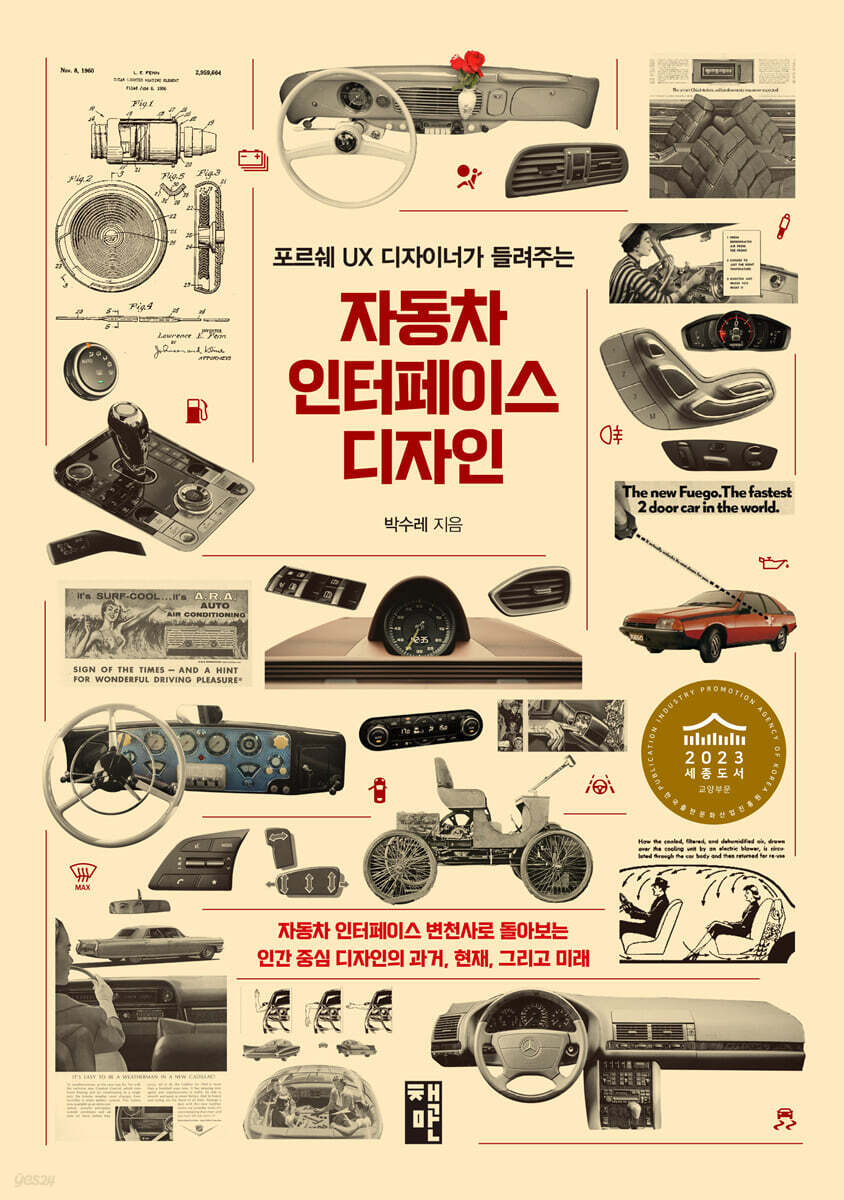
Automotive Interface Design
 |
Description
Book Introduction
“When were side mirrors invented?”
“Is the electric vehicle charging port on the left or the right?”
“Why is the air conditioner temperature control standard 0.5 degrees?”
“Why is a glove box called a glove box?”
This book begins with these trivial questions about cars.
Cars are machines, spaces, tools, and lifestyles that we use every day.
Among popular artifacts, the automobile is almost the only large machine that people can touch and operate directly.
The history of interfaces within the automobile space over the past 100 years provides crucial clues to understanding how humans and automobiles have coexisted.
This book is packed with engaging stories that anyone studying user experience (UX) or curious about cars will enjoy.
Additionally, the book is even more interesting because it includes the author's experiences as a UX designer at Porsche in Germany, giving a glimpse into the concerns of Porsche, a sports car brand with a history of over 70 years, in the field of user experience.
“Is the electric vehicle charging port on the left or the right?”
“Why is the air conditioner temperature control standard 0.5 degrees?”
“Why is a glove box called a glove box?”
This book begins with these trivial questions about cars.
Cars are machines, spaces, tools, and lifestyles that we use every day.
Among popular artifacts, the automobile is almost the only large machine that people can touch and operate directly.
The history of interfaces within the automobile space over the past 100 years provides crucial clues to understanding how humans and automobiles have coexisted.
This book is packed with engaging stories that anyone studying user experience (UX) or curious about cars will enjoy.
Additionally, the book is even more interesting because it includes the author's experiences as a UX designer at Porsche in Germany, giving a glimpse into the concerns of Porsche, a sports car brand with a history of over 70 years, in the field of user experience.
- You can preview some of the book's contents.
Preview
index
Chapter 1: What Automotive UX Designers Do
Everything you see, hear, and touch
Automotive UX Design Process
How far does UX design go?
Chapter 2: Why is a glove box called a glove box?
It was an open car in the first place.
My hands are numb
The beginning of vehicle storage space
With storage space on the dashboard
Glove box located in front of the passenger seat
Chapter 3: Cup Holder, an American Invention
Junk cup holder
The beginning of the cup holder
Before the drive-thru, there was the drive-in.
The ancestor of the modern cup holder
Mr. Cupholder, Don Clark
Cup holders, a new standard
Chapter 4: A car that gives you energy when you breathe in the scent of flowers
Is that a vase?
Electric cars and flowers
The emergence of car air fresheners
21st Century Five Senses Luxury
Chapter 5: The History of Opening and Closing Car Windows
Closed joints and side windows
The evolution of the Ford Model T
The advent of power windows
Full-to-close design
Chapter 6: It's Closer Than It Looks
The first mirrors started in racing
There was only one side mirror?
wing mirror
Adjusting the side mirrors
Power interior mirrors?
21st century cutting-edge side mirrors
Mirrors replaced by cameras
Chapter 7: Who Feels a 0.5 Degree Temperature Difference?
The beginning of in-vehicle air conditioning
aftermarket air conditioner
Cool breeze on your face
Air vent interface
Initial temperature setting
Find the exact temperature
Chapter 8: The Seat Adjustment Switch That Became a Textbook
History of seat adjustment
The first power seat
The Warring States Period of the Power Seat Interface
The emergence of the king of seat adjustment, Benz
What Power Seats Make Possible
The future of seat adjustment interfaces?
Chapter 9_ Where the cigarettes left off
The disappearing cigar jack
Smoking is a daily routine
The era of smoking cessation
Cigarettes are out, smartphones are in.
Chapter 10: People who drive with their dashboard turned
paddle shifters
Full strap
Start
shift light
Straight handle at the bottom
Chapter 11: Legacy of the Machine Age
Gauge
warning lights
Electric vehicle start button
Lights, wipers, heater, air conditioning…
The problem of handling legacy
Chapter 12: People are on board
illusion
children
carelessness
The paradox of safety devices
Are manual transmissions safer?
Chapter 13: The Old Future: Touchscreens
The first automotive touchscreen interface
The Dark Ages of Touchscreens, 1990-2000
The Beginning of Aftermarket GPS in 2000-2010
The touchscreen interface revival
We won't 'touch'
Is it okay because there is driving assistance?
Chapter 14: The Last Analog in the Car: The Clock
The first car clock
Popularization of car watches
Motorsports and Stopwatches
ETA (estimated time of arrival)
luxury interior
Chapter 15: This is not a blinker
From the receiving signal
trafficker
A blinker in the form of a flashing light appears
Blinker = lever?
Self-cancellation mechanism
One-touch blinker
Blinker escaped from lever
A car that is not driven by a person
Chapter 16: Our future is in the back seat.
folding chair
Whether people are riding or cargo is riding
Non-driving space
Autonomous driving = everyone in the back seat
The car experience is different from that of airplanes or trains.
Until you gain trust
Chapter 17: Is Electric Vehicle Charging Left or Right?
Select a sound
power meter
regenerative braking
Navigation
Charging monitoring
charging port
From machines to electronics
Chapter 18_Turn to Unlock
Anti-theft system
Beep! Remote key
Whose key is it?
Ballet-only key
The disappearing key
Chapter 19: Will More Screens Save Us?
Autonomous driving = screen?
Distraction
connection
Screen life cycle
motion sickness
The audio is still intact
Chapter 20: Who Knows This Pictogram?
Pictograms born with warning lights
Products without multilingual labeling
International standards for pictograms
Separately yet together
Now is the time to change
Warning lights that won't go away
Everything you see, hear, and touch
Automotive UX Design Process
How far does UX design go?
Chapter 2: Why is a glove box called a glove box?
It was an open car in the first place.
My hands are numb
The beginning of vehicle storage space
With storage space on the dashboard
Glove box located in front of the passenger seat
Chapter 3: Cup Holder, an American Invention
Junk cup holder
The beginning of the cup holder
Before the drive-thru, there was the drive-in.
The ancestor of the modern cup holder
Mr. Cupholder, Don Clark
Cup holders, a new standard
Chapter 4: A car that gives you energy when you breathe in the scent of flowers
Is that a vase?
Electric cars and flowers
The emergence of car air fresheners
21st Century Five Senses Luxury
Chapter 5: The History of Opening and Closing Car Windows
Closed joints and side windows
The evolution of the Ford Model T
The advent of power windows
Full-to-close design
Chapter 6: It's Closer Than It Looks
The first mirrors started in racing
There was only one side mirror?
wing mirror
Adjusting the side mirrors
Power interior mirrors?
21st century cutting-edge side mirrors
Mirrors replaced by cameras
Chapter 7: Who Feels a 0.5 Degree Temperature Difference?
The beginning of in-vehicle air conditioning
aftermarket air conditioner
Cool breeze on your face
Air vent interface
Initial temperature setting
Find the exact temperature
Chapter 8: The Seat Adjustment Switch That Became a Textbook
History of seat adjustment
The first power seat
The Warring States Period of the Power Seat Interface
The emergence of the king of seat adjustment, Benz
What Power Seats Make Possible
The future of seat adjustment interfaces?
Chapter 9_ Where the cigarettes left off
The disappearing cigar jack
Smoking is a daily routine
The era of smoking cessation
Cigarettes are out, smartphones are in.
Chapter 10: People who drive with their dashboard turned
paddle shifters
Full strap
Start
shift light
Straight handle at the bottom
Chapter 11: Legacy of the Machine Age
Gauge
warning lights
Electric vehicle start button
Lights, wipers, heater, air conditioning…
The problem of handling legacy
Chapter 12: People are on board
illusion
children
carelessness
The paradox of safety devices
Are manual transmissions safer?
Chapter 13: The Old Future: Touchscreens
The first automotive touchscreen interface
The Dark Ages of Touchscreens, 1990-2000
The Beginning of Aftermarket GPS in 2000-2010
The touchscreen interface revival
We won't 'touch'
Is it okay because there is driving assistance?
Chapter 14: The Last Analog in the Car: The Clock
The first car clock
Popularization of car watches
Motorsports and Stopwatches
ETA (estimated time of arrival)
luxury interior
Chapter 15: This is not a blinker
From the receiving signal
trafficker
A blinker in the form of a flashing light appears
Blinker = lever?
Self-cancellation mechanism
One-touch blinker
Blinker escaped from lever
A car that is not driven by a person
Chapter 16: Our future is in the back seat.
folding chair
Whether people are riding or cargo is riding
Non-driving space
Autonomous driving = everyone in the back seat
The car experience is different from that of airplanes or trains.
Until you gain trust
Chapter 17: Is Electric Vehicle Charging Left or Right?
Select a sound
power meter
regenerative braking
Navigation
Charging monitoring
charging port
From machines to electronics
Chapter 18_Turn to Unlock
Anti-theft system
Beep! Remote key
Whose key is it?
Ballet-only key
The disappearing key
Chapter 19: Will More Screens Save Us?
Autonomous driving = screen?
Distraction
connection
Screen life cycle
motion sickness
The audio is still intact
Chapter 20: Who Knows This Pictogram?
Pictograms born with warning lights
Products without multilingual labeling
International standards for pictograms
Separately yet together
Now is the time to change
Warning lights that won't go away
Into the book
The structure we commonly refer to as a 'dashboard' actually originated here.
A plank was added to the front of the carriage to prevent the dirt kicked up by the horses' hind legs from flying up. This was the beginning of what we still call the 'dashboard'.
--- p.43
Even until the 1960s, many cars did not have passenger-side side mirrors.
Because the road was only one lane in each direction, there was no need to worry about cars passing from the right.
So, if there was a slow vehicle in front, you could just cross the center line to overtake it, and considering these situations, one side mirror on the driver's seat was sufficient.
Of course, it makes perfect sense from the perspective of a manufacturer who needs to save on costs.
--- p.95
Thanks to this excellence, this seat adjustment interface has become a kind of 'textbook' that almost every manufacturer has copied today.
However, it was not until the 1990s that it became possible to follow this method, as Mercedes' patent lasted for seventeen years, preventing other manufacturers from imitating it.
--- p.144
Cars are objects used by people and are a type of space, so they inevitably reflect people's behavior patterns.
So, as times change, people's behavior changes, and cars change little by little to keep pace with it.
Cigarettes are gone, smartphones are here.
What will occupy this space in the next hundred years?
--- p.169
The part that first-time Porsche drivers always struggle with is ‘starting the car.’
Since it wasn't where it should have been, I remember wandering around for a long time at first.
While most manufacturers place the ignition key or button on the right side of the driver's seat, Porsche places it on the left, an interface that can be said to have its own history in motorsports.
--- p.179
The seat heating feature introduced by Saab in 1972 was designed to automatically turn on when the seat surface temperature fell below 14 degrees Celsius and automatically turn off when it reached around 27 degrees Celsius.
So, the seat heating system at that time was a fully automatic system that did not require separate human operation.
--- p.199
Machines are somewhat predictable.
There are physical limitations, there is a lifespan, and it is programmed to move as it is programmed.
But people are not like that.
Their bodies are all different in shape and ability, they are sometimes absent-minded or delusional, and they sometimes ignore warning signs that are right in front of them.
No matter what anyone says, the most difficult thing to measure is people.
--- p.202
While there's a fine for touching your smartphone, it's perfectly acceptable to touch your car's infotainment system, which boasts a multitude of touchscreens. In fact, some research suggests that in-car software like Android Auto and Apple CarPlay are safer than automakers' infotainment systems.
--- p.210
Since humans have eyes and ears, they send signals with lights and make sounds to warn us. But if all the cars on the road were autonomous robots, would there really be a need to exchange such primitive signals?
--- p.267
The overwhelming majority of respondents said they rented a car to sleep while looking for a place to catch their eye in the city, and there were also cases where people rented a car for a short period of time to use as a personal space, such as to make a phone call or change clothes.
--- p.277
Since 2019, all electric and hybrid vehicles have been required by law to emit a sound level of 56 decibels at a distance of 2 meters, which at first glance sounds like the sound of a washing machine.
Of course, in addition to these safety noises, manufacturers also work hard to create 'spaceship sounds' to make the sounds they are going to make even better.
A plank was added to the front of the carriage to prevent the dirt kicked up by the horses' hind legs from flying up. This was the beginning of what we still call the 'dashboard'.
--- p.43
Even until the 1960s, many cars did not have passenger-side side mirrors.
Because the road was only one lane in each direction, there was no need to worry about cars passing from the right.
So, if there was a slow vehicle in front, you could just cross the center line to overtake it, and considering these situations, one side mirror on the driver's seat was sufficient.
Of course, it makes perfect sense from the perspective of a manufacturer who needs to save on costs.
--- p.95
Thanks to this excellence, this seat adjustment interface has become a kind of 'textbook' that almost every manufacturer has copied today.
However, it was not until the 1990s that it became possible to follow this method, as Mercedes' patent lasted for seventeen years, preventing other manufacturers from imitating it.
--- p.144
Cars are objects used by people and are a type of space, so they inevitably reflect people's behavior patterns.
So, as times change, people's behavior changes, and cars change little by little to keep pace with it.
Cigarettes are gone, smartphones are here.
What will occupy this space in the next hundred years?
--- p.169
The part that first-time Porsche drivers always struggle with is ‘starting the car.’
Since it wasn't where it should have been, I remember wandering around for a long time at first.
While most manufacturers place the ignition key or button on the right side of the driver's seat, Porsche places it on the left, an interface that can be said to have its own history in motorsports.
--- p.179
The seat heating feature introduced by Saab in 1972 was designed to automatically turn on when the seat surface temperature fell below 14 degrees Celsius and automatically turn off when it reached around 27 degrees Celsius.
So, the seat heating system at that time was a fully automatic system that did not require separate human operation.
--- p.199
Machines are somewhat predictable.
There are physical limitations, there is a lifespan, and it is programmed to move as it is programmed.
But people are not like that.
Their bodies are all different in shape and ability, they are sometimes absent-minded or delusional, and they sometimes ignore warning signs that are right in front of them.
No matter what anyone says, the most difficult thing to measure is people.
--- p.202
While there's a fine for touching your smartphone, it's perfectly acceptable to touch your car's infotainment system, which boasts a multitude of touchscreens. In fact, some research suggests that in-car software like Android Auto and Apple CarPlay are safer than automakers' infotainment systems.
--- p.210
Since humans have eyes and ears, they send signals with lights and make sounds to warn us. But if all the cars on the road were autonomous robots, would there really be a need to exchange such primitive signals?
--- p.267
The overwhelming majority of respondents said they rented a car to sleep while looking for a place to catch their eye in the city, and there were also cases where people rented a car for a short period of time to use as a personal space, such as to make a phone call or change clothes.
--- p.277
Since 2019, all electric and hybrid vehicles have been required by law to emit a sound level of 56 decibels at a distance of 2 meters, which at first glance sounds like the sound of a washing machine.
Of course, in addition to these safety noises, manufacturers also work hard to create 'spaceship sounds' to make the sounds they are going to make even better.
--- p.288
Publisher's Review
“When were side mirrors invented?”
“Is the electric vehicle charging port on the left or the right?”
“Why is the air conditioner temperature control standard 0.5 degrees?”
“Why is a glove box called a glove box?”
This book begins with these trivial questions about cars.
Cars are machines, spaces, tools, and lifestyles that we use every day.
Among popular artifacts, the automobile is almost the only large machine that people can touch and operate directly.
The history of interfaces within the automobile space over the past 100 years provides crucial clues to understanding how humans and automobiles have coexisted.
This book is packed with engaging stories that anyone studying user experience (UX) or curious about cars will enjoy.
Additionally, the book is even more interesting because it includes the author's experiences as a UX designer at Porsche in Germany, giving a glimpse into the concerns of Porsche, a sports car brand with a history of over 70 years, in the field of user experience.
| Target audience for this book |
A general guide for designers and planners studying or working in user experience (UX), as well as for ordinary people who love cars.
Author's Note
Although I worked for a sports car company, I am not what you would call a car guy.
Even when I joined the automobile company, I had no idea what the numbers in BMW meant or what the class names in Benz meant.
After joining the company, I just kept thinking about every nook and cranny of the car every day, and I started to wonder, "Why is this thing stuck here?", and as I dug into those things one by one, I accumulated information and compiled it into a book.
So, in fact, this book is closer to a self-study book that I studied.
The visual appeal of a car's exterior is beyond words, but as I studied the interfaces inside the car one by one, I found the human-smelling history that took place inside so fascinating.
The automobile, which is both a machine and a space, a tool and a way of life, has been supported and developed for a hundred years, and the automobile we drive today is the very thing.
Moreover, as automobiles are currently undergoing a period of great upheaval in terms of electrification and digitalization, I thought it would be meaningful to look back on past changes and prepare for the future.
Didn't they say 'Onggojishin'?
On the other hand, I thought that reflecting people's lifestyles and the times, even though the subject is just cars, could be a good training (practice) for all UX designers.
Since any design for artifacts cannot be separated from an understanding of people, I hope that a look back at the history of automotive interfaces over the years can be an inspiration to all UX researchers.
“Is the electric vehicle charging port on the left or the right?”
“Why is the air conditioner temperature control standard 0.5 degrees?”
“Why is a glove box called a glove box?”
This book begins with these trivial questions about cars.
Cars are machines, spaces, tools, and lifestyles that we use every day.
Among popular artifacts, the automobile is almost the only large machine that people can touch and operate directly.
The history of interfaces within the automobile space over the past 100 years provides crucial clues to understanding how humans and automobiles have coexisted.
This book is packed with engaging stories that anyone studying user experience (UX) or curious about cars will enjoy.
Additionally, the book is even more interesting because it includes the author's experiences as a UX designer at Porsche in Germany, giving a glimpse into the concerns of Porsche, a sports car brand with a history of over 70 years, in the field of user experience.
| Target audience for this book |
A general guide for designers and planners studying or working in user experience (UX), as well as for ordinary people who love cars.
Author's Note
Although I worked for a sports car company, I am not what you would call a car guy.
Even when I joined the automobile company, I had no idea what the numbers in BMW meant or what the class names in Benz meant.
After joining the company, I just kept thinking about every nook and cranny of the car every day, and I started to wonder, "Why is this thing stuck here?", and as I dug into those things one by one, I accumulated information and compiled it into a book.
So, in fact, this book is closer to a self-study book that I studied.
The visual appeal of a car's exterior is beyond words, but as I studied the interfaces inside the car one by one, I found the human-smelling history that took place inside so fascinating.
The automobile, which is both a machine and a space, a tool and a way of life, has been supported and developed for a hundred years, and the automobile we drive today is the very thing.
Moreover, as automobiles are currently undergoing a period of great upheaval in terms of electrification and digitalization, I thought it would be meaningful to look back on past changes and prepare for the future.
Didn't they say 'Onggojishin'?
On the other hand, I thought that reflecting people's lifestyles and the times, even though the subject is just cars, could be a good training (practice) for all UX designers.
Since any design for artifacts cannot be separated from an understanding of people, I hope that a look back at the history of automotive interfaces over the years can be an inspiration to all UX researchers.
GOODS SPECIFICS
- Publication date: May 25, 2022
- Page count, weight, size: 352 pages | 558g | 148*210*20mm
- ISBN13: 9791189909390
- ISBN10: 1189909391
You may also like
카테고리
korean


korean

![GQ KOREA Mark (Monthly): December [2025]](http://librairie.coreenne.fr/cdn/shop/files/8ef265dbbfbf186523ed75ba7319009d.jpg?v=1765340328&width=3840)


