

Meter Group and Fantastic Unit Friends
 |
Description
Book Introduction
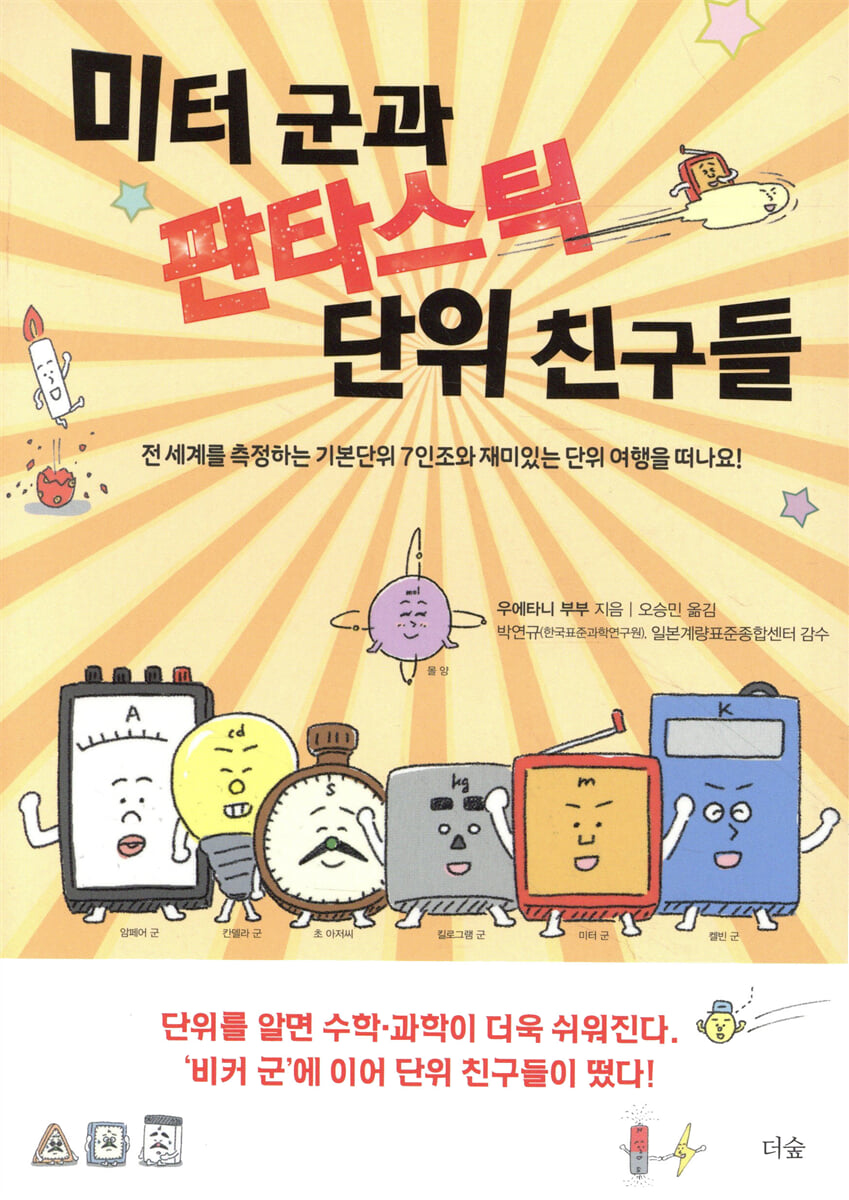
Go on a fun unit journey with the 7 basic units of measurement around the world! Knowing units makes math and science easier! A rich and entertaining story about units with the meter group. The Uetani couple, who brought readers the joy of studying science with the [Beaker Army] series, are back this time with their 'Unit Friends'. In "Meter Group and Fantastic Unit Friends," units of measurement from various fields, such as length, time, and mass, are transformed into adorable characters to introduce themselves. The world of units is explained in an easy and fun way through comics, and you can learn about the background of the creation of units used in math, science, and even everyday life, as well as how to define them and compare them with other units. This is a 'unit science book' that anyone who needs and likes science can read with interest, from teenagers who want to build a foundation in math and science studies, to people who are interested in scientific stories in everyday life that they were not aware of, to people looking for a fun science book. In 'Meter Group and Fantastic Unit Friends', a seven-member group called 'SI7' appears. The seven basic units defined in the International System of Units (SI) are the meter (length), second (time), kilogram (mass), ampere (electric current), kelvin (temperature), candela (luminous intensity), and mole (amount of substance). In addition to the basic units, there are also many other units, such as derived units derived from the basic units, such as Newton and Watt, and special units that are not part of the International System of Units but are used together, such as liter and ton. The basic unit of seven members kindly introduces friends from their respective areas of responsibility. The meter group naturally explains the definition of each unit of length by measuring height with Mr. Kilometer and Mr. Micrometer, who work together in 'length'. The kilogram group introduces not only mass units that have been used since ancient times, such as the don, geun, and gwan, but also the ounce group and pound-c, which are unfamiliar to us. Additionally, we can learn about various aspects of the measurement field that we were unaware of through columns by researchers at the Japan National Center for Measurement Standards. As the units appearing in the formulas in the textbook become more familiar, you will gain new vitality in your studies of math and science. |
- You can preview some of the book's contents.
Preview
index
Chapter 1 / Unit Story Told by the Meter Group
Why did units come into existence?
Meter group, what is the unit?
Introducing the International System of Units
Unit Rules You Must Know
Chapter 2 / What is length?
The Birth of the Meter Group
Definition of meter
Meter Group Profile
Funny Comics: Meter-kun's Special Skills
Other units related to length
Comparison of length units
Funny Comics: Drawings
Unit of area
Unit of volume
Column: Let's go on a unit 'pilgrimage'!
Chapter 3 / What is Time?
Uncle Cho's Secret
Sexagesimal story
Calendar story
First story
Mr. Cho's profile
Funny Comics: Uncle Cho's Special Skills
History of watches
Funny Cartoons: Thunder
Other units related to time
A story about speed and acceleration
Column: The Nobel Prize and the Unit Story
Chapter 4 / What is mass?
The kilogram story
The Birth of the Kilogram
Kilogram Army Profile
Funny Comics: Kilogram Army's Special Skills
Other units related to mass
Comparison of mass units
Density story
Funny Comics: Quiz
Unit of force
Unit of pressure
Work and work rate
Column: What We Learn from Unit Evolution
Chapter 5 / What is Temperature?
Temperature story
History of Temperature
Kelvin Gun, finally born
Kelvin Gun Profile
Funny Comics: Coffee
Column: Units That Inspired Adventure Novels
Chapter 6 / What is current?
Current Story
Ampere and Friends
Ampere Group Profile
Electricity and Magnetism
Great people who contributed to the development of electromagnetism
Funny Cartoons: Zoo
Column: The Mysteries Behind Units
Chapter 7 / What is luminosity?
The story of Gwangdo
Plane angles and solid angles
Definition of the candela group
Candela Group Profile
Funny Comics: Blackout
Chapter 8 / What is the amount of matter?
The story of the amount of matter
Definition of mole
Mol Yang Profile
Funny Comics: Mole Yang's Special Skills
Appendix / Units, Visiting the Research Institute
Research Institute Tour
Unit Conversion Table at a Glance
Characters appearing in this book
References
Why did units come into existence?
Meter group, what is the unit?
Introducing the International System of Units
Unit Rules You Must Know
Chapter 2 / What is length?
The Birth of the Meter Group
Definition of meter
Meter Group Profile
Funny Comics: Meter-kun's Special Skills
Other units related to length
Comparison of length units
Funny Comics: Drawings
Unit of area
Unit of volume
Column: Let's go on a unit 'pilgrimage'!
Chapter 3 / What is Time?
Uncle Cho's Secret
Sexagesimal story
Calendar story
First story
Mr. Cho's profile
Funny Comics: Uncle Cho's Special Skills
History of watches
Funny Cartoons: Thunder
Other units related to time
A story about speed and acceleration
Column: The Nobel Prize and the Unit Story
Chapter 4 / What is mass?
The kilogram story
The Birth of the Kilogram
Kilogram Army Profile
Funny Comics: Kilogram Army's Special Skills
Other units related to mass
Comparison of mass units
Density story
Funny Comics: Quiz
Unit of force
Unit of pressure
Work and work rate
Column: What We Learn from Unit Evolution
Chapter 5 / What is Temperature?
Temperature story
History of Temperature
Kelvin Gun, finally born
Kelvin Gun Profile
Funny Comics: Coffee
Column: Units That Inspired Adventure Novels
Chapter 6 / What is current?
Current Story
Ampere and Friends
Ampere Group Profile
Electricity and Magnetism
Great people who contributed to the development of electromagnetism
Funny Cartoons: Zoo
Column: The Mysteries Behind Units
Chapter 7 / What is luminosity?
The story of Gwangdo
Plane angles and solid angles
Definition of the candela group
Candela Group Profile
Funny Comics: Blackout
Chapter 8 / What is the amount of matter?
The story of the amount of matter
Definition of mole
Mol Yang Profile
Funny Comics: Mole Yang's Special Skills
Appendix / Units, Visiting the Research Institute
Research Institute Tour
Unit Conversion Table at a Glance
Characters appearing in this book
References
Detailed image
.jpg)
Into the book
As you all know, units refer to things like meters and kilograms.
“Oh, that unit? We use it a lot in our daily lives.
Some of you might say, “I know that!”
By the way, did you know that there are seven base units in the International System of Units (SI), which is established according to the 'Rules for Units'?
The seven are the meter (length), kilogram (mass), second (time), candela (luminous intensity), mole (amount of substance), ampere (electrical current), and kelvin (thermodynamic temperature).
This book features characters I named 'SI7' for these basic units (I made all the units in the book into characters).
---From "Entering"
Units serve as a standard for measuring various quantities.
It should be universally usable by anyone, anywhere, anytime.
It must have been the most precise measurement method available at the time.
So when deciding on units, the most advanced knowledge and technology of the time are applied.
Also, it is very important to make people aware of the new units so that they can discard the old ones.
---From "Column: Let's go on a unit 'pilgrimage'!"
There are also many Nobel Prizes awarded for contributions to the creation of fields necessary for unit research.
For example, Wilhelm Röntgen (1901, discovery of X-rays), Lorentz and Zeeman (1902, study of the effect of magnetic fields on radiation phenomena, 'Zeemann effect'), Einstein (1921, contributions to theoretical physics, especially discovery of the law of the photoelectric effect), Niels Bohr (1922, study of atomic structure and radiation).
There are also many unit studies that are expected to win Nobel Prizes in the future.
Among them, the 'optical lattice clock', which is likely to become the standard for redefining the second, is considered to be closest to winning the Nobel Prize.
You too, please keep an eye on this field.
“Oh, that unit? We use it a lot in our daily lives.
Some of you might say, “I know that!”
By the way, did you know that there are seven base units in the International System of Units (SI), which is established according to the 'Rules for Units'?
The seven are the meter (length), kilogram (mass), second (time), candela (luminous intensity), mole (amount of substance), ampere (electrical current), and kelvin (thermodynamic temperature).
This book features characters I named 'SI7' for these basic units (I made all the units in the book into characters).
---From "Entering"
Units serve as a standard for measuring various quantities.
It should be universally usable by anyone, anywhere, anytime.
It must have been the most precise measurement method available at the time.
So when deciding on units, the most advanced knowledge and technology of the time are applied.
Also, it is very important to make people aware of the new units so that they can discard the old ones.
---From "Column: Let's go on a unit 'pilgrimage'!"
There are also many Nobel Prizes awarded for contributions to the creation of fields necessary for unit research.
For example, Wilhelm Röntgen (1901, discovery of X-rays), Lorentz and Zeeman (1902, study of the effect of magnetic fields on radiation phenomena, 'Zeemann effect'), Einstein (1921, contributions to theoretical physics, especially discovery of the law of the photoelectric effect), Niels Bohr (1922, study of atomic structure and radiation).
There are also many unit studies that are expected to win Nobel Prizes in the future.
Among them, the 'optical lattice clock', which is likely to become the standard for redefining the second, is considered to be closest to winning the Nobel Prize.
You too, please keep an eye on this field.
---From "Column: The Nobel Prize and the Unit Story"
Publisher's Review
Meter (length), second (time), kilogram (mass), ampere (electric current), kelvin (temperature), candela (luminous intensity), mole (amount of substance)…
What surprising secrets are hidden in the units we use?
The meter group, the main character of this book, was first created based on the length of the Earth.
One meter is defined as one ten-millionth of the distance from the North Pole to the equator.
Using a method called triangulation, the distance from Dunkirk, France to Barcelona, Spain was measured and calculated to be 1 meter.
In this way, the standard for 1 meter, called the meter prototype, was created, but as the possibility that it could change over time was raised, researchers later applied the unchanging 'speed of light' to the meter.
One meter is currently defined as 'the distance traveled by light in a vacuum in 1/299,792,458 of a second'.
As such, not only the meter but also the units appearing in this book are the result of the efforts of countless scientists.
On May 20, 2019, World Metrology Day, the kilogram, ampere, kelvin, and mole units were redefined.
This book reflects all the redefined parts through the review of Park Yeon-gyu, head of the Physical Standards Division at the Korea Research Institute of Standards and Science, an international expert in measurement standards.
By abandoning unstable or ambiguous measurement methods and defining four new units based on fundamental physical constants, we can see that a great deal of mathematical and scientific knowledge is mobilized for unit measurement.
Therefore, studying how units are created, what processes have changed their definitions, and how they are used in practice is a way to solidify basic knowledge of mathematics and science.
Units are used in many fields such as mathematics, chemistry, physics, and astronomy, but if you don't know them properly, they will only feel like a difficult 'code'.
Listening to the stories your classmates tell will spark your interest in units, and even boring math and science will start to flow smoothly into your head as if you had cracked a code.
Now, let's go on an adventure into the world of units with the basic 7-member group.
What surprising secrets are hidden in the units we use?
The meter group, the main character of this book, was first created based on the length of the Earth.
One meter is defined as one ten-millionth of the distance from the North Pole to the equator.
Using a method called triangulation, the distance from Dunkirk, France to Barcelona, Spain was measured and calculated to be 1 meter.
In this way, the standard for 1 meter, called the meter prototype, was created, but as the possibility that it could change over time was raised, researchers later applied the unchanging 'speed of light' to the meter.
One meter is currently defined as 'the distance traveled by light in a vacuum in 1/299,792,458 of a second'.
As such, not only the meter but also the units appearing in this book are the result of the efforts of countless scientists.
On May 20, 2019, World Metrology Day, the kilogram, ampere, kelvin, and mole units were redefined.
This book reflects all the redefined parts through the review of Park Yeon-gyu, head of the Physical Standards Division at the Korea Research Institute of Standards and Science, an international expert in measurement standards.
By abandoning unstable or ambiguous measurement methods and defining four new units based on fundamental physical constants, we can see that a great deal of mathematical and scientific knowledge is mobilized for unit measurement.
Therefore, studying how units are created, what processes have changed their definitions, and how they are used in practice is a way to solidify basic knowledge of mathematics and science.
Units are used in many fields such as mathematics, chemistry, physics, and astronomy, but if you don't know them properly, they will only feel like a difficult 'code'.
Listening to the stories your classmates tell will spark your interest in units, and even boring math and science will start to flow smoothly into your head as if you had cracked a code.
Now, let's go on an adventure into the world of units with the basic 7-member group.
GOODS SPECIFICS
- Date of issue: January 10, 2020
- Page count, weight, size: 188 pages | 390g | 148*210*13mm
- ISBN13: 9791190357098
- ISBN10: 1190357097
You may also like
카테고리
korean


korean

![GQ KOREA Mark (Monthly): December [2025]](http://librairie.coreenne.fr/cdn/shop/files/8ef265dbbfbf186523ed75ba7319009d.jpg?v=1765340328&width=3840)


