

 |
Book Introduction
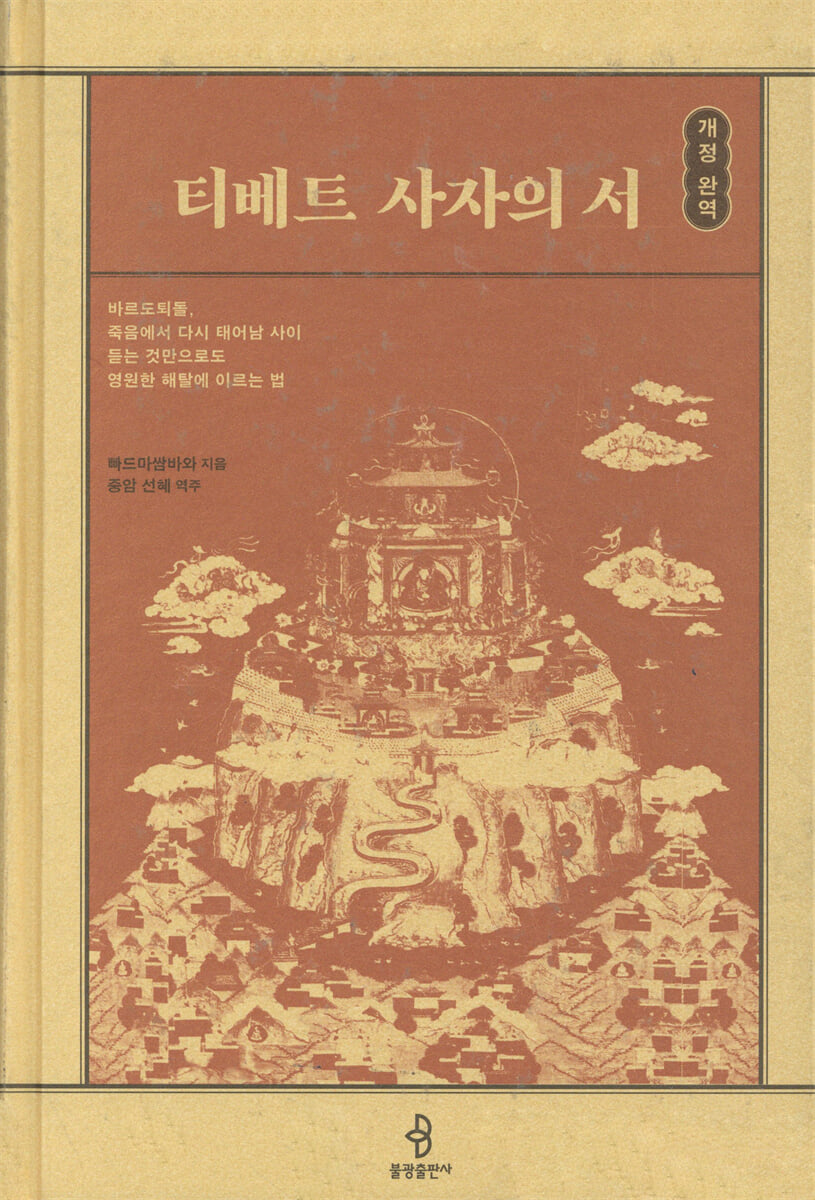
The first complete translation of the Tibetan original text, 『The Tibetan Book of the Dead』, in Korea. 『Bardo Thodol』, better known as 『Tibetan Book of the Dead』, is the greatest practice guide of Tibetan Buddhism and is a sutra written in the 8th century by Padmasambhava, a great sage of Tibetan Buddhism and considered the 'second Buddha'. 『Bardo Thodol』 means 'the method (thodol) that leads to liberation just by hearing it between death and rebirth (bardo)', and was written based on the afterlife that Padmasambhava experienced through deep practice. After death, we wander in the Bardo state for 49 days and reincarnate. The key is to find a way to escape from this Bardo state and achieve liberation. It offers hope and comfort to those who are facing death without being able to achieve complete enlightenment due to insufficient practice during their lifetime, and to those who are alive, it allows them to see their true self where life, death, and reincarnation coexist, and to find answers for themselves on how to live. While the 『Tibetan Book of the Dead』 previously introduced in Korea was a Chinese translation of an English or Japanese version, this book is the first complete translation of the original Tibetan text into Korean. Translator Monk Jungam has been living in India and Nepal for over 30 years, devoting himself to cave training and translating Tibetan sutras. In particular, the monk compared and contrasted three Tibetan versions of the book for translation, correcting errors and adding detailed footnotes on the translated words and their meanings to enable a more accurate understanding of the original text. He also provides detailed guidance on Tibetan Buddhist practices. This book, which contains a deep understanding and experience of the scriptures that came from long practice, can be called the 'most faithful translation' of the Bardo Tödol. |
- You can preview some of the book's contents.
Preview
index
Recommendation for the Revised Edition - Monk Neunghaeng
Preface: How to Become Buddha Without Purification
Re-edited: My Path to Liberation Found in Bardo Tödol
Overview of Bardot Tödol
The Pharmacopoeia of Karma Lingpa
Part 1: The Journey of Bardo Tödol
-Daily practice of brushing teeth during the day
Chapter 1: The Origin of Guru Yoga
Chapter 2: Dawn Yoga for Purifying Body and Mind
Chapter 3: Natural Liberation through Training in the Dharma Practices of the Pure and Blind One
Chapter 4: Natural Liberation from Sin through Worship of the Blind One
Chapter 5: Natural Liberation through Repentance in Front of the Blind and Blind Buddha
Chapter 6: Natural Liberation Through Seeing the True Nature of One Mind
Part 2: The main action of Bardo Tödol
-Prayer for liberation
Chapter 7: A Prayer for the Salvation of the Buddha
Chapter 8: The Main Song of the Six Bardos
Chapter 9: A Prayer for Deliverance from the Horrors of the Bardo
Chapter 10: A Prayer for Salvation from the Perilous Path of the Bardo
Chapter 11: Natural Liberation from the Five Aggregates through Wearing the Body
Part 3: The main action of Bardo Tödol
-The emergence of the four bardos
Chapter 12: The Bardo of the Dharma Nature: The Bardo of the Pure Light of Death
Chapter 13: The Bardo of the Dharma Nature, Where the Appropriate Buddhas Appear
Chapter 14: The Bardo of Dharma Nature, Where the Wrathful Buddhas Appear
Chapter 15: The Bardo of Rebirth, Where the Illusions of the Six Paths Appear
Part 4: The Sequence of Bardo Tödol
- Observation and deception of the symbol of death
Chapter 16: Natural Liberation through Observation of the Symbol of Death
Chapter 17: Natural Liberation from Fear through the Deception of Death
Chapter 18: The Religious World Showing the True Colors of Good and Evil in Bardo
Chapter 19: The True Nature of Good and Evil in the Bardo: The Restoration of the Religious World
Chapter 20: The Origin of the Dharma Realm of the Bardo Tödol
Chapter 21: Incense Offered to the Living Beings of Bardo
Part 5: Bardot's possession
-Prayer for liberation and rebirth in the Pure Land
1.
Prayer for the liberation of the three bodies of the Bardo
2.
The prayer for liberation from bardo passion
3.
The prayer for the liberation from the illusion of bardo
4.
The virtues and explanation of the six-syllable mantra of Avalokitesvara Bodhisattva
5.
The main gate of the Self-Growing Hall with Guru Padmasambha
6.
The virtues and explanation of the Vajra Guru Mantra
7.
A collection of dharanis for liberation
8.
Explanation of the Six Paths of Reincarnation
supplement
The Teaching of Choosing the Pure Land - Karma Chakme
References
Search
Into the book
The 42 Buddhas of the Vajra Realm, who radiate dazzling light in their splendid majesty, have gentle, beautiful, and peaceful appearances, are endowed with 32 marks and 80 characteristics, and adorn their bodies with beautiful ornaments, we offer worship, offerings, take refuge, and pray to the World-Honored Ones of the Vajra Realm.
When our lives are over and our bodies are transformed, and the pure dharma-nature bardo scene appears, when we wander in the swamp of reincarnation [without realizing it] due to the five thick and cruel poisons, may the appropriate World-Honored Ones lead us from the front on the bright path of the five holy wisdoms, may the mothers of the dharma-world and the mothers of the Buddhas push us from behind, and may the kings of the world and the mothers of the heavens who protect the ascetics of the mandala support us from around! May we be saved from the dangerous path of the fearful bardo! May we be guided to the Buddha's perfect enlightenment!
---Page 113 of the text
Practice diligently the Dharma practices and prayers of this Blessed One Hundred and Bold Buddha three times a day.
Even if you have committed the five sins, they will be completely eradicated in this life, and after even the fiery pit of hell has been stirred up and destroyed, you will be reborn in the Pure Land of Vidyadhara and the Tathagata. This is without a doubt.
Also, the original Buddha Samantabhadra (Samantabhadra) directly said, “If someone worships the saints of the mandala of the great illusionary and wrathful deity of the Great Illusion, all of the backwardness of the precepts will be purified, the sins of the five unending hells will be purified, the pits of hell will be stirred up and destroyed, and he will be born in the pure land of Vidyadhara and the Tathagata.”
The merit of practicing the Dharma in this way is inconceivable. It is said that by simply hearing the names of the saints of the Mandala once, one will not be born into the evil paths and will ultimately attain Buddhahood.
The original Buddha Samantabhadra himself said, “If any male or female Yogis hear the names of the saints of this mandala just once, they will not fall into the great hell.” He also said, “If anyone reverently worships the saints of the self-nature mandala of Gyuttava, all the lapses of precepts will be purified, and after recovering precepts, they will attain the realm of peace.”
---Pages 135-136 of the text
Here! The Dharma of natural liberation through seeing one's true nature is concisely expounded for the sake of the virtuous ones who will emerge in the turbid world of the future, by gathering together the secret sutras, the results of practice, and the profound insights personally experienced.
Now is not the time to spread it, so I will hide it in the secret Dharma treasure.
I will definitely meet the sage and wise man of the future!
Ssamaya! Gya! Gya! Gya!
This "Natural Liberation through Seeing the True Nature of One Mind" was written and completed by the great Asari Guru Padmasambhava of Odhyana.
This prayer will not be fulfilled until the end of the world of reincarnation.
[Gya! Gya! Gya! Sarwa Mangalam Ekapricha Svati!]
---Pages 238-239 of the text
Oh, you who are so compassionate! Even though the pain of death is infinitely great and immense, he now has no friend, no savior, no one to rely on, and no one to care for him.
The light of life in this life is going out, and we are leaving for another unknown world.
We are entering the deep darkness of the Bardo.
I'm falling down an endless cliff.
We are entering into the dark bushes.
I am being chased by the apparitions of terrible karma.
Running away into a barren field.
We are being swept away by a huge tsunami.
It is blowing in the fierce wind.
I'm wandering around without a destination.
We are entering a difficult battlefield.
I am being held captive by a cruel demon.
They tremble in fear of the messengers of King Yeomra.
From the world of karma, we are entering the world of karma again.
He has no power now.
The time has come when I have to go alone without any friends.
Oh, you who are of great compassion! Please become the virtuous refuge of this lonely ○○○! Please become a comfortable refuge! Please become a strong protector! Please save me from the darkness of the Bardo! Please save me from the fierce red karma wind! Please rescue me from the terror of the King of Hell! Please save me from the long and arduous path of the Bardo!
---Pages 243-244 of the text
Oh, Ma Ho! The profound, self-generated secret of the four wrathful kings [guarding the four gates of the mandala] who conquer the four demons and achieve self-liberation was born like the roar of a lion roaring without hindrance.
[The secret of Kumarakalasya (the child-treasure-bottle-king)] appears as 'Om Vajra Krodha Kemakeri Karimatsuta Bali Bali Atta Ekarassuri Vasati Enilanila Kaevina Abhisincha.'
After the body of Buddhakumarakalasya (Buddha-child-treasure-bottle-light-king) who defeated the five aggregates with the roar of a lion became one, not two, he was liberated from the realm of self-arising dharma.
(syncopation)
[The secret of Hayagriva (Horse-Headed King)] appears as 'Om Vajra Krodha Hayagriva Hri Sarva Tathagata Mahapancha Om Ayur Jnana Mahapunye Tishta Om'.
After attaining the lifespan of the World-Honored One Hayagriva (Horse-Headed King of Light), who defeated the demon of death with the roar of a lion, he dwells in the Dharma nature of great bliss, eradicates the defilements of ignorance, and attains liberation from his original state without abandoning the five poisons.
[By the secret will of the four kings of the underworld], after destroying the habit of reincarnation and the four demons of the past, and attaining the four bodies of the Tathagata and achieving liberation, [at the time of cremation] wonderful spirit bones, rainbows, light, and sarira appear.
---Pages 294-296 of the text
Write this circular mantra mandala on a piece of blue paper the size of four fingers, using gold, the color of Buddha, and write it in a pure manner.
After straightening it without turning it upside down, wrap it in silk.
A pure Buddhist monk who has well-received the precepts should bless this on the 8th day of the lunar calendar at the time of conjunction with the ghost star, and then wear it or carry it on his body [until his death].
By this, two inexplicable karmas of good and evil grow.
Therefore, for the benefit of all sentient beings, diligently cultivate all good deeds and cultivate [the] non-birth.
Do not commit any sin, even if it is small.
A person who acts in this way, even if he has previously committed the five infinite sins, will not fall into the evil paths by encountering this.
This is the method of attaining Buddhahood without practicing the Dharma, and is called Takdol (natural liberation through the body).
Anyone who sees this mantra mandala will attain Buddhahood and be called Tongdol (natural liberation through seeing).
Anyone who comes into contact with this becomes a Buddha and is called Rekdol (natural liberation through contact).
Anyone who hears this recited will attain Buddhahood and be called a natural liberation through hearing.
Anyone who recites this and whose breath touches it will attain Buddhahood, and this is called Chordol (natural liberation through feeling).
There has never been a Buddha in the past who has not seen this, and there will never be one in the future.
---Pages 300-301 of the text
Oh, descendant of a noble family! Now that which is called death has come.
Let your mind be like this:
“Ah! The hour of my death has come.
Now, relying on this death, I will only arouse the great compassion and supreme Bodhicitta.
Please make up your mind to achieve Buddhahood for the happiness of all sentient beings who fill the void.
Also, specifically, “I will now realize the light of death as the Dharmakaya for the benefit and comfort of all sentient beings.
After attaining the supreme attainment of Mahamudra in that state, he will perform the work of benefiting all sentient beings.
Even if you do not obtain it, you will clearly recognize in the bardo that this is the bardo.
Thus, after attaining the Mahamudra of unity in the Bardo, I will manifest the transformational body that follows all things and benefit all sentient beings who fill the empty space! Let us arouse the supreme Bodhicitta and aspire to it.
Keep this strong desire in your heart and remember the practices of the teachings that you practiced and learned during your lifetime.
---Pages 314-315 of the text
A single ray of clear, transparent, dazzling, and brilliant blue light of the pure consciousness aggregate's wisdom of the body of the Dharma Realm emanates from the heart of the Vairochana Buddha and appears before you.
A splendid ray of light shines down, piercing [the heart] with a dazzling dazzle.
Along with it, the hazy white light of the celestial realm also appears [as if attached to that light of wisdom] and sticks out before you.
At that time, due to the karma of ignorance, you will run away from the dazzling blue light of the Dharma Realm with fear and dread, and instead, you will develop an affinity for the dim white light of the heavenly realm.
At that time, do not fear the bright, dazzling, clear, and radiant light of supreme wisdom! Do not be afraid! It is the light of the Tathagata, called the holy ground of the Dharma Realm.
Believe in it with all your heart, admire it, and embrace it! Furthermore, think, "This light is the ray of Vairochana Buddha's compassion," and pray earnestly! This light is what Vairochana Buddha has revealed to welcome you on the perilous path of the Bardo.
It is the ray of contrast of Vairochana Buddha.
---Page 327 of the text
By repeatedly informing them in this way, no matter how insignificant their good deeds may be, even if they do not realize the first one, they will surely realize the second one, and there is no one who cannot achieve liberation.
However, despite being repeatedly reminded, because the dampness of evil karma is strong and has been stained for a long time, and because they are not familiar with the pure sight of the Dharma nature and the five noble wisdoms, they are led down by the dampness of evil karma and fall down even if they are reminded in this way.
Unable to be absorbed by the hook of the light of compassion, they instead wander downwards, arousing fear and dread in the light and rays of the Dharma nature.
So on the sixth day, the combined being of the five Buddhas appears simultaneously with the Bodhisattva retinue.
At that time, the six lights of the six realms also appear.
To awaken the lion, call his name three times and then say the following:
---Page 341 of the text
In general, although there may be big and small experiences through practice, there will be many small confusions at the time of death.
Therefore, there is no other means of liberation than this 『Bardo Tödol』.
Also, for those who have greatly practiced and learned, the light of the Dharma nature appears brightly after the body and mind are separated.
Especially for those who have recognized it with a clear consciousness during their lifetime and have experienced it for a moment, when the light of death appears in the bardo of death, its power is so brilliant that it is very important to practice diligently during their lifetime [to grasp it clearly].
For those who have practiced the life-giving and perfect-giving of the main deities of the secret tantra in their lifetime, the appearance of the gods of righteousness and wrath in the bardo of the dharma nature is very powerful.
So, it is very important to practice and learn this 『Bardotodul』 especially during one's lifetime.
Therefore, remember this 『Bardotódol』 completely.
Be completely fluent.
Make sure to read carefully.
Let's think about it honestly.
Recite it continuously three times a day.
Make sure you understand the meaning of the text clearly.
Even if you are being chased by 100 villains, train yourself not to forget the meaning.
---Page 382 of the text
Living beings do not know when death will occur.
Therefore, let us observe these symbols of death repeatedly and closely.
If the signs of death appear, abandon all your possessions and have a detached mind.
(Omitted) When the three symbols of death—inner, outer, and secret—appear, if one does not perform the death deception ritual to defeat them, one commits the grave sin of allowing the saints of righteousness and wrath within one's body to perish, and, disobeying the precepts, one falls into hell.
The sutras say that this is greater than the five sins.
Therefore, perform the death deception ritual with all your heart.
Publisher's Review
It is the best practice guide of Tibetan Buddhism.
Bardo Tödol: A Must-Read Before Death, at the Last Moment
The Tibetan Book of the Dead, written by Padmasambhava, a great sage who spread Buddhism to Tibet in the 8th century and is considered the "second Buddha" by Tibetans, is said to have been compiled as a final secret for Buddhists and practitioners in the last days. It is a scripture that records the afterlife, the process of death and the aftermath that he encountered after returning from his experience.
Although it has garnered attention for its vivid depiction of the 49 days of wandering and reincarnation that occur after death before rebirth, the book's content goes beyond simply describing the afterlife.
Along with this, the Buddha, Bodhisattva, and devas who appear in frightening forms once every seven days are clearly illusory figures of their own creation, and the teachings that they practiced and learned in their lifetimes are reminded so that they do not fall into reincarnation. At the same time, specific methods of liberation suitable for each foundation are also introduced in order.
This book, The Tibetan Book of the Dead, is a guidebook containing the practice methods of Tibetan Buddhism and a must-read for practitioners and Buddhists at their last moments.
That is why, in Tibetan Buddhism, the Tibetan Book of the Dead is considered the first among the books on practice.
However, this sutra has been perceived as a book about the afterlife rather than a book of practice.
This is largely due to the title given to the book when it was first introduced to the West.
In fact, the title “Tibetan Book of the Dead” is not the original title, but is taken from the Egyptian “Book of the Dead,” which is famous for its descriptions of the afterlife.
The original title of this sutra, which is not familiar to the general public, is “Bardo Tödol,” which is a combination of the Tibetan words “Bardo,” which means “between death and rebirth,” and “Tödol,” which means “the law that leads to eternal liberation just by hearing it.”
In other words, it means that during the 49-day wandering process, one can learn the method by which one can achieve liberation just by listening to it. It is a title that clearly reveals the reason why Padmasambhava wrote the sutra and clearly reveals its nature as a guide to practice.
The first complete translation of the Tibetan original text in Korea with detailed footnotes,
The most faithful translation of the Tibetan Book of the Dead
This book, 『Revised Complete Translation of the Tibetan Book of the Dead』, is a revised edition of 『Complete Translation of the Tibetan Book of the Dead』 (Jeongwoo Books), the first and only book among related books introduced in Korea to be a complete translation of the original Tibetan text. It corrects errors missed in the previous book in detail and supplements insufficient parts such as the source and content of each passage.
Here, the format and font have been improved to ensure greater readability in terms of content fidelity and aesthetics.
Unlike most of the “Tibetan Book of the Dead” books introduced in Korea so far, which were translated and published in English-speaking countries or Japan and then re-published in Korean, this book is a direct translation of the original Tibetan text, conveying the original text as is.
In addition, the original texts of Tibetan Buddhism, which are transmitted in three different versions, were compared and contrasted to correct errors and typos in the original texts.
Above all, the most notable feature of this book is its extensive and detailed footnotes.
Footnotes are provided to provide detailed explanations of the translated text and its meaning, as well as the practice of Tibetan Buddhism, which cannot be understood solely through the translation, and the sources are listed in detail.
The translator also clearly stated the content of the corrections and the reasons for the errors in the original text that were corrected.
The reason why such a faithful translation of the original text and the extensive collection of data that serves as its basis were possible is because the translator is well-versed in Tibetan Buddhism.
Translator Monk Jungam studied Tibetan Buddhism in places such as the Ganden Monastery in South India in 1991. He is currently staying in Yanglash, Nepal, where Padmasambhava is said to have attained Buddhahood, and is devoting himself to practicing Tibetan Buddhism and translating Tibetan sutras.
In addition to this book, he has published and translated several books related to Tibetan Buddhism, reaching readers.
Among them, the 『Revised Complete Translation of the Tibetan Book of the Dead』 can be considered the 'most faithful translation' of the 『Bardo Tödol』, as it contains the translator's deep understanding and experience of the scriptures that arose from his intense practice.
Learn what death is
Then you will learn about life too.
From the beginning of mankind to the present, the greatest event that all beings must experience is death.
But no one comes back from experiencing death, and no one can clearly explain death.
Naturally, the feelings people have about 'death' are negative emotions such as fear, horror, and sadness.
Religion was born to overcome the fear of death, and one thing that can be found in common in religions large and small around the world is the concept of an afterlife such as 'paradise and hell'.
It tells us how to reach paradise, soothes our fear and sorrow of death, and guides us to be faithful to our present life.
However, the concept of 'paradise' in Buddhism is somewhat different.
This is because the ultimate goal of Buddhism is liberation, which means achieving complete enlightenment and not being reborn, completely cutting off reincarnation.
So, even paradise, which can be compared to heaven, is only a place for practicing to reach liberation, and the most ideal thing is to continuously strive to attain enlightenment while alive.
However, not everyone has the ability to practice and attain liberation while alive.
Most people have the will to attain enlightenment, but they lack the perseverance to achieve liberation.
The reason Padmasambhava wrote The Tibetan Book of the Dead was to teach those who had not been able to attain complete enlightenment through their own practice while alive a way to escape reincarnation and attain complete enlightenment.
So, during the 49 days of wandering after death, things that can cause us to make mistakes and misunderstand will continue to happen, but it not only guides us on how to overcome them, but also shows us how to steer the situation in a better direction even if we choose the wrong path.
Through this, it conveys hope and comfort to those facing death, instead of the despair of the end and the fear of the unknown, and it reminds the living of their true self, where life, death, and reincarnation coexist, allowing them to live every moment of their lives more faithfully.
You may also like
카테고리

korean

![GQ KOREA Mark (Monthly): December [2025]](http://librairie.coreenne.fr/cdn/shop/files/8ef265dbbfbf186523ed75ba7319009d.jpg?v=1765340328&width=3840)


