

Restoring Church
 |
Description
Book Introduction
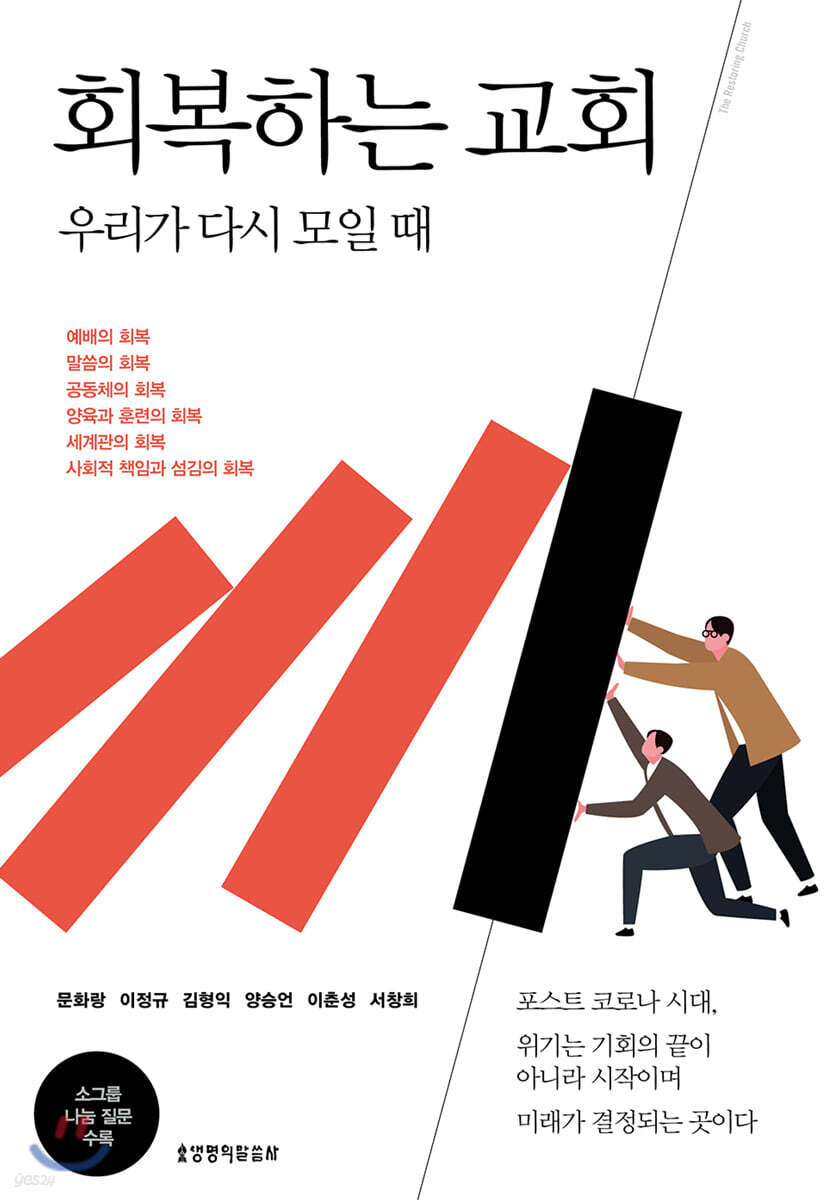
Post-Corona era, A crisis is not the end of opportunity, but the beginning. This is where the future is decided. While Korea and the world are in turmoil due to COVID-19, perhaps the most affected are churches. Due to social distancing and bans on worship services and gatherings, Korean churches have faced the threat of having to suspend public worship services. From online worship services to online communion, the clash of theological and pastoral opinions has made times even more difficult for pastors and congregations. Now that the peak of the COVID-19 pandemic has passed and quarantine guidelines have eased from social distancing to everyday distancing, believers are naturally gathering together in the space called church and having tearful reunions. What should we talk about at this time? What should the church do? This book is a study and compilation of the essence of faith that the church must restore in the post-corona era, conducted by six authors and a co-planner with a sense of mission to answer this question. The six themes are divided into the important framework of faith: 'relationship with God' (worship, word), 'relationship with people' (community, nurturing and training), and 'relationship with the world' (worldview, social responsibility). |
- You can preview some of the book's contents.
Preview
index
Recommendation: An Important First Step for the Church in the Post-Corona Era
Introduction: The Restoring Church: When We Gather Again
Part 1: Relationship with God
1.
Restoration of Worship
Restore God-centered worship _ Culture and
2.
Restoration of the Word
From a small God to a great God again _Lee Jeong-gyu
Part 2: Relationships with People
3.
Restoration of Community
Transitioning from a Worship Community to a Relational Community _Hyungik Kim
4.
Restoration of parenting and training
Training for the Church Gathering Again and the Church Scattered Across the World _Yang Seung-eon
Part 3: Relationship with the World
5.
Restoration of the worldview
Christian Worldview in the New Normal Age _ Lee Chun-seong
6.
Restoring social responsibility and service
A New Servant Is Coming: Leveraging Mobility and Locality _Seo Chang-hee
main
Introduction: The Restoring Church: When We Gather Again
Part 1: Relationship with God
1.
Restoration of Worship
Restore God-centered worship _ Culture and
2.
Restoration of the Word
From a small God to a great God again _Lee Jeong-gyu
Part 2: Relationships with People
3.
Restoration of Community
Transitioning from a Worship Community to a Relational Community _Hyungik Kim
4.
Restoration of parenting and training
Training for the Church Gathering Again and the Church Scattered Across the World _Yang Seung-eon
Part 3: Relationship with the World
5.
Restoration of the worldview
Christian Worldview in the New Normal Age _ Lee Chun-seong
6.
Restoring social responsibility and service
A New Servant Is Coming: Leveraging Mobility and Locality _Seo Chang-hee
main
Detailed image

Into the book
What will the coming era be like? As the saying goes, "Rather than cursing the darkness, shine a ray of light." What the church needs today is not a critical, concerned view of reality, but rather a renewed, ray of hope.
With these concerns in mind, six pastors reflected on the essential elements that the church must restore in the post-Corona era.
No matter how excellent the answer, there is no such thing as a perfect solution.
This book is the opinion of pastors who have been thinking and researching for a long time, but it does not present a single perfect answer. Rather, it should be said to be the beginning of a space for thinking together.
I sincerely hope that this book will serve as a new beginning of hope for churches struggling due to COVID-19.
_From the introduction (by Pastor Sangseop Koh)
When the church pursues a pragmatic ideology, the focus of worship ultimately shifts from God to people.
If we first consider, "How can we make our worship touching and effective for people?", our worship will degenerate into a consumer-centered activity.
Eventually, James K. Smith
As A. Smith pointed out, this will create a “mall’s liturgy.” This trained consumer mindset will have a significant impact on the religious life of believers after the coronavirus.
There is a good chance you will find a church that offers better content for you and your family.
Even if you don't necessarily change churches, you may be dissatisfied with the services at the church you attend and demand something new or try to satisfy it yourself.
Is there no way to prepare for this anticipated future? What must pastors, believers, and churches restore? I believe that restoring the God-centeredness of worship is an urgent priority.
‘God-centered worship!’ _p.
28(1.
Restoration of Worship_ Professor Munhwarang)
When we worship, worship protects us.
When we worship, the spirit of worship is engraved in the body and mind of the believers and trains them.
Worship is not only an act of faith, but also contains a double grace that matures faith.
Participation in worship provides believers with an opportunity for change and makes them new people.
The continuous repetition of worship is a blessing to believers.
Because through repetition, faith is formed and strengthened, and we can enjoy the grace of broadening our horizons of understanding.
The world and the environment surrounding the church are changing rapidly.
We cannot ignore this change.
You must be able to read cultural changes and changes in people's thinking.
We must constantly engage in dialogue with the theological questions that arise in the process of renewing worship and developing a new culture.
However, it is difficult for the essence of worship to be damaged.
We must always keep in mind what the Bible says and examine various issues of worship based on the God-centeredness of worship.
_p.
34(1.
Restoration of Worship_ Professor Munhwarang)
In this time of suffering due to COVID-19, the impact of misunderstandings about God will be even greater.
So we need to think deeply again about who God is in light of His Word.
Rediscovering God's true nature through His Word is like a vaccine that deepens our faith in the midst of suffering and enables us to joyfully serve our neighbors.
Therefore, I will briefly state the doctrines concerning the true God of the Bible that we must restore and discuss how a firm faith in them can strengthen us.
_p.
40(2.
Restoration of the Word_ Pastor Lee Jeong-gyu)
Some might ask this question:
"So what's the purpose? Our business was ruined by COVID-19.
My family lost their lives.
The church was facing a huge financial crisis, and many members left.
"Is God's plan here too? What exactly is that plan?" I don't know the answer.
Sometimes God doesn't give us a reason.
Think of Job.
When we read the Book of Job, we know why Job suffers.
But God never told Job why he was suffering.
We may never fully understand the suffering each of us is experiencing because of COVID-19.
But we can know what is not the answer.
“Because God doesn’t love us,” or “Because God is tormenting us,” these answers are not valid.
Look at the cross.
God is naked, wounded all over, and dripping with blood.
He endures the ridicule and contempt of people with his whole body.
_p.
49(2.
Restoration of the Word_ Pastor Lee Jeong-gyu)
In fact, the existing church paradigm, which has experienced growth by attracting people to worship and pursuing such growth, seems to have little alternative in the face of the sudden disaster of COVID-19.
There is no other way to change the management system that has been used for pastoral care, except to make it a more tightly-knit organization centered on pastors.
“The traditional approach of focusing on external growth by attracting people is ultimately paying the price of consumerism.
Alan Hirsh's dire observation that "consumers who are not family members will eventually leave"2) could not be more apt for the current situation.
_p.
75(3.
Restoration of the Community_ Pastor Hyung-ik Kim)
The liberation of the faith community from the designated sanctuary of the chapel can be a significant turning point, allowing faith to permeate our homes, workplaces, and everyday lives.
This is an opportunity to bring about a shift in thinking and faith, breaking the dualistic framework of sacred and secular thinking and realizing that God is not only involved in every area of our lives but is the owner of every place.
As Jacob said in the wilderness of Bethel, “Surely the Lord is in this place, and I did not know it” (Gen. 28:16).
As churches attempt to make this shift in direction post-COVID, the river they must cross is the transition from a pastor-led management system to a voluntary, united relationship among the congregation.
This is a shift from a ministry that turns believers into religious consumers to a ministry that builds them into mature believers.
It is a church where believers themselves can enjoy rich fellowship in the gospel and become a church that is strengthened by a network of spiritual bonds where they share the strength of God that they experience in their weakness.
_p.
82(3.
Restoration of the Community_ Pastor Hyung-ik Kim)
Family is a vessel that holds everything from birth to death.
We must make it clear that the home is the most basic church and school, and establish the home as a cradle of religious education.
So what should we do? Above all, we must continue to develop models and programs that foster collaboration between Sunday school and families in faith education.
Another good way to involve parents in the Sunday school curriculum is through regular parent-participatory worship services or homework assignments that parents can do together.
In addition, during the process of raising and training adults, we must foster a sense of mission for educating children about their faith and train them to put it into practice.
Realizing that God has entrusted the primary responsibility for religious education to the family (Gen. 18:19), we must train our children to tell Bible stories and develop the habit of praying and blessing with them.
In particular, the restoration of family worship is urgent, and it is necessary to establish family worship as a place to increase intimacy among family members, share their thoughts on faith, and pray, rather than as a typical worship form.
Regularly implementing parenting programs in which the whole family participates can also be a good way to establish the family as the main body of education.
_p.
95(4.
Restoration of Parenting and Training_ Pastor Yang Seung-eon)
Perhaps one of the benefits of COVID-19 is that it has brought individuals who were previously hidden in the crowd to stand alone before God.
As we see in the conversation between Jesus and the Samaritan woman (John 4:20-26), although we were given the freedom to worship wherever we wanted, we still had to examine ourselves to see if we could worship God devoutly in spirit and truth.
As the formalities disappeared, the bare face of our faith was revealed, and it also became an opportunity to realize once again how important inner maturity and growth are.
It was a time when we realized the dangers of a formal religious life and reflected on whether the modern church was producing nominal Christians.
Therefore, we must focus on nurturing and training them to become believers who achieve inner growth and maturity, rather than just being formal believers.
_p.
100(4.
Restoration of Parenting and Training_ Pastor Yang Seung-eon)
Faced with the challenge of COVID-19, most people have voiced the importance of the role of government and experts.
In contrast, churches and other religious institutions that regularly held public meetings were treated as obstacles to solving the problem.
In the midst of all this, there is a famous philosopher who argued about the role of the church.
Although an atheist, Giorgio Agamben of the University of Architecture of Venice in Italy said, “The churches are strangely silent on this issue,” and asked the silent church to answer this abnormal situation.
Despite the prevailing scientific optimism that science is at the cutting edge and its influence will never wane, people still face the limitations of humanity when faced with death.
And like Agamben, people ask the Church to answer about death.
Because the church is still (and I believe forever) the only place that can face death head-on.
_p.
130(5.
Restoration of the Worldview_ Pastor Chunseong Lee)
As the world races toward a life-first mentality due to COVID-19, the church has a responsibility to spread the message that life does not end in this world, but rather that there is eternal life.
It is, as Truman says, forcing the world and people to face the reality of death.
The way to convey this to them without being rude is to become a neighbor to the dying and their families.
Rather than declaring that we Christians have conquered death and transcended it, we must cry out together against suffering and death, like the martyrs in the Book of Revelation, and expose the truth about it.
And in the midst of this cruelty, we, who hope for the salvation of God above, must comfort the world with humility, warmth, and peace (shalom).
Now is the time for the church and Christians to learn the worldview of Christ's death and show it to the world.
_p.
142(5.
Restoration of the Worldview_ Pastor Chunseong Lee)
How should Korean churches and believers serve in this era? If I were to suggest a direction for service that the Korean church should take in the post-COVID era, I would describe it as "cooperation for our neighbors."
These words contain two thoughts about the direction of service.
(1) We must cooperate, and (2) we must be close.
‘Cooperation’ refers to service that strengthens ‘mobility’, and ‘closeness’ refers to service through ‘regionality’.
_p.
149(6.
Restoration of Social Responsibility and Service_ (Seo Chang-hee, Professor)
What is the current state of our church's service? Are church decision-making too slow and distant to demand financial execution for service? While we're interested in the church's name and in service participation, are we indifferent to support and encouragement when members unite as teams to serve? Serve as a team, not as an army.
The saints want 'my team', not the entire congregation.
_p.
172(6.
Restoration of Social Responsibility and Service_ (Seo Chang-hee, Professor)
How should the Korean church serve its neighbors after the COVID-19 pandemic? We must cooperate with our neighbors.
We must create a theme of service that utilizes regional characteristics and create a movement through proper service.
Strategies and insights are everywhere.
But let us remember the heart of Jesus.
Jesus stood before us until the end.
He who served standing up, stood on the cross.
I pray that the Korean church and its believers will stand before the lost souls of Korea until the end, just as they stand before Jesus, who will serve us forever.
With these concerns in mind, six pastors reflected on the essential elements that the church must restore in the post-Corona era.
No matter how excellent the answer, there is no such thing as a perfect solution.
This book is the opinion of pastors who have been thinking and researching for a long time, but it does not present a single perfect answer. Rather, it should be said to be the beginning of a space for thinking together.
I sincerely hope that this book will serve as a new beginning of hope for churches struggling due to COVID-19.
_From the introduction (by Pastor Sangseop Koh)
When the church pursues a pragmatic ideology, the focus of worship ultimately shifts from God to people.
If we first consider, "How can we make our worship touching and effective for people?", our worship will degenerate into a consumer-centered activity.
Eventually, James K. Smith
As A. Smith pointed out, this will create a “mall’s liturgy.” This trained consumer mindset will have a significant impact on the religious life of believers after the coronavirus.
There is a good chance you will find a church that offers better content for you and your family.
Even if you don't necessarily change churches, you may be dissatisfied with the services at the church you attend and demand something new or try to satisfy it yourself.
Is there no way to prepare for this anticipated future? What must pastors, believers, and churches restore? I believe that restoring the God-centeredness of worship is an urgent priority.
‘God-centered worship!’ _p.
28(1.
Restoration of Worship_ Professor Munhwarang)
When we worship, worship protects us.
When we worship, the spirit of worship is engraved in the body and mind of the believers and trains them.
Worship is not only an act of faith, but also contains a double grace that matures faith.
Participation in worship provides believers with an opportunity for change and makes them new people.
The continuous repetition of worship is a blessing to believers.
Because through repetition, faith is formed and strengthened, and we can enjoy the grace of broadening our horizons of understanding.
The world and the environment surrounding the church are changing rapidly.
We cannot ignore this change.
You must be able to read cultural changes and changes in people's thinking.
We must constantly engage in dialogue with the theological questions that arise in the process of renewing worship and developing a new culture.
However, it is difficult for the essence of worship to be damaged.
We must always keep in mind what the Bible says and examine various issues of worship based on the God-centeredness of worship.
_p.
34(1.
Restoration of Worship_ Professor Munhwarang)
In this time of suffering due to COVID-19, the impact of misunderstandings about God will be even greater.
So we need to think deeply again about who God is in light of His Word.
Rediscovering God's true nature through His Word is like a vaccine that deepens our faith in the midst of suffering and enables us to joyfully serve our neighbors.
Therefore, I will briefly state the doctrines concerning the true God of the Bible that we must restore and discuss how a firm faith in them can strengthen us.
_p.
40(2.
Restoration of the Word_ Pastor Lee Jeong-gyu)
Some might ask this question:
"So what's the purpose? Our business was ruined by COVID-19.
My family lost their lives.
The church was facing a huge financial crisis, and many members left.
"Is God's plan here too? What exactly is that plan?" I don't know the answer.
Sometimes God doesn't give us a reason.
Think of Job.
When we read the Book of Job, we know why Job suffers.
But God never told Job why he was suffering.
We may never fully understand the suffering each of us is experiencing because of COVID-19.
But we can know what is not the answer.
“Because God doesn’t love us,” or “Because God is tormenting us,” these answers are not valid.
Look at the cross.
God is naked, wounded all over, and dripping with blood.
He endures the ridicule and contempt of people with his whole body.
_p.
49(2.
Restoration of the Word_ Pastor Lee Jeong-gyu)
In fact, the existing church paradigm, which has experienced growth by attracting people to worship and pursuing such growth, seems to have little alternative in the face of the sudden disaster of COVID-19.
There is no other way to change the management system that has been used for pastoral care, except to make it a more tightly-knit organization centered on pastors.
“The traditional approach of focusing on external growth by attracting people is ultimately paying the price of consumerism.
Alan Hirsh's dire observation that "consumers who are not family members will eventually leave"2) could not be more apt for the current situation.
_p.
75(3.
Restoration of the Community_ Pastor Hyung-ik Kim)
The liberation of the faith community from the designated sanctuary of the chapel can be a significant turning point, allowing faith to permeate our homes, workplaces, and everyday lives.
This is an opportunity to bring about a shift in thinking and faith, breaking the dualistic framework of sacred and secular thinking and realizing that God is not only involved in every area of our lives but is the owner of every place.
As Jacob said in the wilderness of Bethel, “Surely the Lord is in this place, and I did not know it” (Gen. 28:16).
As churches attempt to make this shift in direction post-COVID, the river they must cross is the transition from a pastor-led management system to a voluntary, united relationship among the congregation.
This is a shift from a ministry that turns believers into religious consumers to a ministry that builds them into mature believers.
It is a church where believers themselves can enjoy rich fellowship in the gospel and become a church that is strengthened by a network of spiritual bonds where they share the strength of God that they experience in their weakness.
_p.
82(3.
Restoration of the Community_ Pastor Hyung-ik Kim)
Family is a vessel that holds everything from birth to death.
We must make it clear that the home is the most basic church and school, and establish the home as a cradle of religious education.
So what should we do? Above all, we must continue to develop models and programs that foster collaboration between Sunday school and families in faith education.
Another good way to involve parents in the Sunday school curriculum is through regular parent-participatory worship services or homework assignments that parents can do together.
In addition, during the process of raising and training adults, we must foster a sense of mission for educating children about their faith and train them to put it into practice.
Realizing that God has entrusted the primary responsibility for religious education to the family (Gen. 18:19), we must train our children to tell Bible stories and develop the habit of praying and blessing with them.
In particular, the restoration of family worship is urgent, and it is necessary to establish family worship as a place to increase intimacy among family members, share their thoughts on faith, and pray, rather than as a typical worship form.
Regularly implementing parenting programs in which the whole family participates can also be a good way to establish the family as the main body of education.
_p.
95(4.
Restoration of Parenting and Training_ Pastor Yang Seung-eon)
Perhaps one of the benefits of COVID-19 is that it has brought individuals who were previously hidden in the crowd to stand alone before God.
As we see in the conversation between Jesus and the Samaritan woman (John 4:20-26), although we were given the freedom to worship wherever we wanted, we still had to examine ourselves to see if we could worship God devoutly in spirit and truth.
As the formalities disappeared, the bare face of our faith was revealed, and it also became an opportunity to realize once again how important inner maturity and growth are.
It was a time when we realized the dangers of a formal religious life and reflected on whether the modern church was producing nominal Christians.
Therefore, we must focus on nurturing and training them to become believers who achieve inner growth and maturity, rather than just being formal believers.
_p.
100(4.
Restoration of Parenting and Training_ Pastor Yang Seung-eon)
Faced with the challenge of COVID-19, most people have voiced the importance of the role of government and experts.
In contrast, churches and other religious institutions that regularly held public meetings were treated as obstacles to solving the problem.
In the midst of all this, there is a famous philosopher who argued about the role of the church.
Although an atheist, Giorgio Agamben of the University of Architecture of Venice in Italy said, “The churches are strangely silent on this issue,” and asked the silent church to answer this abnormal situation.
Despite the prevailing scientific optimism that science is at the cutting edge and its influence will never wane, people still face the limitations of humanity when faced with death.
And like Agamben, people ask the Church to answer about death.
Because the church is still (and I believe forever) the only place that can face death head-on.
_p.
130(5.
Restoration of the Worldview_ Pastor Chunseong Lee)
As the world races toward a life-first mentality due to COVID-19, the church has a responsibility to spread the message that life does not end in this world, but rather that there is eternal life.
It is, as Truman says, forcing the world and people to face the reality of death.
The way to convey this to them without being rude is to become a neighbor to the dying and their families.
Rather than declaring that we Christians have conquered death and transcended it, we must cry out together against suffering and death, like the martyrs in the Book of Revelation, and expose the truth about it.
And in the midst of this cruelty, we, who hope for the salvation of God above, must comfort the world with humility, warmth, and peace (shalom).
Now is the time for the church and Christians to learn the worldview of Christ's death and show it to the world.
_p.
142(5.
Restoration of the Worldview_ Pastor Chunseong Lee)
How should Korean churches and believers serve in this era? If I were to suggest a direction for service that the Korean church should take in the post-COVID era, I would describe it as "cooperation for our neighbors."
These words contain two thoughts about the direction of service.
(1) We must cooperate, and (2) we must be close.
‘Cooperation’ refers to service that strengthens ‘mobility’, and ‘closeness’ refers to service through ‘regionality’.
_p.
149(6.
Restoration of Social Responsibility and Service_ (Seo Chang-hee, Professor)
What is the current state of our church's service? Are church decision-making too slow and distant to demand financial execution for service? While we're interested in the church's name and in service participation, are we indifferent to support and encouragement when members unite as teams to serve? Serve as a team, not as an army.
The saints want 'my team', not the entire congregation.
_p.
172(6.
Restoration of Social Responsibility and Service_ (Seo Chang-hee, Professor)
How should the Korean church serve its neighbors after the COVID-19 pandemic? We must cooperate with our neighbors.
We must create a theme of service that utilizes regional characteristics and create a movement through proper service.
Strategies and insights are everywhere.
But let us remember the heart of Jesus.
Jesus stood before us until the end.
He who served standing up, stood on the cross.
I pray that the Korean church and its believers will stand before the lost souls of Korea until the end, just as they stand before Jesus, who will serve us forever.
---From the text
Publisher's Review
Post-Corona era,
A crisis is not the end of opportunity, but the beginning.
This is where the future is decided.
While Korea and the world are in turmoil due to COVID-19, perhaps the most affected are churches. Due to social distancing and bans on worship services and gatherings, Korean churches have faced the threat of having to suspend public worship services. From online worship services to online communion, the clash of theological and pastoral opinions has made times even more difficult for pastors and congregations.
Now that the peak of the COVID-19 pandemic has passed and quarantine guidelines have eased from social distancing to everyday distancing, believers are naturally gathering together in the space called church and having tearful reunions.
What should we talk about at this time? What should the church do?
This book is a study and compilation of the essence of faith that the church must restore in the post-corona era, conducted by six authors and a co-planner with a sense of mission to answer this question.
The six themes are divided into the important framework of faith: 'relationship with God' (worship, word), 'relationship with people' (community, nurturing and training), and 'relationship with the world' (worldview, social responsibility).
How should worship change?
How should we preach in times of trouble?
What should the church community look like?
How should the nurturing and training of the church change?
What kind of worldview should the church have?
How should the church fulfill its social responsibility and serve the world?
It is clear that a crisis situation is an opportunity to return to the essence of the church.
It all depends on how the Korean church responds!
There will be many changes in the post-COVID era, but ultimately, humans remain the same, the world remains the same, and God remains unchanging.
Therefore, this book suggests that we must always return to the essence to find answers to difficult real-world problems.
The six authors, who have researched and wrestled with the topic for a long time in their respective fields, speak unanimously in their book.
The COVID-19 pandemic has thrown the Korean church into a state of crisis, but this crisis is actually a golden opportunity to return to the essence of the church.
For us, a crisis is not the end, but the beginning of opportunity, a place where the future is determined, and the outcome depends entirely on how the Korean church responds going forward.
If the Korean church and its members fail to recover as a faithful faith community in the post-COVID era, we will become unrighteous servants who have squandered the golden opportunity God has given us.
This book allows pastors to reexamine biblical pastoral philosophy in this new normal era, a time of crisis, brought on by the COVID-19 pandemic. It also provides laypeople with deep insight and grace into the areas in which believers must recover.
Each church also includes 'Sharing Questions for Small Groups' so that members can read and share the topic in small groups.
A crisis is not the end of opportunity, but the beginning.
This is where the future is decided.
While Korea and the world are in turmoil due to COVID-19, perhaps the most affected are churches. Due to social distancing and bans on worship services and gatherings, Korean churches have faced the threat of having to suspend public worship services. From online worship services to online communion, the clash of theological and pastoral opinions has made times even more difficult for pastors and congregations.
Now that the peak of the COVID-19 pandemic has passed and quarantine guidelines have eased from social distancing to everyday distancing, believers are naturally gathering together in the space called church and having tearful reunions.
What should we talk about at this time? What should the church do?
This book is a study and compilation of the essence of faith that the church must restore in the post-corona era, conducted by six authors and a co-planner with a sense of mission to answer this question.
The six themes are divided into the important framework of faith: 'relationship with God' (worship, word), 'relationship with people' (community, nurturing and training), and 'relationship with the world' (worldview, social responsibility).
How should worship change?
How should we preach in times of trouble?
What should the church community look like?
How should the nurturing and training of the church change?
What kind of worldview should the church have?
How should the church fulfill its social responsibility and serve the world?
It is clear that a crisis situation is an opportunity to return to the essence of the church.
It all depends on how the Korean church responds!
There will be many changes in the post-COVID era, but ultimately, humans remain the same, the world remains the same, and God remains unchanging.
Therefore, this book suggests that we must always return to the essence to find answers to difficult real-world problems.
The six authors, who have researched and wrestled with the topic for a long time in their respective fields, speak unanimously in their book.
The COVID-19 pandemic has thrown the Korean church into a state of crisis, but this crisis is actually a golden opportunity to return to the essence of the church.
For us, a crisis is not the end, but the beginning of opportunity, a place where the future is determined, and the outcome depends entirely on how the Korean church responds going forward.
If the Korean church and its members fail to recover as a faithful faith community in the post-COVID era, we will become unrighteous servants who have squandered the golden opportunity God has given us.
This book allows pastors to reexamine biblical pastoral philosophy in this new normal era, a time of crisis, brought on by the COVID-19 pandemic. It also provides laypeople with deep insight and grace into the areas in which believers must recover.
Each church also includes 'Sharing Questions for Small Groups' so that members can read and share the topic in small groups.
GOODS SPECIFICS
- Date of issue: June 25, 2020
- Page count, weight, size: 184 pages | 312g | 145*210*10mm
- ISBN13: 9788904167166
- ISBN10: 8904167167
You may also like
카테고리
korean


korean

![GQ KOREA Mark (Monthly): December [2025]](http://librairie.coreenne.fr/cdn/shop/files/8ef265dbbfbf186523ed75ba7319009d.jpg?v=1765340328&width=3840)


