

Why can't I just live well?
 |
Description
Book Introduction
To those who shout, “As long as it’s not me!”
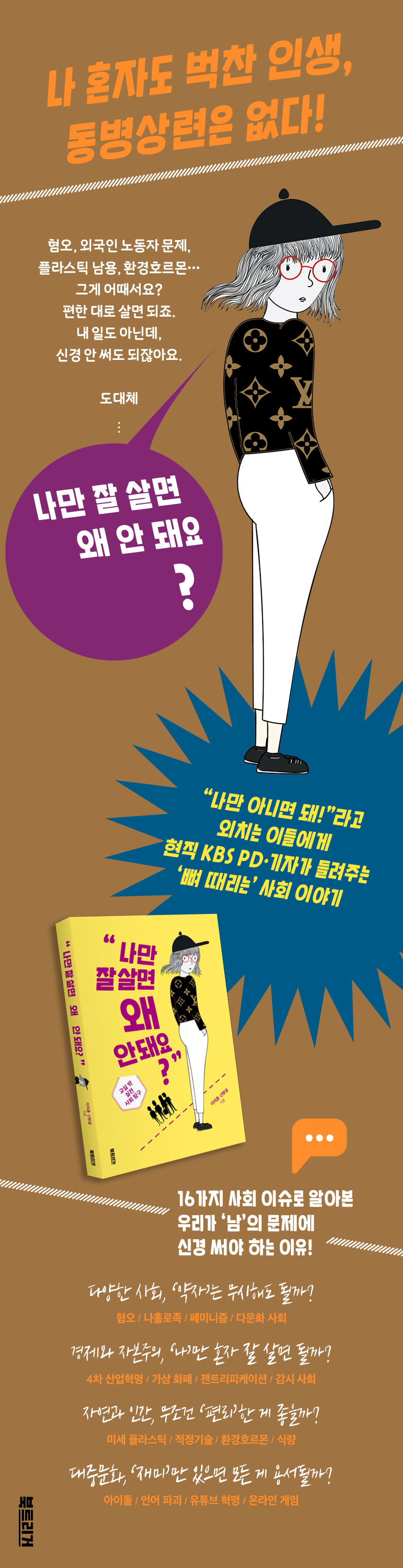
A current KBS producer and reporter shares a heartbreaking social story.
This book makes young people who think of 'me' before 'us' think about 'why we should dream of a life where we and others live together.'
Producer Lee Chi-hoon, who currently plans and produces cultural and scientific documentaries at KBS, and reporter Shin Bang-sil, a KBS weather reporter, analyzed the problems in our society based on various cases and suggested solutions.
Our society today is suffering from extreme selfishness and materialism.
The idea that 'money is everything' and 'I just need to live well' dominates the minds of many people.
The author shows these people what our society, rife with selfishness, looks like, divided into four areas.
In 'Diverse Society', the topic of "Can we ignore the 'weak'?" is examined through hate, loner tribe, feminism, and multicultural society, while in 'Economy and Capitalism', the topic of "Can 'I' live well alone?" is discussed while looking into the 4th Industrial Revolution, virtual currency, gentrification, and surveillance society.
In 'Nature and Humans,' we examine microplastics, appropriate technology, environmental hormones, and food issues, and consider the question, "Is 'convenience' always good?" In 'Popular Culture,' we consider idols, language destruction, YouTube, and online games, and consider the question, "Can everything be forgiven as long as it's 'fun'?"
Through various examples, the author tells us how human selfishness hurts each other and how it makes the Earth sick.
And he doesn't spare any sincere advice on why we should live well together and what we should do to make that happen.
A current KBS producer and reporter shares a heartbreaking social story.
This book makes young people who think of 'me' before 'us' think about 'why we should dream of a life where we and others live together.'
Producer Lee Chi-hoon, who currently plans and produces cultural and scientific documentaries at KBS, and reporter Shin Bang-sil, a KBS weather reporter, analyzed the problems in our society based on various cases and suggested solutions.
Our society today is suffering from extreme selfishness and materialism.
The idea that 'money is everything' and 'I just need to live well' dominates the minds of many people.
The author shows these people what our society, rife with selfishness, looks like, divided into four areas.
In 'Diverse Society', the topic of "Can we ignore the 'weak'?" is examined through hate, loner tribe, feminism, and multicultural society, while in 'Economy and Capitalism', the topic of "Can 'I' live well alone?" is discussed while looking into the 4th Industrial Revolution, virtual currency, gentrification, and surveillance society.
In 'Nature and Humans,' we examine microplastics, appropriate technology, environmental hormones, and food issues, and consider the question, "Is 'convenience' always good?" In 'Popular Culture,' we consider idols, language destruction, YouTube, and online games, and consider the question, "Can everything be forgiven as long as it's 'fun'?"
Through various examples, the author tells us how human selfishness hurts each other and how it makes the Earth sick.
And he doesn't spare any sincere advice on why we should live well together and what we should do to make that happen.
- You can preview some of the book's contents.
Preview
index
First hour
In a diverse society, can we ignore the 'weak'?
Hatred Consumes Korean Society
In the age of the single-person household, people who are comfortable being alone
The feminist wave sweeps across the globe like a giant tidal wave.
Multicultural Society: We Live Together
Second hour
Economy and Capitalism: Is it enough for only 'me' to live well?
The Fourth Industrial Revolution: A New World Opens
Cryptocurrency: At the Crossroads of Investment and Speculation
Gentrification casts a dark shadow over hot spots
Surveillance Society: Someone's Watching
Third hour
For nature and humans, is 'convenience' always better?
Microplastics, the particles of death floating in the ocean
Appropriate Technology, Good Technology for All
Endocrine disruptors are wreaking havoc on the planet.
Food, the power that makes us human
Fourth hour
In popular culture, can everything be forgiven if it's just "fun"?
Idols, the superpowers of pop culture
Language Destruction: Creative Destruction or Wordplay?
The YouTube Revolution: Changing the World with Fun and Diversity
Online games, another world we live in
In a diverse society, can we ignore the 'weak'?
Hatred Consumes Korean Society
In the age of the single-person household, people who are comfortable being alone
The feminist wave sweeps across the globe like a giant tidal wave.
Multicultural Society: We Live Together
Second hour
Economy and Capitalism: Is it enough for only 'me' to live well?
The Fourth Industrial Revolution: A New World Opens
Cryptocurrency: At the Crossroads of Investment and Speculation
Gentrification casts a dark shadow over hot spots
Surveillance Society: Someone's Watching
Third hour
For nature and humans, is 'convenience' always better?
Microplastics, the particles of death floating in the ocean
Appropriate Technology, Good Technology for All
Endocrine disruptors are wreaking havoc on the planet.
Food, the power that makes us human
Fourth hour
In popular culture, can everything be forgiven if it's just "fun"?
Idols, the superpowers of pop culture
Language Destruction: Creative Destruction or Wordplay?
The YouTube Revolution: Changing the World with Fun and Diversity
Online games, another world we live in
Detailed image
Into the book
Today's hateful society was born from a complex web of causes, including economic recession and conflicts between generations and classes.
In this harsh reality, to prevent the vicious cycle of hatred breeding more hatred, it is important to first eliminate the causes that can lead to hatred.
We could use the power of law to do this, but simply punishing the consequences will not solve the fundamental problem.
What we need now is a heart that understands and respects one another, and an attitude of empathy and reflection.
Being considerate and respectful of others is not only for their sake, but also for my own.
--- pp. 25-26 From 'In a Diverse Society, Can the 'Weak' Be Ignored? - Hatred Devours Korean Society'
In fact, the distinction between ‘speculation’ and ‘investment’ is not easy.
Because the criteria for distinguishing between the two are subjective.
There are only two interpretations of this: investment is defined as "an act of obtaining satisfactory returns while ensuring the stability of the principal through thorough analysis," while speculation is defined as "an act of seeking to make large profits by taking advantage of opportunities for price fluctuations."
But when viewed against these criteria, the virtual currency craze that swept our society in 2018 seems closer to speculation.
--- pp.95~96 'Economy and Capitalism: Is it enough for 'I' to live well alone? - Virtual Currency: Standing at the Crossroads of Investment and Speculation'
In addition to raising rents, gentrification also creates the problem of homogenizing commercial areas.
They get rid of the small, unique shops and make it a typical neighborhood you'd see anywhere.
As artists and small business owners are driven out, the alleys that boasted unique culture and atmosphere also disappear, a phenomenon called 'cultural whitening'.
Just as coral in the sea dies and the surrounding area turns white due to the limestone, this is a saying that points out the problem of alleys and streets losing cultural diversity and becoming uniform due to gentrification, which ultimately leads to stagnation again.
--- p.102 'Economy and Capitalism, Is It Enough for 'I' to Live Well Alone? - Gentrification, the Dark Shadow Cast on Hot Places'
Plastic that flows into the ocean poses a greater threat to humanity as it is broken down into smaller pieces by waves and sunlight.
Yet, land-based wastewater treatment plants are completely unable to filter out microplastics.
The pace of developing new plastic materials is very fast, but the systems and equipment to protect the environment from these materials are still in their infancy.
Accordingly, policies banning the manufacture and import of primary microplastics are being implemented around the world.
But the bigger problem is secondary microplastics, which account for an absolute majority (about 95%).
This poses a fundamental challenge: to drastically reduce the use of plastics, which are deeply ingrained in human life.
--- p.128 'For nature and humans, is 'convenience' always better? - Microplastics, grains of death floating in the ocean' from
The reason why environmental hormones are more dangerous to humans is because certain substances accumulate in living organisms and the concentration within the body increases as they pass through the food chain, which is a strong phenomenon called 'biomagnification'.
In other words, environmental hormones move up the food chain, so the higher the predator, the more accumulated they are in the body.
Large mammals, including humans, are top predators, so excessive exposure to environmental hormones can cause fatal problems.
--- p.158 From 'Nature and Humanity, Is 'Convenience' Always Better? - Environmental Hormones, Attacking the Earth as a Disaster'
For teenagers, idol stars are people who have achieved their dreams or are living in an ideal world.
So, when teenagers become immersed in idol stars, they forget the unsatisfactory reality and gain vicarious satisfaction from their successful lives.
The greater the gap between ideals and reality, the more likely it is that teenagers will become obsessed with idols.
For teenagers who are hungry for communication, a sense of belonging, and a sense of connection, being a fan of an idol holds a very special meaning.
By acting together with peers who have similar tastes and intentions, you can forget loneliness and gain emotional stability.
--- p.188 From 'Popular Culture, If It's 'Fun', Will Everything Be Forgivable? - Idols, the Super Power of Popular Culture'
As YouTube has grown in success, other sites that allow users to easily upload and share videos have continued to emerge.
A revolutionary change is taking place in the media world.
In addition, interest in ‘one-person media’ is also growing significantly.
One-person media refers to content such as text, photos, and videos planned, produced, and distributed by an individual.
In this harsh reality, to prevent the vicious cycle of hatred breeding more hatred, it is important to first eliminate the causes that can lead to hatred.
We could use the power of law to do this, but simply punishing the consequences will not solve the fundamental problem.
What we need now is a heart that understands and respects one another, and an attitude of empathy and reflection.
Being considerate and respectful of others is not only for their sake, but also for my own.
--- pp. 25-26 From 'In a Diverse Society, Can the 'Weak' Be Ignored? - Hatred Devours Korean Society'
In fact, the distinction between ‘speculation’ and ‘investment’ is not easy.
Because the criteria for distinguishing between the two are subjective.
There are only two interpretations of this: investment is defined as "an act of obtaining satisfactory returns while ensuring the stability of the principal through thorough analysis," while speculation is defined as "an act of seeking to make large profits by taking advantage of opportunities for price fluctuations."
But when viewed against these criteria, the virtual currency craze that swept our society in 2018 seems closer to speculation.
--- pp.95~96 'Economy and Capitalism: Is it enough for 'I' to live well alone? - Virtual Currency: Standing at the Crossroads of Investment and Speculation'
In addition to raising rents, gentrification also creates the problem of homogenizing commercial areas.
They get rid of the small, unique shops and make it a typical neighborhood you'd see anywhere.
As artists and small business owners are driven out, the alleys that boasted unique culture and atmosphere also disappear, a phenomenon called 'cultural whitening'.
Just as coral in the sea dies and the surrounding area turns white due to the limestone, this is a saying that points out the problem of alleys and streets losing cultural diversity and becoming uniform due to gentrification, which ultimately leads to stagnation again.
--- p.102 'Economy and Capitalism, Is It Enough for 'I' to Live Well Alone? - Gentrification, the Dark Shadow Cast on Hot Places'
Plastic that flows into the ocean poses a greater threat to humanity as it is broken down into smaller pieces by waves and sunlight.
Yet, land-based wastewater treatment plants are completely unable to filter out microplastics.
The pace of developing new plastic materials is very fast, but the systems and equipment to protect the environment from these materials are still in their infancy.
Accordingly, policies banning the manufacture and import of primary microplastics are being implemented around the world.
But the bigger problem is secondary microplastics, which account for an absolute majority (about 95%).
This poses a fundamental challenge: to drastically reduce the use of plastics, which are deeply ingrained in human life.
--- p.128 'For nature and humans, is 'convenience' always better? - Microplastics, grains of death floating in the ocean' from
The reason why environmental hormones are more dangerous to humans is because certain substances accumulate in living organisms and the concentration within the body increases as they pass through the food chain, which is a strong phenomenon called 'biomagnification'.
In other words, environmental hormones move up the food chain, so the higher the predator, the more accumulated they are in the body.
Large mammals, including humans, are top predators, so excessive exposure to environmental hormones can cause fatal problems.
--- p.158 From 'Nature and Humanity, Is 'Convenience' Always Better? - Environmental Hormones, Attacking the Earth as a Disaster'
For teenagers, idol stars are people who have achieved their dreams or are living in an ideal world.
So, when teenagers become immersed in idol stars, they forget the unsatisfactory reality and gain vicarious satisfaction from their successful lives.
The greater the gap between ideals and reality, the more likely it is that teenagers will become obsessed with idols.
For teenagers who are hungry for communication, a sense of belonging, and a sense of connection, being a fan of an idol holds a very special meaning.
By acting together with peers who have similar tastes and intentions, you can forget loneliness and gain emotional stability.
--- p.188 From 'Popular Culture, If It's 'Fun', Will Everything Be Forgivable? - Idols, the Super Power of Popular Culture'
As YouTube has grown in success, other sites that allow users to easily upload and share videos have continued to emerge.
A revolutionary change is taking place in the media world.
In addition, interest in ‘one-person media’ is also growing significantly.
One-person media refers to content such as text, photos, and videos planned, produced, and distributed by an individual.
--- p.218 From 'Popular Culture: Can Everything Be Forgiven If It's 'Fun'? - The YouTube Revolution: Changing the World with Fun and Diversity'
Publisher's Review
The unstoppable rush of excessive competition and materialism!
What kind of society awaits us at the end?
'Highest suicide rate among OECD countries', 'Quality of life for children and adolescents lowest in OECD countries', 'Youth unemployment and low birth rate with no signs of resolution'.
This is the current state of our society.
Moreover, the corruption in politics, the inheritance of the rich, and the incompetent and selfish image of the older generation that make headline news every day are staining our society with disgust.
The problem is that many people who are consumed by hatred have the mindset of “As long as it’s not me!” or “As long as I live well, it’s okay!” and indiscriminately ignore or trample on those who seem weaker than them.
Beyond disparaging specific groups such as foreign workers and sexual minorities, all generations have now become targets of criticism, including those who are picky eaters, mommies, old farts, and old farts.
Moreover, as the perception that 'money is power' spreads, the number of people who think that they can make money simply by speculating in real estate or virtual currency has increased.
What kind of society awaits us in this world of selfishness, condemnation of others, and materialism?
Digging into 16 social issues
Why we must live our lives caring about other people's problems!
“There’s no problem with using a little plastic.
Disgusting, it's not my business, so don't worry about it.
Gentrification, all the shabby buildings are gone and new ones are rising, so it's all good, but why is it bad? I mean, as long as it's convenient for me, as long as it's ignored, as long as it's happy, as long as it's rich, then whatever happens, it doesn't matter.
“Why should I live my life worrying about other people’s problems?”
"Why Can't I Just Live Well?" is a book that began with this trivial yet personal question.
In our busy and hectic lives, we are too busy taking care of ourselves, but textbooks tell us to respect, care for, and understand others.
Why should we do so? This book examines 16 social issues that are a hot topic in our society, delving into why we should live with concern for the problems of others.
In the first hour, “In a diverse society, can we ignore the ‘weak’?” we talk about ‘living together with others.’
First, it addresses the problem of 'hatred' that has become rampant in our society as "respect and consideration for others disappear and are replaced by extreme competition and selfishness."
Next, through the 'solo tribe', we are reminded that while many people find happiness in living alone, there are just as many who struggle with poverty and social isolation.
And, by learning about the history and development of 'feminism', we are dealing with the conflict between men and women, and examining the state of our society, which has already entered a 'multicultural society'.
The second hour, “Economy and Capitalism, Is It Enough for ‘I’ to Live Well Alone?” shows ‘the current state of affairs where people do not hesitate to go through any means necessary to become rich.’
We examine the changes that will occur in our society in the era of the "Fourth Industrial Revolution," as well as the problems of workers who will lose their jobs as a result, and examine the problems and solutions of "virtual currency."
Next, we will learn about 'gentrification', also known as 'nest displacement' and 'commercial displacement', and delve into the problems of the 'surveillance society' that has penetrated even the daily lives of ordinary citizens.
In the third hour, “Nature and Humans: Is ‘Convenience’ Always Better?”, we examine the ‘natural environment being destroyed for human convenience.’
We will learn about the issue of 'microplastics', which is a major issue these days, as well as 'appropriate technology', which is a humane and environmentally friendly technology.
And it points out the problem of 'endocrine disruptors' that arise from chemicals and plastic products, and analyzes in detail the 'food' problem such as food shortages, genetically modified foods, and large grain companies and speculative capital that think of food as a means of making money.
In the fourth hour, “Popular culture: Will everything be forgiven if it’s ‘fun’?” we talk about “the light and shadow of our popular culture.”
It sharply analyzes the fantasies and realities teenagers have about the superpowers of popular culture, the "idols," and deals with the phenomenon of "language destruction," which has recently become widespread due to the development of the Internet and mobile phones.
Next, we will examine the success story and problems of YouTube, which has been gaining immense popularity across all generations, and take a closer look at the appeal of online games and the World Health Organization's (WHO) definition of game addiction as a disease.
Social Studies: How can I become popular?
The answer is in "Why can't I just live well?"
The small yet personal question, “Why can’t I just live well?” expands into a very important and social question as it encounters various problems that arise in our society.
It may seem like if only 'I' do well, it will be enough, and if only 'I' make a lot of money, I will be the happiest in the world, but humans, as social animals, cannot ultimately live alone.
As we examine the social issues addressed in this book, we see that they all lead to the same conclusion: we must put ourselves in the shoes of others, think again, and find ways for humanity to live together well.
Social studies textbooks teach us that we must protect the natural environment, eliminate inequality, and achieve social justice. These are the conditions for a happy life.
It's so vague.
To truly be popular in social studies, you must first understand what specific problems are occurring in our society related to the natural environment and how many people are suffering due to inequality and hatred.
"Why Can't I Just Live Well?" identifies the problems in our society one by one and suggests solutions that can help our society move on a more correct path.
And it tells us why not only ‘I’ but also ‘others’ should live well.
Reading this book will help you understand why we need to look into the lives of others as well as ourselves, and why we need to communicate with them.
What kind of society awaits us at the end?
'Highest suicide rate among OECD countries', 'Quality of life for children and adolescents lowest in OECD countries', 'Youth unemployment and low birth rate with no signs of resolution'.
This is the current state of our society.
Moreover, the corruption in politics, the inheritance of the rich, and the incompetent and selfish image of the older generation that make headline news every day are staining our society with disgust.
The problem is that many people who are consumed by hatred have the mindset of “As long as it’s not me!” or “As long as I live well, it’s okay!” and indiscriminately ignore or trample on those who seem weaker than them.
Beyond disparaging specific groups such as foreign workers and sexual minorities, all generations have now become targets of criticism, including those who are picky eaters, mommies, old farts, and old farts.
Moreover, as the perception that 'money is power' spreads, the number of people who think that they can make money simply by speculating in real estate or virtual currency has increased.
What kind of society awaits us in this world of selfishness, condemnation of others, and materialism?
Digging into 16 social issues
Why we must live our lives caring about other people's problems!
“There’s no problem with using a little plastic.
Disgusting, it's not my business, so don't worry about it.
Gentrification, all the shabby buildings are gone and new ones are rising, so it's all good, but why is it bad? I mean, as long as it's convenient for me, as long as it's ignored, as long as it's happy, as long as it's rich, then whatever happens, it doesn't matter.
“Why should I live my life worrying about other people’s problems?”
"Why Can't I Just Live Well?" is a book that began with this trivial yet personal question.
In our busy and hectic lives, we are too busy taking care of ourselves, but textbooks tell us to respect, care for, and understand others.
Why should we do so? This book examines 16 social issues that are a hot topic in our society, delving into why we should live with concern for the problems of others.
In the first hour, “In a diverse society, can we ignore the ‘weak’?” we talk about ‘living together with others.’
First, it addresses the problem of 'hatred' that has become rampant in our society as "respect and consideration for others disappear and are replaced by extreme competition and selfishness."
Next, through the 'solo tribe', we are reminded that while many people find happiness in living alone, there are just as many who struggle with poverty and social isolation.
And, by learning about the history and development of 'feminism', we are dealing with the conflict between men and women, and examining the state of our society, which has already entered a 'multicultural society'.
The second hour, “Economy and Capitalism, Is It Enough for ‘I’ to Live Well Alone?” shows ‘the current state of affairs where people do not hesitate to go through any means necessary to become rich.’
We examine the changes that will occur in our society in the era of the "Fourth Industrial Revolution," as well as the problems of workers who will lose their jobs as a result, and examine the problems and solutions of "virtual currency."
Next, we will learn about 'gentrification', also known as 'nest displacement' and 'commercial displacement', and delve into the problems of the 'surveillance society' that has penetrated even the daily lives of ordinary citizens.
In the third hour, “Nature and Humans: Is ‘Convenience’ Always Better?”, we examine the ‘natural environment being destroyed for human convenience.’
We will learn about the issue of 'microplastics', which is a major issue these days, as well as 'appropriate technology', which is a humane and environmentally friendly technology.
And it points out the problem of 'endocrine disruptors' that arise from chemicals and plastic products, and analyzes in detail the 'food' problem such as food shortages, genetically modified foods, and large grain companies and speculative capital that think of food as a means of making money.
In the fourth hour, “Popular culture: Will everything be forgiven if it’s ‘fun’?” we talk about “the light and shadow of our popular culture.”
It sharply analyzes the fantasies and realities teenagers have about the superpowers of popular culture, the "idols," and deals with the phenomenon of "language destruction," which has recently become widespread due to the development of the Internet and mobile phones.
Next, we will examine the success story and problems of YouTube, which has been gaining immense popularity across all generations, and take a closer look at the appeal of online games and the World Health Organization's (WHO) definition of game addiction as a disease.
Social Studies: How can I become popular?
The answer is in "Why can't I just live well?"
The small yet personal question, “Why can’t I just live well?” expands into a very important and social question as it encounters various problems that arise in our society.
It may seem like if only 'I' do well, it will be enough, and if only 'I' make a lot of money, I will be the happiest in the world, but humans, as social animals, cannot ultimately live alone.
As we examine the social issues addressed in this book, we see that they all lead to the same conclusion: we must put ourselves in the shoes of others, think again, and find ways for humanity to live together well.
Social studies textbooks teach us that we must protect the natural environment, eliminate inequality, and achieve social justice. These are the conditions for a happy life.
It's so vague.
To truly be popular in social studies, you must first understand what specific problems are occurring in our society related to the natural environment and how many people are suffering due to inequality and hatred.
"Why Can't I Just Live Well?" identifies the problems in our society one by one and suggests solutions that can help our society move on a more correct path.
And it tells us why not only ‘I’ but also ‘others’ should live well.
Reading this book will help you understand why we need to look into the lives of others as well as ourselves, and why we need to communicate with them.
GOODS SPECIFICS
- Date of publication: August 20, 2019
- Page count, weight, size: 332 pages | 324g | 143*207*30mm
- ISBN13: 9791189799137
- ISBN10: 1189799138
You may also like
카테고리
korean


korean

![GQ KOREA Mark (Monthly): December [2025]](http://librairie.coreenne.fr/cdn/shop/files/8ef265dbbfbf186523ed75ba7319009d.jpg?v=1765340328&width=3840)


