

Why are you discouraged?
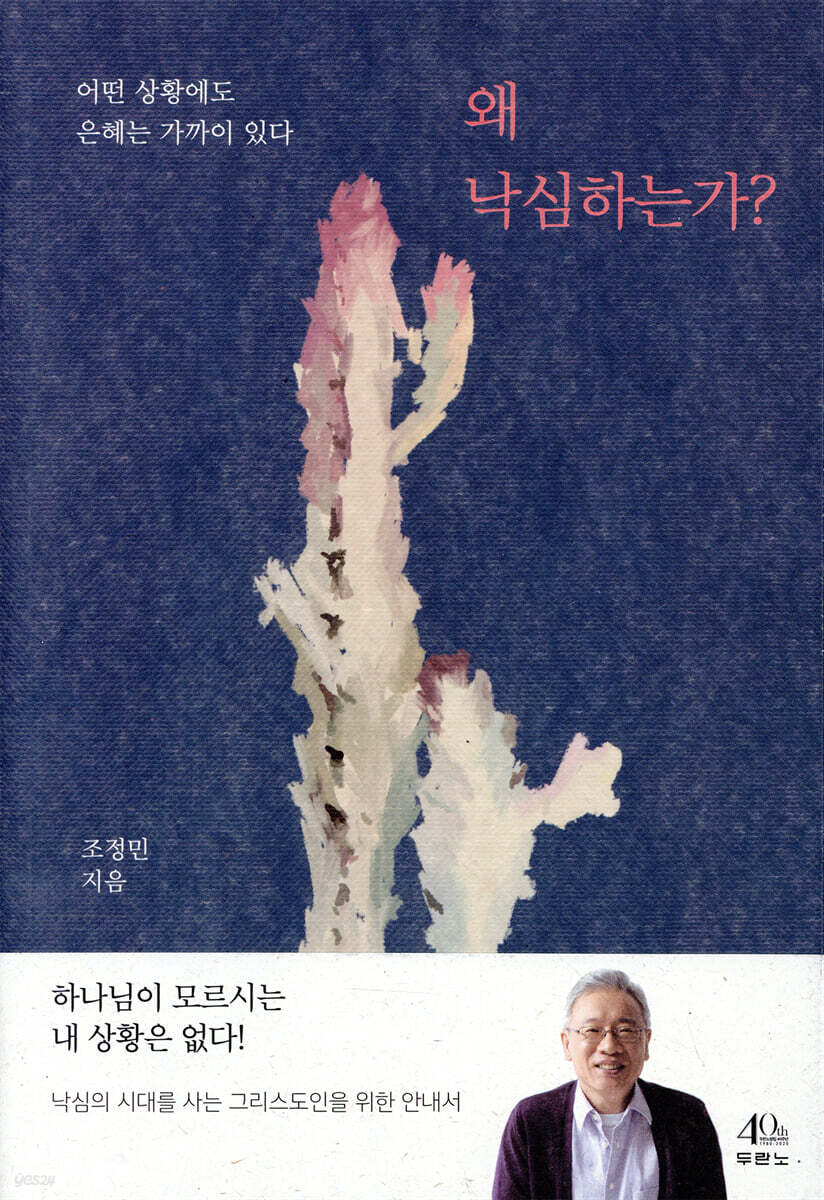 |
Description
Book Introduction
Don't be afraid of the bottom of life
Even if it breaks and shatters, there is a place to return to!
A Guide for Christians Living in a Time of Discouragement
I'm not the only one experiencing this
People are more accustomed to despair than to hope.
So, we usually react much more easily and immediately to negative messages than to hopeful messages.
However, the Bible tells us not to be discouraged or discouraged by any situation or task we face, but to get up and keep moving forward.
Throughout the ages, people of all faiths have experienced discouragement.
Are we the only ones experiencing 40-degree midsummer heat? Are we the only ones facing hardship on the Korean Peninsula? With the entire planet reeling from COVID-19, how can we be the only ones safe?
But we can and must rise again.
And you have to command yourself to get up.
When difficult things come crashing down on you like waves, you must ask yourself why before you drown in a sea of discouragement.
We must be able to criticize ourselves for being like this when we are saved.
When we look into the root of discouragement, we unexpectedly come face to face with a wounded self.
We face doubts that prevent us from holding on tightly to the rope of salvation.
As always, the Word points to a surprising exit.
The Bible, written long ago, provides answers to the real problems we face in the 21st century.
This book delves into six topics about why we get discouraged.
It helps you break free from the despair that seems impossible to escape and start a new life.
Even if it breaks and shatters, there is a place to return to!
A Guide for Christians Living in a Time of Discouragement
I'm not the only one experiencing this
People are more accustomed to despair than to hope.
So, we usually react much more easily and immediately to negative messages than to hopeful messages.
However, the Bible tells us not to be discouraged or discouraged by any situation or task we face, but to get up and keep moving forward.
Throughout the ages, people of all faiths have experienced discouragement.
Are we the only ones experiencing 40-degree midsummer heat? Are we the only ones facing hardship on the Korean Peninsula? With the entire planet reeling from COVID-19, how can we be the only ones safe?
But we can and must rise again.
And you have to command yourself to get up.
When difficult things come crashing down on you like waves, you must ask yourself why before you drown in a sea of discouragement.
We must be able to criticize ourselves for being like this when we are saved.
When we look into the root of discouragement, we unexpectedly come face to face with a wounded self.
We face doubts that prevent us from holding on tightly to the rope of salvation.
As always, the Word points to a surprising exit.
The Bible, written long ago, provides answers to the real problems we face in the 21st century.
This book delves into six topics about why we get discouraged.
It helps you break free from the despair that seems impossible to escape and start a new life.
- You can preview some of the book's contents.
Preview
index
prolog
1 Find the reason for your discouragement.
2 I didn't do anything
3 I'm not the only one experiencing this
4 Regrets are useless
5 Why are you interested in it?
6 Do not be discouraged in doing good.
7 Are you really afraid of the future?
1 Find the reason for your discouragement.
2 I didn't do anything
3 I'm not the only one experiencing this
4 Regrets are useless
5 Why are you interested in it?
6 Do not be discouraged in doing good.
7 Are you really afraid of the future?
Into the book
What is faith in such an age? How should people of faith face this tide? Is there any way out of discouragement in an age where so many discouraging situations await us? What can the Bible, written two thousand years ago, have to say about the crises of the 21st century? What wisdom can the conversations of the men of faith in the Bible, who for most of their lives navigated the nomadic path, teach us in this digital age? Fortunately, there is.
People haven't changed.
The nature of interest has not changed either.
The nature of the relationship has not changed either.
Above all, the types of discouragement are also different.
So God's wisdom still shines.
Even today, the fear of God remains the foundation of wisdom.
--- p.7
The Bible is very sensitive on the subject of discouragement.
In fact, aren't most of us more easily discouraged than encouraged? Yet, why wouldn't God, who created us, be aware of the transformation taking place within us? A mere glance reveals that the Bible, throughout its pages, focuses on how God restores discouraged people.
If you break down the Chinese characters for discouragement, it is 'nak' (落), meaning 'to fall', and 'sim' (心), meaning 'heart'.
It could be interpreted as “the mind fell to a low place” because the desired thing was not achieved.
While mending a broken heart, or a wounded mind, may seem daunting, wouldn't it be worthwhile to try to lift it up and lift it back up? If faith means living a distinct life, how should we deal with the discouragement that everyone experiences? The first step would be to examine the reasons for our own discouragement.
--- p.17
Although Christians are saved from the eternal discouragement of the curse of eternal punishment through salvation, they are inevitably faced with greater discouragement in some ways.
Because they experience sharp conflicts and confrontations by straying from all the paths taken by the people of the world, and are thrown into utter loneliness.
Sometimes we are faced with situations so dire that we have to face the whole world.
As David said in the Psalms, “tens of thousands of people surround me” (Psalm 3:6), and we are faced with a situation where we have no one to trust or rely on.
We too may face such situations today.
When we actually face such a situation, we must remember one thing.
The one thing that is certain is that the forefathers of faith mentioned in the Book of Hebrews have already overcome such situations.
Therefore, we must realize that the hardships we experience in our faith are not something we alone have to endure, but rather something that countless predecessors in faith have already experienced and overcome.
The bottom line is this: if you begin this path with faith, you can endure whatever hardships come your way.
The reality that shifting the paradigm from death to life does not eliminate suffering or eliminate difficulties confuses many people.
But only when our faith overcomes the hardships and difficulties that we cannot bear alone will we be able to escape from this confusion.
--- p.76~77
Q: Isn't repentance supposed to mean turning away from past sins? Yet, many people claim to have repented yet still commit sins.
So some people accuse Christians of being irresponsible, but why is it so hard to turn back?
Repentance is a complete turning away from sin.
It means not committing the same sin twice.
Not repeating sin—this is the reward that repentance gives in life.
But that's not easy.
Being filled with the Holy Spirit does not mean that you will never make mistakes, but that the time it takes to turn back after making a mistake becomes shorter and shorter.
That is, the gap between sin and conversion is gradually narrowing, which is called being filled with the Holy Spirit.
Living a life of constant turning back is a life of repentance.
People who have something truly valuable in their hands and have a clear purpose in life do not hesitate.
Therefore, do not dwell on your own evil habits, but think about how precious the gospel is that has been given to us.
Sometimes, even though you clearly repented and your life changed, people don't acknowledge it.
I turned back, but the situation around me didn't really change.
Didn't the Apostle Paul live exactly like that? He repented after meeting Jesus, but neither the Jews nor Jesus' disciples believed in him.
He was condemned by both sides as a traitor and a persecutor.
If you truly set out to follow God's path, enemies are bound to arise on both sides.
The path to repentance is narrow.
Choosing the narrow path is never easy.
So, we must have a clear object in which we can believe, rely on, and follow.
Repentance is like a kind of proposal.
Once you decide to share your future with one person, you stop looking at others.
It's about being able to focus on one person without wandering around anymore.
What a sense of stability surrounds us after our long wanderings.
Even though hardships begin, the reason we continue on that path without wavering is because of our faith.
--- p.114~115
Fear comes from narcissism.
It is fearful to be overconfident and overpraise one's own existence.
We are nothing more than "the dew that quickly vanishes" (Hosea 6:4), so why worry as if we will live forever? We struggle with today's events, so why worry about tomorrow? Why worry about next year? We can think about the future.
You can design the future.
You can predict the future.
But if you are discouraged because of a future you cannot control, then you are overcome by fear.
Design your future with joy.
Make plans for 10 years from now, 20 years from now.
Make a bucket list of things you want to do before you die and live your life accomplishing them one by one.
People haven't changed.
The nature of interest has not changed either.
The nature of the relationship has not changed either.
Above all, the types of discouragement are also different.
So God's wisdom still shines.
Even today, the fear of God remains the foundation of wisdom.
--- p.7
The Bible is very sensitive on the subject of discouragement.
In fact, aren't most of us more easily discouraged than encouraged? Yet, why wouldn't God, who created us, be aware of the transformation taking place within us? A mere glance reveals that the Bible, throughout its pages, focuses on how God restores discouraged people.
If you break down the Chinese characters for discouragement, it is 'nak' (落), meaning 'to fall', and 'sim' (心), meaning 'heart'.
It could be interpreted as “the mind fell to a low place” because the desired thing was not achieved.
While mending a broken heart, or a wounded mind, may seem daunting, wouldn't it be worthwhile to try to lift it up and lift it back up? If faith means living a distinct life, how should we deal with the discouragement that everyone experiences? The first step would be to examine the reasons for our own discouragement.
--- p.17
Although Christians are saved from the eternal discouragement of the curse of eternal punishment through salvation, they are inevitably faced with greater discouragement in some ways.
Because they experience sharp conflicts and confrontations by straying from all the paths taken by the people of the world, and are thrown into utter loneliness.
Sometimes we are faced with situations so dire that we have to face the whole world.
As David said in the Psalms, “tens of thousands of people surround me” (Psalm 3:6), and we are faced with a situation where we have no one to trust or rely on.
We too may face such situations today.
When we actually face such a situation, we must remember one thing.
The one thing that is certain is that the forefathers of faith mentioned in the Book of Hebrews have already overcome such situations.
Therefore, we must realize that the hardships we experience in our faith are not something we alone have to endure, but rather something that countless predecessors in faith have already experienced and overcome.
The bottom line is this: if you begin this path with faith, you can endure whatever hardships come your way.
The reality that shifting the paradigm from death to life does not eliminate suffering or eliminate difficulties confuses many people.
But only when our faith overcomes the hardships and difficulties that we cannot bear alone will we be able to escape from this confusion.
--- p.76~77
Q: Isn't repentance supposed to mean turning away from past sins? Yet, many people claim to have repented yet still commit sins.
So some people accuse Christians of being irresponsible, but why is it so hard to turn back?
Repentance is a complete turning away from sin.
It means not committing the same sin twice.
Not repeating sin—this is the reward that repentance gives in life.
But that's not easy.
Being filled with the Holy Spirit does not mean that you will never make mistakes, but that the time it takes to turn back after making a mistake becomes shorter and shorter.
That is, the gap between sin and conversion is gradually narrowing, which is called being filled with the Holy Spirit.
Living a life of constant turning back is a life of repentance.
People who have something truly valuable in their hands and have a clear purpose in life do not hesitate.
Therefore, do not dwell on your own evil habits, but think about how precious the gospel is that has been given to us.
Sometimes, even though you clearly repented and your life changed, people don't acknowledge it.
I turned back, but the situation around me didn't really change.
Didn't the Apostle Paul live exactly like that? He repented after meeting Jesus, but neither the Jews nor Jesus' disciples believed in him.
He was condemned by both sides as a traitor and a persecutor.
If you truly set out to follow God's path, enemies are bound to arise on both sides.
The path to repentance is narrow.
Choosing the narrow path is never easy.
So, we must have a clear object in which we can believe, rely on, and follow.
Repentance is like a kind of proposal.
Once you decide to share your future with one person, you stop looking at others.
It's about being able to focus on one person without wandering around anymore.
What a sense of stability surrounds us after our long wanderings.
Even though hardships begin, the reason we continue on that path without wavering is because of our faith.
--- p.114~115
Fear comes from narcissism.
It is fearful to be overconfident and overpraise one's own existence.
We are nothing more than "the dew that quickly vanishes" (Hosea 6:4), so why worry as if we will live forever? We struggle with today's events, so why worry about tomorrow? Why worry about next year? We can think about the future.
You can design the future.
You can predict the future.
But if you are discouraged because of a future you cannot control, then you are overcome by fear.
Design your future with joy.
Make plans for 10 years from now, 20 years from now.
Make a bucket list of things you want to do before you die and live your life accomplishing them one by one.
--- p.193
Publisher's Review
Let's start again with God
Anyone can fail.
You may fall and become discouraged.
But you can start again with God.
God always starts anew and prepares an opportunity for a reversal at each time.
If my life, my own, has become a mess because I have been touching it myself, then now surrendering to God and asking Him to touch it is faith.
If it's completely broken and shattered, then it's time to start over.
Then God will create you anew from the beginning.
The people God wants are not the righteous, but the repentant sinners.
When we repent, we can run full speed toward the future without being tied down by the past.
Anyone can fail.
You may fall and become discouraged.
But you can start again with God.
God always starts anew and prepares an opportunity for a reversal at each time.
If my life, my own, has become a mess because I have been touching it myself, then now surrendering to God and asking Him to touch it is faith.
If it's completely broken and shattered, then it's time to start over.
Then God will create you anew from the beginning.
The people God wants are not the righteous, but the repentant sinners.
When we repent, we can run full speed toward the future without being tied down by the past.
GOODS SPECIFICS
- Publication date: March 25, 2020
- Page count, weight, size: 204 pages | 226g | 130*190*20mm
- ISBN13: 9788953137141
- ISBN10: 8953137144
You may also like
카테고리
korean


korean

![GQ KOREA Mark (Monthly): December [2025]](http://librairie.coreenne.fr/cdn/shop/files/8ef265dbbfbf186523ed75ba7319009d.jpg?v=1765340328&width=3840)


