

10 Ingenious Things That Will Save the Planet
 |
Description
Book Introduction
A new work by author Park Kyung-hwa, recipient of the Presidential Citation on '2019 Environment Day'!!
In the era of environmental counterattack, here's what you need to know before it's too late!
“What item should I use and how should I use it?
“Is it possible for the Earth and humans to coexist happily?”
Author Park Kyung-hwa, who has published representative domestic environmental books such as “Gorillas Hate Cell Phones,” “The Missing Fox and the Native Seed,” and “How Earthlings Use the City,” has talked about how environmental problems that arise in our daily lives affect “me” and “the Earth” and why a life that follows the laws of nature is important, has now listened to the stories of everyday objects!
The author says that in this age of environmental counterattack, what we need to seriously reflect on to solve this problem are the everyday objects we have been using without thinking.
Billions of people on Earth decide whether or not the Earth and humans can coexist happily based on what they use and how they use it.
This book contains specific details about which of the countless objects we use are ingenious and can save the Earth, and how these objects are helping to save the Earth.
It introduces environmental issues related to objects, unknown ingredients and stories behind their origins, the impact of these objects on the environment, and desirable ways to use objects for coexistence between humans and the Earth, based on actual events and various research data.
In the era of environmental counterattack, here's what you need to know before it's too late!
“What item should I use and how should I use it?
“Is it possible for the Earth and humans to coexist happily?”
Author Park Kyung-hwa, who has published representative domestic environmental books such as “Gorillas Hate Cell Phones,” “The Missing Fox and the Native Seed,” and “How Earthlings Use the City,” has talked about how environmental problems that arise in our daily lives affect “me” and “the Earth” and why a life that follows the laws of nature is important, has now listened to the stories of everyday objects!
The author says that in this age of environmental counterattack, what we need to seriously reflect on to solve this problem are the everyday objects we have been using without thinking.
Billions of people on Earth decide whether or not the Earth and humans can coexist happily based on what they use and how they use it.
This book contains specific details about which of the countless objects we use are ingenious and can save the Earth, and how these objects are helping to save the Earth.
It introduces environmental issues related to objects, unknown ingredients and stories behind their origins, the impact of these objects on the environment, and desirable ways to use objects for coexistence between humans and the Earth, based on actual events and various research data.
- You can preview some of the book's contents.
Preview
index
Opening remarks
1.
Stainless steel - the safest bowl
The Inconvenient Truth About Plastic
Brassware and green patina
Invention of stainless steel
The birth of plastic
Operation Plastic Eradication
· Earth Daily _ Can we reduce plastic use?
2.
Metal Chopsticks - Sturdy, Clean, and Long-lasting Dining Tools
Simple but useful eating utensils
Chopsticks Three Kingdoms
20-year-old trees that are used for 20 minutes and then thrown away
The evolution of chopsticks
An ingenious way to eliminate disposable products
· Earth Daily _ What is a sustainable method?
3.
Paper - A light, thin, yet powerful recording medium
Elephant dung paper that brought peace
The invention of paper
Silent Spring and Earth Day
made of paper
The Two Faces of Paper
· Earth Daily _ Should I save paper or read more books?
4.
Reuse Store - Extending the Life of Discarded Items
Traveling trash
Advantages of Reuse Stores
The Beginning of Flea Markets and Reuse Shops
Reuse stores in our country
· Earth Daily _ What items should I donate?
5.
Parks: Green lungs that save complex cities
Yellowstone, the world's first national park
Our country's first national park is Jirisan
City parks are a modern invention
History of our country's parks
Enjoy the benefits the park has to offer!
· Jigu Ilbo _ Should we make it a park or build apartments?
6.
Wildlife Extinction: A Warning to Humans
What Happened to the Bees
Why did tigers become extinct?
Extinction History of Wildlife on the Korean Peninsula
What wild animals do in the forest
The importance of biodiversity
· Earth Daily _ Should we protect the goral or capture it?
7.
Bicycles: Eco-friendly transportation that saves the planet and me.
Fine dust, who are you?
A bicycle is enough
History of the Bicycle
Eco-friendly transportation for the future city
· Earth Daily _ Can we reduce the number of cars?
8.
Appropriate Technology: Human-Centered Technology for a More Convenient and Affluent Life
Simple yet amazing technology
What is appropriate technology?
History of Appropriate Technology
Appropriate Technology: Reaching Developing Countries
The joy of making things with my own hands
· Earth Daily _ Can science and technology solve environmental problems?
9.
Solar cells - safe energy without worrying about depletion
Steamed fish and dried pollack
Concerns about power generation
Solar cells and eco-friendly energy
The Earth's Conquest by Solar Cells
The great success of solar cells
· Earth Daily _ Is solar energy truly eco-friendly?
10.
Passive House - An eco-friendly house that does not emit greenhouse gases
What makes a good home?
Smart Home, Passive House
History of Passive House
Where to find passive houses
The future is the era of passive houses!
· Earth Daily _ Can we solve the problem of climate change?
1.
Stainless steel - the safest bowl
The Inconvenient Truth About Plastic
Brassware and green patina
Invention of stainless steel
The birth of plastic
Operation Plastic Eradication
· Earth Daily _ Can we reduce plastic use?
2.
Metal Chopsticks - Sturdy, Clean, and Long-lasting Dining Tools
Simple but useful eating utensils
Chopsticks Three Kingdoms
20-year-old trees that are used for 20 minutes and then thrown away
The evolution of chopsticks
An ingenious way to eliminate disposable products
· Earth Daily _ What is a sustainable method?
3.
Paper - A light, thin, yet powerful recording medium
Elephant dung paper that brought peace
The invention of paper
Silent Spring and Earth Day
made of paper
The Two Faces of Paper
· Earth Daily _ Should I save paper or read more books?
4.
Reuse Store - Extending the Life of Discarded Items
Traveling trash
Advantages of Reuse Stores
The Beginning of Flea Markets and Reuse Shops
Reuse stores in our country
· Earth Daily _ What items should I donate?
5.
Parks: Green lungs that save complex cities
Yellowstone, the world's first national park
Our country's first national park is Jirisan
City parks are a modern invention
History of our country's parks
Enjoy the benefits the park has to offer!
· Jigu Ilbo _ Should we make it a park or build apartments?
6.
Wildlife Extinction: A Warning to Humans
What Happened to the Bees
Why did tigers become extinct?
Extinction History of Wildlife on the Korean Peninsula
What wild animals do in the forest
The importance of biodiversity
· Earth Daily _ Should we protect the goral or capture it?
7.
Bicycles: Eco-friendly transportation that saves the planet and me.
Fine dust, who are you?
A bicycle is enough
History of the Bicycle
Eco-friendly transportation for the future city
· Earth Daily _ Can we reduce the number of cars?
8.
Appropriate Technology: Human-Centered Technology for a More Convenient and Affluent Life
Simple yet amazing technology
What is appropriate technology?
History of Appropriate Technology
Appropriate Technology: Reaching Developing Countries
The joy of making things with my own hands
· Earth Daily _ Can science and technology solve environmental problems?
9.
Solar cells - safe energy without worrying about depletion
Steamed fish and dried pollack
Concerns about power generation
Solar cells and eco-friendly energy
The Earth's Conquest by Solar Cells
The great success of solar cells
· Earth Daily _ Is solar energy truly eco-friendly?
10.
Passive House - An eco-friendly house that does not emit greenhouse gases
What makes a good home?
Smart Home, Passive House
History of Passive House
Where to find passive houses
The future is the era of passive houses!
· Earth Daily _ Can we solve the problem of climate change?
Detailed image
Into the book
Stainless steel was invented by accident.
It was first discovered by Harry Brearley, a researcher at the Brown Firth Laboratory in Sheffield, England.
Brierley was working on developing a corrosion-resistant metal that could be used in the manufacture of firearms.
One day in 1912, after lunch, Brearley was walking through the factory yard when he came across a shiny piece of iron.
It was a piece of iron that was thrown away because it was deemed useless during various experiments to develop steel that could withstand high temperatures.
But even though it had been abandoned for a long time and had been drenched in rain, the iron pieces hadn't rusted at all.
--- p.24
Before the invention of paper, letters were written on wood, rocks, pottery, silk, shards of pottery, wooden fences, bamboo strips, bronze or iron vessels, vellum made from tree bark, and parchment made from sheep skin.
These materials were bulky, heavy, expensive, and had complex processing processes, making them difficult for everyone to use.
These concerns were completely eliminated when paper was invented, which was light, easy to store, and could hold a lot of text.
--- p.75
Everyone's favorite city park is said to be a modern facility and invention.
Why is something that isn't even a thing considered an invention? The etymology of the word "park" (meaning "park") comes from Old French.
At that time, 'park' meant hunting ground.
Medieval European nobles created their own hunting grounds where they could hunt animals such as deer, rabbits, and foxes in a designated area.
As the civil revolution took place and civil society grew, the royal family and nobles opened their private spaces, such as the royal gardens, hunting grounds, and noble gardens, to the citizens.
The term "public garden" emerged in the process of opening up royal or noble gardens and hunting grounds.
--- p.135
In 2005 alone, 30 percent of honeybees disappeared, and the number is increasing every year.
The United Nations Environment Programme warned that a decline in bees would not only disrupt the ecosystem but also pose serious problems for food security.
According to the Food and Agriculture Organization of the United Nations, 70 percent of the 100 major crop species rely on honeybees.
If bees disappear, various crops such as apples, pears, strawberries, peppers, grains, coffee, and almonds will become extinct, and cotton fibers, T-shirts, and cotton pants made from cotton will also cease to be produced.
People are also said to be suffering from nutritional imbalances because they are unable to eat a variety of plants, and if these symptoms worsen, even humans could become extinct.
--- p.151~152
What is the safe, clean, and inexhaustible source of energy? It's the sun.
We can obtain energy from the sun floating in the sky and generate electricity.
Solar power generation is an environmentally friendly, pollution-free energy source because it does not emit carbon dioxide like fossil fuels such as coal, oil, and natural gas, nor does it emit highly toxic radioactive substances like nuclear power.
It is an infinite resource that can produce electricity anywhere there is sunlight, and is the most abundant energy source available on Earth.
Unlike coal or uranium, it does not need to be transported from far away or stored in separate storage facilities, and it does not create waste.
It was first discovered by Harry Brearley, a researcher at the Brown Firth Laboratory in Sheffield, England.
Brierley was working on developing a corrosion-resistant metal that could be used in the manufacture of firearms.
One day in 1912, after lunch, Brearley was walking through the factory yard when he came across a shiny piece of iron.
It was a piece of iron that was thrown away because it was deemed useless during various experiments to develop steel that could withstand high temperatures.
But even though it had been abandoned for a long time and had been drenched in rain, the iron pieces hadn't rusted at all.
--- p.24
Before the invention of paper, letters were written on wood, rocks, pottery, silk, shards of pottery, wooden fences, bamboo strips, bronze or iron vessels, vellum made from tree bark, and parchment made from sheep skin.
These materials were bulky, heavy, expensive, and had complex processing processes, making them difficult for everyone to use.
These concerns were completely eliminated when paper was invented, which was light, easy to store, and could hold a lot of text.
--- p.75
Everyone's favorite city park is said to be a modern facility and invention.
Why is something that isn't even a thing considered an invention? The etymology of the word "park" (meaning "park") comes from Old French.
At that time, 'park' meant hunting ground.
Medieval European nobles created their own hunting grounds where they could hunt animals such as deer, rabbits, and foxes in a designated area.
As the civil revolution took place and civil society grew, the royal family and nobles opened their private spaces, such as the royal gardens, hunting grounds, and noble gardens, to the citizens.
The term "public garden" emerged in the process of opening up royal or noble gardens and hunting grounds.
--- p.135
In 2005 alone, 30 percent of honeybees disappeared, and the number is increasing every year.
The United Nations Environment Programme warned that a decline in bees would not only disrupt the ecosystem but also pose serious problems for food security.
According to the Food and Agriculture Organization of the United Nations, 70 percent of the 100 major crop species rely on honeybees.
If bees disappear, various crops such as apples, pears, strawberries, peppers, grains, coffee, and almonds will become extinct, and cotton fibers, T-shirts, and cotton pants made from cotton will also cease to be produced.
People are also said to be suffering from nutritional imbalances because they are unable to eat a variety of plants, and if these symptoms worsen, even humans could become extinct.
--- p.151~152
What is the safe, clean, and inexhaustible source of energy? It's the sun.
We can obtain energy from the sun floating in the sky and generate electricity.
Solar power generation is an environmentally friendly, pollution-free energy source because it does not emit carbon dioxide like fossil fuels such as coal, oil, and natural gas, nor does it emit highly toxic radioactive substances like nuclear power.
It is an infinite resource that can produce electricity anywhere there is sunlight, and is the most abundant energy source available on Earth.
Unlike coal or uranium, it does not need to be transported from far away or stored in separate storage facilities, and it does not create waste.
--- p.246
Publisher's Review
The major environmental problems we face, such as fine dust, microplastics, and life-threatening climate change, are mostly caused by humanity's excessive and wasteful use of materials.
The number of registered automobiles continues to increase every year, not only wasting resources but also contributing to the problem of fine dust. Disposable products that are used once and thrown away become microplastics, threatening the lives of marine life and even endangering our dinner tables.
Dutch chemist Paul Crutzen has identified the period from when humans began to have a major impact on the Earth's environment as the Anthropocene, a different geological epoch.
The characteristic of the Anthropocene he speaks of is that the changes humans have brought about to the Earth's environment are very significant.
Due to human activities such as various developments and indiscriminate consumption, many species have become extinct or are in danger of extinction, and humanity is faced with numerous challenges such as reducing energy consumption to overcome the era of sudden climate change and developing new and renewable energy to replace resources that are on the verge of depletion.
In this book, the author discusses items that, when used, drastically reduce the amount of waste or energy consumption, contributing to saving the planet, as well as parks and wild animals that we must know about for an eco-friendly lifestyle.
Through this, I propose that we begin to solve the numerous environmental problems we face not by engaging in grand environmental movements or difficult practices, but by creating our own list of items that can save the Earth.
The book also includes a newspaper-style "Earth Daily" that provides information on current controversies related to objects, making it useful for discussions between parents and children, teachers and students, or friends.
Overcoming the era of climate change
Things are making a big impact to create a better Earth!
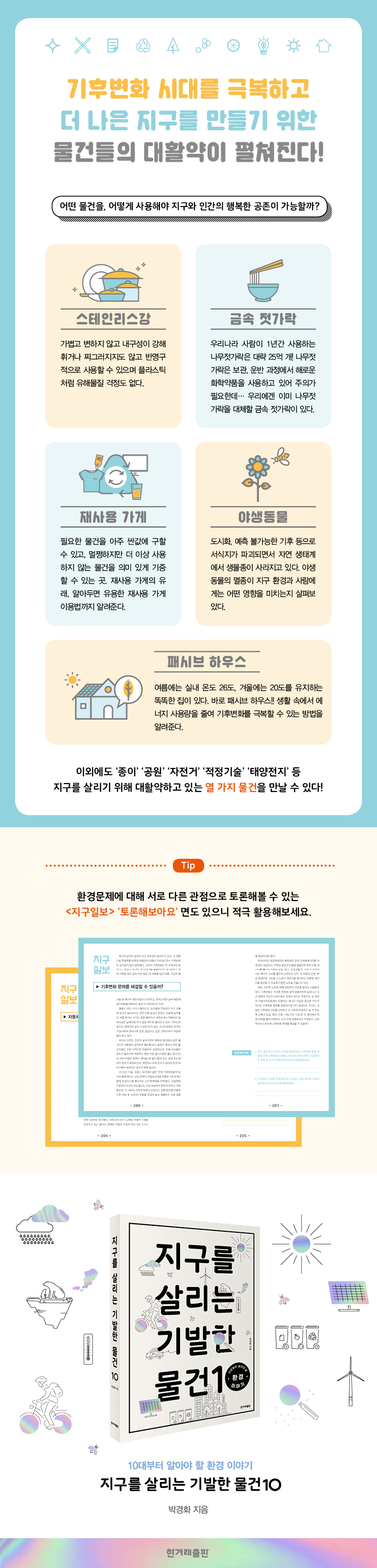
+ Stainless steel
Plastic, while convenient, produces endocrine disruptors, microplastics, and even threatens human life. Made from petroleum, it accelerates resource depletion and endangers human health. Is there a way to phase out plastic? The safest utensils in the world are those made from stainless steel! Lightweight, unyielding, and durable, they won't warp or dent, making them ideal for permanent use. And unlike plastic, they don't contain harmful substances! Learn about the environmental problems caused by plastic and the origins and uses of stainless steel, its eco-friendly alternative.
+ Metal chopsticks
Koreans use approximately 2.5 billion wooden chopsticks a year! Twenty-year-old trees are being ruthlessly cut down to make chopsticks that are used for approximately 20 minutes and then thrown away.
Indiscriminate logging not only accelerates climate change and fine dust problems, but also requires caution as wooden chopsticks, despite being known as sanitary chopsticks, use harmful chemicals during storage and transportation... We already have metal chopsticks to replace wooden chopsticks.
Everything about chopsticks, from the differences in chopsticks and food culture of Korea, China, and Japan, all within the chopsticks cultural sphere, to the history of chopsticks and even the invention of disposable chopsticks that leave no waste!
+ Reuse store
Did you know that humans are the only creatures on Earth who create waste? Our waste production is exploding due to our habit of buying and throwing away.
This waste is exported from developed countries to developing countries, raising ethical concerns and even killing people. But here, there's a place where used items can find a second life.
Reuse shops! A place where you can find the things you need at a fraction of the price and make meaningful donations of items you no longer use.
It covers everything from the serious environmental problems caused by carelessly discarded trash, to the origins of reuse stores and useful tips for using reuse stores.
+ Wild animals
Species are disappearing from natural ecosystems as habitats are destroyed by indiscriminate urbanization and unpredictable climate.
For example, 70 percent of the 100 or so major crops depend on bees, but the recent sharp decline in bees has made harvesting difficult.
It's not just honeybees that are disappearing, but tigers, leopards, musk deer, and other animals whose numbers are increasing by the day... We looked at the impact the extinction of wild animals, which play a crucial role in saving the Earth, has on the Earth's environment and people.
+ Passive House
City buildings use fossil fuels and emit large amounts of greenhouse gases as they run air conditioners and boilers for heating and cooling.
Cities cover just 3 percent of the Earth's surface but account for more than 80 percent of global greenhouse gas emissions.
But here, there is a smart home that maintains an indoor temperature of 26 degrees in the summer and 20 degrees in the winter without turning on the air conditioner or boiler.
Passive House! Let's delve into the history and principles of passive houses and consider ways to reduce energy use in our daily lives and combat climate change.
In addition, you can meet ten items that are actively working to save the Earth, including paper, parks, bicycles, appropriate technology, and solar cells!
The number of registered automobiles continues to increase every year, not only wasting resources but also contributing to the problem of fine dust. Disposable products that are used once and thrown away become microplastics, threatening the lives of marine life and even endangering our dinner tables.
Dutch chemist Paul Crutzen has identified the period from when humans began to have a major impact on the Earth's environment as the Anthropocene, a different geological epoch.
The characteristic of the Anthropocene he speaks of is that the changes humans have brought about to the Earth's environment are very significant.
Due to human activities such as various developments and indiscriminate consumption, many species have become extinct or are in danger of extinction, and humanity is faced with numerous challenges such as reducing energy consumption to overcome the era of sudden climate change and developing new and renewable energy to replace resources that are on the verge of depletion.
In this book, the author discusses items that, when used, drastically reduce the amount of waste or energy consumption, contributing to saving the planet, as well as parks and wild animals that we must know about for an eco-friendly lifestyle.
Through this, I propose that we begin to solve the numerous environmental problems we face not by engaging in grand environmental movements or difficult practices, but by creating our own list of items that can save the Earth.
The book also includes a newspaper-style "Earth Daily" that provides information on current controversies related to objects, making it useful for discussions between parents and children, teachers and students, or friends.
Overcoming the era of climate change
Things are making a big impact to create a better Earth!
+ Stainless steel
Plastic, while convenient, produces endocrine disruptors, microplastics, and even threatens human life. Made from petroleum, it accelerates resource depletion and endangers human health. Is there a way to phase out plastic? The safest utensils in the world are those made from stainless steel! Lightweight, unyielding, and durable, they won't warp or dent, making them ideal for permanent use. And unlike plastic, they don't contain harmful substances! Learn about the environmental problems caused by plastic and the origins and uses of stainless steel, its eco-friendly alternative.
+ Metal chopsticks
Koreans use approximately 2.5 billion wooden chopsticks a year! Twenty-year-old trees are being ruthlessly cut down to make chopsticks that are used for approximately 20 minutes and then thrown away.
Indiscriminate logging not only accelerates climate change and fine dust problems, but also requires caution as wooden chopsticks, despite being known as sanitary chopsticks, use harmful chemicals during storage and transportation... We already have metal chopsticks to replace wooden chopsticks.
Everything about chopsticks, from the differences in chopsticks and food culture of Korea, China, and Japan, all within the chopsticks cultural sphere, to the history of chopsticks and even the invention of disposable chopsticks that leave no waste!
+ Reuse store
Did you know that humans are the only creatures on Earth who create waste? Our waste production is exploding due to our habit of buying and throwing away.
This waste is exported from developed countries to developing countries, raising ethical concerns and even killing people. But here, there's a place where used items can find a second life.
Reuse shops! A place where you can find the things you need at a fraction of the price and make meaningful donations of items you no longer use.
It covers everything from the serious environmental problems caused by carelessly discarded trash, to the origins of reuse stores and useful tips for using reuse stores.
+ Wild animals
Species are disappearing from natural ecosystems as habitats are destroyed by indiscriminate urbanization and unpredictable climate.
For example, 70 percent of the 100 or so major crops depend on bees, but the recent sharp decline in bees has made harvesting difficult.
It's not just honeybees that are disappearing, but tigers, leopards, musk deer, and other animals whose numbers are increasing by the day... We looked at the impact the extinction of wild animals, which play a crucial role in saving the Earth, has on the Earth's environment and people.
+ Passive House
City buildings use fossil fuels and emit large amounts of greenhouse gases as they run air conditioners and boilers for heating and cooling.
Cities cover just 3 percent of the Earth's surface but account for more than 80 percent of global greenhouse gas emissions.
But here, there is a smart home that maintains an indoor temperature of 26 degrees in the summer and 20 degrees in the winter without turning on the air conditioner or boiler.
Passive House! Let's delve into the history and principles of passive houses and consider ways to reduce energy use in our daily lives and combat climate change.
In addition, you can meet ten items that are actively working to save the Earth, including paper, parks, bicycles, appropriate technology, and solar cells!
GOODS SPECIFICS
- Date of issue: July 17, 2019
- Page count, weight, size: 292 pages | 410g | 153*211*20mm
- ISBN13: 9791160402681
- ISBN10: 116040268X
You may also like
카테고리
korean


korean

![GQ KOREA Mark (Monthly): December [2025]](http://librairie.coreenne.fr/cdn/shop/files/8ef265dbbfbf186523ed75ba7319009d.jpg?v=1765340328&width=3840)


