

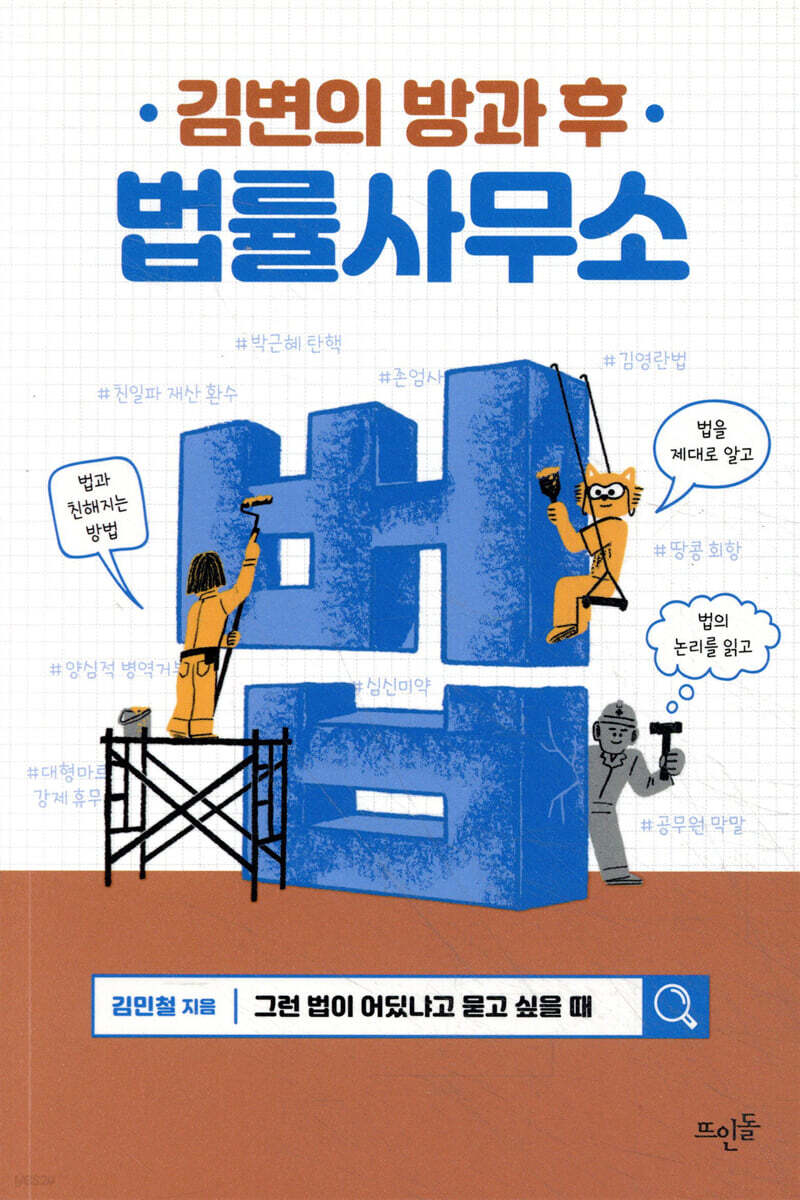
Kim Byun's After-School Law Firm
 |
Description
Book Introduction
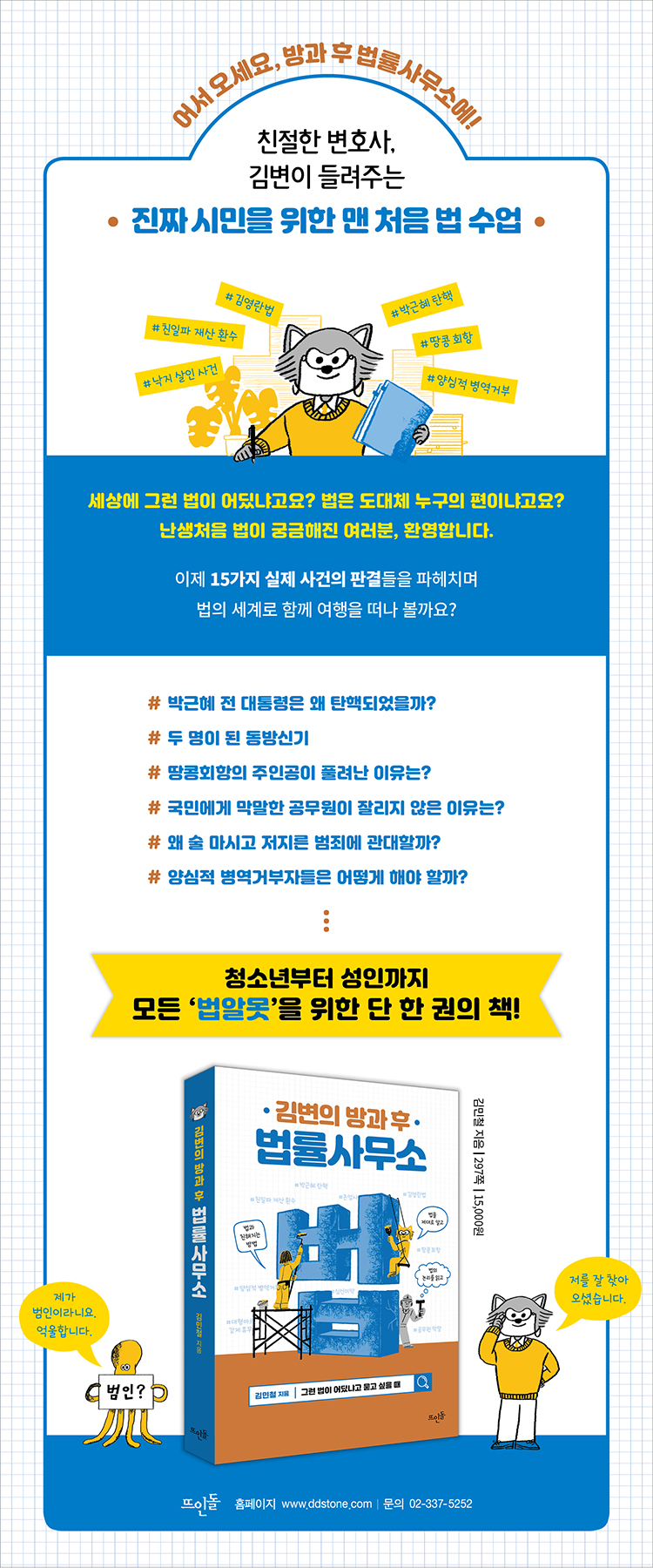
Whose side is the law on? The powerful seem to easily escape the law's net, while ordinary people face unusually harsh sentences.
A conglomerate's daughter is found not guilty of diverting a plane because of peanuts, and a bus driver who worked diligently for 16 years is fired from his job because he couldn't pay 2,400 won in fare.
Moreover, when incidents like the Cho Doo-soon case occur that show a gap in punishment, there are many times when I want to ask, "Where is such a law?"
Frankly, I can't say that people's feelings toward the law are very good.
Attorney Kim Min-cheol, author of “Kim Byun’s After-School Law Firm,” sympathizes with our society’s perception of the law and says, “The law is not perfect.”
However, he emphasizes that 'living without law is more difficult'.
The 'law' is the minimum rules established for living together.
Therefore, in order to create a better world, rather than blindly becoming antipathetic to the law whenever our opinions and judgments differ on an issue, we must properly understand the reason for the existence and operation of the law and then criticize it.
『Kim Byun's After-School Law Firm』 started from this awareness of the problem.
We build a basic understanding of the law by examining the hidden stories behind rulings that made us wonder, "Why are the rulings like this? Can the law be like this?"
Through this process, readers can remove misunderstandings and prejudices about the law.
As you read the story, which is based on the verdicts handed down in 15 real cases, the law, which once seemed distant, will become a reality, as if it were tangible.
A conglomerate's daughter is found not guilty of diverting a plane because of peanuts, and a bus driver who worked diligently for 16 years is fired from his job because he couldn't pay 2,400 won in fare.
Moreover, when incidents like the Cho Doo-soon case occur that show a gap in punishment, there are many times when I want to ask, "Where is such a law?"
Frankly, I can't say that people's feelings toward the law are very good.
Attorney Kim Min-cheol, author of “Kim Byun’s After-School Law Firm,” sympathizes with our society’s perception of the law and says, “The law is not perfect.”
However, he emphasizes that 'living without law is more difficult'.
The 'law' is the minimum rules established for living together.
Therefore, in order to create a better world, rather than blindly becoming antipathetic to the law whenever our opinions and judgments differ on an issue, we must properly understand the reason for the existence and operation of the law and then criticize it.
『Kim Byun's After-School Law Firm』 started from this awareness of the problem.
We build a basic understanding of the law by examining the hidden stories behind rulings that made us wonder, "Why are the rulings like this? Can the law be like this?"
Through this process, readers can remove misunderstandings and prejudices about the law.
As you read the story, which is based on the verdicts handed down in 15 real cases, the law, which once seemed distant, will become a reality, as if it were tangible.
- You can preview some of the book's contents.
Preview
index
Kim Byun's Greeting 006
Chapter 1: Are there any basic principles in the law?
Before facing the law 014
Is there any problem with recovering the assets of descendants of pro-Japanese collaborators? 016
Why was former President Park Geun-hye impeached? 034
TVXQ 050, now two members
Why was the protagonist of Peanut Butter released? 066
Getting a Little Closer to the Law: Why is the Tyranny of the Power Called "Gapjil"? 082
Chapter 2 How Does the Law Actually Work?
Before facing the law 088
Should Kangwon Land compensate casino users for damages?
How was Vice Chairman Lee Jae-yong released from detention? 108
Should night classes at private academies be banned by law? 126
Getting to Know the Law: Can I Get Help from a Lawyer Even If I Don't Have Money? 142
Chapter 3 Why is the law like this?
Before facing the law 148
Why was the defendant in the octopus murder case acquitted? 150
Why didn't Yonsei University spend the 12 billion won it received? 168
Why is our country so lenient on crimes committed while under the influence of alcohol? 184
Why wasn't the civil servant who called the people pigs and dogs fired? 202
Getting a Closer Look at the Law: Is It Easier to Get Acquitted in Murder Cases? 218
Chapter 4 What Verdict Should Be Made?
Before facing the law 224
Should we remove Grandma Kim's ventilator? 226
Why should you be careful when buying food from your school teacher? 242
What about those who refuse to join the military because of their conscience? 260
Why are big box stores closed on Sundays? 276
Getting Closer to the Law: Whose Side Is the Law on? 292
Chapter 1: Are there any basic principles in the law?
Before facing the law 014
Is there any problem with recovering the assets of descendants of pro-Japanese collaborators? 016
Why was former President Park Geun-hye impeached? 034
TVXQ 050, now two members
Why was the protagonist of Peanut Butter released? 066
Getting a Little Closer to the Law: Why is the Tyranny of the Power Called "Gapjil"? 082
Chapter 2 How Does the Law Actually Work?
Before facing the law 088
Should Kangwon Land compensate casino users for damages?
How was Vice Chairman Lee Jae-yong released from detention? 108
Should night classes at private academies be banned by law? 126
Getting to Know the Law: Can I Get Help from a Lawyer Even If I Don't Have Money? 142
Chapter 3 Why is the law like this?
Before facing the law 148
Why was the defendant in the octopus murder case acquitted? 150
Why didn't Yonsei University spend the 12 billion won it received? 168
Why is our country so lenient on crimes committed while under the influence of alcohol? 184
Why wasn't the civil servant who called the people pigs and dogs fired? 202
Getting a Closer Look at the Law: Is It Easier to Get Acquitted in Murder Cases? 218
Chapter 4 What Verdict Should Be Made?
Before facing the law 224
Should we remove Grandma Kim's ventilator? 226
Why should you be careful when buying food from your school teacher? 242
What about those who refuse to join the military because of their conscience? 260
Why are big box stores closed on Sundays? 276
Getting Closer to the Law: Whose Side Is the Law on? 292
Detailed image
Into the book
Many people feel distant from the law.
I was like that too until I started studying law in earnest.
Somehow the law felt rigid and unfamiliar.
But when I actually started studying, I realized that the law wasn't that far away, and that it was very closely related to real life.
I wrote this book because I thought that living without law like this is not easy.
I hope that the gap between ordinary people and the law will be narrowed even a little.
---From "Kim Byeon's Greetings"
Even under these strict standards, the Constitutional Court ruled that former President Park should be impeached.
It was a unanimous decision reached by the eight Constitutional Court justices who participated in the decision.
What is the reason? Former President Park failed to fulfill her duty to serve the public interest and instead abused her power to benefit someone she had a personal connection with.
The Constitutional Court ruled that this was an act that seriously violated the principles of democracy and completely betrayed the people's trust.
Ultimately, this means that former President Park's actions went against the basic principle of the Constitution, the principle of popular sovereignty.
---From Chapter 1
For the principle of private autonomy, a fundamental principle of civil law, to be justified, it must be presupposed that each individual is in a state of equal status and freedom.
But the reality is not like that.
There are strong and weak people in society.
The expression “gap-eul relationship,” which frequently appears in the media, refers to the vertical relationship between the powerful person, A, and the powerless person, B.
If Party A arbitrarily determines the terms of the contract and Party B has no choice but to accept a contract that is extremely disadvantageous to them, it is difficult to view the contract as fair.
---From Chapter 1
How many judges are present in a civil trial? The correct answer is one! And three is also correct.
Why are there two answers? Because the number of judges involved in a trial varies depending on the case.
When a judge presides over a trial alone, we call that judge a sole judge.
Relatively simple cases are tried by a single judge.
In contrast, slightly more complex cases are tried by three judges.
These three judges are called the collegiate panel.
Why do so many judges preside over trials? It's to ensure more careful consideration when handling complex cases, leading to the right conclusion.
There is a proverb that says even a blank piece of paper is better when held up.
When several people work together, they can fill in each other's shortcomings.
---From Chapter 2
Now, there is no longer a need to necessarily lower the level of punishment just because someone is mentally or physically weak.
The punishment may be mild, or it may not be severe.
The courts are also showing an attitude of not wanting to give light punishment to sexual crimes committed under the influence of alcohol.
It is fortunate that the law was revised and the court's attitude changed after the Cho Doo-soon incident.
However, when I think of the victims and their families who suffered extreme pain because of Cho Doo-soon, I am left with a feeling of regret that it would have been better if the laws and systems had changed even a little sooner.
---From Chapter 3
Broadly speaking, law is also a type of social science.
We ponder over 'what is desirable and what is right'.
However, expressions like ‘desirable’ and ‘right’ are not only extremely abstract, but also very subjective.
Because everyone has different thoughts.
So, the judge's subjective opinion cannot help but be involved in the decision.
Of course, the court's decision must be respected and followed.
But the verdict is not an immutable truth.
We need to think about the verdict and discuss whether there might be a more desirable conclusion.
---From Chapter 4
The power to decide 'how to interpret the law' is truly enormous.
Depending on how the court rules, a person's life and a society can change.
The reason we give the courts such great power is because we have the belief and expectation that the courts will be able to make just judgments from an objective and neutral standpoint.
The court is the last resort people can turn to when they are in an unfair situation.
But how can the public trust the courts if they take the lead in doing wrong things for the benefit of the judiciary itself, rather than for the benefit of the people?
I was like that too until I started studying law in earnest.
Somehow the law felt rigid and unfamiliar.
But when I actually started studying, I realized that the law wasn't that far away, and that it was very closely related to real life.
I wrote this book because I thought that living without law like this is not easy.
I hope that the gap between ordinary people and the law will be narrowed even a little.
---From "Kim Byeon's Greetings"
Even under these strict standards, the Constitutional Court ruled that former President Park should be impeached.
It was a unanimous decision reached by the eight Constitutional Court justices who participated in the decision.
What is the reason? Former President Park failed to fulfill her duty to serve the public interest and instead abused her power to benefit someone she had a personal connection with.
The Constitutional Court ruled that this was an act that seriously violated the principles of democracy and completely betrayed the people's trust.
Ultimately, this means that former President Park's actions went against the basic principle of the Constitution, the principle of popular sovereignty.
---From Chapter 1
For the principle of private autonomy, a fundamental principle of civil law, to be justified, it must be presupposed that each individual is in a state of equal status and freedom.
But the reality is not like that.
There are strong and weak people in society.
The expression “gap-eul relationship,” which frequently appears in the media, refers to the vertical relationship between the powerful person, A, and the powerless person, B.
If Party A arbitrarily determines the terms of the contract and Party B has no choice but to accept a contract that is extremely disadvantageous to them, it is difficult to view the contract as fair.
---From Chapter 1
How many judges are present in a civil trial? The correct answer is one! And three is also correct.
Why are there two answers? Because the number of judges involved in a trial varies depending on the case.
When a judge presides over a trial alone, we call that judge a sole judge.
Relatively simple cases are tried by a single judge.
In contrast, slightly more complex cases are tried by three judges.
These three judges are called the collegiate panel.
Why do so many judges preside over trials? It's to ensure more careful consideration when handling complex cases, leading to the right conclusion.
There is a proverb that says even a blank piece of paper is better when held up.
When several people work together, they can fill in each other's shortcomings.
---From Chapter 2
Now, there is no longer a need to necessarily lower the level of punishment just because someone is mentally or physically weak.
The punishment may be mild, or it may not be severe.
The courts are also showing an attitude of not wanting to give light punishment to sexual crimes committed under the influence of alcohol.
It is fortunate that the law was revised and the court's attitude changed after the Cho Doo-soon incident.
However, when I think of the victims and their families who suffered extreme pain because of Cho Doo-soon, I am left with a feeling of regret that it would have been better if the laws and systems had changed even a little sooner.
---From Chapter 3
Broadly speaking, law is also a type of social science.
We ponder over 'what is desirable and what is right'.
However, expressions like ‘desirable’ and ‘right’ are not only extremely abstract, but also very subjective.
Because everyone has different thoughts.
So, the judge's subjective opinion cannot help but be involved in the decision.
Of course, the court's decision must be respected and followed.
But the verdict is not an immutable truth.
We need to think about the verdict and discuss whether there might be a more desirable conclusion.
---From Chapter 4
The power to decide 'how to interpret the law' is truly enormous.
Depending on how the court rules, a person's life and a society can change.
The reason we give the courts such great power is because we have the belief and expectation that the courts will be able to make just judgments from an objective and neutral standpoint.
The court is the last resort people can turn to when they are in an unfair situation.
But how can the public trust the courts if they take the lead in doing wrong things for the benefit of the judiciary itself, rather than for the benefit of the people?
---From Chapter 4
Publisher's Review
A kind lawyer, Kim Byun tells you
The very first law class for real citizens
Living without the law is harder
Whose side is the law on? The powerful seem to easily escape the law's net, while ordinary people face unusually harsh sentences.
A conglomerate's daughter is found not guilty of diverting a plane because of peanuts, and a bus driver who worked diligently for 16 years is fired from his job because he couldn't pay 2,400 won in fare.
Moreover, when incidents like the Cho Doo-soon case occur that show a gap in punishment, there are many times when I want to ask, "Where is such a law?"
Frankly, I can't say that people's feelings toward the law are very good.
Attorney Kim Min-cheol, the author of this book, “Kim Byun’s After-School Law Firm” (hereafter “After-School Law Firm”), sympathizes with our society’s perception of the law and says, “The law is not perfect.”
However, he emphasizes that 'living without law is more difficult'.
We have no choice but to live together with others in society, and to live together, we need order.
The 'law' is what sets the minimum rules for him.
That's why, in order to create a better world and to do my part as a true citizen, I need to know the law.
When my opinion and judgment on an issue differ, rather than blindly opposing the law, I should properly understand the reason for the law's existence and how it works and then criticize it.
『After School Law Firm』 started from this awareness of the problem.
This book provides basic knowledge of the law, reminding us that we must become the agents of creating a more rational legal system.
The author is a practicing lawyer who has written legal stories for readers of all ages, from children to adults, including 『Robinson and the Invincible Law Firm』 and 『The Lawyer on the Sofa』.
As you read Kim Byun's story, which he explains step by step so that anyone can easily understand, you will realize that the law was right by your side.
The Basics of Law: 15 Real-Life Cases
The author unravels the logic of the law through judgments handed down in actual cases.
In particular, we examine puzzling rulings, asking, "Why is the ruling like this? Is this how the law should be?" We strip away misunderstandings and prejudices about the law and reveal its true nature.
For example, the author explains the importance of the principle of legality, which states that "the law must clearly state what constitutes a crime," through the "peanut return" incident, and the reason for prohibiting "analogous interpretation," which interprets a crime by bringing in something similar when there is no clear law for the crime.
In this case, the Supreme Court ruled that the term “route” meant “airway” and did not include ground routes.
Therefore, since viewing the movement of the plane on the ground as a change in the ‘route’ violates the ‘principle of prohibition of analogical interpretation,’ Cho Hyun-ah was found not guilty of the ‘route change crime.’
The disturbance caused by former Korean Air Vice President Cho Hyun-ah deserves criticism.
But readers might go a step further and consider the previously unconsidered idea that punishing her for changing course is a different matter.
The reason why the principle of legality exists and analogical interpretation is prohibited is because we have learned that if people are punished for violating this, the scope of crime will continue to expand, and furthermore, a situation may arise where the state wields public power without any punishment laws.
This book broadens our perspective on the law by using actual events as material.
By examining the reasons for these decisions, readers can gain a more balanced perspective by understanding the basic principles and logic of the law.
How to become deeply ingrained in everyday life
Another thing to note about this book is that it deals with cases that make us realize that the law is right beside us.
A representative example is the issue of ‘conscientious objection to military service.’
According to the Military Service Act, all able-bodied men in the Republic of Korea must serve in the military.
"After School Law Firm" summarizes various opinions on this issue and informs us that the issues of military enlistment and conscientious objection, which are directly related to many people, are actually related to the Constitution.
‘Freedom of conscience’ is stated in Article 19 of the Constitution, “All citizens shall enjoy freedom of conscience.”
Based on this, the Constitutional Court broke with its previous position and ruled in June 2018 that an alternative service system should be introduced into the Military Service Act.
As we follow the reasons why the Constitutional Court and the Supreme Court decided to introduce an alternative service system, we come to understand how directly the law impacts our daily lives.
In addition, we will be able to rediscover the importance of law in our daily lives by examining whether the ordinance banning night classes at private academies, which appears to infringe on the basic rights of citizens, is constitutional, and why our laws have been so lenient on crimes committed while under the influence of alcohol.
Tailored for those who are curious about the law for the first time
『After School Law Firm』 is structured so that even those who are new to law can easily understand the content.
First, Chapter 1, "Does Law Have Fundamental Principles?" examines the core ideologies and fundamental principles that form the basis of law, laying the foundation for a solid foundation.
Chapter 2, "How Does the Law Actually Work?", examines how the law applies to cases and what lawyers do.
Chapter 3, "Why is the Law Like This?", helps us discover the legal logic hidden in seemingly unjust rulings, dispel misunderstandings and prejudices about the law, and critically examine any shortcomings.
Chapter 4, "What Judgment Should We Make?" examines controversial issues and discusses the various values found in law.
Additionally, tip boxes that organize legal terms and concepts are appropriately placed throughout the text to serve as a guide.
The "Before You Face the Law" section at the beginning of each chapter provides a guide to what lies ahead.
In the 'Getting to Know the Law a Little Better' and 'Cleaning Up One Room' sections, we recap the content so far and provide behind-the-scenes stories and in-depth knowledge not covered in the main text.
In addition, the book is richly illustrated with humorous depictions of the characteristics of each case and law, adding vitality to the entire book.
"After School Law Firm" uses these devices to break the stereotype that law is difficult and help people, from teenagers to adults, who are curious about the law for the first time to easily understand the law.
The very first law class for real citizens
Living without the law is harder
Whose side is the law on? The powerful seem to easily escape the law's net, while ordinary people face unusually harsh sentences.
A conglomerate's daughter is found not guilty of diverting a plane because of peanuts, and a bus driver who worked diligently for 16 years is fired from his job because he couldn't pay 2,400 won in fare.
Moreover, when incidents like the Cho Doo-soon case occur that show a gap in punishment, there are many times when I want to ask, "Where is such a law?"
Frankly, I can't say that people's feelings toward the law are very good.
Attorney Kim Min-cheol, the author of this book, “Kim Byun’s After-School Law Firm” (hereafter “After-School Law Firm”), sympathizes with our society’s perception of the law and says, “The law is not perfect.”
However, he emphasizes that 'living without law is more difficult'.
We have no choice but to live together with others in society, and to live together, we need order.
The 'law' is what sets the minimum rules for him.
That's why, in order to create a better world and to do my part as a true citizen, I need to know the law.
When my opinion and judgment on an issue differ, rather than blindly opposing the law, I should properly understand the reason for the law's existence and how it works and then criticize it.
『After School Law Firm』 started from this awareness of the problem.
This book provides basic knowledge of the law, reminding us that we must become the agents of creating a more rational legal system.
The author is a practicing lawyer who has written legal stories for readers of all ages, from children to adults, including 『Robinson and the Invincible Law Firm』 and 『The Lawyer on the Sofa』.
As you read Kim Byun's story, which he explains step by step so that anyone can easily understand, you will realize that the law was right by your side.
The Basics of Law: 15 Real-Life Cases
The author unravels the logic of the law through judgments handed down in actual cases.
In particular, we examine puzzling rulings, asking, "Why is the ruling like this? Is this how the law should be?" We strip away misunderstandings and prejudices about the law and reveal its true nature.
For example, the author explains the importance of the principle of legality, which states that "the law must clearly state what constitutes a crime," through the "peanut return" incident, and the reason for prohibiting "analogous interpretation," which interprets a crime by bringing in something similar when there is no clear law for the crime.
In this case, the Supreme Court ruled that the term “route” meant “airway” and did not include ground routes.
Therefore, since viewing the movement of the plane on the ground as a change in the ‘route’ violates the ‘principle of prohibition of analogical interpretation,’ Cho Hyun-ah was found not guilty of the ‘route change crime.’
The disturbance caused by former Korean Air Vice President Cho Hyun-ah deserves criticism.
But readers might go a step further and consider the previously unconsidered idea that punishing her for changing course is a different matter.
The reason why the principle of legality exists and analogical interpretation is prohibited is because we have learned that if people are punished for violating this, the scope of crime will continue to expand, and furthermore, a situation may arise where the state wields public power without any punishment laws.
This book broadens our perspective on the law by using actual events as material.
By examining the reasons for these decisions, readers can gain a more balanced perspective by understanding the basic principles and logic of the law.
How to become deeply ingrained in everyday life
Another thing to note about this book is that it deals with cases that make us realize that the law is right beside us.
A representative example is the issue of ‘conscientious objection to military service.’
According to the Military Service Act, all able-bodied men in the Republic of Korea must serve in the military.
"After School Law Firm" summarizes various opinions on this issue and informs us that the issues of military enlistment and conscientious objection, which are directly related to many people, are actually related to the Constitution.
‘Freedom of conscience’ is stated in Article 19 of the Constitution, “All citizens shall enjoy freedom of conscience.”
Based on this, the Constitutional Court broke with its previous position and ruled in June 2018 that an alternative service system should be introduced into the Military Service Act.
As we follow the reasons why the Constitutional Court and the Supreme Court decided to introduce an alternative service system, we come to understand how directly the law impacts our daily lives.
In addition, we will be able to rediscover the importance of law in our daily lives by examining whether the ordinance banning night classes at private academies, which appears to infringe on the basic rights of citizens, is constitutional, and why our laws have been so lenient on crimes committed while under the influence of alcohol.
Tailored for those who are curious about the law for the first time
『After School Law Firm』 is structured so that even those who are new to law can easily understand the content.
First, Chapter 1, "Does Law Have Fundamental Principles?" examines the core ideologies and fundamental principles that form the basis of law, laying the foundation for a solid foundation.
Chapter 2, "How Does the Law Actually Work?", examines how the law applies to cases and what lawyers do.
Chapter 3, "Why is the Law Like This?", helps us discover the legal logic hidden in seemingly unjust rulings, dispel misunderstandings and prejudices about the law, and critically examine any shortcomings.
Chapter 4, "What Judgment Should We Make?" examines controversial issues and discusses the various values found in law.
Additionally, tip boxes that organize legal terms and concepts are appropriately placed throughout the text to serve as a guide.
The "Before You Face the Law" section at the beginning of each chapter provides a guide to what lies ahead.
In the 'Getting to Know the Law a Little Better' and 'Cleaning Up One Room' sections, we recap the content so far and provide behind-the-scenes stories and in-depth knowledge not covered in the main text.
In addition, the book is richly illustrated with humorous depictions of the characteristics of each case and law, adding vitality to the entire book.
"After School Law Firm" uses these devices to break the stereotype that law is difficult and help people, from teenagers to adults, who are curious about the law for the first time to easily understand the law.
GOODS SPECIFICS
- Date of issue: April 30, 2019
- Format: Paperback book binding method guide
- Pages, weight, size: 297 pages | 291g | 135*200*20mm
- ISBN13: 9788958077152
- ISBN10: 8958077158
You may also like
카테고리
korean


korean

![GQ KOREA Mark (Monthly): December [2025]](http://librairie.coreenne.fr/cdn/shop/files/8ef265dbbfbf186523ed75ba7319009d.jpg?v=1765340328&width=3840)


