

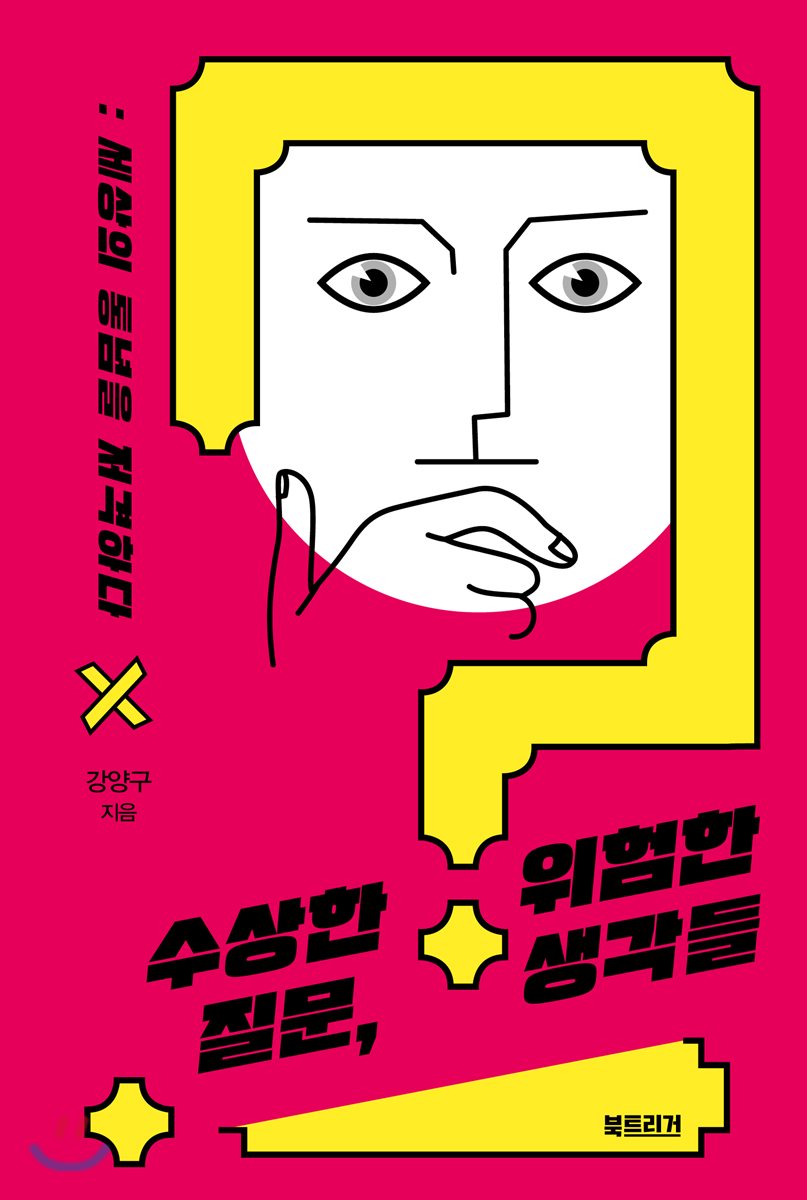
Suspicious Questions, Dangerous Thoughts
 |
Description
Book Introduction
Science, society, and our existence
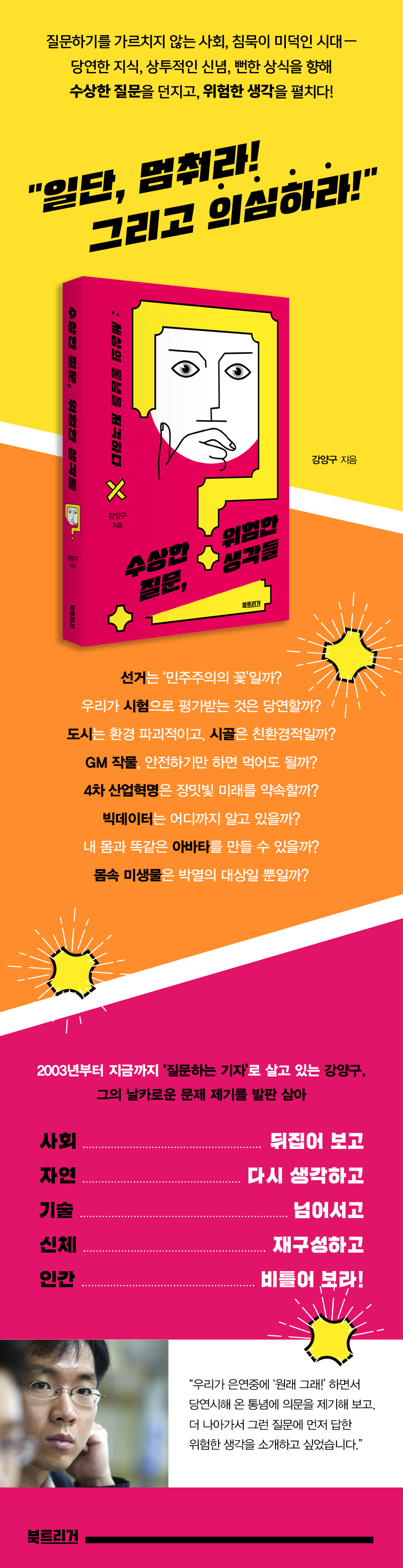
Question all knowledge, beliefs, and common sense surrounding him!
Kang Yang-gu, who has been living as a 'questioning reporter' since 2003, curates and presents the suspicious questions and dangerous thoughts of our society.
The author questions social conventions about society (Chapter 1), nature (Chapter 2), technology (Chapter 3), the body (Chapter 4), and humans (Chapter 5), and sharply digs into the cracks in conventional thinking.
It brings into the forefront of debate issues we've taken for granted, such as elections, marriage, and the examination system, and asks whether they are truly appropriate systems for our society. It also critically delves into the background of cutting-edge scientific knowledge, systematically and densely covering areas like artificial intelligence, big data, biotechnology, and blockchain.
The author, with his characteristically sharp gaze, confronts social systems, human knowledge, science and technology head-on, capturing alternative perspectives among diverse knowledge and facts and introducing them in language accessible to the general public.
Written especially with teenagers in mind, this book serves as a guide for thinking about complex and difficult social issues beyond convention and inertia.
If you want to escape the emptiness of formalized school education and fragmented knowledge, if you want to look back on conventional knowledge and put the brakes on a world that flows according to conventional wisdom, you should open this book right now.
Question all knowledge, beliefs, and common sense surrounding him!
Kang Yang-gu, who has been living as a 'questioning reporter' since 2003, curates and presents the suspicious questions and dangerous thoughts of our society.
The author questions social conventions about society (Chapter 1), nature (Chapter 2), technology (Chapter 3), the body (Chapter 4), and humans (Chapter 5), and sharply digs into the cracks in conventional thinking.
It brings into the forefront of debate issues we've taken for granted, such as elections, marriage, and the examination system, and asks whether they are truly appropriate systems for our society. It also critically delves into the background of cutting-edge scientific knowledge, systematically and densely covering areas like artificial intelligence, big data, biotechnology, and blockchain.
The author, with his characteristically sharp gaze, confronts social systems, human knowledge, science and technology head-on, capturing alternative perspectives among diverse knowledge and facts and introducing them in language accessible to the general public.
Written especially with teenagers in mind, this book serves as a guide for thinking about complex and difficult social issues beyond convention and inertia.
If you want to escape the emptiness of formalized school education and fragmented knowledge, if you want to look back on conventional knowledge and put the brakes on a world that flows according to conventional wisdom, you should open this book right now.
- You can preview some of the book's contents.
Preview
index
Chapter 1 Society - Looking Back
Opposing 'dangerous' elections - Elections are the 'flower of democracy'?
Were they happy when they got married? Is monogamy a reasonable marriage system?
By 2040, regional cities will disappear. Is it possible to save regional cities?
Korean Science, Nobel Prize Winning _ Is the Current Scientific Research Culture Alright?
What's more important than 'how to do well on tests' - Is it natural that we are evaluated by tests?
Chapter 2: Nature - Rethinking
Why We Can't Give Up Nuclear Power Plants - Is Nuclear Energy Irreplaceable?
Strange Game: Finding the Culprit of Fine Dust - Is Fine Dust China's Fault?
Who will save the city? _Cities are environmentally destructive, and the countryside is eco-friendly?
The Tragedy of Cecil in 'The Lion King': Is There No Way for Wild Beasts and Humans to Coexist?
How about grasshopper pasta for lunch today? _How can you eat such disgusting insects?
The Truth About GM Foods: Your Choice _GM Crops: Is It Safe to Eat Them as Long as They're Safe?
Chapter 3: Technology - Beyond
The Truth About the '100-Year-Old Era' We Never Knew - How Meaningful Is Life-Prolonging Medical Care?
Let's block the shadow of the 4th Industrial Revolution with a 'robot tax' _ Will the 4th Industrial Revolution promise a rosy future?
Why is Silicon Valley so obsessed with analog? Is analog "old-fashioned"?
Bitcoin Fever: Look at the Moon, Not Your Finger! _Is Cryptocurrency Just a Bubble?
Is he in love with me? Data knows! _How much does big data know?
Chapter 4: The Body - Reconstruction
Is it possible for humans to upgrade? Will genetic scissors be used only to treat genetic diseases?
Putting your body on a 'chip' - Can we create an 'avatar' that is exactly like my body?
Dreams of Yogurt, Dreams of Kimchi, Dreams of Lactic Acid Bacteria - Are the microorganisms in our bodies merely targets for eradication?
Why are there suddenly so many 'turtles' at school? Is disc surgery really necessary?
Chapter 5: Humans - Twisted View
Is it 'collective intelligence' or 'collective stupidity'? 'We' are smarter than 'me'?
Smart ways for billionaires to change the world - Is passion enough to change the world?
We are all cyborgs! _Is there a clear line separating the natural and the artificial?
How did they overcome 'limits'? _Are human limitations defined only by physical limitations?
Opposing 'dangerous' elections - Elections are the 'flower of democracy'?
Were they happy when they got married? Is monogamy a reasonable marriage system?
By 2040, regional cities will disappear. Is it possible to save regional cities?
Korean Science, Nobel Prize Winning _ Is the Current Scientific Research Culture Alright?
What's more important than 'how to do well on tests' - Is it natural that we are evaluated by tests?
Chapter 2: Nature - Rethinking
Why We Can't Give Up Nuclear Power Plants - Is Nuclear Energy Irreplaceable?
Strange Game: Finding the Culprit of Fine Dust - Is Fine Dust China's Fault?
Who will save the city? _Cities are environmentally destructive, and the countryside is eco-friendly?
The Tragedy of Cecil in 'The Lion King': Is There No Way for Wild Beasts and Humans to Coexist?
How about grasshopper pasta for lunch today? _How can you eat such disgusting insects?
The Truth About GM Foods: Your Choice _GM Crops: Is It Safe to Eat Them as Long as They're Safe?
Chapter 3: Technology - Beyond
The Truth About the '100-Year-Old Era' We Never Knew - How Meaningful Is Life-Prolonging Medical Care?
Let's block the shadow of the 4th Industrial Revolution with a 'robot tax' _ Will the 4th Industrial Revolution promise a rosy future?
Why is Silicon Valley so obsessed with analog? Is analog "old-fashioned"?
Bitcoin Fever: Look at the Moon, Not Your Finger! _Is Cryptocurrency Just a Bubble?
Is he in love with me? Data knows! _How much does big data know?
Chapter 4: The Body - Reconstruction
Is it possible for humans to upgrade? Will genetic scissors be used only to treat genetic diseases?
Putting your body on a 'chip' - Can we create an 'avatar' that is exactly like my body?
Dreams of Yogurt, Dreams of Kimchi, Dreams of Lactic Acid Bacteria - Are the microorganisms in our bodies merely targets for eradication?
Why are there suddenly so many 'turtles' at school? Is disc surgery really necessary?
Chapter 5: Humans - Twisted View
Is it 'collective intelligence' or 'collective stupidity'? 'We' are smarter than 'me'?
Smart ways for billionaires to change the world - Is passion enough to change the world?
We are all cyborgs! _Is there a clear line separating the natural and the artificial?
How did they overcome 'limits'? _Are human limitations defined only by physical limitations?
Detailed image
Into the book
The idea of lottery democracy, or lottery democracy, is simple.
The idea is to elect representatives, such as members of the National Assembly, by drawing lots instead of holding elections.
I seem to hear a counter-argument: 'What would happen to the country if anyone were to become a member of the National Assembly or president?'
But isn't democracy something where 'anyone' can engage in politics?
The same story was told when the now established 'citizen participation trial' system was introduced.
The counterargument was that it was problematic for ordinary citizens who did not know the law to participate in the judgment.
However, if we look at the citizen participation trial system that was introduced in 2008 and has now been in place for over 10 years, the jury verdict and judge's verdict are approximately 93% identical.
In fact, the rate of overturning a first-instance decision (the rate at which a first-instance decision is overturned on appeal) is higher in general trials where only a judge makes the decision than in trials where a jury participates.
Page 25 of the text (against 'dangerous elections')
Let's start by breaking one common misconception.
We are unconsciously caught up in a dichotomy where cities are 'environmental destruction' and rural areas are 'environmental conservation.'
But if you look closely, the truth is quite the opposite.
Edward Glaeser, an economics professor at Harvard University, argues in his book, The Triumph of the City, that “cities are actually much more environmentally friendly.”
… For example, let’s say we need to create a village where 400 people live.
In a city, if you build a 25-story apartment building with four units per floor, you can fit 100 households (400 people) with four people per household in just one building.
But in the countryside, 100 houses for four people each must be built separately.
Naturally, many more fields will have to be destroyed to make way for houses.
Page 103 (Who Will Save the City)
A robot tax could have two effects.
Once we start imposing a robot tax, it will put the brakes on companies from blindly replacing jobs with robots.
Bus and taxi companies that were considering replacing drivers with AI due to labor costs are now having to take a closer look due to the burden of the robot tax.
(In this respect, the argument that the robot tax will stifle innovation is misplaced.
Because one of the important effects of a robot tax is to moderate the pace of innovation.)
There is a more important effect.
Robot taxes can be used as a source of funding for various policies that can offset the negative effects of the Fourth Industrial Revolution, such as mass unemployment and decreased consumption.
For example, a system like 'basic income', which is receiving worldwide attention and would unconditionally give every citizen a significant amount of money, would be made possible through a robot tax.
Pages 169-170 (The Shadow of the Fourth Industrial Revolution: Let's Stop It with a 'Robot Tax')
Ogun-on-a-chip offers several benefits.
First of all, the effects of new drugs and cosmetics, which have previously relied on animal testing, can now be accurately confirmed through Organ-on-a-Chip.
Furthermore, it is possible to tailor the treatment method that is most effective for a specific individual.
It can also minimize the sacrifice of animals such as mice and rabbits.
…even now, using organ-on-a-chip technology, it is possible to grow human muscles or internal organs in three dimensions on a chip.
So, what about cultivating 3D muscle (meat) or internal organs from cows, pigs, or chickens? Couldn't that replace real meat?
Pages 231-232 (Putting Your Body on a Chip)
Can we truly save collective intelligence? … What if dissenting opinions are wrong? For example, should we even acknowledge the right to speak, even if someone claims that "the Holocaust was a complete fabrication"? John Stuart Mill, who more than anyone else emphasized freedom of expression, including dissenting opinions, argued that freedom of expression must be guaranteed 100%, regardless of whether it is "true" or "false."
Mill goes on to point out that the premise that the majority opinion is always absolutely right is flawed.
…If a different opinion is a correct assertion, then it is an opportunity for humanity to gain truth instead of error, so freedom of expression should be guaranteed.
Even if the claim is wrong, freedom of expression must be guaranteed.
Because the truth will shine brighter through the debate between right and wrong claims.
In other words, the point is that even false claims have social utility in themselves.
Pages 266-267 (Collective Intelligence or Collective Idiots)
The idea is to elect representatives, such as members of the National Assembly, by drawing lots instead of holding elections.
I seem to hear a counter-argument: 'What would happen to the country if anyone were to become a member of the National Assembly or president?'
But isn't democracy something where 'anyone' can engage in politics?
The same story was told when the now established 'citizen participation trial' system was introduced.
The counterargument was that it was problematic for ordinary citizens who did not know the law to participate in the judgment.
However, if we look at the citizen participation trial system that was introduced in 2008 and has now been in place for over 10 years, the jury verdict and judge's verdict are approximately 93% identical.
In fact, the rate of overturning a first-instance decision (the rate at which a first-instance decision is overturned on appeal) is higher in general trials where only a judge makes the decision than in trials where a jury participates.
Page 25 of the text (against 'dangerous elections')
Let's start by breaking one common misconception.
We are unconsciously caught up in a dichotomy where cities are 'environmental destruction' and rural areas are 'environmental conservation.'
But if you look closely, the truth is quite the opposite.
Edward Glaeser, an economics professor at Harvard University, argues in his book, The Triumph of the City, that “cities are actually much more environmentally friendly.”
… For example, let’s say we need to create a village where 400 people live.
In a city, if you build a 25-story apartment building with four units per floor, you can fit 100 households (400 people) with four people per household in just one building.
But in the countryside, 100 houses for four people each must be built separately.
Naturally, many more fields will have to be destroyed to make way for houses.
Page 103 (Who Will Save the City)
A robot tax could have two effects.
Once we start imposing a robot tax, it will put the brakes on companies from blindly replacing jobs with robots.
Bus and taxi companies that were considering replacing drivers with AI due to labor costs are now having to take a closer look due to the burden of the robot tax.
(In this respect, the argument that the robot tax will stifle innovation is misplaced.
Because one of the important effects of a robot tax is to moderate the pace of innovation.)
There is a more important effect.
Robot taxes can be used as a source of funding for various policies that can offset the negative effects of the Fourth Industrial Revolution, such as mass unemployment and decreased consumption.
For example, a system like 'basic income', which is receiving worldwide attention and would unconditionally give every citizen a significant amount of money, would be made possible through a robot tax.
Pages 169-170 (The Shadow of the Fourth Industrial Revolution: Let's Stop It with a 'Robot Tax')
Ogun-on-a-chip offers several benefits.
First of all, the effects of new drugs and cosmetics, which have previously relied on animal testing, can now be accurately confirmed through Organ-on-a-Chip.
Furthermore, it is possible to tailor the treatment method that is most effective for a specific individual.
It can also minimize the sacrifice of animals such as mice and rabbits.
…even now, using organ-on-a-chip technology, it is possible to grow human muscles or internal organs in three dimensions on a chip.
So, what about cultivating 3D muscle (meat) or internal organs from cows, pigs, or chickens? Couldn't that replace real meat?
Pages 231-232 (Putting Your Body on a Chip)
Can we truly save collective intelligence? … What if dissenting opinions are wrong? For example, should we even acknowledge the right to speak, even if someone claims that "the Holocaust was a complete fabrication"? John Stuart Mill, who more than anyone else emphasized freedom of expression, including dissenting opinions, argued that freedom of expression must be guaranteed 100%, regardless of whether it is "true" or "false."
Mill goes on to point out that the premise that the majority opinion is always absolutely right is flawed.
…If a different opinion is a correct assertion, then it is an opportunity for humanity to gain truth instead of error, so freedom of expression should be guaranteed.
Even if the claim is wrong, freedom of expression must be guaranteed.
Because the truth will shine brighter through the debate between right and wrong claims.
In other words, the point is that even false claims have social utility in themselves.
Pages 266-267 (Collective Intelligence or Collective Idiots)
--- From the text
Publisher's Review
In an era where the half-life of knowledge is shortening,
The "culture" of this era, curated by the keen sense of a journalist.
The world is changing rapidly.
Science and technology are constantly evolving, making it difficult for ordinary people to keep up with the pace of development. Furthermore, everything that surrounds us, including the systems, laws, and values that have supported society for a long time, is changing at a rapid pace.
At the forefront of change, more knowledge and concepts are being created, developed, and destroyed than ever before.
However, there is still a lot of boring and outdated culture everywhere.
The author points out that the book he read as a teenager 30 years ago is still recommended as required reading at many universities.
For example, Jeremy Rifkin's Entropy and James Watson's The Double Helix, which are considered science classics, and E.
A representative example is H. Carr's What is History?
『Entropy』 was virtually discarded due to fatal errors, and 『The Double Helix』 and 『What is History?』 have changed their status and significance in academia significantly since their publication, yet they are still recommended as "classics" without any context.
The author, who has diligently conveyed to the world the concerns, debates, and intellectual achievements of the times with the sensitive antenna of a journalist, laments this reality.
As ceremonial and conventional knowledge overflows, there is a tendency for essential contemporary knowledge to be neglected.
“Suspicious Questions, Dangerous Thoughts” is a book that arose from these very concerns.
The author, who calls himself a "knowledge curator," boldly cuts away at outdated, outdated knowledge that's out of touch with reality and provides a friendly, accessible overview of the discussions taking place at the forefront of knowledge in our time.
In a rapidly changing era, where the half-life of knowledge is becoming increasingly shorter, the author's curation serves as a useful guide when exploring the vast world of knowledge.
Towards ceremonial knowledge, conventional concepts, and common sense
Ask 'suspicious questions' and spread 'dangerous thoughts'!
What stands out in "Suspicious Questions, Dangerous Ideas" is the new ideas that break the mold.
It questions the perceptions we subconsciously accept as common sense, saying, "That's just how it is!", and the analysis presented based on concrete realities and research results adds interest.
During the two-year period from 2017 to 2018, while writing the manuscript, the author carefully selected ideas from the domestic and international intellectuals he met and the books he read at the time that needed to be considered by the citizens of our time, and presented them in thoroughly accessible language.
I've reviewed the debate and subsequent research surrounding the idea to validate it, and I've tried to provide the most up-to-date information and explain why it's important at this point in time from my own perspective.
This book is a curated collection of the 'suspicious questions' and 'dangerous thoughts' of this era.
By raising suspicious questions such as, “Are elections the flower of democracy?”, “Is monogamy a reasonable marriage system?”, and “Is it natural that we are evaluated by tests?”, it overturns social systems and customs, and it also twists the perception of nature and the environment with weighty questions such as, “Is nuclear energy irreplaceable?”, “Are cities environmentally destructive and rural areas eco-friendly?”, and “Can we eat GM crops as long as they are safe?”
By doing so, we are constantly reminded that the knowledge system we accept as common sense is actually based on prejudice.
For example, a lottery system may be more democratic than elections, which have been considered the foundation of democracy, and urban civilization may be more environmentally friendly than rural civilization.
The realization that common sense, taken for granted, sometimes betrays our morals and ethics and fails to properly capture reality brings the refreshing feeling of breaking free from our frame of thinking.
There are also questions that reveal the depth of knowledge of a science journalist who has always pondered how science, technology, and society interact and change each other.
"Does the Fourth Industrial Revolution promise a bright future?", "How far does big data go?", "Will genetic scissors be used only to treat genetic diseases?", "How meaningful is life-prolonging medical treatment?"—these are all questions that connect isolated discussions about science and technology to society.
By following the discussion, which comprehensively examines the current state of science and technology while not overlooking microscopic details, we can critically reflect on cutting-edge science and technology, including artificial intelligence, big data, biotechnology, and blockchain.
There is also great intellectual pleasure in encountering "dangerous ideas" that anticipate how we will respond to the changes in our lives that will occur when science and technology become deeply ingrained in our daily lives.
Because it combines dense discussion and imagination about technology, it allows us to think about the distant future (or perhaps the near future) in three dimensions.
The concerns, debates, and intellectual achievements of our time!
All of this invites you to the forefront of knowledge.
The questions of scholars, past and present, have always been ultimate.
The process of asking fundamental questions about humanity and the world and finding answers to them has always been an intellectual challenge that mobilized the fiercely competitive logical systems and interpretations of the time.
However, there are few opportunities for the general public to easily understand and enjoy the dynamic achievements of these scholars or groups of experts.
"Suspicious Questions, Dangerous Thoughts" is the result of a concentrated effort to fill this gap.
Ideas appearing in this book have been sourced as accurately as possible.
In particular, it introduces a wide range of books, including books that provided clues to the author's thinking, books that allow for examination of the cases mentioned in each essay, and books that contain arguments for resolutions different from those introduced in the text.
The list of books he has selected and arranged will be of great help in critical reading, providing a macroscopic view of the status and social context of the discussion.
The author also expressed his hope that readers would not be immersed in knowledge itself, but would accept the book's problematic issues as the hot topics of our time and contemplate them intensely.
He wrote this book specifically with teenagers in mind and advises:
“If readers are interested in a topic after reading this book, I encourage them to seek out lectures or read books by those people.
“You will be able to have an experience that broadens your thinking like mine.”
The "culture" of this era, curated by the keen sense of a journalist.
The world is changing rapidly.
Science and technology are constantly evolving, making it difficult for ordinary people to keep up with the pace of development. Furthermore, everything that surrounds us, including the systems, laws, and values that have supported society for a long time, is changing at a rapid pace.
At the forefront of change, more knowledge and concepts are being created, developed, and destroyed than ever before.
However, there is still a lot of boring and outdated culture everywhere.
The author points out that the book he read as a teenager 30 years ago is still recommended as required reading at many universities.
For example, Jeremy Rifkin's Entropy and James Watson's The Double Helix, which are considered science classics, and E.
A representative example is H. Carr's What is History?
『Entropy』 was virtually discarded due to fatal errors, and 『The Double Helix』 and 『What is History?』 have changed their status and significance in academia significantly since their publication, yet they are still recommended as "classics" without any context.
The author, who has diligently conveyed to the world the concerns, debates, and intellectual achievements of the times with the sensitive antenna of a journalist, laments this reality.
As ceremonial and conventional knowledge overflows, there is a tendency for essential contemporary knowledge to be neglected.
“Suspicious Questions, Dangerous Thoughts” is a book that arose from these very concerns.
The author, who calls himself a "knowledge curator," boldly cuts away at outdated, outdated knowledge that's out of touch with reality and provides a friendly, accessible overview of the discussions taking place at the forefront of knowledge in our time.
In a rapidly changing era, where the half-life of knowledge is becoming increasingly shorter, the author's curation serves as a useful guide when exploring the vast world of knowledge.
Towards ceremonial knowledge, conventional concepts, and common sense
Ask 'suspicious questions' and spread 'dangerous thoughts'!
What stands out in "Suspicious Questions, Dangerous Ideas" is the new ideas that break the mold.
It questions the perceptions we subconsciously accept as common sense, saying, "That's just how it is!", and the analysis presented based on concrete realities and research results adds interest.
During the two-year period from 2017 to 2018, while writing the manuscript, the author carefully selected ideas from the domestic and international intellectuals he met and the books he read at the time that needed to be considered by the citizens of our time, and presented them in thoroughly accessible language.
I've reviewed the debate and subsequent research surrounding the idea to validate it, and I've tried to provide the most up-to-date information and explain why it's important at this point in time from my own perspective.
This book is a curated collection of the 'suspicious questions' and 'dangerous thoughts' of this era.
By raising suspicious questions such as, “Are elections the flower of democracy?”, “Is monogamy a reasonable marriage system?”, and “Is it natural that we are evaluated by tests?”, it overturns social systems and customs, and it also twists the perception of nature and the environment with weighty questions such as, “Is nuclear energy irreplaceable?”, “Are cities environmentally destructive and rural areas eco-friendly?”, and “Can we eat GM crops as long as they are safe?”
By doing so, we are constantly reminded that the knowledge system we accept as common sense is actually based on prejudice.
For example, a lottery system may be more democratic than elections, which have been considered the foundation of democracy, and urban civilization may be more environmentally friendly than rural civilization.
The realization that common sense, taken for granted, sometimes betrays our morals and ethics and fails to properly capture reality brings the refreshing feeling of breaking free from our frame of thinking.
There are also questions that reveal the depth of knowledge of a science journalist who has always pondered how science, technology, and society interact and change each other.
"Does the Fourth Industrial Revolution promise a bright future?", "How far does big data go?", "Will genetic scissors be used only to treat genetic diseases?", "How meaningful is life-prolonging medical treatment?"—these are all questions that connect isolated discussions about science and technology to society.
By following the discussion, which comprehensively examines the current state of science and technology while not overlooking microscopic details, we can critically reflect on cutting-edge science and technology, including artificial intelligence, big data, biotechnology, and blockchain.
There is also great intellectual pleasure in encountering "dangerous ideas" that anticipate how we will respond to the changes in our lives that will occur when science and technology become deeply ingrained in our daily lives.
Because it combines dense discussion and imagination about technology, it allows us to think about the distant future (or perhaps the near future) in three dimensions.
The concerns, debates, and intellectual achievements of our time!
All of this invites you to the forefront of knowledge.
The questions of scholars, past and present, have always been ultimate.
The process of asking fundamental questions about humanity and the world and finding answers to them has always been an intellectual challenge that mobilized the fiercely competitive logical systems and interpretations of the time.
However, there are few opportunities for the general public to easily understand and enjoy the dynamic achievements of these scholars or groups of experts.
"Suspicious Questions, Dangerous Thoughts" is the result of a concentrated effort to fill this gap.
Ideas appearing in this book have been sourced as accurately as possible.
In particular, it introduces a wide range of books, including books that provided clues to the author's thinking, books that allow for examination of the cases mentioned in each essay, and books that contain arguments for resolutions different from those introduced in the text.
The list of books he has selected and arranged will be of great help in critical reading, providing a macroscopic view of the status and social context of the discussion.
The author also expressed his hope that readers would not be immersed in knowledge itself, but would accept the book's problematic issues as the hot topics of our time and contemplate them intensely.
He wrote this book specifically with teenagers in mind and advises:
“If readers are interested in a topic after reading this book, I encourage them to seek out lectures or read books by those people.
“You will be able to have an experience that broadens your thinking like mine.”
GOODS SPECIFICS
- Date of issue: March 15, 2019
- Page count, weight, size: 300 pages | 371g | 138*205*17mm
- ISBN13: 9791189799052
- ISBN10: 1189799057
You may also like
카테고리
korean


korean

![GQ KOREA Mark (Monthly): December [2025]](http://librairie.coreenne.fr/cdn/shop/files/8ef265dbbfbf186523ed75ba7319009d.jpg?v=1765340328&width=3840)


