

How to Change Your Destiny
 |
Description
Book Introduction
Everything about the destiny-creating method that Buddha taught to sentient beings!
A simple yet profound teaching that has changed countless lives over time!
There is a truth that we know well, yet often forget.
As many sages of the East and the West have advised in the past, each person's destiny lies in their own hands.
Buddha's thoughts are no different.
As emphasized in 『How to Change Your Destiny』, our destiny and our lives are not controlled by any divine being or unknown force.
The premise of the Buddha's teachings on 'destiny' and 'how to transcend' that destiny is that each person is the sole master of his own destiny.
The book's explanation continues with the Buddha's message that all sentient beings are capable of enlightenment.
In other words, we have declared that we are all equal beings who can enjoy happiness.
Although each person's fate may be different depending on their karma, the possibility of leading a happy life is equally given to everyone.
Therefore, we have no need to confine our lives to the framework of fate and turn them into despair.
Rather, as the book says at the beginning, if we “manage our luck” as we “manage our capital” on a daily basis, we can live the life we want.
A simple yet profound teaching that has changed countless lives over time!
There is a truth that we know well, yet often forget.
As many sages of the East and the West have advised in the past, each person's destiny lies in their own hands.
Buddha's thoughts are no different.
As emphasized in 『How to Change Your Destiny』, our destiny and our lives are not controlled by any divine being or unknown force.
The premise of the Buddha's teachings on 'destiny' and 'how to transcend' that destiny is that each person is the sole master of his own destiny.
The book's explanation continues with the Buddha's message that all sentient beings are capable of enlightenment.
In other words, we have declared that we are all equal beings who can enjoy happiness.
Although each person's fate may be different depending on their karma, the possibility of leading a happy life is equally given to everyone.
Therefore, we have no need to confine our lives to the framework of fate and turn them into despair.
Rather, as the book says at the beginning, if we “manage our luck” as we “manage our capital” on a daily basis, we can live the life we want.
- You can preview some of the book's contents.
Preview
index
Recommendation | Intervene in Your Own Destiny by Jo Yong-heon
Preface | Manage your luck as you manage your capital.
Structure of this book
Chapter 1: Change Your Mind, Change Your Fortune | Life Changes for Illegal Reasons
Change in life begins in the mind | To change your luck, you must first change your mind.
It's Only Fate | Unlock the Password to Your Own Happiness
Be your own master | The Buddha warned against falling into foolish beliefs.
Illegality Lights the Lamp | When You Change, Your Life Changes
Breaking the Habit | Changing Your Thinking with the Wisdom of Buddhism 035
Change Your Mind for Illegal Reasons | Uncover the Power of Wisdom Within
Meet Your Unknown Self | Life Changes with Your Heart
Where does good luck come from? | Karma can increase or decrease luck.
Discovering the Rules for the Happiest Life | Cultivating Happiness and Wisdom Together
Compass of the Heart | Finding the Corner of Pleasure
Good luck doesn't come by chance | Luck Management
Chapter 2: Understanding the Mindful Practice of the Dharma: Turning Your Mind to the Dharma | The Mindful Practice of Opening and Leading Your Life Now
A Source of Wisdom for Life | Reading Buddhist Scriptures in Everyday Life
Traces of an Unsatisfactory Life | Elevating the Mind through Practice
The Starting Point of a Spiritual Journey | The Journey of the Boatman is the Beginning of Buddhist Practice
The smooth journey continues | Sabulgonggahaeng
The World Is in the Eyes | The Five skandhas, the Roots of All Things
All that circulates and returns comes from smoke | The Origin of Life
Life is nothing more than a series of fateful encounters | Realizing Acting Success
Seeing Through Life's Suffering | Heeding the Teachings of the Four Noble Truths
The Two States of Life | Reincarnation and Nirvana
The mind is like a lotus flower | Even ordinary people have Buddha nature.
Return to Your Own Heart | The First Purity
The Three Flavors of Poison Every Human Contains: Greed, Anger, and Foolishness
Step by Step Toward a Good Destiny | The Eightfold Path, the Path That the Law Points to
Become the Savior of Your Own Heart | The Joy of Cultivating Goodness
The First Step to Letting Go | Two Ways to Practice Zen
When practicing spiritual practice | Psychotherapy in the midst of the Dharma
Chapter 3: The Great Life | The Preciousness of the Human Body
Opening the Album of Life | What I Love and What I Cherish Most
The human body is difficult to obtain | The beginning of questions about life
The Sutras Explain the "Human Body" | Three Parables Concerning the Difficulty of Obtaining a Human Body
The Good Fortune of Being Born in India | Good Relationships
The Limits of Happiness and Unhappiness | The Eightfold Path and the Eightfold Path
Human bodies are hard to come by, but we've already got them | Equipped with just ten won
Beware of Losing Your Way on the Thorny Path of Tribulation | Far Away from the Eight Adversities
Breaking Through Life's Obstacles | Escape the Eight Mental Obstacles
Three Treasures to Help You Change Your Mind | The Merits of the Three Jewels
Good Fortune Descends to the Human World | The Buddha's Three Traditions
The human body is difficult to obtain and must be treasured. Love yourself first.
How much time do we have left to come back again? We must cherish the finite opportunity of life.
Enhancing the Value of Health | The Physical Effects of Zen Practice
Become Your Best Self | Zen Practice that Cherishes the Human Body
Chapter 4: Seeing the World Through Law | Life is Free
Pleasure one second before, depression one second after | The Transience of Life
The True Nature of the World as Told by the Buddha | Recognition of the Three Dharma Seals
How far is eternity? | Everything is impermanent.
Why is it 'no-self'? | A product of the five aggregates.
Anatomy of the Self | Where Is the "I"?
Happiness lies in fleeting moments | The ever-changing nature of life
Clearly see the nature of defilements | Ajip
No longer clinging to foolishness, moving toward enlightenment | Breaking down and eliminating attachments
Don't let your eyes deceive you | Appearances
Discerning the Real from the False | The True Form of the Tathagata
Pure Heart | Only with a pure mind can one attain the Way.
A very messy life | Delusion is a weed
The pain of not being able to have or let go | All disasters caused by attachment
The past and future are unattainable | Be content with where you are now.
The Beauty of the Sunset in the West | The Farewell of Death
Silently Watching Life and Death | Facing the End of Life
Unveiling the Mystery of Death | The Moment of Death
Adversity Turns into Joy | Zen Practice: Contemplating Impermanence
For a Better Life | Zen Practice on Death
Chapter 5: The Secret of Changing Destiny | The Law of Karma
The Fairest Judgement | The Revelation of Life through the Law of Cause and Effect
The Cycle of Causality | The Law of Universal Causality
The Most Beautiful State of Life | Everything Follows the Path
The Secret of Pain and Pleasure, Disaster and Blessing | Karma
When the fruit matures | Karma
We are farmers who cultivate our destiny | Sow the seed and reap the fruit.
Life is a Merry-Go-Round | The Cycle of Dependent Links
The inheritance of life never stops | Yeonjeongsamsaeng
How to End Suffering | The Twelve Links and the Four Noble Truths
The Power of Seeds | A Good Heart Creates a Good Destiny
The Prophet Who Foresees the Future | Living beings fear the fruit, and Bodhisattvas fear humanity.
The Battle of Light and Darkness | The Distinction Between Good and Evil
Uprooting the Seeds of Disaster | Eliminating the Ten Evils
Cultivate immeasurable blessings | Cultivate the Ten Good Deeds
Life changes from here | Your environment changes according to your mind.
Be a good person | My lucky fate
Mirroring Cause and Effect | Zen Practice to Purify Karma
Chapter 6: The Path to True Liberation | Transcending the Faults and Misfortunes of Reincarnation
Wandering Between Heaven and Hell | Walking the Path of Reincarnation
Reincarnation | Karma Leads to Rewards and Punishments
Invisible Fairness | The Cycle of the Six Realms of Reincarnation
Luck that disappears in an instant | Samseondo, the symbol of fortune and virtue
A celestial immortal residing in heaven | Enjoying the heavenly way
Soyouyu | Disappearing from the Three Worlds
A whirlwind of pain and pleasure | Humans are in the cycle of reincarnation.
Heaven is not liberation | Life is not about pleasure
Fighting and Winning the War | Asura's Grudge
The Inevitable Path | The Three Evil Paths of Self-Creating Misfortune
An empty shell without thought | A foolish and ignorant animal
Starving Living Beings | Greed Turns into a Demon
Sin has no exit | In front of the gates of hell
Receive the Power of Compassion | Incarnation of Buddha in the Six Realms
A Blooming Heart | Nirvana Sutra
The place where Buddha resides | Pure Land beyond the cycle of reincarnation
Chanting the Word "Amitabha" | Amitabha's Western Paradise
When the mind is calm, the Pure Land is pure | The Pure Land within the human mind
Blooming in Peace | Transcending Reincarnation by Changing Your Mind
The Trajectory of Mastering Life's Improvement | The Practice of Sagong Gahaeng
Chapter 7: Happiness is a Lifelong Practice | How to Transform Your Mind into Joy in Life
Reading the Heart of Nature | Unlocking a Wise Life
Where is the sweet spring of happiness? | A pure heart is the source of blessings.
Life is complete only with love | Awakening Compassion
The Richest Man in the World | Gratitude for Grace is the Most Beautiful
Commonalities with Mu-Sang | The Joy of Living Here and Now
Letting go is the only way to gain | Letting go is the way to better cope.
Smile at Life | A Thorny Flower Growing in the Mud
Just Let It Be | Wisdom for a Lively Life
Time Flows Like Water | Farewell to a Fateful Relationship
Good fortune follows fate | Good connections with good people bring good luck.
Chapter 8: Creating a Lucky Life | Mind Control for Happiness
Enjoying the Scent of Roses Together | Giving is More Joyful Than Receiving
The Wisdom Latent in Your Heart | Simplicity is the Shortcut to Joy
No time for worries | Busy with pleasure, tired of liking
Even unpleasant life is true life | The affliction without affliction
The Snowball's Desire | Eradicate Your Wounds
When to Let Go | Learning Non-Attachment from Confucius
A Beautiful and Joyful Life | Only Ordinary Life Is Truly Fun
Free Your Mind | Uproot the Weeds of Negative Emotions
The Training of the Mind | The Purity in Full Bloom of the Lotus Flower
A New Philosophy of Wealth | Invest in Goodness
Preface | Manage your luck as you manage your capital.
Structure of this book
Chapter 1: Change Your Mind, Change Your Fortune | Life Changes for Illegal Reasons
Change in life begins in the mind | To change your luck, you must first change your mind.
It's Only Fate | Unlock the Password to Your Own Happiness
Be your own master | The Buddha warned against falling into foolish beliefs.
Illegality Lights the Lamp | When You Change, Your Life Changes
Breaking the Habit | Changing Your Thinking with the Wisdom of Buddhism 035
Change Your Mind for Illegal Reasons | Uncover the Power of Wisdom Within
Meet Your Unknown Self | Life Changes with Your Heart
Where does good luck come from? | Karma can increase or decrease luck.
Discovering the Rules for the Happiest Life | Cultivating Happiness and Wisdom Together
Compass of the Heart | Finding the Corner of Pleasure
Good luck doesn't come by chance | Luck Management
Chapter 2: Understanding the Mindful Practice of the Dharma: Turning Your Mind to the Dharma | The Mindful Practice of Opening and Leading Your Life Now
A Source of Wisdom for Life | Reading Buddhist Scriptures in Everyday Life
Traces of an Unsatisfactory Life | Elevating the Mind through Practice
The Starting Point of a Spiritual Journey | The Journey of the Boatman is the Beginning of Buddhist Practice
The smooth journey continues | Sabulgonggahaeng
The World Is in the Eyes | The Five skandhas, the Roots of All Things
All that circulates and returns comes from smoke | The Origin of Life
Life is nothing more than a series of fateful encounters | Realizing Acting Success
Seeing Through Life's Suffering | Heeding the Teachings of the Four Noble Truths
The Two States of Life | Reincarnation and Nirvana
The mind is like a lotus flower | Even ordinary people have Buddha nature.
Return to Your Own Heart | The First Purity
The Three Flavors of Poison Every Human Contains: Greed, Anger, and Foolishness
Step by Step Toward a Good Destiny | The Eightfold Path, the Path That the Law Points to
Become the Savior of Your Own Heart | The Joy of Cultivating Goodness
The First Step to Letting Go | Two Ways to Practice Zen
When practicing spiritual practice | Psychotherapy in the midst of the Dharma
Chapter 3: The Great Life | The Preciousness of the Human Body
Opening the Album of Life | What I Love and What I Cherish Most
The human body is difficult to obtain | The beginning of questions about life
The Sutras Explain the "Human Body" | Three Parables Concerning the Difficulty of Obtaining a Human Body
The Good Fortune of Being Born in India | Good Relationships
The Limits of Happiness and Unhappiness | The Eightfold Path and the Eightfold Path
Human bodies are hard to come by, but we've already got them | Equipped with just ten won
Beware of Losing Your Way on the Thorny Path of Tribulation | Far Away from the Eight Adversities
Breaking Through Life's Obstacles | Escape the Eight Mental Obstacles
Three Treasures to Help You Change Your Mind | The Merits of the Three Jewels
Good Fortune Descends to the Human World | The Buddha's Three Traditions
The human body is difficult to obtain and must be treasured. Love yourself first.
How much time do we have left to come back again? We must cherish the finite opportunity of life.
Enhancing the Value of Health | The Physical Effects of Zen Practice
Become Your Best Self | Zen Practice that Cherishes the Human Body
Chapter 4: Seeing the World Through Law | Life is Free
Pleasure one second before, depression one second after | The Transience of Life
The True Nature of the World as Told by the Buddha | Recognition of the Three Dharma Seals
How far is eternity? | Everything is impermanent.
Why is it 'no-self'? | A product of the five aggregates.
Anatomy of the Self | Where Is the "I"?
Happiness lies in fleeting moments | The ever-changing nature of life
Clearly see the nature of defilements | Ajip
No longer clinging to foolishness, moving toward enlightenment | Breaking down and eliminating attachments
Don't let your eyes deceive you | Appearances
Discerning the Real from the False | The True Form of the Tathagata
Pure Heart | Only with a pure mind can one attain the Way.
A very messy life | Delusion is a weed
The pain of not being able to have or let go | All disasters caused by attachment
The past and future are unattainable | Be content with where you are now.
The Beauty of the Sunset in the West | The Farewell of Death
Silently Watching Life and Death | Facing the End of Life
Unveiling the Mystery of Death | The Moment of Death
Adversity Turns into Joy | Zen Practice: Contemplating Impermanence
For a Better Life | Zen Practice on Death
Chapter 5: The Secret of Changing Destiny | The Law of Karma
The Fairest Judgement | The Revelation of Life through the Law of Cause and Effect
The Cycle of Causality | The Law of Universal Causality
The Most Beautiful State of Life | Everything Follows the Path
The Secret of Pain and Pleasure, Disaster and Blessing | Karma
When the fruit matures | Karma
We are farmers who cultivate our destiny | Sow the seed and reap the fruit.
Life is a Merry-Go-Round | The Cycle of Dependent Links
The inheritance of life never stops | Yeonjeongsamsaeng
How to End Suffering | The Twelve Links and the Four Noble Truths
The Power of Seeds | A Good Heart Creates a Good Destiny
The Prophet Who Foresees the Future | Living beings fear the fruit, and Bodhisattvas fear humanity.
The Battle of Light and Darkness | The Distinction Between Good and Evil
Uprooting the Seeds of Disaster | Eliminating the Ten Evils
Cultivate immeasurable blessings | Cultivate the Ten Good Deeds
Life changes from here | Your environment changes according to your mind.
Be a good person | My lucky fate
Mirroring Cause and Effect | Zen Practice to Purify Karma
Chapter 6: The Path to True Liberation | Transcending the Faults and Misfortunes of Reincarnation
Wandering Between Heaven and Hell | Walking the Path of Reincarnation
Reincarnation | Karma Leads to Rewards and Punishments
Invisible Fairness | The Cycle of the Six Realms of Reincarnation
Luck that disappears in an instant | Samseondo, the symbol of fortune and virtue
A celestial immortal residing in heaven | Enjoying the heavenly way
Soyouyu | Disappearing from the Three Worlds
A whirlwind of pain and pleasure | Humans are in the cycle of reincarnation.
Heaven is not liberation | Life is not about pleasure
Fighting and Winning the War | Asura's Grudge
The Inevitable Path | The Three Evil Paths of Self-Creating Misfortune
An empty shell without thought | A foolish and ignorant animal
Starving Living Beings | Greed Turns into a Demon
Sin has no exit | In front of the gates of hell
Receive the Power of Compassion | Incarnation of Buddha in the Six Realms
A Blooming Heart | Nirvana Sutra
The place where Buddha resides | Pure Land beyond the cycle of reincarnation
Chanting the Word "Amitabha" | Amitabha's Western Paradise
When the mind is calm, the Pure Land is pure | The Pure Land within the human mind
Blooming in Peace | Transcending Reincarnation by Changing Your Mind
The Trajectory of Mastering Life's Improvement | The Practice of Sagong Gahaeng
Chapter 7: Happiness is a Lifelong Practice | How to Transform Your Mind into Joy in Life
Reading the Heart of Nature | Unlocking a Wise Life
Where is the sweet spring of happiness? | A pure heart is the source of blessings.
Life is complete only with love | Awakening Compassion
The Richest Man in the World | Gratitude for Grace is the Most Beautiful
Commonalities with Mu-Sang | The Joy of Living Here and Now
Letting go is the only way to gain | Letting go is the way to better cope.
Smile at Life | A Thorny Flower Growing in the Mud
Just Let It Be | Wisdom for a Lively Life
Time Flows Like Water | Farewell to a Fateful Relationship
Good fortune follows fate | Good connections with good people bring good luck.
Chapter 8: Creating a Lucky Life | Mind Control for Happiness
Enjoying the Scent of Roses Together | Giving is More Joyful Than Receiving
The Wisdom Latent in Your Heart | Simplicity is the Shortcut to Joy
No time for worries | Busy with pleasure, tired of liking
Even unpleasant life is true life | The affliction without affliction
The Snowball's Desire | Eradicate Your Wounds
When to Let Go | Learning Non-Attachment from Confucius
A Beautiful and Joyful Life | Only Ordinary Life Is Truly Fun
Free Your Mind | Uproot the Weeds of Negative Emotions
The Training of the Mind | The Purity in Full Bloom of the Lotus Flower
A New Philosophy of Wealth | Invest in Goodness
Into the book
A person's life is a process of accumulating countless assets and wealth.
Health, wisdom, emotions, money, status, position… all these are assets and wealth, and they guarantee us a joyful and happy life.
However, the degree to which each person possesses it varies.
That is why various gaps in fate appear.
--- p.
6
Luck is not something that comes down from the sky.
It is something we obtain through our own efforts.
The so-called 'lucky ones' whom everyone envies seem to have everything going their way and seem to have no worries, but their good fortune is purely due to their own good attitude.
--- p.
6
Buddhism considers the mind to be the root of action and the source of both pain and pleasure.
Everyone knows the principle that 'if you plant beans, you will get beans, if you plant red beans, you will get red beans.'
Therefore, our lives can be likened to the fields we cultivate, where even if the warm sunlight, rain, and dew fall equally, the seeds we sow are discernible as to whether they are beans or red beans, and thus bear different fruits.
Our mind is the seed that gives rise to all kinds of actions.
Depending on what kind of mind you have, you will take certain actions and bring about certain results in life.
--- p.
20
Because Buddhism views the world through dependent origination and denies the existence of a cause that exists alone and does not change in the world, it raised the ideas of impermanence and non-self.
Buddhism believes that there is no unchanging entity, whether in the external world or in the internal mind.
After all, the mind is not something that remains unchanged forever, so there is a possibility of change.
--- p.
21
It means that we must direct the minds of ordinary people toward the truth and the reality, apply the wisdom of Buddhism in our daily lives, cultivate character and virtue, purify our minds, and beautify our words and actions.
Then, not only will we be happy right now, but we will also be blessed and wise, and our destiny will change.
--- p.
24
The good or bad of our fate is determined by our own actions, and the cards of fate are held in our own hands, so no one but ourselves can accept them for us, and no one can help us change them.
The law teaches us that:
“There is nothing that does not involve raising one’s mind to think, opening one’s mouth to speak, raising one’s hand to take a step, that is not karma.” --- p.
26
When the word fate is mentioned, feudal superstitions inevitably come to mind.
In fact, Buddhism is an atheistic and rational religion.
Buddhist atheism is primarily based on the idea that all dharmas arise from causal relationships, which means that all people receive the results of their karma.
--- p.
29
Our minds store countless life experiences.
Only by recognizing the various psychological factors can we manage effectively, strengthen the power of good hearts, and reject various evil temptations.
(…) In terms of feeling, the emotions of pain, pleasure, worry, and joy arise due to changes in the boundaries of karma that conform and go against them.
We must recognize the importance of the mind, cultivate goodness, cherish it, and use it effectively.
--- p.
40
An old man said:
“Ordinary people are controlled by fate, but wise people control their destiny.” Also, “People should use their destiny and not be dictated by fate.”
In other words, it tells us that fate truly exists and that it influences our lives, but the strings of fate are controlled in our own hands.
--- p.
41
As it is said in the Heart Sutra, “Form is emptiness, and emptiness is form [色卽是空, 空卽是空]” and “All dharmas show the appearance of emptiness [諸法空相],” the human mind contains nothing and possesses a quiet and empty nature [寂靜空性].
According to Buddhism, one must abandon the delusions and attachments in one's mind in order to attain the great freedom of paradise.
--- p.
52
Learning Buddhism does not mean becoming a monk as most people think.
It is hoped that people can escape from the messy and vulgar world, not be tempted by the trap of material desires, not be caught up in prejudices, preconceptions, and fixed ideas, and not be hindered by all colors.
--- p.
58
The foundation of Gahaeng (加行), that is, Jeonhaeng (前行) or Dojeon (道前), refers to the preparation required before formally practicing.
It can be said that all actions performed before a formal capital are performed, such as preparing military supplies and equipment before a march, or filling up the tank of a car or putting air in the tires before driving.
All of the various Buddhist practices have their own prerequisites and grounding practices.
It is like building a house, you must first lay a good foundation, and if the foundation is weak, it is difficult to avoid the house collapsing.
In many Mahayana sutras and treatises, the importance of practice is emphasized, and the content of practice and methods of contemplation and practice are explained in detail.
--- p.
64
'Smoke' means that there is nothing in the world that can exist alone, nothing that stays forever and does not change, and everything is created through a combination of causes and conditions.
'Success (性空)' means that what is created through the combination of causes and conditions is temporary [假有] and its nature is empty [空].
(…) All things in the world, such as mountains, rivers, the earth, flowers, trees, a person, an object, fine dust and sand, etc., are created through the combination of causes and conditions, and as causes and conditions disperse, they also disappear.
Therefore, all phenomena that we see as 'existent' exist due to smoke, and therefore their nature is 'emptiness'.
--- p.
79
All living beings have Buddha-nature and anyone can become a Buddha, but they are obscured by delusion and ignorance and cannot attain enlightenment. If one cuts off and eliminates ignorance and dust, the Buddha-nature will open and one can attain enlightenment on one's own and become a Buddha.
Therefore, it is said, “Buddha is a sentient being who has already become enlightened, and sentient beings are Buddhas who have not yet become enlightened.”
In Volume 1 of the Mahayana Sutra on the Six Perfections of Wisdom, it is said, “All sentient beings enter Buddha-wisdom because their nature is pure and without discrimination. The nature of Buddha and living beings is without discrimination, but ordinary people see it differently, and sages see it without discrimination.”
This is the best evidence that 'Buddha is a person who has attained Buddhahood.'
--- p.
84
In Buddhism, humans are considered to be a product of a combination of causes and conditions, and that it is very difficult to be born into this world in a human body in this life.
It is also said that “life is in the breath”, as it is not easy to obtain but very easy to lose.
Therefore, we must recognize the value of these difficult opportunities.
--- p.
120
Learning to love yourself stems from the reverence and preciousness of life itself.
It enriches our lives, makes us healthier, and frees our souls.
It also allows us to be more free-spirited and become the masters of our own spiritual home.
--- p.
162
Most people, in general, dislike the idea of impermanence.
The impermanence of life makes people afraid, and the impermanence of human feelings makes people sad.
(…) Freeness opens up a wider space for our lives, and many hardships are also free, allowing infinite hope to burn.
Therefore, only through impermanence can we progress, be renewed, and prosper without ceasing.
Impermanence is the most real and kind truth, containing infinite hope and the foundation of life.
--- p.
176~178
Impermanence is the truth that explains all phenomena in the universe and life.
According to physics, nothing in the universe is static and in the same state.
Anything that moves is ‘impermanent’.
--- p.
183
The Buddha said, “Let go of that mind without abiding!”
Here, ‘non-abiding’ means non-attachment.
Leaving the image [Leaving the image] is not being deluded by the myriad forms and dharmas of the universe.
Because one maintains one's pure nature and is detached and not attached, leaving the prize is 'no staying [無住].'
--- p.
210
In Buddhism, they always say, “Live in the present moment.”
The wisdom of life is to eat when it's time to eat, sleep when it's time to sleep, let go of past worries, and let go of worries about the future, devoting your whole body and mind to the present moment.
Every moment is unique.
Health, wisdom, emotions, money, status, position… all these are assets and wealth, and they guarantee us a joyful and happy life.
However, the degree to which each person possesses it varies.
That is why various gaps in fate appear.
--- p.
6
Luck is not something that comes down from the sky.
It is something we obtain through our own efforts.
The so-called 'lucky ones' whom everyone envies seem to have everything going their way and seem to have no worries, but their good fortune is purely due to their own good attitude.
--- p.
6
Buddhism considers the mind to be the root of action and the source of both pain and pleasure.
Everyone knows the principle that 'if you plant beans, you will get beans, if you plant red beans, you will get red beans.'
Therefore, our lives can be likened to the fields we cultivate, where even if the warm sunlight, rain, and dew fall equally, the seeds we sow are discernible as to whether they are beans or red beans, and thus bear different fruits.
Our mind is the seed that gives rise to all kinds of actions.
Depending on what kind of mind you have, you will take certain actions and bring about certain results in life.
--- p.
20
Because Buddhism views the world through dependent origination and denies the existence of a cause that exists alone and does not change in the world, it raised the ideas of impermanence and non-self.
Buddhism believes that there is no unchanging entity, whether in the external world or in the internal mind.
After all, the mind is not something that remains unchanged forever, so there is a possibility of change.
--- p.
21
It means that we must direct the minds of ordinary people toward the truth and the reality, apply the wisdom of Buddhism in our daily lives, cultivate character and virtue, purify our minds, and beautify our words and actions.
Then, not only will we be happy right now, but we will also be blessed and wise, and our destiny will change.
--- p.
24
The good or bad of our fate is determined by our own actions, and the cards of fate are held in our own hands, so no one but ourselves can accept them for us, and no one can help us change them.
The law teaches us that:
“There is nothing that does not involve raising one’s mind to think, opening one’s mouth to speak, raising one’s hand to take a step, that is not karma.” --- p.
26
When the word fate is mentioned, feudal superstitions inevitably come to mind.
In fact, Buddhism is an atheistic and rational religion.
Buddhist atheism is primarily based on the idea that all dharmas arise from causal relationships, which means that all people receive the results of their karma.
--- p.
29
Our minds store countless life experiences.
Only by recognizing the various psychological factors can we manage effectively, strengthen the power of good hearts, and reject various evil temptations.
(…) In terms of feeling, the emotions of pain, pleasure, worry, and joy arise due to changes in the boundaries of karma that conform and go against them.
We must recognize the importance of the mind, cultivate goodness, cherish it, and use it effectively.
--- p.
40
An old man said:
“Ordinary people are controlled by fate, but wise people control their destiny.” Also, “People should use their destiny and not be dictated by fate.”
In other words, it tells us that fate truly exists and that it influences our lives, but the strings of fate are controlled in our own hands.
--- p.
41
As it is said in the Heart Sutra, “Form is emptiness, and emptiness is form [色卽是空, 空卽是空]” and “All dharmas show the appearance of emptiness [諸法空相],” the human mind contains nothing and possesses a quiet and empty nature [寂靜空性].
According to Buddhism, one must abandon the delusions and attachments in one's mind in order to attain the great freedom of paradise.
--- p.
52
Learning Buddhism does not mean becoming a monk as most people think.
It is hoped that people can escape from the messy and vulgar world, not be tempted by the trap of material desires, not be caught up in prejudices, preconceptions, and fixed ideas, and not be hindered by all colors.
--- p.
58
The foundation of Gahaeng (加行), that is, Jeonhaeng (前行) or Dojeon (道前), refers to the preparation required before formally practicing.
It can be said that all actions performed before a formal capital are performed, such as preparing military supplies and equipment before a march, or filling up the tank of a car or putting air in the tires before driving.
All of the various Buddhist practices have their own prerequisites and grounding practices.
It is like building a house, you must first lay a good foundation, and if the foundation is weak, it is difficult to avoid the house collapsing.
In many Mahayana sutras and treatises, the importance of practice is emphasized, and the content of practice and methods of contemplation and practice are explained in detail.
--- p.
64
'Smoke' means that there is nothing in the world that can exist alone, nothing that stays forever and does not change, and everything is created through a combination of causes and conditions.
'Success (性空)' means that what is created through the combination of causes and conditions is temporary [假有] and its nature is empty [空].
(…) All things in the world, such as mountains, rivers, the earth, flowers, trees, a person, an object, fine dust and sand, etc., are created through the combination of causes and conditions, and as causes and conditions disperse, they also disappear.
Therefore, all phenomena that we see as 'existent' exist due to smoke, and therefore their nature is 'emptiness'.
--- p.
79
All living beings have Buddha-nature and anyone can become a Buddha, but they are obscured by delusion and ignorance and cannot attain enlightenment. If one cuts off and eliminates ignorance and dust, the Buddha-nature will open and one can attain enlightenment on one's own and become a Buddha.
Therefore, it is said, “Buddha is a sentient being who has already become enlightened, and sentient beings are Buddhas who have not yet become enlightened.”
In Volume 1 of the Mahayana Sutra on the Six Perfections of Wisdom, it is said, “All sentient beings enter Buddha-wisdom because their nature is pure and without discrimination. The nature of Buddha and living beings is without discrimination, but ordinary people see it differently, and sages see it without discrimination.”
This is the best evidence that 'Buddha is a person who has attained Buddhahood.'
--- p.
84
In Buddhism, humans are considered to be a product of a combination of causes and conditions, and that it is very difficult to be born into this world in a human body in this life.
It is also said that “life is in the breath”, as it is not easy to obtain but very easy to lose.
Therefore, we must recognize the value of these difficult opportunities.
--- p.
120
Learning to love yourself stems from the reverence and preciousness of life itself.
It enriches our lives, makes us healthier, and frees our souls.
It also allows us to be more free-spirited and become the masters of our own spiritual home.
--- p.
162
Most people, in general, dislike the idea of impermanence.
The impermanence of life makes people afraid, and the impermanence of human feelings makes people sad.
(…) Freeness opens up a wider space for our lives, and many hardships are also free, allowing infinite hope to burn.
Therefore, only through impermanence can we progress, be renewed, and prosper without ceasing.
Impermanence is the most real and kind truth, containing infinite hope and the foundation of life.
--- p.
176~178
Impermanence is the truth that explains all phenomena in the universe and life.
According to physics, nothing in the universe is static and in the same state.
Anything that moves is ‘impermanent’.
--- p.
183
The Buddha said, “Let go of that mind without abiding!”
Here, ‘non-abiding’ means non-attachment.
Leaving the image [Leaving the image] is not being deluded by the myriad forms and dharmas of the universe.
Because one maintains one's pure nature and is detached and not attached, leaving the prize is 'no staying [無住].'
--- p.
210
In Buddhism, they always say, “Live in the present moment.”
The wisdom of life is to eat when it's time to eat, sleep when it's time to sleep, let go of past worries, and let go of worries about the future, devoting your whole body and mind to the present moment.
Every moment is unique.
--- p.
218
218
Publisher's Review
Will you live according to your predetermined fate?
Or would you rather live a destiny of your own making?
Everything about the destiny-creating method that Buddha taught to sentient beings!
A simple yet profound teaching that has changed countless lives over time!
For those who are blaming their fate for their difficult lives, I encourage you to start by changing your mind right now, as this book suggests.
- Jo Yong-heon (Oriental scholar and fortune-telling researcher)
Everyone has probably faced a difficult moment in life and wondered, "Why was I born with this fate?"
Many people believe that they are born with a predetermined destiny, or fate, and that their lives will only take that path.
That's why I live my life passively and pessimistically.
Is there really such a thing as "predestiny"? Sadly, Buddha says, "Yes."
Buddhism says that our present life is created by our past karma, and our present karma creates our future life.
The words of Buddha, which everyone has likely heard at least once, illustrate this point well.
If you want to know the cause of your past life, it is what you received in this life.
If you want to know the fruit of the next life, it is what you did in this life.
But this statement is actually hopeful.
In Buddhism, which values conditions and results, that is, the law of cause and effect, ‘fate’ is not recognized.
This saying is actually an expression of the possibility that 'fate can change'.
To you who looks at your ‘Today’s Fortune’ as soon as you open your eyes in the morning
- You are the only one in control of your own destiny.
There is a truth that we know well, yet often forget.
As many sages of the East and the West have advised in the past, each person's destiny lies in their own hands.
Buddha's thoughts are no different.
As this book emphasizes, our destiny, our lives, are not controlled by some divine being or unknown force.
The premise of the Buddha's teachings on 'destiny' and 'how to transcend' that destiny is that each person is the sole master of his own destiny.
The book's explanation continues with the Buddha's message that all sentient beings are capable of enlightenment.
In other words, we proclaim that we are all equal beings capable of enjoying happiness. While each person's fate may differ based on their karma, the possibility of leading a happy life is equally given to everyone.
Therefore, we have no need to confine our lives to the framework of fate and turn them into despair.
Rather, as the book says at the beginning, if we “manage our luck” as we “manage our capital” on a daily basis, we can live the life we want.
Mr. Cho Yong-heon, who wrote the recommendation for this book, says, "Intervene in your own destiny."
Perhaps, when you have tasted the bitterness of life, the easiest thing to do is to 'turn it into fate'.
But, since I am already the one who can change my destiny and even surpass it, there is no reason to stay.
The key is in your 'heart'
- If you just change your mind, the world will soon become paradise.
The so-called 'lucky ones' whom everyone envies seem to have no worries, but their good fortune is purely due to their own good hearts.
- From the introduction
The core of this book and the core of the Buddha's method of enlightenment lies in the 'mind.'
The author says that changing one's life through a change of mind is already universally acknowledged as the best way.
As this book emphasizes, 'thoughts determine the blessings and disasters of life.'
The principle by which a change of heart brings about a change of destiny can be summarized as follows.
'When our mind changes, our attitude changes accordingly. When our attitude changes, our habits change accordingly. When our habits change, our personality changes accordingly. When our personality changes, our life changes accordingly.'
Ultimately, changing your destiny begins with changing your mind (thoughts).
If you can regulate your psychology to the best state and achieve a stable, calm, comfortable, and joyful mind, your life will naturally become happy, enjoyable, free, and unrestrained, and you will naturally become a lucky person.
Saying something like 'I'm unlucky' is actually wrong.
It's just a question of whether we can get a good grasp of it.
In this way, understanding the structure and characteristics of the mind and how changes in the mind can bring good luck to life can be said to be the main foundation of this book.
So how can we practically use our minds to change our destiny?
Four Ways of Thinking to Transform Your Mind Now: The Four Co-Augmented Actions
- A new life philosophy that will change your destiny
In managing capital, we will seek to create maximum value with limited capital.
The same goes for decades of life.
We must create maximum value with our limited life.
In this way, life also requires scientific management.
By doing so, we can become lucky people who achieve success in everything we do and live a happy and abundant life, rather than relying on superstitions such as luck or talismans, such as 'rice cakes falling from the sky.'
This book introduces the 'Four Common Actions' as four ways of thinking to manage one's destiny and life.
The four reasons are 'the difficulty of obtaining a human body [人身難得]', 'the impermanence of life [生命無常]', 'karma and cause [第二]', and 'the faults and misfortunes of reincarnation [過患]'.
The editor introduces the Sagongahaeng as an 'essential preparatory course for Buddhist practice' and 'the simplest introduction to Buddhist knowledge' that all practitioners of any Buddhist sect must do.
Through this method of reasoning, we can direct the foolish minds of our worldly reality, that is, the minds of ordinary people, toward the truth, and apply the wisdom of the Buddha in our daily lives.
·It is difficult to obtain a human body - Our life is only a short stay, so we should know its preciousness and cherish each day more.
We must also value our relationships with fate more.
·Life is impermanent - Everything in the world is constantly changing, and there is nothing that is not changing.
'I' too, am constantly changing, past, present, and future are not static, and all laws are created by conditions, so we should not cling to them as they are impermanent.
The world is beautiful because it is free.
·Karma and Cause - Karma and Cause are natural laws, like the laws of physics and other sciences.
Our lives cannot escape this either.
If we can understand and utilize cause and effect well, we can reap the benefits of sowing seeds and avoid harm.
·The cycle of reincarnation - Our karma is based on cause and effect.
If you do good, good retribution will follow, and if you do evil, evil retribution will follow.
If all our thoughts are pure, we can be at peace in this very place.
In this book, the editor proposes a new philosophy of life that transforms the mind by adding the teachings of the major doctrines that Buddhism holds important, based on the above-mentioned Sagonggahaeng method of reasoning.
Of course, it is far from our daily life ideology.
But if the way we think has been leading our destiny in a bad direction, then it is only natural that there should be a change.
As you follow the book's step-by-step instructions from the first page, you'll realize how much these seemingly insignificant thoughts can contribute to changing our lives.
The oldest self-development method that is still valid for modern people living in the 21st century.
Many people still think that the wisdom of Buddhism is difficult and conceptual and difficult to apply in life.
However, the Buddha's teachings have long been accepted as powerful and practical life wisdom that can substantially improve our lives.
Moreover, as can be seen in many recent examples of Buddhist meditation, the wisdom of Buddha transcends religious beliefs and continues to attract attention from people around the world even in the 21st century.
People living in the past as well as in the present have made great efforts to direct their destiny and life toward the ultimate direction of 'happiness'.
However, as a way of life, it is often difficult to reach that goal even with numerous theories and methods.
The reason may be that the 'change of mind', which is the theme of this book, has not been achieved.
It is a point that everyone acknowledges that no method of living can change one's life without a 'change of mind.'
Ultimately, this book explains that if we change our existing mind and bring about a revolutionary change in our life philosophy like Buddha, the pioneer of the method of changing our destiny by changing our mind, we can live a life full of happiness and joy.
This book, which has become a bestseller in its field even in China, contains the basic Buddhist doctrines and simple and easy-to-understand practices, as well as an age-old self-improvement method that can help us move our lives in a better direction.
The method is an active and enterprising way of life that will free you from a life of boredom and depression, using a language of flawless logic and irreversible metaphors.
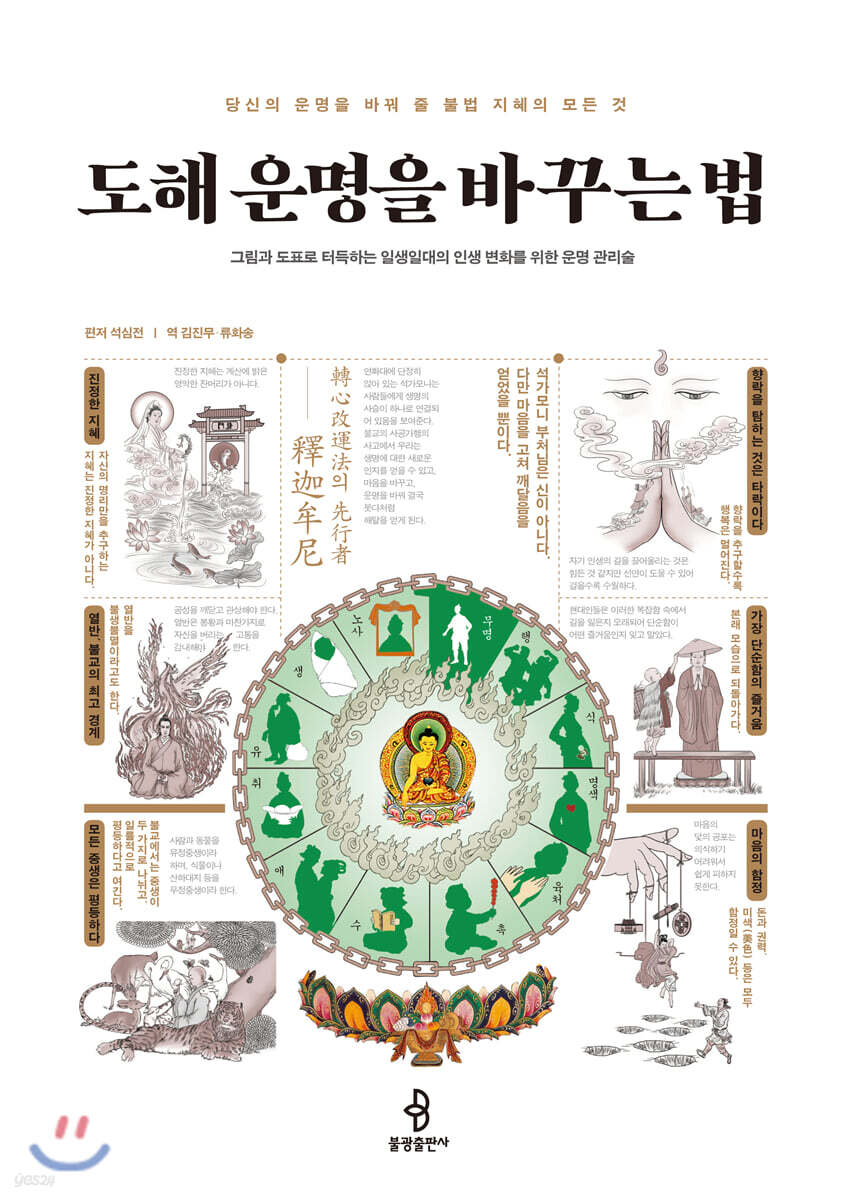
"How to Change Your Destiny with a Diagram" organizes theories that can feel somewhat profound and complex into the most popular and accessible expressions.
Additionally, each section is filled with elaborately drawn pictures and diagrams, allowing readers to gain wisdom and enlightenment while also experiencing a comfortable and enjoyable reading experience.
Therefore, it will be a nectar of life for Buddhists, from beginners to ardent believers, as well as for general readers who wish to pioneer their lives through the long-standing teachings of the East.
Or would you rather live a destiny of your own making?
Everything about the destiny-creating method that Buddha taught to sentient beings!
A simple yet profound teaching that has changed countless lives over time!
For those who are blaming their fate for their difficult lives, I encourage you to start by changing your mind right now, as this book suggests.
- Jo Yong-heon (Oriental scholar and fortune-telling researcher)
Everyone has probably faced a difficult moment in life and wondered, "Why was I born with this fate?"
Many people believe that they are born with a predetermined destiny, or fate, and that their lives will only take that path.
That's why I live my life passively and pessimistically.
Is there really such a thing as "predestiny"? Sadly, Buddha says, "Yes."
Buddhism says that our present life is created by our past karma, and our present karma creates our future life.
The words of Buddha, which everyone has likely heard at least once, illustrate this point well.
If you want to know the cause of your past life, it is what you received in this life.
If you want to know the fruit of the next life, it is what you did in this life.
But this statement is actually hopeful.
In Buddhism, which values conditions and results, that is, the law of cause and effect, ‘fate’ is not recognized.
This saying is actually an expression of the possibility that 'fate can change'.
To you who looks at your ‘Today’s Fortune’ as soon as you open your eyes in the morning
- You are the only one in control of your own destiny.
There is a truth that we know well, yet often forget.
As many sages of the East and the West have advised in the past, each person's destiny lies in their own hands.
Buddha's thoughts are no different.
As this book emphasizes, our destiny, our lives, are not controlled by some divine being or unknown force.
The premise of the Buddha's teachings on 'destiny' and 'how to transcend' that destiny is that each person is the sole master of his own destiny.
The book's explanation continues with the Buddha's message that all sentient beings are capable of enlightenment.
In other words, we proclaim that we are all equal beings capable of enjoying happiness. While each person's fate may differ based on their karma, the possibility of leading a happy life is equally given to everyone.
Therefore, we have no need to confine our lives to the framework of fate and turn them into despair.
Rather, as the book says at the beginning, if we “manage our luck” as we “manage our capital” on a daily basis, we can live the life we want.
Mr. Cho Yong-heon, who wrote the recommendation for this book, says, "Intervene in your own destiny."
Perhaps, when you have tasted the bitterness of life, the easiest thing to do is to 'turn it into fate'.
But, since I am already the one who can change my destiny and even surpass it, there is no reason to stay.
The key is in your 'heart'
- If you just change your mind, the world will soon become paradise.
The so-called 'lucky ones' whom everyone envies seem to have no worries, but their good fortune is purely due to their own good hearts.
- From the introduction
The core of this book and the core of the Buddha's method of enlightenment lies in the 'mind.'
The author says that changing one's life through a change of mind is already universally acknowledged as the best way.
As this book emphasizes, 'thoughts determine the blessings and disasters of life.'
The principle by which a change of heart brings about a change of destiny can be summarized as follows.
'When our mind changes, our attitude changes accordingly. When our attitude changes, our habits change accordingly. When our habits change, our personality changes accordingly. When our personality changes, our life changes accordingly.'
Ultimately, changing your destiny begins with changing your mind (thoughts).
If you can regulate your psychology to the best state and achieve a stable, calm, comfortable, and joyful mind, your life will naturally become happy, enjoyable, free, and unrestrained, and you will naturally become a lucky person.
Saying something like 'I'm unlucky' is actually wrong.
It's just a question of whether we can get a good grasp of it.
In this way, understanding the structure and characteristics of the mind and how changes in the mind can bring good luck to life can be said to be the main foundation of this book.
So how can we practically use our minds to change our destiny?
Four Ways of Thinking to Transform Your Mind Now: The Four Co-Augmented Actions
- A new life philosophy that will change your destiny
In managing capital, we will seek to create maximum value with limited capital.
The same goes for decades of life.
We must create maximum value with our limited life.
In this way, life also requires scientific management.
By doing so, we can become lucky people who achieve success in everything we do and live a happy and abundant life, rather than relying on superstitions such as luck or talismans, such as 'rice cakes falling from the sky.'
This book introduces the 'Four Common Actions' as four ways of thinking to manage one's destiny and life.
The four reasons are 'the difficulty of obtaining a human body [人身難得]', 'the impermanence of life [生命無常]', 'karma and cause [第二]', and 'the faults and misfortunes of reincarnation [過患]'.
The editor introduces the Sagongahaeng as an 'essential preparatory course for Buddhist practice' and 'the simplest introduction to Buddhist knowledge' that all practitioners of any Buddhist sect must do.
Through this method of reasoning, we can direct the foolish minds of our worldly reality, that is, the minds of ordinary people, toward the truth, and apply the wisdom of the Buddha in our daily lives.
·It is difficult to obtain a human body - Our life is only a short stay, so we should know its preciousness and cherish each day more.
We must also value our relationships with fate more.
·Life is impermanent - Everything in the world is constantly changing, and there is nothing that is not changing.
'I' too, am constantly changing, past, present, and future are not static, and all laws are created by conditions, so we should not cling to them as they are impermanent.
The world is beautiful because it is free.
·Karma and Cause - Karma and Cause are natural laws, like the laws of physics and other sciences.
Our lives cannot escape this either.
If we can understand and utilize cause and effect well, we can reap the benefits of sowing seeds and avoid harm.
·The cycle of reincarnation - Our karma is based on cause and effect.
If you do good, good retribution will follow, and if you do evil, evil retribution will follow.
If all our thoughts are pure, we can be at peace in this very place.
In this book, the editor proposes a new philosophy of life that transforms the mind by adding the teachings of the major doctrines that Buddhism holds important, based on the above-mentioned Sagonggahaeng method of reasoning.
Of course, it is far from our daily life ideology.
But if the way we think has been leading our destiny in a bad direction, then it is only natural that there should be a change.
As you follow the book's step-by-step instructions from the first page, you'll realize how much these seemingly insignificant thoughts can contribute to changing our lives.
The oldest self-development method that is still valid for modern people living in the 21st century.
Many people still think that the wisdom of Buddhism is difficult and conceptual and difficult to apply in life.
However, the Buddha's teachings have long been accepted as powerful and practical life wisdom that can substantially improve our lives.
Moreover, as can be seen in many recent examples of Buddhist meditation, the wisdom of Buddha transcends religious beliefs and continues to attract attention from people around the world even in the 21st century.
People living in the past as well as in the present have made great efforts to direct their destiny and life toward the ultimate direction of 'happiness'.
However, as a way of life, it is often difficult to reach that goal even with numerous theories and methods.
The reason may be that the 'change of mind', which is the theme of this book, has not been achieved.
It is a point that everyone acknowledges that no method of living can change one's life without a 'change of mind.'
Ultimately, this book explains that if we change our existing mind and bring about a revolutionary change in our life philosophy like Buddha, the pioneer of the method of changing our destiny by changing our mind, we can live a life full of happiness and joy.
This book, which has become a bestseller in its field even in China, contains the basic Buddhist doctrines and simple and easy-to-understand practices, as well as an age-old self-improvement method that can help us move our lives in a better direction.
The method is an active and enterprising way of life that will free you from a life of boredom and depression, using a language of flawless logic and irreversible metaphors.
"How to Change Your Destiny with a Diagram" organizes theories that can feel somewhat profound and complex into the most popular and accessible expressions.
Additionally, each section is filled with elaborately drawn pictures and diagrams, allowing readers to gain wisdom and enlightenment while also experiencing a comfortable and enjoyable reading experience.
Therefore, it will be a nectar of life for Buddhists, from beginners to ardent believers, as well as for general readers who wish to pioneer their lives through the long-standing teachings of the East.
GOODS SPECIFICS
- Date of issue: September 6, 2019
- Page count, weight, size: 456 pages | 998g | 170*240*27mm
- ISBN13: 9788974796785
- ISBN10: 8974796783
You may also like
카테고리
korean


korean

![GQ KOREA Mark (Monthly): December [2025]](http://librairie.coreenne.fr/cdn/shop/files/8ef265dbbfbf186523ed75ba7319009d.jpg?v=1765340328&width=3840)


