

Web API Design as Informed by Everyday Objects
 |
Description
Book Introduction
Web APIs allow you to leverage the functionality provided by existing services when creating new services or apps.
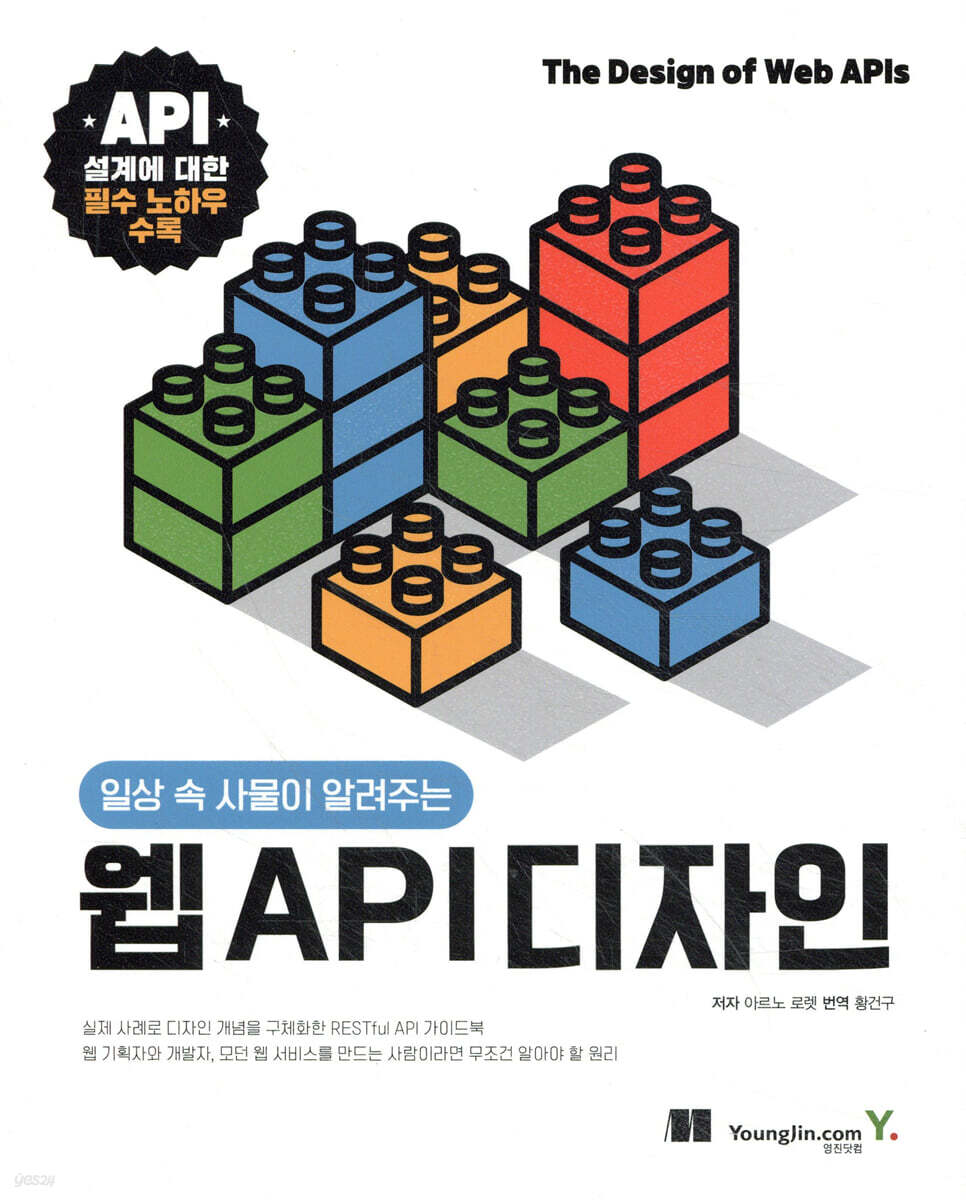
You can think of it as something like Lego that can be easily fitted into a project created by a developer without necessarily knowing the detailed source code of the existing service.
So how do I create an API that allows other developers and other applications to easily use my service?
Having faced and designed various web APIs for over 10 years, Arnaud Loret has organized the know-how that has been only in the minds of web API designers into easily understandable concepts.
"Web API Design as Taught by Everyday Objects" introduces API design methods using everyday objects that we take for granted and do not explore in depth.
This book demonstrates the process of transforming seemingly incomprehensible objects—like a jumbled remote control with a jumble of buttons or an alarm clock counting down to a set time—into something familiar, connecting this process to the web API design process. From the fundamentals of API design itself to designing user-friendly web APIs and managing them once they're operational, this book covers all the concepts necessary to properly design a good API.
Let's get our hands on the essential knowledge for those who create modern web services.
- You can preview some of the book's contents.
Preview
index
Part 1. API Design Fundamentals
1. What is API design?
1.1 What is an API?
1.1.1 Web interface for the software
1.1.2 Turning software into Lego
1.2 Why API Design Matters
1.2.1 Public and private APIs are also used by other developers.
1.2.2 API hides implementation
1.2.3 Poor API Design Leads to Terrible Results
1.3 Elements required for API design
1.3.1 Understanding Design Principles Beyond Programming Interfaces
1.3.2 All aspects of API design
2.
Designing APIs for Users
2.1 The right perspective for designing user interfaces in everyday life
2.1.1 Focusing on the way things work makes the interface complex.
2.1.2 The interface becomes simpler when the user focuses on what he or she can do.
2.2 Software Interface Design Methods
2.2.1 Viewing the API as a control panel for your software
2.2.2 Creating a simple API focused on the consumer's perspective
2.3 API Goal Identification Process
2.3.1 What to do and how to do it
2.3.2 What is input and what is output?
2.3.3 Are there any missing objectives?
2.3.4 Did you find all users?
2.3.5 API Goal Canvas
2.4 Provider Perspectives to Avoid in API Design
2.4.1 Impact of Data
2.4.2 Impact of Code and Business Logic
2.4.3 Impact on software architecture
2.4.4 Impact of human organization
2.4.5 Finding the Provider Perspective in the API Goal Canvas
3.
Designing a Programming Interface
3.1 Introduction to REST API
3.1.1 Analyzing REST API Calls
3.1.2 HTTP Basics
3.1.3 Basic Principles of REST API
3.2 Process of transforming API goals into REST APIs
3.2.1 Identifying Resources and Relationships Between Resources with the API Goal Canvas
3.2.2 Identifying actions, their parameters, and return values using the API Goal Canvas
3.2.3 Resource representation including path
3.2.4 Expressing Actions with HTTP
3.2.5 REST API and HTTP Cheat Sheet
3.3 Designing API Data
3.3.1 Concept Design
3.3.2 Response Design in Concept
3.3.3 Parameter Design in Concept and Response
3.3.4 Checking parameters in data sources
3.3.5 Design of other parameters
3.4 How to maintain balance when facing design challenges
3.4.1 REST Compromise Example
3.4.2 Balancing User Convenience and Rule Compliance
3.5 Why REST is Important When Designing APIs
3.5.1 Introduction to the REST Architectural Style
3.5.2 The Impact of REST Constraints on API Design
4. API design using API specification format
4.1 What is the API specification format?
4.1.1 Introduction to OAS (OpenAPI Specification)
4.1.2 Why Use the API Specification Format?
4.1.3 When to Use API Specification Format
4.2 Describing API resources and actions through OAS
4.2.1 Creating an OAS Document
4.2.2 Resource Description
4.2.3 Description of resource behavior
4.3 Expressing API Data with OpenAPI and JSON Schema
4.3.1 Query Parameter Description
4.3.2 Data Description via JSON Schema
4.3.3 Response Description
4.3.4 Body Parameter Description
4.4 Describing APIs Efficiently in OAS
4.4.1 Reusing Components
4.4.2 Describing Path Parameters
Part 2: Designing a User-Friendly API
5.
Designing Intuitive APIs
5.1 Intuitive Expression
5.1.1 Choosing a clear name
5.1.2 Determining Easy-to-Use Data Types and Formats
5.1.3 Selecting ready-to-use data
5.2 Intuitive Interaction
5.2.1 Requesting intuitive input
5.2.2 Identifying all possible error feedback
5.2.3 Returning Useful Error Feedback
5.2.4 Returning thorough error feedback
5.2.5 Returning Useful Success Feedback
5.3 Intuitive Flow
5.3.1 Creating an Intuitive Goal Chain
5.3.2 Error Prevention
5.3.3 Goal Integration
5.3.4 Designing Stateless Flows
6.
Designing Predictable APIs
6.1 Maintaining Consistency
6.1.1 Designing Consistent Data
6.1.2 Designing Consistent Goals
6.1.3 Four Levels of Consistency
6.1.4 Follow Others: Adhere to Common Practices and Standards
6.1.5 Consistency is difficult to maintain and must be applied wisely.
6.2 Enabling Adaptation
6.2.1 Providing or responding in other formats
6.2.2 Internationalization and Localization
6.2.3 Applying Filters, Pages, and Sorts
6.3 Enabling navigation
6.3.1 Providing Metadata
6.3.2 Creating a Hypermedia API
6.3.3 Taking advantage of the HTTP protocol
7.
Designing concise and systematic APIs
7.1 API Structuring
7.1.1 Structuring Data
7.1.2 Structuring Feedback
7.1.3 Structuring Goals
7.2 API Sizing
7.2.1 Selecting Data Segmentation
7.2.2 Selecting a Goal Segmentation
7.2.3 Selecting API Segmentation
Part 3: Context-Sensitive API Design
8.
Designing Secure APIs
8.1 Overview of API Security
8.1.1 Registering a Consumer
8.1.2 Getting Credentials for API Use
8.1.3 Calling the API
8.1.4 Designing APIs from a Security Perspective
8.2 Enabling Access Control through API Segmentation
8.2.1 Defining flexible and refined scopes
8.2.2 Defining a Simple but Coarser Scope
8.2.3 Choosing a Scope Strategy
8.2.4 Defining Scopes in API Specification Format
8.3 Designing for Access Control
8.3.1 Understanding Data Required for Access Control
8.3.2 Design adjustments as needed
8.4 Handling of sensitive elements
8.4.1 Handling Sensitive Data
8.4.2 Handling Sensitive Objects
8.4.3 Designing Safe Error Feedback
8.4.4 Identifying Architecture and Protocol Issues
9. Developing API Design
9.1 API Evolution Design
9.1.1 Avoiding Breaking Changes in Output Data
9.1.2 Avoiding Breaking Changes in Input Data and Parameters
9.1.3 Avoiding Breaking Changes in Success and Error Feedback
9.1.4 Avoiding Breaking Changes in Goals and Flow
9.1.5 Avoiding Security Vulnerabilities in Breaking Changes
9.1.6 Beware of Invisible Interface Contracts
9.1.7 It's not always the case that breaking changes are the problem.
9.2 Setting the API Version
9.2.1 Comparison of API Versioning and Implementation Versioning
9.2.2 Choosing an API Version Representation from a Consumer Perspective
9.2.3 Determining API Versioning Segmentation
9.2.4 Impacts of API Versioning Beyond Design
9.3 Keep extensibility in mind when designing APIs
9.3.1 Designing Scalable Data
9.3.2 Designing Scalable Interactions
9.3.3 Designing Scalable Flows
9.3.4 Designing Extensible APIs
10.
Designing Network-Efficient APIs
10.1 Overview of Network Communication Considerations
10.1.1 Scene Setting
10.1.2 Analyzing the Problem
10.2 Ensuring network communication efficiency at the protocol level
10.2.1 Enabling Compression and Persistent Connections
10.2.2 Enabling Caching and Conditional Requests
10.2.3 Choosing a Cache Policy
10.3 Ensuring Network Communication Efficiency at the Design Level
10.3.1 Enabling Filtering
10.3.2 Selecting Related Data for List Representation
10.3.3 Creating Data Aggregations (Aggregating)
10.3.4 Suggesting Other Expressions
10.3.5 Enabling Extensions
10.3.6 Enabling Queries
10.3.7 Providing more relevant data and goals
10.3.8 Creating Another API Layer
11.
Designing context-sensitive APIs
11.1 Applying communication tailored to data, goals, and personality
11.1.1 Managing long-running tasks
11.1.2 Notifying Consumers of Events
11.1.3 Streaming Event Flow
11.1.4 Handling Multiple Elements
11.2 Understanding the Full Context
11.2.1 Understand existing consumer practices and constraints.
11.2.2 Carefully consider provider limitations
11.3 Choosing the Right API Style for Your Context
11.3.1 Comparison of Resource, Data, and Function-Based APIs
11.3.2 Thinking Beyond Request/Response and HTTP-Based APIs
12. Documenting APIs
12.1 Creating a Reference Document
12.1.1 Documenting the Data Model
12.1.2 Documenting Goals
12.1.3 Documenting Security
12.1.4 Providing an API Overview
12.1.5 Extracting Documents from Detailed Implementations: Advantages and Disadvantages
12.2 Writing a User Guide
12.2.1 Documenting Use Cases
12.2.2 Documenting Security
12.2.3 Provide an overview of common operations and principles.
12.2.4 Thinking Beyond Static Documentation
12.3 Providing Appropriate Information to Implementation Managers
12.4 Revision and Abolition of Documents
13.
Growing API
13.1 API Lifecycle
13.2 Creating API Design Guidelines
13.2.1 What's Included in the API Design Guidelines
13.2.2 Continuously Creating Guidelines
13.3 Reviewing the API
13.3.1 Challenge and Analyze Requirements
13.3.2 Linting Your Design
13.3.3 Reviewing Design from a Provider's Perspective
13.3.4 Reviewing Design from a Consumer Perspective
13.3.5 Verifying the Implementation
13.4 Communicate and Share
Detailed image

Publisher's Review
This book consists of 3 parts and 13 chapters.
This book should be read sequentially, from beginning to end, with all chapters covered.
Each chapter expands on what you learned in the previous chapter.
That is, you must complete Chapters 1, 2, and 3 before you can move on to the chapters that cover design topics.
Part 1. API Design Fundamentals
Covers the basic concepts and techniques needed to design an API.
Chapter 1 explains what an API is, why design is important, and what elements make up API design.
Chapter 2 focuses on the perspectives of both API users and software that consumes the API, explaining how to create software that doesn't expose the API and how to determine the actual goals of the API.
Chapter 3 introduces the HTTP protocol, REST API, and REST architectural style.
Chapter 4 introduces the OpenAPI specification and shows you how to structure your API in the form of an API description based on your goals.
Part 2.
User-friendly API design
We focus on designing APIs that are easy to understand and use.
Chapter 5 explains how to design simple data representations, error and success feedback, and API call flows so that people can immediately understand and use them easily.
Chapter 6 explains how to design APIs that are consistent, adaptable, and discoverable for consumers, making it easy to guess how they work.
Chapter 7 shows you how to understand all aspects of the API and how to configure and scale it to make it easy to use.
Part 3.
Context-sensitive API design
It tells you why API designers need to consider the entire context surrounding the API and the entire context surrounding the API design process itself.
Chapter 8 explains API security and how to design secure APIs.
Chapter 9 shows you how to modify and version your API without affecting users.
We also introduce how to create an API that is easy to upgrade.
Chapter 10 analyzes how to design network-efficient web APIs.
Chapter 11 looks at the overall context that API designers must consider when designing an API.
This includes coordinating communication mechanisms, assessing and adjusting for consumer or provider limitations, and selecting an appropriate API style.
Chapter 12 explains how API designers can leverage API description formats like the OpenAPI specification to create different types of API documentation.
Chapter 13 explores the entire API lifecycle and introduces how API designers can participate in and contribute to multiple APIs.
In particular, we will look closely at API design guidelines and API reviews.
GOODS SPECIFICS
- Publication date: November 10, 2020
- Page count, weight, size: 448 pages | 1,060g | 188*235*23mm
- ISBN13: 9788931463224
- ISBN10: 8931463227
- KC Certification: Certification Type: Conformity Confirmation
You may also like
카테고리
korean


korean


