

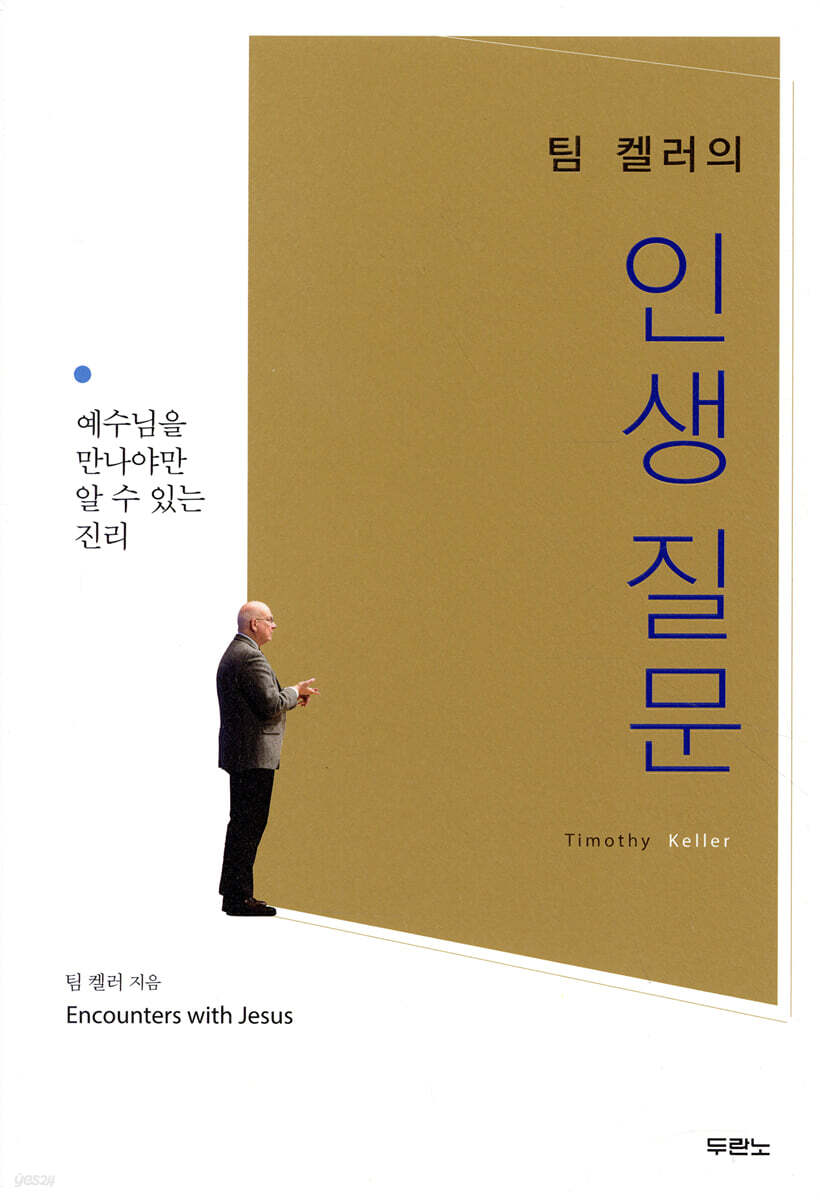
Tim Keller's Life Questions
 |
Description
Book Introduction
A gathering of the best intellectuals, At Oxford and Harvard Compile lectures and discussions into a book. Those who wanted to find the meaning of life The essential question and what Jesus gives Let's hear Hyean's answer together. Those who encountered Jesus Christ face to face faced the same big questions of life as we do today. The answers that had been passed down to them, like those we had, seemed to have no relevance in the real world. But when I met Jesus, everything immediately began to change. He not only gave the answer, but He became the answer. In this book, Tim Keller shows how several key events and encounters in Jesus' life can change our own lives forever. Tim Keller reportedly had the opportunity to lecture and discuss this topic at intellectual gatherings such as Oxford University and the Harvard Club. This book is based on the lecture given at that time. They were more rational than anyone else, more skeptical about religion, more eager to fill the void in their hearts, and more than anything, they were filled with questions about the meaning of life. Together they found answers in the Bible, in the life, death, and ministry of Jesus, and ultimately it brought about many changes. Afterwards, Tim Keller completed this book by filling in the questions that his limited vocabulary could not fully explain with many years of lectures and research. |
- You can preview some of the book's contents.
Preview
index
prolog
Part 1.
Encountering Jesus: Finding Answers to Life
1.
Skeptic: Nathanael
“What good can come from Christianity?”
2.
Insiders and Outsiders: Nicodemus and the Samaritan Woman
"Isn't there something wrong with the world we live in, with the privileged and the marginalized?"
3.
The Sorrowful Sisters: Martha and Mary
“Can Jesus, who is God, understand human sorrow?”
4.
Wedding Feast: Jesus' Mother
“I didn’t come here to give answers, but is Jesus the real answer?”
5.
The First Christian: Mary Magdalene
“Is resurrection really possible?”
Part 2.
Meet your Savior Jesus for eternal life
6.
The Ultimate Enemy: Confronting Satan
“Isn’t the existence of Satan so absurd in today’s world?”
7.
The Two Prophets: Sending the Holy Spirit
“Do I, a cultured and decent person, really need a prophet?”
8.
The Obedient Lord: Death on the Cross
“Why did God have to die?”
9.
At the Father's Right Hand: The Meaning of the Ascension
“Why didn’t you just stay with us instead of ascending?”
10.
Mary's Courage: Obeying Even Without Meeting in Advance
“Is there a price to pay for becoming a Christian?”
Acknowledgements
main
Part 1.
Encountering Jesus: Finding Answers to Life
1.
Skeptic: Nathanael
“What good can come from Christianity?”
2.
Insiders and Outsiders: Nicodemus and the Samaritan Woman
"Isn't there something wrong with the world we live in, with the privileged and the marginalized?"
3.
The Sorrowful Sisters: Martha and Mary
“Can Jesus, who is God, understand human sorrow?”
4.
Wedding Feast: Jesus' Mother
“I didn’t come here to give answers, but is Jesus the real answer?”
5.
The First Christian: Mary Magdalene
“Is resurrection really possible?”
Part 2.
Meet your Savior Jesus for eternal life
6.
The Ultimate Enemy: Confronting Satan
“Isn’t the existence of Satan so absurd in today’s world?”
7.
The Two Prophets: Sending the Holy Spirit
“Do I, a cultured and decent person, really need a prophet?”
8.
The Obedient Lord: Death on the Cross
“Why did God have to die?”
9.
At the Father's Right Hand: The Meaning of the Ascension
“Why didn’t you just stay with us instead of ascending?”
10.
Mary's Courage: Obeying Even Without Meeting in Advance
“Is there a price to pay for becoming a Christian?”
Acknowledgements
main
Into the book
I was like that too
I grew up as a Protestant.
But during my college years, as I went through a spiritual crisis of both body and mind, I began to question my most fundamental beliefs about God, the world, and myself.
Some of the Christians I met at that time were very active in small group Bible studies.
The leader of the group did not act as a teacher or lecturer, but only as a facilitator to help the entire group read and interpret the same biblical passage.
The rules of the meeting were simple, but they were necessary for the activity to proceed properly.
Basically, it was assumed that the Bible was true.
The biblical text had to be considered trustworthy and the biblical authors had to be considered competent.
Furthermore, no one person can impose their own interpretation of the text; small group members must discover the meaning of the Bible together.
As a community, we must strive to discover the rich mysteries hidden in the Bible, based on the premise that we see much more together than as individuals.
I was asked to lead a Bible study group at a time when I was unsure of the state of my faith.
The Bible study material was Conversations with Jesus Christ from the Gospel of John by Marilyn Coontz and Catherine Schell.
The textbook covers 13 scenes of conversation between Jesus and individuals in the Gospel of John.
As my small group and I studied the book together, we were amazed at the deep meaning and insights we discovered within the Bible.
As I looked into the life of Jesus, I realized that the Bible is no ordinary book.
The Bible reveals the beauty of ancient literature, but I discovered something even more moving.
As I studied my encounter with Jesus, I felt the incomprehensible life and power hidden in the Bible.
Strangely enough, conversations from long ago still hit home for me today.
From then on, I explored the Bible not only for intellectual stimulation but also to find God.
I learned that patience and deep thinking are the secrets to insight.
A long time ago, I attended a training session for Bible study leaders.
I still can't forget the activities I did back then.
The instructor presented us with Mark 1:17.
“Jesus said to him, ‘Follow me.
“He said to us, ‘I will make you fishers of men.’” He asked us to spend 30 minutes studying this Bible verse.
After 5-10 minutes, you may feel like you have fully grasped the text, but I urge you to continue meditating and studying.
Then he said, “Write down at least 30 things you saw or learned from this passage.”
I finished writing in 10 minutes and sat there feeling both relieved and bored.
As I was obliged to read the text, I was surprised to find that there was more to record.
When the time came and everyone was gathered together, he had each person mark the item on their list that had most impressed them or been most helpful to them.
And he said, “Raise your hand if anyone has the best insight they’ve ever had in five minutes.”
No one raised their hand.
“Has anyone found it in 10 minutes?” One or two people raised their hands.
“Fifteen minutes?” A few more hands went up.
“20 minutes?” This time, many hands were raised.
“How about 25 minutes?” Finally, most of them raised their hands, smiled, and nodded.
The experience of studying the Bible inductively and patiently changed my life of faith.
If we take the time, open our hearts with the right attitude, and trust in the Word, God will speak to us through the text of Scripture.
Furthermore, learning how to help people hear God's voice in the Bible ultimately determined the direction of my career.
So, it has been almost 40 years since I started teaching and preaching the Bible to people.
The basis of all my lectures, lectures, and sermons is always, as I learned in college, sitting down before a Bible text and carefully digging deep into it.
Even now, I accept the authority of the entire Bible, and I enjoy learning and teaching it in its entirety.
But it was through the Gospels that the spiritual authority of the Bible first struck me deeply.
Especially through the conversations Jesus had with each person - the skeptical disciple Nathanael, his bewildered mother at the wedding feast, the religious doctors who came in the middle of the night, the woman at the well, the two bereaved sisters Mary and Martha, and many others.
I too was shaped by encounters with Jesus, many of which were the result of studying the encounters between Jesus and people in the Gospels.
A few years ago I wrote a book called The Reason for God.
I have always appreciated the arguments of skeptics I have encountered over the years of pastoring in New York City.
Because they played a significant role in revealing and clarifying the uniqueness of Christianity.
I find it quite annoying that Christians dismiss their questions with arrogance.
I recall myself during my college Bible study group, when I was more skeptical than anyone else, and I feel deeply grateful to the small group members who took my questions seriously.
In my experience, investing time and effort into finding answers to difficult questions can deepen your faith.
Even those who were skeptical of Christianity are likely to find joy and open their closed hearts.
For this reason, I was delighted when I was asked to give a five-night lecture to students—most of whom were skeptics—at Oxford Town Hall in England in 2012.
I decided to look at the encounters between Jesus and each person in the Gospel of John.
I thought this topic would be a good choice for the meeting.
As I have personally experienced in the past, the text very convincingly reveals the core teachings and character of Jesus.
As I prepared for the lecture, another reason why this meeting was appropriate occurred to me.
When Jesus met people, he often addressed the universal question of humanity: the meaning of life.
What purpose does the world serve, and how did it go wrong? What are the solutions to these problems, and how can we participate in their resolution? Where can we find answers to these questions in the first place? These are crucial questions that everyone must ask, and they are also ones that honest skeptics explore with particular keenness.
Everyone has an answer to this question, even if it is only a hypothesis.
If you try to live your life without finding the answer, you will soon feel an uncontrollable emptiness.
Some people argue that such an answer is unnecessary.
It is argued that life should be acknowledged as a meaningless pastime in the vast universe and left as is.
“Enjoy life to the fullest while you are alive.
After you die, you won't have to worry about these problems.
So why bother trying to find meaning in life?” Luc Ferry, a French philosopher who was not a Christian, wrote in his book A Brief History of Thought that such a statement was “too cruel to be true.”
This means that even those who say such things cannot truly believe it deep down.
A person cannot live life without hope or meaning.
You can't live without the conviction that there is something worth dedicating your life to.
So we know that we must have answers to the big question, as Luc Perry puts it, “If we are to live well, to live freely, capable of joy, giving, and loving…”
As Perry then argues, the possible answers to these important philosophical questions come from roughly five or six major systems of thought, and most of the most common answers today come from one of them in particular.
For example, do you generally believe it's better to be kind and reach out to your enemies than to kill them? As Perry says, the concept of loving your enemies comes from Christianity and doesn't exist anywhere else.
As we will see later, there are many other concepts that are considered legitimate, noble, or beautiful in the world as products of Christianity alone.
Therefore, to provide solid and thoughtful answers to fundamental questions, it is necessary to have at least some familiarity with Christian teachings.
To do this, it is best to look at how Jesus met people, explained himself and the purpose of the encounter, and how his answers changed their lives.
That was the premise of the Oxford lectures, and those lectures are the basis for chapters 1-5 of this book.
But I couldn't end the book there.
After studying the stories of people who met Jesus face-to-face and were transformed by Him, seeing His beautiful character and purpose, and hearing His answers to important questions, you still have one more question.
Now, after all these years, how can I encounter Jesus? Can I be transformed like those witnesses?
The salvation that the Christian gospel speaks of—eternal change—does not come from our actions or even from the words Jesus spoke when he met people.
The gospel comes from what Jesus did for us.
Therefore, to best experience the life-transforming grace and power of Jesus, we must look at what he accomplished through the major events of his life—his birth, his suffering in the wilderness and in the Garden of Gethsemane, his final hours with his disciples, his death on the cross, his resurrection, and his ascension.
It was through such actions that Jesus achieved a salvation that we could never have achieved on our own.
When you realize this, even you who only knew Jesus as a teacher or historical figure can confess Him as your Redeemer and Savior and your life can be transformed.
So in the second half of the book, we'll look at some key events in Jesus' life.
Chapters 6-10 are based on lectures I gave over several years at a regular breakfast meeting called the Harvard Club in New York City, to leaders in business, government, and culture.
As with the Oxford lectures, the majority of attendees were well-educated and successful, and they were gracious enough to share their doubts and questions with me.
In both lectures, I returned to these Gospel passages, as I have often done over the past several decades.
These are the passages where I first felt the “living and active” nature of the Bible (Hebrews 4:12).
As my past retreat instructors taught me, each time I learned something new from the words, and each time, my passion for sharing what I had learned grew.
There is one more reason why I wanted to write this book.
My beloved granddaughter Lucy was clearly perceptive at 18 months old, but her expressions were far less expressive.
The child would point to something or hold something in his hand and look at me, looking very frustrated.
I wanted to say something, but I was too young to communicate.
We too have many times in our lives when we feel that kind of frustration, like Lucy.
If you have a profound experience and later come down from a mountain top or a concert hall or whatever, and you try to convey it to other people, words won't come close.
When Christians want to express the God they have experienced, it is only natural that they feel that way.
As a teacher and preacher, it is my duty and my deepest desire to help people see the pure beauty of who Jesus Christ is and what He did.
But I always feel frustrated and regretful because I cannot fully convey that beauty due to my limited vocabulary.
Perhaps the very fact that it is a word is insufficient.
Fortunately, there is something in the world that can help us more than anything else in this difficult task: the Gospel accounts of Jesus meeting people.
Whether this is your first or your hundredth article, I hope you too will be reaffirmed by the person of Christ and what He has done for us.
--- From the "Prologue"
The skeptic who came to Jesus
This encounter takes place immediately after the prologue of the Gospel of John.
French philosopher Luc Ferry cited this preface as a turning point in the history of thought.
The Hellenes believed that there was a rational moral order in the universe and called this 'natural order' Logos.
For Hellenes, the meaning of life was to observe the world and understand its order.
They found meaning in life in adapting to it and living well.
The author of the Gospel, John, deliberately borrows the Greek philosophical term logos when he says of Jesus:
In the beginning was the Word (Logos), and the Word was with God, and the Word was God. He was in the beginning with God. All things were made through him, and without him was not anything made that has been made. In him was life, and that life was the light of all mankind. And the Word became flesh and made his dwelling among us, and we have seen his glory (John 1:1-3, 14).
This text was like a thunderbolt to the world of ancient philosophy.
Unlike many modern philosophers, John, like the Greek philosophers, acknowledged that life itself has a purpose (telos).
Every human being was created for a special purpose and must be recognized and respected if they are to live freely and well.
As John declared, the world is not merely the product of blind random forces, nor is history 'the meaningless tale of some foolish man, full of sound and fury.'
But then the Bible immediately asserts that the meaning of life is not a principle or an abstract rational system, but a person.
At this time, the person refers to a human being who lived on this earth.
As Perry says, this claim seemed 'madness' to philosophers of the time.
But from that, a revolution was born.
If Christianity is true, then living well does not consist primarily in philosophical meditation and intellectual pursuits.
If Christianity is the standard, then most people in the world live without knowing the true meaning of life.
On the contrary, that life is in the hands of the individual we meet and form a relationship with.
This applies equally to everyone, everywhere, regardless of background.
(syncopation)
First, let's look at Nathanael's problem.
He was a smart-alecky guy and a bit narrow-minded.
Philip came to him and said, “There is a rabbi you should see.
He holds the answers to the great questions of our time.
When he said, “He is from Nazareth,” Nathanael scoffed, “Surely not from Nazareth!”
At that time, everyone from Jerusalem looked down on those from Galilee.
This attitude is human nature.
Some neighborhoods always look down on other neighborhoods as 'backward neighborhoods'.
So how does the person who is being despised react? They look for someone else to despise.
These things repeat endlessly.
Even Nathanael was not from Jerusalem, but from Galilee.
Even he thought that a place like Nazareth could be treated lightly.
Because Nazareth was considered a more backward rural area even within Galilee.
There's always a certain group of right, smart people, and the rest are (lowering his voice) 'others, etc.'
To signal to the right and smart people that you're on their side, just give them a mocking look when any of these people or places are mentioned.
We want to appear competent and intelligent in the eyes of others.
But often, that sense of identity is sought through ridicule and contempt rather than polite and solid argument.
So even the simple mistakes of others are disguised as failure, regression, and ignorance.
Nathanael could not believe that someone from a place like Nazareth could have answers to the great questions of our time.
"He has the answer? He's from Nazareth? That's impossible." He gave me a look of contempt.
“Are you really from there? Really?”
It wouldn't be surprising if you or someone you know views Christianity in a Nazarene way.
Many people today view Christianity as Nathanael viewed Nazareth.
Christianity is nothing more than a 'Nazareth' to people.
People love to mock what they think Christianity is.
The same attitude is taken toward Christian claims about who Christ is and what he has done and can do for them.
People who know something about Christianity all say, “I know everything about Christianity.
I grew up in it.
I realized long ago that it wasn't for me.
“My mind is already made up,” he says.
In this way, both in the past and in the present, Jesus is still just a man from Nazareth.
I grew up as a Protestant.
But during my college years, as I went through a spiritual crisis of both body and mind, I began to question my most fundamental beliefs about God, the world, and myself.
Some of the Christians I met at that time were very active in small group Bible studies.
The leader of the group did not act as a teacher or lecturer, but only as a facilitator to help the entire group read and interpret the same biblical passage.
The rules of the meeting were simple, but they were necessary for the activity to proceed properly.
Basically, it was assumed that the Bible was true.
The biblical text had to be considered trustworthy and the biblical authors had to be considered competent.
Furthermore, no one person can impose their own interpretation of the text; small group members must discover the meaning of the Bible together.
As a community, we must strive to discover the rich mysteries hidden in the Bible, based on the premise that we see much more together than as individuals.
I was asked to lead a Bible study group at a time when I was unsure of the state of my faith.
The Bible study material was Conversations with Jesus Christ from the Gospel of John by Marilyn Coontz and Catherine Schell.
The textbook covers 13 scenes of conversation between Jesus and individuals in the Gospel of John.
As my small group and I studied the book together, we were amazed at the deep meaning and insights we discovered within the Bible.
As I looked into the life of Jesus, I realized that the Bible is no ordinary book.
The Bible reveals the beauty of ancient literature, but I discovered something even more moving.
As I studied my encounter with Jesus, I felt the incomprehensible life and power hidden in the Bible.
Strangely enough, conversations from long ago still hit home for me today.
From then on, I explored the Bible not only for intellectual stimulation but also to find God.
I learned that patience and deep thinking are the secrets to insight.
A long time ago, I attended a training session for Bible study leaders.
I still can't forget the activities I did back then.
The instructor presented us with Mark 1:17.
“Jesus said to him, ‘Follow me.
“He said to us, ‘I will make you fishers of men.’” He asked us to spend 30 minutes studying this Bible verse.
After 5-10 minutes, you may feel like you have fully grasped the text, but I urge you to continue meditating and studying.
Then he said, “Write down at least 30 things you saw or learned from this passage.”
I finished writing in 10 minutes and sat there feeling both relieved and bored.
As I was obliged to read the text, I was surprised to find that there was more to record.
When the time came and everyone was gathered together, he had each person mark the item on their list that had most impressed them or been most helpful to them.
And he said, “Raise your hand if anyone has the best insight they’ve ever had in five minutes.”
No one raised their hand.
“Has anyone found it in 10 minutes?” One or two people raised their hands.
“Fifteen minutes?” A few more hands went up.
“20 minutes?” This time, many hands were raised.
“How about 25 minutes?” Finally, most of them raised their hands, smiled, and nodded.
The experience of studying the Bible inductively and patiently changed my life of faith.
If we take the time, open our hearts with the right attitude, and trust in the Word, God will speak to us through the text of Scripture.
Furthermore, learning how to help people hear God's voice in the Bible ultimately determined the direction of my career.
So, it has been almost 40 years since I started teaching and preaching the Bible to people.
The basis of all my lectures, lectures, and sermons is always, as I learned in college, sitting down before a Bible text and carefully digging deep into it.
Even now, I accept the authority of the entire Bible, and I enjoy learning and teaching it in its entirety.
But it was through the Gospels that the spiritual authority of the Bible first struck me deeply.
Especially through the conversations Jesus had with each person - the skeptical disciple Nathanael, his bewildered mother at the wedding feast, the religious doctors who came in the middle of the night, the woman at the well, the two bereaved sisters Mary and Martha, and many others.
I too was shaped by encounters with Jesus, many of which were the result of studying the encounters between Jesus and people in the Gospels.
A few years ago I wrote a book called The Reason for God.
I have always appreciated the arguments of skeptics I have encountered over the years of pastoring in New York City.
Because they played a significant role in revealing and clarifying the uniqueness of Christianity.
I find it quite annoying that Christians dismiss their questions with arrogance.
I recall myself during my college Bible study group, when I was more skeptical than anyone else, and I feel deeply grateful to the small group members who took my questions seriously.
In my experience, investing time and effort into finding answers to difficult questions can deepen your faith.
Even those who were skeptical of Christianity are likely to find joy and open their closed hearts.
For this reason, I was delighted when I was asked to give a five-night lecture to students—most of whom were skeptics—at Oxford Town Hall in England in 2012.
I decided to look at the encounters between Jesus and each person in the Gospel of John.
I thought this topic would be a good choice for the meeting.
As I have personally experienced in the past, the text very convincingly reveals the core teachings and character of Jesus.
As I prepared for the lecture, another reason why this meeting was appropriate occurred to me.
When Jesus met people, he often addressed the universal question of humanity: the meaning of life.
What purpose does the world serve, and how did it go wrong? What are the solutions to these problems, and how can we participate in their resolution? Where can we find answers to these questions in the first place? These are crucial questions that everyone must ask, and they are also ones that honest skeptics explore with particular keenness.
Everyone has an answer to this question, even if it is only a hypothesis.
If you try to live your life without finding the answer, you will soon feel an uncontrollable emptiness.
Some people argue that such an answer is unnecessary.
It is argued that life should be acknowledged as a meaningless pastime in the vast universe and left as is.
“Enjoy life to the fullest while you are alive.
After you die, you won't have to worry about these problems.
So why bother trying to find meaning in life?” Luc Ferry, a French philosopher who was not a Christian, wrote in his book A Brief History of Thought that such a statement was “too cruel to be true.”
This means that even those who say such things cannot truly believe it deep down.
A person cannot live life without hope or meaning.
You can't live without the conviction that there is something worth dedicating your life to.
So we know that we must have answers to the big question, as Luc Perry puts it, “If we are to live well, to live freely, capable of joy, giving, and loving…”
As Perry then argues, the possible answers to these important philosophical questions come from roughly five or six major systems of thought, and most of the most common answers today come from one of them in particular.
For example, do you generally believe it's better to be kind and reach out to your enemies than to kill them? As Perry says, the concept of loving your enemies comes from Christianity and doesn't exist anywhere else.
As we will see later, there are many other concepts that are considered legitimate, noble, or beautiful in the world as products of Christianity alone.
Therefore, to provide solid and thoughtful answers to fundamental questions, it is necessary to have at least some familiarity with Christian teachings.
To do this, it is best to look at how Jesus met people, explained himself and the purpose of the encounter, and how his answers changed their lives.
That was the premise of the Oxford lectures, and those lectures are the basis for chapters 1-5 of this book.
But I couldn't end the book there.
After studying the stories of people who met Jesus face-to-face and were transformed by Him, seeing His beautiful character and purpose, and hearing His answers to important questions, you still have one more question.
Now, after all these years, how can I encounter Jesus? Can I be transformed like those witnesses?
The salvation that the Christian gospel speaks of—eternal change—does not come from our actions or even from the words Jesus spoke when he met people.
The gospel comes from what Jesus did for us.
Therefore, to best experience the life-transforming grace and power of Jesus, we must look at what he accomplished through the major events of his life—his birth, his suffering in the wilderness and in the Garden of Gethsemane, his final hours with his disciples, his death on the cross, his resurrection, and his ascension.
It was through such actions that Jesus achieved a salvation that we could never have achieved on our own.
When you realize this, even you who only knew Jesus as a teacher or historical figure can confess Him as your Redeemer and Savior and your life can be transformed.
So in the second half of the book, we'll look at some key events in Jesus' life.
Chapters 6-10 are based on lectures I gave over several years at a regular breakfast meeting called the Harvard Club in New York City, to leaders in business, government, and culture.
As with the Oxford lectures, the majority of attendees were well-educated and successful, and they were gracious enough to share their doubts and questions with me.
In both lectures, I returned to these Gospel passages, as I have often done over the past several decades.
These are the passages where I first felt the “living and active” nature of the Bible (Hebrews 4:12).
As my past retreat instructors taught me, each time I learned something new from the words, and each time, my passion for sharing what I had learned grew.
There is one more reason why I wanted to write this book.
My beloved granddaughter Lucy was clearly perceptive at 18 months old, but her expressions were far less expressive.
The child would point to something or hold something in his hand and look at me, looking very frustrated.
I wanted to say something, but I was too young to communicate.
We too have many times in our lives when we feel that kind of frustration, like Lucy.
If you have a profound experience and later come down from a mountain top or a concert hall or whatever, and you try to convey it to other people, words won't come close.
When Christians want to express the God they have experienced, it is only natural that they feel that way.
As a teacher and preacher, it is my duty and my deepest desire to help people see the pure beauty of who Jesus Christ is and what He did.
But I always feel frustrated and regretful because I cannot fully convey that beauty due to my limited vocabulary.
Perhaps the very fact that it is a word is insufficient.
Fortunately, there is something in the world that can help us more than anything else in this difficult task: the Gospel accounts of Jesus meeting people.
Whether this is your first or your hundredth article, I hope you too will be reaffirmed by the person of Christ and what He has done for us.
--- From the "Prologue"
The skeptic who came to Jesus
This encounter takes place immediately after the prologue of the Gospel of John.
French philosopher Luc Ferry cited this preface as a turning point in the history of thought.
The Hellenes believed that there was a rational moral order in the universe and called this 'natural order' Logos.
For Hellenes, the meaning of life was to observe the world and understand its order.
They found meaning in life in adapting to it and living well.
The author of the Gospel, John, deliberately borrows the Greek philosophical term logos when he says of Jesus:
In the beginning was the Word (Logos), and the Word was with God, and the Word was God. He was in the beginning with God. All things were made through him, and without him was not anything made that has been made. In him was life, and that life was the light of all mankind. And the Word became flesh and made his dwelling among us, and we have seen his glory (John 1:1-3, 14).
This text was like a thunderbolt to the world of ancient philosophy.
Unlike many modern philosophers, John, like the Greek philosophers, acknowledged that life itself has a purpose (telos).
Every human being was created for a special purpose and must be recognized and respected if they are to live freely and well.
As John declared, the world is not merely the product of blind random forces, nor is history 'the meaningless tale of some foolish man, full of sound and fury.'
But then the Bible immediately asserts that the meaning of life is not a principle or an abstract rational system, but a person.
At this time, the person refers to a human being who lived on this earth.
As Perry says, this claim seemed 'madness' to philosophers of the time.
But from that, a revolution was born.
If Christianity is true, then living well does not consist primarily in philosophical meditation and intellectual pursuits.
If Christianity is the standard, then most people in the world live without knowing the true meaning of life.
On the contrary, that life is in the hands of the individual we meet and form a relationship with.
This applies equally to everyone, everywhere, regardless of background.
(syncopation)
First, let's look at Nathanael's problem.
He was a smart-alecky guy and a bit narrow-minded.
Philip came to him and said, “There is a rabbi you should see.
He holds the answers to the great questions of our time.
When he said, “He is from Nazareth,” Nathanael scoffed, “Surely not from Nazareth!”
At that time, everyone from Jerusalem looked down on those from Galilee.
This attitude is human nature.
Some neighborhoods always look down on other neighborhoods as 'backward neighborhoods'.
So how does the person who is being despised react? They look for someone else to despise.
These things repeat endlessly.
Even Nathanael was not from Jerusalem, but from Galilee.
Even he thought that a place like Nazareth could be treated lightly.
Because Nazareth was considered a more backward rural area even within Galilee.
There's always a certain group of right, smart people, and the rest are (lowering his voice) 'others, etc.'
To signal to the right and smart people that you're on their side, just give them a mocking look when any of these people or places are mentioned.
We want to appear competent and intelligent in the eyes of others.
But often, that sense of identity is sought through ridicule and contempt rather than polite and solid argument.
So even the simple mistakes of others are disguised as failure, regression, and ignorance.
Nathanael could not believe that someone from a place like Nazareth could have answers to the great questions of our time.
"He has the answer? He's from Nazareth? That's impossible." He gave me a look of contempt.
“Are you really from there? Really?”
It wouldn't be surprising if you or someone you know views Christianity in a Nazarene way.
Many people today view Christianity as Nathanael viewed Nazareth.
Christianity is nothing more than a 'Nazareth' to people.
People love to mock what they think Christianity is.
The same attitude is taken toward Christian claims about who Christ is and what he has done and can do for them.
People who know something about Christianity all say, “I know everything about Christianity.
I grew up in it.
I realized long ago that it wasn't for me.
“My mind is already made up,” he says.
In this way, both in the past and in the present, Jesus is still just a man from Nazareth.
--- pp.28~29, 31~33
Publisher's Review
Life Questions and Jesus' Answers from the Gospel of John
In 2012, the author gave a lecture at Oxford University in England on the topic of Jesus' encounters with each person in the Gospel of John.
Those present were the greatest intellectuals of their time, the most rational of all, and most of them skeptics.
They were full of questions about life, and they wandered around to find the answers, and ended up at that place.
"Tim Keller's Life Questions" seeks answers to questions everyone has likely asked at least once through the Gospel of John.
Jesus in the Gospel of John met people with many questions about life, and each time, he gave them insightful answers that suited them, guiding them on the path of the gospel.
It is filled with encounters with Nathanael, a skeptic, Nicodemus, an intellectual, the Samaritan woman, Martha, and Mary.
The author interprets these encounters with Jesus clearly and persuasively.
This will refresh the hearts of those, both Christians and non-Christians, who are filled with questions about life.
Is Jesus the real answer?
Is resurrection of the body possible?
Why did God have to die?
What makes Christianity different from other religions?
Finding answers to questions about Christianity.
This book is divided into two parts.
Part 1 is a story about life's questions and answers through the encounters between Jesus and people in the Gospel of John.
Part 2 is about questions people have about Christianity and Jesus, and the answers to those questions.
Although I am a Christian, the author provides easy-to-understand explanations of the truths of Christianity that I did not fully understand, and answers to questions that I buried deep in my heart because I could not understand them even after hearing them.
This book is beneficial to both non-Christians and Christians, as it presents a religious perspective using persuasive arguments and the author's full power in literature, philosophy, and popular culture.
In 2012, the author gave a lecture at Oxford University in England on the topic of Jesus' encounters with each person in the Gospel of John.
Those present were the greatest intellectuals of their time, the most rational of all, and most of them skeptics.
They were full of questions about life, and they wandered around to find the answers, and ended up at that place.
"Tim Keller's Life Questions" seeks answers to questions everyone has likely asked at least once through the Gospel of John.
Jesus in the Gospel of John met people with many questions about life, and each time, he gave them insightful answers that suited them, guiding them on the path of the gospel.
It is filled with encounters with Nathanael, a skeptic, Nicodemus, an intellectual, the Samaritan woman, Martha, and Mary.
The author interprets these encounters with Jesus clearly and persuasively.
This will refresh the hearts of those, both Christians and non-Christians, who are filled with questions about life.
Is Jesus the real answer?
Is resurrection of the body possible?
Why did God have to die?
What makes Christianity different from other religions?
Finding answers to questions about Christianity.
This book is divided into two parts.
Part 1 is a story about life's questions and answers through the encounters between Jesus and people in the Gospel of John.
Part 2 is about questions people have about Christianity and Jesus, and the answers to those questions.
Although I am a Christian, the author provides easy-to-understand explanations of the truths of Christianity that I did not fully understand, and answers to questions that I buried deep in my heart because I could not understand them even after hearing them.
This book is beneficial to both non-Christians and Christians, as it presents a religious perspective using persuasive arguments and the author's full power in literature, philosophy, and popular culture.
GOODS SPECIFICS
- Date of issue: August 21, 2019
- Page count, weight, size: 272 pages | 350g | 140*206*20mm
- ISBN13: 9788953135925
- ISBN10: 8953135923
- KC Certification: Certification Type: Conformity Confirmation
You may also like
카테고리
korean


korean

![GQ KOREA Mark (Monthly): December [2025]](http://librairie.coreenne.fr/cdn/shop/files/8ef265dbbfbf186523ed75ba7319009d.jpg?v=1765340328&width=3840)


