

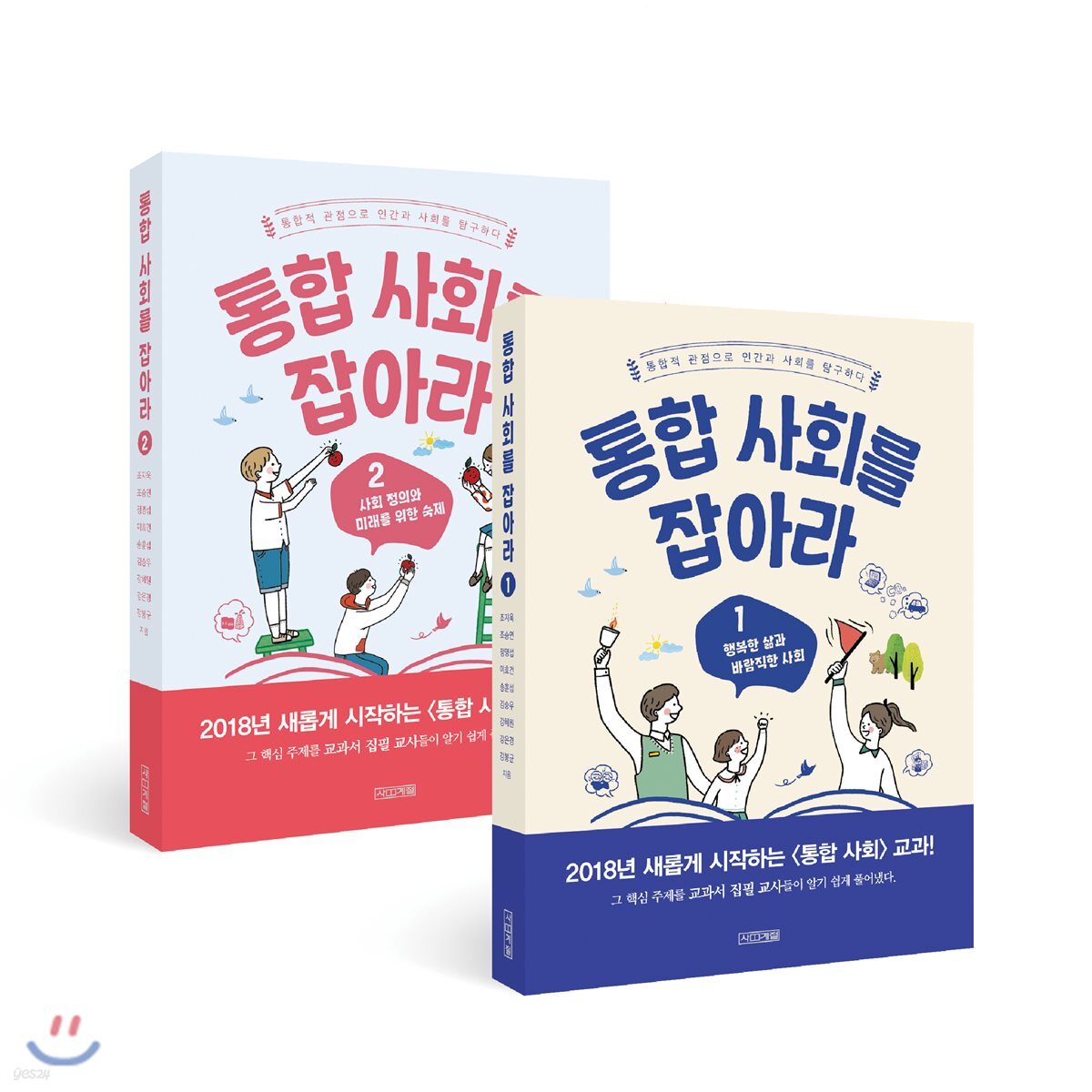
Catch the Unified Society Volumes 1 and 2 Set
 |
Description
Book Introduction
With the 2015 curriculum revision, the 『Integrated Social Studies』 textbook has been applied in high schools since this year, and the 『Social Studies』 textbook, which is structured as an inquiry-based activity, has been applied in middle schools since this year. A common trend is that middle and high school social studies courses aim for student participation. The high school "Integrated Social Studies" textbook was developed to go beyond the practice of imparting systematic knowledge and foster an integrated understanding of life and social phenomena, based on which basic literacy and problem-solving skills can be cultivated. The goal is to cultivate the ability to comprehensively explore various phenomena of oneself, society, and the world based on basic knowledge of temporal, spatial, social, and ethical perspectives, and the ability to seek rational solutions to various problems that arise in daily life and society and to comprehensively reflect on and design life as a member of a community (2015 Social Studies Curriculum). To this end, the new textbooks used from 2018 present integrated educational content from existing subjects such as general social studies, geography, and ethics. While there was a common consensus that the new textbook's direction was educationally sound, there were concerns about the sudden change in teaching methods, and voices from the educational field expressed concerns about the difficulty in digesting topics in an integrated manner. Additionally, students are burdened by activities such as exploration and discussion, as well as evaluation, due to a lack of basic concepts. High school integrated social studies requires extensive knowledge of three subject areas for both teachers and students. For teachers, geography teachers need knowledge of general society and ethics, and general society teachers need knowledge of geography and ethics. There are limitations to having teachers in each field divide the unit and teach it as they did before, as it is an integrated subject. Even for students, it is not easy to know what general social studies, geography, and ethics knowledge and concepts correspond to the educational objectives of each unit. Accordingly, 『Capture the Integrated Society 1,2』 selected and explained the core concepts and topics required in the 『Integrated Social Studies』 curriculum. It will help establish the foundation for basic subject competencies and integrated thinking. |
- You can preview some of the book's contents.
Preview
Detailed image
Publisher's Review
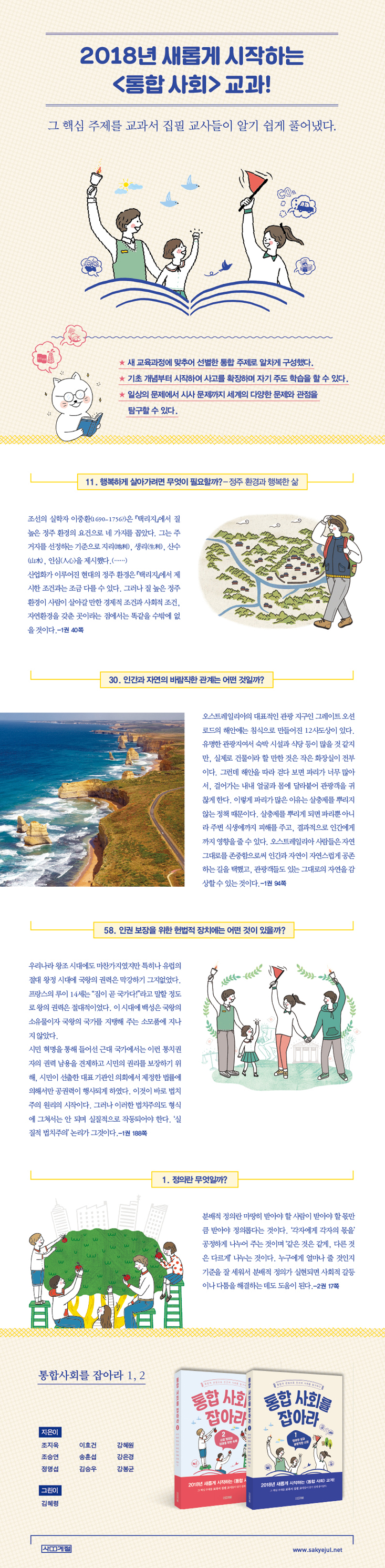
〈Integrated Social Studies〉 is composed of essential research topics for the new curriculum.
This book describes research topics in an interesting way, focusing on case studies, based on the limited scope of the curriculum.
This provides an overview of the issues and key points for student engagement and inquiry activities.
Additionally, the topic of each article is a list of questions for students to consider.
In the process of researching, exploring, and discussing those questions, I have organized them into things that can serve as important foundations for expanding one's thinking.
Each chapter is structured around the nine core concepts of “Integrated Society”: happiness, natural environment, living space, human rights, economy, justice, culture, globalization, and sustainable living. Each concept is divided into detailed topics and covered in a multi-layered manner.
Chapter 1 of Volume 1 examines a desirable perspective on social phenomena and how it is closely related to the goal of life, human happiness.
Chapter 2 provides an understanding of the natural environment as a fundamental condition for the formation of human life and culture, reflects on the causes of environmental problems, and examines efforts to resolve them.
Chapter 3 examines the process of change in living space and explores the changes in regional space resulting from industrialization, urbanization, and the development of transportation and communication.
Chapter 4 examines global human rights issues, including politics and political participation, based on the relationship between human rights issues and the Constitution.
Chapter 5 comprehensively examines the meaning and limitations of a market economy, the roles of households, businesses, and government, and illuminates desirable directions for individual life planning.
Chapter 6 of Volume 2 examines various aspects of justice, examining various perspectives on distributive justice, which is becoming increasingly important in modern society, and reflecting on the realization of justice through liberal and communitarian views of justice.
Chapter 7 examines the world's diverse cultures, examines the meaning and limitations of cultural relativism, and universal ethics, and reflects on life in our society, which is moving toward a multicultural society.
Chapter 8 examines the meaning of globalization, the problems of the globalization era, conflicts and cooperation in the international community, and reflects on the reality of our divided country and its status in the international community, seeking a path forward.
Chapter 9 examines the impact of population issues on society as a whole, the phenomena arising from resource imbalances, and our preparations for a sustainable future.
Teachers who wrote textbooks explained recent social phenomena using case studies to fit the new curriculum.
『Capture the Integrated Society 1,2』 was written by teachers who wrote the high school Integrated Social Studies textbook at Jihaksa, Bisang Education, etc.
The writing of the Integrated Social Studies textbook was a new undertaking that required numerous discussions between ethics, general social studies, and geography teachers. Therefore, it is said that there were many difficulties as different perspectives emerged in the process of understanding the different subjects.
However, on the other hand, it is said that he gained an experience in which his perspective was further broadened through understanding other subjects.
The authors focused their efforts and skills gained from two years of textbook writing on writing this book.
So, I was able to select the core concepts and topics required in the curriculum and clearly explain them using examples of recent social phenomena.
Of course, the process of writing this book involved numerous meetings and discussions before we could arrive at the final result.
The newly launched "Integrated Society" in 2018 is expected to experience various transitional phenomena in the learning and evaluation processes as it is in its early stages of implementation.
In the process, 『Capture an Integrated Society 1,2』 will be able to help teachers and students learn in a balanced manner.
This book describes research topics in an interesting way, focusing on case studies, based on the limited scope of the curriculum.
This provides an overview of the issues and key points for student engagement and inquiry activities.
Additionally, the topic of each article is a list of questions for students to consider.
In the process of researching, exploring, and discussing those questions, I have organized them into things that can serve as important foundations for expanding one's thinking.
Each chapter is structured around the nine core concepts of “Integrated Society”: happiness, natural environment, living space, human rights, economy, justice, culture, globalization, and sustainable living. Each concept is divided into detailed topics and covered in a multi-layered manner.
Chapter 1 of Volume 1 examines a desirable perspective on social phenomena and how it is closely related to the goal of life, human happiness.
Chapter 2 provides an understanding of the natural environment as a fundamental condition for the formation of human life and culture, reflects on the causes of environmental problems, and examines efforts to resolve them.
Chapter 3 examines the process of change in living space and explores the changes in regional space resulting from industrialization, urbanization, and the development of transportation and communication.
Chapter 4 examines global human rights issues, including politics and political participation, based on the relationship between human rights issues and the Constitution.
Chapter 5 comprehensively examines the meaning and limitations of a market economy, the roles of households, businesses, and government, and illuminates desirable directions for individual life planning.
Chapter 6 of Volume 2 examines various aspects of justice, examining various perspectives on distributive justice, which is becoming increasingly important in modern society, and reflecting on the realization of justice through liberal and communitarian views of justice.
Chapter 7 examines the world's diverse cultures, examines the meaning and limitations of cultural relativism, and universal ethics, and reflects on life in our society, which is moving toward a multicultural society.
Chapter 8 examines the meaning of globalization, the problems of the globalization era, conflicts and cooperation in the international community, and reflects on the reality of our divided country and its status in the international community, seeking a path forward.
Chapter 9 examines the impact of population issues on society as a whole, the phenomena arising from resource imbalances, and our preparations for a sustainable future.
Teachers who wrote textbooks explained recent social phenomena using case studies to fit the new curriculum.
『Capture the Integrated Society 1,2』 was written by teachers who wrote the high school Integrated Social Studies textbook at Jihaksa, Bisang Education, etc.
The writing of the Integrated Social Studies textbook was a new undertaking that required numerous discussions between ethics, general social studies, and geography teachers. Therefore, it is said that there were many difficulties as different perspectives emerged in the process of understanding the different subjects.
However, on the other hand, it is said that he gained an experience in which his perspective was further broadened through understanding other subjects.
The authors focused their efforts and skills gained from two years of textbook writing on writing this book.
So, I was able to select the core concepts and topics required in the curriculum and clearly explain them using examples of recent social phenomena.
Of course, the process of writing this book involved numerous meetings and discussions before we could arrive at the final result.
The newly launched "Integrated Society" in 2018 is expected to experience various transitional phenomena in the learning and evaluation processes as it is in its early stages of implementation.
In the process, 『Capture an Integrated Society 1,2』 will be able to help teachers and students learn in a balanced manner.
GOODS SPECIFICS
- Date of publication: March 22, 2018
- Page count, weight, size: 528 pages | 1,136g | 172*235*35mm
You may also like
카테고리
korean


korean

![GQ KOREA Mark (Monthly): December [2025]](http://librairie.coreenne.fr/cdn/shop/files/8ef265dbbfbf186523ed75ba7319009d.jpg?v=1765340328&width=3840)


