

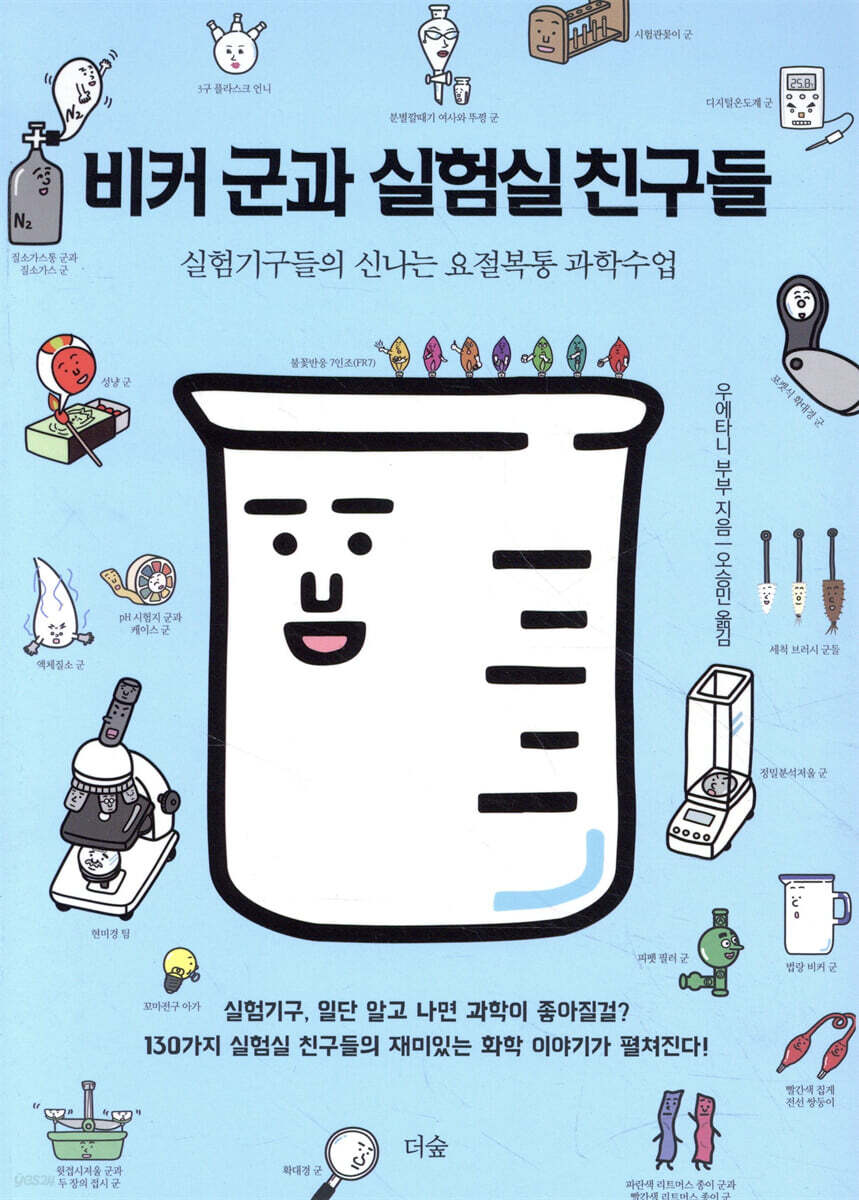
Beaker and his lab friends
 |
Description
Book Introduction
- A word from MD
-
Science classes taught directly by experimental equipmentOver 130 pieces of experimental equipment become the main characters in this fun chemistry story.
The experimental devices, each with its own unique personality as well as its diverse shapes, introduce themselves and humorously analyze their true nature in the form of comics and illustrated guides.
A world of experimental equipment that is much larger and more diverse than you can imagine.
March 9, 2018. Youth PD Kim Tae-hee
Experimental equipment, once you know it, science will get better, right?
Just as they come in many shapes, their personalities and characteristics are also unique!
A fun chemistry story unfolds with over 130 lab friends.
Why is a beaker called a beaker? Beakers are the most common laboratory equipment found in school science labs and laboratories.
But how many people have ever wondered about its name? It turns out that the beaker's name comes from the bird's beak (peak), referring to its pointed spout.
It's not just beakers.
The names, shapes, and materials of all experimental equipment, including beakers, have their own hidden meanings.
"Beaker and His Lab Friends" is a fun science book in which the main characters, the "experimental equipment," are the ones who freely conduct experiments in the laboratory as a playground.
This book, which introduces over 130 experimental devices in detail from a multifaceted perspective, received great attention when it was published in Japan, receiving favorable reviews for being a wonderful illustrated guide with rich imagination, diverse materials, and interesting stories.
It has captured the attention of students, parents, and teachers by providing interesting and in-depth knowledge along with unique illustrations, and has gained wide popularity among people from children to adults interested in science.
This book is divided into chapters based on the purpose of the experimental equipment, and uses a friendly cartoon and illustrated guide format to humorously analyze the true nature of experimental equipment that was previously unknown.
A comprehensive understanding of experimental equipment lowers the barrier to science, which can feel difficult and unfamiliar, while also awakening the joy of studying science.
Just as they come in many shapes, their personalities and characteristics are also unique!
A fun chemistry story unfolds with over 130 lab friends.
Why is a beaker called a beaker? Beakers are the most common laboratory equipment found in school science labs and laboratories.
But how many people have ever wondered about its name? It turns out that the beaker's name comes from the bird's beak (peak), referring to its pointed spout.
It's not just beakers.
The names, shapes, and materials of all experimental equipment, including beakers, have their own hidden meanings.
"Beaker and His Lab Friends" is a fun science book in which the main characters, the "experimental equipment," are the ones who freely conduct experiments in the laboratory as a playground.
This book, which introduces over 130 experimental devices in detail from a multifaceted perspective, received great attention when it was published in Japan, receiving favorable reviews for being a wonderful illustrated guide with rich imagination, diverse materials, and interesting stories.
It has captured the attention of students, parents, and teachers by providing interesting and in-depth knowledge along with unique illustrations, and has gained wide popularity among people from children to adults interested in science.
This book is divided into chapters based on the purpose of the experimental equipment, and uses a friendly cartoon and illustrated guide format to humorously analyze the true nature of experimental equipment that was previously unknown.
A comprehensive understanding of experimental equipment lowers the barrier to science, which can feel difficult and unfamiliar, while also awakening the joy of studying science.
- You can preview some of the book's contents.
Preview
index
preface
【Entering - Beaker appears】
How to read this book
CHAPTER 1 The Beakers and Their Relatives
【Various Beakers】 | Beakers | Conical Beakers | Tall Beakers | 【Partners】 | Handled Beakers | Stainless Steel Beakers and Lid Groups | Enameled Beakers | Quartz Glass Beakers | 【Beakers, Used for Different Purposes】
CHAPTER 2 Friends Who Hold Liquids
【Various Flasks】 | Erlenmeyer Flasks | Round-Bottom Flasks and Flask Holders | Flat-Bottom Flasks | Branch Flasks
| 【Scary Story ①】 | Peach-shaped Flask Group | Flask Group with Branches | 【Scary Story ②】 | Three-neck Flask Sister | Kjeldahl Flask Group | 【Test Tube Collection】 | Test Tube Brothers | Test Tube Tongs Group | Test Tube Holder Group | Centrifuge Tube Group and Microtube Group | Centrifuge Group | 【Share】 | Y-shaped Test Tube Type | Chalet Baron | Evaporating Dish Man | Watch Glass Lady | Reagent Bottle Group and Lid Group | Utensil Bottle Group and Lid Group | Micro Spatula Combination | 【Lids】 | Glass Stopper Group | Silicone Stopper Group | Rubber Stopper Group | Cork Stopper Group
CHAPTER 3 Friends Who Measure
【Volume Measurement】 | Group of Measuring Cylinders | Group of Meter Glasses | Group of Volumetric Flasks | Group of Pipette Fillers | Group of Rubber Bulbs for Gomagome Pipettes | 【Dream of the Rubber Bulbs for Gomagome Pipettes】 | Group of Hole Pipettes | Group of Measuring Pipettes | Group of Gomagome Pipettes | Group of Burettes | 【Weight and Mass Measurement】 | Group of Top-Plate Scales and Group of Two Plates | Three Weight Brothers | Three Plate Weight Brothers | Group of Electronic Balances | Group of Precision Analytical Balances | Group of Bubbles in an Electronic Balance Level | Spring Balance Pot | Group of Tweezers | Group of Medicine Spoons | Group of Medicine Paper | Group of Hidden Pitfalls in Weighing | 【Numerical Measurement】 | Group of Blue Litmus Paper | Group of Red Litmus Paper | Group of pH Test Strips and Cases | Group of Stick Thermometers | Group of Digital Thermometers | Brother Baekyeopsang | Group of Spectrophotometers | Group of Quartz Cells | Uncle Compass | Group of Digital Stopwatches and Grandfather with an Analog Stopwatch
CHAPTER 4 Friends Who Filter, Mix, and Wash
【Various filtration methods】 | Funnel type | Funnel stand group | Filter paper group | Separatory funnel lady and lid group | 【Timing is important】 | Dropping funnel type | Funnel stopper group | Buchner funnel grandfather | Decompression flask group | Aspirator group and rubber tube group | 【Mixing】 | Magnetic bar group | 【Work together】 | Magnetic stirrer group | Glass rod group | Mortar and pestle group | 【Washing】 | Cleaning brush group | Pipette cleaning trio | Cleaning bottle group
CHAPTER 5 Friends Who Heat and Cool
【Heating】 | Alcohol lamp group and lid group | Bunsen burner group | Gas lighter group | Match group | Candle group | 【Without realizing it】 | Laboratory gas range group | Heating mesh type | Triangular grate triplets | Crucible group and lid group | Stand-type combustion spoon sheep | Candle holder-type combustion spoon group | Steel wool group before combustion and steel wool grandfather after combustion | 【Flame reaction】 | Flame reaction seven-member group (FR7) | 【FR7 ①】 | 【FR7 ②】 | 【Cooling】 | Liebig condenser group | Alin condenser group | Graham condenser group | Liquid nitrogen group | Liquid nitrogen transport container group | 【Reason for sanguine temperament】
CHAPTER 6 Observing Friends
【Observe】 | Preparatory Group (Slide Glass Group and Cover Glass Group) | Microscope Team | 【Becoming a Preparatory Group】 | Magnifying Glass Group | Pocket Magnifying Glass Group | Folding Magnifying Glass Group
CHAPTER 7 Electricity and Magnetism Friends
【Electricity and Magnetism】 | Groups of Batteries | Groups of Ammeters and Voltmeters | Power Supply Sheep | Baby Lightbulbs | Twin Red Clippers | Groups of Magnets | 【Attractive Forces】 | Friends of the Iron Dust Pile
CHAPTER 8: Lab Support
【Strong Support Group】 | Nitrogen Gas Cylinder Group and Nitrogen Gas Group | Experimental Stand Group | Double Clamp Group | Fume Hood C | H₂O Molecular Model Group | Cl₂ Molecular Model Group | 【In Search of Real Water】 | Lab Jack Type | Calcium Chloride Tube Group | Electronic Calculator Robot | Desiccator Bowl Group | Emergency Shower Group
supplement
Character correlation
Experimental Equipment Olympics
Glossary of Terms
Search
Column
01 Experimental equipment developed thanks to alchemy
02 The 'King' Ancestors of the Beaker Group
03 Louis Pasteur and the Swan-Neck Flask
04 Great Experimental Scientists in History
05 How to measure high temperature
06 Anecdotes about washing
07 The Great Bunsen Burner
08 Lenses active in science and art
09 The world's strongest neodymium magnet
10 Things You Didn't Know About Gowns
Detailed image

Into the book
Most of the experimental equipment used for heating, including beakers, are made of borosilicate glass such as Pyrex developed by Corning in the United States.
It is a type of rigid glass that is stronger and has less thermal expansion than regular glass.
Glass expands when heated, but because it does not conduct heat well, only the heated part expands, causing distortion and breaking.
If the thermal expansion is small, the distortion will also be small.
So, hard glass does not break easily even when heated.
---From "Beaker-kun Appears_Beaker-kun's Notes"
Among the commonly used experimental devices, there are many whose origins are unknown.
However, Erlenmeyer flasks are an exception.
This is because there is a record that it was invented by Emil Erlenmeyer, a German chemist and pharmacist, and the original drawing he made at the time is handed down.
Erlenmeyer discovered various organic compounds.
In 1857, he improved upon the existing flask and published the prototype of the Erlenmeyer flask, and further refined it so that glassware manufacturers could sell it.
So the English name for the Erlenmeyer flask is Erlenmeyer flask.
It's usually called an Erlenmeyer flask, but I think it would look cool if you said, "Excuse me, can I have that Erlenmeyer flask over there?"
---Among “various flasks”
The Bunsen burner is one of the most powerful heating devices.
In the flame reaction experiment, he plays an important role, just like the main character.
Because the heating efficiency is higher than that of an alcohol lamp, the color of the flame is clearer.
For reference, a platinum loop is usually used for the burner's flame reaction, but it is often lost, so if you are only observing the color, stainless steel wire is also fine.
If it's stainless steel, you can wrap a long wire around it like a mosquito coil and soak it in a solution of dissolved metal salts.
Then, the sparkling part will become larger and more colorful, allowing you to observe it better.
Nowadays, small laboratory gas stoves are often used instead of Bunsen burners.
There are products similar in size to alcohol lamps, and they can use butane gas from portable gas ranges, making them convenient in many ways.
---From "The Great Bunsen Burner"
How can we measure temperatures above the boiling point of mercury (approximately 357°C)? The first method is electrical.
The thermal electromotive force generated at the junction is measured using a device called a thermocouple, which is a combination of two types of metals.
In other methods using a resistance thermometer, the object to be measured is brought into contact with a platinum wire or the like to allow electricity to flow, and then the resistance value is measured.
It uses the principle that the electrical resistance of metal changes depending on temperature.
Another method is a radiometric thermometer, which measures the intensity of infrared and visible light and converts it into temperature.
Nowadays, many thermometers and small thermometers using this method are used.
It is characterized by measuring temperature without direct contact with the object.
It is a type of rigid glass that is stronger and has less thermal expansion than regular glass.
Glass expands when heated, but because it does not conduct heat well, only the heated part expands, causing distortion and breaking.
If the thermal expansion is small, the distortion will also be small.
So, hard glass does not break easily even when heated.
---From "Beaker-kun Appears_Beaker-kun's Notes"
Among the commonly used experimental devices, there are many whose origins are unknown.
However, Erlenmeyer flasks are an exception.
This is because there is a record that it was invented by Emil Erlenmeyer, a German chemist and pharmacist, and the original drawing he made at the time is handed down.
Erlenmeyer discovered various organic compounds.
In 1857, he improved upon the existing flask and published the prototype of the Erlenmeyer flask, and further refined it so that glassware manufacturers could sell it.
So the English name for the Erlenmeyer flask is Erlenmeyer flask.
It's usually called an Erlenmeyer flask, but I think it would look cool if you said, "Excuse me, can I have that Erlenmeyer flask over there?"
---Among “various flasks”
The Bunsen burner is one of the most powerful heating devices.
In the flame reaction experiment, he plays an important role, just like the main character.
Because the heating efficiency is higher than that of an alcohol lamp, the color of the flame is clearer.
For reference, a platinum loop is usually used for the burner's flame reaction, but it is often lost, so if you are only observing the color, stainless steel wire is also fine.
If it's stainless steel, you can wrap a long wire around it like a mosquito coil and soak it in a solution of dissolved metal salts.
Then, the sparkling part will become larger and more colorful, allowing you to observe it better.
Nowadays, small laboratory gas stoves are often used instead of Bunsen burners.
There are products similar in size to alcohol lamps, and they can use butane gas from portable gas ranges, making them convenient in many ways.
---From "The Great Bunsen Burner"
How can we measure temperatures above the boiling point of mercury (approximately 357°C)? The first method is electrical.
The thermal electromotive force generated at the junction is measured using a device called a thermocouple, which is a combination of two types of metals.
In other methods using a resistance thermometer, the object to be measured is brought into contact with a platinum wire or the like to allow electricity to flow, and then the resistance value is measured.
It uses the principle that the electrical resistance of metal changes depending on temperature.
Another method is a radiometric thermometer, which measures the intensity of infrared and visible light and converts it into temperature.
Nowadays, many thermometers and small thermometers using this method are used.
It is characterized by measuring temperature without direct contact with the object.
---From "How to Measure High Temperature"
Publisher's Review
Guaranteed laughter! Stimulate scientific imagination and curiosity!
A unique science class where experimental equipment speaks directly to you.
Of all the scientific materials, why laboratory equipment? After all, chemical experiments can only be conducted with laboratory equipment.
You need laboratory equipment to conduct experiments such as containing, measuring, mixing, heating or cooling liquids, and observing them.
As you learn about experimental equipment, you will be able to approach chemical concepts more familiarly.
For example, you can learn the basicity, neutrality, and acidity of liquids by recognizing the causes of discoloration of red and blue litmus paper.
All reasons aside, this book indirectly answers the question, "Why?" with, "Because it's fun!"
There has never been a book in which experimental equipment was the main character.
As you read this book, which is like a fun class where the experimental equipment speaks for itself, you will find yourself nodding your head in interest and often bursting into laughter.
Fun, as always, can develop into a voluntary desire to learn.
Lab mates flexibly demonstrate their characteristics as experimental instruments by revealing their individual personalities.
For example, the Erlenmeyer flask group, which is weak to pressure changes, is a personality that is afraid of getting hot, the Baekyeopsang group was commonly used in the past but is not used much these days, so they are described as being dull, and the liquid nitrogen group is a choleric group that is always angry because of its low boiling point.
If you follow their personalities, you will be able to understand the experimental equipment naturally without having to memorize it separately.
In addition, it includes precautions and instructions for use during experiments, as well as behind-the-scenes stories about the experimental scientists.
This is a rich science book that goes beyond just fun information and fosters scientific thinking and imagination.
Beaker Army, Microscope Team, Baron Chalet, Three-Neck Flask Sister, Rapjack Brother…
From familiar to somewhat unfamiliar instruments
A delightful guide to laboratory equipment, showcasing a variety of laboratory equipment in one place.
“I want to draw something fun using science or chemistry, which I like.
"What if we made experimental equipment into characters? Then the main character would probably be… ."
The author of this book decided to draw a cartoon with a laboratory apparatus as the main character, and decided to make a beaker the main character.
We started with beakers because they are the most familiar and basic laboratory equipment, but the number has increased and over 130 laboratory equipment characters have been created, ranging from familiar equipment to things like beakers, flasks, and test tubes, to things with unfamiliar names like quartz cells, fume hoods, and pipette fillers.
As the author, a former researcher, personally writes the content and delivers it through characters he created, you will encounter a highly complete laboratory equipment guide in terms of both content and format.
The author's scientific perspective shines through, especially through the radar charts found only in this book.
The price and the mania index (popularity index) are basic, but by interestingly explaining objective factors such as durability, rolling index, index of easy breakage or damage, index with cool names, and index used in various experiments from a subjective point of view, it has created an easy and enjoyable science book that anyone can read.
Another great lesson this book offers us is the fresh idea that the main characters in the laboratory may not be humans but experimental equipment.
GOODS SPECIFICS
- Date of issue: March 1, 2018
- Page count, weight, size: 176 pages | 362g | 148*210*13mm
- ISBN13: 9791186900444
- ISBN10: 118690044X
You may also like
카테고리
korean


korean

![GQ KOREA Mark (Monthly): December [2025]](http://librairie.coreenne.fr/cdn/shop/files/8ef265dbbfbf186523ed75ba7319009d.jpg?v=1765340328&width=3840)


