

Dalai Lama's lecture on the path to enlightenment
 |
Description
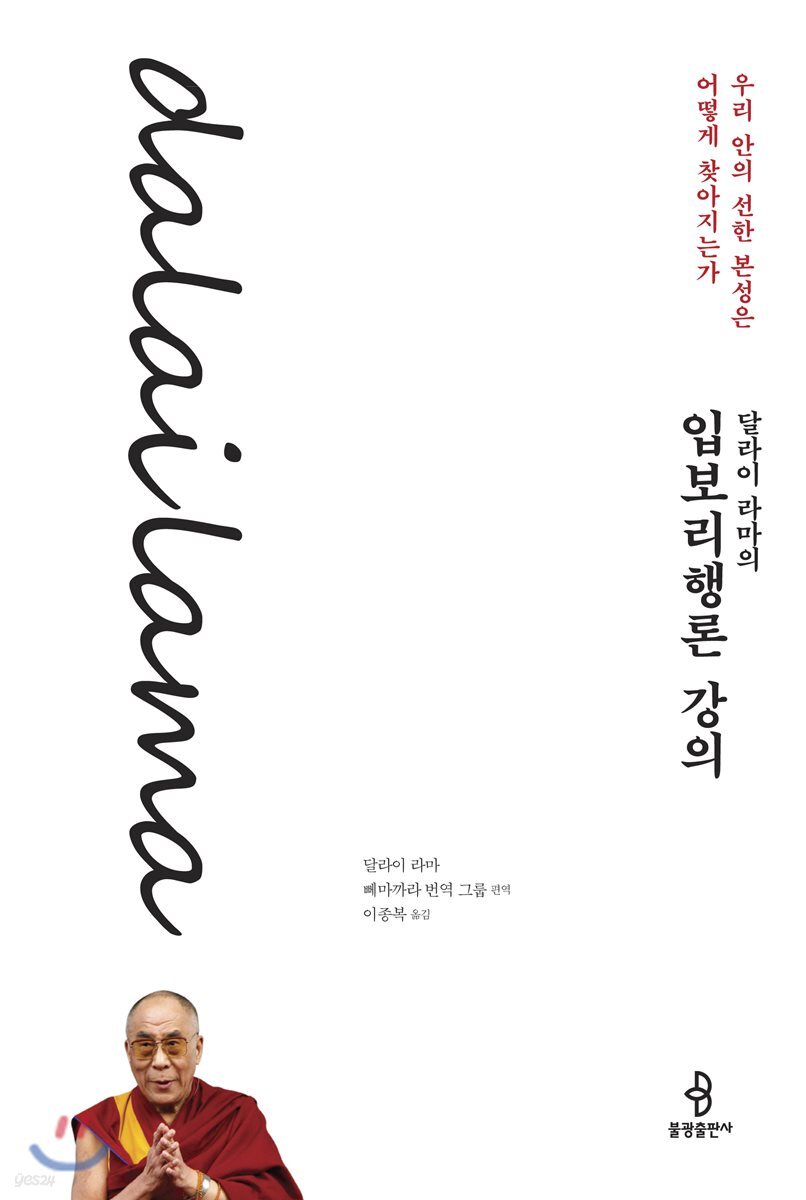
Book Introduction
The perfect practice method for training a good mind, 『Theory of Entering the Bodhi Path』,
The Dalai Lama's key lectures on "The Path to Bodhicitta" that moved people around the world
“For me, Buddhism is not a religion, but a way of life.
“It is the source of wisdom, inner peace and happiness.”
This is the Buddhist view of the Dalai Lama, the spiritual teacher of people all over the world.
He always wishes for the peace and happiness of humanity, and emphasizes the spirit of altruism, saying that greater happiness comes when we help others.
Buddhism is a religion that teaches us to protect all living beings by awakening love and compassion within us.
The Dalai Lama lives a life of pacifism, thoroughly practicing these teachings.
In Buddhism, the Dalai Lama's life is called the 'life of a Bodhisattva.'
A bodhisattva is a person who has courage and faith and strives to attain enlightenment for the happiness of all living beings.
That is, it is the complete personality that Buddhism presents, and it is the goal of life that we all must achieve in this life.
The literature that helps us live this life of a bodhisattva is the 『Entering into Bodhi Haengnon (入菩提行論)』.
『The Treatise on the Path to Bodhisattva』, written by the 8th century Indian monk Shantideva, is the most widely known introductory text to the practice of bodhisattva.
It contains the method of drawing out the mind of a Bodhisattva, that is, the good mind within us, and the method of firmly protecting and practicing that mind without retreating.
The Dalai Lama has given countless lectures on the "Entry into the Bodhi Path," and this book is a distillation of the lectures he gave to thousands of audiences over a week in August 1991 in Dordogne, a region in southwestern France.
Although it has been published for the first time in Korea 28 years later, its teachings remain so vivid that the passage of time is completely imperceptible.
The Dalai Lama's key lectures on "The Path to Bodhicitta" that moved people around the world
“For me, Buddhism is not a religion, but a way of life.
“It is the source of wisdom, inner peace and happiness.”
This is the Buddhist view of the Dalai Lama, the spiritual teacher of people all over the world.
He always wishes for the peace and happiness of humanity, and emphasizes the spirit of altruism, saying that greater happiness comes when we help others.
Buddhism is a religion that teaches us to protect all living beings by awakening love and compassion within us.
The Dalai Lama lives a life of pacifism, thoroughly practicing these teachings.
In Buddhism, the Dalai Lama's life is called the 'life of a Bodhisattva.'
A bodhisattva is a person who has courage and faith and strives to attain enlightenment for the happiness of all living beings.
That is, it is the complete personality that Buddhism presents, and it is the goal of life that we all must achieve in this life.
The literature that helps us live this life of a bodhisattva is the 『Entering into Bodhi Haengnon (入菩提行論)』.
『The Treatise on the Path to Bodhisattva』, written by the 8th century Indian monk Shantideva, is the most widely known introductory text to the practice of bodhisattva.
It contains the method of drawing out the mind of a Bodhisattva, that is, the good mind within us, and the method of firmly protecting and practicing that mind without retreating.
The Dalai Lama has given countless lectures on the "Entry into the Bodhi Path," and this book is a distillation of the lectures he gave to thousands of audiences over a week in August 1991 in Dordogne, a region in southwestern France.
Although it has been published for the first time in Korea 28 years later, its teachings remain so vivid that the passage of time is completely imperceptible.
- You can preview some of the book's contents.
Preview
index
Entering
Acknowledgements
The translators of the song
The Path of Bodhisattva
Chapter 1: The Benefits of Bodhicitta
Chapter 2: Offerings and Purification
Chapter 3: Understanding Bodhicitta Properly
Chapter 4: The Non-Deliberation of the Bodhi Mind
Chapter 5: The Protection of Right Knowledge
Chapter 6: The Practice of Tolerance
Chapter 7: The Practice of Diligence
Chapter 8: The Practice of Zen
Chapter 9: The Practice of Wisdom
Chapter 10: Dedication
Translator's Note
Glossary of Terms
References
Acknowledgements
The translators of the song
The Path of Bodhisattva
Chapter 1: The Benefits of Bodhicitta
Chapter 2: Offerings and Purification
Chapter 3: Understanding Bodhicitta Properly
Chapter 4: The Non-Deliberation of the Bodhi Mind
Chapter 5: The Protection of Right Knowledge
Chapter 6: The Practice of Tolerance
Chapter 7: The Practice of Diligence
Chapter 8: The Practice of Zen
Chapter 9: The Practice of Wisdom
Chapter 10: Dedication
Translator's Note
Glossary of Terms
References
Into the book
For the Dalai Lama, Buddhism is not a doctrine or a religion, but a way of life, a source of wisdom, inner peace, and happiness.
Buddhism awakens love and compassion within us and teaches us to protect all living beings on this planet.
_Page 4
The path of compassion is the path of a bodhisattva who cultivates a compassionate mind that refuses to stand by and watch the suffering of others any longer, and who first cultivates his own mind in order to bring peace to the minds of those who are suffering.
_Page 5
In this book, the Dalai Lama presents the results of the extensive learning he acquired at the monastic universities during his stay in Tibet.
The result is profound knowledge, extraordinary insights into the human condition, and what it truly means to be a responsible and good person.
_Page 10
Everything we do, say, and think when we are young is the cause of the happiness and suffering we experience when we are older.
Page 17
The practice of a bodhisattva consists of the practice of the six paramitas or the ten paramitas.
This can be summarized in three practices: refraining from evil, practicing virtuous conduct, and working for the benefit of all living beings.
Shantideva explains this path of bodhisattva practice in three stages: initiation, practice, and attainment. _Page 30
We will come to realize that many things we thought existed up to now are not actually so.
It's like realizing you're caught in the foolish belief that a drop of water will last forever.
Page 32
The book “Theory of the Beginning of Bodhicitta” explains how to arouse the mind of Bodhicitta.
Then, in the three chapters of non-attendance, cessation, and patience, he explains how to prevent the Bodhicitta from deteriorating.
And the following chapters on diligence, meditation, and wisdom explain how to continuously develop the Bodhicitta.
Page 39
Even though Bodhisattvas remain in reincarnation, they are not trapped in the prison of reincarnation.
Because they know the downsides of reincarnation.
But because of his great compassion, he does not stay in Nirvana.
Knowing that there are problems on both sides, Bodhisattvas aspire to enlightenment that transcends both.
Page 36
Suspension must be applied to all our actions, and we must constantly examine ourselves, always observing what is right and what is wrong.
By doing this, the mind, which is like an elephant, violent and intoxicated by the three poisons of greed, anger, and foolishness, is tied to the pillar of good deeds with the rope of repression, and is governed with the hook of stillness.
Page 85
A servant who does not do as he is told will never receive his wages.
If factory workers don't do their jobs, they won't be paid and they'll be fired from the factory.
But our bodies don't listen to us the way we want them to, even though we've fed them, clothed them, and put in all our effort.
Even if you tell them not to grow old, they still grow old, and even if you tell them not to get sick, they still get sick.
Obsession with the body is completely wrong.
Page 90
Shantideva explains that if we do not have pure compassion in our hearts and have not fully realized emptiness, it is not right to give away our bodies, all our possessions, and all our merits.
We need to protect our bodies so that we can practice altruistic actions while purifying all selfish thoughts.
Page 95
Everyone has some altruistic tendencies.
But that altruism reaches its limits too quickly.
The mind that cultivates altruism until the vow to help others reaches infinity is called Bodhicitta.
The greatest obstacles to cultivating this mind are the desire to harm others, resentment, and anger.
Page 110
If we truly want to take a step forward, there is no practice more important than humility.
You cannot call yourself a practitioner without practicing compassion.
Page 131
Let us strive to overcome both their suffering and ours.
If all beings equally desire happiness, why should we be the only ones to be happy? Why should we protect ourselves from suffering while leaving others in their lurch? (pp. 186-187)
We do not desire suffering, and we know that the root of suffering is an undisciplined mind.
Because the mind misperceives and misunderstands phenomena, afflictions arise and peace cannot be found.
This is why we suffer.
To avoid this, we must cultivate a mind that can see properly and the wisdom to see the true nature of phenomena.
Page 223
Buddhism awakens love and compassion within us and teaches us to protect all living beings on this planet.
_Page 4
The path of compassion is the path of a bodhisattva who cultivates a compassionate mind that refuses to stand by and watch the suffering of others any longer, and who first cultivates his own mind in order to bring peace to the minds of those who are suffering.
_Page 5
In this book, the Dalai Lama presents the results of the extensive learning he acquired at the monastic universities during his stay in Tibet.
The result is profound knowledge, extraordinary insights into the human condition, and what it truly means to be a responsible and good person.
_Page 10
Everything we do, say, and think when we are young is the cause of the happiness and suffering we experience when we are older.
Page 17
The practice of a bodhisattva consists of the practice of the six paramitas or the ten paramitas.
This can be summarized in three practices: refraining from evil, practicing virtuous conduct, and working for the benefit of all living beings.
Shantideva explains this path of bodhisattva practice in three stages: initiation, practice, and attainment. _Page 30
We will come to realize that many things we thought existed up to now are not actually so.
It's like realizing you're caught in the foolish belief that a drop of water will last forever.
Page 32
The book “Theory of the Beginning of Bodhicitta” explains how to arouse the mind of Bodhicitta.
Then, in the three chapters of non-attendance, cessation, and patience, he explains how to prevent the Bodhicitta from deteriorating.
And the following chapters on diligence, meditation, and wisdom explain how to continuously develop the Bodhicitta.
Page 39
Even though Bodhisattvas remain in reincarnation, they are not trapped in the prison of reincarnation.
Because they know the downsides of reincarnation.
But because of his great compassion, he does not stay in Nirvana.
Knowing that there are problems on both sides, Bodhisattvas aspire to enlightenment that transcends both.
Page 36
Suspension must be applied to all our actions, and we must constantly examine ourselves, always observing what is right and what is wrong.
By doing this, the mind, which is like an elephant, violent and intoxicated by the three poisons of greed, anger, and foolishness, is tied to the pillar of good deeds with the rope of repression, and is governed with the hook of stillness.
Page 85
A servant who does not do as he is told will never receive his wages.
If factory workers don't do their jobs, they won't be paid and they'll be fired from the factory.
But our bodies don't listen to us the way we want them to, even though we've fed them, clothed them, and put in all our effort.
Even if you tell them not to grow old, they still grow old, and even if you tell them not to get sick, they still get sick.
Obsession with the body is completely wrong.
Page 90
Shantideva explains that if we do not have pure compassion in our hearts and have not fully realized emptiness, it is not right to give away our bodies, all our possessions, and all our merits.
We need to protect our bodies so that we can practice altruistic actions while purifying all selfish thoughts.
Page 95
Everyone has some altruistic tendencies.
But that altruism reaches its limits too quickly.
The mind that cultivates altruism until the vow to help others reaches infinity is called Bodhicitta.
The greatest obstacles to cultivating this mind are the desire to harm others, resentment, and anger.
Page 110
If we truly want to take a step forward, there is no practice more important than humility.
You cannot call yourself a practitioner without practicing compassion.
Page 131
Let us strive to overcome both their suffering and ours.
If all beings equally desire happiness, why should we be the only ones to be happy? Why should we protect ourselves from suffering while leaving others in their lurch? (pp. 186-187)
We do not desire suffering, and we know that the root of suffering is an undisciplined mind.
Because the mind misperceives and misunderstands phenomena, afflictions arise and peace cannot be found.
This is why we suffer.
To avoid this, we must cultivate a mind that can see properly and the wisdom to see the true nature of phenomena.
Page 223
--- From the text
Publisher's Review
It also helps us to reveal and act on our good nature.
Wisdom is needed
“Every being desires happiness equally, so why do I desire happiness alone?
Why should we protect ourselves from suffering while leaving others to suffer?
This is the question the Dalai Lama, who emphasizes altruism, poses to us.
At first glance, it may seem like a moral textbook, but when it comes from the mouth of the spiritual master, the Dalai Lama, it feels like a different weight.
How many times do we think about ‘others’ as we live?
How many times have you tried to help someone, only to feel like you've lost out, or complained that no one even recognized your good deed?
Everyone has some altruistic tendencies.
But that altruism reaches its limits too quickly.
So, the Dalai Lama says that a good heart that helps others definitely requires 'wisdom'.
It is said that wisdom is needed to go beyond the pride, hatred, and anger that come from boasting about helping others, and to face the suffering of others as it is and examine what they truly need.
『The Book of the Fourfold Path』 is a text that deals with this very wisdom.
It focuses on gaining the wisdom necessary to cultivate and cultivate a good heart, that is, altruism for others.
The book “Theory of Altruism” explains how to develop altruism.
And it also tells us how to prevent this mind from deteriorating.
A representative practice method is called the Six Perfections.
This six-paramita practice method, which refers to the six types of almsgiving, precepts, patience, diligence, meditation, and wisdom, is a practice that bodhisattvas who wish to cultivate the spirit of altruism must practice.
The Dalai Lama has beautiful and wise content.
Ipborihaengron, moved to tears
The Dalai Lama leads the Tibetan government-in-exile and has maintained a strict non-violent policy.
Even though I am in the victim's position, I do not feel angry, but rather I am concerned about the perpetrator who committed the evil deed.
Because I think their unforgivable sins stem from their foolishness.
The high level of altruism mentioned in the 『Ipbolihaengron』 seeks to discipline even the perpetrators of evil deeds and turn them into good people.
The Dalai Lama says:
“The joy my enemy seems to be enjoying now is actually just a wave in the endless cycle of life.
So, rather than being jealous or angry at the happiness of those who are committing evil deeds now, we should use it as an opportunity to cultivate compassion.”
In this way, the Dalai Lama uses his own life as an example to demonstrate a simple yet moving way of communicating truth within the context of traditional Buddhist teachings.
This is a teaching that only when we understand the origin of karma with compassion as the source and expand the scope of happiness by practicing compassion through expedient means can we achieve the practice of bodhisattva.
It also says that the good nature within us cannot be damaged by anyone, and that the mind can expand infinitely.
I hope to explain human nature in concise and heartfelt terms, and to awaken, even if only a little, the latent power of love and affection we possess.
To this end, we will find ways to become a person with a good heart in our daily lives and explain them in an easy way.
That teaching is the direction and meaning of life that we must pursue.
The Dalai Lama, who has lectured on the "Treatise on the Beginning of the Bodhi Path" to countless people, is said to still be moved by the teachings and sometimes shed tears.
This is probably because they sincerely accept and follow the teachings of the 『Ipboli Haengnon』.
The emotion of poetic metaphor,
The path to true enlightenment is easy and comfortable.
『The Book of the Bodhisattva's Practice』 is an introductory book for those who have vowed to become a bodhisattva.
In Buddhism, a bodhisattva is described as a being armed with an altruistic spirit, to the point of being described as "a practitioner who has vowed never to enter nirvana until all suffering beings are saved."
The mind that vows to become a bodhisattva is called 'Bodhicitta (菩提心)', and the book that discusses 'the practical method for developing this Bodhicitta' is 'Theory of Entering Bodhi Haengnon'.
This treatise was written around the 8th century by the Indian monk Shantideva, who is revered as a saint, and is highly regarded as the best text explaining the practice of a bodhisattva.
It is a treatise highly revered by teachers of all Tibetan Buddhist sects, and more than a hundred outstanding teachers have written commentaries on it.
It consists of a total of 10 chapters, and the central practice method is the six paramitas.
Chapter 1 praises the Bodhicitta, Chapter 2 is about the three refuges and repentance, Chapter 3 is about the vow to Bodhicitta, Chapter 4 is about the way to keep this vow, Chapter 5 is about the protection of right knowledge, Chapter 6 is about patience, Chapter 7 is about diligence, Chapter 8 is about meditation, Chapter 9 is about wisdom, and the last Chapter 10 is about praising all Buddhas and Bodhisattvas [returning to the past], concluding the content.
Among these, the six paramitas are contained in Chapter 2, and Chapters 5 to 9 explain the practice of the six paramitas in the order of precepts, patience, diligence, meditation, and wisdom.
Boshi refers to the act of helping others mentally and materially without expecting anything in return; jikji refers to the rules that must be followed while practicing; and inyok refers to the mind that endures and tolerates any insult.
Diligence means continuing to make all these efforts without stopping, and meditation means concentrating the mind and entering a state where it is not shaken under any circumstances.
Finally, wisdom is the result of all these practices, and refers to the state of having attained the wisdom to properly see through the reality of the world.
That is, it means being awakened to the truth and having attained enlightenment.
This treatise, which expresses in flowing poetry everything a bodhisattva should possess, including the Bodhicitta, the six paramitas, and the practice of dedication, is also characterized by making complex and extensive Buddhist doctrines easy to memorize.
In other words, it can be said that the doctrine was made into beautiful song lyrics.
Even today, Tibetan monks and many Buddhists around the world recite this verse and walk the path of Bodhisattva.
Like a star, a mirage, or a firework,
Like a magical illusion, dew, or bubble,
Like a dream, a flash, or a cloud,
All that has been accomplished must be viewed in this way.
Page 13
To those who wish to touch the land, it becomes an island,
To those who seek light, it is a lamp,
It will be a shelter for those who need a place to rest,
May I be a servant to those who need a servant.
Page 66
Everything becomes familiar when you get used to it
[It's] getting easier to endure.
So by getting used to the little pains
You will be able to endure great pain.
Page 108
Wisdom is needed
“Every being desires happiness equally, so why do I desire happiness alone?
Why should we protect ourselves from suffering while leaving others to suffer?
This is the question the Dalai Lama, who emphasizes altruism, poses to us.
At first glance, it may seem like a moral textbook, but when it comes from the mouth of the spiritual master, the Dalai Lama, it feels like a different weight.
How many times do we think about ‘others’ as we live?
How many times have you tried to help someone, only to feel like you've lost out, or complained that no one even recognized your good deed?
Everyone has some altruistic tendencies.
But that altruism reaches its limits too quickly.
So, the Dalai Lama says that a good heart that helps others definitely requires 'wisdom'.
It is said that wisdom is needed to go beyond the pride, hatred, and anger that come from boasting about helping others, and to face the suffering of others as it is and examine what they truly need.
『The Book of the Fourfold Path』 is a text that deals with this very wisdom.
It focuses on gaining the wisdom necessary to cultivate and cultivate a good heart, that is, altruism for others.
The book “Theory of Altruism” explains how to develop altruism.
And it also tells us how to prevent this mind from deteriorating.
A representative practice method is called the Six Perfections.
This six-paramita practice method, which refers to the six types of almsgiving, precepts, patience, diligence, meditation, and wisdom, is a practice that bodhisattvas who wish to cultivate the spirit of altruism must practice.
The Dalai Lama has beautiful and wise content.
Ipborihaengron, moved to tears
The Dalai Lama leads the Tibetan government-in-exile and has maintained a strict non-violent policy.
Even though I am in the victim's position, I do not feel angry, but rather I am concerned about the perpetrator who committed the evil deed.
Because I think their unforgivable sins stem from their foolishness.
The high level of altruism mentioned in the 『Ipbolihaengron』 seeks to discipline even the perpetrators of evil deeds and turn them into good people.
The Dalai Lama says:
“The joy my enemy seems to be enjoying now is actually just a wave in the endless cycle of life.
So, rather than being jealous or angry at the happiness of those who are committing evil deeds now, we should use it as an opportunity to cultivate compassion.”
In this way, the Dalai Lama uses his own life as an example to demonstrate a simple yet moving way of communicating truth within the context of traditional Buddhist teachings.
This is a teaching that only when we understand the origin of karma with compassion as the source and expand the scope of happiness by practicing compassion through expedient means can we achieve the practice of bodhisattva.
It also says that the good nature within us cannot be damaged by anyone, and that the mind can expand infinitely.
I hope to explain human nature in concise and heartfelt terms, and to awaken, even if only a little, the latent power of love and affection we possess.
To this end, we will find ways to become a person with a good heart in our daily lives and explain them in an easy way.
That teaching is the direction and meaning of life that we must pursue.
The Dalai Lama, who has lectured on the "Treatise on the Beginning of the Bodhi Path" to countless people, is said to still be moved by the teachings and sometimes shed tears.
This is probably because they sincerely accept and follow the teachings of the 『Ipboli Haengnon』.
The emotion of poetic metaphor,
The path to true enlightenment is easy and comfortable.
『The Book of the Bodhisattva's Practice』 is an introductory book for those who have vowed to become a bodhisattva.
In Buddhism, a bodhisattva is described as a being armed with an altruistic spirit, to the point of being described as "a practitioner who has vowed never to enter nirvana until all suffering beings are saved."
The mind that vows to become a bodhisattva is called 'Bodhicitta (菩提心)', and the book that discusses 'the practical method for developing this Bodhicitta' is 'Theory of Entering Bodhi Haengnon'.
This treatise was written around the 8th century by the Indian monk Shantideva, who is revered as a saint, and is highly regarded as the best text explaining the practice of a bodhisattva.
It is a treatise highly revered by teachers of all Tibetan Buddhist sects, and more than a hundred outstanding teachers have written commentaries on it.
It consists of a total of 10 chapters, and the central practice method is the six paramitas.
Chapter 1 praises the Bodhicitta, Chapter 2 is about the three refuges and repentance, Chapter 3 is about the vow to Bodhicitta, Chapter 4 is about the way to keep this vow, Chapter 5 is about the protection of right knowledge, Chapter 6 is about patience, Chapter 7 is about diligence, Chapter 8 is about meditation, Chapter 9 is about wisdom, and the last Chapter 10 is about praising all Buddhas and Bodhisattvas [returning to the past], concluding the content.
Among these, the six paramitas are contained in Chapter 2, and Chapters 5 to 9 explain the practice of the six paramitas in the order of precepts, patience, diligence, meditation, and wisdom.
Boshi refers to the act of helping others mentally and materially without expecting anything in return; jikji refers to the rules that must be followed while practicing; and inyok refers to the mind that endures and tolerates any insult.
Diligence means continuing to make all these efforts without stopping, and meditation means concentrating the mind and entering a state where it is not shaken under any circumstances.
Finally, wisdom is the result of all these practices, and refers to the state of having attained the wisdom to properly see through the reality of the world.
That is, it means being awakened to the truth and having attained enlightenment.
This treatise, which expresses in flowing poetry everything a bodhisattva should possess, including the Bodhicitta, the six paramitas, and the practice of dedication, is also characterized by making complex and extensive Buddhist doctrines easy to memorize.
In other words, it can be said that the doctrine was made into beautiful song lyrics.
Even today, Tibetan monks and many Buddhists around the world recite this verse and walk the path of Bodhisattva.
Like a star, a mirage, or a firework,
Like a magical illusion, dew, or bubble,
Like a dream, a flash, or a cloud,
All that has been accomplished must be viewed in this way.
Page 13
To those who wish to touch the land, it becomes an island,
To those who seek light, it is a lamp,
It will be a shelter for those who need a place to rest,
May I be a servant to those who need a servant.
Page 66
Everything becomes familiar when you get used to it
[It's] getting easier to endure.
So by getting used to the little pains
You will be able to endure great pain.
Page 108
GOODS SPECIFICS
- Date of publication: February 27, 2019
- Page count, weight, size: 248 pages | 322g | 140*215*20mm
- ISBN13: 9788974796570
- ISBN10: 8974796570
You may also like
카테고리
korean


korean

![GQ KOREA Mark (Monthly): December [2025]](http://librairie.coreenne.fr/cdn/shop/files/8ef265dbbfbf186523ed75ba7319009d.jpg?v=1765340328&width=3840)


